Categories
Culture Current Events Experiences Language Learning Science Technology Theocratic

wúkě‐bǐnǐ

wúkě (wú·kě {there is not} · {being able} 无可 無可)bǐnǐ (bǐ·nǐ {to compare} · {to compare; parallel} → [to compare; match; draw a parallel] 比拟 比擬) 👈🏼 Tap/click to show/hide the “flashcard”

[Notes: Tap/click on a Pīnyīn (Pīn·yīn {Piecing Together of} · Sounds → [Pinyin] 拼音) expression to reveal its “flashcard”; tap/click on a “flashcard” or its Pīnyīn (Pīn·yīn {Piecing Together of} · Sounds → [Pinyin] 拼音) expression to hide the “flashcard”. 📖 📄 📘 icons mean 📖 Reveal All, 📄 Reveal Advanced, and 📘 Reveal None re all the “flashcards” in the heading, paragraph, etc. that they are placed at the beginning of.]

Rather than dismissively thinking to ourselves that the songs produced by the organization are “just songs”, we should remember that the slave class takes seriously its responsibility to provide spiritual food to God’s people, and so it is going to make sure that the lyrics in its songs are spiritually correct, while also being emotionally moving.—Ezekiel 33:32; Matthew 24:45.

Without Compare
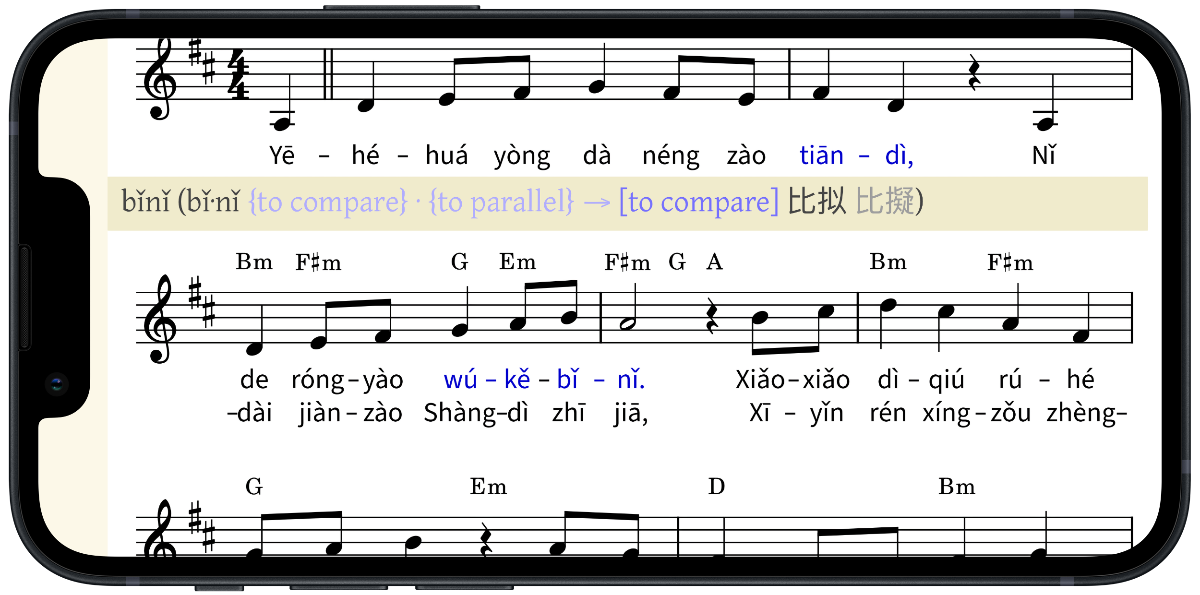
“wúkě‐bǐnǐ” _Pīnyīn_ Plus info, Song 152 (music+_Pīnyīn_), on iPhone 13 mini (landscape orientation)

This week’s MEotW in the unofficial Pīnyīn (Pīn·yīn {Piecing Together of} · Sounds → [Pinyin] 拼音) Plus resource “Sing Out Joyfully” Bk. (Pīnyīn+Music, Pīnyīn Plus, Web)

This week’s MEotW, “wúkě (wú·kě {there is not} · {being able} 无可 無可)bǐnǐ (bǐ·nǐ {to compare} · {to compare; parallel} → [to compare; match; draw a parallel] 比拟 比擬)”, comes from the first verse of song 152, which is entitled “A Place That Will Bring You Praise” in English and “Nǐ de ((Nǐ You 你) (de ’s 的) [Your]) Róngyào (Róng·yào Glorious · {Brilliant → [Glorious]} → [Glorious] 荣耀 榮耀) zhī ( 之) Jiā ([mw for establishments] 家) in Mandarin:

English:

Jehovah, the Maker of heaven,
By heaven you can’t be contained,
Even less an earthly dwelling place.
But your spirit can here remain.

Mandarin (WOL, Pīnyīn (Pīn·yīn {Piecing Together of} · Sounds → [Pinyin] 拼音) Plus):

📖 📄 📘 Yēhéhuá (Jehovah 耶和华 耶和華) yòng (used 用) (big → [great] 大) néng (ability 能) zào ({to make} 造) tiāndì (tiān·dì heavens · earth 天地),
Nǐ de ((Nǐ you 你) (de ’s 的) [your]) róngyào (róng·yào glory · {being brilliant → [glory]} → [glory] 荣耀 榮耀) wúkě (wú·kě {there is not} · {being able} 无可 無可)bǐnǐ (bǐ·nǐ {to compare} · {to parallel} → [to compare] 比拟 比擬).
Xiǎoxiǎo (Xiǎo·xiǎo small · small → [miniscule] 小小) dìqiú (dì·qiú earth · globe 地球) rúhé (rú·hé like · how → [how] 如何) néng (can 能) chéngzài (chéng·zài bear · hold → [bear the weight of] 承载 承載)
Nǐ de ((Nǐ you 你) (de ’s 的) [your]) lìliang (lì·liang power · quantity 力量), nǐ de ((nǐ you 你) (de ’s 的) [your]) hòu’ài (hòu’·ài {thick → [deep]} · love 厚爱 厚愛)?

“Wúkě (Wú·kě {there is not} · {being able} 无可 無可)bǐnǐ (bǐ·nǐ {to compare} · {to compare; parallel} → [to compare; match; draw a parallel] 比拟 比擬) means “there is not being able to compare”. So, the line that it appears in, “Nǐ de ((Nǐ you 你) (de ’s 的) [your]) róngyào (róng·yào glory · {being brilliant → [glory]} → [glory] 荣耀 榮耀) wúkě (wú·kě {there is not} · {being able} 无可 無可)bǐnǐ (bǐ·nǐ {to compare} · {to parallel} → [to compare] 比拟 比擬)”, means “Your glory is without compare”.

People of this world support corrupt, self-seeking politicians, worship the blind chance that they say powers evolution, look for space aliens, place their hopes in artificial intelligence, and so on. However, none of those could accomplish what Jehovah God has accomplished—He alone is the One who actually created the universe and all the living things in it. So, as expressed by this week’s MEotW, Jehovah’s glory truly is without compare, and there is no one and nothing else that people should look to and hope in in these dark times.

As Mandarin field language learners, let us be determined to keep on doing our best to sing Jehovah’s praises well in this largest of all worldwide language fields. Not only is the Mandarin field the largest one in the world, with about a billion people worldwide for whom Mandarin is their mother tongue, it’s also about 2½ times the size of the worldwide English field. So, it could be said that there should really be about 2½ times as many publishers in the worldwide Mandarin field as there are in the worldwide English field. Yes, “the harvest is great, but the workers are few”, so sing out loud in the Mandarin field, and sing out strong!—Matthew 9:37, 38.
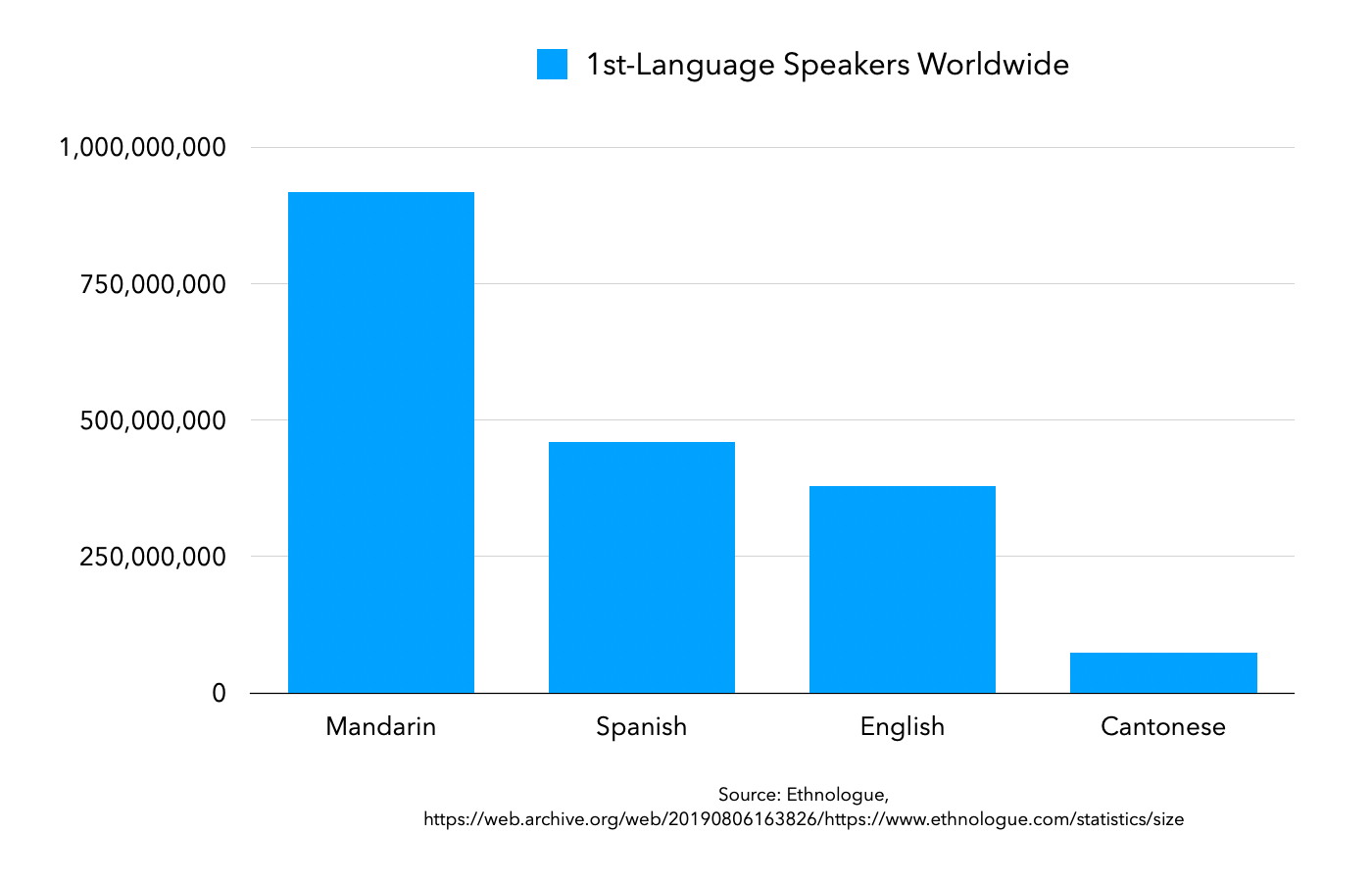
Chart: Languages by First-Language Speakers—2019

Musical Notation 🎼 and the Mandarin Field

In this post about a Mandarin expression found in our songbook, another subject that I want to touch on is: Is musical notation 🎼 too hard to be worth the trouble of producing it and using it? Are fewer and fewer people able to read it? I was fortunate enough to have been taught how to read musical notation in school. I have never thought of musical notation as being particularly difficult to use (it’s much easier to learn than characters, which many unquestioningly try to learn), and I find that it helps me to sing Kingdom songs more correctly (according to the intended melody, message, etc.) and more confidently more of the time. However, I am aware that not everyone in the Mandarin field has the same experience with musical notation. For example, a while ago, an older brother told me that he didn’t know how to read musical notation. Also, some people in the Mandarin field may have been affected by how education systems in this old world have been facing significant challenges relating to providing music education for younger ones.

Regardless of how the world may be failing in many cases to equitably provide good music education, Jehovah’s organization has pointed out that music is important in Jehovah’s worship. For example, not long ago, a Meeting Workbook said:

Music can have a powerful influence on the mind and body. Singing is an important part of our worship of Jehovah.

In accordance with the importance of music in Jehovah’s worship, Mandarin field language learners used to have available to them official material from the organization containing musical notation with Pīnyīn (Pīn·yīn {Piecing Together of} · Sounds → [Pinyin] 拼音) in the lyrics. However, perhaps at least partially because of the technical difficulty and costliness of producing material with musical notation and both Chinese characters and Pīnyīn (Pīn·yīn {Piecing Together of} · Sounds → [Pinyin] 拼音) in the lyrics, as of this writing, early in 2025, there is no official material currently available from the organization that shows Pīnyīn (Pīn·yīn {Piecing Together of} · Sounds → [Pinyin] 拼音) and musical notation on the same page or screen.

The organization continues to publish official songbook material for different languages in general that contains musical notation, so it evidently still considers musical notation to generally be worthwhile to produce. It continues to produce official material for the current songbook that uses musical notation along with lyrics rendered only in Chinese characters, without Pīnyīn (Pīn·yīn {Piecing Together of} · Sounds → [Pinyin] 拼音), and it has even produced official material that uses jiǎnpǔ (jiǎn·pǔ simple · {register or record for reference → [musical notation]} → [numbered musical notation] 简谱 簡譜) (a kind of musical notation also known as numbered musical notation) and Chinese characters.

For those who find it helpful in their Mandarin field activities to put musical notation together with Pīnyīn (Pīn·yīn {Piecing Together of} · Sounds → [Pinyin] 拼音), the unofficial Pīnyīn (Pīn·yīn {Piecing Together of} · Sounds → [Pinyin] 拼音) Plus resource “Sing Out Joyfully” Bk. (Pīnyīn+Music, Pīnyīn Plus, Web) exists and is continuing to be improved. As shown in the screenshot above, this resource aids Mandarin field language learners by breaking with tradition and featuring lyrics in the musical notation that are only in relatively large-print Pīnyīn (Pīn·yīn {Piecing Together of} · Sounds → [Pinyin] 拼音) by default—characters are relegated to Pīnyīn (Pīn·yīn {Piecing Together of} · Sounds → [Pinyin] 拼音) Plus “flashcards” that are added as time allows.

Unlike the traditionally-used but unnecessarily extraordinarily complex characters that need to be accompanied by Pīnyīn (Pīn·yīn {Piecing Together of} · Sounds → [Pinyin] 拼音) before many are able to read them, Pīnyīn (Pīn·yīn {Piecing Together of} · Sounds → [Pinyin] 拼音) itself is a simple, elegant alphabetical full writing system for Mandarin that is easy to learn and remember. Also, it is no harder to typeset than other alphabetical writing systems with diacritics, such as the writing systems now used for French, Czech, Vietnamese, etc.*

In its Tips: section at the bottom of its home page, the “Sing Out Joyfully” Bk. (Pīnyīn+Music, Pīnyīn Plus, Web) resource contains these links that some may find helpful:


For convenience:

The direct link for the Pīnyīn (Pīn·yīn {Piecing Together of} · Sounds → [Pinyin] 拼音) Plus resource for the “Sing Out Joyfully” book is:

The short link for Chinese field language-learning links for the “Sing Out Joyfully” book is:

More Pīnyīn (Pīn·yīn {Piecing Together of} · Sounds → [Pinyin] 拼音) and Pīnyīn (Pīn·yīn {Piecing Together of} · Sounds → [Pinyin] 拼音) Plus web material based on the Mandarin “Sing Out Joyfully” book will be made available in the Pīnyīn (Pīn·yīn {Piecing Together of} · Sounds → [Pinyin] 拼音) Plus web resource as time allows.


* Thanks to ongoing advancements in personal computing hardware and software, producing material that contains things like musical notation and Pīnyīn (Pīn·yīn {Piecing Together of} · Sounds → [Pinyin] 拼音) text at reasonable cost is quicker and easier than ever. At this time, production of the musical notation in the “Sing Out Joyfully” Bk. (Pīnyīn+Music, Pīnyīn Plus, Web) resource begins in free open source software called MuseScore Studio, running on a Mac. Pīnyīn (Pīn·yīn {Piecing Together of} · Sounds → [Pinyin] 拼音) text for the lyrics in the musical notation is entered using macOS’s ABC – Extended input source (keyboard layout). (Just using Pīnyīn (Pīn·yīn {Piecing Together of} · Sounds → [Pinyin] 拼音) text only here simplifies things so much compared to having to somehow input characters with Pīnyīn (Pīn·yīn {Piecing Together of} · Sounds → [Pinyin] 拼音) ruby text!) When it’s ready, the musical notation for a song is exported from MuseScore Studio into SVG format, which is a plain text format that allows for the inclusion of links that activate Pīnyīn (Pīn·yīn {Piecing Together of} · Sounds → [Pinyin] 拼音) Plus flashcards on webpages. The coding for the SVG links is currently mostly done using the text editor BBEdit, in which editing large text files is quite performant. For Pīnyīn (Pīn·yīn {Piecing Together of} · Sounds → [Pinyin] 拼音) Plus web material production in general, my current favourite tool is Nova, but such web material can be produced in any application suitable for web development, such as Visual Studio Code, etc. ^
Categories
Culture Experiences History Language Learning Names Science Technology Theocratic

Dàilìlā

Dàilìlā (De·liʹlah 黛利拉) 👈🏼 Tap/click to show/hide the “flashcard”

[Notes: Tap/click on a Pīnyīn (Pīn·yīn {Piecing Together of} · Sounds → [Pinyin] 拼音) expression to reveal its “flashcard”; tap/click on a “flashcard” or its Pīnyīn (Pīn·yīn {Piecing Together of} · Sounds → [Pinyin] 拼音) expression to hide the “flashcard”. 📖 📄 📘 icons mean 📖 Reveal All, 📄 Reveal Advanced, and 📘 Reveal None re all the “flashcards” in the heading, paragraph, etc. that they are placed at the beginning of.]

A few years back, I wrote up a brief web page listing reasons for producing Pīnyīn (Pīn·yīn {Piecing Together of} · Sounds → [Pinyin] 拼音), etc. material for the Imitate (ia) book. Some, especially some who grew up in the West, may have felt that this book is made up of “just stories”, and ones that they were already quite familiar with, at that. However, we must remember that Chinese Bible students may often have a different perspective regarding the Bible accounts that are made to come to life in the Imitate book. As that web page said:

  • Many Chinese people in the world have not been exposed to Bible accounts the way many Westerners have.
  • Also, I have heard that some, perhaps many, Chinese Bible students tend to approach their Bible studies like intellectual exercises for accumulating chōuxiàng (abstract) head knowledge as if for a school exam, rather than as training for their hearts for their own real lives.

Later, the web page touches on how some of the real-world benefits of good storytelling like that found in the Imitate book involve empathy:

    • The actress Natalie Portman once said, “I love acting. I think it’s the most amazing thing to be able to do. Your job is practicing empathy. You walk down the street imagining every person’s life.”
  • The Imitate book helps build Bible students’ empathy towards Bible characters, which in turn helps Bible students realize that others would feel empathy towards them as well if they imitated these Bible characters—not everyone will just think they’re crazy, like many worldly friends or family members might think.

While even fictional stories can have the benefits described in the links and the quote above, true stories from the Bible can have even greater benefits, including spiritual ones.

Besides the Imitate book, another book from Jehovah’s organization that relates Bible accounts is the Learn From the Bible (lfb) book. The letter from the Governing Body in this book says that, similarly to the Imitate book, the Learn From the Bible book also “brings the Bible accounts to life and captures the feelings of those depicted”, while, unlike the Imitate book, it “tells the story of the human family from creation onward”. While the Learn From the Bible book is especially suitable for children, the letter from the Governing Body in this book says that “it can also be used to help adults who desire to learn more about the Bible”. So, it would be good to consider on this blog some of the expressions used in the Mandarin Learn From the Bible book.

Femme Fatale

This week’s MEotW, “Dàilìlā (De·liʹlah 黛利拉)”, appears in the third paragraph of Lesson 38 of the Mandarin Learn From the Bible book, which is entitled “Yēhéhuá (Jehovah 耶和华 耶和華) Shǐ (Made 使) Cānsūn (Samson 参孙 參孫) (Strength 力) ({to Be Big} → [to Be Great] 大) Wúqióng (Wú·qióng {Not to Have} · {Being Impoverished} → [to Be Boundless] 无穷 無窮) (“Jehovah Made Samson Strong”):

English:

Later, the Philistines went to Samson’s girlfriend, Delilah, and said: ‘We will pay you thousands of silver pieces if you find out why Samson is so strong. We want to catch him and put him in prison.’ Delilah wanted the money, so she agreed.

Mandarin (WOL, Pīnyīn (Pīn·yīn {Piecing Together of} · Sounds → [Pinyin] 拼音) Plus):

📖 📄 📘 Hòulái (Hòu·lái afterwards · {(it) came to be} 后来 後來), Cānsūn (Samson 参孙 參孫) àishangle (ài·shang·le loved · upon · {to completion} → [fell in love with] 爱上了 愛上了) (one 一) ge ([mw]個/个) jiào (called叫/呌) Dàilìlā (De·liʹlah 黛利拉) de (’s 的) nǚrén (nǚ·rén female · person → [woman] 女人), Fēilìshì‐rén ((Fēilìshì Phi·lisʹti·a 非利士)‐(rén people 人) [Phi·lisʹtines]) jiù (then 就) (went 去) zhǎo ({to look for} 找) Dàilìlā (De·liʹlah 黛利拉) shuō ({to say}說/説): “Wǒmen (Wǒ·men we · [pl] 我们 我們) yào (want 要) ({to hold} 把) Cānsūn (Samson 参孙 參孫) zhuā ({to be seized} → [to be caught] 抓) qilai (qi·lai up · {to come} 起来 起來), guānjìn (guān·jìn {to be shut → [to be confined]} · {to be entering into} 关进 關進) láo (pen → [prison] 牢) li (inside裡/裏). Zhǐyào (Zhǐ·yào only · {requiring that} → [provided] 只要) (you 你) gàosu (tell 告诉 告訴) wǒmen (wǒ·men us · [pl] 我们 我們), (he 他) wèishénme (wèi·shén·me for · what · [suf] [why] 为什么 為什/甚麼) lìqi (lì·qi strength · {air → [vital energy (in Ch. metaphysics)]} → [physical strength] 力气 力氣) nàme (nà·me {that (much)} · [suf] 那么/末 那麼/末) ({is big} → [is great] 大), wǒmen (wǒ·men we · [pl] 我们 我們) jiù (then 就) gěi ({will give}) (you 你) hěn (very 很) duō (much 多) yínzi (yín·zi silver · [suf for nouns] 银子 銀子).” Dàilìlā (De·liʹlah 黛利拉) hěn ({very much} 很) xiǎngyào (wanting 想要) qián ({the money}), jiù (then 就) dāyingle (dā·ying·le {{replied to → [agreed with]} · {responded to → [complied with]} → [answered positively to]} · {to completion} 答应了 答應了) Fēilìshì‐rén ((Fēilìshì Phi·lisʹti·a 非利士)‐(rén people 人) [Phi·lisʹtines]).

“Dàilìlā (De·liʹlah 黛利拉) is a newer translation of “Delilah” that began to appear in the Mandarin Learn From the Bible book in its 2024-10 Printing, and that seems to have begun to appear in Mandarin versions of the New World Translation Bible starting with the version named the Shèngjīng Xīn Shìjiè Yìběn (Xiūdìng Bǎn) ((Shèng·jīng (The) Holy · Scriptures 圣经 聖經) (Xīn New 新) (Shì·jiè {Generation → [World]} · Extent → [World] 世界) (Yì·běn Translated · {Root or Stem → [Edition]} 译本 譯本) ((Xiū·dìng Mended · Revised 修订 修訂) (Bǎn {Printing Plate (or Block)} → [Edition] 版))) [New World Translation of the Holy Scriptures (Revised 2013)]), which was first published in 2019. (The translation of “Delilah” used in older versions of these Mandarin publications was “Dàlìlā (De·liʹlah 大利拉)”.)

In the new Mandarin translation of “Delilah”, the first character was changed from “大 (Dà)” to “黛 (Dài)”, which, while being pronounced only slightly differently, has a very different meaning—while “大 (Dà)” basically means “big”, “黛 (Dài)” means “black pigment used by women in ancient times to paint their eyebrows”, according to Pleco’s built-in dictionary. Apparently, while maintaining (improving?) the basic phonetic similarity to the original language name, whoever did the translating that resulted in “Dàilìlā (De·liʹlah 黛利拉) may have snuck in a semantic (meaning-related) allusion to Delilah’s femme fatale persona:

femme fatale

An alluring and seductive woman, especially one who leads men into compromising and dangerous situations.

Borrowing from French femme fatale (literally “deadly woman”).

Beware of Honey Traps!

Speaking of which, Samson certainly had an unfortunate record with the ladies, didn’t he? Jehovah made the related situations turn out as defeats for the enemies of his people, but for Samson, the situation with Delilah especially resulted in much pain and devastation—he ended up betrayed, stripped of his God-given power, brutally blinded, imprisoned, and finally dead, even if he was able to take many of his enemies with him. There had been at least some warning signs, like Delilah nagging him repeatedly to reveal the source of his strength—HELLO!—but Samson didn’t catch on that this woman wasn’t really on his side, even if she was by his side for a while. It seems that Samson at first treated Delilah’s requests as just a cute game, but tragically, the situation turned out to actually be literally a deadly serious one.—Judges 14–16.

Such use of romantic or sexual relationships against people is such an established practice that it’s been given a name—honey trapping. We students of the Bible also know that this practice is so old that it goes back to the very first man and woman, Adam and Eve. Satan is wicked, and ultimately a loser on a strategic level, but that doesn’t mean he’s not smart and crafty tactically—he knew what he was doing when he decided to first approach Eve, arguably literally the most beautiful woman who has ever lived. The Bible reveals that “Adam was not deceived”, but still, when beautiful Eve offered him the forbidden fruit, he decided to be a pushover, follow her lead, and turn away from Jehovah. (1 Timothy 2:14) Some have observed that men can get stupid around a beautiful woman, and considering Adam’s example, it’s undoubtedly genetic!

It may be accurate to say that this kind of spiritual attack is “playing dirty”. However, this is Satan the Devil we are talking about—of course he and his agents are going to play dirty, like the agents of the intelligence agencies of the nations of Satan’s world have been known to do. Also, as this world keeps deteriorating, more and more people are becoming more and more physically-minded (i.e., unspiritual), materialistic, and self-centred, making them more easily manipulated lures and victims in spiritual honey trapping schemes. (2 Timothy 3:13; 1 Corinthians 2:14; Matthew 24:38, 39) So, down to this day, and including within the Mandarin field, honey trapping remains a go-to tactic for Satan the Devil.

Here are a couple of related experiences that I know of: Years ago, I had a Bible student who was an intelligent young man who seemed to mentally understand what he was learning, and yet he eventually stopped studying and got into a relationship with a woman who went to a church that he must have known taught wrong things. I also know of a brother who was an elder, and who even became a missionary in Taiwan along with his wife, and yet he left his wife to live with a Taiwanese woman for a while, resulting in him getting disfellowshipped and divorced. He eventually left behind that adulterous relationship and got reinstated, but what a regrettable trail of pain and devastation left behind by someone who once shone so brightly and did so much in the Mandarin field.

Protectively Proficient Mandarin, Nuclear Bombs, and Stars

Hopefully, we will be able to learn from such real-life experiences and avoid becoming a Samson to any alluring Delilah being used, whether knowingly or not, by our spiritual enemies. As per the Mandarin language-learning focus of this blog, developing the related abilities to understand and speak Mandarin well can potentially help us to more truly and accurately get to know any Mandarin-speaking person who may show up on our romantic radar. (With everything going on in such situations, that’s hard enough when both the people involved are fluent in the same language, never mind if one only has a weak or lame grasp of the language. That might result in one knowing just enough Mandarin to get into trouble, while not knowing enough to understand what’s really going on.)

However, as shown by some of the examples mentioned above, while knowing is half the battle, we also have to get the other half right—successfully applying what we learn to what we do. Romantic and sexual attraction can be powerful—bikinis were in fact named after Bikini Atoll, the site of a series of nuclear weapons tests. Faced with such powerful forces that could push us in destructive directions if we let them, we need to become, with Jehovah’s help, even more powerful spiritually. Jehovah’s holy spirit is the most powerful force in the universe, the source of all the energy in all the stars, compared to which even nuclear bombs are tiny firecrackers, so it’s definitely possible.—Genesis 1:1, 2.

As an example of just how powerful Jehovah’s holy spirit is even compared to humans’ nuclear bombs, according to my research and calculations, every day, the sun, produced with power from the holy spirit, puts out the energy of almost 8 quadrillion (1015) 1-megaton nuclear bombs. (A single 1-megaton nuclear bomb would release about 67 times the amount of energy released by the atomic bomb dropped on Hiroshima.) And according to NASA, “it turns out that our Sun is an average-sized star. There are bigger stars, and there are smaller stars. We have found stars that are 100 times bigger in diameter than our sun.” So, while the forces of romantic and sexual attraction can be powerful, if we always choose to put Jehovah first regardless of our relationship status and pray and act accordingly, Jehovah’s holy spirit can certainly operate even more powerfully in our lives.—1 Corinthians 7:25–35; Philippians 4:13.


For convenience:

The direct link for the Pīnyīn (Pīn·yīn {Piecing Together of} · Sounds → [Pinyin] 拼音) Plus resource for the Learn From the Bible book is:

The short link for Chinese field language-learning links for the Learn From the Bible book is:

More Pīnyīn (Pīn·yīn {Piecing Together of} · Sounds → [Pinyin] 拼音) and Pīnyīn (Pīn·yīn {Piecing Together of} · Sounds → [Pinyin] 拼音) Plus web material based on the Mandarin Learn From the Bible book will be made available in the Pīnyīn (Pīn·yīn {Piecing Together of} · Sounds → [Pinyin] 拼音) Plus web resource as time allows.

Categories
Culture Experiences History Language Learning Technology Theocratic

guīju

guīju (guī·ju [([is] following)] {compasses; dividers → [rules; regulations]} · {carpenter’s squares → [rules; regulations]} → [[[is] following] rules; customs; established practices/standards | [[is] following] social etiquette; manners | [is] well-behaved; well-disciplined] 规矩 規矩) 👈🏼 Tap/click to show/hide the “flashcard”

[Notes: Tap/click on a Pīnyīn (Pīn·yīn {Piecing Together of} · Sounds → [Pinyin] 拼音) expression to reveal its “flashcard”; tap/click on a “flashcard” or its Pīnyīn (Pīn·yīn {Piecing Together of} · Sounds → [Pinyin] 拼音) expression to hide the “flashcard”. 📖 📄 📘 icons mean 📖 Reveal All, 📄 Reveal Advanced, and 📘 Reveal None re all the “flashcards” in the heading, paragraph, etc. that they are placed at the beginning of.]

I have long especially liked 1 Corinthians 13. It contains counsel on what really does and doesn’t matter in life, an extensive description and definition of the most important kind of love, and a sublime discussion about the need to become complete, mature, as a person. As these apply to life in general, so too do they apply to our lives as Mandarin field language learners.

As Mandarin field language learners, it can benefit us greatly to consider what we can learn from 1 Corinthians 13, and along the way, we can also consider some of the Mandarin expressions used in that chapter in the current version of the Mandarin New World Translation Bible (nwtsty).

“Does Not Behave Indecently”

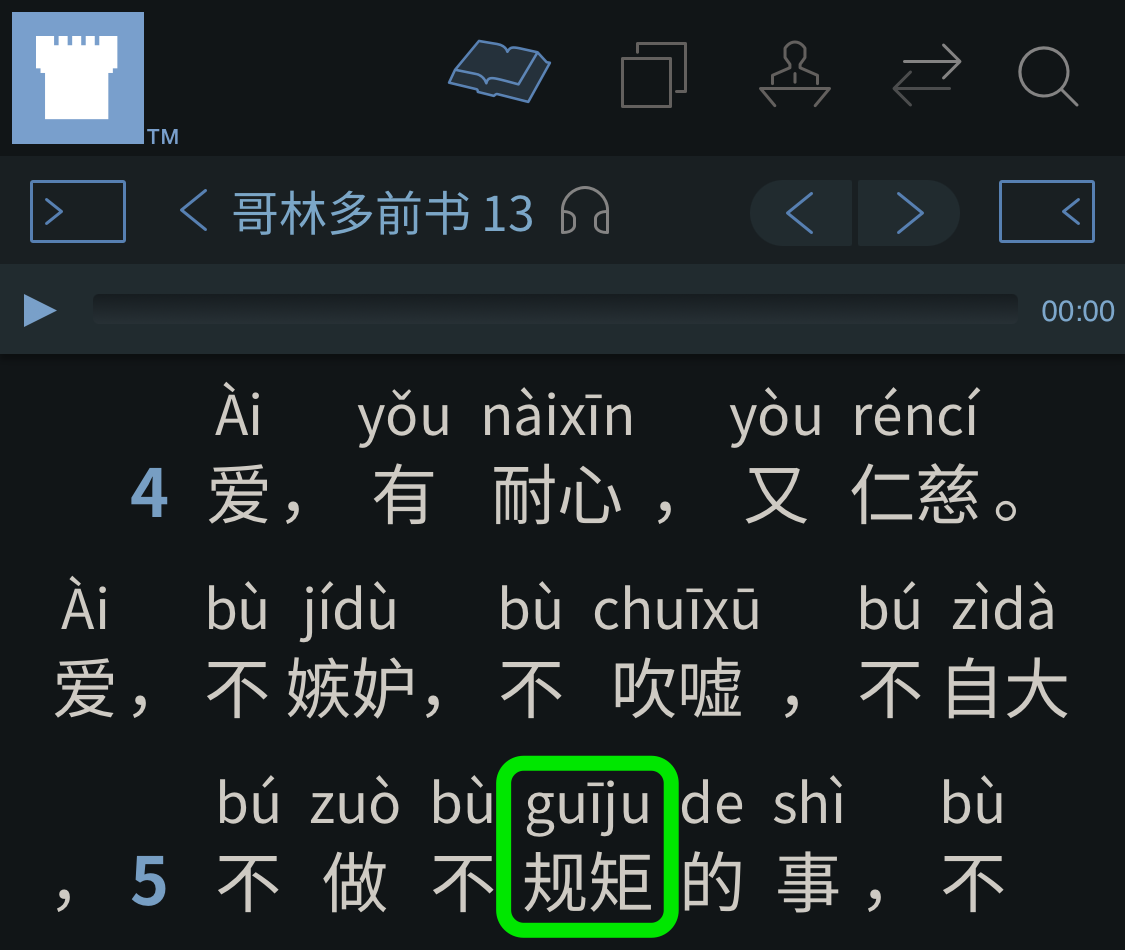
This week’s MEotW, “guīju (guī·ju [([is] following)] {compasses; dividers → [rules; regulations]} · {carpenter’s squares → [rules; regulations]} → [[[is] following] rules; customs; established practices/standards | [[is] following] social etiquette; manners | [is] well-behaved; well-disciplined] 规矩 規矩)”, is used in verse 5 (WOL) of 1 Corinthians 13:

Screenshot of “_guīju_” in 1 Co. 13:5 (nwtsty, CHS+_Pīnyīn_ WOL)

(Dark mode for the Watchtower ONLINE LIBRARY (WOL) website, as shown in the above image, can be enabled in the Safari web browser by using the Noir Safari extension. Other web browsers may also have extensions with similar functionality.)

For comparison, here are the current English and Pīnyīn (Pīn·yīn {Piecing Together of} · Sounds → [Pinyin] 拼音) Plus renderings of 1 Corinthians 13:4, 5:

English:

4 Love is patient and kind. Love is not jealous. It does not brag, does not get puffed up, 5does not behave indecently, does not look for its own interests, does not become provoked. It does not keep account of the injury.

Pīnyīn (Pīn·yīn {Piecing Together of} · Sounds → [Pinyin] 拼音) Plus:

📖 📄 📘 4 Ài (love), yǒu (has 有) nàixīn (nài·xīn {being (of/with) enduring} · heart → [patience] 耐心), yòu (also 又) réncí (rén·cí {is kind} 仁慈). Ài (love), (not 不) jídù ({is jealous} 嫉妒), (not 不) chuīxū (chuī·xū {does puff → [does brag]} · {does sigh → [does praise]} → [does brag] 吹嘘 吹噓), (not 不) zìdà (zì·dà {(does consider) self} · {to be big → [to be great]} 自大), 5 (not 不) zuò ({does do} 做) (not 不) guīju (guī·ju (following) {dividers → [rules]} · {carpenter’s squares → [regulations]} → [following established standards] 规矩 規矩) de ( 的) shì (things 事), (not 不) qiú ({does seek} 求) zìjǐ (self 自己) de (’s 的) lìyì (lì·yì {sharpening → [advantage]} · benefit → [benefit] 利益), (not 不) qīngyì (qīng·yì lightly · easily 轻易 輕易) dòngnù (dòng·nù {does have moved} · anger → [does get angry] 动怒 動怒), (not 不) jìjiào (jì·jiào {does count} · {does dispute about} 计较 計較) biéren (bié·ren other · people 别人 別人) zàochéng (zào·chéng {have created} · {to come to be} 造成) de (’s 的) shānghài (injuring → [injury] 伤害 傷害),

The individual morphemes in “guīju (guī·ju [([is] following)] {compasses; dividers → [rules; regulations]} · {carpenter’s squares → [rules; regulations]} → [[[is] following] rules; customs; established practices/standards | [[is] following] social etiquette; manners | [is] well-behaved; well-disciplined] 规矩 規矩) literally mean “compasses; dividers” “carpenter’s squares”, and they both can effectively mean “rules; regulations”. When these morphemes are put together in “guīju (guī·ju [([is] following)] {compasses; dividers → [rules; regulations]} · {carpenter’s squares → [rules; regulations]} → [[[is] following] rules; customs; established practices/standards | [[is] following] social etiquette; manners | [is] well-behaved; well-disciplined] 规矩 規矩)”, the resulting expression effectively means “[[is] following] rules; customs; established practices/standards | [[is] following] social etiquette; manners | [is] well-behaved; well-disciplined”, corresponding, in the usage of 1 Corinthians 13:5 in the current English and Mandarin versions of the New World Translation Bible, with the English expression “decent”.

Decent According to Whom?

Especially since we are considering this expression as it’s used in God’s Word the Bible as part of direction from God that he inspired the apostle Paul to write down, we must understand that what is meant here by “decent” is determined from God’s point of view, not necessarily with regard to human traditions or conventions.

As followers of Christ, we should keep in mind that Jesus himself said and did some things that did not conform with the traditions and conventions of his time. For example, rather than just going along with the draconian* human traditions of the time regarding the Sabbath, Jesus, knowing the real purpose of the Sabbath, did God’s work on the Sabbath, including healing people. If you had been present, how would you have felt about what Jesus did? Would you have been glad that Jesus had accomplished such good things? Or, would you have been dismayed and offended by how Jesus broke tradition?

The Bible records that some people took issue with the healing that Jesus performed on the Sabbath, basically accusing Jesus of behaving indecently in their eyes. However, Jesus knew that it was more important to keep doing what was right and decent in God’s eyes than it was to follow the traditions and customs of mere humans.—Luke 13:10–17; John 5:1–17.

“Strife and Jealousy”

In the New World Translation Bible in the Watchtower Online Library, one of the scriptures linked to 1 Corinthians 13:5 with regard to “indecently” is Romans 13:13:

Let us walk decently as in the daytime, not in wild parties and drunkenness, not in immoral intercourse and brazen conduct, not in strife and jealousy.

Note that among the things that God’s Word lists as being indecent, along with things like drunkenness and sexual immorality, are “strife and jealousy”.

If someone makes an issue of a Mandarin field language learner who, say, uses Pīnyīn (Pīn·yīn {Piecing Together of} · Sounds → [Pinyin] 拼音) instead of following tradition and exclusively focusing on characters, is that person not being like those who made an issue of Jesus healing on the Sabbath? Instead of being happy and joyful because of the good that Jesus was doing, those opposers of Jesus were jealous of how “the entire crowd began to rejoice at all the glorious things he did”. (Luke 13:17) Opposers of Pīnyīn (Pīn·yīn {Piecing Together of} · Sounds → [Pinyin] 拼音) use today may similarly be jealous of how those who make good use of Pīnyīn (Pīn·yīn {Piecing Together of} · Sounds → [Pinyin] 拼音) can accomplish much in Jehovah’s service without having to put the kind of blood, sweat, and tears into learning characters the traditional way that they did. In their tradition-loving eyes, breaking from tradition and using innovative and game-changingly effective new tools like Pīnyīn (Pīn·yīn {Piecing Together of} · Sounds → [Pinyin] 拼音) may seem “indecent”, but in God’s eyes, it is the jealousy-motivated strife such ones cause over people doing good in his service that is truly indecent.

In God's organization, our unity is based on God's truth, not on human tradition.

[image or embed]

— tiandi, Links News (@tiandilinksnews.bsky.social) February 2, 2025 at 8:27 AM

Those who are motivated by true Christian love, as described in 1 Corinthians 13, would rejoice over how Pīnyīn (Pīn·yīn {Piecing Together of} · Sounds → [Pinyin] 拼音) helps Mandarin field language learners to bear witness to the truth more effectively, instead of considering it “cheating”, since love “rejoices with the truth”. (John 18:37; 1 Corinthians 13:6) Also, those who are motivated by true Christian love would not be jealous of how game-changing tools like Pīnyīn (Pīn·yīn {Piecing Together of} · Sounds → [Pinyin] 拼音) help Mandarin field language learners to more easily get more done, since “love is not jealous”. (1 Corinthians 13:4) Additionally, as per this week’s MEotW, those who are motivated by true Christian love would not stir up strife and make an issue of Mandarin field language learners beneficially using innovative new tools like Pīnyīn (Pīn·yīn {Piecing Together of} · Sounds → [Pinyin] 拼音) instead of just following human traditions involving characters, since love “does not behave indecently” in God’s eyes.—1 Corinthians 13:5.


* “Draconian” means “very severe, cruel, or harsh”, and it comes from an ancient word that means “dragon”. Guess what culture is one of the only ones to consider the dragon a good, positive symbol, in contrast to how the Bible uses the dragon to represent Satan the Devil. (Revelation 12:9) That’s right, it’s the worldly Chinese culture, the same one that improperly places primary emphasis on the proudly, perversely, abnormally difficult-to-learn-and-remember Chinese characters. ^