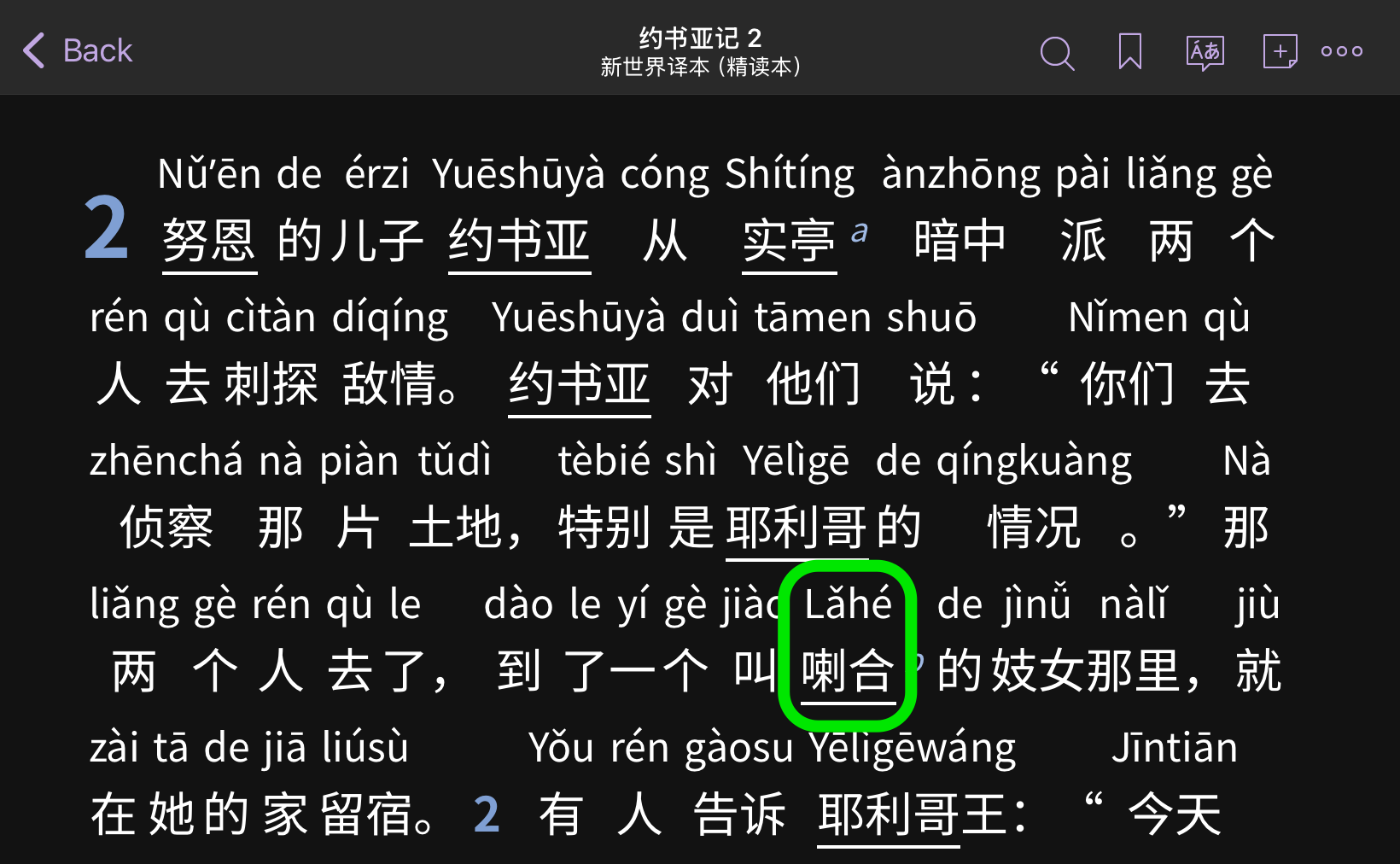
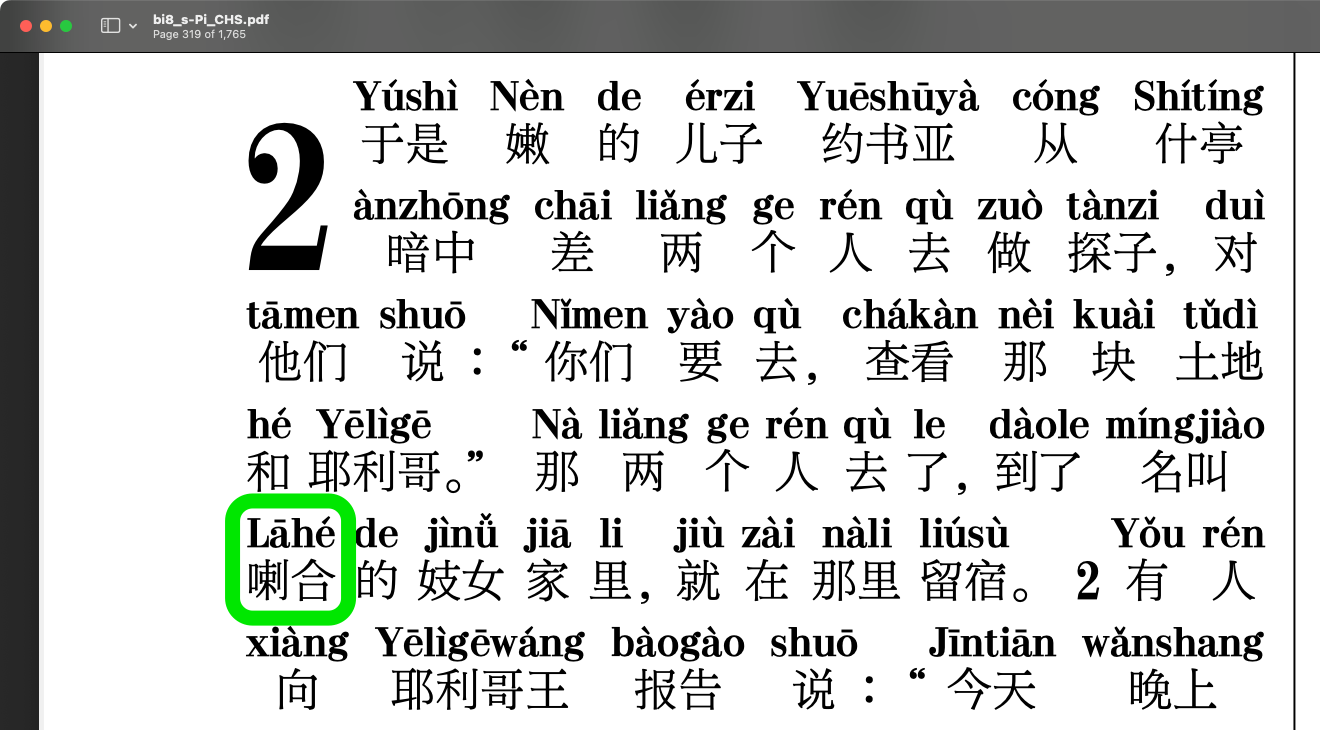
Lísú‐rén+ ((Lí·sú {Apart from} · {Vulgar → [Secular] (World)} 离俗 離俗)‐(rén people | person[s] | man/men 人) → [Nazʹi·rite[s]]) 👈🏼 Tap/click to show/hide the “flashcard”
[Notes: Tap/click on a Pīnyīn (Pīn·yīn {Piecing Together of} · Sounds → [Pinyin] 拼音) expression to reveal its “flashcard”; tap/click on a “flashcard” or its Pīnyīn (Pīn·yīn {Piecing Together of} · Sounds → [Pinyin] 拼音) expression to hide the “flashcard”. 📖 📄 ➕ icons mean 📖 Reveal All, 📄 Reveal Advanced, and ➕ Reveal + Symbols re all the “flashcards” in the heading, paragraph, etc. that they are placed at the beginning of.]
A few years back, I wrote up a brief web page listing reasons for producing Pīnyīn (Pīn·yīn {Piecing Together of} · Sounds → [Pinyin] 拼音), etc. material for the Imitate (ia) book. Some, especially some who grew up in the West, may have felt that this book is made up of “just stories”, and ones that they were already quite familiar with, at that. However, we must remember that Chinese Bible students may often have a different perspective regarding the Bible accounts that are made to come to life in the Imitate book. As that web page said:
- Many Chinese people in the world have not been exposed to Bible accounts the way many Westerners have.
- Also, I have heard that some, perhaps many, Chinese Bible students tend to approach their Bible studies like intellectual exercises for accumulating chōuxiàng (abstract) head knowledge as if for a school exam, rather than as training for their hearts for their own real lives.
Later, the web page touches on how some of the real-world benefits of good storytelling like that found in the Imitate book involve empathy:
- …
- The actress Natalie Portman once said, “I love acting. I think it’s the most amazing thing to be able to do. Your job is practicing empathy. You walk down the street imagining every person’s life.”
- The Imitate book helps build Bible students’ empathy towards Bible characters, which in turn helps Bible students realize that others would feel empathy towards them as well if they imitated these Bible characters—not everyone will just think they’re crazy, like many worldly friends or family members might think.
While even fictional stories can have the benefits described in the links and the quote above, true stories from the Bible can have even greater benefits, including spiritual ones.
Besides the Imitate book, another book from Jehovah’s organization that relates Bible accounts is the Learn From the Bible (lfb) book. The letter from the Governing Body in this book says that, similarly to the Imitate book, the Learn From the Bible book also “brings the Bible accounts to life and captures the feelings of those depicted”, while, unlike the Imitate book, it “tells the story of the human family from creation onward”. While the Learn From the Bible book is especially suitable for children, the letter from the Governing Body in this book says that “it can also be used to help adults who desire to learn more about the Bible”. So, it would be good to consider on this blog some of the expressions used in the Mandarin Learn From the Bible book.
Apart from the Vulgar World
This week’s MEotW, “Lísú‐rén ((Lí·sú {Apart from} · {Vulgar → [Secular] (World)} 离俗 離俗)‐(rén people | person[s] | man/men 人) → [Nazʹi·rite[s]])”, appears in the first paragraph of Lesson 38 of the Mandarin Learn From the Bible book, which is entitled “Yēhéhuá (Jehovah 耶和华 耶和華) Shǐ (Made 使) Cānsūn (Samson 参孙 參孫) Lì (Strength 力) Dà ({to Be Big} → [to Be Great] 大) Wúqióng+ (Wú·qióng {Not to Have} · {Being Impoverished} → [to Be Boundless] 无穷 無窮)” (“Jehovah Made Samson Strong”):
He will be a Nazirite.’ Do you know who the Nazirites were? They were special servants of Jehovah.
Mandarin (WOL, Pīnyīn (Pīn·yīn {Piecing Together of} · Sounds → [Pinyin] 拼音) + 🔗):
📖 📄 ➕ Tā (he 他) yào (will 要) zuò (be 做) Lísú‐rén+ ((Lí·sú {Apart from} · {Vulgar → [Secular] (World)} 离俗 離俗)‐(rén person 人) → [Nazʹi·rite]).” Nǐ (you 你) zhīdào (zhī·dào {do know} · {(the) way (of)} → [do know] 知道) shénme (shén·me what · [suf] 什么 什/甚麼) shì (were 是) Lísú‐rén ((Lí·sú {Apart from} · {Vulgar → [Secular] (World)} 离俗 離俗)‐(rén people 人) → [Nazʹi·rites]) ma ([? ptcl for “yes/no” questions] 吗 嗎)? Lísú‐rén ((Lí·sú {Apart from} · {Vulgar → [Secular] (World)} 离俗 離俗)‐(rén people 人) → [Nazʹi·rites]) shì (were 是) Yēhéhuá (Jehovah 耶和华 耶和華) de (’s 的) tèbié púrén,
The Mandarin Learn From the Bible book here uses “Lísú‐rén ((Lí·sú {Apart from} · {Vulgar → [Secular] (World)} 离俗 離俗)‐(rén people | person[s] | man/men 人) → [Nazʹi·rite[s]])” to correspond with the English expression “Nazirite”. The Glossary in the Watchtower ONLINE LIBRARY contains the following entry for this expression:
A word taken from the Hebrew for “One Singled Out,” “Dedicated One,” “Separated One.” There were two classes of Nazirites: those who volunteered and those who were appointed as such by God. A man or a woman could take a special vow to Jehovah to live as a Nazirite for a period of time. Those voluntarily taking the vow had three principal restrictions: they were to drink no alcohol nor eat any product of the grapevine, they were not to cut their hair, and they were not to touch a dead body. Those appointed by God as Nazirites remained such for life, and Jehovah specified the requirements for them.—Nu 6:2-7; Jg 13:5.
The morphemes in “Lísú‐rén ((Lí·sú {Apart from} · {Vulgar → [Secular] (World)} 离俗 離俗)‐(rén people | person[s] | man/men 人) → [Nazʹi·rite[s]])” mean “Apart from” “Vulgar (Secular) (World)” “person”. (Another expression that uses that noteworthy middle morpheme is past MEotW “shìsú+ (shì·sú {generation’s → [world’s]} · customs | {(of the) generation → [world]} · {vulgar → [secular]} | {generation → [world]} · {vulgar → [secular] (world)} 世俗)”.) Comparing those meanings with the above description of “Nazirite”, we can see that “Lísú‐rén ((Lí·sú {Apart from} · {Vulgar → [Secular] (World)} 离俗 離俗)‐(rén people | person[s] | man/men 人) → [Nazʹi·rite[s]])” is one of the rare Bible names that is translated into Mandarin based on its meaning, rather than based on its sound. (In fact, it’s the only one that I can think of at this time that is translated that way.) Interestingly, the footnote for Numbers 6:2 in the Mandarin NWT Study Bible tells us that “Lísú‐rén ((Lí·sú {Apart from} · {Vulgar → [Secular] (World)} 离俗 離俗)‐(rén people | person[s] | man/men 人) → [Nazʹi·rite[s]])” can also be translated based on its sound, as “Náxì’ěr‐rén ((Náxì’ěr Na·zirʹ 拿细耳 拿細耳)‐(rén people | person[s] | man/men 人) → [Nazʹi·rite[s] (Nu. 6:2 ftn.: alternate translation, now usually “Lísú‐rén”)])”:
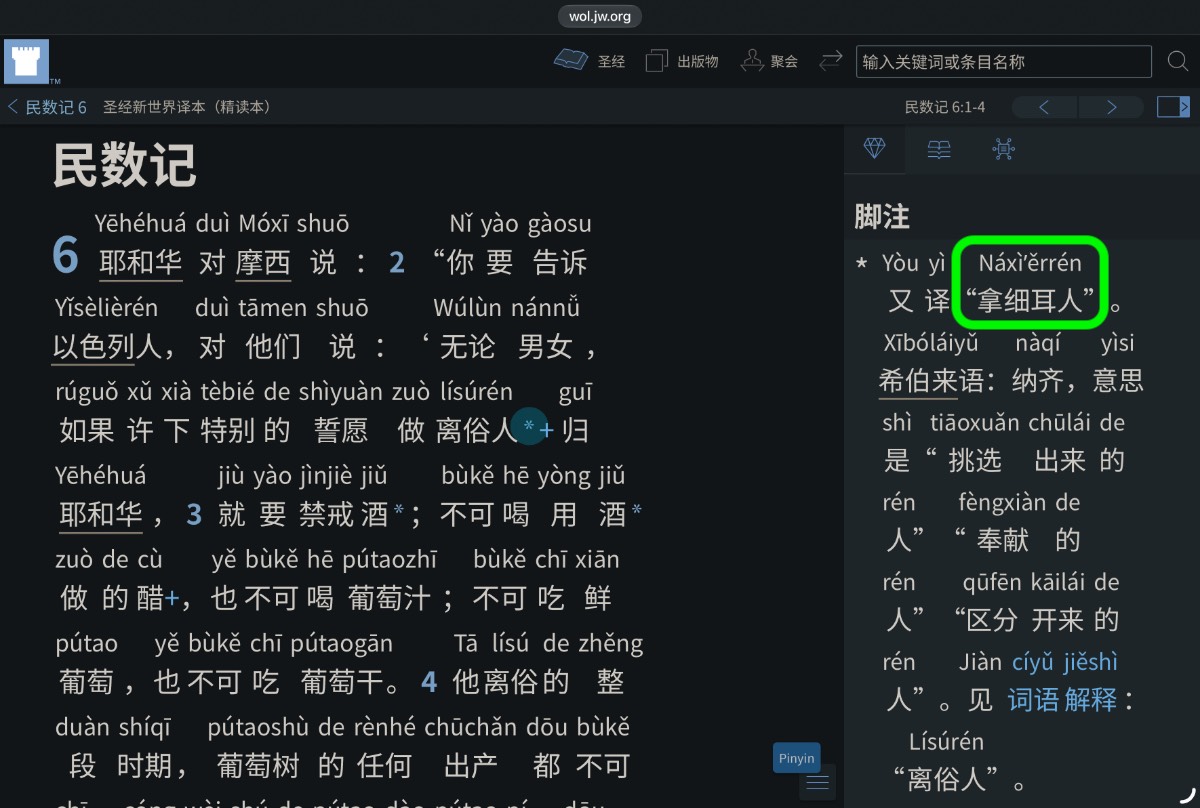
(Dark mode for the Watchtower ONLINE LIBRARY (WOL) website, as shown in the above image, can be enabled in the Safari web browser by using the Noir Safari extension. Other web browsers may also have extensions with similar functionality.)
This is, as the English saying goes, an exception that proves the rule—generally, Mandarin versions of names that originated in other languages are designed based on the sound of the original language name, in accord with the basic linguistic principle that when it comes to human languages, speech is primary, not writing, regardless of how those who repeat the Ideographic Myth erroneously claim that Chinese characters are awesome because they supposedly represent meaning visually without relying on speech sounds.
For convenience:
The direct link for the Pīnyīn (Pīn·yīn {Piecing Together of} · Sounds → [Pinyin] 拼音) Plus / Pīnyīn (Pīn·yīn {Piecing Together of} · Sounds → [Pinyin] 拼音)+ resource for the Learn From the Bible book is:
The short link for Chinese field language-learning links for the Learn From the Bible book is:
More Pīnyīn (Pīn·yīn {Piecing Together of} · Sounds → [Pinyin] 拼音) and Pīnyīn (Pīn·yīn {Piecing Together of} · Sounds → [Pinyin] 拼音) Plus web material based on the Mandarin Learn From the Bible book will be made available in the Pīnyīn (Pīn·yīn {Piecing Together of} · Sounds → [Pinyin] 拼音) Plus / Pīnyīn (Pīn·yīn {Piecing Together of} · Sounds → [Pinyin] 拼音)+ web resource as time allows.