Categories
Current Events Science Technology Theocratic

réngōng zhìnéng

réngōng (rén·gōng human · work → [artificial] 人工)
zhìnéng (zhì·néng intelligence · ability → [intelligence] 智能) 👈🏼 Tap/click to show/hide the “flashcard”

[Notes: Tap/click on a Pīnyīn (Pīn·yīn {Piecing Together of} · Sounds → [Pinyin] 拼音) expression to reveal its “flashcard”; tap/click on a “flashcard” or its Pīnyīn (Pīn·yīn {Piecing Together of} · Sounds → [Pinyin] 拼音) expression to hide the “flashcard”. 📖 📄 📘 icons mean 📖 Reveal All, 📄 Reveal Advanced, and 📘 Reveal None re all the “flashcards” in the heading, paragraph, etc. that they are placed at the beginning of.

As of this writing, jw.org is again featuring the article referred to below. So, this is basically a reposting of a post from a few years back.]

At the time of this writing, jw.org was featuring the article “Artificial Intelligence—A Blessing or a Curse?—What Does the Bible Say?”. Where the English version of this article uses the expression “artificial intelligence”, the Mandarin version uses this week’s MEotW, “réngōng (rén·gōng human · work → [artificial] 人工) zhìnéng (zhì·néng intelligence · ability → [intelligence] 智能):

English:

Recently, world leaders, scientists, and technologists have commented on the power of artificial intelligence (AI). While acknowledging its value, they have also expressed concern over its potential misuse.

Mandarin:

📖 📄 📘 Jìnqī (Jìn·qī {near → [recent]} · {period of time} → [recently] 近期), xǔduō (xǔ·duō numbers · many 许多 許多) guójiā (guó·jiā nation · family → [national] 国家 國家) lǐngdǎorén (lǐngdǎo·rén leading · persons → [leaders] 领导人 領導人), kēxuéjiā (kē·xué·jiā {{branches of study} · learning → [science]} · -ists → [scientists] 科学家 科學家), yǐjí (and 以及) kējì (kē·jì {branches of study → [science]} · {skills → [technology]} → [technology] 科技) jīngyīng (jīng·yīng elite · {flowers → [outstanding persons]} → [elite] 精英) dōu ({all of them} 都) duì (towards) réngōng (rén·gōng human · work → [artificial] 人工) zhìnéng (zhì·néng intelligence · ability → [intelligence] 智能) (AI) de (’s 的) yòngtú (yòng·tú {to be used} · routes → [applications] 用途) shēn (deeply 深) biǎo ({have expressed} 表) guānzhù (guān·zhù {closing with (them) → [being concerned about (them)]} · {pouring into (them) → [concentrating on (them)]} → [paying close attention to (them)] 关注 關注). Suīrán (Suī·rán although · -ly 虽然 雖然) tāmen (tā·men he/she · [pl] → [they] 他们 他們) dōu (all 都) zàntóng (zàn·tóng favour · {are with} → [approve of] 赞同 贊/讚同) réngōng (rén·gōng human · work → [artificial] 人工) zhìnéng (zhì·néng intelligence · ability → [intelligence] 智能) yǒu (having 有) hěn (very 很) duō (many 多) yìchu (yì·chu beneficial · places → [benefits] 益处 益處), dàn (however 但) ((they) also 也) hěn ({very much} 很) dānxīn (dān·xīn {carry on shoulder poles → [bear (heavy)]} · hearts → [worry] 担/耽心 擔/耽心) zhèi (this) xiàng ({item of}) kējì (kē·jì {branches of study → [science]} · {skills → [technology]} → [technology] 科技) huì (will) bèi ([passive signifier] → [be] 被) lànyòng (làn·yòng {overflowingly → [indiscriminately]} · used → [misused] 滥用 濫用).

Related Expressions

The “zhìnéng (zhì·néng wisdom; knowledge; intelligence; resourcefulness; wit; cleverness · ability → [intelligence; intellectual power/ability | smart(phone, etc.)] 智能) in “réngōng (rén·gōng human · work → [artificial] 人工) zhìnéng (zhì·néng intelligence · ability → [intelligence] 智能) also appears in “zhìnéng shǒujī ((zhì·néng intelligence · ability → [smart] 智能) (shǒu·jī hand · machine → [mobile phone] 手机 手機) [smartphone]), which is used in China to mean “smartphone”. As pointed out by the Referenced Theo. Expressions (RTE) resource, this expression appears in the November 2009 issue of Awake! magazine, on page 3.

It’s also noteworthy that the “zhì (wisdom; knowledge; intelligence; resourcefulness; wit; cleverness 智) in “réngōng (rén·gōng human · work → [artificial] 人工) zhìnéng (zhì·néng intelligence · ability → [intelligence] 智能) appears in “zhìhuì (zhì·huì wisdom · intelligence → [wisdom] 智慧), the Mandarin word for “wisdom”. It also appears in “zhōngxìn (zhōng·xìn faithful · {believing → [having faith]} → [faithful] 忠信) ruìzhì (ruì·zhì {having foresight} · {(having) wisdom} 睿智) de (’s 的) núlì (slave 奴隶 奴隸), the Mandarin expression for “faithful and discreet slave”.—Matthew 24:45 (English; Mandarin).

A Beginning? Or Not?

Regarding intelligence, artificial or otherwise, it’s illuminating to consider these verses in Proverbs:

The fear of Jehovah is the beginning of knowledge.
Only fools despise wisdom and discipline.
Proverbs 1:7

The fear of Jehovah is the beginning of wisdom,
And knowledge of the Most Holy One is understanding.
Proverbs 9:10

To show true knowledge and wisdom—and indeed, intelligence—in life, we need to consider all the factors that are relevant in life, and we especially need to not have insufficient regard for the biggest, most relevant factor of all in life—Jehovah God, who created human intelligence (which was perfect in the first human couple, but which that couple caused to become imperfect and corrupted). Humans who do not have fear of (or “reverence for”, as per the footnote for Pr. 1:7) Jehovah—the Creator of human life and human intelligence—do not even begin to have true knowledge or wisdom, and thus are not equipped to develop artificial intelligence with true knowledge or wisdom.

Indeed, while humans can now store, read, and perform some basic processes on data, even huge amounts of data, human researchers have limited understanding about, and disagree about, how a system like the human brain or an artificial intelligence system can truly—not just appear to—know or understand something, or have wisdom (scientific paper, Medium article) about something. This may help to partly explain why a significant percentage of the time, current artificial intelligence systems output incorrect statements with complete confidence, as if they were true.

Yes, while many are now fascinated by, and/or concerned about, the increasing power of artificial intelligence, people should be focusing first on Jehovah God’s divine intelligence, the most powerful intelligence in the entire universe, that thankfully is motivated by love, guided by wisdom, and dedicated to justice.—1 John 4:8; Romans 11:33; Deuteronomy 32: 3, 4.

Categories
Current Events History Science Technology Theocratic

néngyuán

néngyuán (néng·yuán energy · {source (of a river)} → [energy [source]] 能源) 👈🏼 Tap/click to show/hide the “flashcard”

[Notes: Tap/click on a Pīnyīn (Pīn·yīn {Piecing Together of} · Sounds → [Pinyin] 拼音) expression to reveal its “flashcard”; tap/click on a “flashcard” or its Pīnyīn (Pīn·yīn {Piecing Together of} · Sounds → [Pinyin] 拼音) expression to hide the “flashcard”. 📖 📄 📘 icons mean 📖 Reveal All, 📄 Reveal Advanced, and 📘 Reveal None re all the “flashcards” in the heading, paragraph, etc. that they are placed at the beginning of.]

At the time of this writing, jw.org is featuring the article “Meeting Mankind’s Energy Needs—What the Bible Says”. This week’s MEotW, “néngyuán (néng·yuán energy · {source (of a river)} → [energy [source]] 能源), occurs often in the Mandarin version of this article, including in the title:

English:

Meeting Mankind’s Energy Needs—What the Bible Says

Mandarin:

📖 📄 📘 Néngyuán (néng·yuán Energy · {Sources (of Rivers)} → [Energy [Sources]] 能源) Kùnjú (Kùn·jú {Surrounded → [Hard-Pressed]} · Situation 困局) Yǒu ({Will Have} 有) Jiějué (Jiě·jué {Being Untied → [Being Solved]} · {Being Decided} → [Being Resolved] 解决 解決) de (’s 的) (One 一) Tiān (Sky → [Day] 天) ma ([? ptcl for “yes/no” questions])? Shèngjīng (Shèng·jīng (the) Holy · Scriptures → [the Bible] 圣经 聖經) de (’s 的) Guāndiǎn (Guān·diǎn {Looking at → [View]} · Point → [Viewpoint] 观点 觀點) Shì (Is 是) Shénme (Shén·me What · [suf] 什么 什/甚麼)?

The Importance of Energy

That the current fighting in the Middle East around the Strait of Hormuz is driving up gas prices in many places is undoubtedly a big reason why the above-mentioned article is being featured on jw.org at this time. Yes, energy is more than just an abstract scientific concept.

In physics, energy is defined as “the capacity for doing work”, which in turn involves applying force to move something a certain distance. So, practically speaking, energy provides the ability to move physical things, like our cars. And since heat is connected to temperature, which “reflects the average kinetic energy of the particles in a system”, energy also provides the ability to heat things, like our homes. (By the way, in physics, “power is defined as the rate of producing or consuming energy.”)

Looking back in history, oil—along with other fossil fuels still the dominant source of energy down to this day, in spite of increasing use of clean energy—was a big factor in why Japan attacked Pearl Harbour in 1941, and in why Nazi Germany ultimately lost to the Allies in World War II.

Coming back to the present day, besides gas prices being driven up by the ongoing fighting in the Middle East, another reason why energy is now of concern to many is that oodles and gobs of energy are needed to train and operate artificial intelligence (AI) models, which are increasingly being hyped and used by many.

Another Usage Example

Regarding “néngyuán (néng·yuán energy · {source (of a river)} → [energy [source]] 能源)”, note that its morphemes literally mean “energy · source (of a river)”. However, the expression as a whole is at times used to effectively mean just “energy”.

To help Mandarin field language learners get more of a feel for how to use this expression, here is another usage example, taken from the above-mentioned jw.org article:

English:

Challenge: international conflict. Some regions are rich in energy resources, but they suffer from wars, conflicts, and disputes over territory. And when conflicts disrupt supply chains for oil or gas, many people face shortages and higher prices.

The Bible says: “Jehovah…is bringing an end to wars throughout the earth.”—Psalm 46:8, 9.

Jehovah God will eliminate conflict and wars.

Mandarin:

📖 📄 📘 Zǔ’ài (Zǔ’·ài obstructing · hindering (thing) → [obstacle] 阻碍 阻礙): guójì (guó·jì nations · {boundaries → [among]} → [international] 国际 國際) jiān (among間/閑) de (’s 的) chōngtū (chōng·tū {dashings → [clashings]} · {chimneys → [chargings]} → [conflicts] 冲突 衝突). Yǒuxiē (Yǒu·xiē {(there) are having → [(there) are]} · some 有些) dìqū (dì·qū lands · regions 地区 地區) yōngyǒu (yōng·yǒu {holding in their arms} · having → [having] 拥有 擁有) chōngzú (chōng·zú filled · ample 充足) de (’s 的) shíyóu (shí·yóu rock · oil → [oil] 石油) ({(together) with} → [and]和/龢) tiānrán (tiān·rán {(of) heaven → [natural]} · so → [natural] 天然) (gas氣/气), dànshì (dàn·shì but · {(it) is (the case that)} 但是) yīnwei (yīn·wei {because of} · {on account of} 因为 因為) zhànzhēng (zhàn·zhēng wars · contendings → [wars] 战争 戰爭), chōngtū (chōng·tū {dashings → [clashings]} · {chimneys → [chargings]} → [conflicts] 冲突 衝突), lǐngtǔ (lǐng·tǔ {neck → [collar] → [have jurisdiction over]} · {soil → [land]} → [territory] 领土 領土) jiūfēn (jiū·fēn (things) {being entangled in} · {being tangled} → [disputes] 纠纷 糾紛), dǎozhì (dǎo·zhì {(these) lead} · {to extend to} 导致 導致) néngyuán (néng·yuán energy · {source (of a river)} → [energy [source]] 能源) gōngyìng (gōng·yìng supplying · {responding (to the needs/requests)} → [supply] 供应 供應) liàn (chains) shòudào (shòu·dào {being subjected to} · {arriving at} 受到) yǐngxiǎng (yǐng·xiǎng relfection · sound → [being affected] 影响 影響). Jiéguǒ (Jié·guǒ {tied (into a knot) → [formed]} · fruit → [as a result] 结果 結果), hěn (very 很) duō (many 多) rén (people 人) miànlín (miàn·lín face · {are near to} 面临 面臨) néngyuán (néng·yuán energy · {source (of a river)} → [energy [source]] 能源) duǎnquē (duǎn·quē {being short → [being lacking]} · {being lacking} → [shortages] 短缺) huòzhě (huò·zhě or · [suf] 或者) néngyuán (néng·yuán energy · {source (of a river)} → [energy [source]] 能源) jiàgé (jià·gé price · {grid → [pattern]} → [prices] 价格 價格) shàngzhǎng (shàng·zhǎng upward · {rising (of water/prices/etc.)} 上涨 上漲) de (’s 的) wèntí (wèn·tí asking · problems → [problems] 问题 問題).

📖 📄 📘 Shèngjīng (Shèng·jīng (the) Holy · Scriptures → [the Bible] 圣经 聖經) shuō (says說/説): Yēhéhuá (Jehovah 耶和华 耶和華)zhōngzhǐ (zhōng·zhǐ {is ending} · {is halting} 终止 終止) zhànzhēng (zhàn·zhēng wars · contendings → [wars] 战争 戰爭), píngdìng (píng·dìng {is making to be flat, level, even → [is making to be peaceful]} · {is making to be settled → [is making to be calm]} 平定) tiānxià (tiān·xià heaven · under → [the whole world] 天下)” (Shīpiān (Shī·piān {Sacred Song} · {Piece of Writing} → [Psalm] 诗篇 詩篇) 46:8, 9)

📖 📄 📘 Yēhéhuá (Jehovah 耶和华 耶和華) huì (will) xiāochú (xiāo·chú eliminate · {get rid of} 消除) zhànzhēng (zhàn·zhēng wars · contendings → [wars] 战争 戰爭) ({(together) with} → [and]和/龢) chōngtū (chōng·tū {dashings → [clashings]} · {chimneys → [chargings]} → [conflicts] 冲突 衝突).

Jehovah’s Energy

Yes, Jehovah can and will resolve the issues the world is facing involving energy. Regarding the sheer amount of energy that Jehovah has at his disposal, a past MEotW post said:

As an example of just how powerful Jehovah’s holy spirit is even compared to humans’ nuclear bombs, according to my research and calculations, every day, the sun, produced with power from the holy spirit, puts out the energy of almost 8 quadrillion (1015) 1-megaton nuclear bombs. (A single 1-megaton nuclear bomb would release about 67 times the amount of energy released by the atomic bomb dropped on Hiroshima.) And according to NASA, “it turns out that our Sun is an average-sized star. There are bigger stars, and there are smaller stars. We have found stars that are 100 times bigger in diameter than our sun.”

And of course, as we who have gotten to know Jehovah have learned, Jehovah God is far from being all muscle and no brains or heart or conscience. In addition to having unlimited power, we can rest assured that he also has the wisdom, the justice, and most importantly, the love required to best beneficially use all that power and energy—he is truly the ultimate Néngyuán (Néng·yuán Energy · {Source (of a River)} → [Energy Source] 能源)!

Categories
Culture Science Technology Theocratic

jiéjīng

jiéjīng (jié·jīng {tied (into a knot) → [formed]} · crystal → [crystallized | crystal; crystallization | crystalline] 结晶 結晶) 👈🏼 Tap/click to show/hide the “flashcard”

[Notes: Tap/click on a Pīnyīn (Pīn·yīn {Piecing Together of} · Sounds → [Pinyin] 拼音) expression to reveal its “flashcard”; tap/click on a “flashcard” or its Pīnyīn (Pīn·yīn {Piecing Together of} · Sounds → [Pinyin] 拼音) expression to hide the “flashcard”. 📖 📄 📘 icons mean 📖 Reveal All, 📄 Reveal Advanced, and 📘 Reveal None re all the “flashcards” in the heading, paragraph, etc. that they are placed at the beginning of.]

The Shēngmìng Láizì Chuàngzào Ma? ((Shēngmìng Life 生命) (Lái·zì Came · From 来自 來自) (Chuàng·zào Initiating · {Making, Creating} → [Creating] 创造 創造) (Ma [? ptcl for “yes/no” questions])? [Was Life Created? (lc)]) (Was Life Created? (lc)) brochure and the Shēngmìng de Qǐyuán—Zhíde Sīkǎo de Wǔ Ge Wèntí ((Shēngmìng Life 生命) (de ’s 的) (Qǐ·yuán {Rising → [Starting]} · Source → [Origin] 起源/原)—(Zhí·de Worth · Getting → [Worth] 值得) (Sī·kǎo {Thinking About} · Examining 思考) (de ’s 的) (Wǔ Five 五) (Ge [mw]個/个) (Wèn·tí Asking · Subjects → [Questions] 问题 問題) [The Origin of Life—Five Questions Worth Asking (lf)]) (The Origin of Life—Five Questions Worth Asking (lf)) brochure were originally published back in 2010, but relatively recently, the English version of the Was Life Created? brochure was updated to the December 2022 Printing, and the Mandarin version of it was updated to the February 2023 Printing. Also, the Was Life Created? brochure and the Origin of Life brochure are now in the Teaching Toolbox section in the JW Library app. So, it would be good to consider some of the expressions used in the Mandarin versions of these publications that can be so helpful when discussing whether life was created.

It’s Crystal Clear

This week’s MEotW, “jiéjīng (jié·jīng {tied (into a knot) → [formed]} · crystal → [crystallized | crystal; crystallization | crystalline] 结晶 結晶)”, occurs in the box at the end of the QUESTION 1 section of the Origin of Life brochure, which section is entitled, in English, “How Did Life Begin?”:

English:

Question: What takes greater faith—to believe that the millions of intricately coordinated parts of a cell arose by chance or to believe that the cell is the product of an intelligent mind?

Mandarin (WOL, Pīnyīn (Pīn·yīn {Piecing Together of} · Sounds → [Pinyin] 拼音) Plus):

📖 📄 📘 Qǐng (please) xiǎngxiang (xiǎng·xiang {think about} · {think about} 想想): Xìbāo (Xì·bāo tiny · womb → [cell] 细胞 細胞) de (’s 的) wúshù (wú·shù without · number 无数 無數) bùfen (parts 部分) cuòzōng (cuò·zōng {are interlocked → [are intricate]} · {are combined → [are composite]} → [are intricate] 错综 錯綜)fùzá (fù·zá {are turned around → [are compound]} · {are mixed} → [are complex] 复杂 複雜), xiānghù ({with each other} 相互) xiétiáo (xié·tiáo {assisting → [coordinatedly]} · {are regulated → [fit in perfectly]} → [coordinate] 协调 協調), (you 你) rènwéi (rèn·wéi {do identify} · {(it) to be} (that) 认为 認為) xìbāo (xì·bāo tiny · womb → [cell] 细胞 細胞) shì (is 是) pèngqiǎo (pèng·qiǎo {having bumped into} · {being coincidental} → [by chance] 碰巧) chǎnshēng (chǎn·shēng {given birth to → [produced]} · {given birth to → [caused to exist]} → [brought into being] 产生 產生) de ({’s (thing)} 的), háishi (hái·shi {still more → [or]} · {is (it)} 还是 還是) zhìhuì (zhì·huì wisdom · intelligence → [wisdom] 智慧) de (’s 的) jiéjīng (jié·jīng {tied (into a knot) → [formed]} · crystal → [crystallization] 结晶 結晶) ne ([? ptcl] 呢)? (which 哪) (one 一) yàng (form → [way]) cái ({only then}才/纔) shì (is 是) bùkě (bù·kě (one) not · can → [(one) cannot] 不可) zhìxìn (zhì·xìn place · {believing in} → [believe (usually used in the negative)] 置信) de ({’s (way)} 的) ne ([? ptcl] 呢)?

It’s Really Crystal Clear

The MEotW post on “cuòzōng (cuò·zōng {[is] interlocked and jagged → [[is] intricate]} · {[is] combined → [[is] composite]} → [[is] intricate; complex; tangled] 错综 錯綜)fùzá (fù·zá {[is] turned around → [[is] compound; complex]} · {[is] mixed} → [[is] complicated; complex] 复杂 複雜)”, which occurs a bit before this week’s MEotW “jiéjīng (jié·jīng {tied (into a knot) → [formed]} · crystal → [crystallized | crystal; crystallization | crystalline] 结晶 結晶) in the above-quoted paragraph, contains this sentence:

In “cuòzōng (cuò·zōng {[being] interlocked and jagged → [[being] intricate]} · {[being] combined → [[being] composite]} → [[being] intricate; complex; tangled | (mental) complex (n)] 错综 錯綜)”, “cuò ({[is] alternating; staggered} [→ [[is] wrong; mistaken; incorrect; erroneous | missed | grinding; rubbing | moving to the side | mistake; error; blunder [→ [fault]]]] | {[is] interlocked and jagged} [→ [intricate]]) literally means “interlocked and jagged”, and it effectively means “intricate”.

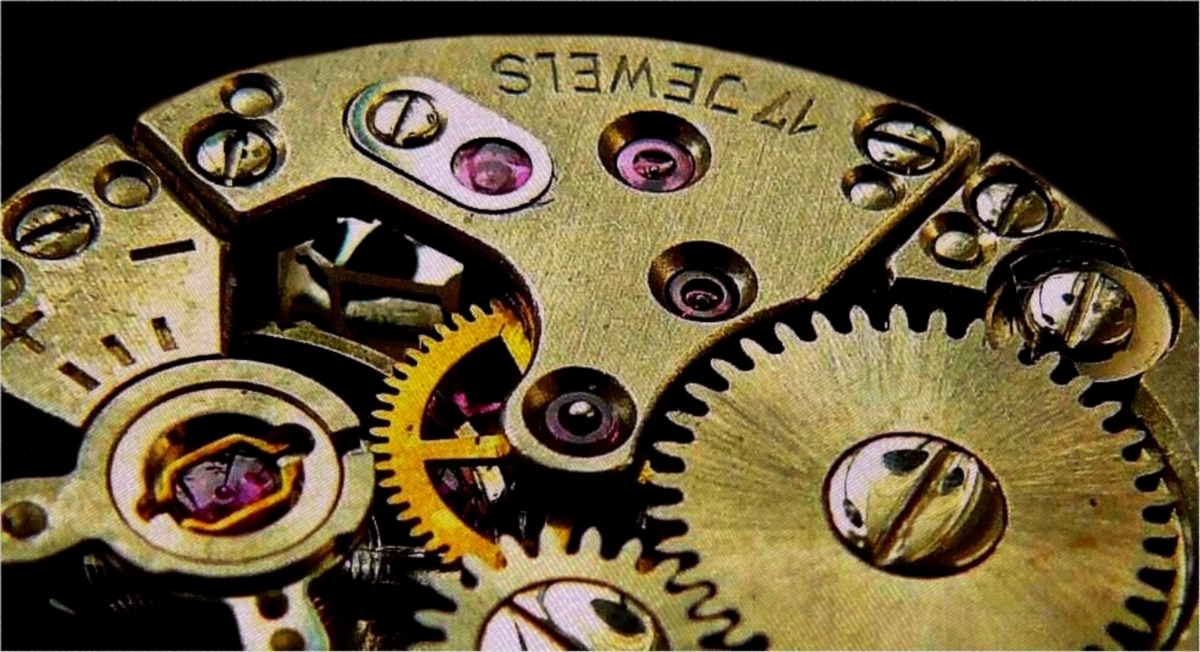
“Interlocked and jagged” and “intricate” may bring to mind a clockwork mechanism, like this:

Closeup of a clockwork mechanism

To people who see such a clockwork mechanism, it would generally be really crystal clear that such a mechanism is a product of intelligence, and it is interesting to consider how “jiéjīng (jié·jīng {tied (into a knot) → [formed]} · crystal → [crystallized | crystal; crystallization | crystalline] 结晶 結晶) works as a Mandarin translation for “product”, as it does in the above example from the Origin of Life brochure.

The “jié ({tie [(a knot of)]}; knit; weave [→ [congeal; form; forge; cement | join together; bind; connect; unite | settle; conclude]] | {tying (of a knot)} → [knot | (electrical) junction | node | written guarantee; affidavit; bond]) in “jiéjīng (jié·jīng {tied (into a knot) → [formed]} · crystal → [crystallized | crystal; crystallization | crystalline] 结晶 結晶) literally means “tie (into a knot)”, and in this context it effectively means “form” (used as a verb). (This “jié ({tie [(a knot of)]}; knit; weave [→ [congeal; form; forge; cement | join together; bind; connect; unite | settle; conclude]] | {tying (of a knot)} → [knot | (electrical) junction | node | written guarantee; affidavit; bond]) also appears in well-known expressions like “jiéguǒ (jié·guǒ {tied (into a knot) → [formed]} · fruit → [result | as a result] 结果 結果)”, “jiélùn (jié·lùn {tying up → [concluding]} · determining → [conclusion; verdict] 结论 結論)”, and “jiéhūn (jié·hūn {tie (a knot of)} · {marrying → [marriage]} → [marry; get married] 结婚 結婚)”.) The other morpheme “jīng (crystal [→ [clear; brilliant; bright; radiant; glittering; sparkling]] 晶) means “crystal”. Being put together this way, “jiéjīng (jié·jīng {tied (into a knot) → [formed]} · crystal → [crystallized | crystal; crystallization | crystalline] 结晶 結晶) on one level of literalness can mean “formed crystal”, and it can effectively mean “crystallization”. This word literally refers to something that has solidified into a crystal, and it can metaphorically refer to “a mental synthesis that becomes fixed or concrete by a process resembling crystal formation”. Similary, a product is something that is produced, that previously was not fixed, concrete, or solid, but that is made to become so, by, for example, intelligence—a crystallization is a product of the process of crystal formation, and a product is a crystallization, a solid result, of the production process.

It’s Really, Really Crystal Clear

If it’s crystal clear that a clockwork mechanism like the one in the image above must have been the product, or crystallization, of intelligence, then what about “the millions of intricately coordinated parts of a cell”? To give us an idea of how some of the parts of a cell function, here is a video I came across that uses computer animation to help us visualize how tiny molecular machines (discussed in the MEotW post on “fēnzǐ jùhé‐tǐ ((fēn·zǐ {divided (off)} · {small and hard thing} → [molecular] 分子) (jù·hé assembled · {closed → [combined]} → [polymerized] 聚合)‐(tǐ body體/体/躰) [(protein) molecular machine])”) inside our cells copy DNA:

Surely, it’s really, really crystal clear that the tiny molecular machines inside our cells must have been, even more so than any clockwork mechanism, the product, or crystallization, of intelligent design! For example, human-made clockwork mechanisms cannot make copies of themselves, but the molecular machines in our cells can, while being way smaller and more intricate! That is solid evidence that our cells and the molecular machines in them were produced by a higher intelligence than that of humans (a superintelligence, in the terminology of the artificial intelligence field), rather than some subhuman force like mindless blind chance.

The Real Thing Is Even Better

If one came across a wooden doll like Pinocchio that looks like a boy, would that person assume that that wooden doll somehow came into being by chance? Hardly anyone would make that assumption—it would be crystal clear that someone must have made that doll. In the story of Pinocchio, that someone who made Pinocchio was named Geppetto. (By the way, according to the Chinese Wikipedia page for Pinocchio, in Mandarin, “Pinocchio” is “Pǐnuòcáo (Pinocchio 匹诺曹 匹諾曹)”, and “Geppetto” is “Jiépèituō (Geppetto 杰佩托 傑/杰佩/珮托/託)”.)

It would have been dismissively insulting to Geppetto to suggest that all the skill, care, and craftsmanship that he put into making Pinocchio was unnecessary, and that Pinocchio just somehow came into existence from a pile of wood scraps without any help from Geppetto. Similarly, people are dismissively insulting Jehovah God when they suggest that real boys (and girls, and men, and women, and plants, and animals, etc.) just somehow evolved, and did not need any of Jehovah’s skill, care, and craftsmanship to come into existence.

Screenshot of Pinocchio from the trailer for the film Pinocchio (1940).

The real thing is even better!

Let us, then, not hesitate to make good use of the Origin of Life brochure in the Mandarin field, to help ensure that our loving and wise Creator gets the praise and honour he deserves in this field in which many were taught that there is no Creator.—Revelation 4:11.


For convenience:

The direct link for the current-generation Pīnyīn (Pīn·yīn {Piecing Together of} · Sounds → [Pinyin] 拼音) Plus resource for the Origin of Life brochure is:

The short link for Chinese field language-learning links for the Origin of Life brochure is:

More Pīnyīn (Pīn·yīn {Piecing Together of} · Sounds → [Pinyin] 拼音) and Pīnyīn (Pīn·yīn {Piecing Together of} · Sounds → [Pinyin] 拼音) Plus web material based on the Mandarin Origin of Life brochure will be made available in the Pīnyīn (Pīn·yīn {Piecing Together of} · Sounds → [Pinyin] 拼音) Plus web resource as time allows.