yuánzé+
(yuán·zé
original · rule →[principle]
原则
原則) 👈🏼 Tap/click to show/hide the “flashcard”
[Notes:Tap/click on a Pīnyīn
(Pīn·yīn
{Piecing Together of} · Sounds →[Pinyin]
拼音) expression to reveal its “flashcard”; tap/click on a “flashcard”or its Pīnyīn
(Pīn·yīn
{Piecing Together of} · Sounds →[Pinyin]
拼音) expression to hide the“flashcard”. 📖📄 ➕ icons mean 📖Reveal All, 📄Reveal Advanced, and ➕ Reveal + Symbols re all the “flashcards” in the heading, paragraph, etc. that they are placed at the beginning of.]
One of the publications that is now recommended to be used on Bible studies is the Yǒngyuǎn Xiǎngshòu Měihǎo de Shēngmìng—Hùdòng‐Shì Shèngjīng Kèchéng
((Yǒng·yuǎn
Eternally · {Far (in Time)}
永远
永遠)
(Xiǎng·shòu
Enjoy · Receive
享受)
(Měi·hǎo
Beautiful · Good
美好)
(de
’s
的)
(Shēngmìng
Life
生命)—(Hù·dòng
{Each Other} · Moving → [Interactive]
互动
互動)‐(Shì
(Type
式)
(Shèng·jīng
Holy · Scriptures → [Bible]
圣经
聖經)
(Kè·chéng
Lessons · Procedure → [Course]
课程
課程)
→[Enjoy Life Forever!—An Interactive Bible Course (lff)]) (Enjoy Life Forever! (lff)) book. This week’s MEotW, “yuánzé
(yuán·zé
original · rule →[principle]
原则
原則)”, appears in lesson 16, point 5 of this book:
The first morpheme in this week’s MEotW, “yuán
(origin; source; start | primary; original [→ [unprocessed; raw; crude | primitve; initial; basic]] | originally
原)”, means “origin; source; start”, or “primary; original”. Other expressions in which this morpheme appears include “qǐyuán
(qǐ·yuán
{rising → [starting]} · source →[origin]
起源/原)”,“yuánshǐ+
(yuán·shǐ
original · beginning; starting [→ [primitive; primeval; primordial; proto-]]
原⧸元始)”,“yuányīn
(yuán·yīn
origin · cause; reason
原因)”, and “yuánzǐ+
(yuán·zǐ
original · {small and hard thing} →[atom | atomic]
原子)”.
The other morpheme “zé
(rule; regulation | standard; norm; criterion | then; {in that case} | {indeed (indicating concession)}; {in contrast/comparison} | [mw for written items]
则
則)” means “rule; regulation” in this context, with “standard; norm; criterion” being a related meaning. Other Mandarin expressions that make use of it include “fǎzé
(fǎ·zé
law · rule; regulation; principle [→ [formula | standard method | binding agreement]]
法则
法則)”,“fǒuzé+
(fǒu·zé
(if) not · {(according with) rule/regulation/standard/criterion} →[otherwise; if not; or else]
否则
否則)”,“zhǔnzé
(zhǔn·zé
standards · rules [→ [norms; standards; criteria]]
准则
準則)”, and “yǐ
(use
以)‐shēn
(body →[self]
身)‐zuò
({to be}
作)‐zé+
(standard →[example]
则
則)”.
So, the constituent morphemes in “yuánzé
(yuán·zé
original · rule →[principle]
原则
原則)” literally mean “original rule”, and taken together, they are used to effectively mean “principle”.
Original Rules, First Principles
Showing that “original rules” is a good way to describe what principles are, the April 15, 2002 issue of The Watchtowersays:
Principles are living, essential truths, and wise Christians learn to love them. …How do principles differ from laws? Principles provide the basis for laws. Rules, which tend to be specific, may be for some particular time or situation, but principles are timeless. …Divine principles do not become outdated or pass away.
“First principles thinking” consists of decomposing things down to the fundamental axioms [Wordnik entry] in the given arena, before reasoning up by asking which ones are relevant to the question at hand, then cross-referencing conclusions based on chosen axioms and making sure conclusions do not violate any fundamental laws.
Following principles is harder than, but also better than, just following the literal letter of the law, or the rigid traditions handed down from dead imperfect humans, or the canned procedures that may or may not be appropriate for ever-changing and ever-developing situations, or the broad, easy-to-follow road that “everyone else” is on, but that is leading off into destruction.—Matthew 7:13, 14.
Why is following principles harder than following these other things? As Romans 12:1, 2 shows, understanding and following right principles requires us to use our “power of reason”, to even ‘make our minds over’, so that we may prove to ourselves and get to be in harmony with “the good and acceptable and perfect will of God”. When we succeed at being in harmony with God’s will, though, we experience many matchless blessings and benefits, because “who is like Jehovah our God”?—Psalm 113:5.
A Principle for Language Learning
In the Mandarin language field, “speech is primary, writing is secondary” is an important principle of linguistics (language science) that we need to follow. This has been corroborated by the Source, the Origin, of language itself, Jehovah God, in his Word:
For if the trumpet sounds an indistinct call, who will get ready for battle? In the same way, unless you with the tongue use speech that is easily understood, how will anyone know what is being said? You will, in fact, be speaking into the air. It may be that there are many kinds of speech in the world, and yet no kind is without meaning. For if I do not understand the sense of the speech, I will be a foreigner to the one speaking, and the one speaking will be a foreigner to me.
—1 Corinthians 14:8–11
Yes, in the Mandarin language field, we need to as a matter of principle focus first on understandable Mandarin speech, the original form of the Mandarin language, not on the Chinese characters mandated by mere human tradition.
For convenience:
The direct link for the Pīnyīn
(Pīn·yīn
{Piecing Together of} · Sounds →[Pinyin]
拼音) Plus / Pīnyīn
(Pīn·yīn
{Piecing Together of} · Sounds →[Pinyin]
拼音)+ resource for the Enjoy Life Forever! book is:
More Pīnyīn
(Pīn·yīn
{Piecing Together of} · Sounds →[Pinyin]
拼音)+ web material based on the Mandarin Enjoy Life Forever! book will be made available in the Pīnyīn
(Pīn·yīn
{Piecing Together of} · Sounds →[Pinyin]
拼音) Plus / Pīnyīn
(Pīn·yīn
{Piecing Together of} · Sounds →[Pinyin]
拼音)+web resource as time allows.
jìnghuà+
(jìng·huà
{to be clean/pure} · transform →[cleanse; purify; purge]
净化
凈/淨化) 👈🏼 Tap/click to show/hide the “flashcard”
[Notes:Tap/click on a Pīnyīn
(Pīn·yīn
{Piecing Together of} · Sounds →[Pinyin]
拼音) expression to reveal its “flashcard”; tap/click on a “flashcard”or its Pīnyīn
(Pīn·yīn
{Piecing Together of} · Sounds →[Pinyin]
拼音) expression to hide the“flashcard”. 📖📄 ➕ icons mean 📖Reveal All, 📄Reveal Advanced, and ➕ Reveal + Symbols re all the “flashcards” in the heading, paragraph, etc. that they are placed at the beginning of.]
We in the Mandarin field should keep in mind that many Mandarin-speaking people were taughtto believein evolution, and thus tend to not believe in God. The Shēngmìng Láizì Chuàngzào Ma?
((Shēngmìng
Life
生命)
(Lái·zì
Came · From
来自
來自)
(Chuàng·zào
Initiating · {Making, Creating} → [Creating]
创造
創造)
(Ma
[? ptcl for “yes/no” questions]
吗
嗎)?
→[Was Life Created? (lc)])(Was Life Created? (lc)) brochure and the Shēngmìng de Qǐyuán—Zhíde Sīkǎo de Wǔ Ge Wèntí
((Shēngmìng
Life
生命)
(de
’s
的)
(Qǐ·yuán
{Rising → [Starting]} · Source → [Origin]
起源/原)—(Zhí·de
Worth · Getting → [Worth]
值得)
(Sī·kǎo
{Thinking About} · Examining
思考)
(de
’s
的)
(Wǔ
Five
五)
(Ge
[mw]
个
個/个)
(Wèn·tí
Asking · Subjects → [Questions]
问题
問題)
→[The Origin of Life—Five Questions Worth Asking (lf)])(The Origin of Life—Five Questions Worth Asking (lf)) brochure were originally published back in 2010, but they are still considered current publications, and relatively recently, the English version of the Was Life Created? brochure was updated to the December 2022 Printing, and the Mandarin version of it was updated to the February 2023 Printing. So, it would be good for us to consider some of the expressions used in the Mandarin versions of the Was Life Created? and Origin of Life brochures, which can be so helpful when discussing the fundamentally important question of whether life was created.
Cleansing Cycles
This week’s MEotW, which appears in the section of the Mandarin Was Life Created? brochure entitled “Shēngjī+
(Shēng·jī
Life · {Mechanism → [Being Organic]} →[Life]
生机
生機)‐Bóbó
(Bó·bó
Flourishing · Flourishing
勃勃)de
(’s
的)Dìqiú
(Dì·qiú
Earth · Globe → [Earth]
地球)” (“The Living Planet”), is “jìnghuà
(jìng·huà
{to be clean/pure} · transform →[cleanse; purify; purge]
净化
凈/淨化)”:
As can be seen from the above quotes, the Mandarin Was Life Created? brochure uses “jìnghuà
(jìng·huà
{to be clean/pure} · transform →[cleanse; purify; purge]
净化
凈/淨化)” to correspond with “cleanse”. Looking into the morphemic construction of “jìnghuà
(jìng·huà
{to be clean/pure} · transform →[cleanse; purify; purge]
净化
凈/淨化)”, we see that the first morpheme“jìng
({[is] clean/pure} [→ [completely; to be finished; with nothing left | only; merely; nothing but | net (income/etc.)]] | {cleanse; make clean}
净
凈/淨)” in this context means “to be clean”. The second morpheme “huà
(change; transform; convert [→ [melt; dissolve; thaw | abbr. for huàxué (chemistry)]]
化)” means “to transform”. After taking into consideration Yoda Mandarin word order, we get an expression that literally means “to transform to be clean”, and that effectively means “to cleanse”.
Here are some other expressions that use “huà
(change; transform; convert [→ [melt; dissolve; thaw | abbr. for huàxué (chemistry)]]
化)”:
The Was Life Created? brochure points out that the earth’s water cycle and its carbon and oxygen cycles constantly supply clean water and air for the earth’s inhabitants:
📖📄➕Zhèyàng
(Zhè·yàng
this · {form → [way]}
这样
這樣),
zhíwù+
(zhí·wù
planted · things →[plants]
植物)déyǐ
(dé·yǐ
get · {so as to}
得以)shēngzhǎng
(shēng·zhǎng
{be given life to → [grow]} · grow →[grow]
生长
生長),
kōngqì
(kōng·qì
{(that which) is empty → [air]} · air →[the air]
空气
空氣)yě
(also
也)déyǐ
(dé·yǐ
gets · {so as to}
得以)jìnghuà
(jìng·huà
{to be clean} · {be transformed} →[be cleansed]
净化
凈/淨化),
ér
(and
而)guòchéng
(guò·chéng
{to be passed through} · {journey → [procedure]} →[the process]
过程
過程)shì
(is
是)nàme
(nà·me
that · [suf] → [so]
那么/末
那麼/末)qīngjié
(clean
清洁
清潔),
gāoxiào+
(gāo·xiào
{of high} · {effect → [efficiency]}
高效),
ānjìng
(quiet
安静
安靜).
In stark contrast to these elegant, clean, and efficient natural cycles, many human systems pollute the air and water of our planet. This is powerful evidence that the earth’s natural cycles like the water cycle and the carbon and oxygen cycles are products, not of subhuman blind chance and evolution, but of a Creator who is far more intelligent, farsighted, and capable than us small-minded, imperfect humans.
For convenience:
The direct link for the current-generation Pīnyīn
(Pīn·yīn
{Piecing Together of} · Sounds →[Pinyin]
拼音)+ resource for the Was Life Created? brochure is:
More Pīnyīn
(Pīn·yīn
{Piecing Together of} · Sounds →[Pinyin]
拼音)+ web material based on the Mandarin Was Life Created? brochure will be made available in the Pīnyīn
(Pīn·yīn
{Piecing Together of} · Sounds →[Pinyin]
拼音)+web resource as time allows.
bǎihé+
(bǎi·hé
{hundred (things)} · {closed → [joined]} →[lily]
百合)‐huā+
(flower
花) 👈🏼 Tap/click to show/hide the “flashcard”
[Notes:Tap/click on a Pīnyīn
(Pīn·yīn
{Piecing Together of} · Sounds →[Pinyin]
拼音) expression to reveal its “flashcard”; tap/click on a “flashcard”or its Pīnyīn
(Pīn·yīn
{Piecing Together of} · Sounds →[Pinyin]
拼音) expression to hide the“flashcard”. 📖📄 ➕ icons mean 📖Reveal All, 📄Reveal Advanced, and ➕ Reveal + Symbols re all the “flashcards” in the heading, paragraph, etc. that they are placed at the beginning of.]
Rather than dismissively thinking to ourselves that the songs produced by the organization are “just songs”, we should remember that the slave class takes seriously its responsibility to provide spiritual food to God’s people, and so it is going to make sure that the lyrics in its songs are spiritually correct, while also being emotionally moving.—Ezekiel 33:32; Matthew 24:45.
This week’s MEotW, “bǎihé
(bǎi·hé
{hundred (things)} · {closed → [joined]} →[lily]
百合)‐huā
(flower
花)”, comes from the second verse of song 163, this year’s convention song, which is entitled “Happy Are These Eyes” in English and “Wǒ de
((Wǒ
Me
我)
(de
’s
的)
→[My])Yǎnjing
(Yǎn·jing
Eyes’ · Eyeballs →[Eyes]
眼睛)Duōme
(Duō·me
{(How) Much} · [suf] →[How]
多么
多麼)Yǒufú
(Yǒu·fú
Have · Blessings → [Are Happy]
有福)” in Mandarin:
In the above example, “bǎihé
(bǎi·hé
{hundred (things)} · {closed → [joined]} →[lily]
百合)‐huā
(flowers
花)” is used to correspond to “lilies”. According to my mother, who used to be a teacher in China, the morphemes in “bǎihé
(bǎi·hé
{hundred (things)} · {closed → [joined]} →[lily]
百合)” refer to “a hundred (things, likely flower petals)” “joined”. (Considering how beautiful lilies can be, and considering some of the other possible meanings of the morphemes involved, one may also speculate that another possible meaning could be “hundred agreeablenesses”, that is, “wholly agreeable”.) The last morpheme “huā
(flower; blossom [→ [spend; expend | pattern; design]] | {[is] flowery}
花)” is a well-known expression that means “flower”.
In addition to “bǎihé
(bǎi·hé
{hundred (things)} · {closed → [joined]} →[lily]
百合)‐huā
(flower
花)”, many other Mandarin expressions also use “bǎi
(hundred [→ [numerous; all [kinds of]]]
百)”, which literally means “hundred”, to effectively mean “numerous; all”. Here are a few examples:
bǎikē‐quánshū
((bǎi·kē
{hundred → [numerous]} · {branches of study} → [encyclopedic]
百科)‐(quán·shū
complete · book
全书
全書)
→[encyclopedia/encyclopædia])
bǎiwù
(bǎi·wù
{hundred → [all]} · things
百物)
bǎixìng
(bǎi·xìng
{hundred → [all]} · surnames →[common people | all existing surnames]
百姓)
Zhūzǐ‐Bǎijiā
((Zhū·zǐ
Various · Masters
诸子
諸子)‐(Bǎi·jiā
{Hundred → [Numerous]} · {Families → [Schools of Thought]}
百家)
→[The Hundred Schools of Thought])
(Wikipedia article about these ancient Chinese philosophies and schools of thought)
Attempted Hijacking
The Wikipedia page for lilies lists several items regarding symbolisms relating to lilies. One worldly symbolism that it may be good for us in the Mandarin field to be aware of is described there as follows:
White lilies have been used since the Romantic era of Japanese literature to symbolize beauty and purity in women, and are a de facto symbol of the yuri genre (yuri (百合) translates literally to “lily”),[source] which describes the portrayal of intimate love, sex, or emotional connections between women. The term Yurizoku (百合族; lit. “lily tribe”) was coined in 1976 by Ito Bungaku, editor of the gay men’s magazine Barazoku (see above), to refer to his female readers.[source][source] While not all those women were lesbians, and it is unclear whether this was the first instance of the term yuri in this context, an association of yuri with lesbianism subsequently developed.[source] In Korea and China, “lily” is used as a semantic loan from the Japanese usage to describe female-female romance media, where each use the direct translation of the term – baekhap (백합) in Korea[source] and bǎihé (百合) in China.[source]
Yes, this seems to be an unfortunate hijacking or appropriation by Satan’s world of something beautiful that Jehovah made, to instead represent something ugly and perverse in his eyes. Another example of this is the hijacking or appropriation in the world of the rainbow to be “a symbol of LGBTQ pride”, when Jehovah God himself said that actually, the rainbow is “the sign of the covenant” that “never again will all flesh be destroyed by the waters of a flood”, which happened in the first place in large part because of the kinds of things that the world is misusing the rainbow to represent today. (Genesis 9:8–17) So, when mentioning “bǎihé
(bǎi·hé
{hundred (things)} · {closed → [joined]} →[lily]
百合)‐huā
(flower
花)” in the Mandarin field, we should make clear what we mean, and stick to references like the mention of lilies in Matthew 6:28, 29, which seems to be the inspiration for the above-quoted snippet from song 163:
Also, why are you anxious about clothing? Take a lesson from the lilies of the field, how they grow; they do not toil, nor do they spin; but I tell you that not even Solʹo·mon in all his glory was arrayed as one of these.
Not only is the above use of “bǎihé
(bǎi·hé
{hundred (things)} · {closed → [joined]} →[lily]
百合)‐huā
(flower
花)” in harmony with Jehovah’s standards, it obviously also long predates the worldly symbolism mentioned earlier. And of course, since Jehovah not only inspired the above-quoted scripture, but also createdbǎihé
(bǎi·hé
{hundred (things)} · {closed → [joined]} →[lily]
百合)‐huā
(flowers
花) in the first place, he certainly gets the final say regarding what they should mean to us!
Musical Notation 🎼 and the Mandarin Field
In this post about a Mandarin expression found in our songbook, another subject that I want to touch on is: Is musical notation 🎼 too hard to be worth the trouble of producing it and using it? Are fewer and fewer people able to read it? I was fortunate enough to have been taught how to read musical notation in school. I have never thought of musical notation as being particularly difficult to use (it’s much easier to learn than characters, which many unquestioningly try to learn), and I find that it helps me to sing Kingdom songs more correctly (according to the intended melody, message, etc.) and more confidently more of the time. However, I am aware that not everyone in the Mandarin field has the same experience with musical notation. For example, a while ago, an older brother told me that he didn’t know how to read musical notation. Also, some people in the Mandarin field may have been affected by how education systems in this old world have been facing significantchallenges relating to providing music education for younger ones.
Regardless of how the world may be failing in many cases to equitably provide good music education, Jehovah’s organization has pointed out that music is important in Jehovah’s worship. For example, not long ago, a Meeting Workbook said:
Music can have a powerful influence on the mind and body. Singing is an important part of our worship of Jehovah.
In accordance with the importance of music in Jehovah’s worship, Mandarin field language learners used to have available to them official material from the organization containing musical notation with Pīnyīn
(Pīn·yīn
{Piecing Together of} · Sounds →[Pinyin]
拼音) in the lyrics. However, perhaps at least partially because of the technical difficulty and costliness of producing material with musical notation and both Chinese characters and Pīnyīn
(Pīn·yīn
{Piecing Together of} · Sounds →[Pinyin]
拼音) in the lyrics, as of this writing, there is no official material currently available from the organization that shows Pīnyīn
(Pīn·yīn
{Piecing Together of} · Sounds →[Pinyin]
拼音) and musical notation on the same page or screen.
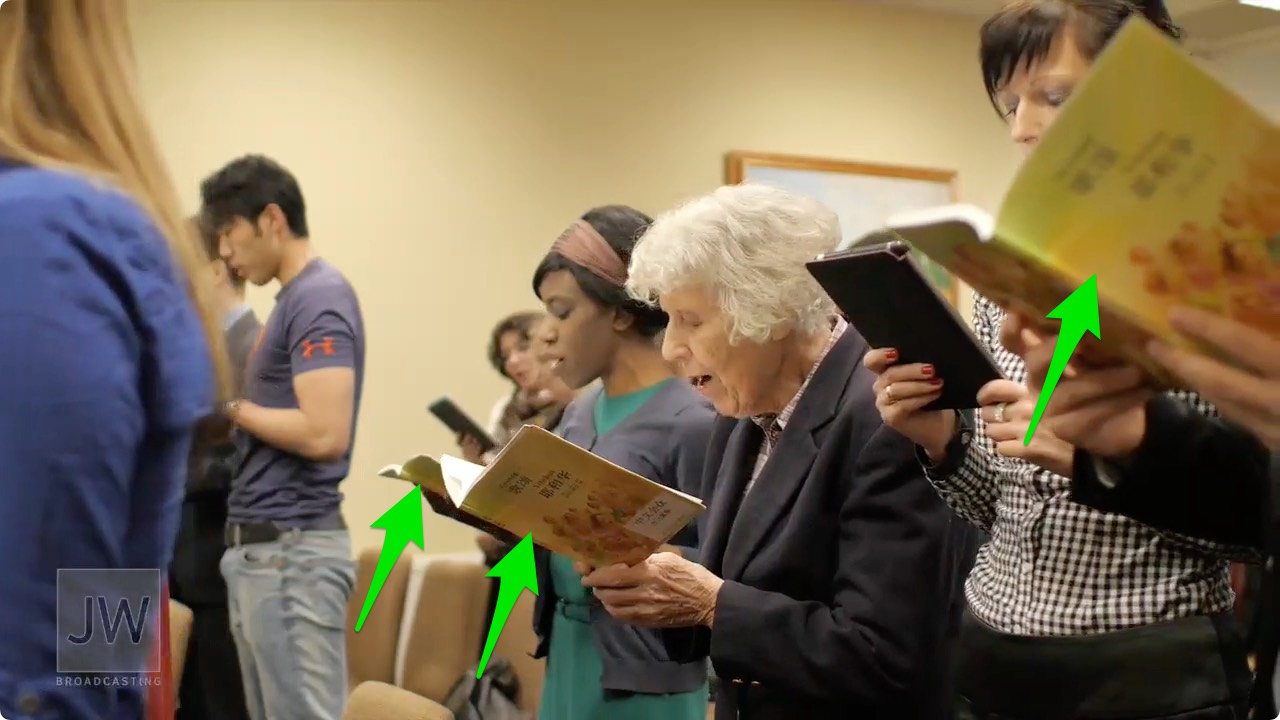
A screenshot from an official video, of Sis. Margarita Königer and others using official Pīnyīn
(Pīn·yīn
{Piecing Together of} · Sounds →[Pinyin]
拼音)Sing to Jehovah songbooks with musical notation
The organization continues to publish official songbook material for different languages in general that contains musical notation, so it evidently still considers musical notation to generally be worthwhile to produce. It continues to produce official material for the current songbook that uses musical notation along with lyrics rendered only in Chinese characters, without Pīnyīn
(Pīn·yīn
{Piecing Together of} · Sounds →[Pinyin]
拼音), and it has even produced official material that uses jiǎnpǔ+
(jiǎn·pǔ
simple · {register or record for reference → [musical notation]} →[numbered musical notation]
简谱
簡譜) (a kind of musical notation also known as numbered musical notation) and Chinese characters.
For Jehovah’s official organization, continuing to produce musical notation with lyrics rendered in Chinese characters but discontinuing production of musical notation that includes Pīnyīn
(Pīn·yīn
{Piecing Together of} · Sounds →[Pinyin]
拼音) lyrics when it becomes necessary to conserve time and effort makes sense, when we consider that the primary focus of Jehovah’s official organization is to provide spiritual instruction, not language instruction, even though language instruction can provide significant practical help to people seeking to learn or teach sprititual truths. (Another reminder of this primary focus is the recent discontinuation of the JW Language app.) The way the world is, with its deeply embedded traditions and prejudices, people whose mother tongue is Mandarin—and who thus learn spiritual truths best in Mandarin—mainly still use Chinese characters as their “mother writing system”, even as the game-changing practical benefits of Pīnyīn
(Pīn·yīn
{Piecing Together of} · Sounds →[Pinyin]
拼音) are obvious to unprejudiced Mandarin language learners.
For those who find it helpful in their Mandarin field activities to put musical notation together with Pīnyīn
(Pīn·yīn
{Piecing Together of} · Sounds →[Pinyin]
拼音), the unofficial Pīnyīn
(Pīn·yīn
{Piecing Together of} · Sounds →[Pinyin]
拼音) Plus / Pīnyīn
(Pīn·yīn
{Piecing Together of} · Sounds →[Pinyin]
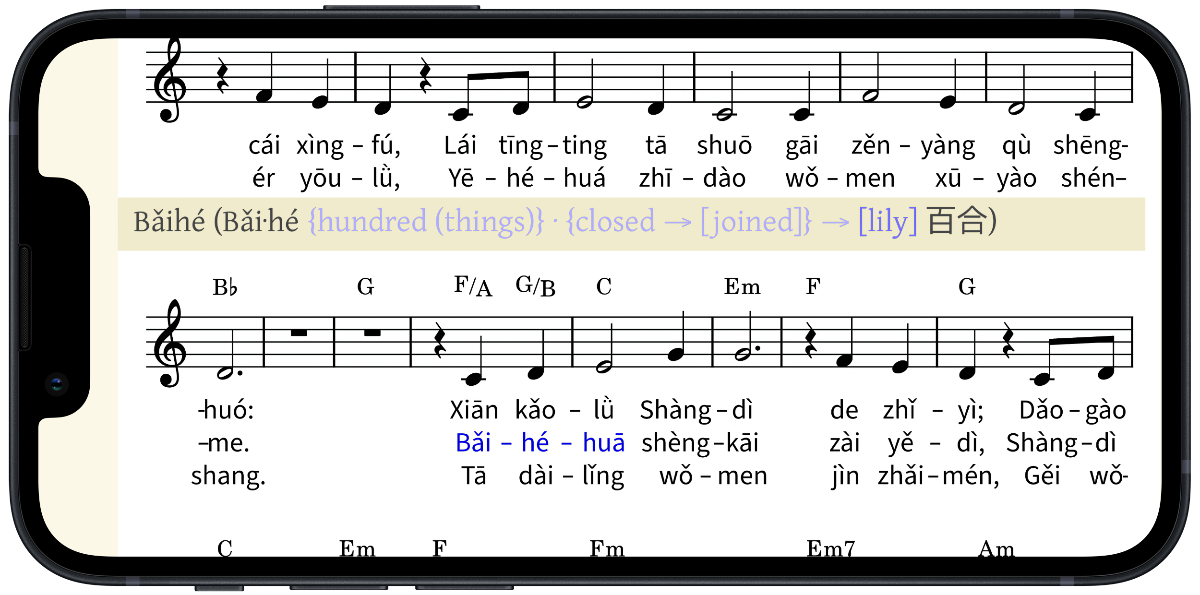
拼音)+ resource “Sing Out Joyfully” Bk. (Pīnyīn+Music, Pīnyīn Plus / Pīnyīn+, Web) exists and is continuing to be improved. As shown in the screenshot near the beginning of this post, this resource aids Mandarin field language learners by breaking with tradition and featuring lyrics in the musical notation that are only in relatively large-print Pīnyīn
(Pīn·yīn
{Piecing Together of} · Sounds →[Pinyin]
拼音) by default—characters are relegated to Pīnyīn
(Pīn·yīn
{Piecing Together of} · Sounds →[Pinyin]
拼音) Plus / Pīnyīn
(Pīn·yīn
{Piecing Together of} · Sounds →[Pinyin]
拼音)+ “flashcards” that are added as time allows.
Unlike the traditionally-used but unnecessarily extraordinarily complex characters that need to be accompanied by Pīnyīn
(Pīn·yīn
{Piecing Together of} · Sounds →[Pinyin]
拼音) before many are able to read them, Pīnyīn
(Pīn·yīn
{Piecing Together of} · Sounds →[Pinyin]
拼音) itself is a simple, elegant alphabetical full writing system for Mandarin that is easy to learn and remember. Also, it is no harder to typeset than other alphabetical writing systems with diacritics, such as the writing systems now used for French, Czech, Vietnamese, etc.*
The direct link for the Pīnyīn
(Pīn·yīn
{Piecing Together of} · Sounds →[Pinyin]
拼音) Plus / Pīnyīn
(Pīn·yīn
{Piecing Together of} · Sounds →[Pinyin]
拼音)+ resource for the “Sing Out Joyfully” book is:
More Pīnyīn
(Pīn·yīn
{Piecing Together of} · Sounds →[Pinyin]
拼音) and Pīnyīn
(Pīn·yīn
{Piecing Together of} · Sounds →[Pinyin]
拼音)+ web material based on the Mandarin “Sing Out Joyfully” book will be made available in the Pīnyīn
(Pīn·yīn
{Piecing Together of} · Sounds →[Pinyin]
拼音) Plus / Pīnyīn
(Pīn·yīn
{Piecing Together of} · Sounds →[Pinyin]
拼音)+web resource as time allows.
* Thanks to ongoing advancements in personal computing hardware and software, producing material that contains things like musical notation and Pīnyīn
(Pīn·yīn
{Piecing Together of} · Sounds →[Pinyin]
拼音) text at reasonable cost is quicker and easier than ever. At this time, production of the musical notation in the “Sing Out Joyfully” Bk. (Pīnyīn+Music, Pīnyīn Plus / Pīnyīn+, Web) resource begins in free open source software called MuseScore Studio, running on a Mac. Pīnyīn
(Pīn·yīn
{Piecing Together of} · Sounds →[Pinyin]
拼音) text for the lyrics in the musical notation is entered using macOS’s ABC – Extended input source (keyboard layout). (Just using Pīnyīn
(Pīn·yīn
{Piecing Together of} · Sounds →[Pinyin]
拼音) text only here simplifies things so much compared to having to somehow input characters with Pīnyīn
(Pīn·yīn
{Piecing Together of} · Sounds →[Pinyin]
拼音)ruby text!) When it’s ready, the musical notation for a song is exported from MuseScore Studio into SVG format, which is a plain text format that allows for the inclusion of links that activate Pīnyīn
(Pīn·yīn
{Piecing Together of} · Sounds →[Pinyin]
拼音)+ flashcards on webpages. (These SVG links are a bit more involved to produce than “regular” web Pīnyīn
(Pīn·yīn
{Piecing Together of} · Sounds →[Pinyin]
拼音)+ material, but at least the procedure for doing so is consistent and dependable, unlike Chinese characters, which have no consistent, dependable system regarding how they are designed compared to how they are pronounced.) The coding for the SVG links is currently done using the text editor BBEdit, in which editing large text files is quite performant. For Pīnyīn
(Pīn·yīn
{Piecing Together of} · Sounds →[Pinyin]
拼音)+ web material production in general, my current favourite tool is Nova, but such web material can be produced in any application suitable for web development, such as Visual Studio Code, etc. ^