Categories
Culture Experiences History Language Learning

jī‐tóng‐yā‐jiǎng

jī‐tóng‐yā‐jiǎng+ ((jī chicken雞/鷄)‐(tóng {together with}同/仝)‐(yā duck)‐(jiǎng speaking) [people not understanding each other because of speaking different languages (from Cantonese)]) 👈🏼 Tap/click to show/hide the “flashcard”

[I’m still unusually busy with preparing musical notation + Pīnyīn (Pīn·yīn {Piecing Together of} · Sounds → [Pinyin] 拼音) songbook material for this year’s Mandarin conventions, and now, also with rolling out the next generation Pīnyīn (Pīn·yīn {Piecing Together of} · Sounds → [Pinyin] 拼音)+ format. (See this Links News post for more information on that.) So, here’s a repost of a post from a few years back, on a subject of basic importance to Mandarin field language learners.]

[Yes, this expression comes from Cantonese, but the above Mandarin version does appear in Mandarin dictionaries, so it qualifies as a Mandarin expression!]

Recently, while out to dinner with one of the first families to serve in the local Cantonese congregation, along with the circuit overseer serving the local Chinese circuit and his wife, the subject came up of how Mandarin and Cantonese are actually different languages, not just dialects of the same language.

Chickens Talking with Ducks

The wife of the circuit overseer asked what the difference is between a language and a dialect. So, I proceeded to explain something that is emphasized by American sinologist and University of Pennsylvania Professor of East Asian Languages and Civilizations Victor H. Mair, that a primary way accepted by most linguists to distinguish a language from a dialect is mutual intelligibility, as is discussed in this excerpt from the MEotW post on “fāngyán (fāng·yán {direction → [place]} · speech → [topolect; dialect (common but misleading translation)] 方言)”:

It has been said that “a language is a dialect with an army and navy”, but in his article Professor Mair gives us a more linguistically correct and useful way to distinguish between a language and a dialect:

Regardless of the imprecision of lay usage, we should strive for a consistent means of distinguishing between language and dialect. Otherwise we might as well use the two terms interchangeably. That way lies chaos and the collapse of rational discourse. Mutual intelligibility [emphasis added] is normally accepted by most linguists as the only plausible criterion for making the distinction between language and dialect in the vast majority of cases. Put differently, no more suitable, workable device for distinguishing these two levels of speech has yet been proposed. If there are to be exceptions to the useful principle of mutual intelligibility, there should be compelling reasons for them. Above all, exceptions should not be made the rule.

What is mutual intelligibility? Simply put, in linguistics, two or more speech varieties are said to be mutually intelligible if they are “able to be understood by one another’s speakers”. For example, if one person only knows English, and another person only knows Spanish, they can’t really understand each other if they try to talk to each other—English and Spanish are not mutually intelligible, and are suitably recognized as being different languages, not just different dialects of “European”.

Similarly, if one person only knows Mandarin, and another person only knows Cantonese, they can’t really understand each other if they try to talk to each other—Mandarin and Cantonese are not mutually intelligible. So, while they may be “fāngyán+ (fāng·yán {direction → [place]} · {(patterns of) speech} 方言)”, linguistically, Mandarin and Cantonese should really be considered to be different languages, not just different dialects of “Chinese”.

Indeed, I have heard people use this week’s MEotW, “jī‐tóng‐yā‐jiǎng+ ((jī chicken雞/鷄)‐(tóng {together with}同/仝)‐(yā duck)‐(jiǎng speaking) [people not understanding each other because of speaking different languages (from Cantonese)])”, to specifically describe Mandarin-speakers and Cantonese-speakers trying to talk to each other, and not understanding each other. 🐓 🦆

After I explained the gist of the above, one of the daughters of the family at the dinner—who had been labouring for decades under the misconception that Mandarin and Cantonese are just dialects and that someone who knows one can easily learn the other—said, “Now I don’t feel like an idiot.”

Uncommon Knowledge?

It could be said that ones such as this family and this circuit overseer and his wife, who have all worked so hard and served for so long in the Chinese language fields, should already have known such a basic thing about the Chinese languages. However, the following things are unfortunately true:

  • Even publishers who are learning a language to serve in that language’s field generally consider such linguistic (language science) knowledge to be specialized technical knowledge that is beyond what they need to learn, and possibly beyond what they could even comprehend.
  • Western-educated publishers learning a Chinese language may unwittingly go along with the Western worldly tendency to exoticize things related to China. (John DeFrancis, in his book The Chinese Language: Fact and Fantasy (p. 37), calls this “Exotic East Syndrome”.) They may be content with—or even enjoy—the alluring veil of mystery and mystique surrounding certain things related to China and Chinese culture. Thus, they don’t seek to learn about and understand deeper truths about such things, that may pierce through this obscuring veil, and burst this bubble.—Compare 2 Corinthians 3:14, including the margin note.
  • The central ruling authorities of China have long actively promoted the scientifically incorrect idea that the different varieties of speech in China are just dialects of the one Chinese language. This idea is political propaganda supporting the idea that it’s good for there to be central ruling authorities in China.
  • Traditional worldly Chinese language instructors and others who are knowledgeable about Chinese languages and Chinese characters are eager to promote and perpetuate the traditional thinking about Chinese languages and characters, that they have invested so much time and effort in, and that they are so proud of.
  • Chinese-educated publishers who are already steeped in the traditional ideas about Chinese languages, Chinese characters, etc., and who are thus lauded and deferred to as experts by other publishers, may be eager to simply unquestioningly pass on the cultural knowledge and ideas that they were taught, and that they are lauded and respected for.
  • With so much misinformation “in the air”, including from trusted authority figures, “everyone knows” that there is one Chinese language, with dialects that include Mandarin, Cantonese, etc. Since “everyone knows” this, it’s easy to just go along with it, especially in an Eastern culture like the Chinese culture that emphasizes conforming to the group. As Eastern cultures, Japanese, Korean, etc. cultures are similar in this respect, so publishers from those cultural backgrounds may also generally tend to just go along with what “everyone knows” about there being just one Chinese language that has various dialects.—Ephesians 2:2.
  • The Bible makes it clear that Satan the Devil is “a liar and the father of the lie”. It also describes him as “the great dragon…who is misleading the entire inhabited earth”. So, while we can only speculate about the details of what strings are purposely pulled in the spirit realm by Satan and his demons as opposed to what human folly they simply passively observe, we can be sure that Satan is delighted with all the ways in which people are misled in and about the Chinese culture, in which the dragon is considered a positive, revered symbol.—John 8:44; Revelation 12:9.

So, for reasons such as the above, even the basic linguistic truth that Mandarin, Cantonese, Shanghainese, etc. actually function as different languages is unfortunately not yet common knowledge among those serving in the Chinese fields. As the saying goes, which some say is a Chinese proverb, “error will travel over half the globe, while truth is pulling on her boots”.

Jesus said, though, that true worshippers worship “with spirit and truth”, and that “the truth will set you free”. With regard to Chinese languages, Chinese characters, etc., the truth about them can even set one free from unnecessarily feeling like an “idiot”, as the sister mentioned above so eloquently put it, because of labouring under all the political propaganda, traditions, and other kinds of misinformation and wrong thinking that unfortunately surround Chinese languages, Chinese characters, etc.—John 4:23; 8:32.

Huge Worldwide Effects

In addition to being hugely freeing for individual language learners, spreading the truth about the Chinese languages, Chinese characters, etc. is also important on a larger scale, since the worldwide Mandarin field, for one, is the largest language field in the world, and probably the largest language field that has ever existed in human history. For comparison, according to Ethnologue, a resource on world languages, the worldwide Mandarin field (those worldwide whose mother tongue is Mandarin) is about twice the size of the second largest worldwide language field, the Spanish field, and it’s about two and a half times the size of the third largest worldwide language field, the English field. Allowing various untruths to continue to divert and bog down the language-learning efforts of those who come to help in the worldwide Mandarin field can have incalculable overall negative effects on the preaching work in this enormous field.
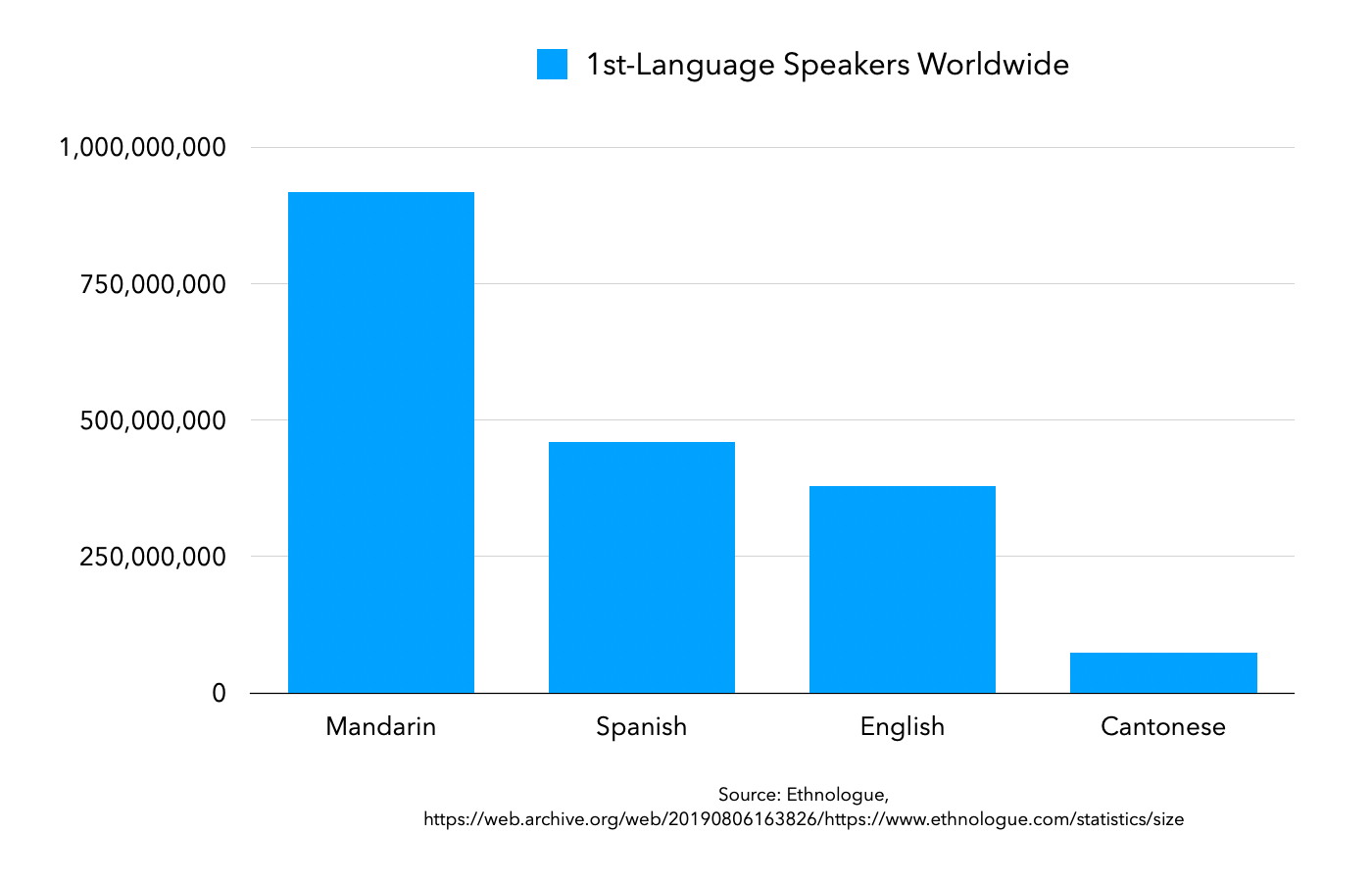
Chart: Languages by First-Language Speakers—2019

So, even as we hang on to Bible truth, let us also hang on to the linguistic truths that we learn, and let us do what we can to share them with our fellow workers in the vast worldwide Chinese fields.

Categories
Culture Language Learning Science Technology Theocratic

yǔzhòu

yǔzhòu+ (yǔ·zhòu universe · {all time, past, present, and future} → [[the] universe; cosmos; space | cosmic] 宇宙) 👈🏼 Tap/click to show/hide the “flashcard”

[Notes: Tap/click on a Pīnyīn (Pīn·yīn {Piecing Together of} · Sounds → [Pinyin] 拼音) expression to reveal its “flashcard”; tap/click on a “flashcard” or its Pīnyīn (Pīn·yīn {Piecing Together of} · Sounds → [Pinyin] 拼音) expression to hide the “flashcard”. 📖 📄 ➕ icons mean 📖 Reveal All, 📄 Reveal Advanced, and ➕ Reveal + Symbols re all the “flashcards” in the heading, paragraph, etc. that they are placed at the beginning of.]

At the time of this writing, jw.org was featuring an article from the No. 3 2021 issue of Awake! magazine, about what the universe tells us about a Creator. The title of this article, in English and in Mandarin, is as follows:

English:

What the Universe Tells Us

Mandarin:

📖 📄 Yǔzhòu+ (Yǔ·zhòu Universe · {All Time, Past, Present, and Future} → [The Universe] 宇宙) Gàosu (Tells 告诉 告訴) Wǒmen (Wǒ·men Us · [pl] 我们 我們) Shénme (Shén·me What · [suf] 什么 什/甚麼)?

As can be seen from the above example, “yǔzhòu+ (yǔ·zhòu universe · {all time, past, present, and future} → [[the] universe; cosmos; space | cosmic] 宇宙)”, this week’s MEotW, is the Mandarin expression meaning “the universe”. And, as can be seen from this expression’s Pīnyīn (Pīn·yīn {Piecing Together of} · Sounds → [Pinyin] 拼音) Plus “flashcard”, its constituent morphemes mean “[the] universe; all time, past, present, and future”.

Wiktionary’s entry for “yǔzhòu (yǔ·zhòu universe · {all time, past, present, and future} → [[the] universe; cosmos; space | cosmic] 宇宙) contains the following comment about the etymology of this expression:

Meyer (2010) proposes that “eaves and roof beams” was a synecdoche for a domicile’s entire space; this figure of speech would later be appropriated by early authors and later Huainanziʼs contributors as “a metaphor for the cosmos, taking “eaves” [] and “roof beams” [] to represent the dimensions of space and time[, respectively] that compose the entire phenomenal universe.”[1]

Spacetime

Interestingly, these meanings of the morphemes in “yǔzhòu (yǔ·zhòu universe · {all time, past, present, and future} → [[the] universe; cosmos; space | cosmic] 宇宙) match up with the morphemes in the English word “spacetime”. The Wikipedia article for this is introduced with the following:

In physics, spacetime, also called the space-time continuum, is a mathematical model that fuses the three dimensions of space and the one dimension of time into a single four-dimensional continuum. Spacetime diagrams are useful in visualizing and understanding relativistic effects, such as how different observers perceive where and when events occur.

Until the turn of the 20th century, the assumption had been that the three-dimensional geometry of the universe (its description in terms of locations, shapes, distances, and directions) was distinct from time (the measurement of when events occur within the universe). However, space and time took on new meanings with the Lorentz transformation and special theory of relativity.

In 1908, Hermann Minkowski presented a geometric interpretation of special relativity that fused time and the three spatial dimensions into a single four-dimensional continuum now known as Minkowski space. This interpretation proved vital to the general theory of relativity, wherein spacetime is curved by mass and energy.

“Because They Were Designed?”

“Yǔzhòu (Yǔ·zhòu universe · {all time, past, present, and future} → [[the] universe; cosmos; space | cosmic] 宇宙) also appears in the concluding paragraph of the above-mentioned article from the No. 3 2021 issue of Awake!:

English:

Based on his scientific knowledge of the universe and its properties, physicist Paul Davies concluded: “I cannot believe that our existence in this universe is a mere quirk of fate, an accident of history, an incidental blip in the great cosmic drama. . . . We are truly meant to be here.” Davies does not teach that God created the universe and human life, but what do you think? The universe and the earth seem to be designed to make life possible. Could it be that they seem that way because they were designed?

Mandarin:

📖 📄 Wùlǐ‐xué‐jiā+ ((Wù·lǐ things’ · {logic → [laws]} → [physics] 物理)‐(xué studying)‐(jiā -ist 家) [physicist]) Bǎoluó (Paul 保罗 保羅) Dàiwéisī (Davies 戴维斯 戴維斯) gēnjù (gēn·jù {(at) root} · {according to} → [based on] 根据 根據) zìjǐ (self 自己) duì (towards) yǔzhòu+ (yǔ·zhòu universe · {all time, past, present, and future} → [the universe] 宇宙) (and 及) tiānwén+ (tiān·wén heavens’ · {natural phenomena} → [astronomical] 天文) fǎzé (fǎ·zé laws · principles 法则 法則) de ( 的) liǎojiě (liǎo·jiě understanding · {untying → [solving]} → [understanding] 了解 了/瞭解) zhèyàng (zhè·yàng this · {form → [way]} 这样 這樣) shuō (said說/説): “ (I 我) wúfǎ (wú·fǎ {do not have} · {way to} → [cannot] 无法 無法) xiāngxìn (xiāng·xìn {each other → [it]} · believe → [believe] 相信), rénlèi (rén·lèi human·kind 人类 人類) zài (in 在) zhèige (zhèi·ge this · [mw] 这个 這個) yǔzhòu (yǔ·zhòu universe · {all time, past, present, and future} → [universe] 宇宙) de (’s 的) cúnzài (cún·zài existing · {being present} 存在), zhǐshì (zhǐ·shì merely · is 只是) qiǎohé+ (qiǎo·hé {being coincidental → [coincidentally]} · {closing → [fitting]} → [coincidental] 巧合) huò (or 或) xìjù‐xìng ((xìjù (having) drama 戏剧 戲劇)‐(xìng nature → [quality] 性) [dramatic]) de (’s 的) tūfā+ (tū·fā {chimney → [dashing forward → [unexpectedly]]} · issued → [appeared unexpectedly] 突) shìjiàn (shì·jiàn incident · [mw] 事件)wǒmen de ((wǒ·men us · [pl] 我们 我們) (de ’s 的) [our]) cúnzài (cún·zài existing · {being present} 存在) kěndìng (kěn·dìng agreeing · certainly → [definitely] 肯定) shì (is 是) yǒu (having 有) yuányīn (yuán·yīn origin · reason 原因) de ({’s (thing)} 的).” Dàiwéisī (Davies 戴维斯 戴維斯) bìng (actually並/竝/并) méiyǒu (méi·yǒu not · {has → [does]} → [does not] 没有 沒有) zhǔzhāng+ (zhǔ·zhāng advocate · spread (that) → [hold (that)] 主张 主張) yǔzhòu (yǔ·zhòu universe · {all time, past, present, and future} → [the universe] 宇宙) ({(together) with} → [and]和/龢) rénlèi (rén·lèi human·kind 人类 人類) shì (are 是) Shàngdì (Shàng·dì Above’s · {Emperor → [God]} → [God] 上帝) chuàngzào (chuàng·zào initiated · {made, created} → [created] 创造 創造) de ({’s (things)} 的). Dàn (but 但) (you 你) juéde (jué·de {to wake to → [to feel]} · {(how do) get} → [how do feel] 觉得 覺得) ne ([? ptcl] 呢)? Jìrán (Jì·rán since · -ly 既然) yǔzhòu (yǔ·zhòu universe · {all time, past, present, and future} → [the universe] 宇宙) ({(together) with} → [and]和/龢) dìqiú (dì·qiú earth · globe → [the earth] 地球) zhème (zhè·me {this (much)} · [suf for interrogatives and adverbs] 这么/末 這麼/末) shìhé (shì·hé {are suitable for} · {are closing with → [are fitting with]} 适合 適合) shēngmìng (life 生命) cúnzài (cún·zài existing · {being present} 存在), nàme (nà·me {(in) that (case) → [then]} · [suf] 那么/末 那麼/末) tāmen (tā·men it · [pl] [they] 它们 它/牠們) shì (are 是) bèi ([passive signifier] [were] 被) shèjì+ (shè·jì {set up} · planned → [designed] 设计 設計) chulai (chu·lai out · {to come} 出来 出來) de ({’s (things)} 的) ma ([? ptcl for “yes/no” questions])?

A Particular Need in the Mandarin Field

It’s worth noting that the No. 3 2021 issue of Awake! was recently in the Teaching Toolbox in the JW Library app. In fact, for a time, 3 out of the 6 books or brochures in the Teaching Toolbox—fully one half of them—were focused on the subject of creation/evolution. Additionally, the Enjoy Life Forever! book, which is still in the Teaching Toolbox, has an entire lesson on the subject “How Did Life Begin?”. This big presence in the Teaching Toolbox for a time of material focused on creation/evolution reflects a recent heavy emphasis on this issue on the part of the organization.

Indeed, for people in general to find real spiritual truth and make real spiritual progress, the question of the Creator’s existence is the first basic question that needs to be answered well in their minds, otherwise they are left with just the conflicting opinions, speculations, and platitudes of mere limited, imperfect humans. As Proverbs 9:10 says:

The fear of Jehovah is the beginning of wisdom,
And knowledge of the Most Holy One is understanding.

In the Mandarin field in particular, it is especially necessary to focus on the issue of the Creator’s existence, because current worldly Chinese culture has particularly heavily predisposed many Mandarin-speakers to not believe in a Creator.

At the same time, the worldwide Mandarin field is by far the largest language field in the world, and it’s likely that it is the largest language field ever in history.

Chart: Languages by First-Language Speakers—2019

So, the need is especially great for Mandarin field language learners to be able to help Mandarin-speakers overcome their cultural backgrounds and cultivate faith in the Creator!

Creation/Evolution, and Also the Great Wall of Characters

However, I suspect that even in their mother tongue, many Mandarin field language learners would be hesitant to discuss creation/evolution, since it is an especially deeply technical subject. Adding the requirement to conduct the discussion in Mandarin, which has traditionally been written using the extraordinarily complex Chinese characters, to many just makes an already daunting task seem even more undoable.

The Great Wall of China

In addition to the inherent technical difficulty of the subject of creation/evolution, Mandarin field language learners also face the Great Wall of characters.

To help with this formidable challenge, the organization’s official Mandarin digital material for the No. 3 2021 issue of Awake!, and for the Was Life Created? and Origin of Life brochures, is available with Pīnyīn (Pīn·yīn {Piecing Together of} · Sounds → [Pinyin] 拼音). Additionally, unofficial Pīnyīn (Pīn·yīn {Piecing Together of} · Sounds → [Pinyin] 拼音) Plus material—specifically designed, not to be spiritual food, but for helping Mandarin field language learners to get past the Great Wall of characters and actually learn to understand and speak the Mandarin they need—is available for the Was Life Created? and Origin of Life brochures, and should eventually be available for the No. 3 2021 issue of Awake! too. For updates on these Pīnyīn (Pīn·yīn {Piecing Together of} · Sounds → [Pinyin] 拼音) Plus resources, keep an eye on this blog, on the Links News blog, and on the related account on the social network of your choice listed on this blog’s Contact page.

Categories
Culture Language Learning Science Technology Theocratic

qià‐dào‐hǎochu

qià‐dào‐hǎochu+ ((qià just; exactly 恰)‐(dào {[is] having arrived at} 到)‐(hǎo·chu good · places; points [→ [benefits; advantages | gain; profit]] 好处 好處) [[is] perfect; just right]) 👈🏼 Tap/click to show/hide the “flashcard”

[Notes: Tap/click on a Pīnyīn (Pīn·yīn {Piecing Together of} · Sounds → [Pinyin] 拼音) expression to reveal its “flashcard”; tap/click on a “flashcard” or its Pīnyīn (Pīn·yīn {Piecing Together of} · Sounds → [Pinyin] 拼音) expression to hide the “flashcard”. 📖 📄 ➕ icons mean 📖 Reveal All, 📄 Reveal Advanced, and ➕ Reveal + Symbols re all the “flashcards” in the heading, paragraph, etc. that they are placed at the beginning of.]

At the time of this writing, the Teaching Toolbox in the JW Library app had recently included the No. 3 2021 issue of Awake! magazine. While it is not currently in the Teaching Toolbox, this question considered in this issue, “Should You Believe in a Creator?”, remains an important one for Mandarin field language learners to pay special attention to. Many of the Mandarin-speaking people in the field especially need help with this matter, because their cultural background tends to cause them to not believe in a Creator. At the same time, though, whether the Creator exists remains the first major question that needs to be settled before they can make real further spiritual progress. Another important factor is that the worldwide Mandarin field continues to be huge, probably the language field with more people in it than any other language field in history.

For us Mandarin field language learners, though, using Mandarin to discuss the question of the Creator’s existence is especially challenging and requires special effort from us, because of the particularly deeply technical concepts and vocabulary involved. And, this is in addition to the usual unusual challenges presented by Chinese characters, the general misinformation and disinformation present in the world about the Chinese languages, etc.

Finely Tuned to Be Just Right

This week’s MEotW, “qià‐dào‐hǎochu ((qià just; exactly 恰)‐(dào {[is] having arrived at} 到)‐(hǎo·chu good · places; points [→ [benefits; advantages | gain; profit]] 好处 好處) [[is] perfect; just right])”, occurs in the No. 3 2021 issue of Awake! magazine in the fifth and sixth paragraphs of the article “What the Universe Tells Us”:

English:

The universe is fine-tuned to support life. Consider what scientists call the weak force. It keeps our sun burning at a steady rate. If the force were weaker, the sun would never have formed. If it were stronger, the sun would have disappeared long ago.

The weak force is just one of several finely tuned features that we depend on. …

Mandarin:

📖 📄 Yǔzhòu (Yǔ·zhòu universe · {all time, past, present, and future} → [universe] 宇宙) zhōng (within 中) de (’s 的) gèzhǒng (gè·zhǒng each · {type of} 各种 各種) (force 力) dōu ({each one of them} 都) qià‐dào‐hǎochu+ ((qià exactly 恰)‐(dào {is having arrived at} 到)‐(hǎo·chu good · place 好处 好處) [is just right]), suǒyǐ (suǒ·yǐ {that which} · {is the reason} → [thus] 所以) shēngmìng (life 生命) cái ({only then}才/纔) néng ({is able} 能) cúnzài (cún·zài {to exist} · {to be present} 存在). Lái (come) kànkan (kàn·kan {look at} · {look at} 看看) kēxué‐jiā ((kē·xué {branches of study} · learning → [science] 科学 科學)‐(jiā -ists 家) [scientists]) suǒ ({that which (they)} 所) shuō ({speak of}說/説) de (’s 的) ruò+ (weak 弱)hélì+ (hé·lì {pit (of a fruit) → [nuclear]} · force 核力), zhèi (this) zhǒng ({type of}種/种) (force 力) ràng (allows) tàiyáng (tài·yáng highest · {positive/active/male principle in nature (Chinese philosophy)} → [sun] 太阳 太陽) (at 以) wěndìng (wěn·dìng steady · set 稳定 穩定) de (’s 的) sùdù (sù·dù {being fast → [speed]} · degree → [rate] 速度) ránshāo (rán·shāo {to be ignited} · {to burn} 燃烧 燃燒). Rúguǒ (Rú·guǒ if · {fruit → [if indeed]} 如果) zhèi (this) zhǒng ({type of}種/种) (force 力) ruò ({was weak} 弱) yìdiǎnr (yì·diǎnr a · bit (more) 一点 一點), tàiyáng (tài·yáng highest · {positive/active/male principle in nature (Chinese philosophy)} → [sun] 太阳 太陽) jiù (then 就) wúfǎ (wú·fǎ {would not have had} · way → [would have been unable] 无法 無法) xíngchéng+ (xíng·chéng {form (n)} · {to come to be} → [to form] 形成); rúguǒ (rú·guǒ if · {fruit → [if indeed]} 如果) zhèi (this) zhǒng ({type of}種/种) (force 力) qiáng ({was strong}強/彊) yìdiǎnr (yì·diǎnr a · bit (more) 一点 一點), tàiyáng (tài·yáng highest · {positive/active/male principle in nature (Chinese philosophy)} → [sun] 太阳 太陽) jiù (then 就) huì (would) ránshāo (rán·shāo ignite · burn 燃烧 燃燒) de (getting 得) tài ({too much} 太) kuài ({to be quick} 快), zǎo ({early on} 早) jiù (then 就) xiāoshī+ (xiāo·shī {would have disappeared} · {would have been lost} 消失) le ([(at the end of a phrase/sentence) indicates a change] 了).

📖 📄 Ruò (weak 弱)hélì (hé·lì {pit (of a fruit) → [nuclear]} · force 核力) qià‐dào‐hǎochu ((qià exactly 恰)‐(dào {is having arrived at} 到)‐(hǎo·chu good · place 好处 好處) [is just right]), dàn (but 但) (it 它) zhǐshì (zhǐ·shì only · is 只是) wéichí (wéi·chí maintaining · {holding → [sustaining]} → [sustaining] 维持 維持) shēngmìng (life 生命) de (’s 的) qízhōng (qí·zhōng them · among 其中) (one 一) ge ([mw]個/个) yīnsù+ (yīn·sù cause · {raw silk → [basic element]} → [factor] 因素). …

In the above examples, “qià‐dào‐hǎochu+ ((qià just; exactly 恰)‐(dào {[is] having arrived at} 到)‐(hǎo·chu good · places; points [→ [benefits; advantages | gain; profit]] 好处 好處) [[is] perfect; just right]) is used to correspond with the English expressions “fine-tuned” and “finely tuned”. While much cruder than the exquisite systems found in the natural world, many systems produced by human technology can help us to understand the need for certain factors to be finely tuned before an even moderately complex system can function properly. For example, a phone number that’s off by just one number is a wrong number, and older readers will remember radios that needed to be tuned to a certain frequency before the desired radio station could be heard clearly. Speaking of readers, anyone reading this post first had to follow a link (or manually type in a URL) that had to be coded just right—if the web address requested was not within a narrow margin of error, this post would not have loaded!

Let us, then, remember this week’s MEotW, “qià‐dào‐hǎochu ((qià just; exactly 恰)‐(dào {[is] having arrived at} 到)‐(hǎo·chu good · places; points [→ [benefits; advantages | gain; profit]] 好处 好處) [[is] perfect; just right])”, so that we can be helped to be able to talk to Mandarin-speaking people about how the universe, the sun, the earth, our own bodies, etc. are tuned to be just right, so that we can live, ponder how we got here, and get to know our Creator.


A Pīnyīn (Pīn·yīn {Piecing Together of} · Sounds → [Pinyin] 拼音) Plus resource for the No. 3 2021 issue of Awake! magazine, which discusses the question “Should You Believe in a Creator?”, is in the works. For updates on the Pīnyīn (Pīn·yīn {Piecing Together of} · Sounds → [Pinyin] 拼音) Plus resources that are available, keep an eye on this blog, on the Links News blog, and on the related account on the social network of your choice listed on this blog’s Contact page.