Categories
Culture Experiences History Language Learning Technology Theocratic

jiāng‐xīn‐bǐ‐xīn

jiāng‐xīn‐bǐ‐xīn ((jiāng take)‐(xīn heart 心)‐(bǐ {to compare} 比)‐(xīn heart[s] 心) [be empathetic; put oneself in sb. else’s shoes; feel for another/others]) 👈🏼 Tap/click to show/hide the “flashcard”

[Notes: Tap/click on a Pīnyīn (Pīn·yīn {Piecing Together of} · Sounds → [Pinyin] 拼音) expression to reveal its “flashcard”; tap/click on a “flashcard” or its Pīnyīn (Pīn·yīn {Piecing Together of} · Sounds → [Pinyin] 拼音) expression to hide the “flashcard”. 📖 📄 📘 icons mean 📖 Reveal All, 📄 Reveal Advanced, and 📘 Reveal None re all the “flashcards” in the heading, paragraph, etc. that they are placed at the beginning of.]

Rather than dismissively thinking to ourselves that the songs produced by the organization are “just songs”, we should remember that the slave class takes seriously its responsibility to provide spiritual food to God’s people, and so it is going to make sure that the lyrics in its songs are spiritually correct, while also being emotionally moving.—Ezekiel 33:32; Matthew 24:45.

Comparing Hearts

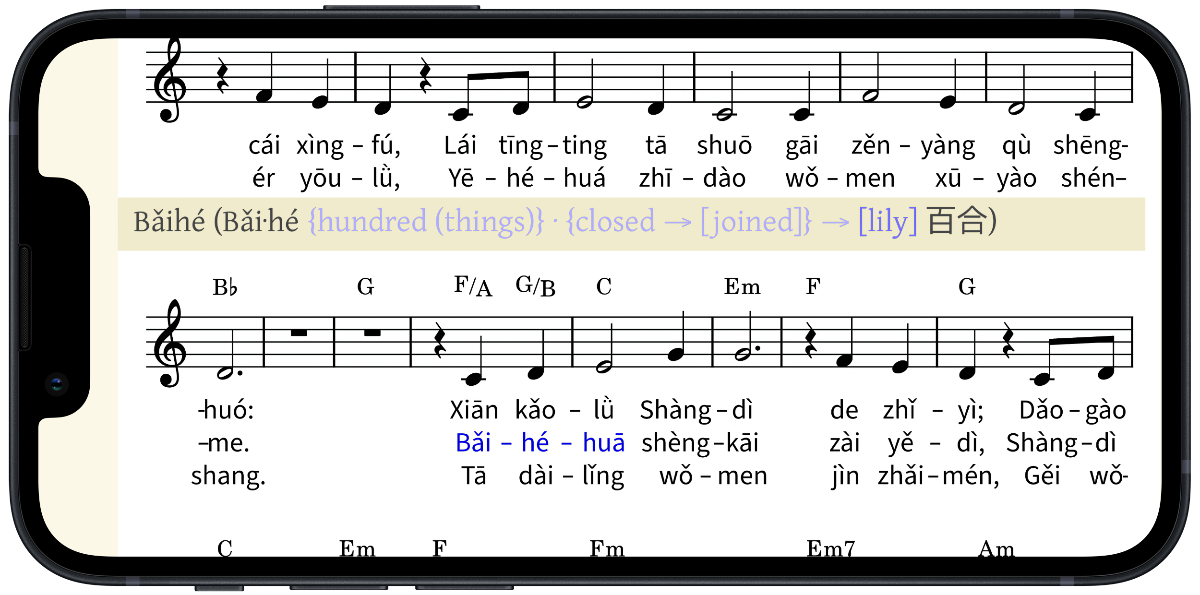
“jiāng‐xīn‐bǐ‐xǐn” _Pīnyīn_ Plus info, Song 163 (music+_Pīnyīn_), on iPhone 13 mini (landscape orientation)

This week’s MEotW in the unofficial Pīnyīn (Pīn·yīn {Piecing Together of} · Sounds → [Pinyin] 拼音) Plus resource “Sing Out Joyfully” Bk. (Pīnyīn+Music, Pīnyīn Plus, Web)

This week’s MEotW, “jiāng‐xīn‐bǐ‐xīn ((jiāng take)‐(xīn heart 心)‐(bǐ {to compare} 比)‐(xīn heart[s] 心) [be empathetic; put oneself in sb. else’s shoes; feel for another/others])”, comes from the first verse of song 163, this year’s convention song, which is entitled “Happy Are These Eyes” in English and “Wǒ de ((Wǒ Me 我) (de ’s 的) [My]) Yǎnjing (Yǎn·jing Eyes’ · Eyeballs → [Eyes] 眼睛) Duōme (Duō·me {(How) Much} · [suf] [How] 多么 多麼) Yǒufú (Yǒu·fú Have · Blessings → [Are Happy] 有福) in Mandarin:

English:

With a humble heart, he would pray.
He was kind to all and ready to forgive.

Mandarin (WOL, Pīnyīn (Pīn·yīn {Piecing Together of} · Sounds → [Pinyin] 拼音) Plus):

📖 📄 📘 Dǎogào (Dǎo·gào (when) praying · {requesting | telling} → [(when) praying] 祷告 禱告) yào ((we) must 要) qiānbēi (qiān·bēi {be modest} · {be low} → [be humble] 谦卑 謙卑) yào ((we) must 要) zhēnxīn (zhēn·xīn {be (of) true} · hearts → [be sincere] 真心);
Lèyì (Lè·yì {be (of) happy} · {meaning → [intention]} → [be willing] 乐意 樂意) yuánliàng (yuán·liàng {to pardon} · {to forgive} 原谅 原諒) rén (people 人), nǔlì (nǔ·lì exert · strength 努力) jiāng‐xīn‐bǐ‐xīn ((jiāng {to take})‐(xīn heart 心)‐(bǐ {to compare} 比)‐(xīn hearts 心) [to be empathetic]).

While not being a direct translation, “jiāng‐xīn‐bǐ‐xīn ((jiāng {to take})‐(xīn heart 心)‐(bǐ {to compare} 比)‐(xīn hearts 心) [to be empathetic]) seems to correspond with “was kind to all” in the above example. A more literal translation of “jiāng‐xīn‐bǐ‐xīn ((jiāng {to take})‐(xīn heart 心)‐(bǐ {to compare} 比)‐(xīn hearts 心) [to be empathetic]) as used above would be “to take heart to compare hearts”. Effectively, this is a rather poetic way to say “to be empathetic”.

Other Mandarin expressions related to empathy include:

  • tǐxù (tǐ·xù {bodily → [personally]} · pity; {sympathize [with]} [→ [empathize with]] 体恤 體恤)
  • tǐxù zhī xīn ((tǐ·xù {bodily → [personally]} · pitying; sympathizing [→ [empathizing]] 体恤 體恤) (zhī ’s 之) (xīn heart 心) [empathy])
  • tóngqíng (tóng·qíng {(have the) same} · feeling (as) → [sympathize with; show/have sympathy/empathy for] 同情)
  • tóngqíng‐xīn ((tóng·qíng {(having the) same} · feeling 同情)‐(xīn heart 心) [sympathy; fellow feeling; compassion; empathy])
  • liánxù (lián·xù sympathizing · pitying [→ [[having] compassion]] 怜恤 憐恤)

Empathy and Mandarin Field Language Learning

The importance of empathy with regard to Mandarin field language learning is emphasized in the below excerpt from the article “Pīnyīn (Pīn·yīn {Piecing Together of} · Sounds → [Pinyin] 拼音) Was Plan A”:

Yes, Pīnyīn was Plan A, but China unfortunately let the proud, self-serving B players have their way.

Is that the way we as Jehovah’s people should be? Shouldn’t godly, self-sacrificing love move us to do what’s best for others rather than fulfilling the imperfect human instinct for being self-glorifying, self-justifying, and self-serving? Are we showing pride in the name of love?

In this, I agree with Zhōu Ēnlái (周恩来/周恩來, Zhou Enlai), the first Premier of the People’s Republic of China, who agreed with Lǐ Zhúchén (李烛尘/李燭塵, Li Zhuchen), who said,

Every time the question of the reform of Chinese characters is brought up, somebody raises an objection, or even stubbornly opposes it for this or that reason. Some say that the characters are not difficult. I will say that such a person is like one who, as soon as his wounds are healed, forgets the pain he suffered. …If he will but recall his bitter experience in learning characters, and consider the interests of the children and the illiterates by placing himself in their place, he will not dissent or object so strongly. [This was actually said regarding opposition to the simplification of the characters, but the principle applies to opposition to Pīnyīn as well.—W. W.]

More recently, one commenter pointed out:

It takes a very grown-up person to say “I did this the hard way, but child, I want you to do it the easy way, for the greater good.”

Also, during the 2014 Stanford Commencement address, Bill Gates said:

If we have optimism, but we don’t have empathy, then it doesn’t matter how much we master the secrets of science, we’re not really solving problems—we’re just working on puzzles.

Mr. Gates’ above observation applies to the subject at hand in that while many enjoy trying to solve the puzzles presented by Chinese characters, and while many also enjoy being known for being good at solving these puzzles, empathy should move us to recognize that there are much bigger issues involved than just our personal enjoyment or glorification.

Yes, when even some worldly people can recognize the above points, we Christians should recognize even more the need to show love and empathy rather than being proud, self-glorifying, self-justifying, and self-serving. Also, we should be actively and determinedly following the course of true Christian love and empathy rather than just going along with others who are proud, self-glorifying, self-justifying, and self-serving. We should especially do so when we have scriptures such as this to guide us:

Knowledge puffs up, but love builds up.—1 Corinthians 8:1.

Musical Notation 🎼 and the Mandarin Field

In this post about a Mandarin expression found in our songbook, another subject that I want to touch on is: Is musical notation 🎼 too hard to be worth the trouble of producing it and using it? Are fewer and fewer people able to read it? I was fortunate enough to have been taught how to read musical notation in school. I have never thought of musical notation as being particularly difficult to use (it’s much easier to learn than characters, which many unquestioningly try to learn), and I find that it helps me to sing Kingdom songs more correctly (according to the intended melody, message, etc.) and more confidently more of the time. However, I am aware that not everyone in the Mandarin field has the same experience with musical notation. For example, a while ago, an older brother told me that he didn’t know how to read musical notation. Also, some people in the Mandarin field may have been affected by how education systems in this old world have been facing significant challenges relating to providing music education for younger ones.

Regardless of how the world may be failing in many cases to equitably provide good music education, Jehovah’s organization has pointed out that music is important in Jehovah’s worship. For example, not long ago, a Meeting Workbook said:

Music can have a powerful influence on the mind and body. Singing is an important part of our worship of Jehovah.

In accordance with the importance of music in Jehovah’s worship, Mandarin field language learners used to have available to them official material from the organization containing musical notation with Pīnyīn (Pīn·yīn {Piecing Together of} · Sounds → [Pinyin] 拼音) in the lyrics. However, perhaps at least partially because of the technical difficulty and costliness of producing material with musical notation and both Chinese characters and Pīnyīn (Pīn·yīn {Piecing Together of} · Sounds → [Pinyin] 拼音) in the lyrics, as of this writing, there is no official material currently available from the organization that shows Pīnyīn (Pīn·yīn {Piecing Together of} · Sounds → [Pinyin] 拼音) and musical notation on the same page or screen.
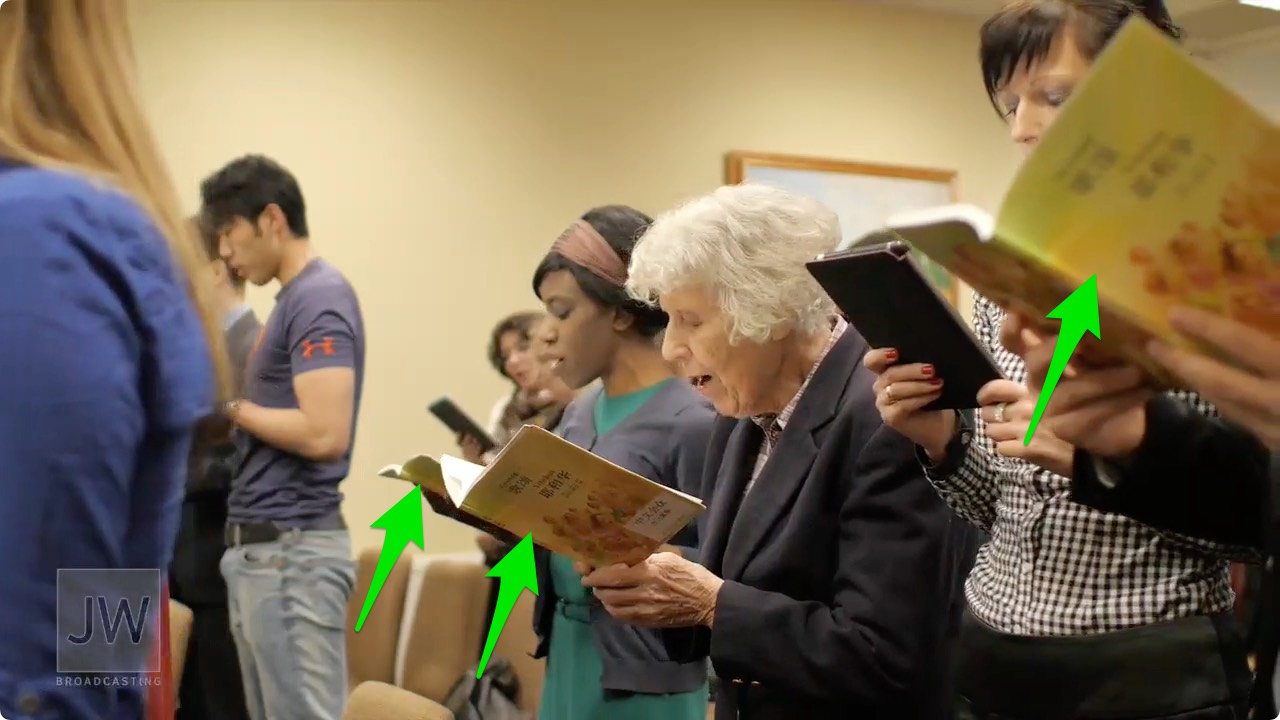
Screenshot of Sis. Margarita Königer and others using official _Pīnyīn_ _Sing to Jehovah_ songbooks with musical notation

A screenshot from an official video, of Sis. Margarita Königer and others using official Pīnyīn (Pīn·yīn {Piecing Together of} · Sounds → [Pinyin] 拼音) Sing to Jehovah songbooks with musical notation

The organization continues to publish official songbook material for different languages in general that contains musical notation, so it evidently still considers musical notation to generally be worthwhile to produce. It continues to produce official material for the current songbook that uses musical notation along with lyrics rendered only in Chinese characters, without Pīnyīn (Pīn·yīn {Piecing Together of} · Sounds → [Pinyin] 拼音), and it has even produced official material that uses jiǎnpǔ (jiǎn·pǔ simple · {register or record for reference → [musical notation]} → [numbered musical notation] 简谱 簡譜) (a kind of musical notation also known as numbered musical notation) and Chinese characters.

For Jehovah’s official organization, continuing to produce musical notation with lyrics rendered in Chinese characters but discontinuing production of musical notation that includes Pīnyīn (Pīn·yīn {Piecing Together of} · Sounds → [Pinyin] 拼音) lyrics when it becomes necessary to conserve time and effort makes sense, when we consider that the primary focus of Jehovah’s official organization is to provide spiritual instruction, not language instruction, even though language instruction can provide significant practical help to people seeking to learn or teach sprititual truths. (Another reminder of this primary focus is the recent discontinuation of the JW Language app.) The way the world is, with its deeply embedded traditions and prejudices, people whose mother tongue is Mandarin—and who thus learn spiritual truths best in Mandarin—mainly still use Chinese characters as their “mother writing system”, even as the game-changing practical benefits of Pīnyīn (Pīn·yīn {Piecing Together of} · Sounds → [Pinyin] 拼音) are obvious to unprejudiced Mandarin language learners.

And, even as the organization has continued to add Pīnyīn (Pīn·yīn {Piecing Together of} · Sounds → [Pinyin] 拼音) ruby text to much of its Mandarin material, in recognition of the value of these practical benefits—even people who have been learning characters since childhood occasionally, perhaps even regularly, suffer from character amnesia, due to the inhuman complexity and number of the characters, and also, there are actually tens of millions of Chinese people who are still illiterate regarding the characters—it seems that when faced with the prospect of producing a version of the current songbook with musical notation, characters, and Pīnyīn (Pīn·yīn {Piecing Together of} · Sounds → [Pinyin] 拼音) ruby text, those in charge, perhaps remembering how difficult and time-consuming it was to do so for the previous songbook, felt that it would just be too much this time.

For those who find it helpful in their Mandarin field activities to put musical notation together with Pīnyīn (Pīn·yīn {Piecing Together of} · Sounds → [Pinyin] 拼音), the unofficial Pīnyīn (Pīn·yīn {Piecing Together of} · Sounds → [Pinyin] 拼音) Plus resource “Sing Out Joyfully” Bk. (Pīnyīn+Music, Pīnyīn Plus, Web) exists and is continuing to be improved. As shown in the screenshot near the beginning of this post, this resource aids Mandarin field language learners by breaking with tradition and featuring lyrics in the musical notation that are only in relatively large-print Pīnyīn (Pīn·yīn {Piecing Together of} · Sounds → [Pinyin] 拼音) by default—characters are relegated to Pīnyīn (Pīn·yīn {Piecing Together of} · Sounds → [Pinyin] 拼音) Plus “flashcards” that are added as time allows.

Unlike the traditionally-used but unnecessarily extraordinarily complex characters that need to be accompanied by Pīnyīn (Pīn·yīn {Piecing Together of} · Sounds → [Pinyin] 拼音) before many are able to read them, Pīnyīn (Pīn·yīn {Piecing Together of} · Sounds → [Pinyin] 拼音) itself is a simple, elegant alphabetical full writing system for Mandarin that is easy to learn and remember. Also, it is no harder to typeset than other alphabetical writing systems with diacritics, such as the writing systems now used for French, Czech, Vietnamese, etc.*

In its Tips: section at the bottom of its home page, the “Sing Out Joyfully” Bk. (Pīnyīn+Music, Pīnyīn Plus, Web) resource contains these links that some may find helpful:


For convenience:

The direct link for the Pīnyīn (Pīn·yīn {Piecing Together of} · Sounds → [Pinyin] 拼音) Plus resource for the “Sing Out Joyfully” book is:

The short link for Chinese field language-learning links for the “Sing Out Joyfully” book is:

More Pīnyīn (Pīn·yīn {Piecing Together of} · Sounds → [Pinyin] 拼音) and Pīnyīn (Pīn·yīn {Piecing Together of} · Sounds → [Pinyin] 拼音) Plus web material based on the Mandarin “Sing Out Joyfully” book will be made available in the Pīnyīn (Pīn·yīn {Piecing Together of} · Sounds → [Pinyin] 拼音) Plus web resource as time allows.


* Thanks to ongoing advancements in personal computing hardware and software, producing material that contains things like musical notation and Pīnyīn (Pīn·yīn {Piecing Together of} · Sounds → [Pinyin] 拼音) text at reasonable cost is quicker and easier than ever. At this time, production of the musical notation in the “Sing Out Joyfully” Bk. (Pīnyīn+Music, Pīnyīn Plus, Web) resource begins in free open source software called MuseScore Studio, running on a Mac. Pīnyīn (Pīn·yīn {Piecing Together of} · Sounds → [Pinyin] 拼音) text for the lyrics in the musical notation is entered using macOS’s ABC – Extended input source (keyboard layout). (Just using Pīnyīn (Pīn·yīn {Piecing Together of} · Sounds → [Pinyin] 拼音) text only here simplifies things so much compared to having to somehow input characters with Pīnyīn (Pīn·yīn {Piecing Together of} · Sounds → [Pinyin] 拼音) ruby text!) When it’s ready, the musical notation for a song is exported from MuseScore Studio into SVG format, which is a plain text format that allows for the inclusion of links that activate Pīnyīn (Pīn·yīn {Piecing Together of} · Sounds → [Pinyin] 拼音) Plus flashcards on webpages. (These SVG links are a bit more involved to produce than “regular” web Pīnyīn (Pīn·yīn {Piecing Together of} · Sounds → [Pinyin] 拼音) Plus material, but at least the procedure for doing so is consistent and dependable, unlike Chinese characters, which have no consistent, dependable system regarding how they are designed compared to how they are pronounced.) The coding for the SVG links is currently done using the text editor BBEdit, in which editing large text files is quite performant. For Pīnyīn (Pīn·yīn {Piecing Together of} · Sounds → [Pinyin] 拼音) Plus web material production in general, my current favourite tool is Nova, but such web material can be produced in any application suitable for web development, such as Visual Studio Code, etc. ^
Categories
Culture Language Learning Science Technology Theocratic

búyì

búyì (bú·yì un·righteous[ness] 不义 不義) 👈🏼 Tap/click to show/hide the “flashcard”

[Notes: Tap/click on a Pīnyīn (Pīn·yīn {Piecing Together of} · Sounds → [Pinyin] 拼音) expression to reveal its “flashcard”; tap/click on a “flashcard” or its Pīnyīn (Pīn·yīn {Piecing Together of} · Sounds → [Pinyin] 拼音) expression to hide the “flashcard”. 📖 📄 📘 icons mean 📖 Reveal All, 📄 Reveal Advanced, and 📘 Reveal None re all the “flashcards” in the heading, paragraph, etc. that they are placed at the beginning of.]

I have long especially liked 1 Corinthians 13. It contains counsel on what really does and doesn’t matter in life, an extensive description and definition of the most important kind of love, and a sublime discussion about the need to become complete, mature, as a person. As these apply to life in general, so too do they apply to our lives as Mandarin field language learners.

As Mandarin field language learners, it can benefit us greatly to consider what we can learn from 1 Corinthians 13, and along the way, we can also consider some of the Mandarin expressions used in that chapter in the current version of the Mandarin New World Translation Bible (nwtsty).

“Unrighteousness”

This week’s MEotW, “búyì (bú·yì un·righteous[ness] 不义 不義)”, is used in verse 6 (WOL) of 1 Corinthians 13:

Screenshot of “_búyì_” in 1 Co. 13:6 (nwtsty, CHS+_Pīnyīn_ WOL)

(Dark mode for the Watchtower ONLINE LIBRARY (WOL) website, as shown in the above image, can be enabled in the Safari web browser by using the Noir Safari extension. Other web browsers may also have extensions with similar functionality.)

For comparison, here are the current English and Pīnyīn (Pīn·yīn {Piecing Together of} · Sounds → [Pinyin] 拼音) Plus renderings of 1 Corinthians 13:6:

English:

It does not rejoice over unrighteousness, but rejoices with the truth.

Pīnyīn (Pīn·yīn {Piecing Together of} · Sounds → [Pinyin] 拼音) Plus:

📖 📄 📘 (not 不) yīn ({because of} 因) búyì (bú·yì un·righteousness 不义 不義) ér (thus 而) huānxǐ (huān·xǐ {does be joyful} · {does be happy} 欢喜 歡喜), zhǐ (only只/秖/衹/祇) yīn ({because of} 因) zhēnlǐ (zhēn·lǐ true · reasoning → [the truth] 真理) ér (thus 而) gāoxìng (gāo·xìng (is with) high · enthusiasm → [is glad] 高兴 高興).

In the above examples, “búyì (bú·yì un·righteous[ness] 不义 不義) corresponds to “unrighteousness”, and it does so pretty straightforwardly, right down to the literal meanings of its morphemes. Regarding righteousness, the Insight book’s entry on “Righteousness” says:

the original-language terms are at times translated “justice”

So, “unrighteous” can mean “unjust” or “unfair”.

Don’t Be Unfair

While a certain amount of knowledge about Chinese characters is obviously of some practical benefit in this world in which characters are “everywhere”, remember that ultimately, Chinese characters are only “everywhere” because of human tradition—linguistically speaking, there is actually no technical need for any of the Chinese languages to be written using Chinese characters. With regard to the Mandarin field specifically, this is exemplified by the fact that Pīnyīn (Pīn·yīn {Piecing Together of} · Sounds → [Pinyin] 拼音) works well as a full writing system for Modern Standard Mandarin, meaning that anything that can be said in Modern Standard Mandarin, from the simpest expressions to the deepest, most advanced expressions, can be written with Pīnyīn (Pīn·yīn {Piecing Together of} · Sounds → [Pinyin] 拼音). (In fact, Plan A for modern China was for Pīnyīn (Pīn·yīn {Piecing Together of} · Sounds → [Pinyin] 拼音) to eventually replace Chinese characters, but unfortunately, the B players have gotten their way in China so far.)

With that in mind, and also remembering the scriptural counsel at 1 Corinthians 14:8–11, it follows then that just following the crowd and focusing in our Mandarin field language learning on the traditionally imposed but extraordinarily complex Chinese characters, and thus allowing them to distract from, hinder, and impede our efforts to learn to understand Mandarin speech and to use understandable Mandarin speech to praise Jehovah and help people spiritually, would be unfair in the following ways:

  • It would be unfair to people in the field and at the meetings who lose out on how we could have helped and encouraged them spiritually using understandable Mandarin speech.
  • It would also be unfair to us ourselves, because it makes it much harder than necessary for us to function in the Mandarin field, and we also lose out and get weakened spiritually because of not understanding Mandarin speech at the meetings, assemblies, etc. that we could have been strengthened and encouraged by if we had only understood it!
  • Last but not least, it would be unfair to Jehovah God, to whom we have dedicated our best, but who would not be getting our best, if we are giving our first devotion to the human traditions involving Chinese characters, and then just giving Jehovah whatever’s left over after we’ve let the characters drain us with their unnecessary and self-indulgent difficulties and vagaries.

Indeed, it just wouldn’t be right for us to let devotion to mere human tradition prevent us from serving Jehovah and helping people in the Mandarin field as well as we ought to be able to, based on how Jehovah actually made us to use language!

Categories
Culture Experiences History Language Learning Science Theocratic

záluàn‐wú‐zhāng

záluàn (zá·luàn miscellaneous; mixed · {in disorder}; chaotic; random; arbitrary → [disorderly; mixed; in a jumble/mess; chaotic] 杂乱 雜亂) ({not having}; without; no無/无)zhāng (sections [→ [order | rules; regulation; constitution | composition; structure; system; pattern]] 章) 👈🏼 Tap/click to show/hide the “flashcard”

[Notes: Tap/click on a Pīnyīn (Pīn·yīn {Piecing Together of} · Sounds → [Pinyin] 拼音) expression to reveal its “flashcard”; tap/click on a “flashcard” or its Pīnyīn (Pīn·yīn {Piecing Together of} · Sounds → [Pinyin] 拼音) expression to hide the “flashcard”. 📖 📄 📘 icons mean 📖 Reveal All, 📄 Reveal Advanced, and 📘 Reveal None re all the “flashcards” in the heading, paragraph, etc. that they are placed at the beginning of.]

We in the Mandarin field should keep in mind that many Mandarin-speaking people were taught to believe in evolution, and thus tend to not believe in God. The Shēngmìng Láizì Chuàngzào Ma? ((Shēngmìng Life 生命) (Lái·zì Came · From 来自 來自) (Chuàng·zào Initiating · {Making, Creating} → [Creating] 创造 創造) (Ma [? ptcl for “yes/no” questions])? [Was Life Created? (lc)]) (Was Life Created? (lc)) brochure and the Shēngmìng de Qǐyuán—Zhíde Sīkǎo de Wǔ Ge Wèntí ((Shēngmìng Life 生命) (de ’s 的) (Qǐ·yuán {Rising → [Starting]} · Source → [Origin] 起源/原)—(Zhí·de Worth · Getting → [Worth] 值得) (Sī·kǎo {Thinking About} · Examining 思考) (de ’s 的) (Wǔ Five 五) (Ge [mw]個/个) (Wèn·tí Asking · Subjects → [Questions] 问题 問題) [The Origin of Life—Five Questions Worth Asking (lf)]) (The Origin of Life—Five Questions Worth Asking (lf)) brochure were originally published back in 2010, but they are still considered current publications, and relatively recently, the English version of the Was Life Created? brochure was updated to the December 2022 Printing, and the Mandarin version of it was updated to the February 2023 Printing. So, it would be good for us to consider some of the expressions used in the Mandarin versions of the Was Life Created? and Origin of Life brochures, which can be so helpful when discussing the fundamentally important question of whether life was created.

Not Haphazard

This week’s MEotW, “záluàn (zá·luàn miscellaneous; mixed · {in disorder}; chaotic; random; arbitrary → [disorderly; mixed; in a jumble/mess; chaotic] 杂乱 雜亂) ({not having}; without; no無/无)zhāng (sections [→ [order | rules; regulation; constitution | composition; structure; system; pattern]] 章)”, occurs in paragraph 12 of the QUESTION 2 section of the Origin of Life brochure, which section is entitled, in English, “Is Any Form of Life Really Simple?”:

English:

Imagine that you have been allowed past the “security guard” and are now inside the cell. The interior of a prokaryotic cell is filled with a watery fluid that is rich in nutrients, salts, and other substances. The cell uses these raw ingredients to manufacture the products it needs. But the process is not haphazard. Like an efficiently run factory, the cell organizes thousands of chemical reactions so that they take place in a specific order and according to a set timetable.

Mandarin (WOL, Pīnyīn (Pīn·yīn {Piecing Together of} · Sounds → [Pinyin] 拼音) Plus):

📖 📄 📘 Jiǎshè (Jiǎ·shè {being artificial} · {set up} → [suppose] 假设 假設) (you 你) dédào (dé·dào {have gotten} · {arriving at} 得到)ménwèi (mén·wèi door/entrance · {guarding (person’s)} 门卫 門衛)yǔnxǔ (permitting 允许 允許), kěyǐ (kě·yǐ {are able} · [suf] 可以) jìnrù ({to enter} 进入 進入) xìbāo (xì·bāo tiny · womb → [cell] 细胞 細胞)gōngchǎng (gōng·chǎng work · factory → [factory] 工厂 工廠)le ([(at the end of a phrase/sentence) indicates a change] 了). (you 你) huì (will) fāxiàn (fā·xiàn {send out → [develop]} · {appearing of} → [find] 发现/见 發現/見) yuánhé (yuán·hé primitive · {pit (of a fruit) → [nucleus]} → [prokaryotic] 原核) xìbāo (xì·bāo tiny · womb → [cell] 细胞 細胞) nèi (inside) mǎn ({filled with}滿) shì (is 是) xiàng (like 像/象) shuǐ (water 水) yíyàng (yí·yàng {(of) one} · form → [the same] 一样 一樣) de (’s 的) yètǐ (yè·tǐ fluid · {bodies → [substances]} → [fluids] 液体 液體), zhèixiē (zhèi·xiē this · {indefinite number of} → [these] 这些 這些) yètǐ (yè·tǐ fluid · {bodies → [substances]} → [fluids] 液体 液體) hányǒu (hán·yǒu {hold in the mouth → [contain]} · have 含有) fēngfù (fēng·fù rich · abundant 丰富 豐富) de (’s 的) yǎngfèn (yǎng·fèn supporting · components → [nutrients] 养分 養分), yán (salts), ({(together) with} → [and]和/龢) qítā (qí·tā them · otherwise’s → [other] 其他) wùzhì (wù·zhì matter · substances → [substances] 物质 物質). Xìbāo (Xì·bāo tiny · womb → [cell] 细胞 細胞) yòng (uses 用) zhèixiē (zhèi·xiē this · {indefinite number of} → [these] 这些 這些)yuán (original → [raw] 原) cáiliào (cái·liào {timber → [material]} · materials → [materials] 材料)zhìzào (zhì·zào {to manufacture} · {to make} → [to manufacture] 制造 製造) suǒxū (suǒ·xū {those which} · {are needed} 所需) de (’s 的) dōngxi (dōng·xi easts · wests → [things] 东西 東西), dàn (but 但) guòchéng (guò·chéng {to be passed through} · {journey → [procedure]} → [process] 过程 過程) bìng (definitely並/竝/并) (not 不) shì (is 是) záluàn (zá·luàn mixed · random → [disorderly] 杂乱 雜亂) (without無/无)zhāng (sections → [structure] 章) de ({’s (process)} 的). Xìbāo (Xì·bāo tiny · womb → [cell] 细胞 細胞) hǎoxiàng (hǎo·xiàng {well → [very much]} · {is like} 好像/象) yùnzuò (yùn·zuò transports · does → [operates] 运作 運作) shùnchàng (shùn·chàng {being following → [being suiting]} · {being smooth} → [smoothly] 顺畅 順暢) de (’s 的) gōngchǎng (gōng·chǎng work · factory → [factory] 工厂 工廠) nàyàng (nà·yàng that · {form → [way]} 那样 那樣), zài (in 在) xìbāo (xì·bāo tiny · womb → [cell] 细胞 細胞) li (inside裡/裏) jìnxíng (jìn·xíng {are advanced} · {are walked → [are carried out]} 进行 進行) de (’s 的) wúshù (wú·shù without · number 无数 無數) huàxué (huà·xué {transforming → [chemistry]} · studying → [chemical] 化学 化學) fǎnyìng (fǎn·yìng {in the reverse direction} · respondings → [reactions] 反应 反應) quándōu (quán·dōu completely · all 全都) ànshí (àn·shí {according to} · {(particular) times} → [on schedule] 按时 按時) jìnxíng (jìn·xíng {are advanced} · {are walked → [are carried out]} 进行 進行), érqiě (ér·qiě and · moreover 而且) jǐngrán (jǐng·rán {are orderly} · {are correct} 井然)yǒuxù (yǒu·xù {are having} · sequence 有序).

In the above examples, “záluàn (zá·luàn miscellaneous; mixed · {in disorder}; chaotic; random; arbitrary → [disorderly; mixed; in a jumble/mess; chaotic] 杂乱 雜亂) ({not having}; without; no無/无)zhāng (sections [→ [order | rules; regulation; constitution | composition; structure; system; pattern]] 章) is used to translate the English word “haphazard”. Yes, in contrast to the haphazard mess that any system generated by random chance would be (if anything even resembling a system gets generated at all), the system inside our cells for manufacturing needed products actually operates with a very high degree of organization, orderliness, and efficiency. This is strong evidence that our cells were actually not produced by the random processes of evolution, but rather, by an organized and orderly intelligent Creator.

Haphazard, Not Haphazard

Of particular interest to Mandarin field language learners, if we look at Chinese characters, which were designed by imperfect humans, it would be fair to describe the way they were designed as being haphazard, even compared to other human-designed systems. For example, the book The Chinese Language: Fact and Fantasy, on page 111, says:

Comparatively speaking, the Japanese syllabaries are quite simple and efficient. Their forty-seven symbols do a reasonably good job of representing the sound system of Japanese with its mere 113 different syllables. In contrast, the Chinese syllabary, which must cope with a far more complex syllabic system (3,877 syllables in earlier Chinese and 1,277 in current standard Chinese if tones are included, 398 if tones are excluded), is not only appallingly large but also quite unstandardized and hence extremely inefficient—all this of course due to the fact that it has not been manipulated and refined like the Japanese syllabaries but throughout its history right down to today has evolved in a more or less haphazard manner.

One of the ways in which Chinese characters are relatively haphazard is in how they represent their pronunciations. Even though many characters have phonetic (relating to speech sounds) elements that supposedly relate to how they are to be pronounced, ultimately, there is no consistent, overall system such that if a character is like this, then its pronunciation must thus be that—if you bump into a Chinese character that you never learned, or that you learned but forgot (this character amnesia actually happens all the time, even to experienced native Mandarin speakers), then ultimately you can only guess at how to pronounce it!

Speaking of phonetic elements, characters are so old that the phonetic elements of characters that have them may actually be based on old pronunciations that are different from the modern day pronunciations that these phonetic elements appear to modern readers to indicate. So, even the supposedly phonetic elements of characters are not reliable indicators of the modern Mandarin pronunciations of these characters, adding to the overall haphazard nature of characters.

Another haphazard aspect of characters is the many homographs among them, that is, different words that are written with the same characters, but that have different possible pronunciations and meanings, such that one must examine the context to deduce which pronunciation and meaning are actually the intended ones in any given situation.

In marked contrast, Pīnyīn (Pīn·yīn {Piecing Together of} · Sounds → [Pinyin] 拼音) is a simple, elegant, consistent system of representing modern Mandarin speech, such that if Pīnyīn (Pīn·yīn {Piecing Together of} · Sounds → [Pinyin] 拼音) expressions are written a certain way, then they must be pronounced a certain way—not haphazard at all!


For convenience:

The direct link for the current-generation Pīnyīn (Pīn·yīn {Piecing Together of} · Sounds → [Pinyin] 拼音) Plus resource for the Origin of Life brochure is:

The short link for Chinese field language-learning links for the Origin of Life brochure is:

More Pīnyīn (Pīn·yīn {Piecing Together of} · Sounds → [Pinyin] 拼音) and Pīnyīn (Pīn·yīn {Piecing Together of} · Sounds → [Pinyin] 拼音) Plus web material based on the Mandarin Origin of Life brochure will be made available in the Pīnyīn (Pīn·yīn {Piecing Together of} · Sounds → [Pinyin] 拼音) Plus web resource as time allows.