Categories
Culture Language Learning Languages Science

Zhōngwén

Zhōngwén (Zhōng·wén {Central → [Chinese]} · Writing 中文) ← Tap/click to show/hide the “flashcard”

[This is a reposting of a post that was originally posted on October 26, 2020. It’s about something that is fundamentally important for Mandarin field language learners to understand correctly.]

As discussed in a previous MEotW, the expression “Zhōngguó (Zhōng·guó Central · Nation → [China] 中国 中國)” is commonly used to refer to China, since historically, China views itself as the centre of the world, so much so, in fact, that it is the only nation to name itself as such. We can see then that Mandarin expressions starting with “Zhōng (Central → [Chinese] 中)-” can refer to things related to China.

In that case then, are “Zhōnghuà (Zhōng·huà {Central → [Chinese]} · Speech 中话 中話)” or “Zhōngyǔ (Zhōng·yǔ {Central → [Chinese]} · Language 中语 中語)” used to refer to any Chinese language, similarly to how “pǔtōnghuà (pǔ·tōng·huà common; universal · {through(out) → [common]} · speech → [(Modern Standard) Mandarin (term commonly used in China)] 普通话 普通話)” and “Guóyǔ (Guó·yǔ National · Language → [(Modern Standard) Mandarin (term commonly used in Taiwan)] 国语 國語)” are used to refer to Mandarin? Apparently not, according to my dictionaries.

Instead, Chinese people commonly use “Zhōngwén (Zhōng·wén {Central → [Chinese]} · Writing 中文)”—this week’s MEotW—to mean “Chinese language”. It should be noted, though, that although “Zhōngwén (Zhōng·wén {Central → [Chinese]} · Writing 中文)” is often used to refer to Chinese speech (e.g., in “shuō (speak說/説) Zhōngwén (Zhōng·wén {Central → [Chinese]} · Writing 中文)” (“speak Chinese”)), “wén (writing; script [→ [language | culture]] 文)” really means “writing”.

Why do so many Chinese people thus conflate writing with speech and language, when they, while related, are really distinctly different things? This seems to be a symptom of the deeply ingrained Chinese cultural conceit that the Chinese characters are the primary aspect of the Chinese languages—to many Chinese people, the characters are the language. This is contrary to the principle recognized by modern linguists (language scientists) that speech is the primary aspect of any language, not writing. The truth of this basic linguistic principle is shown by the fact that many languages don’t even have a writing system, showing that the required foundation of a language is its speech, not its writing.

Our Creator himself touches on this matter in his Word the Bible:

8 For if the trumpet sounds an indistinct call, who will get ready for battle? 9 In the same way, unless you with the tongue use speech that is easily understood, how will anyone know what is being said? You will, in fact, be speaking into the air. 10 It may be that there are many kinds of speech in the world, and yet no kind is without meaning. 11 For if I do not understand the sense of the speech, I will be a foreigner to the one speaking, and the one speaking will be a foreigner to me.—1 Corinthians 14:8–11.

Yes, Jehovah God himself, the One who designed us with our ability to use language, emphasizes the primary importance of understandable speech when it comes to communicating with people, especially when communicating about the potentially life-saving good news of the Kingdom.

Chinese people, however, often have the mistaken view, based on nothing more than deeply ingrained human tradition and not a little cultural pride, that their characters writing system is the primary aspect of the Chinese languages. So, we must take that into consideration when they or people deferring to them erroneously tell us, with all sincerity, that we need to focus first on Chinese characters in our efforts to learn one or more of the Chinese languages. The truth, as testified to by both real language experts among humans and by the Creator himself, is that speech—both understanding speech and speaking understandably—should be our primary focus as Chinese field language-learners.

Regarding the expression “Zhōngwén (Zhōng·wén {Central → [Chinese]} · Writing 中文)”, another thing I have noticed is that when Mandarin-speakers say “Zhōngwén (Zhōng·wén {Central → [Chinese]} · Writing 中文)”, they mean Mandarin speech, but when Cantonese-speakers say “Zhōngwén (Zhōng·wén {Central → [Chinese]} · Writing 中文)” in Cantonese, they mean Cantonese speech. As a Chinese person, I must reluctantly admit that with such habits, and with naming their nation “Zhōngguó (Zhōng·guó Central · Nation → [China] 中国 中國)”, the central nation of the world, many Chinese people have taken quite far the tendency of imperfect humans to consider themselves the centre of the universe!
Categories
Current Events Experiences History Language Learning Technology Theocratic

lìliang

lìliang (lì·liang power; strength; force · quantity 力量) 👈🏼 Tap/click to show/hide the “flashcard”

[Notes: Tap/click on a Pīnyīn (Pīn·yīn {Piecing Together of} · Sounds → [Pinyin] 拼音) expression to reveal its “flashcard”; tap/click on a “flashcard” or its Pīnyīn (Pīn·yīn {Piecing Together of} · Sounds → [Pinyin] 拼音) expression to hide the “flashcard”. 📖 📄 📘 icons mean 📖 Reveal All, 📄 Reveal Advanced, and 📘 Reveal None re all the “flashcards” in the heading, paragraph, etc. that they are placed at the beginning of.]

One of the publications that is now recommended to be used on Bible studies is the Yǒngyuǎn Xiǎngshòu Měihǎo de Shēngmìng—Hùdòng Shì Shèngjīng Kèchéng ((Yǒng·yuǎn Eternally · {Far (in Time)} 永远 永遠) (Xiǎng·shòu Enjoy · Receive 享受) (Měi·hǎo Beautiful · Good 美好) (de ’s 的) (Shēngmìng Life 生命)—(Hù·dòng {Each Other} · Moving → [Interactive] 互动 互動) (Shì (Type 式) (Shèng·jīng Holy · Scriptures → [Bible] 圣经 聖經) (Kè·chéng Lessons · Procedure → [Course] 课程 課程) [Enjoy Life Forever!—An Interactive Bible Course (lff)]) (Enjoy Life Forever! (lff)) book. An outstanding feature of this book is its extensive use of the post-paper technology of video, which enables information to be presented much more vividly than could be done with paper. Also, at this time, one of the unique features of Pīnyīn (Pīn·yīn {Piecing Together of} · Sounds → [Pinyin] 拼音) Plus material is Pīnyīn (Pīn·yīn {Piecing Together of} · Sounds → [Pinyin] 拼音) Plus video transcripts. These can help us Mandarin field language learners to analyze and understand the Mandarin speech used in the many videos referenced in the Mandarin Enjoy Life Forever! book. This in turn can help us make more effective use of these videos while participating in Mandarin Bible discussions using this book.

This week’s MEotW, “lìliang (lì·liang power; strength; force · quantity 力量)”, occurs in subtitle 69 of the transcript for the video for lesson 16, point 6 of the Mandarin Enjoy Life Forever! book:

English:

Someone touched me,

for I know that power went out of me.

Mandarin:

68
00:03:30,620 → 00:03:32,038
📖 📄 📘 Yídìng (Yí·dìng {(with) one} · {setting fixedly} → [definitely] 一定) yǒurén (yǒu·rén {(there) was having → [(there) was]} · person (who) 有人) (touched 摸) (me 我)

69
00:03:32,038 → 00:03:34,207
📖 📄 📘 (I 我) juéde (jué·de {to wake to → [to feel]} · got → [got to feel] 觉得 覺得) yǒu ({(there) was having} → [(there) was] 有) lìliang (lì·liang power · quantity 力量) cóng (from) (me 我) shēnshang (shēn·shang {body → [self]} · upon 身上) chūqu (chū·qu {having gone out} · {to go} 出去).

Here, “lìliang (lì·liang power; strength; force · quantity 力量) is used as the Mandarin word for “power”. Speaking of God’s power and the vocabulary used to talk about it in Mandarin, “lìliang (lì·liang power; strength; force · quantity 力量) appears in “shénshèng lìliang ((shén·shèng godly · holy 神圣 神聖) (lì·liang force · quantity 力量) [holy spirit])”, the expression currently used in the publications of Jehovah’s organization to translate “holy spirit”. (Interestingly, comparing the English and Mandarin (WOL, Pīnyīn (Pīn·yīn {Piecing Together of} · Sounds → [Pinyin] 拼音) Plus) versions of song 112 in the “Sing Out Joyfully” book, we see that there, “we ask you for your spirit” is translated as “kěnqiú (kěn·qiú (we) earnestly · request 恳求 懇求) (you 你) cìyǔ ({to give} 赐予/与 賜予/與) lìliang (lì·liang force · quantity → [(as per the English lyrics, this may be an abbr. for shénshèng lìliang (holy spirit))] 力量)”. I suppose it’s possible, though, that this apparent abbreviation of “shénshèng lìliang ((shén·shèng godly · holy 神圣 神聖) (lì·liang force · quantity 力量) [holy spirit]) to “lìliang (lì·liang force · quantity → [(this may be an abbr. for shénshèng lìliang (holy spirit), e.g., in the lyrics for song 112)] 力量) was just something done to fit the song’s rhythm.)

“Power Had Gone Out of Him”

The above-mentioned video—and the Bible account it was based on—simply refers to “power”, translated into Mandarin as “lìliang (lì·liang power; strength; force · quantity 力量)”. However, considering the miraculously beneficial results of this flow of “power”, much more must have been involved than what humans typically think of when they think of power.

Power flowing out of Jesus may make some imagine something happening like what happens when contact is made that completes a circuit with a battery, like when one tries to jump-start a car. When that’s done properly and the power flows, the result can be the safe and gratifying starting up of the previously unstartable car. I once had an experience, though, that didn’t go as expected, when I helped to jump-start an old Nissan that for some reason had the colours on its battery posts reversed from the usual practice, such that the post that I thought was the negative post was actually the positive post, and vice versa. The result in that case was a runaway flow of power that caused the jumper cable to rapidly heat up and catch fire! (Fortunately, I was able to grab a long wooden stick I had in the trunk of my car for chipping away at road ice, and use it to forcibly break the cable, which by then had been weakened by the extreme heat.)

So, power alone is not enough to ensure good results. Indeed, power alone can destroy rather than make things better. Besides my misadventure with that confusingly designed car battery, another obvious example is what happened when huge amounts of power were released by the explosions of the atomic bombs dropped on Hiroshima and Nagasaki.

In the case of the sick woman who touched Jesus’ outer garments, Jesus only knew that “power had gone out of him”—he didn’t know this woman and didn’t understand her situation until she explained things to him after the fact. So, even without Jesus’ active participation and direction, the “power” that went out from him displayed

  • recognition of the woman’s faith and of the rightness of helping her, even if she was technically in violation of the Mosaic Law,
  • understanding of the nature of her sickness and of the technical process required to completely and immediately heal her of it,
  • and willingness to help her in this way.

Power, Beneficially Applied

It is evident from what happened in this situation that, as corroborated by the rest of God’s Word, God’s almighty power is always used along with his abundant justice, wisdom, and love—it never runs amok on its own, like a runaway electric current or an exploding bomb.

While humans in Satan’s world continue to fight wars and otherwise hungrily seek power for its own sake, it’s good to know of Jehovah God’s unmatched power, and of how he always uses it justly, wisely, and lovingly. In the Mandarin field, we have the privilege of helping people in what’s probably the largest language field ever to also come to an appreciation of the impressive and moving ways in which Jehovah God uses power.

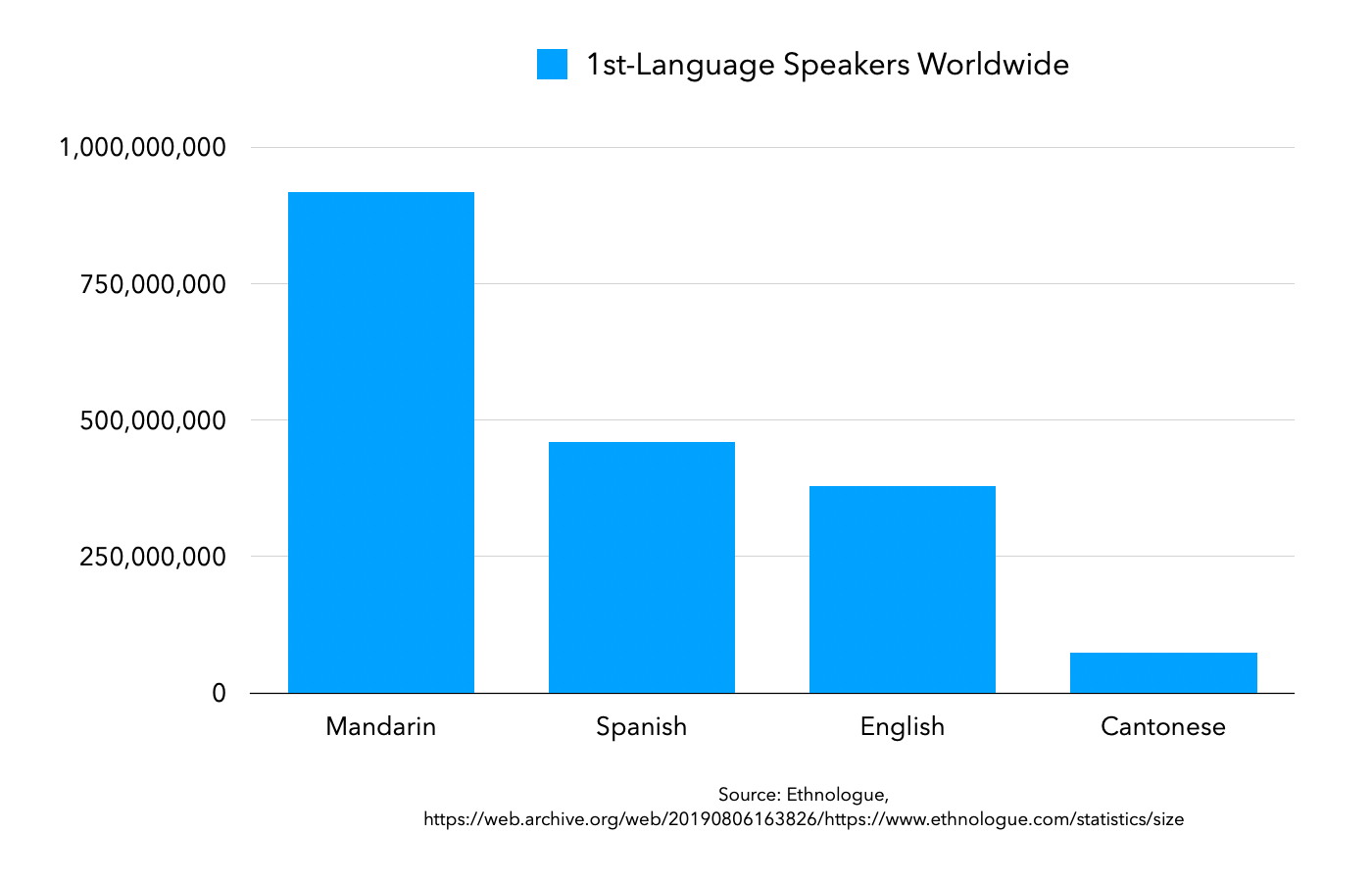
Chart: Languages by First-Language Speakers—2019


For convenience:

The direct link for the Pīnyīn (Pīn·yīn {Piecing Together of} · Sounds → [Pinyin] 拼音) Plus resource for the Enjoy Life Forever! book is:

The short link for Chinese field language-learning links for the Enjoy Life Forever! book is:

More Pīnyīn (Pīn·yīn {Piecing Together of} · Sounds → [Pinyin] 拼音) and Pīnyīn (Pīn·yīn {Piecing Together of} · Sounds → [Pinyin] 拼音) Plus web material based on the Mandarin Enjoy Life Forever! book will be made available in the Pīnyīn (Pīn·yīn {Piecing Together of} · Sounds → [Pinyin] 拼音) Plus web resource as time allows.

Categories
Culture History Language Learning Science Technology Theocratic

shēngjī‐bóbó

shēngjī (shēng·jī life · {mechanism → [being organic]} → [life] 生机 生機)bóbó (bó·bó flourishing; thriving; vigorous · flourishing; thriving; vigorous 勃勃) 👈🏼 Tap/click to show/hide the “flashcard”

[Notes: Tap/click on a Pīnyīn (Pīn·yīn {Piecing Together of} · Sounds → [Pinyin] 拼音) expression to reveal its “flashcard”; tap/click on a “flashcard” or its Pīnyīn (Pīn·yīn {Piecing Together of} · Sounds → [Pinyin] 拼音) expression to hide the “flashcard”. 📖 📄 📘 icons mean 📖 Reveal All, 📄 Reveal Advanced, and 📘 Reveal None re all the “flashcards” in the heading, paragraph, etc. that they are placed at the beginning of.]

The Shēngmìng Láizì Chuàngzào Ma? ((Shēngmìng Life 生命) (Lái·zì Came · From 来自 來自) (Chuàng·zào Initiating · {Making, Creating} → [Creating] 创造 創造) (Ma [? ptcl for “yes/no” questions])? [Was Life Created? (lc)]) (Was Life Created? (lc)) brochure and the Shēngmìng de Qǐyuán—Zhíde Sīkǎo de Wǔ Ge Wèntí ((Shēngmìng Life 生命) (de ’s 的) (Qǐ·yuán {Rising → [Starting]} · Source → [Origin] 起源/原)—(Zhí·de Worth · Getting → [Worth] 值得) (Sī·kǎo {Thinking About} · Examining 思考) (de ’s 的) (Wǔ Five 五) (Ge [mw]個/个) (Wèn·tí Asking · Subjects → [Questions] 问题 問題) [The Origin of Life—Five Questions Worth Asking (lf)]) (The Origin of Life—Five Questions Worth Asking (lf)) brochure were originally published back in 2010, but relatively recently, the English version of the Was Life Created? brochure was updated to the December 2022 Printing, and the Mandarin version of it was updated to the February 2023 Printing. Also, the Was Life Created? brochure and the Origin of Life brochure are now in the Teaching Toolbox section in the JW Library app. So, it would be good to consider some of the expressions used in the Mandarin versions of these publications that can be so helpful when discussing whether life was created.

“Living”

This week’s MEotW, which appears in the title of one of the sections of the Mandarin Was Life Created? brochure, is “shēngjī (shēng·jī life · {mechanism → [being organic]} → [life] 生机 生機)bóbó (bó·bó flourishing; thriving; vigorous · flourishing; thriving; vigorous 勃勃)”:

English:

The Living Planet

Mandarin (WOL; Pīnyīn (Pīn·yīn {Piecing Together of} · Sounds → [Pinyin] 拼音) Plus)

📖 📄 📘 Shēngjī (Shēng·jī Life · {Mechanism → [Being Organic]} → [Life] 生机 生機)Bóbó (Bó·bó Flourishing · Flourishing 勃勃) de (’s 的) Dìqiú (Dì·qiú Earth · Globe 地球)

As can be seen from the above quotes, the Mandarin Was Life Created? brochure uses “shēngjī (shēng·jī life · {mechanism → [being organic]} → [life] 生机 生機)bóbó (bó·bó flourishing; thriving; vigorous · flourishing; thriving; vigorous 勃勃) to effectively mean “living”. Considering the morphemes in it, this expression could also be translated as “brimming with life”, or something similar.

Mechanisms, Organisms, and Crises

The “jī ({machine; mechanism [→ [airplane; aircraft | being organic]]} | {incipient moment; crucial point} | chance; opportunity; occasion | intention; idea機/机) in “shēngjī (shēng·jī life · {mechanism → [being organic]} → [life] 生机 生機)bóbó (bó·bó flourishing; thriving; vigorous · flourishing; thriving; vigorous 勃勃) is a particularly polysemous morpheme, meaning that it has many possible related meanings. For example, it can literally mean “mechanism”, and it can effectively mean “organic”. This seems to indicate that worldly Chinese culture recognizes that living things contain what are effectively mechanisms. Indeed, scientists (and Jehovah’s organization) speak of the molecular machines inside living cells.

A computer-animated visualization of how tiny molecular machines inside our cells copy DNA

The “jī ({machine; mechanism [→ [airplane; aircraft | being organic]]} | {incipient moment; crucial point} | chance; opportunity; occasion | intention; idea機/机) in “shēngjī (shēng·jī life · {mechanism → [being organic]} → [life] 生机 生機)bóbó (bó·bó flourishing; thriving; vigorous · flourishing; thriving; vigorous 勃勃) also appears in the Mandarin expression for “crisis”, “wēijī (wēi·jī {ridge of a roof → [dangerous | endangering]} · {incipient moment; crucial point | occasion} | {(for) ridge of a roof → [(for) danger]} · occasion; opportunity → [crisis] 危机 危機)”, which some have misconstrued as meaning that there is positive opportunity in danger. For more information about that, check out the MEotW post discussing that expression.

Reduplications and Idioms

The latter half of “shēngjī (shēng·jī life · {mechanism → [being organic]} → [life] 生机 生機)bóbó (bó·bó flourishing; thriving; vigorous · flourishing; thriving; vigorous 勃勃) is an example of reduplication, which is quite common in Mandarin. Another expression which features reduplication is past MEotW “rénxīn (rén·xīn people’s · hearts → [popular/public feeling] 人心)huánghuáng (huáng·huáng {being afraid; fearful; scared; frightened [→ [being anxious; uneasy; nervous]]} · {being afraid; fearful; scared; frightened [→ [being anxious; uneasy; nervous]]} 惶惶)”, which has a similar structure to that of “shēngjī (shēng·jī life · {mechanism → [being organic]} → [life] 生机 生機)bóbó (bó·bó flourishing; thriving; vigorous · flourishing; thriving; vigorous 勃勃)”.

Speaking of structure, the MEotW post on “rénxīn (rén·xīn people’s · hearts → [popular/public feeling] 人心)huánghuáng (huáng·huáng {being afraid; fearful; scared; frightened [→ [being anxious; uneasy; nervous]]} · {being afraid; fearful; scared; frightened [→ [being anxious; uneasy; nervous]]} 惶惶) said the following about whether expressions like “rénxīn (rén·xīn people’s · hearts → [popular/public feeling] 人心)huánghuáng (huáng·huáng {being afraid; fearful; scared; frightened [→ [being anxious; uneasy; nervous]]} · {being afraid; fearful; scared; frightened [→ [being anxious; uneasy; nervous]]} 惶惶) and “shēngjī (shēng·jī life · {mechanism → [being organic]} → [life] 生机 生機)bóbó (bó·bó flourishing; thriving; vigorous · flourishing; thriving; vigorous 勃勃) qualify as chéngyǔ (chéng·yǔ {(things that) have become} · sayings → [set phrases (typically of 4 characters)] 成语 成語):

Considering its structure, we can say that “rénxīn (rén·xīn people’s · hearts → [popular/public feeling] 人心)huánghuáng (huáng·huáng {being afraid; fearful; scared; frightened [→ [being anxious; uneasy; nervous]]} · {being afraid; fearful; scared; frightened [→ [being anxious; uneasy; nervous]]} 惶惶) is an idiom. However, it does not seem to be a chéngyǔ (chéng·yǔ {(sth. that) has become} · saying → [set phrase (typically of 4 characters); idiom] 成语 成語). This excerpt from the MEotW post on “chéngyǔ (chéng·yǔ {(sth. that) has become} · saying → [set phrase (typically of 4 characters); idiom] 成语 成語) discusses the difference:

So, it appears that while chéngyǔ (chéng·yǔ {(things that) have become} · sayings → [set phrases (typically of 4 characters); idioms] 成语 成語) can be called idioms in English, not all Chinese idioms are chéngyǔ (chéng·yǔ {(things that) have become} · sayings → [set phrases (typically of 4 characters); idioms] 成语 成語). It seems that “chéngyǔ (chéng·yǔ {(things that) have become} · sayings → [set phrases (typically of 4 characters); idioms] 成语 成語)” specifically refers to Chinese idioms that originated in Classical Chinese, or Literary Chinese. This writing style has largely been replaced by written vernacular Chinese, which has been the standard style of writing for Modern Standard Mandarin for about a century now.

Since they originated in Classical Chinese, which hasn’t been current for about a century, chéngyǔ (chéng·yǔ {(things that) have become} · sayings → [set phrases (typically of 4 characters); idioms] 成语 成語) often cannot be fully understood by modern speakers and readers of Mandarin, since knowledge about the source material for chéngyǔ (chéng·yǔ {(things that) have become} · sayings → [set phrases (typically of 4 characters); idioms] 成语 成語) has naturally been fading with the passing of time.

Lots and Lots of Life

Whether or not “shēngjī (shēng·jī life · {mechanism → [being organic]} → [life] 生机 生機)bóbó (bó·bó flourishing; thriving; vigorous · flourishing; thriving; vigorous 勃勃) is a chéngyǔ (chéng·yǔ {(sth. that) has become} · saying → [set phrase (typically of 4 characters); idiom] 成语 成語), it’s certainly appropriate for describing an earth that is well-suited for, and that is filled with, a huge variety of exquisitely designed living things. It is fitting that the Was Life Created? brochure quotes Psalm 104:24 in this regard:

How many your works are, O Jehovah!
You have made all of them in wisdom.
The earth is full of what you have made.


For convenience:

The direct link for the current-generation Pīnyīn (Pīn·yīn {Piecing Together of} · Sounds → [Pinyin] 拼音) Plus resource for the Was Life Created? brochure is:

The short link for Chinese field language-learning links for the Was Life Created? brochure is:

More Pīnyīn (Pīn·yīn {Piecing Together of} · Sounds → [Pinyin] 拼音) and Pīnyīn (Pīn·yīn {Piecing Together of} · Sounds → [Pinyin] 拼音) Plus web material based on the Mandarin Was Life Created? brochure will be made available in the Pīnyīn (Pīn·yīn {Piecing Together of} · Sounds → [Pinyin] 拼音) Plus web resource as time allows.