Categories
Current Events Theocratic

kèchéng

kèchéng+ (kè·chéng lessons · {journey → [procedure]} → [course; curriculum; (Bible) study] 课程 課程) 👈🏼 Tap/click to show/hide the “flashcard”

[This is an updated version of a post that was originally posted on September 5, 2022.]

[Notes: Tap/click on a Pīnyīn (Pīn·yīn {Piecing Together of} · Sounds → [Pinyin] 拼音) expression to reveal its “flashcard”; tap/click on a “flashcard” or its Pīnyīn (Pīn·yīn {Piecing Together of} · Sounds → [Pinyin] 拼音) expression to hide the “flashcard”. 📖 📄 ➕ icons mean 📖 Reveal All, 📄 Reveal Advanced, and ➕ Reveal + Symbols re all the “flashcards” in the heading, paragraph, etc. that they are placed at the beginning of.]

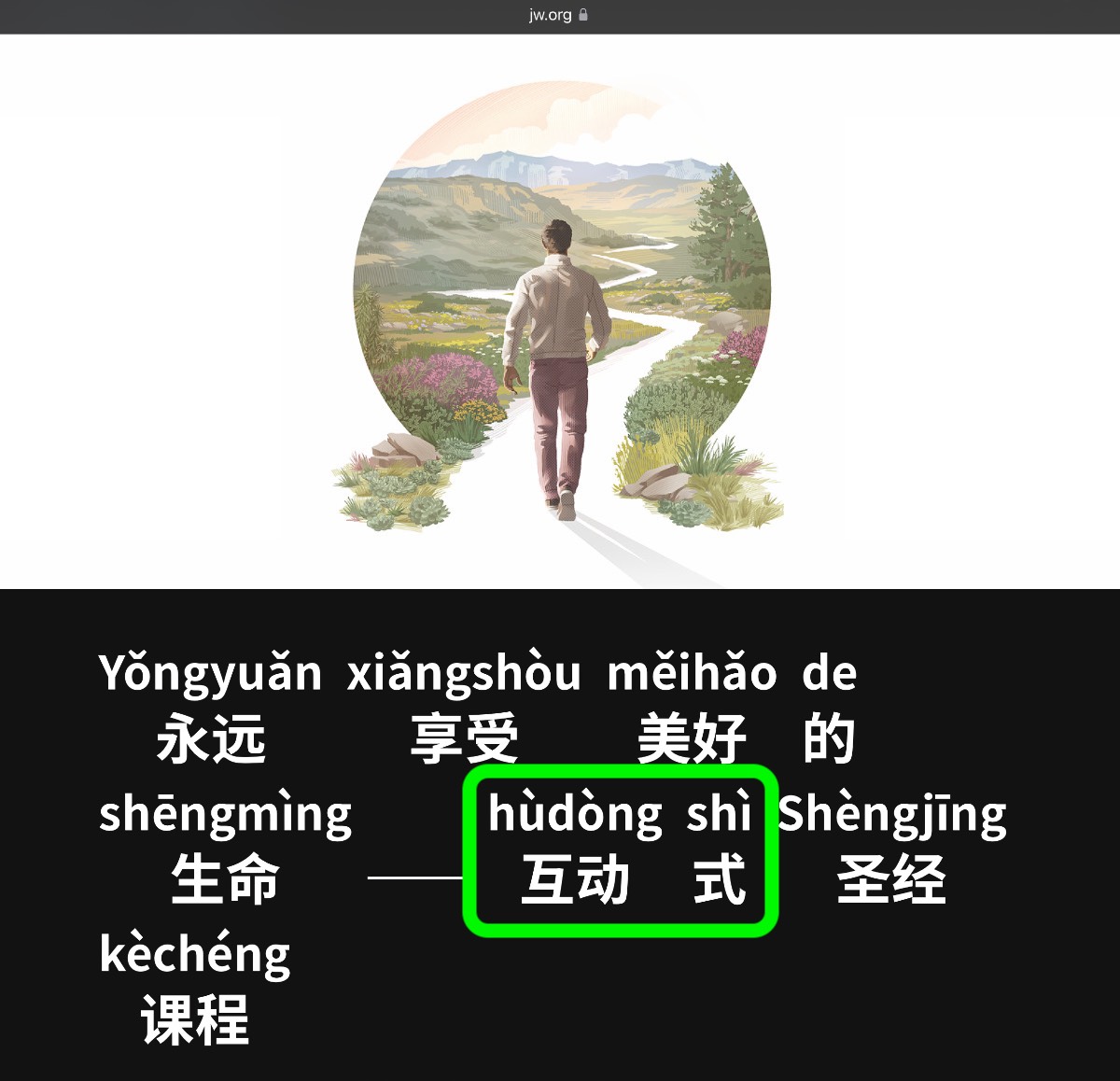
This month, September 2026, there is a worldwide campaign featuring the Enjoy Life Forever! brochure. Appropriately, as of this writing, jw.org is featuring the article “Guided Bible Study Course—Enjoy Life Forever!”. The Mandarin version of this article makes use of the expression “kèchéng (kè·chéng lessons · {journey → [procedure]} → [course; curriculum; (Bible) study] 课程 課程)”, perhaps preceded by “Shèngjīng+ (Shèng·jīng Holy · Scriptures → [Bible] 圣经 聖經)”, to correspond with the English expressions “Bible study course”, “course”, and “Bible course”.

Interestingly, “[Shèngjīng (Shèng·jīng Holy · Scriptures → [Bible] 圣经 聖經)] yánjiū (yán·jiū {grinding → [studying]} · {studying carefully} → [study] 研究)”, an expression that has long been used in the past to mean “[Bible] study”, does not appear at all in the above-mentioned article.

Related Expressions

The “+ (subject; course; class | lesson)” in “kèchéng (kè·chéng lessons · {journey → [procedure]} → [course; curriculum; (Bible) study] 课程 課程) may be familiar to those who have used the Mandarin versions of publications like the Good News brochure and the Enjoy Life Forever! brochure/book, since that is the Mandarin word used to correspond with the English word “lesson”. For example, “Lesson 10” is “Dì‐10 ((Dì [pref to form ordinal numerals] 第)‐(Shí Ten 10) [10th]) + (Lesson)”.

Besides “kèchéng (kè·chéng lessons · {journey → [procedure]} → [course; curriculum; (Bible) study] 课程 課程)”, another word that “ (subject; course; class | lesson)” appears in is “kèběn+ (kè·běn {course | lessons} · {root or stem → [mw for books, etc.]} [textbook; coursebook] 课本 課本)”, which the above-mentioned article uses in reference to the Enjoy Life Forever! book that is now officially recommended for use on Bible studies. (Interestingly, the English version of the article does not use the word “textbook”, which is the main dictionary definition for “kèběn (kè·běn {course | lessons} · {root or stem → [mw for books, etc.]} [textbook; coursebook] 课本 課本)”. It does, though, refer to the Enjoy Life Forever! book as an “interactive Bible course”. So, “coursebook” may be a better match for “kèběn (kè·běn {course | lessons} · {root or stem → [mw for books, etc.]} [textbook; coursebook] 课本 課本) in this case.)

As for the second morpheme in “kèchéng (kè·chéng lessons · {journey → [procedure]} → [course; curriculum; (Bible) study] 课程 課程), it is also used, perhaps unexpectedly, in “gōngchéng+ (gōng·chéng work · {journey → [procedure]} → [engineering | [engineering/work] project] 工程) and in “gōngchéng‐shī+ ((gōng·chéng work · {journeys → [procedures]} → [engineering] 工程)‐(shī master → [skilled person; expert; specialist]) [engineer])”.

Usage Examples

Here are a couple of examples of “kèchéng (kè·chéng lessons · {journey → [procedure]} → [course; curriculum; (Bible) study] 课程 課程) in use, taken from the above-mentioned article:

English:

In this free interactive Bible course, you will get answers to such questions as:

  • How can I find happiness in life?
  • Will evil and suffering ever end?
  • Will I ever see my dead loved ones again?
  • Does God really care about me?
  • How can I pray and be heard by God?

Mandarin:

📖 📄 (you 你) kěyǐ (kě·yǐ can · [suf] 可以) cóng (from) zhèige (zhèi·ge this · [mw] 这个 這個) miǎnfèi (miǎn·fèi exempting · {costing → [fee]} → [free of charge] 免费 免費) de (’s 的) hùdòng+ (hù·dòng {each other} · moving → [interactive] 互动 互動)shì (type 式) Shèngjīng (Shèng·jīng Holy · Scriptures → [Bible] 圣经 聖經) kèchéng (kè·chéng lessons · {journey → [procedure]} → [course] 课程 課程) dédào (dé·dào get · {arriving at} 得到) yǐxià (yǐ·xià at · below’s 以下) wèntí (wèn·tí asking · subjects → [questions] 问题 問題) de ( 的) dá’àn (dá’·àn answering · {long, narrow tables or desks → [sets of information]} → [answers] 答案):

  • 📖 📄 Zěnyàng (Zěn·yàng (in) what · {form → [way]} → [how] 怎样 怎樣) cái ({only then}才/纔) néng (can 能) guòshang (guò·shang {(I) pass} · {(to be) upon} 过上 過上) xìngfú+ (xìng·fú fortunate · {(having) blessings} → [happy] 幸福) de (’s 的) shēnghuó (shēng·huó life · living 生活)?
  • 📖 📄 Èshì (È·shì evil · things 恶事 惡事) ({(together) with} → [and]和/龢) tòngkǔ (tòng·kǔ {being in pain} · {being bitter → [suffering]} 痛苦) huì (will) yǒu (have 有) zhōngzhǐ+ (zhōng·zhǐ ending · stopping 终止 終止) de (’s 的) (one 一) tiān (sky → [day] 天) ma ([? ptcl for “yes/no” questions])?
  • 📖 📄 (I 我) huì (will) gēn (with 跟) qùshì+ (qù·shì {have gone from} · {generation → [world]} → [have passed away] 去世) de (’s 的) qīnyǒu (qīn·yǒu relatives · friends 亲友 親友) chóngjù+ (chóng·jù again · meet 重聚) ma ([? ptcl for “yes/no” questions])?
  • 📖 📄 Shàngdì (Shàng·dì Above’s · {Emperor → [God]} → [God] 上帝) guānxīn+ (guān·xīn {does close → [does concern]} · heart (with) → [does care about] 关心 關心) (me 我) ma ([? ptcl for “yes/no” questions])?
  • 📖 📄 Shàngdì (Shàng·dì Above’s · {Emperor → [God]} → [God] 上帝) huì (will) tīng (hear聽/听) wǒ de ((wǒ me 我) (de ’s 的) [my]) dǎogào+ (dǎo·gào prayers · {requestings | tellings} → [prayers] 祷告 禱告) ma ([? ptcl for “yes/no” questions])?

English:

You will get the entire course free, including the study guide Enjoy Life Forever! and a Bible if you need one.

Mandarin:

📖 📄 Zhěnggè (Zhěng·gè entire · [mw] 整个 整個) kèchéng (kè·chéng lessons · {journey → [procedure]} → [course] 课程 課程) ({(together) with} → [and]和/龢) kèběn (kè·běn course · {root or stem → [mw for books, etc.]} [coursebook] 课本 課本) Yǒngyuǎn (Yǒng·yuǎn Eternally · {Far (in Time)} 永远 永遠) Xiǎngshòu (Xiǎng·shòu Enjoy · Receive 享受) Měihǎo (Měi·hǎo Beautiful · Good 美好) de (’s 的) Shēngmìng (Life 生命) dōu (all → [both] 都) shì (are 是) miǎnfèi (miǎn·fèi exempting · {costing → [fee]} → [free of charge] 免费 免費) de ({’s (things)} 的). ((if) you 你) xūyào (require 需要) de (’s 的) huà (word), wǒmen (wǒ·men we · [pl] 我们 我們) (also 也) kěyǐ (kě·yǐ can · [suf] 可以) miǎnfèi (miǎn·fèi exempting · {costing → [fee]} → [free of charge] 免费 免費) tígōng (tí·gōng {carry (hanging down from the hand) → [raise]} · provide 提供) (one 一) běn ({root or stem of a} → [mw for books, etc.] 本) Shèngjīng (Shèng·jīng Holy · Scriptures → [Bible] 圣经 聖經) gěi ({to be given to}) (you 你).


For convenience:

The direct link for the Pīnyīn (Pīn·yīn {Piecing Together of} · Sounds → [Pinyin] 拼音)+ resource for the Enjoy Life Forever! brochure is:

The short link for Chinese field language-learning links for the Enjoy Life Forever! brochure is:

Categories
Culture Experiences Language Learning Science Theocratic

nándào

nándào+ (nán·dào {is (it) difficult} · {to say [→ [to suppose]] (that)} → [can/could it be that; is it possible that; do you really mean to say that; don’t tell me that] 难道 難道) 👈🏼 Tap/click to show/hide the “flashcard”

[Notes: Tap/click on a Pīnyīn (Pīn·yīn {Piecing Together of} · Sounds → [Pinyin] 拼音) expression to reveal its “flashcard”; tap/click on a “flashcard” or its Pīnyīn (Pīn·yīn {Piecing Together of} · Sounds → [Pinyin] 拼音) expression to hide the “flashcard”. 📖 📄 ➕ icons mean 📖 Reveal All, 📄 Reveal Advanced, and ➕ Reveal + Symbols re all the “flashcards” in the heading, paragraph, etc. that they are placed at the beginning of.]

One of the publications that is now recommended to be used on Bible studies is the Yǒngyuǎn Xiǎngshòu Měihǎo de Shēngmìng—Hùdòng Shì Shèngjīng Kèchéng ((Yǒng·yuǎn Eternally · {Far (in Time)} 永远 永遠) (Xiǎng·shòu Enjoy · Receive 享受) (Měi·hǎo Beautiful · Good 美好) (de ’s 的) (Shēngmìng Life 生命)—(Hù·dòng {Each Other} · Moving → [Interactive] 互动 互動) (Shì (Type 式) (Shèng·jīng Holy · Scriptures → [Bible] 圣经 聖經) (Kè·chéng Lessons · Procedure → [Course] 课程 課程) [Enjoy Life Forever!—An Interactive Bible Course (lff)]) (Enjoy Life Forever! (lff)) book. This week’s MEotW, “nándào+ (nán·dào {is (it) difficult} · {to say [→ [to suppose]] (that)} → [can/could it be that; is it possible that; do you really mean to say that; don’t tell me that] 难道 難道)”, appears in subtitle 35 of the video used in point 5 of lesson 15 of this book:

English:

[Jesus’] mother, Mary, lived in Nazareth.
Could he tell her while in the womb,
‘Please take me to Bethlehem because the scriptures say
I must be born there’?

Mandarin (Pīnyīn (Pīn·yīn {Piecing Together of} · Sounds → [Pinyin] 拼音)+ 🔗):

34
00:02:05,141 → 00:02:08,812
📖 📄 Yēsū (Jesus 耶稣 耶穌) de ( 的) mǔqin (mǔ·qin mother · relative 母亲 母親) Mǎlìyà (Mary 马利亚 馬利亞) yuánběn+ (yuán·běn originally · {root or stem → [originally]} 原本) zhù (lived 住) zài (in 在) Násālè+ (Nazʹa·reth 拿撒勒).

35
00:02:08,812 → 00:02:12,882
📖 📄 Nándào+ (Nán·dào {is (it) difficult} · {to say → [to suppose] (that)} → [could it be that] 难道 難道) Yēsū (Jesus 耶稣 耶穌) nénggòu (néng·gòu {was able} · enough 能够 能夠) zài (in 在) māma (mā·ma ma·ma 妈妈 媽媽) de (’s 的) dùzi+ (dù·zi belly · [suf for nouns] 肚子) li (inside裡/裏) gēn (with 跟) māma (mā·ma ma·ma 妈妈 媽媽) shuō ({to say}說/説),

Lesson 15 point 5 video subtitle 36

36
00:02:12,882 → 00:02:14,651
📖 📄 (you 你) yào (must 要) ({go to} 去) Bólìhéng (Bethʹle·hem 伯利恒 伯利恆) shēng+ ({to give birth to} 生) (me 我),

37
00:02:14,651 → 00:02:17,220
📖 📄 (I 我) cái ({only then}才/纔) néng ({will be able} 能) yìngyàn+ (yìng·yàn {to respond to} · verifying (regarding) → [to fulfil] 应验 應驗) Shèngjīng (Shèng·jīng Holy · Scriptures → [Bible] 圣经 聖經) yùyán (yù·yán {in advance} · saying → [prophecy] 预言 預言)ma ([? ptcl for “yes/no” questions])?

It’s Hard to Say?

Over the years, I would occasionally encounter “nándào (nán·dào {is (it) difficult} · {to say [→ [to suppose]] (that)} → [can/could it be that; is it possible that; do you really mean to say that; don’t tell me that] 难道 難道) in my Mandarin field activities, and I would find it hard to say whether my initial impression was correct, that its morphemes literally translated to “is (it) difficult” “to arrive at (that)”. When I finally got around to looking up this expression and analyzing it, it turned out that I was right about the first morpheme, but wrong about the second one—the first morpheme “nán ({[is] difficult}; {[is] hard} | difficultly | {make difficult/difficulties})” is indeed the one that means “difficult” or “hard”, and that also appears in “nántí (nán·tí difficult · topic → [problem] 难题 難題)”, but the second morpheme is actually not the “dào ({arrive [at/in/etc.]}; reaching [→ [[up/out/etc.] to; until]] 到) that means “to arrive at”. Rather, it is the “dào (way; path; road [→ [mw]] | say; speak; talk; chat | think; suppose 道) that is used in “chuándào (chuán·dào spreading · way → [preaching] 传道 傳道) and in “dàoli (dào·li way; path; road · reasoning; logic; doctrine [→ [principle]] 道理)”, where it means “way; path; road”. When it’s used in “nándào (nán·dào {is (it) difficult} · {to say [→ [to suppose]] (that)} → [can/could it be that; is it possible that; do you really mean to say that; don’t tell me that] 难道 難道) though, it seems to have a different meaning that I was not familiar with before, that of “say; speak”.

When the morphemes of “nándào (nán·dào {is (it) difficult} · {to say [→ [to suppose]] (that)} → [can/could it be that; is it possible that; do you really mean to say that; don’t tell me that] 难道 難道) are put together, then, they literally mean “is (it) difficult” “to say [or, to suppose] (that)”, and they can effectively mean “can/could it be that; is it possible that; do you really mean to say that; don’t tell me that”. As Pleco’s built-in dictionary says, this enigmatic expression is used for “giving force to a rhetorical question”.

A Usage Example From the Bible

Here is another example of “nándào (nán·dào {is (it) difficult} · {to say [→ [to suppose]] (that)} → [can/could it be that; is it possible that; do you really mean to say that; don’t tell me that] 难道 難道) in use, from a familiar Bible account:

English:

You are not greater than our forefather Jacob, who gave us the well and who together with his sons and his cattle drank out of it, are you?”

Mandarin (WOL, Pīnyīn (Pīn·yīn {Piecing Together of} · Sounds → [Pinyin] 拼音)+ 🔗):

📖 📄 Zhèi (this) kǒu ({mouth of a} → [mw for things with mouths/openings] 口) jǐng+ (well 井) shì (is 是) wǒmen de ((wǒ·men us · [pl] 我们 我們) (de ’s 的) [our]) zǔxiān (zǔ·xiān forefather · {earlier (person) → [ancestor]} → [forefather] 祖先) Yǎgè+ (Jacob 雅各) liúgěi (liú·gěi {left behind} · {to be given to} 留给 留給) wǒmen (wǒ·men us · [pl] 我们 我們) de ({’s (well)} 的), (he 他) zìjǐ (himself 自己) ({(together) with} → [and]和/龢) érzi (ér·zi {(his) children → [his sons]} · [suf for nouns] 儿子 兒子), jiāchù+ (jiā·chù (his) household · livestock → [his cattle] 家畜) dōu (all 都) (drank 喝) zhèi (this) kǒu ({mouth of a} → [mw for things with mouths/openings] 口) jǐng (well 井) de (’s 的) shuǐ (water 水), nándào+ (nán·dào {is (it) difficult} · {to say → [to suppose] (that)} → [can it be that] 难道 難道) (you 你) ({compared to} 比) (him 他) hái ({still more}) ({are big} → [are great] 大) ma ([? ptcl for “yes/no” questions])?”

A Question for the Mandarin Field

Here is a rhetorical question for Mandarin field language learners to consider:

English:

Is learning Chinese characters really the most important aspect of learning Mandarin?

Mandarin:

📖 📄 Nándào+ (Nán·dào {is (it) difficult} · {to say → [to suppose] (that)} → [can it be that] 难道 難道) xué (learning) Hànzì+ (Hàn·zì {Han (Chinese)} · Characters 汉字 漢字) zhēnde (zhēn·de {being real} · {’s (thing)} → [really] 真的) shì (is 是) xué (learning) pǔtōng‐huà+ ((pǔ·tōng common · {through(out) → [common]} 普通)‐(huà speech) [(Modern Standard) Mandarin (term commonly used in China)]) de (’s 的) zuì (most最/㝡) zhòngyào (zhòng·yào weighty · important 重要) de (’s 的) (one 一) fāngmiàn (fāng·miàn {direction → [side]} · face → [aspect] 方面) ma ([? ptcl for “yes/no” questions])?

For an answer to this question that’s based, not on human tradition or cultural pride, but rather on the Bible, The Watchtower, and linguistics (language science), check out the article “SPEECH is Top Priority, Not Characters”.

Here is an excerpt:

Just like it’s an established fact that the earth is round, according to modern linguistics (the scientific study of language) this is also an established fact: “Speech is primary, writing is secondary and is always derivative of speech.” This scientific truth about language, that Jehovah built us and wired us to primarily communicate meaning through speech, supports what 1 Corinthians 14:8–11 (quoted above) says about understandable speech being of prime importance to Christian evangelizers.


For convenience:

The direct link for the Pīnyīn (Pīn·yīn {Piecing Together of} · Sounds → [Pinyin] 拼音) Plus / Pīnyīn (Pīn·yīn {Piecing Together of} · Sounds → [Pinyin] 拼音)+ resource for the Enjoy Life Forever! book is:

The short link for Chinese field language-learning links for the Enjoy Life Forever! book is:

More Pīnyīn (Pīn·yīn {Piecing Together of} · Sounds → [Pinyin] 拼音)+ web material based on the Mandarin Enjoy Life Forever! book will be made available in the Pīnyīn (Pīn·yīn {Piecing Together of} · Sounds → [Pinyin] 拼音) Plus / Pīnyīn (Pīn·yīn {Piecing Together of} · Sounds → [Pinyin] 拼音)+ web resource as time allows.

Categories
Culture Technology Theocratic

wú‐suǒwèi

wú‐suǒwèi+ ((wú {[(considers that)] there is not}無/无)‐(suǒ·wèi {that which} · {is said to be} 所谓 所謂) [does not matter | is indifferent; does not care]) 👈🏼 Tap/click to show/hide the “flashcard”

[Notes: Tap/click on a Pīnyīn (Pīn·yīn {Piecing Together of} · Sounds → [Pinyin] 拼音) expression to reveal its “flashcard”; tap/click on a “flashcard” or its Pīnyīn (Pīn·yīn {Piecing Together of} · Sounds → [Pinyin] 拼音) expression to hide the “flashcard”. 📖 📄 ➕ icons mean 📖 Reveal All, 📄 Reveal Advanced, and ➕ Reveal + Symbols re all the “flashcards” in the heading, paragraph, etc. that they are placed at the beginning of.]

One of the publications that is now recommended to be used on Bible studies is the Yǒngyuǎn Xiǎngshòu Měihǎo de Shēngmìng—Hùdòng Shì Shèngjīng Kèchéng ((Yǒng·yuǎn Eternally · {Far (in Time)} 永远 永遠) (Xiǎng·shòu Enjoy · Receive 享受) (Měi·hǎo Beautiful · Good 美好) (de ’s 的) (Shēngmìng Life 生命)—(Hù·dòng {Each Other} · Moving → [Interactive] 互动 互動) (Shì (Type 式) (Shèng·jīng Holy · Scriptures → [Bible] 圣经 聖經) (Kè·chéng Lessons · Procedure → [Course] 课程 課程) [Enjoy Life Forever!—An Interactive Bible Course (lff)]) (Enjoy Life Forever! (lff)) book. This week’s MEotW, “wú‐suǒwèi ((wú {[(considers that)] there is not}無/无)‐(suǒ·wèi {that which} · {is said to be} 所谓 所謂) [does not matter | is indifferent; does not care])”, appears in lesson 14 of this book, in the “SOME PEOPLE SAY” section:

English:

SOME PEOPLE SAY: “It’s impossible to please God.”

Mandarin (WOL, Pīnyīn (Pīn·yīn {Piecing Together of} · Sounds → [Pinyin] 拼音) Plus):

📖 📄 RÚGUǑ (RÚ·GUǑ IF · {FRUIT → [IF INDEED]} 如果) YǑURÉN (YǑU·RÉN {(THERE) ARE HAVING → [(THERE) ARE]} · PEOPLE 有人) SHUŌ (SAYING說/説): Zhǐyào (Zhǐ·yào only · {requiring (that)} → [so long as] 只要) xīnli (xīn·li hearts · inside 心里 心裡/裏) yǒu ({(we) have} 有) Shàngdì (Shàng·dì Above’s · {Emperor → [God]} → [God] 上帝) jiù (then 就) xíng+ ({(it) goes} → [it’s alright] 行), zěnme (zěn·me however · [suf] 怎么 怎麼/麽) chóngbài (chóng·bài (we) {esteem → [worship]} · {do obeisance to → [worship]} → [(we) worship] 崇拜) Shàngdì (Shàng·dì Above’s · {Emperor → [God]} → [God] 上帝) dōu ({in all those cases} 都) wú‐suǒwèi+ ((wú {there is not}無/无)‐(suǒ·wèi {that which} · {is said to be} 所谓 所謂) [it does not matter]).”

As can be seen from the above, the English and Mandarin versions of this section of lesson 14 express different meanings—the Mandarin version actually means something like “As long as we have God in our hearts it’s alright, it doesn’t matter how we worship God.” Apparently, it was decided that the English and Mandarin fields have different needs in this regard. Anyway, in the above example, this week’s MEotW “wú‐suǒwèi ((wú {[(considers that)] there is not}無/无)‐(suǒ·wèi {that which} · {is said to be} 所谓 所謂) [does not matter | is indifferent; does not care]) effectively means “it does not matter”.

How do this expression’s morphemes work together to produce this effective meaning? The literal meaning of the morphemes is “{there is not} {that which} {is said to be}”, which kind of has the flavour of “there is nothing to speak of”. It’s not hard to see then, why this expression effectively means “does not matter | is indifferent; does not care”.

Playing It Cool?

Another place where I have seen “wú‐suǒwèi ((wú {[(considers that)] there is not}無/无)‐(suǒ·wèi {that which} · {is said to be} 所谓 所謂) [does not matter | is indifferent; does not care]) used is in the Faye Wong song “Shìyán (Shì·yán Pledging · Words → [Pledge] 誓言)”:

Mandarin:

📖 📄 Rúguǒ (Rú·guǒ if · {fruit → [if indeed]} 如果) (you 你) néng (could 能) gěi (give) (me 我) (one 一) ge ([mw]個/个) zhēnchéng+ (zhēn·chéng true · sincere 真诚 真誠) de (’s 的) juéduì (jué·duì {being cut off → [absolutely]} · {facing → [being compared]} → [being definite] 绝对 絕對)
Wú‐suǒwèi ((Wú {(I consider that) there is not}無/无)‐(suǒ·wèi {that which} · {is said to be} 所谓 所謂) [(I) don’t care]), (I 我) shénme (shén·me {(about) what → [(about) anything]} · [suf] 什么 什/甚麼) dōu ({in all those cases} 都) wú‐suǒwèi ((wú {(consider that) there is not}無/无)‐(suǒ·wèi {that which} · {is said to be} 所谓 所謂) [don’t care]).

English:

If you could give me a sincere certainty…
I don’t care, I don’t care about anything.

In this part of the song, she is trying to “play it cool,” saying that whatever he says or does doesn’t matter to her, that she doesn’t care. Ironically, though, those who tell such things to others and to themselves often do so precisely because they do care. Later in the song, she sings:

Mandarin:

📖 📄 Bié (don’t) yǐwéi (yǐ·wéi consider · {(the case) to be} (that) 以为 以為) zhízhuó+ (zhí·zhuó persisting · applying → [persevering] 执着 執著) de (’s 的) xīn (heart 心) jiù (then 就) búhuì (bú·huì not · can → [cannot] 不会 不會) bèi ({be covered by being → [passive signifier]} [be] 被) pèngsuì (pèng·suì knocked · {to be broken to pieces} 碰碎).
Bié (don’t) yǐwéi (yǐ·wéi consider · {(the case) to be} (that) 以为 以為) (I 我) zhēnde (zhēn·de really · ’s 真的) wú‐suǒwèi ((wú {(consider that) there is not}無/无)‐(suǒ·wèi {that which} · {is said to be} 所谓 所謂) [don’t care]).

English:

Don’t think that a persevering heart can’t be shattered.
Don’t think that I really don’t care.

Lyrics for the Faye Wong song “Shìyán” (“Pledge”) in Apple Music, on an iPad

Lyrics for the Faye Wong song “Shìyán (Shì·yán Pledging · Words → [Pledge] 誓言) (“Pledge”) in Apple Music, on an iPad (It’s great that they give the option of showing the Pīnyīn (Pīn·yīn {Piecing Together of} · Sounds → [Pinyin] 拼音), but it would have been even better if they included tone marks, even if the tones are not heard during singing.)


For convenience:

The direct link for the Pīnyīn (Pīn·yīn {Piecing Together of} · Sounds → [Pinyin] 拼音) Plus resource for the Enjoy Life Forever! book is:

The short link for Chinese field language-learning links for the Enjoy Life Forever! book is:

More Pīnyīn (Pīn·yīn {Piecing Together of} · Sounds → [Pinyin] 拼音) and Pīnyīn (Pīn·yīn {Piecing Together of} · Sounds → [Pinyin] 拼音) Plus web material based on the Mandarin Enjoy Life Forever! book will be made available in the Pīnyīn (Pīn·yīn {Piecing Together of} · Sounds → [Pinyin] 拼音) Plus web resource as time allows.