Categories
Current Events History Science Technology Theocratic

néngyuán

néngyuán (néng·yuán energy · {source (of a river)} → [energy [source]] 能源) 👈🏼 Tap/click to show/hide the “flashcard”

[Notes: Tap/click on a Pīnyīn (Pīn·yīn {Piecing Together of} · Sounds → [Pinyin] 拼音) expression to reveal its “flashcard”; tap/click on a “flashcard” or its Pīnyīn (Pīn·yīn {Piecing Together of} · Sounds → [Pinyin] 拼音) expression to hide the “flashcard”. 📖 📄 📘 icons mean 📖 Reveal All, 📄 Reveal Advanced, and 📘 Reveal None re all the “flashcards” in the heading, paragraph, etc. that they are placed at the beginning of.]

At the time of this writing, jw.org is featuring the article “Meeting Mankind’s Energy Needs—What the Bible Says”. This week’s MEotW, “néngyuán (néng·yuán energy · {source (of a river)} → [energy [source]] 能源), occurs often in the Mandarin version of this article, including in the title:

English:

Meeting Mankind’s Energy Needs—What the Bible Says

Mandarin:

📖 📄 📘 Néngyuán (néng·yuán Energy · {Sources (of Rivers)} → [Energy [Sources]] 能源) Kùnjú (Kùn·jú {Surrounded → [Hard-Pressed]} · Situation 困局) Yǒu ({Will Have} 有) Jiějué (Jiě·jué {Being Untied → [Being Solved]} · {Being Decided} → [Being Resolved] 解决 解決) de (’s 的) (One 一) Tiān (Sky → [Day] 天) ma ([? ptcl for “yes/no” questions])? Shèngjīng (Shèng·jīng (the) Holy · Scriptures → [the Bible] 圣经 聖經) de (’s 的) Guāndiǎn (Guān·diǎn {Looking at → [View]} · Point → [Viewpoint] 观点 觀點) Shì (Is 是) Shénme (Shén·me What · [suf] 什么 什/甚麼)?

The Importance of Energy

That the current fighting in the Middle East around the Strait of Hormuz is driving up gas prices in many places is undoubtedly a big reason why the above-mentioned article is being featured on jw.org at this time. Yes, energy is more than just an abstract scientific concept.

In physics, energy is defined as “the capacity for doing work”, which in turn involves applying force to move something a certain distance. So, practically speaking, energy provides the ability to move physical things, like our cars. And since heat is connected to temperature, which “reflects the average kinetic energy of the particles in a system”, energy also provides the ability to heat things, like our homes. (By the way, in physics, “power is defined as the rate of producing or consuming energy.”)

Looking back in history, oil—along with other fossil fuels still the dominant source of energy down to this day, in spite of increasing use of clean energy—was a big factor in why Japan attacked Pearl Harbour in 1941, and in why Nazi Germany ultimately lost to the Allies in World War II.

Coming back to the present day, besides gas prices being driven up by the ongoing fighting in the Middle East, another reason why energy is now of concern to many is that oodles and gobs of energy are needed to train and operate artificial intelligence (AI) models, which are increasingly being hyped and used by many.

Another Usage Example

Regarding “néngyuán (néng·yuán energy · {source (of a river)} → [energy [source]] 能源)”, note that its morphemes literally mean “energy · source (of a river)”. However, the expression as a whole is at times used to effectively mean just “energy”.

To help Mandarin field language learners get more of a feel for how to use this expression, here is another usage example, taken from the above-mentioned jw.org article:

English:

Challenge: international conflict. Some regions are rich in energy resources, but they suffer from wars, conflicts, and disputes over territory. And when conflicts disrupt supply chains for oil or gas, many people face shortages and higher prices.

The Bible says: “Jehovah…is bringing an end to wars throughout the earth.”—Psalm 46:8, 9.

Jehovah God will eliminate conflict and wars.

Mandarin:

📖 📄 📘 Zǔ’ài (Zǔ’·ài obstructing · hindering (thing) → [obstacle] 阻碍 阻礙): guójì (guó·jì nations · {boundaries → [among]} → [international] 国际 國際) jiān (among間/閑) de (’s 的) chōngtū (chōng·tū {dashings → [clashings]} · {chimneys → [chargings]} → [conflicts] 冲突 衝突). Yǒuxiē (Yǒu·xiē {(there) are having → [(there) are]} · some 有些) dìqū (dì·qū lands · regions 地区 地區) yōngyǒu (yōng·yǒu {holding in their arms} · having → [having] 拥有 擁有) chōngzú (chōng·zú filled · ample 充足) de (’s 的) shíyóu (shí·yóu rock · oil → [oil] 石油) ({(together) with} → [and]和/龢) tiānrán (tiān·rán {(of) heaven → [natural]} · so → [natural] 天然) (gas氣/气), dànshì (dàn·shì but · {(it) is (the case that)} 但是) yīnwei (yīn·wei {because of} · {on account of} 因为 因為) zhànzhēng (zhàn·zhēng wars · contendings → [wars] 战争 戰爭), chōngtū (chōng·tū {dashings → [clashings]} · {chimneys → [chargings]} → [conflicts] 冲突 衝突), lǐngtǔ (lǐng·tǔ {neck → [collar] → [have jurisdiction over]} · {soil → [land]} → [territory] 领土 領土) jiūfēn (jiū·fēn (things) {being entangled in} · {being tangled} → [disputes] 纠纷 糾紛), dǎozhì (dǎo·zhì {(these) lead} · {to extend to} 导致 導致) néngyuán (néng·yuán energy · {source (of a river)} → [energy [source]] 能源) gōngyìng (gōng·yìng supplying · {responding (to the needs/requests)} → [supply] 供应 供應) liàn (chains) shòudào (shòu·dào {being subjected to} · {arriving at} 受到) yǐngxiǎng (yǐng·xiǎng relfection · sound → [being affected] 影响 影響). Jiéguǒ (Jié·guǒ {tied (into a knot) → [formed]} · fruit → [as a result] 结果 結果), hěn (very 很) duō (many 多) rén (people 人) miànlín (miàn·lín face · {are near to} 面临 面臨) néngyuán (néng·yuán energy · {source (of a river)} → [energy [source]] 能源) duǎnquē (duǎn·quē {being short → [being lacking]} · {being lacking} → [shortages] 短缺) huòzhě (huò·zhě or · [suf] 或者) néngyuán (néng·yuán energy · {source (of a river)} → [energy [source]] 能源) jiàgé (jià·gé price · {grid → [pattern]} → [prices] 价格 價格) shàngzhǎng (shàng·zhǎng upward · {rising (of water/prices/etc.)} 上涨 上漲) de (’s 的) wèntí (wèn·tí asking · problems → [problems] 问题 問題).

📖 📄 📘 Shèngjīng (Shèng·jīng (the) Holy · Scriptures → [the Bible] 圣经 聖經) shuō (says說/説): Yēhéhuá (Jehovah 耶和华 耶和華)zhōngzhǐ (zhōng·zhǐ {is ending} · {is halting} 终止 終止) zhànzhēng (zhàn·zhēng wars · contendings → [wars] 战争 戰爭), píngdìng (píng·dìng {is making to be flat, level, even → [is making to be peaceful]} · {is making to be settled → [is making to be calm]} 平定) tiānxià (tiān·xià heaven · under → [the whole world] 天下)” (Shīpiān (Shī·piān {Sacred Song} · {Piece of Writing} → [Psalm] 诗篇 詩篇) 46:8, 9)

📖 📄 📘 Yēhéhuá (Jehovah 耶和华 耶和華) huì (will) xiāochú (xiāo·chú eliminate · {get rid of} 消除) zhànzhēng (zhàn·zhēng wars · contendings → [wars] 战争 戰爭) ({(together) with} → [and]和/龢) chōngtū (chōng·tū {dashings → [clashings]} · {chimneys → [chargings]} → [conflicts] 冲突 衝突).

Jehovah’s Energy

Yes, Jehovah can and will resolve the issues the world is facing involving energy. Regarding the sheer amount of energy that Jehovah has at his disposal, a past MEotW post said:

As an example of just how powerful Jehovah’s holy spirit is even compared to humans’ nuclear bombs, according to my research and calculations, every day, the sun, produced with power from the holy spirit, puts out the energy of almost 8 quadrillion (1015) 1-megaton nuclear bombs. (A single 1-megaton nuclear bomb would release about 67 times the amount of energy released by the atomic bomb dropped on Hiroshima.) And according to NASA, “it turns out that our Sun is an average-sized star. There are bigger stars, and there are smaller stars. We have found stars that are 100 times bigger in diameter than our sun.”

And of course, as we who have gotten to know Jehovah have learned, Jehovah God is far from being all muscle and no brains or heart or conscience. In addition to having unlimited power, we can rest assured that he also has the wisdom, the justice, and most importantly, the love required to best beneficially use all that power and energy—he is truly the ultimate Néngyuán (Néng·yuán Energy · {Source (of a River)} → [Energy Source] 能源)!
Categories
Current Events Experiences History Language Learning Technology Theocratic

lìliang

lìliang (lì·liang power; strength; force · quantity 力量) 👈🏼 Tap/click to show/hide the “flashcard”

[Notes: Tap/click on a Pīnyīn (Pīn·yīn {Piecing Together of} · Sounds → [Pinyin] 拼音) expression to reveal its “flashcard”; tap/click on a “flashcard” or its Pīnyīn (Pīn·yīn {Piecing Together of} · Sounds → [Pinyin] 拼音) expression to hide the “flashcard”. 📖 📄 📘 icons mean 📖 Reveal All, 📄 Reveal Advanced, and 📘 Reveal None re all the “flashcards” in the heading, paragraph, etc. that they are placed at the beginning of.]

One of the publications that is now recommended to be used on Bible studies is the Yǒngyuǎn Xiǎngshòu Měihǎo de Shēngmìng—Hùdòng Shì Shèngjīng Kèchéng ((Yǒng·yuǎn Eternally · {Far (in Time)} 永远 永遠) (Xiǎng·shòu Enjoy · Receive 享受) (Měi·hǎo Beautiful · Good 美好) (de ’s 的) (Shēngmìng Life 生命)—(Hù·dòng {Each Other} · Moving → [Interactive] 互动 互動) (Shì (Type 式) (Shèng·jīng Holy · Scriptures → [Bible] 圣经 聖經) (Kè·chéng Lessons · Procedure → [Course] 课程 課程) [Enjoy Life Forever!—An Interactive Bible Course (lff)]) (Enjoy Life Forever! (lff)) book. An outstanding feature of this book is its extensive use of the post-paper technology of video, which enables information to be presented much more vividly than could be done with paper. Also, at this time, one of the unique features of Pīnyīn (Pīn·yīn {Piecing Together of} · Sounds → [Pinyin] 拼音) Plus material is Pīnyīn (Pīn·yīn {Piecing Together of} · Sounds → [Pinyin] 拼音) Plus video transcripts. These can help us Mandarin field language learners to analyze and understand the Mandarin speech used in the many videos referenced in the Mandarin Enjoy Life Forever! book. This in turn can help us make more effective use of these videos while participating in Mandarin Bible discussions using this book.

This week’s MEotW, “lìliang (lì·liang power; strength; force · quantity 力量)”, occurs in subtitle 69 of the transcript for the video for lesson 16, point 6 of the Mandarin Enjoy Life Forever! book:

English:

Someone touched me,

for I know that power went out of me.

Mandarin:

68
00:03:30,620 → 00:03:32,038
📖 📄 📘 Yídìng (Yí·dìng {(with) one} · {setting fixedly} → [definitely] 一定) yǒurén (yǒu·rén {(there) was having → [(there) was]} · person (who) 有人) (touched 摸) (me 我)

69
00:03:32,038 → 00:03:34,207
📖 📄 📘 (I 我) juéde (jué·de {to wake to → [to feel]} · got → [got to feel] 觉得 覺得) yǒu ({(there) was having} → [(there) was] 有) lìliang (lì·liang power · quantity 力量) cóng (from) (me 我) shēnshang (shēn·shang {body → [self]} · upon 身上) chūqu (chū·qu {having gone out} · {to go} 出去).

Here, “lìliang (lì·liang power; strength; force · quantity 力量) is used as the Mandarin word for “power”. Speaking of God’s power and the vocabulary used to talk about it in Mandarin, “lìliang (lì·liang power; strength; force · quantity 力量) appears in “shénshèng lìliang ((shén·shèng godly · holy 神圣 神聖) (lì·liang force · quantity 力量) [holy spirit])”, the expression currently used in the publications of Jehovah’s organization to translate “holy spirit”. (Interestingly, comparing the English and Mandarin (WOL, Pīnyīn (Pīn·yīn {Piecing Together of} · Sounds → [Pinyin] 拼音) Plus) versions of song 112 in the “Sing Out Joyfully” book, we see that there, “we ask you for your spirit” is translated as “kěnqiú (kěn·qiú (we) earnestly · request 恳求 懇求) (you 你) cìyǔ ({to give} 赐予/与 賜予/與) lìliang (lì·liang force · quantity → [(as per the English lyrics, this may be an abbr. for shénshèng lìliang (holy spirit))] 力量)”. I suppose it’s possible, though, that this apparent abbreviation of “shénshèng lìliang ((shén·shèng godly · holy 神圣 神聖) (lì·liang force · quantity 力量) [holy spirit]) to “lìliang (lì·liang force · quantity → [(this may be an abbr. for shénshèng lìliang (holy spirit), e.g., in the lyrics for song 112)] 力量) was just something done to fit the song’s rhythm.)

“Power Had Gone Out of Him”

The above-mentioned video—and the Bible account it was based on—simply refers to “power”, translated into Mandarin as “lìliang (lì·liang power; strength; force · quantity 力量)”. However, considering the miraculously beneficial results of this flow of “power”, much more must have been involved than what humans typically think of when they think of power.

Power flowing out of Jesus may make some imagine something happening like what happens when contact is made that completes a circuit with a battery, like when one tries to jump-start a car. When that’s done properly and the power flows, the result can be the safe and gratifying starting up of the previously unstartable car. I once had an experience, though, that didn’t go as expected, when I helped to jump-start an old Nissan that for some reason had the colours on its battery posts reversed from the usual practice, such that the post that I thought was the negative post was actually the positive post, and vice versa. The result in that case was a runaway flow of power that caused the jumper cable to rapidly heat up and catch fire! (Fortunately, I was able to grab a long wooden stick I had in the trunk of my car for chipping away at road ice, and use it to forcibly break the cable, which by then had been weakened by the extreme heat.)

So, power alone is not enough to ensure good results. Indeed, power alone can destroy rather than make things better. Besides my misadventure with that confusingly designed car battery, another obvious example is what happened when huge amounts of power were released by the explosions of the atomic bombs dropped on Hiroshima and Nagasaki.

In the case of the sick woman who touched Jesus’ outer garments, Jesus only knew that “power had gone out of him”—he didn’t know this woman and didn’t understand her situation until she explained things to him after the fact. So, even without Jesus’ active participation and direction, the “power” that went out from him displayed

  • recognition of the woman’s faith and of the rightness of helping her, even if she was technically in violation of the Mosaic Law,
  • understanding of the nature of her sickness and of the technical process required to completely and immediately heal her of it,
  • and willingness to help her in this way.

Power, Beneficially Applied

It is evident from what happened in this situation that, as corroborated by the rest of God’s Word, God’s almighty power is always used along with his abundant justice, wisdom, and love—it never runs amok on its own, like a runaway electric current or an exploding bomb.

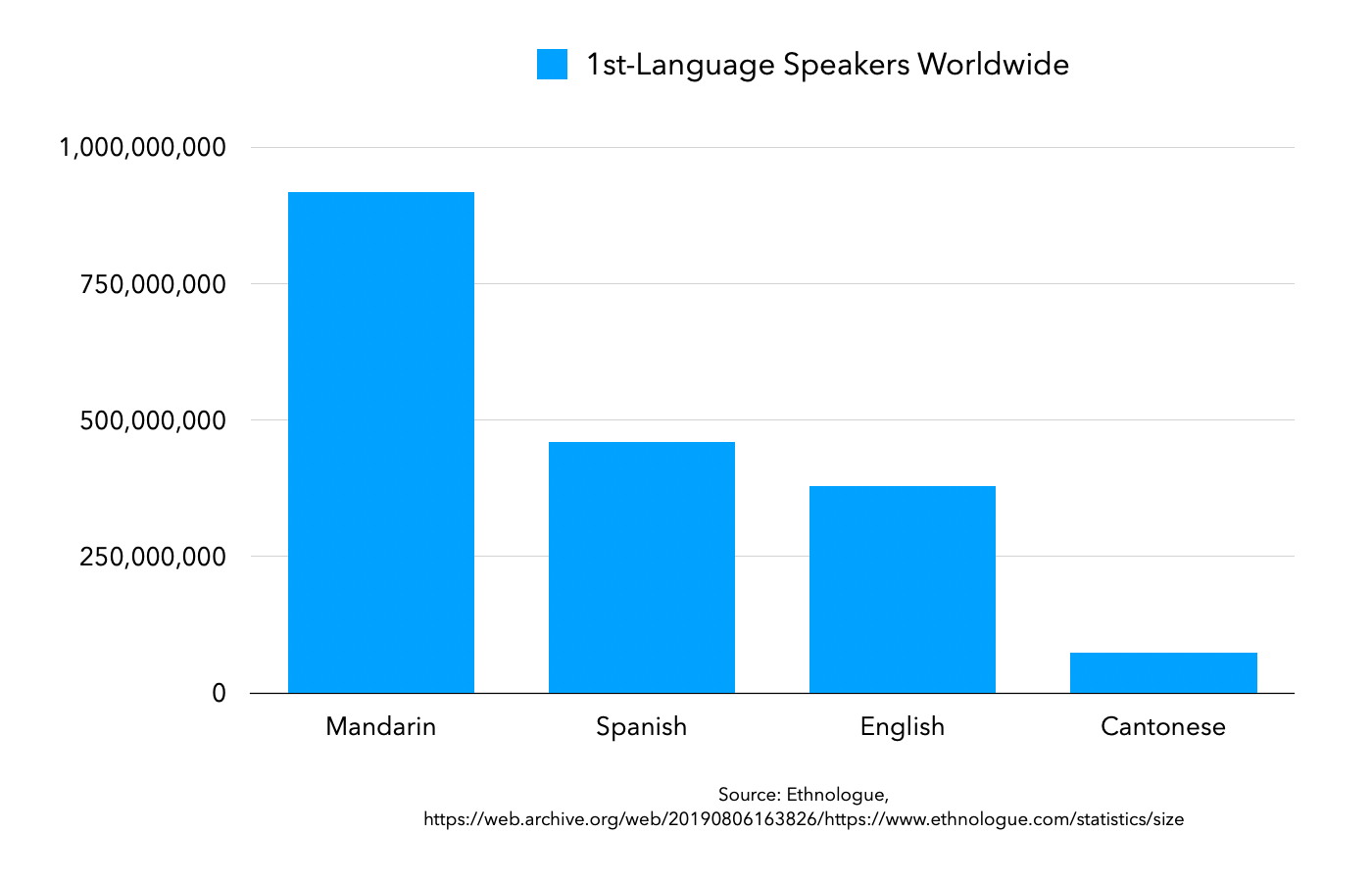
While humans in Satan’s world continue to fight wars and otherwise hungrily seek power for its own sake, it’s good to know of Jehovah God’s unmatched power, and of how he always uses it justly, wisely, and lovingly. In the Mandarin field, we have the privilege of helping people in what’s probably the largest language field ever to also come to an appreciation of the impressive and moving ways in which Jehovah God uses power.

Chart: Languages by First-Language Speakers—2019


For convenience:

The direct link for the Pīnyīn (Pīn·yīn {Piecing Together of} · Sounds → [Pinyin] 拼音) Plus resource for the Enjoy Life Forever! book is:

The short link for Chinese field language-learning links for the Enjoy Life Forever! book is:

More Pīnyīn (Pīn·yīn {Piecing Together of} · Sounds → [Pinyin] 拼音) and Pīnyīn (Pīn·yīn {Piecing Together of} · Sounds → [Pinyin] 拼音) Plus web material based on the Mandarin Enjoy Life Forever! book will be made available in the Pīnyīn (Pīn·yīn {Piecing Together of} · Sounds → [Pinyin] 拼音) Plus web resource as time allows.

Categories
Culture Current Events Experiences Language Learning Science Technology Theocratic

cōnghuì

cōnghuì (cōng·huì {[is] quick at hearing → [[is] intelligent; bright; clever; sharp-witted]} · {[is] intelligent; bright} → [[is] intelligent; bright; witty] 聪慧 聰慧) 👈🏼 Tap/click to show/hide the “flashcard”

[Notes: Tap/click on a Pīnyīn (Pīn·yīn {Piecing Together of} · Sounds → [Pinyin] 拼音) expression to reveal its “flashcard”; tap/click on a “flashcard” or its Pīnyīn (Pīn·yīn {Piecing Together of} · Sounds → [Pinyin] 拼音) expression to hide the “flashcard”. 📖 📄 📘 icons mean 📖 Reveal All, 📄 Reveal Advanced, and 📘 Reveal None re all the “flashcards” in the heading, paragraph, etc. that they are placed at the beginning of.]

The Shēngmìng Láizì Chuàngzào Ma? ((Shēngmìng Life 生命) (Lái·zì Came · From 来自 來自) (Chuàng·zào Initiating · {Making, Creating} → [Creating] 创造 創造) (Ma [? ptcl for “yes/no” questions])? [Was Life Created? (lc)]) (Was Life Created? (lc)) brochure and the Shēngmìng de Qǐyuán—Zhíde Sīkǎo de Wǔ Ge Wèntí ((Shēngmìng Life 生命) (de ’s 的) (Qǐ·yuán {Rising → [Starting]} · Source → [Origin] 起源/原)—(Zhí·de Worth · Getting → [Worth] 值得) (Sī·kǎo {Thinking About} · Examining 思考) (de ’s 的) (Wǔ Five 五) (Ge [mw]個/个) (Wèn·tí Asking · Subjects → [Questions] 问题 問題) [The Origin of Life—Five Questions Worth Asking (lf)]) (The Origin of Life—Five Questions Worth Asking (lf)) brochure were originally published back in 2010, but relatively recently, the English version of the Was Life Created? brochure was updated to the December 2022 Printing, and the Mandarin version of it was updated to the February 2023 Printing. Also, the Was Life Created? brochure and the Origin of Life brochure are now in the Teaching Toolbox section in the JW Library app. So, it would be good to consider some of the expressions used in the Mandarin versions of these publications that can be so helpful when discussing whether life was created.

“There Is No Intelligent Creator”?

This week’s MEotW, which appears in the section of the Mandarin Was Life Created? brochure entitled “Nǐ (You 你) Xiāngxìn (Xiāng·xìn It · {Do Believe} → [Do Believe] 相信) Shénme (Shén·me What · [suf] 什么 什/甚麼) Ne ([? ptcl] 呢)?” (“What Do You Believe?”), is “cōnghuì (cōng·huì {[is] quick at hearing → [[is] intelligent; bright; clever; sharp-witted]} · {[is] intelligent; bright} → [[is] intelligent; bright; witty] 聪慧 聰慧)”:

English:

Will you trust the claims of those who say that there is no intelligent Creator and that the Bible is unreliable? Or will you examine what the Bible actually says?

Mandarin (WOL; Pīnyīn (Pīn·yīn {Piecing Together of} · Sounds → [Pinyin] 拼音) Plus)

📖 📄 📘 Yǒuxiē (Yǒu·xiē {(there) are having → [(there) are]} · some 有些) rén (people 人) shuō (saying說/説) méiyǒu (méi·yǒu (there) not · {is having → [is]} → [(there) does not exist] 没有 沒有) cōnghuì (cōng·huì {quick at hearing → [intelligent]} · intelligent → [intelligent] 聪慧 聰慧) de (’s 的) Zàowù‐Zhǔ ((Zào·wù Created · Things 造物)‐(Zhǔ Master 主) [Creator]), Shèngjīng (Shèng·jīng (the) Holy · Scriptures → [the Bible] 圣经 聖經) (also 也) (not 不) kěkào (kě·kào {is able} · {to be leaned on → [to be relied on]} → [is reliable] 可靠), (you 你) xiāngxìn (xiāng·xìn them · {do believe} → [do believe] 相信) tāmen de ((tā·men him/her · [pl] → [them] 他们 他們) (de ’s 的) [their]) huà (words) ma ([? ptcl for “yes/no” questions])? Háishi (Hái·shi {still more → [or]} · {is (it) that} 还是 還是) huì ((you) will) qīnzì (qīn·zì {in person} · self 亲自 親自) kànkan (kàn·kan {look at} · {look at} 看看) Shèngjīng (Shèng·jīng (the) Holy · Scriptures → [the Bible] 圣经 聖經) dàodǐ (dào·dǐ to · bottom → [in the final analysis] 到底) zěnme (zěn·me what · [suf] 怎么 怎麼/麽) shuō (says說/説) ne ([? ptcl] 呢)?

As can be seen from the above quotes, the Mandarin Was Life Created? brochure uses “cōnghuì (cōng·huì {[is] quick at hearing → [[is] intelligent; bright; clever; sharp-witted]} · {[is] intelligent; bright} → [[is] intelligent; bright; witty] 聪慧 聰慧) to effectively mean “intelligent”. Related expressions include “cōngming (cōng·ming {[is] quick at hearing → [[is] intelligent; bright; clever; sharp-witted]} · {[is] bright → [[is] understanding]} 聪明 聰明)”, which has the same first morpheme as “cōnghuì (cōng·huì {[is] quick at hearing → [[is] intelligent; bright; clever; sharp-witted]} · {[is] intelligent; bright} → [[is] intelligent; bright; witty] 聪慧 聰慧)”, and “zhìhuì (zhì·huì wisdom · intelligence → [wisdom] 智慧)”, which has the same second morpheme.

Note that the first morpheme in “cōnghuì (cōng·huì {[is] quick at hearing → [[is] intelligent; bright; clever; sharp-witted]} · {[is] intelligent; bright} → [[is] intelligent; bright; witty] 聪慧 聰慧) literally means “quick at hearing”. This may remind us of the scripture at James 1:19:

Know this, my beloved brothers: Everyone must be quick to listen, slow to speak, slow to anger,

Brains and Brawn

These days, people in the world are making a big deal about what artificial intelligence can do, but in many ways, current artificial intelligence is not even as intelligent and sensible as an average human child, so of course it cannot compare with the original Divine Intelligence, the Almighty God Jehovah. Is madly pursuing artificial intelligence—that in many ways is not really that intelligent, that does not love humans back, and that could prove to be beyond humans’ ability to control—really an intelligent thing to be doing? Are the feverish efforts to develop ever more powerful artificial intelligence really about intelligence, or the blind pursuit of power?

Many in this world, including dictators (and wannabe dictators) and their supporters, certain varieties of technology enthusiasts, people intent on climbing the corporate ladder, etc., have shown that they simple-mindedly and hard-heartedly worship power above all else, and that they dismiss the value of intelligence (and also dismiss such vital things as love and justice as being inconsequential).

Regarding how many view knowledge and intelligence, famous science fiction writer and professor Isaac Asimov said this about a common attitude he observed in the USA:

There is a cult of ignorance in the United States, and there has always been. The strain of anti-intellectualism has been a constant thread winding its way through our political and cultural life, nurtured by the false notion that democracy means that “my ignorance is just as good as your knowledge.”

Actually, though, in many situations, sufficient intelligence can make all the difference. What difference can intelligence make? I remember that when I watched the movie Jurassic Park (which is about dinosaurs that humans recreate, and that then prove to be beyond the humans’ ability to control), the time I found the predatory velociraptors most scary was not when they were using their teeth, claws, or speed, or otherwise showing how powerful they were. Rather, it was when one of them showed considerable intelligence and figured out how to turn a door handle to open the door that children it was chasing were hiding behind.

Yes, sufficient intelligence, or wisdom, can be the difference between whether something gets done—even something as simple as opening a door—and if it never gets done. This is so even if much power is involved, and it is so no matter how long random chance is allowed to “work” on it. Jehovah God’s creative wisdom and intelligence, in addition to his almighty power, are certainly evident all around us in the natural world, in things that could never have come into existence without them. As Psalm 104:24 and Jeremiah 10:12 say:

How many your works are, O Jehovah!
You have made all of them in wisdom.
The earth is full of what you have made.

He is the Maker of the earth by his power,
The One who established the productive land by his wisdom
And who stretched out the heavens by his understanding.

Working Hard and Working Smart

Speaking of intelligence, sometimes Mandarin learners who work smart by using Pīnyīn (Pīn·yīn {Piecing Together of} · Sounds → [Pinyin] 拼音) whenever they can are accused by Chinese character chauvinists (masochists?) of being unwilling to work hard. However, does working smart necessarily mean not working hard? The best results actually come from doing both—working hard and working smart—not just doing one or the other.

And really, are we not showing an anti-intelligence and anti-wisdom attitude if we oppose doing God’s work the easy way in order to support doing things the hard way, just for the sake of preserving human tradition? Do we want to be part of the “cult of ignorance”?


For convenience:

The direct link for the current-generation Pīnyīn (Pīn·yīn {Piecing Together of} · Sounds → [Pinyin] 拼音) Plus resource for the Was Life Created? brochure is:

The short link for Chinese field language-learning links for the Was Life Created? brochure is:

More Pīnyīn (Pīn·yīn {Piecing Together of} · Sounds → [Pinyin] 拼音) and Pīnyīn (Pīn·yīn {Piecing Together of} · Sounds → [Pinyin] 拼音) Plus web material based on the Mandarin Was Life Created? brochure will be made available in the Pīnyīn (Pīn·yīn {Piecing Together of} · Sounds → [Pinyin] 拼音) Plus web resource as time allows.