Categories
Culture Experiences History Science Technology Theocratic

chuàngzào

chuàngzào (chuàng·zào initiating · {making, creating} → [creating | creation; innovation] 创造 創造) 👈🏼 Tap/click to show/hide the “flashcard”

[As of this writing, jw.org is featuring the article “Did God Use Evolution to Create the Different Types of Life?”. This article was linked to a few years ago in an MEotW post, with regard to theistic evolution. So, this is basically a reposting of that post.]

The Shēngmìng Láizì Chuàngzào Ma? ((Shēngmìng Life 生命) (Lái·zì Came · From 来自 來自) (Chuàng·zào Initiating · {Making, Creating} → [Creating] 创造 創造) (Ma [? ptcl for “yes/no” questions])? [Was Life Created? (lc)]) (Was Life Created? (lc)) brochure and the Shēngmìng de Qǐyuán—Zhíde Sīkǎo de Wǔ Ge Wèntí ((Shēngmìng Life 生命) (de ’s 的) (Qǐ·yuán {Rising → [Starting]} · Source → [Origin] 起源/原)—(Zhí·de Worth · Getting → [Worth] 值得) (Sī·kǎo {Thinking About} · Examining 思考) (de ’s 的) (Wǔ Five 五) (Ge [mw]個/个) (Wèn·tí Asking · Subjects → [Questions] 问题 問題) [The Origin of Life—Five Questions Worth Asking (lf)]) (The Origin of Life—Five Questions Worth Asking (lf)) brochure were originally published back in 2010, but recently, the English version of the Was Life Created? brochure was updated to the December 2022 Printing, and the Mandarin version of it was updated to the February 2023 Printing. Also, the Was Life Created? brochure and the Origin of Life brochure are now in the Teaching Toolbox section in the JW Library app. So, it would be good to consider some of the expressions used in the Mandarin versions of these publications that can be so helpful when discussing whether life was created.

How It Started

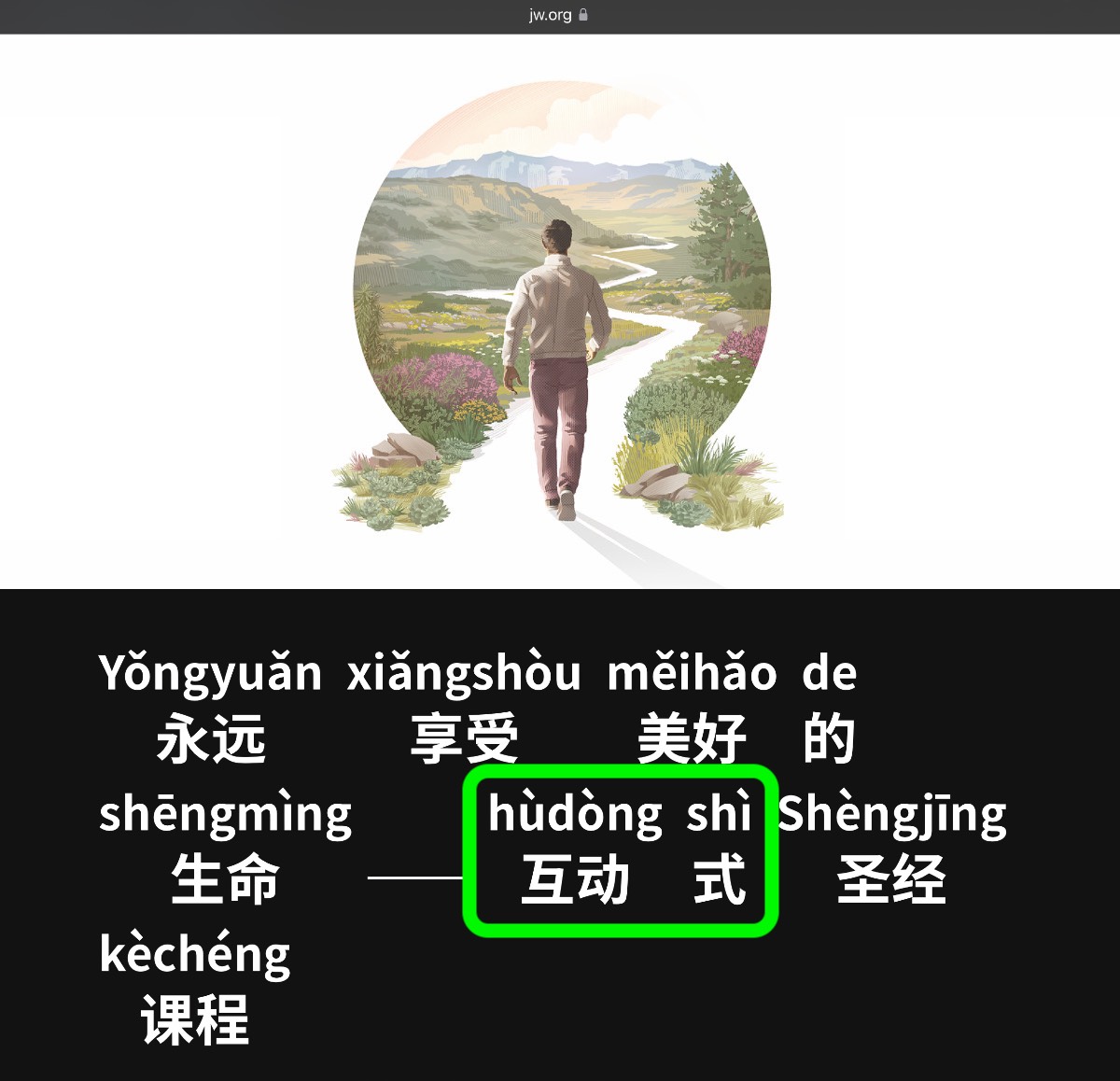
This week’s MEotW, which appears right in the title of the Mandarin Was Life Created? brochure, is “chuàngzào (chuàng·zào initiating · {making, creating} → [creating | creation; innovation] 创造 創造). While this is basically a verb meaning “create”, it can also be used as a noun meaning “creation”. Such verbal/gerundial nouns were discussed in the MEotW post on “jiàodǎo (jiào·dǎo teaching · {guiding [→ [instructing]]} 教导 教導)”:

One interesting thing to note about “jiàodǎo (jiào·dǎo teaching · {guiding [→ [instructing]]} 教导 教導)” (and about “jiàoxun (teaching → [reprimanding | knowledge gained from an error] 教训 教訓)”, for that matter) is that their component morphemes seem to basically be verbs. In certain contexts, however, they are used as nouns. An example of this being done in English is that “teach” and “teaching” are verbs (e.g. “Jesus was teaching the crowd.”), but in certain contexts, “teaching” is used as a noun (e.g. “The crowd was amazed at the teaching Jesus shared with them.”). When a word is used this way, it’s called a verbal noun, or a gerundial noun. Verbal nouns are quite common in Mandarin.

How It Breaks Down

The “chuàng (initiate; create; start; originate; {achieve (sth. for the first time)}創/刱/剏/剙) in “chuàngzào (chuàng·zào initiating · {making, creating} → [creating | creation; innovation] 创造 創造) is also used in “Chuàngshìjì (Chuàng·shì·jì {Initiating, Creating of} · {Generation → [World]} · Record → [Genesis] 创世记 創世記), and is associated with originality and creativity. For example, this “chuàng (initiate; create; start; originate; {achieve (sth. for the first time)}創/刱/剏/剙) also occurs in “chuàngzuò (chuàng·zuò initiated; created; originated · {made [→ [written/composed]]} [(thing)] [→ [created; produced; written [(thing)]] [→ [creative work; creation]]] 创作 創作) and in “chuàngzuò lì ((chuàng·zuò {to initiate/create/originate} · {to make [→ [to write/compose]]} → [to create/produce/write] 创作 創作) (lì power → [ability] 力) [creative ability; creativity; originality]), which can respectively mean “creative work” and “creativity”.

As for the “zào (make; build; create 造) in “chuàngzào (chuàng·zào initiating · {making, creating} → [creating | creation; innovation] 创造 創造), it’s more associated with making and building, and it’s the same “zào (make; build; create 造) that’s in “jiànzào (construct; build 建造). “Jiànzào (build 建造) fángwū (houses 房屋), for example, means “build houses”.

How It Comes Together

So, “chuàngzào (chuàng·zào initiating · {making, creating} → [creating | creation; innovation] 创造 創造), being made up of “chuàng (initiate; create; start; originate; {achieve (sth. for the first time)}創/刱/剏/剙) and “zào (make; build; create 造), covers the entire process of coming up with the idea for something, and then actually making or building it. This is in contrast with the idea of theistic evolution (Mandarin: Shéndǎo‐jìnhuà‐lùn ((Shén·dǎo God · guided; led 神导 神導)‐(jìn·huà {to advance} · transforming → [evolution] 进化 進化)‐(lùn discussing → [theory; doctrine]) [theistic evolution])), that God somehow got the ball rolling and then sat back and let the process of evolution develop all the wonderful living things in the natural world.

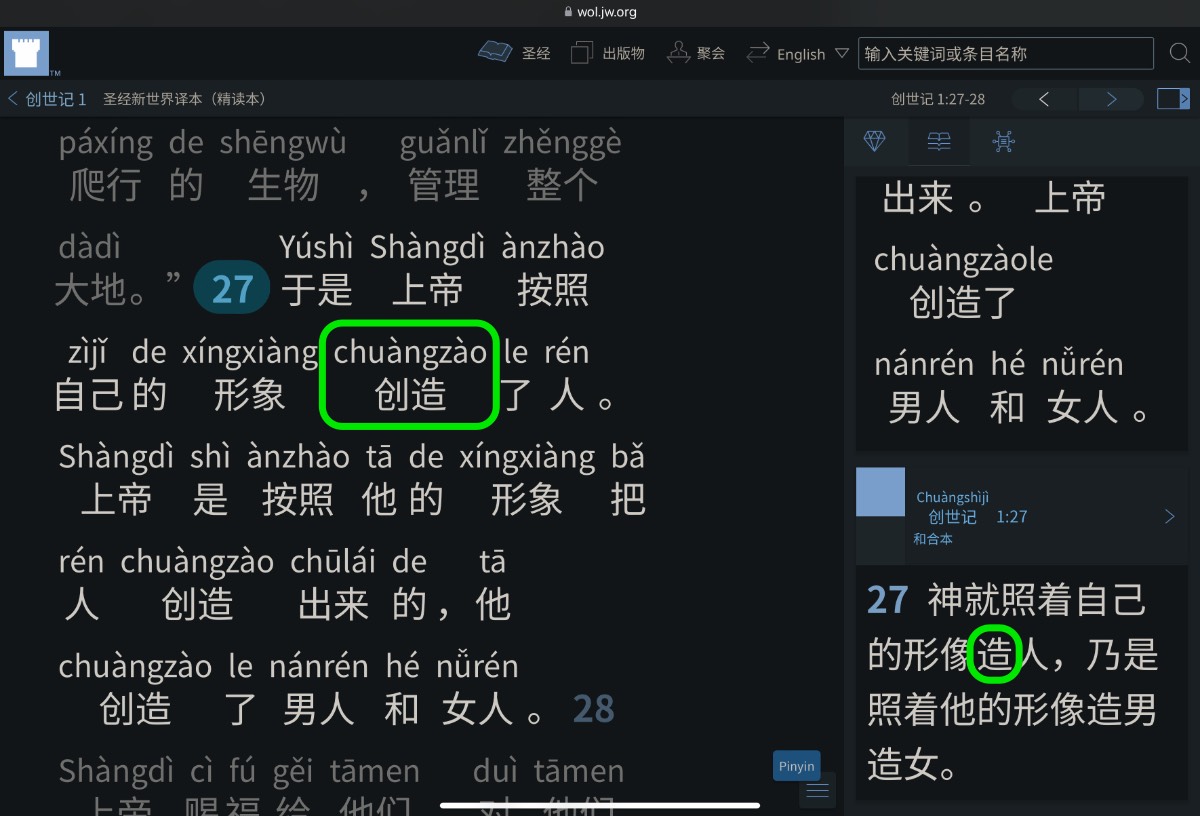
One person in particular whom I remember having such a viewpoint was my grade 7 teacher, who was actually quite smug about how her Catholic/personal beliefs had thus seemingly neatly reconciled the contradictions between the worldly “scientific” theory of evolution and the creation account in the Bible book of Genesis. However, the actual wording of the Genesis account, including how it is often translated into Mandarin, does not really go along with such a seemingly neat reconciliation with evolution.—Genesis 1:27 (English WOL, Mandarin WOL, Pīnyīn (Pīn·yīn {Piecing Together of} · Sounds → [Pinyin] 拼音) Plus).

“_Chuàngzào_” in Genesis 1:27 (NWT (nwtsty), WOL CHS+Pinyin), with “_zào_” in _Héhé Běn_

To represent how God caused humans to come into existence, the Mandarin New World Translation Bible uses “chuàngzào (chuàng·zào initiated · {made, created} → [created] 创造 創造), and the Héhé Běn ((Hé·hé Harmonious · {Closed → [United]} 和合) (Běn {Root or Stem} → [Edition] 本) [Union Version (Chinese Bible)]) uses “zào (made; built; created 造). Both these expressions contain the sense of “made, created”, and perhaps “built”.

How the Py+ Material Is Going

A while ago, I got the feeling that I should shift focus to get to work on producing current-generation Pīnyīn (Pīn·yīn {Piecing Together of} · Sounds → [Pinyin] 拼音) Plus material for the Was Life Created? brochure, which I had last produced older-style material for several years earlier. The official material for this brochure had also not been changed for several years, with the last Mandarin printing of it being dated 2016-12.

However, not long after I had started working on new Pīnyīn (Pīn·yīn {Piecing Together of} · Sounds → [Pinyin] 拼音) Plus material for this brochure, I noticed that a new printing, dated 2022-12, had been put out for the English version of the Was Life Created? brochure, and then, a new printing, dated 2023-02, appeared in the JW Library app for the Mandarin version of this brochure. Also, the Was Life Created? brochure and the Origin of Life brochure were added to the Teaching Toolbox section in the JW Library app at around this time. It seems that Jehovah had decided that the time had come for renewed focus on these brochures, and it seems that the work of producing Pīnyīn (Pīn·yīn {Piecing Together of} · Sounds → [Pinyin] 拼音) Plus material for the Was Life Created? brochure was privileged to be part of this renewed focus.

At the time of this writing, the old 3-line files (iPad-Letter-A4, XLP-iPhone-A5) together with the newer Pīnyīn (Pīn·yīn {Piecing Together of} · Sounds → [Pinyin] 拼音) Plus web resource cover the entire Was Life Created? brochure. (The 3-line files were based on an older version of the brochure, though.) The Pīnyīn (Pīn·yīn {Piecing Together of} · Sounds → [Pinyin] 拼音) Plus web resource (which can be used offline in supporting browsers) itself now covers the entire Was Life Created? brochure except for page 17.


For convenience:

The direct link for the current generation Pīnyīn (Pīn·yīn {Piecing Together of} · Sounds → [Pinyin] 拼音) Plus resource for the Was Life Created? brochure is:

The short link for Chinese field language-learning links for the Was Life Created? brochure is:

More Pīnyīn (Pīn·yīn {Piecing Together of} · Sounds → [Pinyin] 拼音) and Pīnyīn (Pīn·yīn {Piecing Together of} · Sounds → [Pinyin] 拼音) Plus web material based on the Mandarin Was Life Created? brochure will be made available in the Pīnyīn (Pīn·yīn {Piecing Together of} · Sounds → [Pinyin] 拼音) Plus web resource as time allows. Work is now underway to produce a Pīnyīn (Pīn·yīn {Piecing Together of} · Sounds → [Pinyin] 拼音) Plus web resource for the Mandarin Origin of Life brochure as well.

Categories
Culture Science Theocratic

jǐngjǐng‐yǒu‐tiáo

jǐngjǐng‐yǒu‐tiáo ((jǐng·jǐng {[is] neat; orderly} · {[is] neat; orderly} → [[is] methodical] 井井)‐(yǒu {[is] having} 有)‐(tiáo {sth. long and narrow; strip; slip} → [orderliness]) [[is] in perfect order; shipshape; methodical; neat and tidy]) 👈🏼 Tap/click to show/hide the “flashcard”

[Notes: Tap/click on a Pīnyīn (Pīn·yīn {Piecing Together of} · Sounds → [Pinyin] 拼音) expression to reveal its “flashcard”; tap/click on a “flashcard” or its Pīnyīn (Pīn·yīn {Piecing Together of} · Sounds → [Pinyin] 拼音) expression to hide the “flashcard”. 📖 📄 📘 icons mean 📖 Reveal All, 📄 Reveal Advanced, and 📘 Reveal None re all the “flashcards” in the heading, paragraph, etc. that they are placed at the beginning of.]

Not that long ago, the No. 3 2021 issue of Awake! magazine was featured in the Teaching Toolbox of the JW Library app. This week’s MEotW, “jǐngjǐng‐yǒu‐tiáo ((jǐng·jǐng {[is] neat; orderly} · {[is] neat; orderly} → [[is] methodical] 井井)‐(yǒu {[is] having} 有)‐(tiáo {sth. long and narrow; strip; slip} → [orderliness]) [[is] in perfect order; shipshape; methodical; neat and tidy])”, occurs in the second paragraph (that is, the first regular paragraph) of the article in that issue entitled “Yǔzhòu (Yǔ·zhòu Universe · {All Time, Past, Present, and Future} → [The Universe] 宇宙) Gàosu (Tells 告诉 告訴) Wǒmen (Wǒ·men Us · [pl] 我们 我們) Shénme (Shén·me What · [suf] 什么 什/甚麼)?” (“What the Universe Tells Us”):

English:

The universe is organized. “Galaxies are not randomly splayed out across the sky but instead follow a weblike pattern,” according to an article in Astronomy magazine. How is this possible? Scientists believe that the secret may lie in an invisible material known as dark matter. This dark matter has been called “a kind of unseen scaffolding upon which . . . galaxies, galaxy clusters, and galaxy superclusters . . . are aligned and supported.”

Mandarin:

📖 📄 📘 Yǔzhòu (Yǔ·zhòu universe · {all time, past, present, and future} → [the universe] 宇宙) shì (is 是) jǐngrán (jǐng·rán orderly · correct → [methodical] 井然)yǒuxù (yǒu·xù having · order → [systematic] 有序) de ({’s (thing)} 的). Tiānwén‐Xué ((Tiān·wén Heavens’ · {Natural Phenomena} → [Astronomy] 天文)‐(Xué Studying) [Astronomy]) zázhì (zá·zhì miscellaneous · records (publication) → [magazine] 杂志 雜志/誌) de (’s 的) (one 一) piān ({piece of an} → [mw for paper, book leaves, articles, chapters, Psalms, etc.] 篇) wénzhāng (wén·zhāng writing · composition → [article] 文章) shuō (said說/説): “Xīngxì (Xīng·xì {of stars} · {tied (things) → [systems]} → [galaxies] 星系) zài (in 在) tàikōng (tài·kōng highest · {(that which) is empty → [space]} → [outer space] 太空) zhōng (within 中) de (’s 的) fēnbù (fēn·bù {being divided → [being distributed]} · {being spread} → [distribution] 分布 分布/佈) (not 不) shì (is 是) záluàn (zá·luàn mixed · random → [disorderly] 杂乱 雜亂) (without無/无)zhāng (sections → [structure] 章) de ({’s (thing)} 的), ér ({but (rather)} 而) shì (is 是) jǐngjǐng‐yǒu‐tiáo ((jǐng·jǐng orderly · orderly → [methodical] 井井)‐(yǒu having 有)‐(tiáo strips → [orderliness]) [methodical]) de ({’s (thing)} 的).” Wèi‐shénme ((Wèi for)‐(shén·me what · [suf] 什么 什/甚麼) [why]) huì ({would (it)}) zhèyàng (zhè·yàng (be) this · {pattern → [way]} 这样 這樣) ne ([? ptcl] 呢)? Kēxué‐jiā ((Kē·xué {branches of study} · learning → [science] 科学 科學)‐(jiā -ists 家) [scientists]) rènwéi (rèn·wéi identify · {(it) to be} 认为 認為), qízhōng (qí·zhōng {them (the reasons)} · among 其中) de (’s 的) guānjiàn (guān·jiàn {closing → [key part]} · key → [key] 关键 關鍵) zàiyú (zài·yú exists · in → [lies in] 在于 在於) (one 一) zhǒng ({kind of}種/种) kàn‐bujiàn ((kàn {looked at} 看)‐(bu·jiàn not · {is seen} 不见 不見) [invisible]) de (’s 的) dōngxi (dōng·xi east · west → [thing] 东西 東西), jiàozuò (jiào·zuò called · {to be} 叫做) àn (dark 暗)wùzhì (wù·zhì matter · substance → [matter] 物质 物質). Àn (dark 暗)wùzhì (wù·zhì matter · substance → [matter] 物质 物質) hǎobǐ (hǎo·bǐ well · {is compared to} → [may be likened to] 好比) (one 一) ge ([mw]個/个) kàn‐bujiàn ((kàn {looked at} 看)‐(bu·jiàn not · {is seen} 不见 不見) [invisible]) de (’s 的) kuàngjià (kuàng·jià frame · rack → [frame] 框架)ràng (making) xīngxì (xīng·xì {of stars} · {tied (things) → [systems]} → [galaxies] 星系), xīngxì (xīng·xì {of stars} · {tied (things) → [system]} → [galaxy] 星系)tuán ({rolled into balls (things)} → [clusters]團/糰), ({(together) with} → [and]和/龢) chāo‐xīngxì‐tuán ((chāo {jumping/leaping over} → [super-] 超)‐(xīng·xì {of stars} · {tied (things) → [system]} → [galaxy] 星系)‐(tuán {rolled into balls (things)} → [clusters]團/糰) [galaxy superclusters])liú (stay留/畱) zài (in 在) gùdìng (gù·dìng {being firm → [firmly]} · set 固定) de (’s 的) wèizhi (wèi·zhi {places → [positions]} · placed → [positions] 位置) shang (upon 上)”.

As can be seen from above, where the English article says that galaxies are distributed according to a pattern, the Mandarin version says that the distribution of galaxies in space is “jǐngjǐng‐yǒu‐tiáo ((jǐng·jǐng orderly · orderly → [methodical] 井井)‐(yǒu having 有)‐(tiáo strips → [orderliness]) [methodical])”. Yes, here is yet another Mandarin expression that we can use to express that the universe is highly organized.

Whether or not dark matter really exists or there is some other explanation for the effects currently attributed by many to dark matter, the bottom line is that with all the forces, phenomena, natural laws, etc. at play, the galaxies, etc. in the universe are not randomly and chaotically distributed, but rather, are very methodically ordered and arranged. This testifies to the existence of “some organizing principle”, as one influential astronomer quoted in the above-mentioned article put it, or God, as the Bible puts it.—Genesis 1:1.

“A…Pattern”

Many in the world are scouring the heavens looking for signs of extraterrestrial intelligence, for example, as part of the SETI initiative. Well, as the Awake! issue mentioned above shows, and as the Bible says at Psalm 19:1:

The heavens are declaring the glory of God;
The skies above proclaim the work of his hands.

The truth is that the universe is full of patterns, like the orderly distribution of the galaxies, that are far from random, and that realistically could only have come from God, who technically qualifies as an Extraterrestrial (outside the earth) Superintelligence (an intelligence beyond that of humans). Unfortunately, Satan’s world has brainwashed even highly intelligent scientists with preconceived ideas and prejudices that make them just reflexively filter out and dismiss patterns that are right in front of them, but that are “natural”!

Categories
Culture Language Learning Science Technology Theocratic

yǔzhòu

yǔzhòu (yǔ·zhòu universe · {all time, past, present, and future} → [[the] universe; cosmos; space | cosmic] 宇宙) 👈🏼 Tap/click to show/hide the “flashcard”

[Notes: Tap/click on a Pīnyīn (Pīn·yīn {Piecing Together of} · Sounds → [Pinyin] 拼音) expression to reveal its “flashcard”; tap/click on a “flashcard” or its Pīnyīn (Pīn·yīn {Piecing Together of} · Sounds → [Pinyin] 拼音) expression to hide the “flashcard”. 📖 📄 📘 icons mean 📖 Reveal All, 📄 Reveal Advanced, and 📘 Reveal None re all the “flashcards” in the heading, paragraph, etc. that they are placed at the beginning of.]

At the time of this writing, jw.org was featuring an article from the No. 3 2021 issue of Awake! magazine, about what the universe tells us about a Creator. The title of this article, in English and in Mandarin, is as follows:

English:

What the Universe Tells Us

Mandarin:

📖 📄 📘 Yǔzhòu (Yǔ·zhòu Universe · {All Time, Past, Present, and Future} → [The Universe] 宇宙) Gàosu (Tells 告诉 告訴) Wǒmen (Wǒ·men Us · [pl] 我们 我們) Shénme (Shén·me What · [suf] 什么 什/甚麼)?

As can be seen from the above example, “yǔzhòu (yǔ·zhòu universe · {all time, past, present, and future} → [[the] universe; cosmos; space | cosmic] 宇宙)”, this week’s MEotW, is the Mandarin expression meaning “the universe”. And, as can be seen from this expression’s Pīnyīn (Pīn·yīn {Piecing Together of} · Sounds → [Pinyin] 拼音) Plus “flashcard”, its constituent morphemes mean “[the] universe; all time, past, present, and future”.

Wiktionary’s entry for “yǔzhòu (yǔ·zhòu universe · {all time, past, present, and future} → [[the] universe; cosmos; space | cosmic] 宇宙) contains the following comment about the etymology of this expression:

Meyer (2010) proposes that “eaves and roof beams” was a synecdoche for a domicile’s entire space; this figure of speech would later be appropriated by early authors and later Huainanziʼs contributors as “a metaphor for the cosmos, taking “eaves” [] and “roof beams” [] to represent the dimensions of space and time[, respectively] that compose the entire phenomenal universe.”[1]

Spacetime

Interestingly, these meanings of the morphemes in “yǔzhòu (yǔ·zhòu universe · {all time, past, present, and future} → [[the] universe; cosmos; space | cosmic] 宇宙) match up with the morphemes in the English word “spacetime”. The Wikipedia article for this is introduced with the following:

In physics, spacetime, also called the space-time continuum, is a mathematical model that fuses the three dimensions of space and the one dimension of time into a single four-dimensional continuum. Spacetime diagrams are useful in visualizing and understanding relativistic effects, such as how different observers perceive where and when events occur.

Until the turn of the 20th century, the assumption had been that the three-dimensional geometry of the universe (its description in terms of locations, shapes, distances, and directions) was distinct from time (the measurement of when events occur within the universe). However, space and time took on new meanings with the Lorentz transformation and special theory of relativity.

In 1908, Hermann Minkowski presented a geometric interpretation of special relativity that fused time and the three spatial dimensions into a single four-dimensional continuum now known as Minkowski space. This interpretation proved vital to the general theory of relativity, wherein spacetime is curved by mass and energy.

“Because They Were Designed?”

“Yǔzhòu (Yǔ·zhòu universe · {all time, past, present, and future} → [[the] universe; cosmos; space | cosmic] 宇宙) also appears in the concluding paragraph of the above-mentioned article from the No. 3 2021 issue of Awake!:

English:

Based on his scientific knowledge of the universe and its properties, physicist Paul Davies concluded: “I cannot believe that our existence in this universe is a mere quirk of fate, an accident of history, an incidental blip in the great cosmic drama. . . . We are truly meant to be here.” Davies does not teach that God created the universe and human life, but what do you think? The universe and the earth seem to be designed to make life possible. Could it be that they seem that way because they were designed?

Mandarin:

📖 📄 📘 Wùlǐ‐xué‐jiā ((Wù·lǐ things’ · {logic → [laws]} → [physics] 物理)‐(xué studying)‐(jiā -ist 家) [physicist]) Bǎoluó (Paul 保罗 保羅) Dàiwéisī (Davies 戴维斯 戴維斯) gēnjù (gēn·jù {(at) root} · {according to} → [based on] 根据 根據) zìjǐ (self 自己) duì (towards) yǔzhòu (yǔ·zhòu universe · {all time, past, present, and future} → [the universe] 宇宙) (and 及) tiānwén (tiān·wén heavens’ · {natural phenomena} → [astronomical] 天文) fǎzé (fǎ·zé laws · principles 法则 法則) de ( 的) liǎojiě (liǎo·jiě understanding · {untying → [solving]} → [understanding] 了解 了/瞭解) zhèyàng (zhè·yàng this · {form → [way]} 这样 這樣) shuō (said說/説): “ (I 我) wúfǎ (wú·fǎ {do not have} · {way to} → [cannot] 无法 無法) xiāngxìn (xiāng·xìn {each other → [it]} · believe → [believe] 相信), rénlèi (rén·lèi human·kind 人类 人類) zài (in 在) zhèige (zhèi·ge this · [mw] 这个 這個) yǔzhòu (yǔ·zhòu universe · {all time, past, present, and future} → [universe] 宇宙) de (’s 的) cúnzài (cún·zài existing · {being present} 存在), zhǐshì (zhǐ·shì merely · is 只是) qiǎohé (qiǎo·hé {being coincidental → [coincidentally]} · {closing → [fitting]} → [coincidental] 巧合) huò (or 或) xìjù‐xìng ((xìjù (having) drama 戏剧 戲劇)‐(xìng nature → [quality] 性) [dramatic]) de (’s 的) tūfā (tū·fā {chimney → [dashing forward → [unexpectedly]]} · issued → [appeared unexpectedly] 突) shìjiàn (shì·jiàn incident · [mw] 事件)wǒmen de ((wǒ·men us · [pl] 我们 我們) (de ’s 的) [our]) cúnzài (cún·zài existing · {being present} 存在) kěndìng (kěn·dìng agreeing · certainly → [definitely] 肯定) shì (is 是) yǒu (having 有) yuányīn (yuán·yīn origin · reason 原因) de ({’s (thing)} 的).” Dàiwéisī (Davies 戴维斯 戴維斯) bìng (actually並/竝/并) méiyǒu (méi·yǒu not · {has → [does]} → [does not] 没有 沒有) zhǔzhāng (zhǔ·zhāng advocate · spread (that) → [hold (that)] 主张 主張) yǔzhòu (yǔ·zhòu universe · {all time, past, present, and future} → [the universe] 宇宙) ({(together) with} → [and]和/龢) rénlèi (rén·lèi human·kind 人类 人類) shì (are 是) Shàngdì (Shàng·dì Above’s · {Emperor → [God]} → [God] 上帝) chuàngzào (chuàng·zào initiated · {made, created} → [created] 创造 創造) de ({’s (things)} 的). Dàn (but 但) (you 你) juéde (jué·de {to wake to → [to feel]} · {(how do) get} → [how do feel] 觉得 覺得) ne ([? ptcl] 呢)? Jìrán (Jì·rán since · -ly 既然) yǔzhòu (yǔ·zhòu universe · {all time, past, present, and future} → [the universe] 宇宙) ({(together) with} → [and]和/龢) dìqiú (dì·qiú earth · globe → [the earth] 地球) zhème (zhè·me {this (much)} · [suf for interrogatives and adverbs] 这么/末 這麼/末) shìhé (shì·hé {are suitable for} · {are closing with → [are fitting with]} 适合 適合) shēngmìng (life 生命) cúnzài (cún·zài existing · {being present} 存在), nàme (nà·me {(in) that (case) → [then]} · [suf] 那么/末 那麼/末) tāmen (tā·men it · [pl] [they] 它们 它/牠們) shì (are 是) bèi ([passive signifier] [were] 被) shèjì (shè·jì {set up} · planned → [designed] 设计 設計) chulai (chu·lai out · {to come} 出来 出來) de ({’s (things)} 的) ma ([? ptcl for “yes/no” questions])?

A Particular Need in the Mandarin Field

It’s worth noting that the No. 3 2021 issue of Awake! was recently in the Teaching Toolbox in the JW Library app. In fact, for a time, 3 out of the 6 books or brochures in the Teaching Toolbox—fully one half of them—were focused on the subject of creation/evolution. Additionally, the Enjoy Life Forever! book, which is still in the Teaching Toolbox, has an entire lesson on the subject “How Did Life Begin?”. This big presence in the Teaching Toolbox for a time of material focused on creation/evolution reflects a recent heavy emphasis on this issue on the part of the organization.

Indeed, for people in general to find real spiritual truth and make real spiritual progress, the question of the Creator’s existence is the first basic question that needs to be answered well in their minds, otherwise they are left with just the conflicting opinions, speculations, and platitudes of mere limited, imperfect humans. As Proverbs 9:10 says:

The fear of Jehovah is the beginning of wisdom,
And knowledge of the Most Holy One is understanding.

In the Mandarin field in particular, it is especially necessary to focus on the issue of the Creator’s existence, because current worldly Chinese culture has particularly heavily predisposed many Mandarin-speakers to not believe in a Creator.

At the same time, the worldwide Mandarin field is by far the largest language field in the world, and it’s likely that it is the largest language field ever in history.

Chart: Languages by First-Language Speakers—2019

So, the need is especially great for Mandarin field language learners to be able to help Mandarin-speakers overcome their cultural backgrounds and cultivate faith in the Creator!

Creation/Evolution, and Also the Great Wall of Characters

However, I suspect that even in their mother tongue, many Mandarin field language learners would be hesitant to discuss creation/evolution, since it is an especially deeply technical subject. Adding the requirement to conduct the discussion in Mandarin, which has traditionally been written using the extraordinarily complex Chinese characters, to many just makes an already daunting task seem even more undoable.

The Great Wall of China

In addition to the inherent technical difficulty of the subject of creation/evolution, Mandarin field language learners also face the Great Wall of characters.

To help with this formidable challenge, the organization’s official Mandarin digital material for the No. 3 2021 issue of Awake!, and for the Was Life Created? and Origin of Life brochures, is available with Pīnyīn (Pīn·yīn {Piecing Together of} · Sounds → [Pinyin] 拼音). Additionally, unofficial Pīnyīn (Pīn·yīn {Piecing Together of} · Sounds → [Pinyin] 拼音) Plus material—specifically designed, not to be spiritual food, but for helping Mandarin field language learners to get past the Great Wall of characters and actually learn to understand and speak the Mandarin they need—is available for the Was Life Created? and Origin of Life brochures, and should eventually be available for the No. 3 2021 issue of Awake! too. For updates on these Pīnyīn (Pīn·yīn {Piecing Together of} · Sounds → [Pinyin] 拼音) Plus resources, keep an eye on this blog, on the Links News blog, and on the related account on the social network of your choice listed on this blog’s Contact page.