Categories
Culture Experiences History Language Learning Technology Theocratic

zìxué‐chéngcái

zìxué‐chéngcái ((zì·xué self · learned; studied 自学 自學)‐(chéng·cái became · {capable person} 成才) [[be] self-taught]) 👈🏼 Tap/click to show/hide the “flashcard”

[Notes: Tap/click on a Pīnyīn (Pīn·yīn {Piecing Together of} · Sounds → [Pinyin] 拼音) expression to reveal its “flashcard”; tap/click on a “flashcard” or its Pīnyīn (Pīn·yīn {Piecing Together of} · Sounds → [Pinyin] 拼音) expression to hide the “flashcard”. 📖 📄 📘 icons mean 📖 Reveal All, 📄 Reveal Advanced, and 📘 Reveal None re all the “flashcards” in the heading, paragraph, etc. that they are placed at the beginning of.]

Recently, jw.org featured the video “Benjamin Boothroyd—A Self-Taught Bible Scholar”. Where the English title of this video uses the expression “self-taught”, the title of the Mandarin version uses this week’s MEotW, “zìxué‐chéngcái ((zì·xué self · learned; studied 自学 自學)‐(chéng·cái became · {capable person} 成才) [[be] self-taught])”:

English:

Benjamin Boothroyd—A Self-Taught Bible Scholar

Mandarin:

📖 📄 📘 Běnjiémíng (Benjamin 本杰明 本傑明) Bùsīluóyīdé (Boothroyd 布思罗伊德 布思羅伊德): Zìxué‐Chéngcái ((Zì·xué Self · Learned 自学 自學)‐(Chéng·cái Became · {Capable Person} 成才) [Self-Taught]) de (’s 的) Shèngjīng (Shèng·jīng Holy · Scriptures → [Bible] 圣经 聖經) Xuézhě (Xué·zhě Studying · Person → [Scholar] 学者 學者)

The Morphemes

The first morpheme in this week’s MEotW, “zì (self | from; since 自)”, here means “self”, as it does in “zìjǐ (self[’s] 自己)”. The next morpheme, “xué (learn/learning | study [→ [imitate]])”, here means “learned; studied”. Another expression in which it appears is “xuésheng (xué·sheng learning · {growing (one) → [student]} → [student; pupil] 学生 學生)”, which means “student”. These first two morphemes, when put together to form “zìxué (zì·xué self · learn; study 自学 自學)”, refer to learning or studying by oneself.

The third morpheme in this week’s MEotW, “chéng (become; {come to be}; {to turn into}; {to complete}; accomplish; succeed; {fully developed/grown}; {assume [the shape of]}; {to fill} | {to completion} 成)”, here means “became”. It also appears in many other expressions, including “chéngwéi (chéng·wéi become · {to be} 成为 成為) and “chénggōng (chéng·gōng {becoming [of]}; {accomplishing [of]} · {meritorious service/deed}; achievement → [succeed | success | successful[ly]] 成功)”. The final morpheme “cái ({only then} | {only (before a number)} | actually; really; very | talent; ability; gift | {capable person} | {person of a certain type}才/纔) in this context means “capable person”. So, “chéngcái (chéng·cái become · {capable person} 成才) here means “became capable person”, and the entire expression “zìxué‐chéngcái ((zì·xué self · learned; studied 自学 自學)‐(chéng·cái became · {capable person} 成才) [[be] self-taught]) literally means “self-learned/studied, became capable person”, and effectively means “self-taught”.

Being Self-Taught in the Mandarin Field

Apart from the introductory organization-sponsored language classes that many of us took, we Mandarin field language learners are pretty much all self-taught with regard to Mandarin, especially when it comes to the somewhat specialized Mandarin that we must use in the Mandarin field. But does being largely self-taught mean that none of us can really be any good at Mandarin? Are we doomed to plateau at a mediocre level at best?

One thing I appreciated from the video mentioned above is that Benjamin Boothroyd, who was self-taught but became a world-class Bible scholar and translator, was motivated only to pursue the truth. As he wrote (as mentioned in the English video starting at the 6:38 mark):

I have no interest to serve but that of truth.

Regarding those with such a focus on the truth, at John 18:37, Jesus said:

For this I have been born, and for this I have come into the world, that I should bear witness to the truth. Everyone who is on the side of the truth listens to my voice.

Those who are “on the side of the truth” and who listen to Jesus’ voice open themselves up to receiving the most important education we can get. This best possible education comes from Jehovah God himself, not any worldly or human source. As Isaiah 54:13 says:

And all your sons will be taught by Jehovah,
And the peace of your sons will be abundant.

Even when it comes to nontrivial technical matters, Jehovah can help certain ones develop the technical knowledge, skills, and expertise that are needed to accomplish his will. For example, as Exodus 35:30–35 tells us, he did so when some specialized technical work needed to be done when Moses and the Israelites were in the wilderness:

30 Then Moses said to the Israelites: “See, Jehovah has chosen Bezʹal·el the son of Uʹri the son of Hur of the tribe of Judah. 31 He has filled him with the spirit of God, giving him wisdom, understanding, and knowledge of every sort of craftsmanship 32 for making artistic designs, for working with gold, silver, and copper, 33 for cutting and setting stones, and for making all kinds of artistic wood products. 34 And he has put it into his heart to teach, he and O·hoʹli·ab the son of A·hisʹa·mach of the tribe of Dan. 35 He has filled them with skill to do all the work of a craftsman, an embroiderer, and a weaver using blue thread, purple wool, scarlet material, and fine linen, and of a loom worker. These men will do every sort of work and prepare every sort of design.

Yes, if we focus on the truth and stay open to Jehovah’s direction, we can make “self-taught” also mean “taught by Jehovah”! And since Jehovah created this universe that human scientists, technicians, artists, musicians, etc. are just trying to figure out and work in, he can, if he wants to, even potentially teach us to become more knowledgeable and skilled in certain fields than many worldly humans are, as he may have done with Bezʹal·el and O·hoʹli·ab.—Psalm 119:98–100.

Modern Resources for Mandarin Self-Learning

In support of our efforts to be successfully self-taught in effectively using Mandarin to praise and serve Jehovah, we today are blessed with many available resources, the likes of which Bezʹal·el, O·hoʹli·ab, and Mr. Boothroyd would undoubtedly have loved to have had access to. For example, one of the basic things that teaching and learning require is the transfer of information to those seeking to learn, and in that regard, we humans today generally have access to, at reasonable cost, computing—i.e., information-processing—devices that can easily be carried by hand, but that are, in some ways, millions of times more capable than the Apollo Guidance Computer (AGC) that guided the Apollo 11 spacecraft to the moon.

In addition to these mobile devices themselves, we should also consider the apps and the text, audio, video, etc. content that they enable us to use to help us learn Mandarin. These include the JW Language app, as well as the JW Library app that now allows for content that displays Pīnyīn (Pīn·yīn {Piecing Together of} · Sounds → [Pinyin] 拼音). Here are a couple of short links listing some of the resources available for Mandarin field language learners:

No Need to Have Impostor Syndrome in the Mandarin Field

In view of the above, if Jehovah has guided us to serve in the Mandarin field, we need not allow ourselves to be burdened with impostor syndrome, even if we haven’t received extensive worldly training in the Mandarin language. If we let ourselves be “taught by Jehovah” instead of just relying on our own talent or abilities or on mere worldly knowledge or human traditions, and if we resolutely make good use of the available resources and apply ourselves to learn whatever we need to learn in order to do Jehovah’s work well, Jehovah can and will bless our efforts and help us succeed. Also, if we follow Boothroyd’s example and pursue truth rather than “glory from men”, then the truth will be able to set us free from the unnecessary burdens imposed by proud but fallacious human traditions such as those involving Chinese characters. (John 5:41–44; 8:32) As the apostle Paul said at 1 Corinthians 1:26–31:

26 For you see his calling of you, brothers, that there are not many wise in a fleshly way, not many powerful, not many of noble birth, 27 but God chose the foolish things of the world to put the wise men to shame; and God chose the weak things of the world to put the strong things to shame; 28 and God chose the insignificant things of the world and the things looked down on, the things that are not, to bring to nothing the things that are, 29 so that no one might boast in the sight of God. 30 But it is due to him that you are in union with Christ Jesus, who has become to us wisdom from God, also righteousness and sanctification and release by ransom, 31 so that it may be just as it is written: “The one who boasts, let him boast in Jehovah.”

Categories
Culture Current Events Experiences History Language Learning Science Technology

zìmǎn

zìmǎn (zì·mǎn self · {full → [satisfied]} → [complacent; self-satisfied; smug] 自满 自滿) 👈🏼 Tap/click to show/hide the “flashcard”

As a Chinese person who grew up in a Western country, and who came to serve in Chinese language fields, I sometimes pondered a question that I eventually learned is called the Needham Question:

“Needham’s Grand Question”, also known as “The Needham Question”, is this: why had China been overtaken by the West in science and technology, despite their earlier successes? In Needham’s words,

“Why did modern science, the mathematization of hypotheses about Nature, with all its implications for advanced technology, take its meteoric rise only in the West at the time of Galileo?”, and why it “had not developed in Chinese civilization” which, in the previous many centuries “was much more efficient than occidental in applying” natural knowledge to practical needs.[source][source]

Indeed, China long ago gave us the Four Great Inventions (the compass, gunpowder, papermaking, and printing), so why did it stop inventing such great things, and leave it to the West to invent digital computers, go to the moon first, etc.?

The Wikipedia page linked to above, and also this page that I found on the web, mention many possible factors that scholars have proposed relating to the Needham Question. It may be said that since this question focuses on scientific and technological progress in the context of human political and cultural systems, it is not quite the number one question that we Mandarin field language learners need to be concerned with. However, gaining some understanding of factors relating to this question can help us develop a balanced view of how and how much we should allow traditional Chinese political and cultural views to influence how we apply science and technology to our God-honouring and life-saving work in the Mandarin field. At the very least, the very fact that many have pondered the Needham Question over the years demonstrates that no, worldly Chinese culture is not so perfect and accomplished that we should just unquestioningly adopt worldly Chinese ways of doing things in the Mandarin field.

While the web pages linked to above discuss many sociological, cultural, technical, etc. factors that may have played a role in how China developed, or failed to develop, scientifically and technologically compared to the West, going over this information brought to mind some principles mentioned in the Bible.

“By Their Fruits”

Regarding what really matters in our lives and in our work, Jesus said this at Matthew 7:16–18:

By their fruits you will recognize them. Never do people gather grapes from thorns or figs from thistles, do they? Likewise, every good tree produces fine fruit, but every rotten tree produces worthless fruit. A good tree cannot bear worthless fruit, nor can a rotten tree produce fine fruit.

I remember in years past seeing ads for job openings that required candidates to be “results-oriented”. When I saw such ads, I would wonder, “Why bother saying that? Isn’t every worker of course supposed to be results-oriented?” It turns out that actually, many people are more focused on appearing to be working, on procedures for their own sake, on climbing the corporate ladder, on office politics, etc., than on actually doing the work and getting results.

What Jesus said in the above-quoted scripture emphasizes to us that in our lives and in our work as his disciples, we should be focused on producing “fine fruit”, getting good results for Jehovah, not just on unthinkingly following whatever traditions or procedures we inherited from the worldly human culture we grew up with. Also, we should not be focused on appearing to others who also grew up with such traditions, procedures, and ways of doing things that we are following them, so as to get “glory from men”.—John 5:39–44.

“Pride Is Before a Crash”

As someone who has studied and worked with technology for decades, one thing I have observed regarding the march of changing computing technologies—e.g., impressive IBM mainframes being eclipsed by “toy” personal computers running Microsoft and Apple operating systems, Microsoft’s then-CEO ridiculing the iPhone when it came out, Microsoft prioritizing its Windows legacy and becoming largely irrelevant in the mobile and tablet spaces, etc.—is that the Bible principle at Proverbs 16:18 holds true:

Pride is before a crash,
And a haughty spirit before stumbling.

This basic factor of the progress-limiting effects of being proud and self-satisfied is well expressed in this week’s MEotW, “zìmǎn (zì·mǎn self · {full → [satisfied]} → [complacent; self-satisfied; smug] 自满 自滿)”. As is often discussed on this blog, in the Mandarin field, one area in which progress-limiting pride and self-satisfaction play huge roles is the attitude of many towards the archaic, cumbersome human-invented technology that is the Chinese characters. And yes, a writing system like the Chinese characters is indeed a technology:

[Writing] really is a technology. It’s a thing you do on top of language to do stuff with language, but it’s not the language itself. There are thousands and possibly millions of languages that have never been written down in the history of humanity. We have no idea. We’ve never met a society of humans, or heard of a society of humans, without language. But those are spoken and signed languages, which are just kind of there. Writing, by contrast, was invented somewhere between 3 and 4 times in the history of humanity.

Since writing systems like the Chinese characters are technologies, we should expect writing systems to change and progress like other technologies do, no matter how proud and self-satisfied some people are when it comes to traditional, long-established writing systems like the Chinese characters.

If we generally no longer use punched cards to control computers because we now have keyboards, mice, trackpads, touchscreens, etc., then why use the archaic Chinese characters when the more modern simple and elegant Pīnyīn (Pīn·yīn {Piecing Together of} · Sounds → [Pinyin] 拼音) system is available? Is “‘everyone’ still uses Chinese characters” really a good reason? What if “everyone” still used punched cards? What would you do, as someone who knows about way better and easier-to-use alternatives?

Punched card used to load software into an old mainframe computer

Creative Commons Attribution License logo BinaryApe [source]

Chinese characters are the punched cards of writing systems. Punched cards were not totally impossible to use, but there are now much better and easier-to-use ways to control computers.

Of course, in situations in which we need to share information with people who still use computers controlled by punched cards, we would probably need to use punched cards, but how about other situations? Similarly, when producing publications for or writing to people who only read Chinese characters, we need to use Chinese characters, but how about other situations? For example, we Mandarin field language learners usually read and write Mandarin so that we ourselves can be helped to say something good in Mandarin at the right time. Can we make advantageous use of Pīnyīn (Pīn·yīn {Piecing Together of} · Sounds → [Pinyin] 拼音) in such situations?

Avoid Unbalanced Admiration

Both Western and Eastern human worldly cultures have their strong points and successes, but they also both have their problematic aspects and failures. So, we should not oversimplify things and jump to the conclusion that either culture is all good or all bad. I myself have found it advantageous to have had the opportunity to be exposed to both Western and Eastern ways of doing things, and to be able to select useful aspects of both to apply in my own life and work. Yes, balanced appreciation of the possibly useful differences between East and West can be beneficial. However, especially since we have the privilege of being taught by Jehovah himself, we need to avoid unbalanced admiration of either Eastern or Western worldly human cultures. (Isaiah 54:13; John 6:45; 1 Corinthians 1:18–31) We Mandarin field language learners particularly need to avoid having what sinologist and linguist John DeFrancis called “Exotic East Syndrome”:

The belief that in the Orient things strange and mysterious replace the mundane truths applicable to the West.

Yes, spiritual and scientific truths remain true for China and Chinese people, such as the basic linguistic truth that speech is primary and writing is secondary.

Commendably, many Chinese individuals have shown themselves to be humble lovers of truth. Unfortunately, though, as I have studied the worldly Chinese culture, I have found that it is in many ways a proud, self-satisfied culture, as described by this week’s MEotW. As has been discussed before on this blog, China is the only nation that routinely calls itself the “Central Nation (Zhōngguó (Zhōng·guó Central · Nation → [China | Chinese] 中国 中國))”. Also, the whole concept of “losing/saving face” is based on the worldly Chinese concept of miànzi (miàn·zi face · [suf for nouns] [→ [reputation; prestige; esteem; honor]] 面子).

As for the worldly Chinese/Eastern cultural practice that “the nail that sticks out gets hammered down”, this really shows pride and self-satisfaction on a systemic or cultural level—while enforcing humility (humiliation?) among individuals, it shows that there is a proud and self-satisfied assumption that the system or culture overall is so good already that it is above being improved upon by “mere” individuals. Really, though, the only One who has demonstrated that he is truly at that level is Jehovah God himself, and the Bible shows that still, he is willing to invite individuals to provide their ideas and input, and to empower them to follow through on them. (1 Kings 22:19–23) Unlike many proud, self-satisfied humans and their systems and cultures, Jehovah has shown that he does not suffer from “not invented here” syndrome, the zìmǎn (zì·mǎn self · {full → [satisfied]} → [self-satisfied] 自满 自滿) belief that only he could possibly have a good idea or make or do something useful. This is so even though he himself is the Almighty Creator of the whole universe.

“Throw Off Every Weight”

Regarding the Needham Question, another Bible scripture that comes to mind for me is Hebrews 12:1, which says, in part:

Let us also throw off every weight…, and let us run with endurance the race that is set before us,

As is widely known, Chinese characters are a huge part of worldly Chinese culture, and with their inhuman number and complexity, they are also abnormally difficult for us imperfect humans to learn and remember. So, naturally, some wonder if Chinese characters have had the effect of weighing China down, or holding China back. In fact, as my article “Pīnyīn (Pīn·yīn {Piecing Together of} · Sounds → [Pinyin] 拼音) Was Plan A” says:

Concerning the obstacles presented by Chinese characters, the great Chinese writer Lǔ Xùn, who passed away in 1936, reportedly said, “Hànzì bú miè, Zhōngguó bì wáng.” (“汉字不灭,中国必亡。/ 漢字不滅,中國必亡。” “If Chinese characters are not abolished, China will certainly die.”)

Of course, since the time of Lǔ Xùn ((Lǔ {Stupid; Rash (surname)}) (Xùn Fast; Quick; Swift 迅) (pen name of Zhōu Shùrén, the greatest Chinese writer of the 20th cent. and a strong advocate of alphabetic writing)), China has not died, but has instead gone on to much worldly success, so at least so far, it seems that Chinese characters are not quite fatal to China. However, even a rudimentary technical analysis, along with real-world phenomema like tíbǐ (tí·bǐ {carry (hanging down from the hand) → [raise; lift]} · pen; pencil; {writing brush} [→ [start writing; write]] 提笔 提筆)wàng (forget 忘) (character 字) (character amnesia), makes it obvious that the extraordinary unnecessary complexities and vagaries of Chinese characters impose great costs and difficulties on those using them—who knows, if China had long ago moved on from the characters to use alphabetic writing, maybe it could have gotten to the moon first. True, some athletes purposely train while wearing additional weights, but the way traditional Chinese culture insists on pervasive use of the unnecessarily extraordinarily complex characters, it’s like requiring those athletes to actually run marathons, etc., for real while wearing heavy unnecessary weights.

In the Mandarin field, it seems quite possible that the unnecessary costs and difficulties imposed by characters could actually be fatal in some cases, barring extraordinary intervention from Jehovah God. As the article “Pīnyīn (Pīn·yīn {Piecing Together of} · Sounds → [Pinyin] 拼音) Was Plan A” goes on to say:

True, with the simplification of the characters, the assistance of Pīnyīn, and the extra hard work put forth by the Chinese people to “tough out” the extra technical burdens presented by the characters, it now seems unlikely from a worldly viewpoint that the use of characters will cause the nation of China to die (although we know it will die at Armageddon, and its culture’s influence will eventually fade away completely after that). However, how sad it would be if many Chinese people died unnecessarily because the ongoing obstacles presented by Chinese characters hindered our efforts to reach their hearts with the life-saving message from God’s Word.

So, as Hebrews 12:1 says, let us Mandarin field language learners “throw off every weight”, and whenever possible, not allow the unnecessary heavy cultural baggage of the Chinese characters to weigh us down in our vital God-honouring and life-saving work. Even if Jehovah makes special arrangements to make sure that none of his Chinese sheep ultimately get left behind, what will he think of us if we fail to make every reasonable effort to avoid unnecessary difficulties as we do this life-saving work that he has assigned to us?—Ezekiel 3:17–19.

Categories
Culture Experiences History Language Learning Technology Theocratic

guīju

guīju (guī·ju [([is] following)] {compasses; dividers → [rules; regulations]} · {carpenter’s squares → [rules; regulations]} → [[[is] following] rules; customs; established practices/standards | [[is] following] social etiquette; manners | [is] well-behaved; well-disciplined] 规矩 規矩) 👈🏼 Tap/click to show/hide the “flashcard”

[Notes: Tap/click on a Pīnyīn (Pīn·yīn {Piecing Together of} · Sounds → [Pinyin] 拼音) expression to reveal its “flashcard”; tap/click on a “flashcard” or its Pīnyīn (Pīn·yīn {Piecing Together of} · Sounds → [Pinyin] 拼音) expression to hide the “flashcard”. 📖 📄 📘 icons mean 📖 Reveal All, 📄 Reveal Advanced, and 📘 Reveal None re all the “flashcards” in the heading, paragraph, etc. that they are placed at the beginning of.]

I have long especially liked 1 Corinthians 13. It contains counsel on what really does and doesn’t matter in life, an extensive description and definition of the most important kind of love, and a sublime discussion about the need to become complete, mature, as a person. As these apply to life in general, so too do they apply to our lives as Mandarin field language learners.

As Mandarin field language learners, it can benefit us greatly to consider what we can learn from 1 Corinthians 13, and along the way, we can also consider some of the Mandarin expressions used in that chapter in the current version of the Mandarin New World Translation Bible (nwtsty).

“Does Not Behave Indecently”

This week’s MEotW, “guīju (guī·ju [([is] following)] {compasses; dividers → [rules; regulations]} · {carpenter’s squares → [rules; regulations]} → [[[is] following] rules; customs; established practices/standards | [[is] following] social etiquette; manners | [is] well-behaved; well-disciplined] 规矩 規矩)”, is used in verse 5 (WOL) of 1 Corinthians 13:
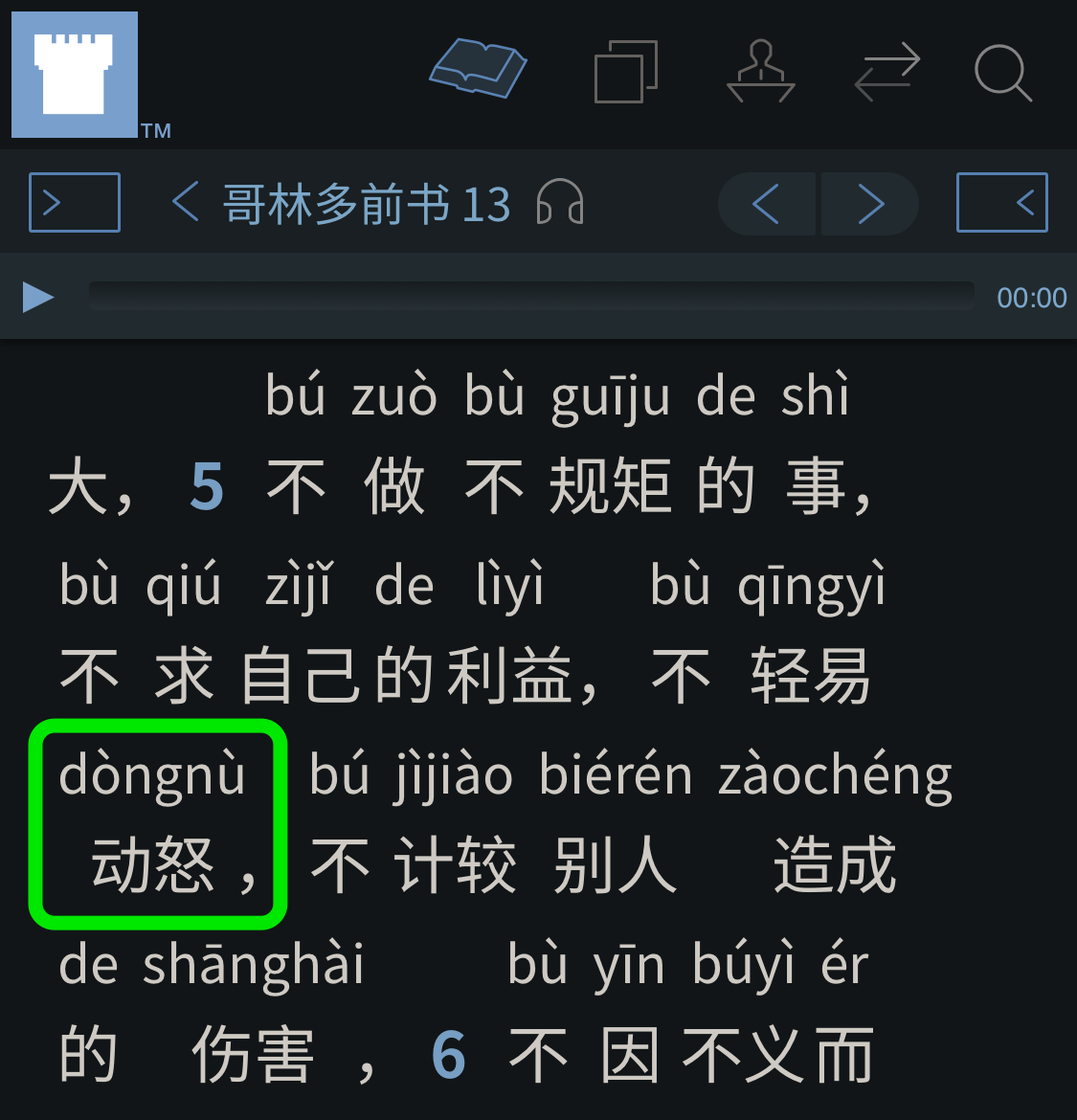
Screenshot of “_guīju_” in 1 Co. 13:5 (nwtsty, CHS+_Pīnyīn_ WOL)

(Dark mode for the Watchtower ONLINE LIBRARY (WOL) website, as shown in the above image, can be enabled in the Safari web browser by using the Noir Safari extension. Other web browsers may also have extensions with similar functionality.)

For comparison, here are the current English and Pīnyīn (Pīn·yīn {Piecing Together of} · Sounds → [Pinyin] 拼音) Plus renderings of 1 Corinthians 13:4, 5:

English:

4 Love is patient and kind. Love is not jealous. It does not brag, does not get puffed up, 5does not behave indecently, does not look for its own interests, does not become provoked. It does not keep account of the injury.

Pīnyīn (Pīn·yīn {Piecing Together of} · Sounds → [Pinyin] 拼音) Plus:

📖 📄 📘 4 Ài (love), yǒu (has 有) nàixīn (nài·xīn {being (of/with) enduring} · heart → [patience] 耐心), yòu (also 又) réncí (rén·cí {is kind} 仁慈). Ài (love), (not 不) jídù ({is jealous} 嫉妒), (not 不) chuīxū (chuī·xū {does puff → [does brag]} · {does sigh → [does praise]} → [does brag] 吹嘘 吹噓), (not 不) zìdà (zì·dà {(does consider) self} · {to be big → [to be great]} 自大), 5 (not 不) zuò ({does do} 做) (not 不) guīju (guī·ju (following) {dividers → [rules]} · {carpenter’s squares → [regulations]} → [following established standards] 规矩 規矩) de ( 的) shì (things 事), (not 不) qiú ({does seek} 求) zìjǐ (self 自己) de (’s 的) lìyì (lì·yì {sharpening → [advantage]} · benefit → [benefit] 利益), (not 不) qīngyì (qīng·yì lightly · easily 轻易 輕易) dòngnù (dòng·nù {does have moved} · anger → [does get angry] 动怒 動怒), (not 不) jìjiào (jì·jiào {does count} · {does dispute about} 计较 計較) biéren (bié·ren other · people 别人 別人) zàochéng (zào·chéng {have created} · {to come to be} 造成) de (’s 的) shānghài (injuring → [injury] 伤害 傷害),

The individual morphemes in “guīju (guī·ju [([is] following)] {compasses; dividers → [rules; regulations]} · {carpenter’s squares → [rules; regulations]} → [[[is] following] rules; customs; established practices/standards | [[is] following] social etiquette; manners | [is] well-behaved; well-disciplined] 规矩 規矩) literally mean “compasses; dividers” “carpenter’s squares”, and they both can effectively mean “rules; regulations”. When these morphemes are put together in “guīju (guī·ju [([is] following)] {compasses; dividers → [rules; regulations]} · {carpenter’s squares → [rules; regulations]} → [[[is] following] rules; customs; established practices/standards | [[is] following] social etiquette; manners | [is] well-behaved; well-disciplined] 规矩 規矩)”, the resulting expression effectively means “[[is] following] rules; customs; established practices/standards | [[is] following] social etiquette; manners | [is] well-behaved; well-disciplined”, corresponding, in the usage of 1 Corinthians 13:5 in the current English and Mandarin versions of the New World Translation Bible, with the English expression “decent”.

Decent According to Whom?

Especially since we are considering this expression as it’s used in God’s Word the Bible as part of direction from God that he inspired the apostle Paul to write down, we must understand that what is meant here by “decent” is determined from God’s point of view, not necessarily with regard to human traditions or conventions.

As followers of Christ, we should keep in mind that Jesus himself said and did some things that did not conform with the traditions and conventions of his time. For example, rather than just going along with the draconian* human traditions of the time regarding the Sabbath, Jesus, knowing the real purpose of the Sabbath, did God’s work on the Sabbath, including healing people. If you had been present, how would you have felt about what Jesus did? Would you have been glad that Jesus had accomplished such good things? Or, would you have been dismayed and offended by how Jesus broke tradition?

The Bible records that some people took issue with the healing that Jesus performed on the Sabbath, basically accusing Jesus of behaving indecently in their eyes. However, Jesus knew that it was more important to keep doing what was right and decent in God’s eyes than it was to follow the traditions and customs of mere humans.—Luke 13:10–17; John 5:1–17.

“Strife and Jealousy”

In the New World Translation Bible in the Watchtower Online Library, one of the scriptures linked to 1 Corinthians 13:5 with regard to “indecently” is Romans 13:13:

Let us walk decently as in the daytime, not in wild parties and drunkenness, not in immoral intercourse and brazen conduct, not in strife and jealousy.

Note that among the things that God’s Word lists as being indecent, along with things like drunkenness and sexual immorality, are “strife and jealousy”.

If someone makes an issue of a Mandarin field language learner who, say, uses Pīnyīn (Pīn·yīn {Piecing Together of} · Sounds → [Pinyin] 拼音) instead of following tradition and exclusively focusing on characters, is that person not being like those who made an issue of Jesus healing on the Sabbath? Instead of being happy and joyful because of the good that Jesus was doing, those opposers of Jesus were jealous of how “the entire crowd began to rejoice at all the glorious things he did”. (Luke 13:17) Opposers of Pīnyīn (Pīn·yīn {Piecing Together of} · Sounds → [Pinyin] 拼音) use today may similarly be jealous of how those who make good use of Pīnyīn (Pīn·yīn {Piecing Together of} · Sounds → [Pinyin] 拼音) can accomplish much in Jehovah’s service without having to put the kind of blood, sweat, and tears into learning characters the traditional way that they did. In their tradition-loving eyes, breaking from tradition and using innovative and game-changingly effective new tools like Pīnyīn (Pīn·yīn {Piecing Together of} · Sounds → [Pinyin] 拼音) may seem “indecent”, but in God’s eyes, it is the jealousy-motivated strife such ones cause over people doing good in his service that is truly indecent.

In God's organization, our unity is based on God's truth, not on human tradition.

[image or embed]

— tiandi, Links News (@tiandilinksnews.bsky.social) February 2, 2025 at 8:27 AM

Those who are motivated by true Christian love, as described in 1 Corinthians 13, would rejoice over how Pīnyīn (Pīn·yīn {Piecing Together of} · Sounds → [Pinyin] 拼音) helps Mandarin field language learners to bear witness to the truth more effectively, instead of considering it “cheating”, since love “rejoices with the truth”. (John 18:37; 1 Corinthians 13:6) Also, those who are motivated by true Christian love would not be jealous of how game-changing tools like Pīnyīn (Pīn·yīn {Piecing Together of} · Sounds → [Pinyin] 拼音) help Mandarin field language learners to more easily get more done, since “love is not jealous”. (1 Corinthians 13:4) Additionally, as per this week’s MEotW, those who are motivated by true Christian love would not stir up strife and make an issue of Mandarin field language learners beneficially using innovative new tools like Pīnyīn (Pīn·yīn {Piecing Together of} · Sounds → [Pinyin] 拼音) instead of just following human traditions involving characters, since love “does not behave indecently” in God’s eyes.—1 Corinthians 13:5.


* “Draconian” means “very severe, cruel, or harsh”, and it comes from an ancient word that means “dragon”. Guess what culture is one of the only ones to consider the dragon a good, positive symbol, in contrast to how the Bible uses the dragon to represent Satan the Devil. (Revelation 12:9) That’s right, it’s the worldly Chinese culture, the same one that improperly places primary emphasis on the proudly, perversely, abnormally difficult-to-learn-and-remember Chinese characters. ^