Categories
Culture Experiences History Language Learning Technology Theocratic

zìxué‐chéngcái

zìxué‐chéngcái ((zì·xué self · learned; studied 自学 自學)‐(chéng·cái became · {capable person} 成才) [[be] self-taught]) 👈🏼 Tap/click to show/hide the “flashcard”

[Notes: Tap/click on a Pīnyīn (Pīn·yīn {Piecing Together of} · Sounds → [Pinyin] 拼音) expression to reveal its “flashcard”; tap/click on a “flashcard” or its Pīnyīn (Pīn·yīn {Piecing Together of} · Sounds → [Pinyin] 拼音) expression to hide the “flashcard”. 📖 📄 📘 icons mean 📖 Reveal All, 📄 Reveal Advanced, and 📘 Reveal None re all the “flashcards” in the heading, paragraph, etc. that they are placed at the beginning of.]

Recently, jw.org featured the video “Benjamin Boothroyd—A Self-Taught Bible Scholar”. Where the English title of this video uses the expression “self-taught”, the title of the Mandarin version uses this week’s MEotW, “zìxué‐chéngcái ((zì·xué self · learned; studied 自学 自學)‐(chéng·cái became · {capable person} 成才) [[be] self-taught])”:

English:

Benjamin Boothroyd—A Self-Taught Bible Scholar

Mandarin:

📖 📄 📘 Běnjiémíng (Benjamin 本杰明 本傑明) Bùsīluóyīdé (Boothroyd 布思罗伊德 布思羅伊德): Zìxué‐Chéngcái ((Zì·xué Self · Learned 自学 自學)‐(Chéng·cái Became · {Capable Person} 成才) [Self-Taught]) de (’s 的) Shèngjīng (Shèng·jīng Holy · Scriptures → [Bible] 圣经 聖經) Xuézhě (Xué·zhě Studying · Person → [Scholar] 学者 學者)

The Morphemes

The first morpheme in this week’s MEotW, “zì (self | from; since 自)”, here means “self”, as it does in “zìjǐ (self[’s] 自己)”. The next morpheme, “xué (learn/learning | study [→ [imitate]])”, here means “learned; studied”. Another expression in which it appears is “xuésheng (xué·sheng learning · {growing (one) → [student]} → [student; pupil] 学生 學生)”, which means “student”. These first two morphemes, when put together to form “zìxué (zì·xué self · learn; study 自学 自學)”, refer to learning or studying by oneself.

The third morpheme in this week’s MEotW, “chéng (become; {come to be}; {to turn into}; {to complete}; accomplish; succeed; {fully developed/grown}; {assume [the shape of]}; {to fill} | {to completion} 成)”, here means “became”. It also appears in many other expressions, including “chéngwéi (chéng·wéi become · {to be} 成为 成為) and “chénggōng (chéng·gōng {becoming [of]}; {accomplishing [of]} · {meritorious service/deed}; achievement → [succeed | success | successful[ly]] 成功)”. The final morpheme “cái ({only then} | {only (before a number)} | actually; really; very | talent; ability; gift | {capable person} | {person of a certain type}才/纔) in this context means “capable person”. So, “chéngcái (chéng·cái become · {capable person} 成才) here means “became capable person”, and the entire expression “zìxué‐chéngcái ((zì·xué self · learned; studied 自学 自學)‐(chéng·cái became · {capable person} 成才) [[be] self-taught]) literally means “self-learned/studied, became capable person”, and effectively means “self-taught”.

Being Self-Taught in the Mandarin Field

Apart from the introductory organization-sponsored language classes that many of us took, we Mandarin field language learners are pretty much all self-taught with regard to Mandarin, especially when it comes to the somewhat specialized Mandarin that we must use in the Mandarin field. But does being largely self-taught mean that none of us can really be any good at Mandarin? Are we doomed to plateau at a mediocre level at best?

One thing I appreciated from the video mentioned above is that Benjamin Boothroyd, who was self-taught but became a world-class Bible scholar and translator, was motivated only to pursue the truth. As he wrote (as mentioned in the English video starting at the 6:38 mark):

I have no interest to serve but that of truth.

Regarding those with such a focus on the truth, at John 18:37, Jesus said:

For this I have been born, and for this I have come into the world, that I should bear witness to the truth. Everyone who is on the side of the truth listens to my voice.

Those who are “on the side of the truth” and who listen to Jesus’ voice open themselves up to receiving the most important education we can get. This best possible education comes from Jehovah God himself, not any worldly or human source. As Isaiah 54:13 says:

And all your sons will be taught by Jehovah,
And the peace of your sons will be abundant.

Even when it comes to nontrivial technical matters, Jehovah can help certain ones develop the technical knowledge, skills, and expertise that are needed to accomplish his will. For example, as Exodus 35:30–35 tells us, he did so when some specialized technical work needed to be done when Moses and the Israelites were in the wilderness:

30 Then Moses said to the Israelites: “See, Jehovah has chosen Bezʹal·el the son of Uʹri the son of Hur of the tribe of Judah. 31 He has filled him with the spirit of God, giving him wisdom, understanding, and knowledge of every sort of craftsmanship 32 for making artistic designs, for working with gold, silver, and copper, 33 for cutting and setting stones, and for making all kinds of artistic wood products. 34 And he has put it into his heart to teach, he and O·hoʹli·ab the son of A·hisʹa·mach of the tribe of Dan. 35 He has filled them with skill to do all the work of a craftsman, an embroiderer, and a weaver using blue thread, purple wool, scarlet material, and fine linen, and of a loom worker. These men will do every sort of work and prepare every sort of design.

Yes, if we focus on the truth and stay open to Jehovah’s direction, we can make “self-taught” also mean “taught by Jehovah”! And since Jehovah created this universe that human scientists, technicians, artists, musicians, etc. are just trying to figure out and work in, he can, if he wants to, even potentially teach us to become more knowledgeable and skilled in certain fields than many worldly humans are, as he may have done with Bezʹal·el and O·hoʹli·ab.—Psalm 119:98–100.

Modern Resources for Mandarin Self-Learning

In support of our efforts to be successfully self-taught in effectively using Mandarin to praise and serve Jehovah, we today are blessed with many available resources, the likes of which Bezʹal·el, O·hoʹli·ab, and Mr. Boothroyd would undoubtedly have loved to have had access to. For example, one of the basic things that teaching and learning require is the transfer of information to those seeking to learn, and in that regard, we humans today generally have access to, at reasonable cost, computing—i.e., information-processing—devices that can easily be carried by hand, but that are, in some ways, millions of times more capable than the Apollo Guidance Computer (AGC) that guided the Apollo 11 spacecraft to the moon.

In addition to these mobile devices themselves, we should also consider the apps and the text, audio, video, etc. content that they enable us to use to help us learn Mandarin. These include the JW Language app, as well as the JW Library app that now allows for content that displays Pīnyīn (Pīn·yīn {Piecing Together of} · Sounds → [Pinyin] 拼音). Here are a couple of short links listing some of the resources available for Mandarin field language learners:

No Need to Have Impostor Syndrome in the Mandarin Field

In view of the above, if Jehovah has guided us to serve in the Mandarin field, we need not allow ourselves to be burdened with impostor syndrome, even if we haven’t received extensive worldly training in the Mandarin language. If we let ourselves be “taught by Jehovah” instead of just relying on our own talent or abilities or on mere worldly knowledge or human traditions, and if we resolutely make good use of the available resources and apply ourselves to learn whatever we need to learn in order to do Jehovah’s work well, Jehovah can and will bless our efforts and help us succeed. Also, if we follow Boothroyd’s example and pursue truth rather than “glory from men”, then the truth will be able to set us free from the unnecessary burdens imposed by proud but fallacious human traditions such as those involving Chinese characters. (John 5:41–44; 8:32) As the apostle Paul said at 1 Corinthians 1:26–31:

26 For you see his calling of you, brothers, that there are not many wise in a fleshly way, not many powerful, not many of noble birth, 27 but God chose the foolish things of the world to put the wise men to shame; and God chose the weak things of the world to put the strong things to shame; 28 and God chose the insignificant things of the world and the things looked down on, the things that are not, to bring to nothing the things that are, 29 so that no one might boast in the sight of God. 30 But it is due to him that you are in union with Christ Jesus, who has become to us wisdom from God, also righteousness and sanctification and release by ransom, 31 so that it may be just as it is written: “The one who boasts, let him boast in Jehovah.”
Categories
Culture Experiences Language Learning Science Theocratic

({register or record for reference} [→ [musical notation [→ [set to music; compose (music)]] | sth. to base oneself on | table; chart; list | guide; manual | standards | airs; pretensions | spectrum (physics)]]) ← Tap/click to show/hide the “flashcard”

[Notes: Tap/click on a Pīnyīn (Pīn·yīn {Piecing Together of} · Sounds → [Pinyin] 拼音) expression to reveal its “flashcard”; tap/click on a “flashcard” or its Pīnyīn (Pīn·yīn {Piecing Together of} · Sounds → [Pinyin] 拼音) expression to hide the “flashcard”. 📖 📄 📘 icons mean 📖 Reveal All, 📄 Reveal Advanced, and 📘 Reveal None re all the “flashcards” in the heading, paragraph, etc. that they are placed at the beginning of.]

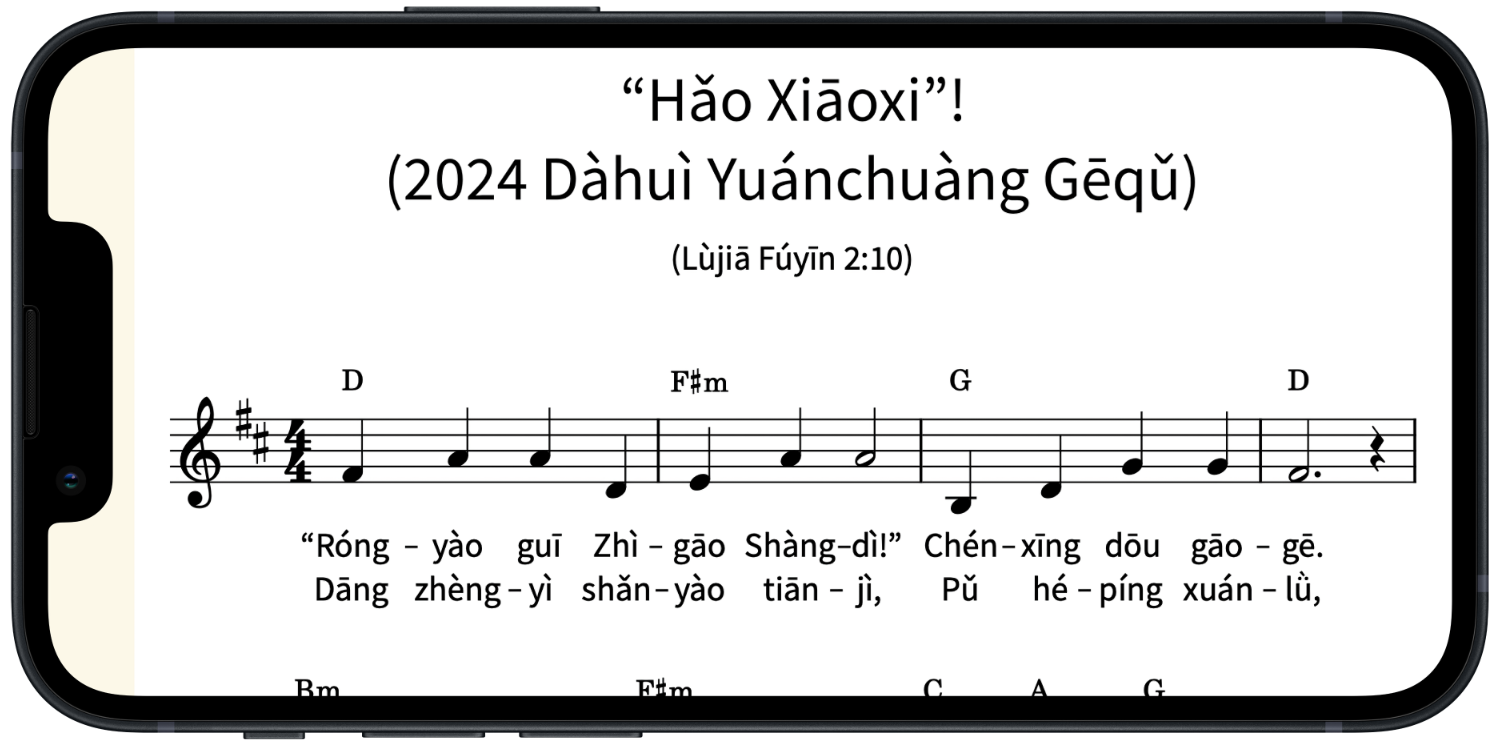
Summer is nearing, and soon, many of us will be singing together in Mandarin at our Mandarin conventions. Unfortunately, at the time of this writing, there was no official Pīnyīn (Pīn·yīn {Piecing Together of} · Sounds → [Pinyin] 拼音) available on the official page for the Mandarin version of this year’s convention song, but I am happy to report that proofread Pīnyīn (Pīn·yīn {Piecing Together of} · Sounds → [Pinyin] 拼音) lyrics or better and proofread musical notation 🎼 with Pīnyīn (Pīn·yīn {Piecing Together of} · Sounds → [Pinyin] 拼音) lyrics for this year’s convention song, and for all the other songs scheduled to be sung at this year’s Mandarin conventions, are now available at this unofficial Pīnyīn (Pīn·yīn {Piecing Together of} · Sounds → [Pinyin] 拼音) Plus resource:

2024 convention song “‘Hǎo Xiāoxi’!” (music+_Pīnyīn_), on iPhone 13 mini (landscape orientation)

[Note: As with all the other Pīnyīn (Pīn·yīn {Piecing Together of} · Sounds → [Pinyin] 拼音) Plus resources, the above-mentioned Pīnyīn (Pīn·yīn {Piecing Together of} · Sounds → [Pinyin] 拼音) Plus resource is made to be supplementary language-learning material for those learning the Mandarin language to help others in the Mandarin field. For spiritual food (which is for you yourself to learn spiritual things from, and which ideally should be in your own mother tongue), please go to jw.org.]

Very Lyrical Mandarin Lyrics

This week’s MEotW, “pǔ ({register or record for reference} [→ [musical notation [→ [set to music; compose (music)]] | sth. to base oneself on | table; chart; list | guide; manual | standards | airs; pretensions | spectrum (physics)]])”, comes from the second verse of the Mandarin version of this year’s convention song:

English:

He will reign for righteousness.
Peace he will provide.
Jesus is the way to endless life.

Mandarin (jw.org, Pīnyīn (Pīn·yīn {Piecing Together of} · Sounds → [Pinyin] 拼音) Plus):

📖 📄 📘 Dāng (when) zhèngyì (zhèng·yì {being upright} · righteousness 正义 正義) shǎnyào (shǎn·yào shines · {to be bright} (on) → [shines on] 闪耀 閃耀) tiānjì (tiān·jì sky · boundary → [horizon] 天际 天際),
({register or record for reference} → [musical notation] → [compose]) hépíng (hé·píng {being (together) with (one another)}’s · {being flat, level, even}’s → [peace’s (nwtsty-CHS Appx. A2 says this term mainly refers to the absence of war or conflict)] 和平) xuánlǜ (xuán·lǜ looping · {regulation → [style of poetry]} → [melody] 旋律),
Qīngchūn (Qīng·chūn {being green → [youth]} · spring → [youth] 青春) huì (will) xiàng (like 像/象) (river 河) bēnliú (bēn·liú rush · flow 奔流) bùxī (bù·xī not · {being ceasing} → [unceasingly] 不息).

Interestingly, this passage of the Mandarin lyrics is more poetic—or lyrical, since we are dealing with lyrics—than is strictly required to correspond to the original English lyrics in meaning. Here is a translation of these Mandarin lyrics back into English:

When righteousness shines on the horizon,
Compose peace’s melody,
Youth will like a rushing river flow unceasingly.

“Pǔ ({register or record for reference} [→ [musical notation [→ [set to music; compose (music)]] | sth. to base oneself on | table; chart; list | guide; manual | standards | airs; pretensions | spectrum (physics)]]) corresponds with “compose” in the above back translation. This Mandarin expression seems to basically mean “register or record for reference”, and it also has several effective meanings other than “compose”, depending on the context. One of these effective meanings is “musical notation”, such as when it’s used in “jiǎnpǔ (jiǎn·pǔ simple · {register or record for reference → [musical notation]} → [numbered musical notation] 简谱 簡譜)”, which refers to a type of simple numbered musical notation that many Chinese people are familiar with. (In fact, a jiǎnpǔ (jiǎn·pǔ simple · {register or record for reference → [musical notation]} → [numbered musical notation] 简谱 簡譜) version of the “Sing Out Joyfully” to Jehovah book is available on jw.org.)

Music and Mandarin Tones

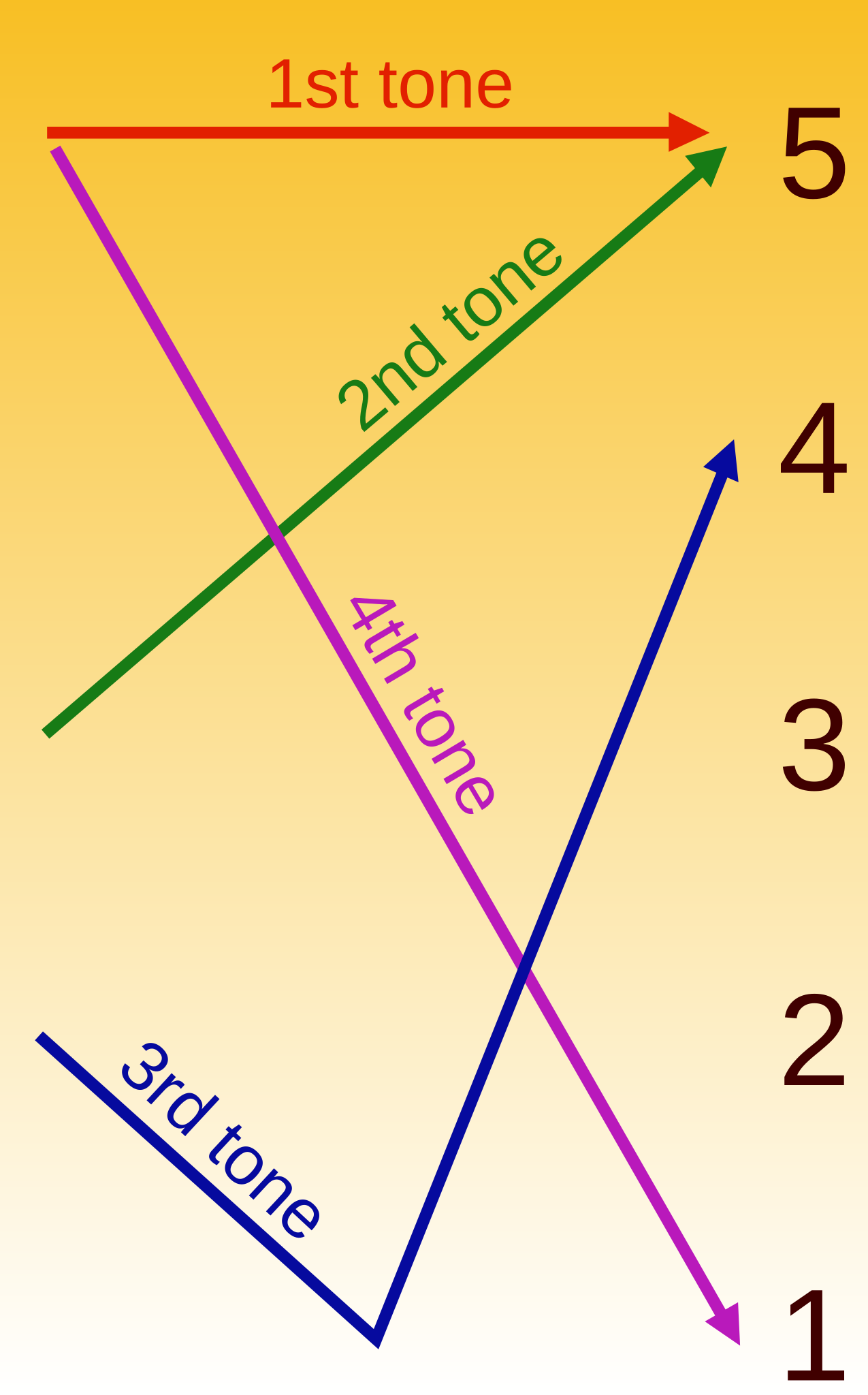
Another effective meaning that “pǔ ({register or record for reference} [→ [musical notation [→ [set to music; compose (music)]] | sth. to base oneself on | table; chart; list | guide; manual | standards | airs; pretensions | spectrum (physics)]]) can have is “spectrum”. So, it seems that this can also be considered a kind of ({register or record for reference} [→ [musical notation [→ [set to music; compose (music)]] | sth. to base oneself on | table; chart; list | guide; manual | standards | airs; pretensions | spectrum (physics)]]):

Chart showing the relative changes in pitch for the four tones of Mandarin Chinese

Chart showing the relative changes in pitch for the four tones of Mandarin Chinese
Creative Commons Attribution-ShareAlike License logo Wereon

Tones in Mandarin are made of pitch, something that is also an important concept in music. It is not surprising, then, that being musically inclined can help one in learning Mandarin. Does that mean that one must be a musical genius to master Mandarin? Not at all! There are about a billion people in China who speak Mandarin just fine, and they can’t all be musical geniuses.

Music, Tones, and Talent

While some are definitely more naturally talented with music or with languages (or with both) than others, talent is far from being the only factor in how well one can come to make music, or learn a tonal language like Mandarin.

As an example, many years ago, early in my own musical journey, I was in a music store trying to tune a guitar by myself. I was trying my best, but I was having a hard time telling which pitches were higher and which were lower—my pitch-discriminating “muscles” were still quite undeveloped. I was doing so poorly that a nearby employee of the music store was imploring me to just let him tune the guitar! Because of my love of music and my determination, though, over time I kept working on improving my ability to distinguish different pitches, and eventually I improved greatly.

I also remember that when I was a young kid in the local Cantonese congregation in an English-speaking country, there was a time when my Bible teacher was putting me through exercises in recognizing different Cantonese tones, and I was doing terribly, not being able to tell which tones were which. Now, though, after acquiring information such as that in the graph above about the nature of the tones, and after ongoing effort and practice over time, my tone-discriminating abilities are much more highly developed, and I can instantly tell which Cantonese or Mandarin tones are which.

Propaganda and Misinformation vs. Truth

Keep in mind, though, that improving the sound of your Mandarin requires focusing on exactly that—the sound of your Mandarin. I have observed that many, influenced by worldly propaganda and misinformation, unfortunately focus instead on the visible Chinese characters, resulting in the invisible sound of their spoken Mandarin being neglected. However, modern linguistics (language science) and God’s Word the Bible both testify that the truth is that speech is actually the real primary aspect of language.—1 Corinthians 14:8–11.

In contrast to the time when I was following the crowd and focusing on characters, I have found that switching to using Pīnyīn (Pīn·yīn {Piecing Together of} · Sounds → [Pinyin] 拼音) as much as possible has helped me to properly focus on the sound of Mandarin. (Matthew 7:13, 14) After I made that switch, people began saying that I sound like a native Mandarin-speaker, whereas no one had ever said that back when I was focused on characters.

Moving Forward Surprisingly Much

So, while I know that others are more talented at music and at Mandarin than I am, I have been able to put whatever talent I have to good use and improve greatly at both music and Mandarin, by continuing to study them and to work at them with the help of the available tools and resources. Regarding Mandarin specifically, I have also been helped to greatly improve by learning to recognize worldly propaganda and misinformation about it, which enables me to avoid being misled by these.

If you continue to study Mandarin and to work on learning it for the Mandarin field out of love, if you continue to take advantage of the available resources and tools like Pīnyīn (Pīn·yīn {Piecing Together of} · Sounds → [Pinyin] 拼音), and if you avoid being misled by worldly propaganda and misinformation, then with the blessing and the help of Jehovah, the Source of music, language, talent, etc., you can also greatly improve, perhaps even to an extent that would surprise your past self!


For convenience:

The direct link for the Pīnyīn (Pīn·yīn {Piecing Together of} · Sounds → [Pinyin] 拼音) Plus resource for the “Sing Out Joyfully” book is:

The short link for Chinese field language-learning links for the “Sing Out Joyfully” book is:

More Pīnyīn (Pīn·yīn {Piecing Together of} · Sounds → [Pinyin] 拼音) and Pīnyīn (Pīn·yīn {Piecing Together of} · Sounds → [Pinyin] 拼音) Plus web material based on the Mandarin “Sing Out Joyfully” book will be made available in the Pīnyīn (Pīn·yīn {Piecing Together of} · Sounds → [Pinyin] 拼音) Plus web resource as time allows.

Categories
Culture Language Learning Science Technology Theocratic

cì’ěr

cì’ěr (cì’·ěr {stabs; pricks → [irritates; pierces]} · ear → [grating on the ear; jarring; ear-piercing] 刺耳) ← Tap/click to show/hide the “flashcard”

I have long especially liked 1 Corinthians 13. It contains counsel on what really does and doesn’t matter in life, an extensive description and definition of the most important kind of love, and a sublime discussion about the need to become complete, mature, as a person. As these apply to life in general, so too do they apply to our lives as Mandarin field language learners.

As Mandarin field language learners, it can benefit us greatly to consider what we can learn from 1 Corinthians 13, and along the way, we can also consider some of the Mandarin expressions used in that chapter in the current version of the Mandarin New World Translation Bible (nwtsty).

“Clashing”

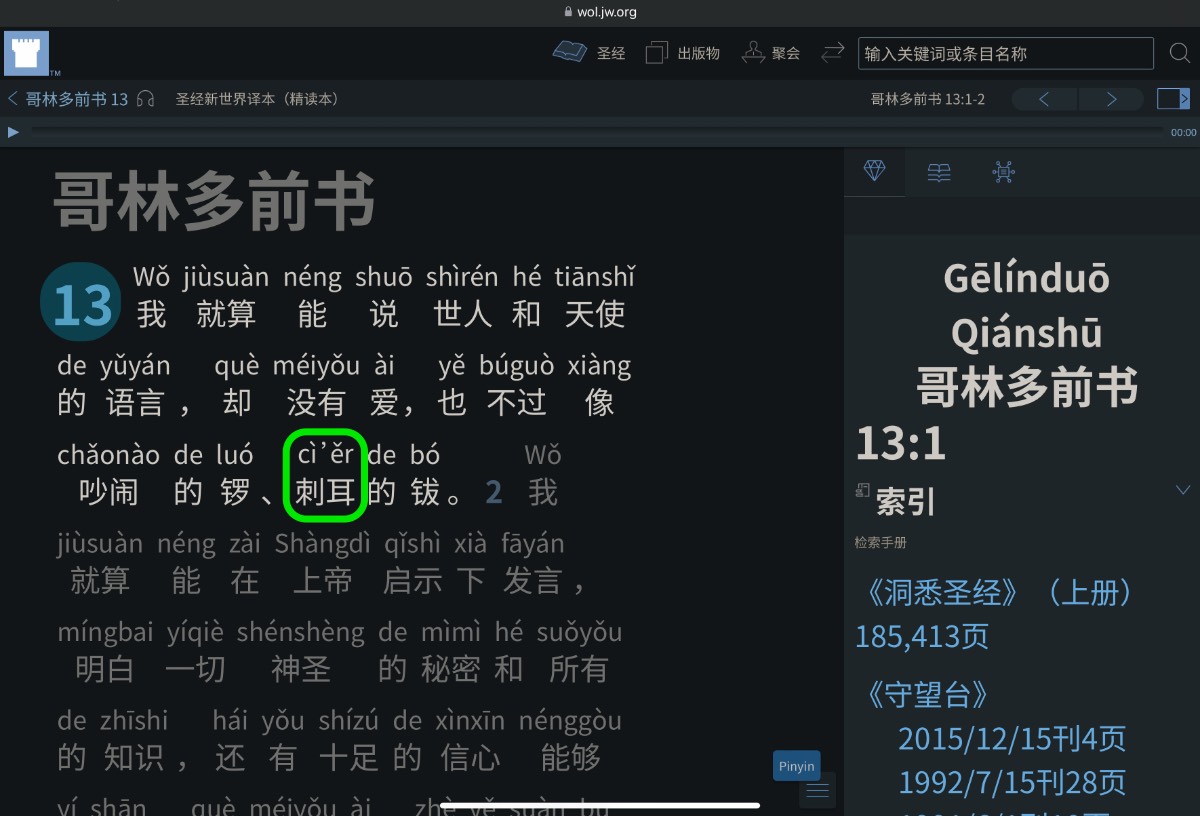
This week’s MEotW, “cì’ěr (cì’·ěr {stabs; pricks → [irritates; pierces]} · ear → [grating on the ear; jarring; ear-piercing] 刺耳), occurs in verse 1 (WOL, Pīnyīn (Pīn·yīn {Piecing Together of} · Sounds → [Pinyin] 拼音) Plus) of 1 Corinthians 13:

Screenshot of “cì’ěr” in 1 Co. 13:1 (nwtsty, CHS+_Pīnyīn_ WOL)

(Dark mode for the Watchtower ONLINE LIBRARY (WOL) website, as shown in the above image, can be enabled in the Safari web browser by using the Noir Safari extension.)

“Cì’ěr (Cì’·ěr {stabs; pricks → [irritates; pierces]} · ear → [grating on the ear; jarring; ear-piercing] 刺耳) literally means “stabs ear”, and is used in the Mandarin New World Translation Bible’s rendering of 1 Corinthians 13:1 to translate the “clashing” in “clashing cymbal”. In this context, “cì’ěr (cì’·ěr {stabs; pricks → [irritates; pierces]} · ear → [grating on the ear; jarring; ear-piercing] 刺耳) effectively means “grating on the ear; jarring; ear-piercing”.

Mandarin Field Need-Greater? Or Ear-Grater 😬?

First, let me establish that of course Jehovah and we who are in the Mandarin field deeply appreciate those who have been moved by love to come and try to learn Mandarin and help out in the Mandarin field. Given that, sometimes things do happen that can literally and figuratively grate on the ears of those who truly serve in this field out of love, and who have become acquainted with what good Mandarin sounds like.

The Tone Beast…

One time, a brother I know whose mother tongue is English gave a Mandarin talk during which so many of his tones were off that at times I was genuinely having trouble making out what words he was saying, even when I was listening closely. After that meeting, when I tried to kindly advise him that this was the case, he jokingly quipped something like ‘Well, at least I made you listen closely!’

Maybe this brother really did try his best, and maybe his reply was just an attempt to lighten the mood with some humour. He may also have felt safe using some humour because we know each other and generally get along fairly well. However, his words in this case might also be taken to show that he took his responsibility to give a good Mandarin talk a bit lightly. If so, things said with such a flippant attitude could grate on the ears of someone who views with appropriate seriousness the God-honouring and life-saving work that needs to be done in the Mandarin field.

It is true that especially for those whose mother tongue is, say, English, the tones can be one of the most difficult aspects of Mandarin for them to master, since that way of using pitch (how high or low a “note” is) is so different from how they use pitch in English. The sincere efforts of Mandarin field language learners in this regard are much appreciated!

…And How to Tame It

For those of us who are trying to learn Mandarin for the Mandarin field, it should help if we keep the following points in mind regarding Mandarin tones:

  • Tones are just as important to conveying meaning in Mandarin as vowels are to conveying meaning in English. In English, if someone says a wrong vowel, that person is not actually saying the word that person meant to say, and that person is not expressing the meaning that person meant to express. For example, there’s a world of difference between “I love you” and “I leave you”, even though it’s “only” the matter of a single vowel. Similarly, in Mandarin, if someone uses a wrong tone, that person is saying a whole different word from what that person meant to say, as shown by the classic example of “mā (ma; mom; mummy; mother)/ (hemp; flax; linen | (surname) | {[is] pocked; pockmarked; pitted; spotty} [→ [[is] rough; coarse]] | numbed; tingling | sesame麻/蔴)/ (horse [(surname)] [→ [knight chess piece; horse piece in Chinese chess | [is] big; large]])/ ({verally abuse}; curse; swear; {call names} [→ [condemn; rebuke; reprove; scold]]罵/駡)/ma ([? ptcl for “yes/no” questions]).
  • In languages like English, we may change the pitch of what we are saying to do things like add emphasis, ask a question, etc. In Mandarin, though, as explained above, the tone of a syllable—which involves how pitch is used while saying it—is an essential part of how that syllable represents meaning. So, while in English the way we use pitch while saying a word may be negotiable based on how we want to emphasize it, etc., in Mandarin, tones are non-negotiable, like our stand on blood transfusions is non-negotiable. A first tone, for example, must always be recognizable as a first tone and must not be changed into a fourth tone or something, no matter how much we want to emphasize a Mandarin word with a first tone in it!
    • How can we add emphasis in Mandarin, then? Study 10 of the Teaching (th) brocure, entitled “Modulation”, tells us that ‘we can convey ideas clearly and stir emotion by varying our volume, pitch, and pace’. So, while the pitches of Mandarin tones are non-negotiable, we can still add emphasis in Mandarin by varying volume—by speaking softer or louder—and/or by varying pace—by speaking slower or faster.
  • Wrong tones can be really cì’ěr (cì’·ěr {stabbing → [irritating]} · ear → [grating on the ear] 刺耳) because, as mentioned above, tones are made of pitch, and when one speaks with wrong pitches, it’s a lot like singing off-key—very grating to the ears of those who know how the music of the language should sound! 🎵

With the above points in mind, do the following:

  • Practise recognizing the different tones and telling them apart when listening to Mandarin speech. This is especially important if you have just recently started to learn Mandarin, and are not used to what Mandarin tones sound like yet. Such practice is needed to gradually train your hearing. As it is with determining if a musical instrument is in tune or not, eventually, with focus and practice, recognizing Mandarin tones will become easier, even second nature.
    • As you get better at being able to recognize good Mandarin tones when you hear them, that will in turn help you to make sure you speak with good Mandarin tones. Speaking of which…
  • Practise speaking with correct Mandarin tones. This is also especially important if you have just recently started to learn Mandarin, and are not used to speaking with Mandarin tones yet. Such practice is needed to gradually train your body’s system for producing speech. Beware: If you let yourself get into bad habits early on involving the tones, then you’ll have to walk a long, hard road to get rid of these bad habits later. As it is with playing a musical instrument well, eventually, with focus, study, and practice, speaking with correct Mandarin tones will become easier, even second nature. 🎸

The Cantonese Twist

As discussed in the MEotW post on “fāngyán (fāng·yán {direction → [place]} · speech → [topolect; dialect (common but misleading translation)] 方言), to those who know Mandarin well, Cantonese that is twisted to try to make it sound like Mandarin sounds awful:

Well, as someone who along with many others has come to the Mandarin field from the Cantonese field, I have had the dubious pleasure of observing how some have tried to speak Mandarin by just taking the Cantonese they knew and twisting it a little, since they were relying on the conventional wisdom that Mandarin and Cantonese are just different dialects of the same language. As well-meaning as they may have been, the results were often just as bad as when someone sings badly off-key, or as Star Trek fans may say, they often sounded like the language equivalent of a transporter accident 🙀. Even after decades in the Mandarin field, some publishers who had come over from the Cantonese field still say some Mandarin words with Cantonese-y pronunciations.

Any Cantonese-speakers who help out in the Mandarin field are very much appreciated, but it would be good for everyone involved if they realized that, contrary to worldly political propaganda, Mandarin and Cantonese are not just different dialects of the same Chinese language. Rather, as linguists recognize, Mandarin and Cantonese, being mutually unintelligible, are really different languages, like French and English are different languages. So, we should all understand and expect that as different languages, Mandarin and Cantonese have different phonologies. That is, they basically sound different, not just like slightly twisted versions of each other. Some, in fact, have compared how different Mandarin and Cantonese sound to how different chickens and ducks sound.

Avoiding Being “a Clashing Cymbal”

If I speak in the tongues of men and of angels but do not have love, I have become a clanging gong or a clashing cymbal.
1 Corinthians 13:1.

Chinese people are known for being very appreciative of Westerners who try to speak Mandarin or one of the other Chinese languages, and for often praising the spoken results of such efforts as being much better than they actually are. Beginning Chinese language learners especially are often given lots of leeway when it comes to how they sound.

After a few years or even decades, though, does our Mandarin speech, for example, still sound not much better than it did when we started learning Mandarin? Some have observed that those who focus on Chinese characters and pay relatively little attention to Mandarin speech often—unsurprisingly—don’t speak Mandarin very well. Some may say that their focusing on Chinese characters shows their love for Chinese culture, but is it not more important for Christians especially to show love for Chinese people by learning to actually understand what they say and learning to speak to them understandably? And as Witnesses of Jehovah, is it not more important to show love for Jehovah by being able to speak clearly, understandably, and movingly in Mandarin about him and the good news of his Kingdom?

While a lot of leeway is rightly given to beginning Mandarin language leaners, one not progressing after learning Mandarin for a long time might in some cases give at least the impression of a lack of caring, a lack of love on the part of that one. (Hebrews 5:12) As humans, we can often tell if something has not been made, done, or said lovingly, with care, for example, if not much attention to “details” like tones is evident. On the other hand, even if some music is performed or something is said in a way that may show only a modest amount of skill or talent, but that does show a lot of love, people often appreciate that more than if one is displaying great skill or talent, but is only doing so to show off or something. Such a one would indeed seem like “a clanging gong or a clashing cymbal”, or, as the Mandarin NWT Bible says, a “chǎonào ({(disturbing by) making noise} 吵闹 吵鬧) de (’s 的) luó (gong), cì’ěr (cì’·ěr {stabbing → [irritating]} · ear → [grating on the ear] 刺耳) de (’s 的) (cymbal)”.—1 Corinthians 13:1 (English, Mandarin).