Categories
Culture Current Events Language Learning Theocratic

shǔlíng zhànzhēng

shǔlíng (shǔ·líng {(in the) category (of)} · spirit → [spiritual (nwtsty-CHS Appx. A2 notes change from “shǔlíng” to “xīnlíng”, etc.)] 属灵 屬靈)
zhànzhēng (zhàn·zhēng war · contending → [war; warfare] 战争 戰爭) ← Tap/click to show/hide the “flashcard”

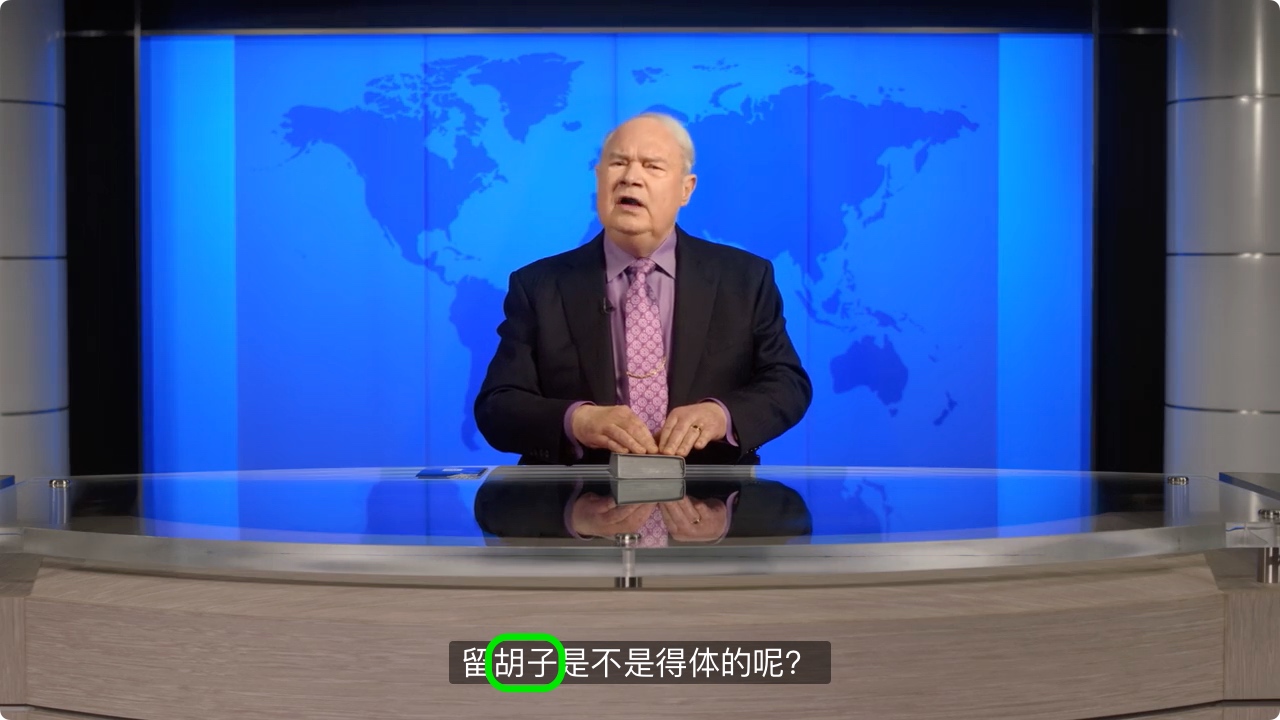
Lately, the organzation has often been using “xīnlíng (xīn·líng heart · spirit [→ [spiritual]] 心灵 心靈) (MEotW post) where it used to use “shǔlíng (shǔ·líng {(in the) category (of)} · spirit → [spiritual (nwtsty-CHS Appx. A2 notes change from “shǔlíng” to “xīnlíng”, etc.)] 属灵 屬靈). I noticed that in at least one of the videos presented during this year’s Mandarin convention, for example. However, a recent search on the Watchtower ONLINE LIBRARY for “心灵战争” (“xīnlíng (xīn·líng heart · spirit → [spiritual] 心灵 心靈) zhànzhēng (zhàn·zhēng war · contending → [war] 战争 戰爭), a possible translation for “spiritual war”) returns no results at all. Searching for “心灵 战争”, with a space between the two words, returns some results, but not for the complete expression “xīnlíng (xīn·líng heart · spirit → [spiritual] 心灵 心靈) zhànzhēng (zhàn·zhēng war · contending → [war; warfare] 战争 戰爭). So, it seems like for now at least, “xīnlíng (xīn·líng heart · spirit → [spiritual] 心灵 心靈) zhànzhēng (zhàn·zhēng war · contending → [war; warfare] 战争 戰爭) is not an officially used thing. However, a search on the WOL for this week’s MEotW, “shǔlíng (shǔ·líng {(in the) category (of)} · spirit → [spiritual (nwtsty-CHS Appx. A2 notes change from “shǔlíng” to “xīnlíng”, etc.)] 属灵 屬靈) zhànzhēng (zhàn·zhēng war · contending → [war; warfare] 战争 戰爭), did return some fairly recent results, including one from the May 2018 Watchtower.

It may just be that the English expression “spiritual war” has not come up in the organization’s production pipeline for translation into Mandarin for a while. I suppose time will tell if “xīnlíng (xīn·líng heart · spirit → [spiritual] 心灵 心靈) zhànzhēng (zhàn·zhēng war · contending → [war; warfare] 战争 戰爭) eventually becomes a replacement translation for “shǔlíng (shǔ·líng {(in the) category (of)} · spirit → [spiritual (nwtsty-CHS Appx. A2 notes change from “shǔlíng” to “xīnlíng”, etc.)] 属灵 屬靈) zhànzhēng (zhàn·zhēng war · contending → [war; warfare] 战争 戰爭). For now at least, it seems that “shǔlíng (shǔ·líng {(in the) category (of)} · spirit → [spiritual (nwtsty-CHS Appx. A2 notes change from “shǔlíng” to “xīnlíng”, etc.)] 属灵 屬靈) zhànzhēng (zhàn·zhēng war · contending → [war; warfare] 战争 戰爭) is still a relatively currently used official translation of “spiritual war”.—Ephesians 6:11, 12; 2 Corinthians 10:4, 5.

[Note, 2023-07-26: While searching the WOL for “spiritual war” returned limited post-2018 results, a more advanced search suggested by a reader turned up some more recent results, with some interesting Mandarin translations that are different from “shǔlíng (shǔ·líng {(in the) category (of)} · spirit → [spiritual (nwtsty-CHS Appx. A2 notes change from “shǔlíng” to “xīnlíng”, etc.)] 属灵 屬靈) zhànzhēng (zhàn·zhēng war · contending → [war; warfare] 战争 戰爭). For more information, see the next MEotW post.]

Know the Enemy

Speaking of war, many would agree that there is wisdom in this quote from Sūn Zǐ ((Sūn {Grandson (surname)}) (Zǐ Son’s; Child’s; Offspring’s 子) [Sun Tzu’s]) Bīngfǎ (Bīng·fǎ Soldier’s · Way → [Art of War] 兵法) (孫子兵法, The Art of War):

If you know the enemy and know yourself, you need not fear the result of a hundred battles. If you know yourself but not the enemy, for every victory gained you will also suffer a defeat. If you know neither the enemy nor yourself, you will succumb in every battle.

With that in mind, let us consider a hypothetical scene from the command centre of Satan and the demons for their spiritual war against Jehovah and against the truth, taking place some time in the early part of the 21st century:

***

The Other Side of the Mandarin Front

Satan: Our hated Enemy Jehovah is raising up more workers for the Mandarin field. What is the state of our defences in this largest language field of all?

Demon: There is a useful government in place in China, where about 95% of all the earth’s Chinese people live. This government is intent on and efficient at suppressing all conceivable threats to its power, including religions like that of Jehovah’s people, that refuse to obey it rather than their God. This government even has a project underway to rewrite the Bible so that it serves their interests, those cheeky darlings!

Culturally, many proud, long-standing, personally inhibiting traditions are in place, making it difficult for many Mandarin-speakers to accept the truth, or to progress spiritually or otherwise as individuals if they do. (The well-known English expression “save face” was, after all, derived from a Chinese expression.)

Speaking of defences, one outstanding set of proud Chinese cultural traditions that serves as a highly effective fortification blocking the way to potential Mandarin-speaking sheep is the Great Wall of Chinese characters. This inhumanly complex system imposes extraordinary costs in the time and effort required for the simple, everyday tasks of reading and writing Chinese languages like Mandarin.

The Great Wall of China

Chinese characters even put unnecessarily heavy mental loads on native speakers, causing even them to sometimes be unable to remember how to read or write even certain common characters. Unsurprisingly, then, this delightful ball and chain made of human tradition is especially highly effective at making things difficult for any whom Jehovah raises up from other language fields to work in the Mandarin field, poor unfortunate souls who have not already been learning characters all their lives.

We have observed that only about one in ten of such ones is able to cope well with the unnecessary difficulties imposed by characters. The rest struggle along at greatly reduced spiritual combat effectiveness, and the Great Wall of characters even ends up completely filtering out many who try to serve in the Mandarin field, causing them to eventually leave it and become Mandarin field casualties, as viewed by Jehovah’s side.

Satan: How about these efforts by some in Jehovah’s organization to get through and around the Great Wall of characters by making and using Pīnyīn (Pīn·yīn {Piecing Together of} · Sounds → [Pinyin] 拼音) resources? It seems that Jehovah’s organization now uses Pīnyīn (Pīn·yīn {Piecing Together of} · Sounds → [Pinyin] 拼音) more than any other organization on earth.

Demon: That may be so, but overall, the Great Wall of characters is holding. The traditions around Chinese characters are among the most deeply entrenched human cultural traditions in existence. So, Chinese characters remain the entrenched default writing system for Mandarin-speakers worldwide, and, as you know, the vast majority of humans simply accept the default systems that are presented to them, and don’t bother to think about how it could be worthwhile to find better ways of doing things. This works out great for us when people just unthinkingly adopt the religion of their parents or the morals of their peers, and it works great for us when it comes to the Great Wall of characters too.

As a result, even though Pīnyīn (Pīn·yīn {Piecing Together of} · Sounds → [Pinyin] 拼音) works fine as a simple and easy-to-use full writing system for Mandarin, and even though some in Jehovah’s organization have made extraordinary progress in making advantageous use of Pīnyīn (Pīn·yīn {Piecing Together of} · Sounds → [Pinyin] 拼音), Pīnyīn (Pīn·yīn {Piecing Together of} · Sounds → [Pinyin] 拼音) remains a cultural outlier, and Pīnyīn (Pīn·yīn {Piecing Together of} · Sounds → [Pinyin] 拼音) users continue to be ridiculed and pressured by the great majority whom we have successfully brainwashed regarding characters. Pride, tradition, and peer pressure continue to be highly effective spiritual weapons of mass destruction for us in the Mandarin field, as they are in other fronts of the spiritual war.

Satan: Excellent. There will always be pesky upstarts among Jehovah’s people who challenge the human traditions that serve us so gloriously well, and Jehovah may even help them, but it deeply satisfies my great unholy anger to see that we are keeping them suppressed so effectively. Carry on.

***

Don’t like seeing Satan’s spiritual war plans working out in the Mandarin field? Then fight back with spirit and truth and reject obstructive human traditions that make it much harder than necessary to serve God in the Mandarin field, “so that we may not be overreached by Satan, for we are not ignorant of his designs.”—John 4:23, 24; 2 Corinthians 2:11.

Categories
Culture History Language Learning Technology Theocratic

jiùsuàn

jiùsuàn (jiù·suàn {even if} · {figuring → [considering]} 就算) ← Tap/click to show/hide the “flashcard”

I have long especially liked 1 Corinthians 13. It contains counsel on what really does and doesn’t matter in life, an extensive description and definition of the most important kind of love, and a sublime discussion about the need to become complete, mature, as a person. As these apply to life in general, so too do they apply to our lives as Mandarin field language learners.

As Mandarin field language learners, it can benefit us greatly to consider what we can learn from 1 Corinthians 13, and along the way, we can also consider some of the Mandarin expressions used in that chapter in the current version of the Mandarin New World Translation Bible (nwtsty).

“If…”

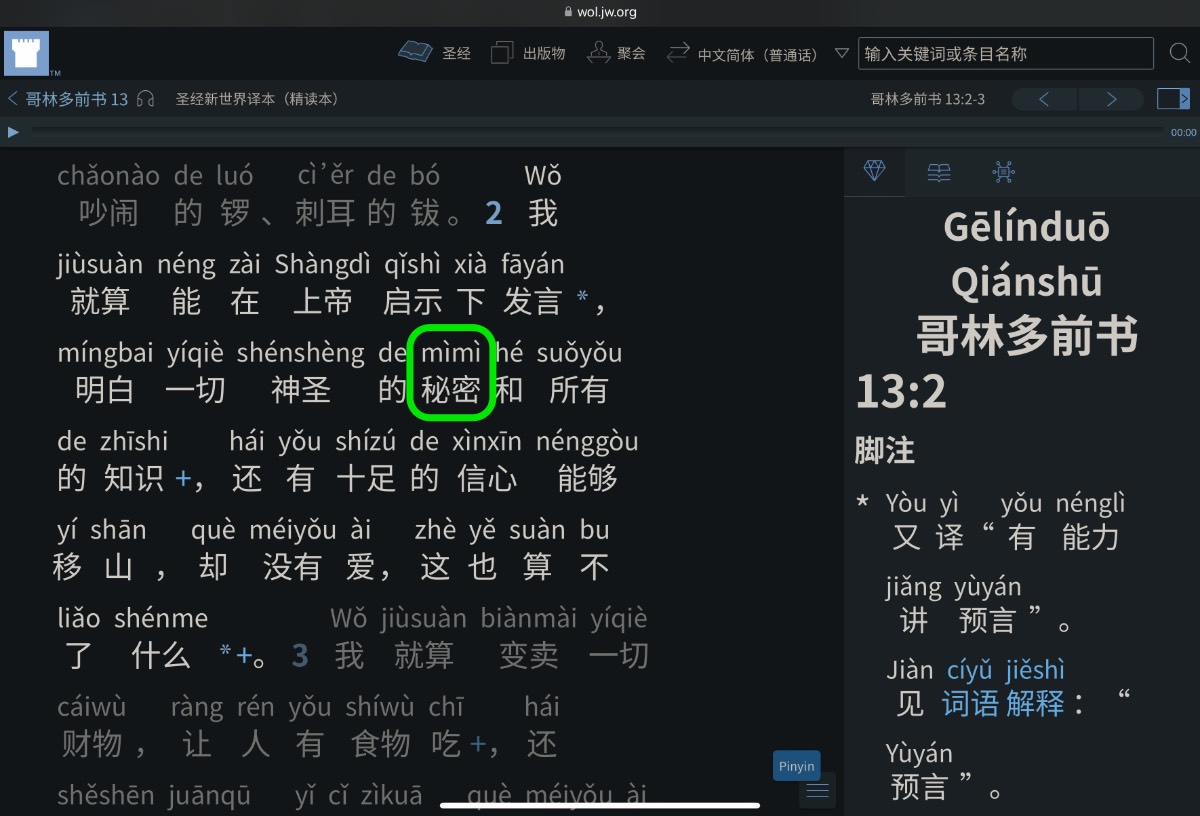
The second Mandarin expression that occurs in verse 1 (WOL, Pīnyīn (Pīn·yīn {Piecing Together of} · Sounds → [Pinyin] 拼音) Plus) of 1 Corinthians 13 (after “Wǒ (I 我)) is this week’s MEotW, “jiùsuàn (jiù·suàn {even if} · {figuring → [considering]} 就算).

Screenshot of “jiùsuàn” in 1 Co. 13:1 (nwtsty, CHS+_Pīnyīn_ WOL)

(Dark mode for the Watchtower ONLINE LIBRARY (WOL) website, as shown in the above image, can be enabled in the Safari web browser by using the Noir Safari extension.)

“Jiù (then; already | exactly | regarding | immediately | merely | {move towards} | {engage in} | accomplish; make | accommodate | {go with} | {even if} 就) can mean many different things, as can be seen from its Pīnyīn (Pīn·yīn {Piecing Together of} · Sounds → [Pinyin] 拼音) Plus information. The meaning that seems to apply in “jiùsuàn (jiù·suàn {even if} · {figuring → [considering]} 就算) is “even if”.

Calculating…

As for “suàn (calculate; compute; figure | count (v) [→ [consider/regard as]] 算), one of its meanings is “calculate”. (In fact, a “jìsuàn jī ((jì·suàn computing · calculating 计算 計算) (jī machine機/机) [computer | calculator (Taiwan)]) is a computer, or a calculator.)

There certainly is a long history of calculating done in the long history of China, such as all the calculating done to save face, advance ambitions, and acquire status in the official bureaucracy and in the imperial court. Perhaps because of Chinese cultural tradition or out of habit inherited from the world, some may have a tendency to do similar calculating in the Mandarin field. Rather than focusing on the work of praising Jehovah and preaching to and teaching Mandarin-speaking ones, some might be focusing on ways to receive “glory from one another”.—John 5:44.

1 Corinthians 13:1–3 admonishes us though, that jiùsuàn (jiù·suàn {even if} · {figuring → [considering]} 就算) this is done, even if such calculating is done to figure in things like ‘speaking in the tongues of men and of angels’, ‘understanding…all knowledge’ (perhaps, for example, knowledge of Chinese characters), various boastworthy deeds, etc., if one does not have love, then all those other things mean nothing:

If I speak in the tongues of men and of angels but do not have love, I have become a clanging gong or a clashing cymbal. 2 And if I have the gift of prophecy and understand all the sacred secrets and all knowledge, and if I have all the faith so as to move mountains, but do not have love, I am nothing. 3 And if I give all my belongings to feed others, and if I hand over my body so that I may boast, but do not have love, I do not benefit at all.

Let us, then, examine our hearts to make sure that we avoid letting pride be our motivation. Instead, let us cultivate love for Jehovah and for our Mandarin-speaking neighbours, so that love is what motivates us in our efforts to learn the language and serve in the Mandarin field.

Categories
Culture History Language Learning Names Technology

Hànzì

Hànzì (Hàn·zì {Han (Chinese)} · Characters 汉字 漢字) ← Tap/click to show/hide the “flashcard”

Hànzì (Hàn·zì {Han (Chinese)} · Characters 汉字 漢字)” is what Chinese characters are called in Mandarin. Actually, “Hànzì (Hàn·zì {Han (Chinese)} · Characters 汉字 漢字)” literally means “Han characters”, but as discussed in the MEotW post on “Hànyǔ (Hàn·yǔ {Han (Chinese)} · Language [→ [(Modern Standard) Mandarin]] 汉语 漢語)”, the Han are by far the largest ethnic group in China, and they are the dominant cultural force in China. Thus, Han characters are, in effect, Chinese characters.

漢字 汉字

Han culture has affected not only China, but also many of the surrounding nations. The words used by some of these nations to refer to “Chinese characters” are obvious echoes of “Hànzì (Hàn·zì {Han (Chinese)} · Characters 汉字 漢字)”:

  • Japanese: kanji
  • Korean: Hanja
  • Vietnamese: hán tự

Hànzì (Hàn·zì {Han (Chinese)} · Characters 汉字 漢字) are still used a lot in modern Japanese writing. However, although Hànzì (Hàn·zì {Han (Chinese)} · Characters 汉字 漢字) used to be the dominant writing system in Korea and in Vietnam, those nations have moved on to mainly use alphabetic writing systems.

The Korean Connection

Regarding the situation in Korea, the Awake! article “Let’s Try Writing in Hankul!” says:

BEFORE Hankul [or Hangul] was created, the Korean language did not have its own script. For more than a thousand years, educated Koreans wrote their language using Chinese characters. Over the years, however, various attempts were made to devise a better writing system. But since all of them were based on Chinese characters, only the well-educated could use them.

King Sejong spearheaded the creation of an alphabet that would both suit spoken Korean and be easy to learn and use.

Sadly, some scholars opposed Hankul, precisely because it was so easy to learn! They derisively called it Amkul, meaning “women’s letters.” They disdained a system that could be learned even by women, who back then were not taught to read in the schools. This prejudice against Hankul persisted among upper-class Koreans for some time. In fact, more than 400 years elapsed before the Korean government declared that Hankul could be used in official documents.

The Chinese Conundrum

How about the writing system situation in China itself? Do the Chinese languages need to be written using Hànzì (Hàn·zì {Han (Chinese)} · Characters 汉字 漢字)? Chinese traditionalists have influenced many people to assume so, but there is actually no technical linguistic requirement that any Chinese language be written using Hànzì (Hàn·zì {Han (Chinese)} · Characters 汉字 漢字)—writing Chinese languages using Hànzì (Hàn·zì {Han (Chinese)} · Characters 汉字 漢字) is purely and merely a deeply embedded tradition.

Proof that the use of Hànzì (Hàn·zì {Han (Chinese)} · Characters 汉字 漢字) is merely a tradition and not a technical requirement comes from the fact that Pīnyīn (Pīn·yīn {Piecing Together of} · Sounds → [Pinyin] 拼音), a phonetic alphabetic system designed by a Chinese government team, is a good, workable full writing system for Modern Standard Mandarin.

Why has China held on to its traditional use of Hànzì (Hàn·zì {Han (Chinese)} · Characters 汉字 漢字) when other nations have moved on to alphabetic writing systems? As mentioned in the MEotW post on “Zhōngguó (Zhōng·guó Central · Nation → [China | Chinese] 中国 中國)”,

Some wonder why China has held on to its archaic characters writing system instead of moving on to using a modern alphabetic writing system like almost every other nation does, even though outstanding native sons like Lǔ Xùn ((Lǔ Stupid; Rash (surname)) (Xùn Fast; Quick; Swift 迅) (pen name of Zhōu Shùrén, the greatest Chinese writer of the 20th cent. and a strong advocate of alphabetic writing)) have advocated strongly for that. Perhaps the proud self-centredness of the only nation to name itself the centre of the world provides a clue….

When the Communists took over China a few years after World War II, their Plan A for China’s writing system situation actually did involve eventually moving on from the characters to an alphabetic writing system that would be developed, which turned out to be Pīnyīn (Pīn·yīn {Piecing Together of} · Sounds → [Pinyin] 拼音). However, the government needed the help of the people already educated in Hànzì (Hàn·zì {Han (Chinese)} · Characters 汉字 漢字), and many of these people opposed this plan that they feared would involve leaving behind, or at least de-emphasizing, a cultural tradition that they were very proud of, that they had invested very much time and effort into mastering, and that gave them much prestige in the existing environment.1 In other words, the pride and prejudice of those who had already been educated in the Hànzì (Hàn·zì {Han (Chinese)} · Characters 汉字 漢字) caused them to disparage and oppose the idea of a simpler alternative writing system, just as had been the case in Korea, as noted above. So, the simplification of the Hànzì (Hàn·zì {Han (Chinese)} · Characters 汉字 漢字) is the farthest China has gotten so far with regard to official writing system reform, and even that has only been achieved in the face of much criticism and opposition.

Chairman Máo Zédōng ((Máo Hair (surname) 毛) (Zé·dōng Marsh · East 泽东 澤東) (the founder of the People’s Republic of China)) (Wikipedia article) himself supported continuing to move on, from simplification of the characters to actually adopting Pīnyīn (Pīn·yīn {Piecing Together of} · Sounds → [Pinyin] 拼音) as a writing system. In a letter to an old schoolmate, he wrote:

…Pinyin writing is a form of writing that is relatively convenient. Chinese characters are too complicated and difficult. At present we are only engaged in reform along the lines of simplification, but some day in the future we must inevitably carry out a basic reform.2

Letter from Mao endorsing a transition from Chinese characters to alphabetic writing

(The above picture is from near the beginning of the book The Chinese Language: Fact and Fantasy, by John DeFrancis.)

While obviously what Máo ((Máo Hair (surname) 毛) (abbr. for Máo Zédōng, the founder of the People’s Republic of China)) foresaw regarding a writing system “basic reform” in China has not yet come true, American sinologist and University of Pennsylvania Professor of East Asian Languages and Civilizations Victor H. Mair wrote in a blog post:

So, those who are in favor of HP [Hànyǔ (Hàn·yǔ {Han (Chinese)} · Language → [(Modern Standard) Mandarin] 汉语 漢語) Pīnyīn (Pīn·yīn {Piecing Together of} · Sounds → [Pinyin] 拼音)] don’t need to be concerned, and those who are opposed to HP don’t need to be frightened. HP is ineluctably playing a greater and greater role in the educational, cultural, social, political, and every other aspect of the lives of Chinese citizens, and this is occurring without regard to anyone pushing it as a governmental program. It is happening because of the wishes of those who actually use it for a wide variety of helpful purposes.

Digraphia [the use of more than one writing system for the same language, in this case the use of both Hànzì (Hàn·zì {Han (Chinese)} · Characters 汉字 漢字) and Pīnyīn (Pīn·yīn {Piecing Together of} · Sounds → [Pinyin] 拼音) for writing Modern Standard Mandarin] is emerging before our very eyes, enabling people to use the alphabet and the characters for whatever purposes they deem suitable. Nobody needs to take a vote or carry out a survey for this to happen.

Tourists or Missionaries?

Regardless of how worldly Chinese people view the Hànzì (Hàn·zì {Han (Chinese)} · Characters 汉字 漢字), how should we dedicated Mandarin field language-learners view them? It would be easy to fall back on the commonly accepted view, the tourist’s view, that the Hànzì (Hàn·zì {Han (Chinese)} · Characters 汉字 漢字) are an integral and fascinating part of China’s precious cultural heritage that we should duly respect and even heap adulation upon.

However, as Mandarin field language-learners, we are not in the Mandarin field to be tourists just enjoying the exotic foreign culture. On the contrary, we must be more like missionaries or spiritual rescue workers involved in an urgent life-saving work, because lives are indeed involved. As ones involved in an urgent, life-saving work, we need tools, technologies, and systems that efficiently and effectively help us to get this work done without wasting time and effort when people’s everlasting lives are at stake. From this sober and pragmatic angle, the extraordinarily difficult-to-learn-and-remember Hànzì (Hàn·zì {Han (Chinese)} · Characters 汉字 漢字) are far from ideal. Thus, while there is obviously value in learning as many Hànzì (Hàn·zì {Han (Chinese)} · Characters 汉字 漢字) as one is reasonably able to, it is fortunate that Pīnyīn (Pīn·yīn {Piecing Together of} · Sounds → [Pinyin] 拼音) exists and is available as a simple, effective alternative writing system for Mandarin, for the many times when it is not necessary to use Hànzì (Hàn·zì {Han (Chinese)} · Characters 汉字 漢字).


1. John DeFrancis, The Chinese Language: Fact and Fantasy (Honolulu: University of Hawaii Press, 1984), p. 258. ^

2. Ibid., p. 295. ^