chénggōng+ (chéng·gōng {becoming [of]}; {accomplishing [of]} · {meritorious service/deed}; achievement → [succeed | success | successful[ly]] 成功) 👈🏼 Tap/click to show/hide the “flashcard”
As part of a series of posts about some common myths about Chinese characters, this post discusses the Successfulness Myth. So, this week’s MEotW is “chénggōng (chéng·gōng {becoming [of]}; {accomplishing [of]} · {meritorious service/deed}; achievement → [succeed | success | successful[ly]] 成功)”, which can effectively mean “successful”.
Success?
In the book The Chinese Language: Fact and Fantasy, linguist and sinologist John DeFrancis begins the chapter entitled “The Successfulness Myth” with the following:
Success, like beauty, is in the eye of the beholder. No other aspect of Chinese characters is so much a matter of subjective judgment. I focus on such modern concerns as mass literacy and see failure. Others, concentrating on other aspects, see great success.
From some perspectives, Chinese characters have unquestionably been a great success. “We all agree,” said Premier Zhou Enlai (1965:7), “that as a written record they have made immortal contributions to history.” They have indeed made immortal contributions to a civilization deserving of superlative tributes that would extend Edgar Allen Poe’s “the glory that was Greece and the grandeur that was Rome” to include also “the splendor that was China.”
Given this esteem for the past role of Chinese characters, it seems almost sacrilegious to suggest that because of their difficulty they have failed, and will continue to fail, in meeting some of the major needs felt by modern society. Nevertheless, in the case of one such need, that for mass literacy, I believe that success via characters must be characterized as a myth.
Speaking of the eye of the beholder, what can we deduce about how Jehovah God sees Chinese characters? A case can probably be made that characters are a leading contender for being the most widespread and deeply entrenched human cultural tradition in all of human history, which is a kind of success, I guess. However, while imperfect humans of this system may find that impressive, is that the kind of thing that impresses Jehovah God, whom the Bible calls “the Ancient of Days”? (Daniel 7:9) From Jehovah’s point of view, are characters a successful and effective tool for helping to glorify his great name and spread the good news of his Kingdom? Or, have they been a Great Wall impeding the preaching and teaching work that Jehovah wants accomplished in the vast worldwide Mandarin field? When Jesus, who perfectly reflected God’s qualities, encountered successfully entrenched human traditions that got in the way of doing what was good in God’s eyes, how did he respond?—John 14:9; Mark 3:1–5; 7:13.
“To Jehovah, for whom ‘a thousand years is as one day’, Chinese civilization has only been around for a few days.…
“…we should boast in Jehovah, not in needlessly and self-indulgently complex knowledge relating to a mere worldly human culture” troubadourworks.com/tiandi/meotw…
#MEotW #PīnyīnPlus
— tiandi, Links News (@tiandilinksnews.bsky.social) Dec 2, 2024 at 3:40 PM

Does Jehovah see Chinese characters as a successful writing system? Or does he see characters as a Great Wall obstructing his vital preaching and teaching work in the worldwide Mandarin field?
“Success” Through Definition and Denial
Regarding how some have defined successful literacy through the learning of characters, DeFrancis says:
If literacy sights are set low enough it may be possible to claim great success for the characters both in the imperial era and at the present time. Illiteracy can be eliminated by defining it out of existence, which is apparently what the “Gang of Four” did when, according to Zhou Youguang (1980e:21), it proclaimed that China no longer had any illiterates. The picture becomes less rosy, however, if we insist that literacy should be defined as the ability to accomplish such relatively elementary tasks as corresponding about family matters and reading newspapers and instructions in various matters. For this, a knowledge of about four thousand characters is required, and even then Chinese, unlike their poorly educated Western counterparts, will be unable to express in writing everything they can express in speech.
After offering some thoughts on how solid information could be obtained on actual rates of maintained literacy among the people of China, DeFrancis says:
Until solid information like this becomes available, all we can do is speculate. My own speculations lead me to share the profound skepticism of many Chinese, including Lu Xun, who doubted that the people as a whole could achieve an acceptable level of literacy on the basis of the traditional script, even in its simplified form. Here it must be pointed out clearly that this skepticism has never taken the form of a belief in the absolute impossibility of achieving literacy with a character-based script. The skepticism takes the form, rather, of the belief that the nature of the script and the material conditions of life for the vast majority of people, especially the 80 percent comprising the peasantry, are such that in the not too distant future there is little possibility of their becoming literate in the full sense of the term. This is the only timetable and the only definition of literacy acceptable to many people interested in the ability of the masses to raise their cultural level (DeFrancis 1950).
It is possible, however, that others may count achievements in literacy based on characters a success because they do not accept the emphasis on the importance of mass literacy. …
…And radio and television may indeed reduce the need for literacy in the areas of mass indoctrination and information. In the light of these considerations, success in an educational system may well be measured, as it is at present in China, less by the ability to solve the problem of mass literacy than by the success in producing a body of technicians and specialists in science and technology.
Concerning how some claim success for the characters by denying that they are difficult, DeFrancis writes:
LITERACY THROUGH MODEST EFFORT
The assertion that the difficulty of the Chinese characters is a prime reason for the lack of success in achieving mass literacy evokes several kinds of responses. One, already noted, is to deny the lack of success. Another is to deny the characters are difficult, which automatically removes one explanation for any failures. Karlgren (1929:40) has expressed the following view:
Even very learned Chinese do not encumber their memory with more than about six thousand characters. Four thousand is, as we have said, a tolerably high figure, and even with three thousand some progress can be made. For a receptive child this is a modest task, and an adult foreigner in the course of a year’s study masters without difficulty from two to three thousand characters.
Karlgren’s view of mastering large numbers of characters “without difficulty” is not supported by the experience of those involved in teaching reading either to foreigners or to the Chinese themselves. His estimates may be right for someone like himself, who probably had a photographic memory, and for others, especially Chinese intellectuals, whose lifestyle, not to mention livelihood, is characterized by almost full-time involvement in reading and writing, so that they often fail to appreciate the difficulty that ordinary people who spend long hours at hard physical labor encounter in finding the time and the energy to attain and retain literacy. As a more observant writer, George Jan (1969:141), has noted:
Another serious deficiency in mass education in the communes was the tendency for peasants to lapse back into illiteracy because of their failure to practice their newly acquired skill. According to the statistics of Wan-jung County [Wanrong County in Shanxi], of the 34,000 people who had received instruction in reading by October 1958, one-third had again become illiterate, and the other two-thirds were unable even to read newspapers. If this was generally true, the qualitative significance of the illiteracy-elimination program in the communes must be questioned.
Regarding how some, including Chinese officials, have sought to “move the goalposts” by defining literacy as knowing a limited number of characters, DeFrancis says:
A limited number of characters cannot possibly serve (unless they are used as phonetic symbols) as a medium of free expression to convey the thousands of concepts the average Chinese commands in speech.
Yet this idea of literacy through a limited number of characters is widely held and forms the basis for official policy. In 1952 the official definition of “basic literacy” increased Yen’s figure of 1,000 characters to 1,500 for peasants and 2,000 for workers (Zhou Youguang 1979:329). Attempts to reach this goal initially placed much emphasis on Mao Zedong’s instructions to proceed by searching out in each village the characters locally needed to record work points and to write down names of people, places, implements, and so on. He thought two or three hundred characters would do. Next another few hundred would be learned to handle matters beyond the village. There would be successive additions of characters for a total of 1,500, the mastery of which was considered the test of literacy (Mao 1956: 165; Hu and Seifman 1976). Although 1,500 characters unquestionably have some utility, their mastery can hardly be equated with achieving literacy in the full sense of the term, and even this limited success, as the Wanrong case shows, has tended to be ephemeral.
How About Simplification, Etc.?
DeFrancis proceeds to go over several different methods and approaches that have been tried to help improve the literacy situation in China, including the simplification of the characters. Regarding this, he says:
The true extent to which simplification has eased the burden of learning characters must remain a matter of subjective evaluation until there is firm supporting evidence. Such evidence must take two forms. First is a survey along the lines previously indicated to find out the exact state of literacy among different segments of the population. Second is research to disentangle how much of whatever advance in literacy that has been achieved, and there undoubtedly has been some, is due to simplification itself and how much to other factors, such as improved living conditions and more widespread schooling, especially in urban centers.
My own view is that simplification was a distinctly secondary factor and that high-level decision makers like Mao Zedong, who as members of the educated elite were of course already quite familiar with the simpler characters, through infomal use, were mistaken in thinking that just because they themselves were able to save much time and effort by using the abbreviated forms, therefore illiterates would also find it significantly easier to learn to read and write if the simplifications were officially adopted as part of the writing system. No doubt illiterates thought so too and, according to the official line, clamored for the change. As far as language reformers are concerned, however, many place little stock in extravagant claims of success and reject the ability of simplified characters to contribute to the elimination of illiteracy among the masses. Zhou Youguang (1978a) has expressed the view that the time needed to master characters has not been significantly reduced by simplification. Wang Li (1980:13–15) has dismissed simplified characters as a solution: “Simplified characters are simply a transitional stage. Strictly speaking, they are not even a transitional stage. They are far removed from a basic reform.” This comment is in line with the statement attributed earlier to Liu Shaoqi that simplification “will turn out badly in the future” (Wang Boxi 1974:22–23). Although it is by no means certain that Liu actually made this statement, the fact that the criticism was attributed to him suggests that many people have been skeptical of the value of character simplification. Such doubts, which have been echoed directly or indirectly by many advocates of reform, suggest the need for a blunt and harsh conclusion: A whole generation, both of people and of time, has been uselessly sacrificed in a timid, bumbling, and predictably unsuccessful attempt to achieve mass literacy through simplification of characters.
How About the Examples of Japan and Taiwan?
Continuing on, DeFrancis discusses how relevant or not the examples of Japan and Taiwan are to the matter of successful literacy in China through the learning of characters:
JAPAN AS A MODEL FOR LITERACY
This conclusion is rejected by those who advance a final argument against the idea that the difficulty of the characters, even in simplified form, makes them unsuited for mass literacy. It is argued that although this was true of the old society, the new order initiated in 1949 will eventually make it possible for everyone to learn to read and write. Expression of this view is frequently supported by the contention that Japan with its high rate of literacy in a character-based script provides proof of what China too can accomplish. The superficiality and irrelevance of this argument becomes apparent if we look a little more closely at the true state of literacy in Japan.
…
More recently Sato Hideo, head of the Research Section for Historical Documents, National Institute for Educational Research in the Japanese Ministry of Education, has estimated that public school graduates, who now receive nine years of compulsory schooling, retain a recognition knowledge of the 1,945 kanji but soon forget how to write all but 500 or so (1980: personal communication). As far as this limited kanji orthography is concerned, they may possibly be considered literate in reading it but must surely be considered illiterate in writing it. More precisely, their literacy in reading consists in reading the mixture of partly phonetic kanji and purely phonetic kana, whereas their literacy in writing is largely limited to writing phonetically. Such is the concrete reality of what Neustupńy calls “the myth of 99 percent literacy” in the character-based writing system of Japan.
Moreover, apart from the use of kana by Japanese illiterate in writing kanji, the simple syllabic script is also used, even by those literate in kanji, in many aspects of Japanese life, such as computer technology, and has general application in informal writing because kana is so much quicker and easier to handle than kanji. There are even areas, such as Telex, where romaji is the preferred or exclusive medium of communication. Thus the Japanese policy of limiting the number of kanji in the writing system has resulted in consolidating a narrowed use of characters in such obvious activities as schooling while expanding the role of kana and rōmaji in less publicized fields.
The character-based Chinese writing system as presently constituted does not permit the Japanese option of limiting the number of characters in the basic system or of dispensing with them entirely in some areas. It is not clear how much support there would be for the idea of developing a Japanese-like writing system by using a limited number of characters interspersed with alphabetic symbols such as Zhuyin Zimu or Pinyin. Zhou Youguang (1979:337-338) thinks worthy of serious consideration the suggestion made by a fellow language reformer that interspersing Pinyin with characters could serve as a means for effecting a gradual transition to Pinyin. On the other hand, an American delegation to China reported that “when we raised this question, it was glossed over by our Chinese hosts” (CETA 1980:23). This means that the all-character Chinese writing system must be recognized as incomparably more difficult than the mixed writing of Japan. Apart from the greater difficulty in determining what goes with what in a given text, a knowledge of twice the number of characters is essential for an equivalent level of literacy. And all this in turn means that it is superficial in the extreme to view Japan’s “success” as providing any sort of model of what China too can accomplish.
TAIWAN AS A MODEL FOR LITERACY
Taiwan has also been advanced as a model for achieving literacy via Chinese characters. There is more relevance to this contention, but not much more, since it needs to be qualified by noting the special conditions that set Taiwan apart from Mainland China. In Taiwan, speakers of Min or Taiwanese and Hakka are intermixed with speakers of Mandarin in a fashion quite different from the situation on the mainland with its huge blocs of regionalect speakers only thinly diluted by speakers of Putonghua. The small size of the island and the ease of communication, both physically and by radio and television, contribute to continual contact among members of different linguistic groups. A relatively efficient educational system, based in part on the fifty-year experience under Japanese occupation, made it easy to shift the medium of instruction from one foreign-imposed language to another form of speech imposed by the dominant group of Mandarin speakers, the majority quite well educated, who took over control of the island in 1945. The latter, in order to survive as an intrusive minority, were forced to promote their own speech among the whole island population with an intensity that is utterly beyond the capacity of the PRC. One result of this situation is that after only a few decades “more than 80 percent of the population is bilingual, speaking both Taiwanese and Mandarin” (Cheng 1978:308). This successful promotion of Mandarin in Taiwan has provided the means to promote literacy in a system of writing based on this standard language. The much higher standard of living in Taiwan, which is unlikely to be matched on the mainland for many years to come, is a major cause of whatever success has been achieved in literacy based on characters. Finally, although the conditions peculiar to Taiwan have undoubtedly aided literacy in characters, a careful assessment of success in more specific terms of level of achievement and particularly of retention of literacy would be desirable before making projections elsewhere, especially in view of the reality behind the myth of 99 percent literacy in Japan.
“Time and Cost”
In his book, DeFrancis thus concludes the chapter on the Successfulness Myth:
TWO CRUCIAL FACTORS: TIME AND COST
It is essential to give special consideration to the two crucial factors of time and cost in considering the potential for success in Mainland China. One major cost—the added time necessary for literacy in characters—has been a constant theme in discussion of Chinese writing reform and is receiving new emphasis in connection with China’s drive for the Four Modernizations. It is frequently remarked that Chinese children must devote at least two more years than do their Western counterparts to the task of learning to read and write. In an article pointedly entitled “We Can No Longer Waste Time,” one writer cites the frequently mentioned calculation that “if we do not change our Chinese characters, with our population of close to a billion people, if each person wastes two years, then in every generation 2 billion [man-] years are lost” (Li Yisan 1979:4). The Declaration of the Chinese Language Reform Association of Institutions of Higher Learning adds to this wastage another three years in each lifetime due to the inefficiency of characters relative to alphabetic writing (Association 1981:284). For a population of a billion literates this would bring the total wastage to 5 billion man-years in each generation, a figure which is probably a gross underestimation.
…
Some people give optimistic answers to these questions. They minimize the difficulties that need to be overcome to achieve success. Literate themselves, and forgetful of the generally favored circumstances which enabled them to become literate, they feel little sense of urgency in pressing for an effective policy that would enable others less favored also to become literate. Wang Li (1981:4–5) is highly critical of such attitudes. He takes to task literates who point to their own command of characters as evidence that these are not difficult, charges them with disregarding the needs of the masses in emphasizing their own need for access to China’s literary heritage, and calls on intellectuals to think of the masses by promoting Pinyin. Such views have been expressed repeatedly. The inability of Chinese characters to meet modern needs has been apparent to many Chinese for almost a hundred years. Beginning in the 1890s, and increasingly in recent years, the demand has been growing for what the Chinese call wénzì gǎigé: language reform.
A View from the Mandarin Field
For what it’s worth, in the corner of the worldwide Mandarin field that I have been in for decades, where there is a significant minority of publishers who were educated in China, Taiwan, Hong Kong, Korea, Japan, etc., I have observed that it is indeed a common view that of course the characters are a successful writing system, and of course they are not too difficult to learn.
However, while many who have spent many long years to learn the characters “the hard way” have successfully used them to learn about or teach Bible truth, I have also seen many Mandarin field language learners, many of whom were ordinary people just trying to help out in the Mandarin field, struggle to learn and also remember the characters. (One estimate I have heard is that only about 1 in 10 Chinese field language learners seem to get along just fine with the characters—the rest struggle.) Sadly, many of them eventually left the Mandarin field, citing difficulties with the language, even though spoken Mandarin is actually not especially difficult to learn compared to other spoken languages. That leaves the characters writing system as the evident actual main difficulty.
While it is not impossible to use Chinese characters to read and write Mandarin, and while the literacy situation in China has according to official figures improved significantly since DeFrancis’ book The Chinese Language: Fact and Fantasy was published in 1984, the inherent unnecessary extraordinary complexity of the characters has obviously made it much more difficult and time-consuming than it should be to learn and to remember how to read and write Mandarin. Really, it’s apparent that any real success that the characters have had as a learnable and usable writing system (as opposed to phony success resulting from lowered standards and expectations, etc.) in places like Hong Kong, Taiwan, Japan, etc. has been in spite of the characters, not because of the characters, and has only been achieved with great, unnecessary difficulty through heroically persistent efforts. However, something as basic as reading and writing shouldn’t universally require such heroic efforts to achieve. As pioneering computer scientist Alan Kay said, “simple things should be simple”. Also, as well-known jazz musician Charles Mingus said, “Making the simple complicated is commonplace. Making the complicated simple—awesomely simple—that’s creativity.”

To illustrate, consider that it was not impossible to use punched cards to control computers, and that it could be said that punched cards could successfully be used to accomplish the goal of controlling computers. However, who would agree that punched cards were so successful that they are the ultimate way of controlling computers, and that they should be enshrined as the only way in which people should ever control computers? If such an attitude had ever become entrenched in the culture, would anyone have ever invented or been allowed to distribute the personal computer or the smartphone, with their far more intuitive and easy-to-use graphical user interfaces?
Unfortunately, instead of allowing for the adoption of an easier-to-use writing system more suitable for ordinary people, China’s approach to literacy has been to just force everyone to continue learning the basic existing system that the educated elite had already invested much time and effort into, but that unfortunately is the writing system equivalent of punched cards for controlling computers.
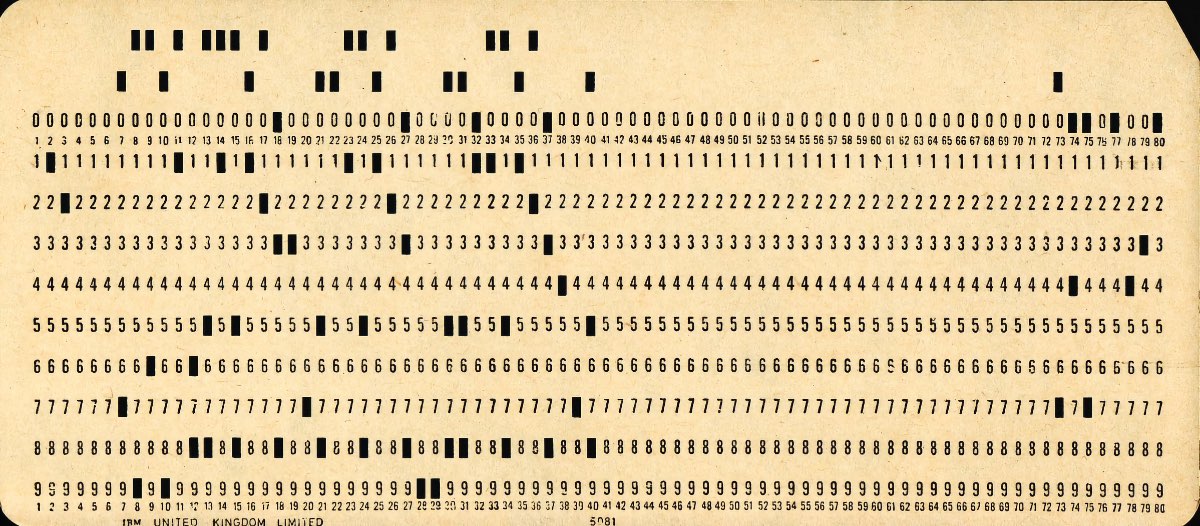

Chinese characters are the punched cards of writing systems. Punched cards were not totally impossible to use, but there are now much better and easier-to-use ways to control computers.
This is not a question of mere convenience—recall the vital role our personal computers and mobile devices played during the COVID-19 pandemic, during which these devices allowed the vast majority of Jehovah’s people to continue attending and participating in meetings through Zoom videoconferencing. In that trying situation, computing devices that had to be controlled by punched cards just would not have worked successfully! (Imagine having to fill out a stack of punched cards, and then having to put them through your card reader, just to tell your mainframe computer that takes up most of your living room to invoke the Zoom command that would indicate to your Watchtower Study conductor that you want to make a comment. Just, NO! Okay then, how about using the newer, slightly simplified punched cards? …)
Similarly, how well we can communicate with and give spiritual assistance to Mandarin-speaking sheeplike ones can have a big impact on their spiritual health and welfare. So, whether Chinese characters help or hinder our ability to learn how to successfully communicate in Mandarin, or whether a simpler system like Pīnyīn (Pīn·yīn {Piecing Together of} · Sounds → [Pinyin] 拼音) would enable us to be more successful in this regard, are questions of vital importance.
The ZT Experiment
The article “Pīnyīn (Pīn·yīn {Piecing Together of} · Sounds → [Pinyin] 拼音) Was Plan A” has a section about the ZT experiment, an experimental program that “encouraged students to read and write in pinyin for longer periods than was stipulated by the conventional curriculum.” How successful was using more Pīnyīn (Pīn·yīn {Piecing Together of} · Sounds → [Pinyin] 拼音) found to be, compared to the traditional method of focusing on characters?
It is actually not necessary to rely merely on personal opinion when considering whether or not it would be a good idea for Mandarin-learners to use Pīnyīn more than it has traditionally been used. For one thing, many of us have seen and experienced much evidence for this ourselves in recent years, during which Jehovah has blessed the worldwide Mandarin field with explosive growth as Pīnyīn has been used more and more for training and helping Mandarin-learners. This is in striking contrast to the agonizingly slow growth experienced in the Chinese field in earlier years, when Chinese language training was more focused on characters.
Strong additional evidence was provided by an experimental program that was conducted in many elementary schools throughout China to explore what would result from expanded use of Pīnyīn. Under the Z.T. subheading there, the article “The Prospects for Chinese Writing Reform”, mentioned above, discusses this interesting experimental program. …
…
Basically, compared to those in the standard program who were just taught Pīnyīn for a couple of months or so purely as a phonetic aid for pronouncing characters, the students who were allowed to use Pīnyīn on its own as a writing system for a couple of years or so not only did significantly better in learning the language and in learning the Chinese characters, they also did significantly better overall academically. This is not surprising to me, since language is needed to learn and progress in any and every other field of learning.
So, the ZT experiment has shown that while those who focused on characters as per the traditional “hard way” had some success, those who used more Pīnyīn (Pīn·yīn {Piecing Together of} · Sounds → [Pinyin] 拼音) had more success in various ways!
Considering all the above, it can be seen that while Chinese characters have been successful in some ways, the myth of the complete, unqualified, incomparable, overwhelming successfulness of the inhumanly numerous and complex Chinese characters is…BUSTED!