Categories
Culture Current Events History Technology Theocratic

shèjiāo wǎngzhàn

shèjiāo wǎngzhàn ((shè·jiāo {god of the land → [society] → [social]} · {meeting → [associating]} → [social contact/interaction] 社交) (wǎng·zhàn {net → [web]} · {stand → [station]} → [website] 网站 網站) [social networking website; social network]) ← Tap/click to show/hide the “flashcard”

[Notes: Tap/click on a Pīnyīn (Pīn·yīn {Piecing Together of} · Sounds → [Pinyin] 拼音) expression to reveal its “flashcard”; tap/click on a “flashcard” or its Pīnyīn (Pīn·yīn {Piecing Together of} · Sounds → [Pinyin] 拼音) expression to hide the “flashcard”. 📖 📄 📘 icons mean 📖 Reveal All, 📄 Reveal Advanced, and 📘 Reveal None re all the “flashcards” in the heading, paragraph, etc. that they are placed at the beginning of.]

At the time of this writing, jw.org had recently featured a video that was introduced with the following words, which included this week’s MEotW, “shèjiāo wǎngzhàn ((shè·jiāo {god of the land → [society] → [social]} · {meeting → [associating]} → [social contact/interaction] 社交) (wǎng·zhàn {net → [web]} · {stand → [station]} → [website] 网站 網站) [social networking website; social network])”, in the Mandarin text:

English:

Be Social-Network Smart

Learn how to avoid the pitfalls of social networking.

Mandarin:

📖 📄 📘 Zài (On 在) Shèjiāo Wǎngzhàn ((Shè·jiāo {God of the Land → [Society] → [Social]} · {Meeting → [Associating]} → [Social Contact/Interaction] 社交) (Wǎng·zhàn {Net → [Web]} · {Stands → [Stations]} → [Websites] 网站 網站) [Social Networks]) Zuò (Be 做) ge ([mw]個/个) Cōngming (Cōng·ming Intelligent · {Bright → [Understanding]} 聪明 聰明) Rén (Person 人)

📖 📄 📘 Lái (come) kànkan (kàn·kan see · see 看看) zěnyàng (zěn·yàng what · {pattern → [way]} → [how] 怎样 怎樣) cái ({only then}才/纔) néng ({to be able} 能) bìmiǎn ({to avoid} 避免) diàojìn (diào·jìn falling · {to go into} 掉进 掉進) shèjiāo wǎngzhàn ((shè·jiāo {god of the land → [society] → [social]} · {meeting → [associating]} → [social contact/interaction] 社交) (wǎng·zhàn {net → [web]} · {stands → [stations]} → [websites] 网站 網站) [social networks]) de ( 的) xiànjǐng (xiàn·jǐng {to be fallen into} · pitfalls 陷阱).

In the above excerpts from jw.org, “shèjiāo wǎngzhàn ((shè·jiāo {god of the land → [society] → [social]} · {meeting → [associating]} → [social contact/interaction] 社交) (wǎng·zhàn {net → [web]} · {stand → [station]} → [website] 网站 網站) [social networking website; social network]) means “social networks”. A quick search on the Watchtower ONLINE LIBRARY reveals that the organization has been using “shèjiāo wǎngzhàn ((shè·jiāo {god of the land → [society] → [social]} · {meeting → [associating]} → [social contact/interaction] 社交) (wǎng·zhàn {net → [web]} · {stand → [station]} → [website] 网站 網站) [social networking website; social network]) to translate “social networking sites”, “social networking”, etc. since at least about 2007, not long after the launch in 2004 of the huge, well-known social network Facebook.

Websites and Native Apps

While on one level of literalness “shèjiāo wǎngzhàn ((shè·jiāo {god of the land → [society] → [social]} · {meeting → [associating]} → [social contact/interaction] 社交) (wǎng·zhàn {net → [web]} · {stand → [station]} → [website] 网站 網站) [social networking website; social network]) means “social website” or “social networking website”, and while technically social networks can often also be accessed using native apps, social networks often start out using websites, and these websites generally continue to be major ways to access these social networks after native apps for them become available. The important thing is that undoubtedly people who know Mandarin will generally understand that you are referring to a social network when you use “shèjiāo wǎngzhàn ((shè·jiāo {god of the land → [society] → [social]} · {meeting → [associating]} → [social contact/interaction] 社交) (wǎng·zhàn {net → [web]} · {stand → [station]} → [website] 网站 網站) [social networking website; social network]).

Websites on the World Wide Web can be accessed using web browsers, in which these websites basically work the same on different computing devices like Windows, Mac, and Linux desktop and laptop computers, iPhones and iPads, Android devices, etc. (In this old world’s technological Babel, it’s not always quite that simple, as an example discussed below illustrates, but perhaps amazingly, this is true now to a large extent.) Thus, a website can often be a single development target that provides at least the same basic functionality on many different computing platforms.

An app that is native to Windows/Mac/iPhone/Android/etc. can take advantage of the full performance of, as well as specific features of, the specific platform it is native to, and thus can be noticeably faster, nicer, etc. than a website designed for the lowest common denominator middleman that is the web environment. However, for a social network, developing a native app for each of several computing platforms is generally comparatively difficult, time-consuming, and expensive. Thus, social networks often start out by providing a website for people to use, and then they may or may not go on to develop native apps for particular computing platforms like the iPhone, Android, etc.

Alternate and Related Expressions

An alternate Mandarin term used to translate “social network”, which more literally matches its meaning, is “shèjiāo wǎngluò ((shè·jiāo {god of the land → [society] → [social]} · {meeting → [associating]} → [social contact/interaction] 社交) (wǎng·luò net · enmeshing → [network (computing, transport, etc.) (PRC)] 网络 網絡) [(online) social network]). A search on the Watchtower ONLINE LIBRARY shows that the organization has also been using this term since at least 2007. Note that the organization has sometimes preceded this term with “zàixiàn (zài·xiàn on·line 在线 在線), which means “online”. This distinguishes online social networks from the more abstract social networks (which may or may not be online) studied in the social and behavioural sciences. (By the way, “wǎngluò (wǎng·luò net · enmeshing → [network (computing, transport, etc.) (PRC)] 网络 網絡) is a PRC (People’s Republic of China) term. The corresponding term used in Taiwan is “wǎnglù (wǎng·lù net · road; path; way; route → [network (computing, transport, etc.) (Tw)] 网路 網路)”.)

An expression that is related to “shèjiāo wǎngzhàn ((shè·jiāo {god of the land → [society] → [social]} · {meeting → [associating]} → [social contact/interaction] 社交) (wǎng·zhàn {net → [web]} · {stand → [station]} → [website] 网站 網站) [social networking website; social network]) and “shèjiāo wǎngluò ((shè·jiāo {god of the land → [society] → [social]} · {meeting → [associating]} → [social contact/interaction] 社交) (wǎng·luò net · enmeshing → [network (computing, transport, etc.) (PRC)] 网络 網絡) [(online) social network])”, and that some may use as an abbreviation for one or both of them, is “shèjiāo wǎng ((shè·jiāo {god of the land → [society] → [social]} · {meeting → [associating]} → [social contact/interaction] 社交) (wǎng net → [network] → [Web; Internet]) [social media; abbr. for shèjiāo wǎngluò/wǎngzhàn (social networks/social networking websites)])”.

“Shèhuì wǎngluò ((Shè·huì {god of the land → [society] → [social]} · {gathering → [society] → [social]} → [social] 社会 社會) (wǎng·luò net · enmeshing → [network (computing, transport, etc.) (PRC)] 网络 網絡) [social network (abstract concept)]) is an expression that evidently refers to the more conceptual social networks mentioned above, that are studied in the social and behavioural sciences. A similar expression is “guānxi wǎng ((guān·xi {closing [with] → [involving]} · {tying → [relating]} → [relationship] 使徒) (wǎng net → [network]網/网) [Internet and/or real-life social network, relationship network, network of friends/connections])”.

Browser Babel and Subtitles

As a side note, while researching this post, I discovered that the Referenced Theo. Expressions (RTE)’s bookmarklet (tap/click on the “Show bookmarklets” link) for adding unproofread, computer-generated Pīnyīn (Pīn·yīn {Piecing Together of} · Sounds → [Pinyin] 拼音) to a web page with Chinese characters will also add such Pīnyīn (Pīn·yīn {Piecing Together of} · Sounds → [Pinyin] 拼音) to the subtitles of the Mandarin videos on jw.org (the ones I was able to try, at least), if one is using one of the following web browsers on a Mac, or presumably, on a PC or an Android device:

  • Firefox
  • Microsoft Edge
  • Presumably, other browsers that, like MS Edge, use the Blink browser engine, such as Google Chrome, Opera, etc.
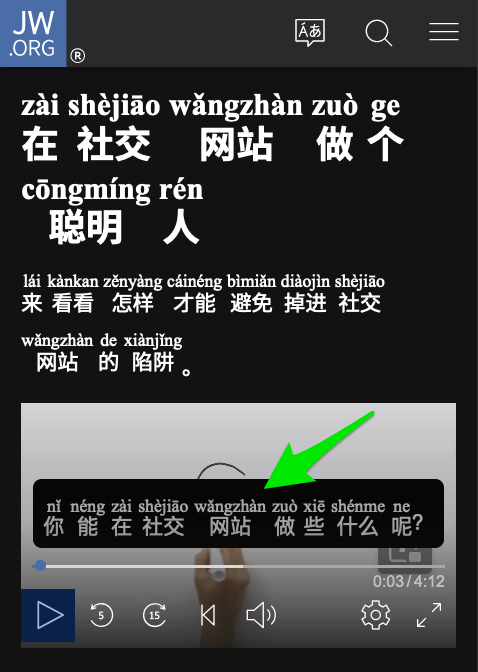
Screenshot of a Mandarin video on jw.org, in Firefox, after processing by the RTE _Pīnyīn_ bookmarklet, with an arrow pointing out the _Pīnyīn_ added to the subtitles

Unfortunately, at this time, this does not work on Safari browsers, whether on a Mac or on an iPad or iPhone. In those web browsers, the Chinese characters of the video subtitles remain unadorned by added Pīnyīn (Pīn·yīn {Piecing Together of} · Sounds → [Pinyin] 拼音) when the bookmarklet does its thing. While this is a case of Apple’s Safari web browsers allowing for less functionality compared to other browsers, the underlying reason for this may be related to Apple’s relatively high prioritization of user privacy and security, which benefits users in other ways.

Pīnyīn (Pīn·yīn {Piecing Together of} · Sounds → [Pinyin] 拼音) Plus video transcripts can potentially provide more and better-proofread information (and are usable in all major modern browsers, including Safari), but when such material is not available for a particular Mandarin video, for many the above option is much better than having to deal with raw characters. Also, there may be some benefit in seeing even unproofread Pīnyīn (Pīn·yīn {Piecing Together of} · Sounds → [Pinyin] 拼音) displayed right in the video picture as one is watching a Mandarin video.
Categories
Culture History Language Learning Technology Theocratic

cuò

cuò ({[is] alternating; staggered} [→ [[is] wrong; mistaken; incorrect; erroneous | missed | grinding; rubbing | moving to the side | mistake; error; blunder [→ [fault]]]] | {[is] interlocked and jagged} [→ [intricate]]) ← Tap/click to show/hide the “flashcard”

[Notes: Tap/click on a Pīnyīn (Pīn·yīn {Piecing Together of} · Sounds → [Pinyin] 拼音) expression to reveal its “flashcard”; tap/click on a “flashcard” or its Pīnyīn (Pīn·yīn {Piecing Together of} · Sounds → [Pinyin] 拼音) expression to hide the “flashcard”. 📖 📄 📘 icons mean 📖 Reveal All, 📄 Reveal Advanced, and 📘 Reveal None re all the “flashcards” in the heading, paragraph, etc. that they are placed at the beginning of.]

One of the publications that is now recommended to be used on Bible studies is the Yǒngyuǎn Xiǎngshòu Měihǎo de Shēngmìng—Hùdòng Shì Shèngjīng Kèchéng ((Yǒng·yuǎn Eternally · {Far (in Time)} 永远 永遠) (Xiǎng·shòu Enjoy · Receive 享受) (Měi·hǎo Beautiful · Good 美好) (de ’s 的) (Shēngmìng Life 生命)—(Hù·dòng {Each Other} · Moving → [Interactive] 互动 互動) (Shì (Type 式) (Shèng·jīng Holy · Scriptures → [Bible] 圣经 聖經) (Kè·chéng Lessons · Procedure → [Course] 课程 課程) [Enjoy Life Forever!—An Interactive Bible Course (lff)]) (Enjoy Life Forever! (lff)) book. This week’s MEotW, “cuò ({[is] alternating; staggered} [→ [[is] wrong; mistaken; incorrect; erroneous | missed | grinding; rubbing | moving to the side | mistake; error; blunder [→ [fault]]]] | {[is] interlocked and jagged} [→ [intricate]])”, occurs at about the 18 second mark of the video for lesson 08, point 6 of this book:

📖 📄 📘 (I 我) zǒng (always總/縂) juéde (jué·de {to wake to → [to feel]} · got → [got to feel] 觉得 覺得), fāshēng (fā·shēng {issued forth} · {came to life} → [happened] 发生 發生) zài (on 在) (me 我) shēnshang (shēn·shang {body → [self]} · upon 身上) de (’s 的) shì (things 事) dōu (all 都) shì (were 是) wǒ de ((wǒ me 我) (de ’s 的) [my]) cuò ({being staggered} → [error] → [fault]).

Many undoubtedly already know this word to mean “wrong” or “mistaken”. However, examination of the various meanings provided for it in various dictionaries, perhaps with an app like Pleco that allows one to quickly check multiple dictionaries, seems to reveal that there is an extra layer of meaning underneath the meaning of “wrong” or “mistaken” that many at first think of for “cuò ({[is] alternating; staggered} [→ [[is] wrong; mistaken; incorrect; erroneous | missed | grinding; rubbing | moving to the side | mistake; error; blunder [→ [fault]]]] | {[is] interlocked and jagged} [→ [intricate]])”. This more basic meaning seems to be that of “alternating”, or “staggered”—basically, not lining up.

As I have continued to research into the meanings of Mandarin expressions as part of my work on this blog, my work on Pīnyīn (Pīn·yīn {Piecing Together of} · Sounds → [Pinyin] 拼音) Plus material, and just as part of my overall Mandarin language-learning journey, I have come across many such expressions that seem to have turned out to have extra layers of meaning underneath the ones I was at first familiar with.

Digging Deeper

The historical roots of Mandarin Chinese stretch far back in time. As the Wikipedia article on Old Mandarin summarizes:

Old Mandarin or Early Mandarin was the speech of northern China during the Jurchen-ruled Jin dynasty and the Mongol-led Yuan dynasty (12th to 14th centuries).

So, it’s not surprising that there may be etymological layers of meaning underneath the meanings of Mandarin expressions that we are familiar with today. It’s much like how occasionally physical things from the past get discovered in places where people lived and did things in the past, like how so many artifacts have been discovered in places like Egypt or the lands that are now where ancient Mesopotamia used to be, or like how workers excavating the site of the current World Trade Centre building complex came across the remains of a wooden ship.

An Old Chinese Alphabet!

Interestingly, the above-mentioned Wikipedia article on Old Mandarin mentions an alphabet:

The phonology of Old Mandarin has been inferred from the ‘Phags-pa script, an alphabet created in 1269 for several languages of the Mongol empire, including Chinese…

The Wikipedia article on the ʼPhags-pa script provides some further summarized information:

The Phagspa script or ʼPhags-pa script[source] is an alphabet designed by the Tibetan monk and State Preceptor (later Imperial Preceptor) Drogön Chögyal Phagpa for Kublai Khan, the founder of the Yuan dynasty, as a unified script for the written languages within the Yuan. The actual use of this script was limited to about a hundred years during the Mongol-led Yuan dynasty, and it fell out of use with the advent of the Ming dynasty.[source][source]

It was used to write and transcribe varieties of Chinese, the Tibetic languages, Mongolian, the Uyghur language, Sanskrit, probably Persian,[source][source][source][source] and other neighboring languages[citation needed] during the Yuan era.

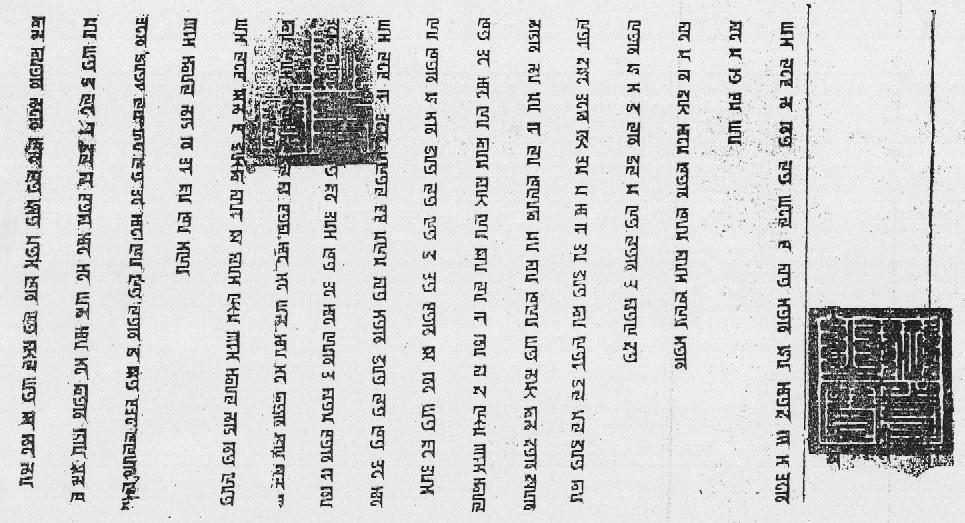
A manuscript copy of an imperial edict of the Yuan dynasty in ʼPhags-pa script
Creative Commons Public Domain logo
A manuscript copy of an imperial edict of the Yuan dynasty in ʼPhags-pa script

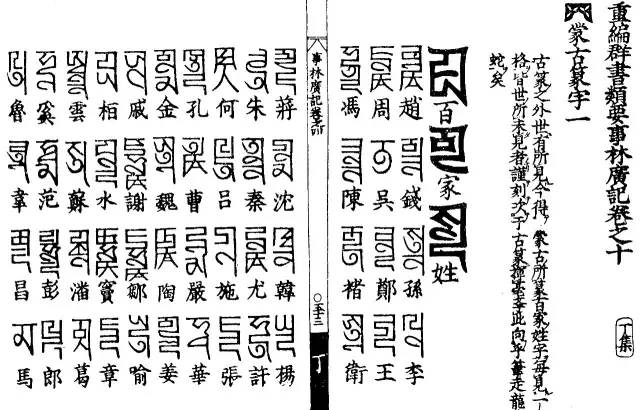
An example of the Chinese poem “Hundred Family Surnames” written in Chinese characters and in ʼPhags-pa script
Creative Commons Public Domain logo
An example of the Chinese poem “Hundred Family Surnames” written in Chinese characters and in ʼPhags-pa script

So, despite the claims of some Chinese traditionalists that the Chinese languages can only be written using Chinese characters, Chinese languages, including an old form of Mandarin, have been written with an alphabet before, one that was created for Kublai Khan himself! (Interestingly, Kublai Khan was the ruler of China when Marco Polo visited there. So, this famous Italian may have been there when Chinese languages were written using an alphabet.) Méi ({(there) is not having}) cuò ({being staggered} → [mistake]), there is historical precedent for the idea that a Chinese language like Modern Standard Mandarin can be written with an alphabetical writing system like Pīnyīn (Pīn·yīn {Piecing Together of} · Sounds → [Pinyin] 拼音).


For convenience:

The direct link for the current generation Pīnyīn (Pīn·yīn {Piecing Together of} · Sounds → [Pinyin] 拼音) Plus resource for the Enjoy Life Forever! book is:

The short link for Chinese field language-learning links for the Enjoy Life Forever! book is:

More Pīnyīn (Pīn·yīn {Piecing Together of} · Sounds → [Pinyin] 拼音) and Pīnyīn (Pīn·yīn {Piecing Together of} · Sounds → [Pinyin] 拼音) Plus web material based on the Mandarin Enjoy Life Forever! book will be made available in the Pīnyīn (Pīn·yīn {Piecing Together of} · Sounds → [Pinyin] 拼音) Plus web resource as time allows.

Categories
Culture Experiences History Science Technology Theocratic

chuàngzào

chuàngzào (chuàng·zào initiating · {making, creating} → [creating | creation; innovation] 创造 創造) ← Tap/click to show/hide the “flashcard”

The Shēngmìng Láizì Chuàngzào Ma? ((Shēngmìng Life 生命) (Lái·zì Came · From 来自 來自) (Chuàng·zào Initiating · {Making, Creating} → [Creating] 创造 創造) (Ma [? ptcl for “yes/no” questions])? [Was Life Created? (lc)]) (Was Life Created? (lc)) brochure and the Shēngmìng de Qǐyuán—Zhíde Sīkǎo de Wǔ Ge Wèntí ((Shēngmìng Life 生命) (de ’s 的) (Qǐ·yuán {Rising → [Starting]} · Source → [Origin] 起源/原)—(Zhí·de Worth · Getting → [Worth] 值得) (Sī·kǎo {Thinking About} · Examining 思考) (de ’s 的) (Wǔ Five 五) (Ge [mw]個/个) (Wèn·tí Asking · Subjects → [Questions] 问题 問題) [The Origin of Life​—Five Questions Worth Asking (lf)]) (The Origin of Life​—Five Questions Worth Asking (lf)) brochure were originally published back in 2010, but recently, the English version of the Was Life Created? brochure was updated to the December 2022 Printing, and the Mandarin version of it was updated to the February 2023 Printing. Also, the Was Life Created? brochure and the Origin of Life brochure are now in the Teaching Toolbox section in the JW Library app. So, it would be good to consider some of the expressions used in the Mandarin versions of these publications that can be so helpful when discussing whether life was created.

How It Started

This week’s MEotW, which appears right in the title of the Mandarin Was Life Created? brochure, is “chuàngzào (chuàng·zào initiating · {making, creating} → [creating | creation; innovation] 创造 創造). While this is basically a verb meaning “create”, it can also be used as a noun meaning “creation”. Such verbal/gerundial nouns were discussed in the MEotW post on “jiàodǎo (jiào·dǎo teaching · {guiding [→ [instructing]]} 教导 教導)”:

One interesting thing to note about “jiàodǎo (jiào·dǎo teaching · {guiding [→ [instructing]]} 教导 教導)” (and about “jiàoxun (teaching → [reprimanding | knowledge gained from an error] 教训 教訓)”, for that matter) is that their component morphemes seem to basically be verbs. In certain contexts, however, they are used as nouns. An example of this being done in English is that “teach” and “teaching” are verbs (e.g. “Jesus was teaching the crowd.”), but in certain contexts, “teaching” is used as a noun (e.g. “The crowd was amazed at the teaching Jesus shared with them.”). When a word is used this way, it’s called a verbal noun, or a gerundial noun. Verbal nouns are quite common in Mandarin.

How It Breaks Down

The “chuàng (initiate; create; start; originate; {achieve (sth. for the first time)}創/刱/剏/剙) in “chuàngzào (chuàng·zào initiating · {making, creating} → [creating | creation; innovation] 创造 創造) is also used in “Chuàngshìjì (Chuàng·shì·jì {Initiating, Creating of} · {Generation → [World]} · Record → [Genesis] 创世记 創世記), and is associated with originality and creativity. For example, this “chuàng (initiate; create; start; originate; {achieve (sth. for the first time)}創/刱/剏/剙) also occurs in “chuàngzuò (chuàng·zuò initiated; created; originated · {made [→ [written/composed]]} [(thing)] [→ [created; produced; written [(thing)]] [→ [creative work; creation]]] 创作 創作) and in “chuàngzuò lì ((chuàng·zuò {to initiate/create/originate} · {to make [→ [to write/compose]]} → [to create/produce/write] 创作 創作) (lì power → [ability] 力) [creative ability; creativity; originality]), which can respectively mean “creative work” and “creativity”.

As for the “zào (make; build; create 造) in “chuàngzào (chuàng·zào initiating · {making, creating} → [creating | creation; innovation] 创造 創造), it’s more associated with making and building, and it’s the same “zào (make; build; create 造) that’s in “jiànzào (construct; build 建造). “Jiànzào (build 建造) fángwū (houses 房屋), for example, means “build houses”.

How It Comes Together

So, “chuàngzào (chuàng·zào initiating · {making, creating} → [creating | creation; innovation] 创造 創造), being made up of “chuàng (initiate; create; start; originate; {achieve (sth. for the first time)}創/刱/剏/剙) and “zào (make; build; create 造), covers the entire process of coming up with the idea for something, and then actually making or building it. This is in contrast with the idea of theistic evolution, that God somehow got the ball rolling and then sat back and let the process of evolution develop all the wonderful living things in the natural world.

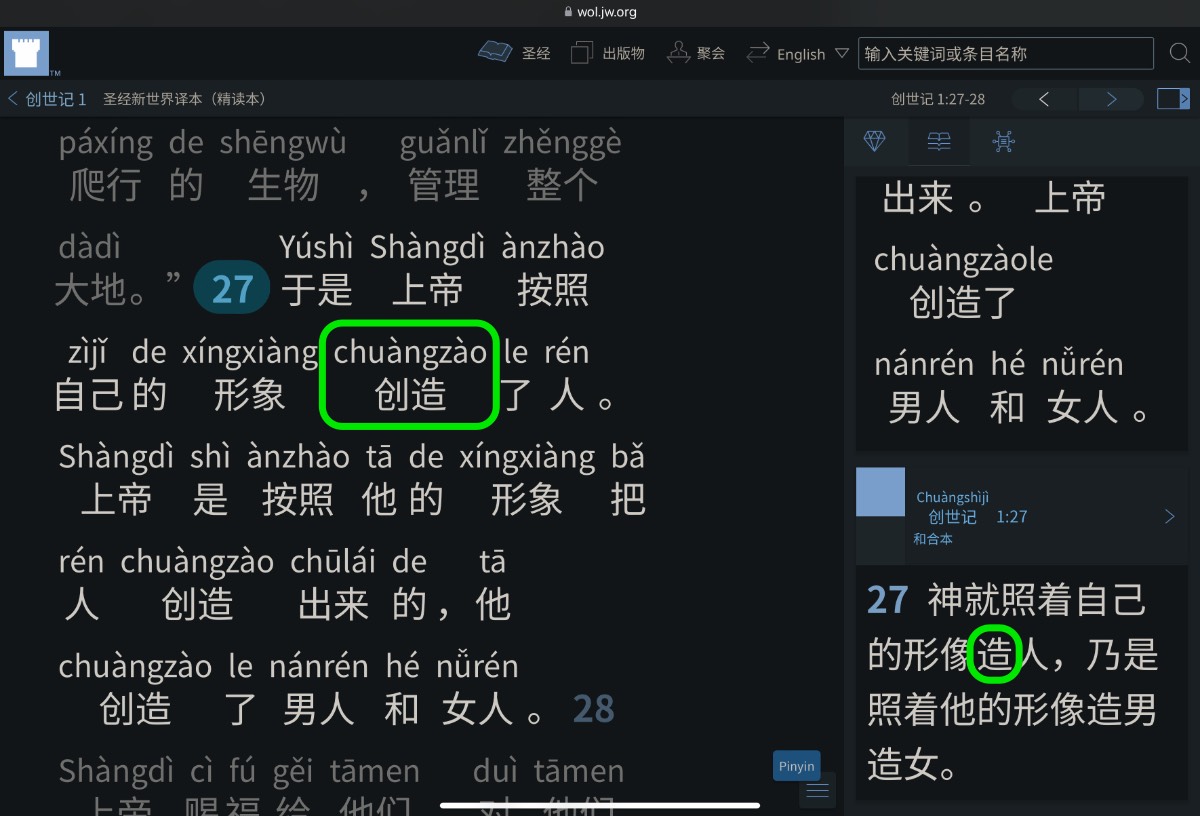
One person in particular whom I remember having such a viewpoint was my grade 7 teacher, who was actually quite smug about how her Catholic/personal beliefs had thus seemingly neatly reconciled the contradictions between the worldly “scientific” theory of evolution and the creation account in the Bible book of Genesis. However, the actual wording of the Genesis account, including how it is often translated into Mandarin, does not really go along with such a seemingly neat reconciliation with evolution.—Genesis 1:27 (English WOL, Mandarin WOL, Pīnyīn (Pīn·yīn {Piecing Together of} · Sounds → [Pinyin] 拼音) Plus).

“_Chuàngzào_” in Genesis 1:27 (NWT (nwtsty), WOL CHS+Pinyin), with “_zào_” in _Héhé Běn_

To represent how God caused humans to come into existence, the Mandarin New World Translation Bible uses “chuàngzào (chuàng·zào initiated · {made, created} → [created] 创造 創造), and the Héhé Běn ((Hé·hé Harmonious · {Closed → [United]} 和合) (Běn {Root or Stem} → [Edition] 本) [Union Version (Chinese Bible)]) uses “zào (made; built; created 造). Both these expressions contain the sense of “made, created”, and perhaps “built”.

How the Py+ Material Is Going

A while ago, I got the feeling that I should shift focus to get to work on producing current-generation Pīnyīn (Pīn·yīn {Piecing Together of} · Sounds → [Pinyin] 拼音) Plus material for the Was Life Created? brochure, which I had last produced older-style material for several years earlier. The official material for this brochure had also not been changed for several years, with the last Mandarin printing of it being dated 2016-12.

However, not long after I had started working on new Pīnyīn (Pīn·yīn {Piecing Together of} · Sounds → [Pinyin] 拼音) Plus material for this brochure, I noticed that a new printing, dated 2022-12, had been put out for the English version of the Was Life Created? brochure, and then, a new printing, dated 2023-02, appeared in the JW Library app for the Mandarin version of this brochure. Also, the Was Life Created? brochure and the Origin of Life brochure were added to the Teaching Toolbox section in the JW Library app at around this time. It seems that Jehovah had decided that the time had come for renewed focus on these brochures, and it seems that the work of producing Pīnyīn (Pīn·yīn {Piecing Together of} · Sounds → [Pinyin] 拼音) Plus material for the Was Life Created? brochure is privileged to be part of this renewed focus.

At the time of this writing, the old 3-line files (iPad-Letter-A4, XLP-iPhone-A5) together with the new Pīnyīn (Pīn·yīn {Piecing Together of} · Sounds → [Pinyin] 拼音) Plus web resource cover the entire Was Life Created? brochure. (The 3-line files were based on an older version of the brochure, though.) Also, the Pīnyīn (Pīn·yīn {Piecing Together of} · Sounds → [Pinyin] 拼音) Plus web resource (which can be used offline in supporting browsers) contains no more Pīnyīn (Pīn·yīn {Piecing Together of} · Sounds → [Pinyin] 拼音)-only material that has only been partially proofread—all the Pīnyīn (Pīn·yīn {Piecing Together of} · Sounds → [Pinyin] 拼音)-only material has now been fully proofread.


For convenience:

The direct link for the current generation Pīnyīn (Pīn·yīn {Piecing Together of} · Sounds → [Pinyin] 拼音) Plus resource for the Was Life Created? brochure is:

The short link for Chinese field language-learning links for the Was Life Created? brochure is:

More Pīnyīn (Pīn·yīn {Piecing Together of} · Sounds → [Pinyin] 拼音) and Pīnyīn (Pīn·yīn {Piecing Together of} · Sounds → [Pinyin] 拼音) Plus web material based on the Mandarin Was Life Created? brochure will be made available in the Pīnyīn (Pīn·yīn {Piecing Together of} · Sounds → [Pinyin] 拼音) Plus web resource as time allows. Work is now underway to produce a Pīnyīn (Pīn·yīn {Piecing Together of} · Sounds → [Pinyin] 拼音) Plus web resource for the Mandarin Origin of Life brochure as well.