Categories
Culture Experiences Language Learning Science Technology Theocratic

wūdú

wūdú (voodoo 巫毒) 👈🏼 Tap/click to show/hide the “flashcard”

[Notes: Tap/click on a Pīnyīn (Pīn·yīn {Piecing Together of} · Sounds → [Pinyin] 拼音) expression to reveal its “flashcard”; tap/click on a “flashcard” or its Pīnyīn (Pīn·yīn {Piecing Together of} · Sounds → [Pinyin] 拼音) expression to hide the “flashcard”. 📖 📄 📘 icons mean 📖 Reveal All, 📄 Reveal Advanced, and 📘 Reveal None re all the “flashcards” in the heading, paragraph, etc. that they are placed at the beginning of.]

One of the publications that is now recommended to be used on Bible studies is the Yǒngyuǎn Xiǎngshòu Měihǎo de Shēngmìng—Hùdòng Shì Shèngjīng Kèchéng ((Yǒng·yuǎn Eternally · {Far (in Time)} 永远 永遠) (Xiǎng·shòu Enjoy · Receive 享受) (Měi·hǎo Beautiful · Good 美好) (de ’s 的) (Shēngmìng Life 生命)—(Hù·dòng {Each Other} · Moving → [Interactive] 互动 互動) (Shì (Type 式) (Shèng·jīng Holy · Scriptures → [Bible] 圣经 聖經) (Kè·chéng Lessons · Procedure → [Course] 课程 課程) [Enjoy Life Forever!—An Interactive Bible Course (lff)]) (Enjoy Life Forever! (lff)) book. An outstanding feature of this book is its extensive use of the post-paper technology of video, which enables information to be presented much more vividly than could be done with paper. Also, at this time, one of the unique features of Pīnyīn (Pīn·yīn {Piecing Together of} · Sounds → [Pinyin] 拼音) Plus material is Pīnyīn (Pīn·yīn {Piecing Together of} · Sounds → [Pinyin] 拼音) Plus video transcripts. These can help us Mandarin field language learners to analyze and understand the Mandarin speech used in the many videos referenced in the Mandarin Enjoy Life Forever! book. This in turn can help us make more effective use of these videos while participating in Mandarin Bible discussions using this book.

This week’s MEotW, “wūdú (voodoo 巫毒)”, occurs in subtitle 3 of the transcript for the video for lesson 14, point 5 of the Mandarin Enjoy Life Forever! book:

English:

At a tender age, I had a troubled mind

as to how I would be pleasing to God

and also at the same time be pleasing in the eyes of the voodoo.

Mandarin:

1
00:00:02,952 → 00:00:06,556
📖 📄 📘 Cóngxiǎo (Cóng·xiǎo from · {being little → [being young]} → [from childhood] 从小 從小) (I 我) jiù (then 就) yìzhí (yì·zhí one · {being straight} → [all the while] 一直) zài ({had been in} → [had then been] 在) xiǎng (thinking 想)

2
00:00:06,556 → 00:00:11,461
📖 📄 📘 (I 我) zěnyàng (zěn·yàng (in) what · {pattern → [way]} → [how] 怎样 怎樣) zuò ({would do} 做) kěyǐ (kě·yǐ {to be able} · [suf] 可以) tóngshí (tóng·shí {(at the) same} · {(particular) time} 同时 同時) ràng ({to make}) Shàngdì (Shàng·dì Above’s · {Emperor → [God]} → [God] 上帝) xǐyuè ({to be pleased} 喜悦 喜悅),

3
00:00:11,461 → 00:00:14,964
📖 📄 📘 yòu (also 又) ràng ({to make}) wūdú (voodoo 巫毒) de (’s 的) shénlíng (shén·líng gods · spirits 神灵 神靈) xǐyuè ({to be pleased} 喜悦 喜悅).

Speech Is Primary!

The individual morphemes of “wūdú (voodoo 巫毒) have interesting meanings (“witch/wizard/shaman” and “poison”), but ultimately, “wūdú (voodoo 巫毒) is a loanword from the English word “voodoo”, which in turn comes, via Louisiana French, from the Fon word “vodun”, meaning “god; deity”.

How similar these loanwords sound reminds us that, as linguists say, speech, with its invisible sounds to represent meaning, is actually the primary aspect of language, as opposed to writing, which is secondary, no matter how intricate its visual symbols are.

Power-Hungry?

As Jehovah’s people, we have been taught to seek to imitate him and cultivate and display a healthy balance and combination of Jehovah’s four cardinal attributes: power, justice, wisdom, and love. (Ephesians 5:1, 2) However, those who are devoted to voodoo and other forms of spiritism seek power over all else. This unbalanced thirst for power over all else, ignoring and even actively fighting against wisdom, justice, and love, is common in Satan’s world, which is made in Satan’s deformed spiritual image.

The perceived voodooesque power of characters—including their mythical idol-like power to represent invisible meaning with their mesmerizing visual designs, and also the cultural power, social status, and glamour associated with them—is of course appealing to those who conform to the power-hungry template of those infected with the spirit of Satan’s world.

When such ones are presented with the simple, humble effectiveness of Pīnyīn (Pīn·yīn {Piecing Together of} · Sounds → [Pinyin] 拼音), they recoil at this this threat to their precious characters-based power, much as the Pharisees, etc. recoiled at the threat Jesus and his back-to-spiritual-basics teachings posed to their traditions-based power. On the other hand, Mandarin field language learners who are truly motivated by love for God and neighbour see in Pīnyīn (Pīn·yīn {Piecing Together of} · Sounds → [Pinyin] 拼音) an excellent tool for helping them to effectively use Mandarin speech—the actual primary aspect of the Mandarin language—to help them praise and glorify Jehovah and give spiritual assistance to honest-hearted people in the Mandarin field.
汉字 / 漢字? Pīnyīn?

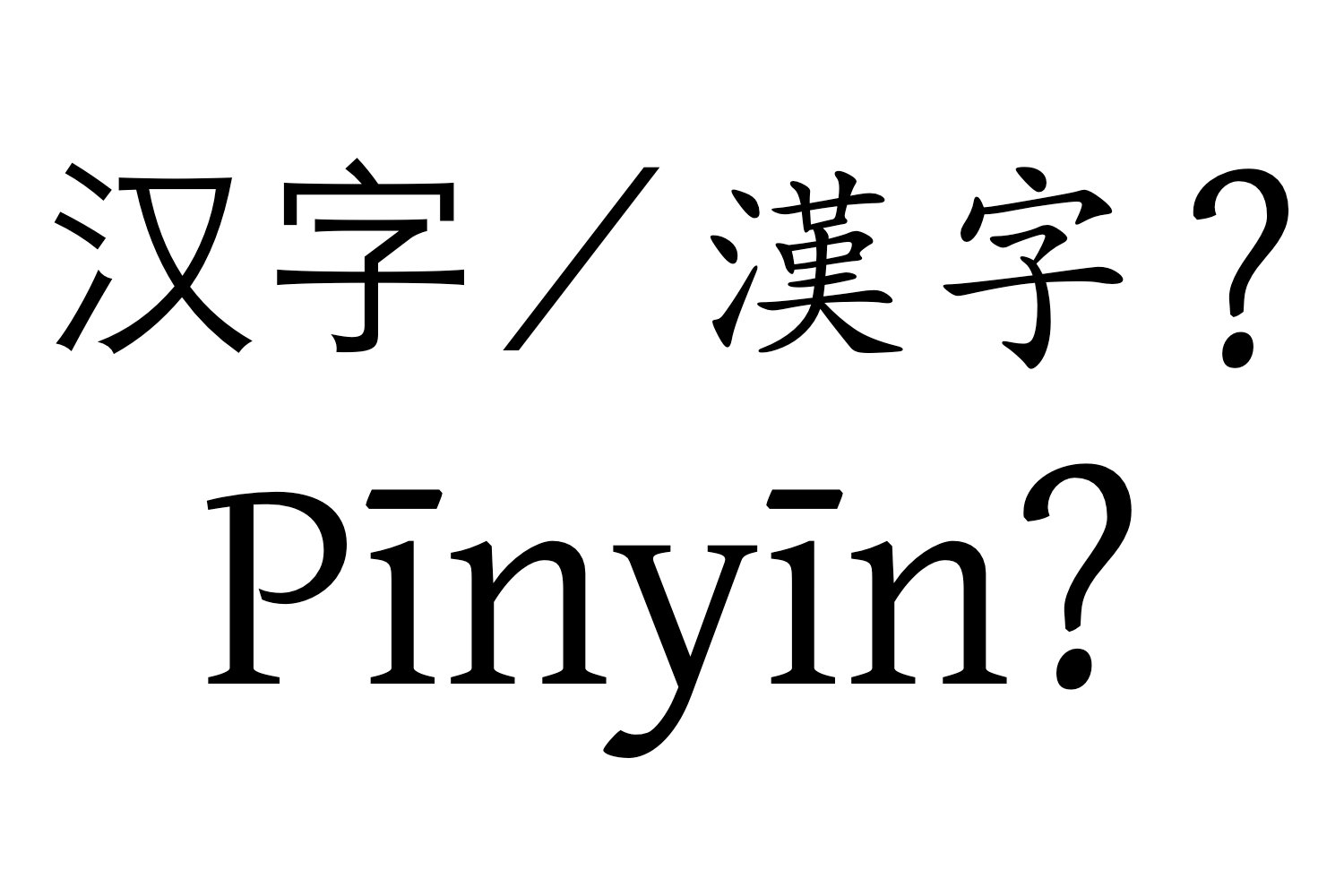
Indeed, whereas some feel that characters present a test of our determination to serve God in the face of difficulties, it is evident that characters can actually present a test of our motivations as Mandarin field language learners, especially when Pīnyīn (Pīn·yīn {Piecing Together of} · Sounds → [Pinyin] 拼音) is available (as it often is now). Are we in our pride hungry for the voodooesque power often associated with the characters? Or are we truly motivated by love of God and neighbour to look for ways to get past the unnecessarily obstructive Great Wall of characters, and to make good use of Pīnyīn (Pīn·yīn {Piecing Together of} · Sounds → [Pinyin] 拼音), in many situations the evidently better tool for glorifying God and helping our Mandarin-speaking neighbours, when it is available?—1 Corinthians 13.

The Great Wall of China

How do we respond to the seemingly powerful Great Wall of characters?


For convenience:

The direct link for the Pīnyīn (Pīn·yīn {Piecing Together of} · Sounds → [Pinyin] 拼音) Plus resource for the Enjoy Life Forever! book is:

The short link for Chinese field language-learning links for the Enjoy Life Forever! book is:

More Pīnyīn (Pīn·yīn {Piecing Together of} · Sounds → [Pinyin] 拼音) and Pīnyīn (Pīn·yīn {Piecing Together of} · Sounds → [Pinyin] 拼音) Plus web material based on the Mandarin Enjoy Life Forever! book will be made available in the Pīnyīn (Pīn·yīn {Piecing Together of} · Sounds → [Pinyin] 拼音) Plus web resource as time allows.
Categories
Culture Current Events Experiences Technology Theocratic

jūnduì

jūnduì (jūn·duì {armed forces}; army · {row of people → [team; group; unit]} → [armed forces; army; troops] 军队 軍隊) 👈🏼 Tap/click to show/hide the “flashcard”

[Notes: Tap/click on a Pīnyīn (Pīn·yīn {Piecing Together of} · Sounds → [Pinyin] 拼音) expression to reveal its “flashcard”; tap/click on a “flashcard” or its Pīnyīn (Pīn·yīn {Piecing Together of} · Sounds → [Pinyin] 拼音) expression to hide the “flashcard”. 📖 📄 📘 icons mean 📖 Reveal All, 📄 Reveal Advanced, and 📘 Reveal None re all the “flashcards” in the heading, paragraph, etc. that they are placed at the beginning of.]

Recently, jw.org featured the video “I Put Down My Rifle”, perhaps at least partially due to the increasing military activity in the world. The person whose experience the video recounts is shown to be in Canada, so another factor may be that Canada, along with other Commonwealth member states, recently observed Rememberance Day on November 11.

A significant expression that appears in the Mandarin version of this video is this week’s MEotW, “jūnduì (jūn·duì {armed forces}; army · {row of people → [team; group; unit]} → [armed forces; army; troops] 军队 軍隊)”. For example, this passage begins at around the 0:18 mark:

English:

I lived the army 24/7. The clothes I wore, the people I associated with—everything was military.

Mandarin:

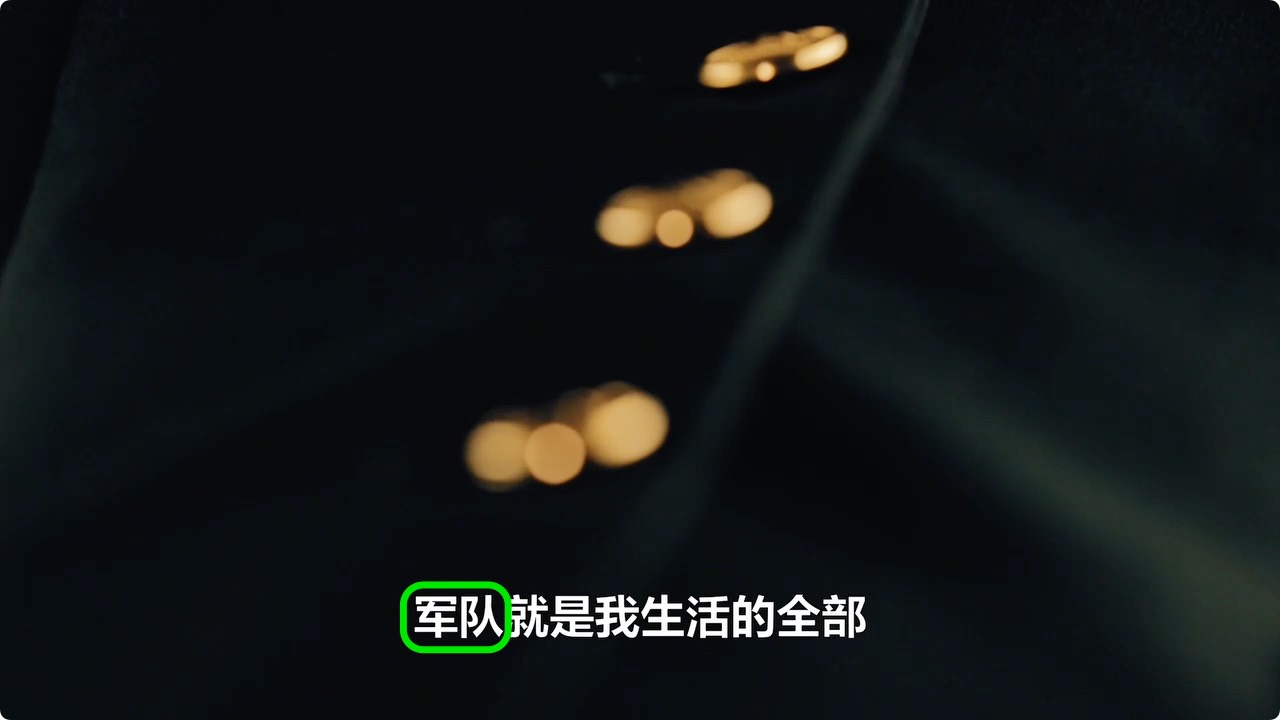
📖 📄 📘 (I 我) shēnshang (shēn·shang {body → [self]} · upon 身上) chuān ({pierced through} → [was dressed in] 穿) de ({’s (clothes)} 的), (my 我) shēnbiān (shēn·biān {body → [self]} · beside → [beside me] 身边 身邊) de (’s 的) rén (people 人)yíqiè (yí·qiè {one (whole)} · {corresponding (set)} → [everything] 一切) dōu (all 都) gēn (with 跟) jūnduì (jūn·duì {armed forces} · {row of people → [team]} → [armed forces] 军队 軍隊) yǒuguān (yǒu·guān had · {closing with → [connection]} 有关 有關). Jūnduì (Jūn·duì army · {row of people → [team]} → [the army] 军队 軍隊) jiùshì (jiù·shì exactly · was 就是) (my 我) shēnghuó (shēng·huó life · living 生活) de (’s 的) quánbù (quán·bù entire · part → [all] 全部).

Screenshot of “Jūnduì” from around 0:26 of the Mandarin version of the video “I Put Down My Rifle”

(By the way, on a technical note, the Mandarin version of this video is the first from the organization that I have come across that doesn’t have a usual type of subtitle track, that users can choose to have superimposed on top of the video picture by apps, etc. that play the video. Instead, the subtitles, rendered in Chinese characters, seem to be “baked into” the actual video picture—there is no way to choose whether to display the Chinese subtitles or not. Perhaps this was done to ensure that viewers of the Mandarin video would be able to see the subtitles without first having to look for a setting that they would have to set.)

“We Are Jehovah’s Army!”

Interestingly, song 71 in our current songbook is called, in English, “We Are Jehovah’s Army!”. The Mandarin (WOL, Pīnyīn (Pīn·yīn {Piecing Together of} · Sounds → [Pinyin] 拼音) Plus) title, “Yēhéhuá (Jehovah 耶和华 耶和華) de (’s 的) Yīngyǒng (Yīng·yǒng {Are Flowers → [Are Outstanding Persons]} · Valiant → [Valiant] 英勇) Zhànshì (Zhàn·shì War · Soldiers → [Soldiers] 战士 戰士)”, is not a direct translation, but rather translates more like “Jehovah’s Valiant Soldiers”.

It’s an often-used illustration that our efforts in Jehovah’s service can be likened to spiritual warfare. (2 Corinthians 10:3–5; Ephesians 6:11–18) The experience highlighted in the video mentioned above emphasizes to us that while training for physical warfare in the service of the human nations of this world encourages crudeness and aggression, serving Jehovah God and fighting for peace and for the truth means showing kindness and being motivated by love. And while some say that part of the appeal of joining a human worldly jūnduì (jūn·duì army · {row of people → [team]} → [army] 军队 軍隊) is the fulfilment that comes from being part of something bigger than yourself, no family is bigger than Jehovah’s universal family, and no purpose is greater than that of doing God’s will as one of his valiant soldiers.—Ecclesiastes 12:13.

Categories
Culture Current Events History Science Technology Theocratic

app

app (a-p-p)

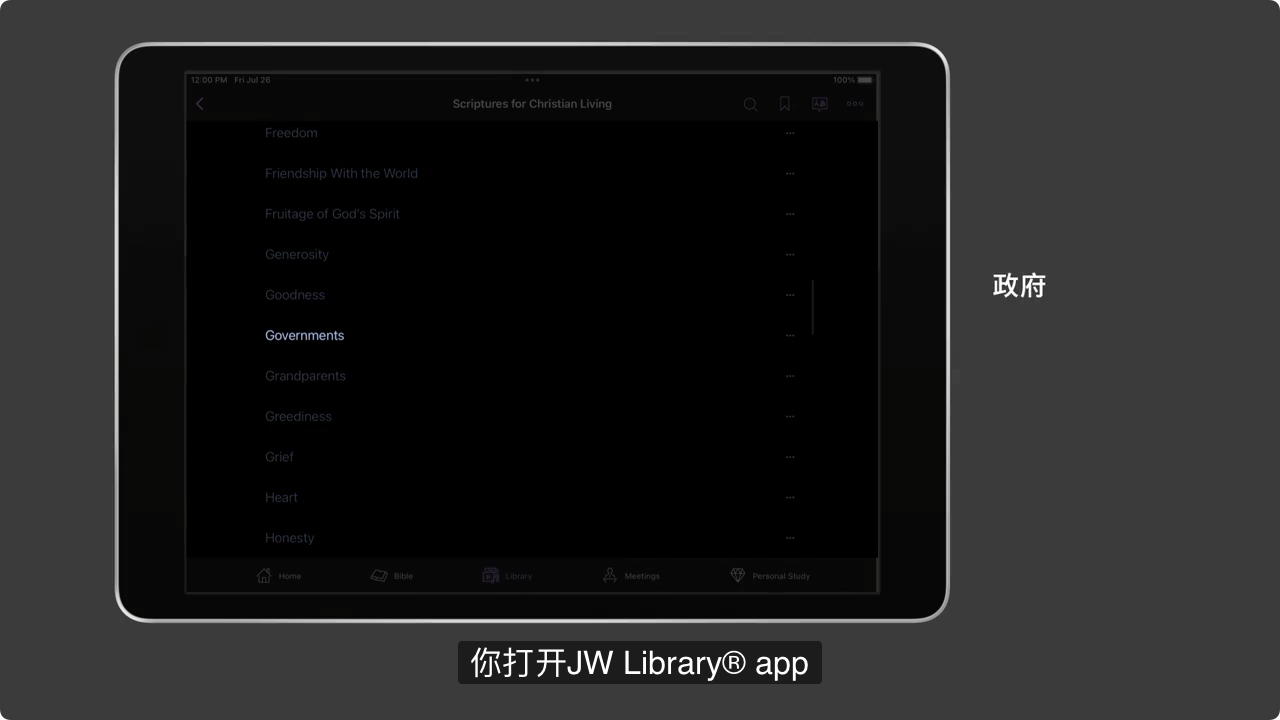
This week’s MEotW, “app” (sometimes written as “APP”), is now the organization’s official way to translate “app” in Mandarin, as much as there is an official way to do so. For example, it’s used in the Mandarin version of the 2024 Governing Body Update #5 video, at around the 11:06 mark—the subtitles say “app”, while the narrator says what sounds like “ay pee pee”.

“app” used in the Mandarin version of the 2024 Governing Body Update #5 video

(By the way, note that in this screenshot, the JW Library app is shown in Dark Mode—afters many years of people being used to using computer displays with white backgrounds that mimick paper, the organization is showing that there is nothing objectionable about the dark or black backgrounds enabled by computing device displays, backgrounds which can be easier on the eyes in some situations. After all, the default mode of the universe that Jehovah created is dark mode!)

An Unexpected Pronunciation

Yes, interestingly, as we can hear from the aforementioned video, when one refers to the JW Library app in Mandarin, in addition to using the English app name “JW Library” instead of a corresponding native Mandarin expression, one spells out the letters of “app” instead of just saying the English word “app”.

Why use three syllables to pronounce this exceedingly simple one-syllable English word in such an unusual and unexpected way? An Internet search turned up a Quora page discussing this question, which page contains the following excerpt that seems to summarize the points made in many of the replies:

Since the the original form “application” is not widely known, app is thought to be an acronym. In the aspect of pronunciation, closed syllables ending with p do not meet the Chinese pronunciation habit.

So, in other words, some believe that:

  • Being unfamiliar with the English word “application” that “app” is an abbreviation for, many Mandarin-speaking people erroneously thought that “app” is an acronym/initialism like “USA” or “PRC”, and acronyms are pronounced by saying the names of the letters in them. [2024-08-21: Thanks to reader SB for bringing up the matter of acronyms vs. initialisms. It seems that there is agreement that initialisms are, or can be, pronounced letter by letter, like “USA” and the Mandarin “app” are. However, there is not agreement about whether expressions pronounced that way count as acronyms, since some hold that only expressions like “NASA” that are pronounced as words should be considered acronyms.]
    • The fact that the Mandarin “app” is sometimes written in all upper case letters as “APP”, like an acronym/initialism would be written, lends credence to this theory.
  • Because Mandarin does not have words that end with a “p” sound, people who have only ever spoken Mandarin are not used to saying such words, and thus were naturally inclined to not just pronounce “app” like it is pronounced in English.
    • Some drag Chinese characters and Pīnyīn (Pīn·yīn {Piecing Together of} · Sounds → [Pinyin] 拼音) into discussion of this question, but these writing systems are just secondary visual representations of the actual primary factor relating to this issue, which is the system of sounds used in Mandarin speech. (I believe that technically, this is referred to as Mandarin phonology.)
    • Personally, I have doubts about this proposed factor, since other one-syllable English words ending with a “p” sound, like “jeep” (“jípǔ (jeep 吉普)”) and “Trump” (“Tèlǎngpǔ (Trump 特朗普)/Chuānpǔ (Trump (Tw) 川普)”), have been borrowed by Mandarin without requiring Mandarin-speakers to spell out their letters. I suppose it’s possible, as some have said, that putting “app” through this process results in a Mandarin expression that sounds confusingly similar to other expressions.

It’s also interesting that “app”, with its spelled-out letters, is used in Mandarin to correspond with the English word “app”, including in official media published by the organization, even though a native Mandarin expression meaning “app” does indeed exist. As shown in dictionaries, “yìngyòng (yìng·yòng apply · use | applied · used [(instance/etc.)] [→ [applied; for practical application; practical | application; practical use | (computing) app]] 应用 應用) may be used to mean “app”, and just as “app” is short for “application”, “yìngyòng (yìng·yòng apply · use | applied · used [(instance/etc.)] [→ [applied; for practical application; practical | application; practical use | (computing) app]] 应用 應用) is short for “yìngyòng chéngxù ((yìng·yòng applied · used (instance) → [application] 应用 應用) (chéng·xù {journey → [procedure]} · order; sequence → [(computer) programme] 程序) [application programme]) (or “yìngyòng chéngshì ((yìng·yòng applied · used (instance) → [application] 应用 應用) (chéng·shì {journey → [procedure]} · pattern → [(computer) programme (Tw)] 程式) [application programme (Tw)]) in Taiwan).

“Resistance Is Futile”

While Chinese traditionalists may futilely carry on about keeping Chinese culture “pure”, the common use of “app” in Mandarin is yet another example of Chinese culture naturally being influenced by Western culture, since the phenomenon of the modern mobile app followed on from the Western invention of the iPhone. Regarding the influence of Western culture on Chinese people, I have also noticed that some Chinese people seem to consider it “cool” to sprinkle in some English words here and there when they are speaking Mandarin, Cantonese, etc., even when they know the corresponding native Mandarin, Cantonese, etc. expressions.

Speaking of “cool”, a recent Language Log blog post written by Victor Mair and entitled “The Englishization of Chinese enters a new phase” said the following about “cool”, and about our MEotW “app”:

He takes the well-known example of “cool” (I’ll summarize what he says here). Before the year 2000, if somebody mentioned in a praiseworthy way that something was “kù 酷”, which at that time literally meant “cruel; ruthless; brutal; oppressive; savage”, people would consider that he was mixing English “coo[l]” in his Chinese speech, because at that time English “cool” was still in the early stages of being absorbed into Chinese. Standard dictionaries listed only the negative, pejorative meanings of “kù 酷”; there was not a trace of the positive meaning of “neat; nifty” and so forth. However, with the passage of time and with more and more saying “coo[l]” in a positive, approbatory sense, it gradually became a Chinese word. Now, if you say that someone or something is “kù 酷” (i.e., “cool”), no one would think that you’re mixing English in your speech. The positive meanings “cool; neat; nifty” have now become the primary definitions for “kù 酷”.

…people are no longer feeling the need to syllabize, much less hanziize, English words. They just say them flat out, and nobody blinks an eye that they are English words in Chinese. They have already instantly become Chinese terms — at least in speech. Nobody has cared to figure out how they should be written in hanzi [Chinese characters]. Even if you write them, you write them with roman letters…the roman alphabet has become an integral part of the Chinese writing system

There are hundreds of such words in current Chinese discourse, and they are at diverse stages of absorption into Chinese, e.g., “app”, “logo”, and “Ptú P图” (lit. “P picture/image”).

Yes, along with the “JW Library” app name, “app” is yet another example of how English words and Latin alphabet letters—like those used in Pīnyīn (Pīn·yīn {Piecing Together of} · Sounds → [Pinyin] 拼音)—are being incorporated into how people speak and write Mandarin Chinese “in the wild”, in the real world.

Anyway, as discussed in the 2024 Governing Body Update #5 video mentioned above, we stay neutral with regard to the world’s conflicts. While this obviously includes the world’s wars and political conflicts, in principle, this also applies to the world’s culture wars and its cultural conflicts and competitions. Our focus should be on how we can advance the interests of God’s Kingdom, and promote God’s righteous ways of doing things.—Matthew 6:33.