Categories
Culture Experiences Language Learning Science Theocratic

yì‐zhī‐bàn‐jiě

yì‐zhī‐bàn‐jiě ((yì {one (part)} 一)‐(zhī know 知)‐(bàn {half (part)} 半)‐(jiě untie → [solve] → [understand] 解) [have half-baked understanding; be a dilettante/amateur]) 👈🏼 Tap/click to show/hide the “flashcard”

[Notes: Tap/click on a Pīnyīn (Pīn·yīn {Piecing Together of} · Sounds → [Pinyin] 拼音) expression to reveal its “flashcard”; tap/click on a “flashcard” or its Pīnyīn (Pīn·yīn {Piecing Together of} · Sounds → [Pinyin] 拼音) expression to hide the “flashcard”. 📖 📄 📘 icons mean 📖 Reveal All, 📄 Reveal Advanced, and 📘 Reveal None re all the “flashcards” in the heading, paragraph, etc. that they are placed at the beginning of.]

We in the Mandarin field should keep in mind that many Mandarin-speaking people were taught to believe in evolution, and thus tend to not believe in God. The Shēngmìng Láizì Chuàngzào Ma? ((Shēngmìng Life 生命) (Lái·zì Came · From 来自 來自) (Chuàng·zào Initiating · {Making, Creating} → [Creating] 创造 創造) (Ma [? ptcl for “yes/no” questions])? [Was Life Created? (lc)]) (Was Life Created? (lc)) brochure and the Shēngmìng de Qǐyuán—Zhíde Sīkǎo de Wǔ Ge Wèntí ((Shēngmìng Life 生命) (de ’s 的) (Qǐ·yuán {Rising → [Starting]} · Source → [Origin] 起源/原)—(Zhí·de Worth · Getting → [Worth] 值得) (Sī·kǎo {Thinking About} · Examining 思考) (de ’s 的) (Wǔ Five 五) (Ge [mw]個/个) (Wèn·tí Asking · Subjects → [Questions] 问题 問題) [The Origin of Life—Five Questions Worth Asking (lf)]) (The Origin of Life—Five Questions Worth Asking (lf)) brochure were originally published back in 2010, but they are still considered current publications, and relatively recently, the English version of the Was Life Created? brochure was updated to the December 2022 Printing, and the Mandarin version of it was updated to the February 2023 Printing. So, it would be good for us to consider some of the expressions used in the Mandarin versions of the Was Life Created? and Origin of Life brochures, which can be so helpful when discussing the fundamentally important question of whether life was created.

“Poorly Understood”

This week’s MEotW, which appears in the section of the Mandarin Was Life Created? brochure entitled “Shēngjī (Shēng·jī Life · {Mechanism → [Being Organic]} → [Life] 生机 生機)Bóbó (Bó·bó Flourishing · Flourishing 勃勃) de (’s 的) Dìqiú (Dì·qiú Earth · Globe → [Earth] 地球) (“The Living Planet”), is “yì‐zhī‐bàn‐jiě ((yì {one (part)} 一)‐(zhī know 知)‐(bàn {half (part)} 半)‐(jiě untie → [solve] → [understand] 解) [have half-baked understanding; be a dilettante/amateur])”:

English:

Life on earth could never exist were it not for a series of very fortunate “coincidences,” some of which were unknown or poorly understood until the 20th century.

Mandarin (WOL; Pīnyīn (Pīn·yīn {Piecing Together of} · Sounds → [Pinyin] 拼音) Plus)

📖 📄 📘 Dìqiú (Dì·qiú earth · globe → [earth] 地球) zài (in 在) hěn (very 很) duō (many 多) fāngmiàn (fāng·miàn {directions → [sides]} · faces → [aspects] 方面) dōu ({all of them} 都)qiǎohé (qiǎo·hé {being coincidental → [coincidentally]} · {closing → [matching]} → [coincidental] 巧合)de (-ly 地) pèihe (pèi·he matches · {closes → [accords]} → [is suitable] 配合) de (getting 得) tiān‐yī‐wúfèng ((tiān (to be) heavenly 天)‐(yī garment 衣)‐(wú·fèng without · seams 无缝 無縫) [to be flawless]), yào (if 要)bu ((it) not 不)shì (was 是) zhèyàng (zhè·yàng this · {form → [way]} 这样 這樣), dìqiú (dì·qiú earth · globe → [earth] 地球) shang (upon 上) gēnběn (gēn·běn (at) {root (of a plant)} · {root or stem of a plant} → [basically] 根本) jiù (then 就) (not 不) kěnéng (could 可能) yǒu (have 有) shēngmìng (life 生命). Duìyú (Duì·yú towards · {with regard to} 对于 對於) zhèixiē (zhèi·xiē this · {indefinite number of} → [these] 这些 這些)qiǎohé (qiǎo·hé coincidental · {closings → [matchings]}[coincidences] 巧合)”, kēxué‐jiā ((kē·xué {branches of study} · learning → [science] 科学 科學)‐(jiā -ists 家) [scientists]) yìzhí (yì·zhí one · {being straight} → [all along] 一直) yì‐zhī‐bàn‐jiě ((yì {one (part)} 一)‐(zhī {were knowing} 知)‐(bàn {half (part)} 半)‐(jiě {were untying} → [were solving] → [were understanding] 解) [were having half-baked understanding]) shènzhì (shèn·zhì extremely · {going to the extent of} → [even] 甚至) yìwú‐suǒzhī ((yì·wú {one → [entirely]} · {were not having} 一无 一無) (suǒ·zhī {that which (they)} · {were knowing} 所知) [were knowing nothing]), zhídào (zhí·dào straight · {up until} 直到) 20 shìjì (shì·jì generation · era → [century] 世纪 世紀) cái ({only then}才/纔) míngbai (míng·bai {were bright (about them) → [were understanding (them)]} · {to be white → [clearly]} 明白) duō (more 多) yìdiǎnr (yì·diǎn·r a · bit · {child → [(diminutive) non-syllabic retroflex suffix; pronunciation feature in Beijing dialect]} 一点(儿) 一點(兒)).

As can be seen from the above quotes, the Mandarin Was Life Created? brochure uses “yì‐zhī‐bàn‐jiě ((yì {one (part)} 一)‐(zhī know 知)‐(bàn {half (part)} 半)‐(jiě untie → [solve] → [understand] 解) [have half-baked understanding; be a dilettante/amateur]) to correspond to the expression “poorly understood” that appears in the English version.

Know More Than “Just Enough to be Dangerous”

The matter of understanding reminds me of a couple of lines from the Beatles song “Strawberry Fields Forever”:

Living is easy with eyes closed
Misunderstanding all you see

Yes, many are unfortunately content to live without understanding of many things or just with whatever understandings they were given by others, since that way of living spares them of the effort required to think for themselves. However, no one ever really came into the truth that way—even those who “grew up in the truth” had to ultimately make the truth their own if they were to stay in the truth.

When it comes to the subject of creation/evolution, and also the Mandarin language itself that we seek to be able to use to speak about that subject, we need to grow and develop our knowledge and understanding beyond the point of “knowing just enough to be dangerous”. With true science, true religion, and also truly effective language learning, there must be willingness to leave behind old ideas when newly discovered evidence and newly acquired knowledge and understanding show that those ideas are in error, or are inadequate. As Proverbs 4:18 says:

But the path of the righteous is like the bright morning light
That grows brighter and brighter until full daylight.

“Become Full-Grown in Your Understanding”

For example, the traditional cultural doctrine that Mandarin learners should focus on learning characters is only partially, superficially true, insofar as it is indeed of some practical value, in this current system that has remained enthralled with characters, to be able to read and write Mandarin Chinese that’s written in characters. However, as shown by language science and by 1 Corinthians 14:8–11 in God’s Word itself, the most basically important aspect to focus on when learning a language for the ministry is actually understandable speech:

For if the trumpet sounds an indistinct call, who will get ready for battle? In the same way, unless you with the tongue use speech that is easily understood, how will anyone know what is being said? You will, in fact, be speaking into the air. It may be that there are many kinds of speech in the world, and yet no kind is without meaning. For if I do not understand the sense of the speech, I will be a foreigner to the one speaking, and the one speaking will be a foreigner to me.

We imperfect humans tend to focus on what is visible and apparently easy to measure, as opposed to what is invisible and not as apparently easy to measure. Idols, for instance, are visible and apparently easy to measure—an idol worshipper might say, or just subconsciously feel, “Look, I can plainly see my god, that idol, so I’ve got the religious/spiritual aspect of my life covered.” Similarly, a traditionally inclined Mandarin learner may say, or just subconsciously feel, “Look, these visible and visually fascinating Chinese characters obviously represent the Mandarin language, and are emphasized and glamourized by many people, so by focusing on the characters, I’ll have Mandarin learning covered.”

However, visible idols are actually false gods, and the only true God Jehovah is invisible. Similarly, the visible and visually fascinating Chinese characters, as glamourized as they are, are not actually the Mandarin language itself—they are just an unnecessarily convoluted traditional system of writing the Mandarin language, which actually consists of invisible Mandarin speech.

So, when preparing to talk to Mandarin-speaking people about whether life was created, let us proceed with understanding that is as full as possible regarding both the topic itself and also the Mandarin language that we use to discuss it, rather than being content with “misunderstanding all you see”, or with half-baked understandings passed on from others. As 1 Corinthians 14 goes on to say, “become full-grown in your understanding”.—1 Corinthians 14:20.


For convenience:

The direct link for the current-generation Pīnyīn (Pīn·yīn {Piecing Together of} · Sounds → [Pinyin] 拼音) Plus resource for the Was Life Created? brochure is:

The short link for Chinese field language-learning links for the Was Life Created? brochure is:

More Pīnyīn (Pīn·yīn {Piecing Together of} · Sounds → [Pinyin] 拼音) and Pīnyīn (Pīn·yīn {Piecing Together of} · Sounds → [Pinyin] 拼音) Plus web material based on the Mandarin Was Life Created? brochure will be made available in the Pīnyīn (Pīn·yīn {Piecing Together of} · Sounds → [Pinyin] 拼音) Plus web resource as time allows.

Categories
Culture Experiences History Language Learning Theocratic

zài‐suǒ‐bùxī

zài‐suǒ‐bùxī ((zài in 在)‐(suǒ place 所)‐(bù·xī not · {cherish → [stint [on]]} 不惜) [not grudge/balk [at]/stint [on]]) 👈🏼 Tap/click to show/hide the “flashcard”

[Notes: Tap/click on a Pīnyīn (Pīn·yīn {Piecing Together of} · Sounds → [Pinyin] 拼音) expression to reveal its “flashcard”; tap/click on a “flashcard” or its Pīnyīn (Pīn·yīn {Piecing Together of} · Sounds → [Pinyin] 拼音) expression to hide the “flashcard”. 📖 📄 📘 icons mean 📖 Reveal All, 📄 Reveal Advanced, and 📘 Reveal None re all the “flashcards” in the heading, paragraph, etc. that they are placed at the beginning of.]

Rather than dismissively thinking to ourselves that the songs produced by the organization are “just songs”, we should remember that the slave class takes seriously its responsibility to provide spiritual food to God’s people, and so it is going to make sure that the lyrics in its songs are spiritually correct, while also being emotionally moving.—Ezekiel 33:32; Matthew 24:45.

Not Balking

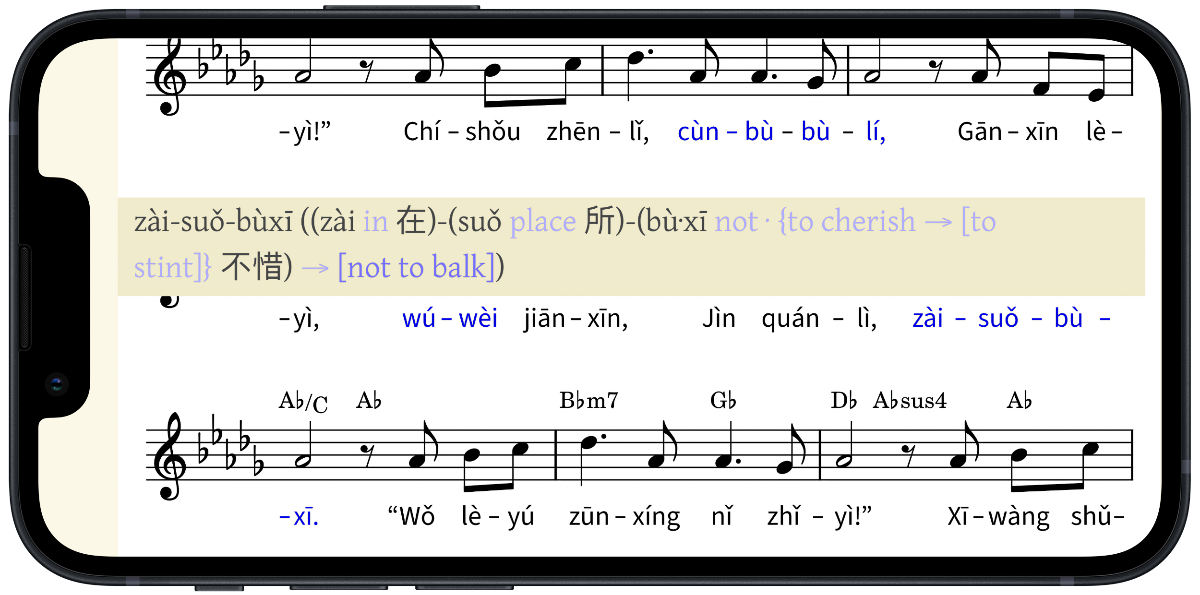
“zài‐suǒ-bùxī” _Pīnyīn_ Plus info, Song 161 (music+_Pīnyīn_), on iPhone 13 mini (landscape orientation)

This week’s MEotW in the unofficial Pīnyīn (Pīn·yīn {Piecing Together of} · Sounds → [Pinyin] 拼音) Plus resource “Sing Out Joyfully” Bk. (Pīnyīn+Music, Pīnyīn Plus, Web)

This week’s MEotW, “zài‐suǒ‐bùxī ((zài in 在)‐(suǒ place 所)‐(bù·xī not · {cherish → [stint [on]]} 不惜) [not grudge/balk [at]/stint [on]])”, comes from the chorus of song 161, which is entitled “To Do Your Will Is My Delight” in English and “Wǒ (I 我) Lèyú (Lè·yú {Am Happy} · to 乐于 樂於) Zūnxíng (Zūn·xíng {Abide by} · {Walk → [Do]} 遵行) Nǐ de ((Nǐ You 你) (de ’s 的) [Your]) Zhǐyì (Zhǐ·yì Will · {Meaning → [Will]} → [Will] 旨意) in Mandarin:

English:

To do your will is my delight.
I give you all my strength and might.
This joy I feel; this joy is real.
I will walk on in your light.

Mandarin (WOL, Pīnyīn (Pīn·yīn {Piecing Together of} · Sounds → [Pinyin] 拼音) Plus):

📖 📄 📘 (I 我) lèyú (lè·yú {am happy} · to 乐于 樂於) zūnxíng (zūn·xíng {abide by} · {walk → [do]} 遵行) (your 你) zhǐyì (zhǐ·yì will · {meaning → [will]} → [will] 旨意)!”
Chíshǒu (Chí·shǒu {to hold → [to support]} · {to defend → [to abide by]} → [to hold fast to] 持守) zhēnlǐ (zhēn·lǐ true · reasoning → [the truth] 真理), cùnbù (cùn·bù {Ch. inch (3⅓ cm) → [tiny]} · step 寸步) (not 不) ({to depart}離/离),
Gānxīn (Gān·xīn {to be (of) sweet → [to be of willing]} · heart → [to be willing] 甘心) lèyì (lè·yì {to be (of) happy} · {meaning → [intention]} → [to be willing] 乐意 樂意), wúwèi (wú·wèi {to be without} · {fearing of} 无畏 無畏) jiānxīn (jiān·xīn {(things being) arduous} · {(things being) hot (in taste) → [(things being) hard]} → [hardships] 艰辛 艱辛),
Jìn ({to expend to the limit}) quánlì (quán·lì whole · strength 全力), zài‐suǒ‐bùxī ((zài in 在)‐(suǒ place 所)‐(bù·xī not · {to cherish → [to stint]} 不惜) [not to balk]).

While not being a direct translation, “jìn ({to expend to the limit}) quánlì (quán·lì whole · strength 全力), zài‐suǒ‐bùxī ((zài in 在)‐(suǒ place 所)‐(bù·xī not · {to cherish → [to stint]} 不惜) [not to balk]) seems to correspond with “I give you all my strength and might” in the above example. In this context, it seems that “zài‐suǒ‐bùxī ((zài in 在)‐(suǒ place 所)‐(bù·xī not · {cherish → [stint [on]]} 不惜) [not grudge/balk [at]/stint [on]]) effectively means “not to balk” when faced with a certain situation. The delightfully awkward English word “balk” means “to stop short and refuse to go on”.

Getting Past the Great Wall of Characters

The Great Wall of China

Do we balk when faced with the Great Wall of Characters?

Some who are in the Mandarin field or considering joining it may balk at the prospect of dealing with the extaordinarily and inhumanly complex Chinese characters. However, while characters have been and can be like a Great Wall in the way of Mandarin language learners being able to function and contribute well in the Mandarin field, the historical experience of those who have braved the Mandarin field over the last few decades has been that Jehovah and his appointed King and Leader Jesus have evidently arranged for the Great Wall of Characters to be made manageable by those who take advantage of their provisions. For many years now, both official and unofficial resources have provided Pīnyīn (Pīn·yīn {Piecing Together of} · Sounds → [Pinyin] 拼音) alternative routes around and past the Great Wall of Characters, and many unofficial resources have also included English, Spanish, etc. meanings.

Jesus did not balk at confronting the human traditions of his day that made it unnecessarily and unreasonably difficult to serve God, and evidently, neither are he and his heavenly Father content to allow modern-day human traditions like those surrounding Chinese characters to keep making things unnecessarily and unreasonably difficult for those who serve him today in the vast worldwide Mandarin field.—Mark 7:13; Matthew 13:38.

“How Much More Valuable”

While some may balk at the idea of using Pīnyīn (Pīn·yīn {Piecing Together of} · Sounds → [Pinyin] 拼音) instead of the Chinese characters mandated by human tradition, we should consider how Jesus handled a situation involving the human tradtions of his day regarding the Sabbath, as recorded at Matthew 12:9–13:

After departing from that place, he went into their synagogue, and look! there was a man with a withered hand! So they asked him, “Is it lawful to cure on the Sabbath?” so that they might accuse him. He said to them: “If you have one sheep and that sheep falls into a pit on the Sabbath, is there a man among you who will not grab hold of it and lift it out? How much more valuable is a man than a sheep! So it is lawful to do a fine thing on the Sabbath.” Then he said to the man: “Stretch out your hand.” And he stretched it out, and it was restored sound like the other hand.

To adapt what Jesus spoke of to the modern day Mandarin field, suppose a businessman who is still learning Mandarin is negotiating a potentially lucrative business deal with some Mandarin-speaking people in China. If Chinese characters were making it difficult for him to understand those people and their proposed business contracts, would this businessman balk at using Pīnyīn (Pīn·yīn {Piecing Together of} · Sounds → [Pinyin] 拼音) to help him understand and use the language necessary to conduct this business, close this deal, and potentially make a lot of money? Probably not! Why leave money on the table? But, how much more valuable are human beings, Mandarin-speaking “sheep” whom we could help to gain everlasting life, than any amount of Old World money that will soon be worthless? Jesus used the power available to him to do a fine thing even though it was the Sabbath, so let us not allow mere human tradition to cause us to balk at using the empowering resources available to us to do fine things in the Mandarin field!—Matthew 25:31–46; Ezekiel 7:19.

And by the way, in a way, Chinese characters are seven times worse than the Sabbath traditions of Jesus’ day—those Sabbath traditions only made things unnecessarily difficult for God’s people one day a week, but in today’s world, Chinese characters place unnecessary burdens on Jehovah’s people seven days a week!


For convenience:

The direct link for the Pīnyīn (Pīn·yīn {Piecing Together of} · Sounds → [Pinyin] 拼音) Plus resource for the “Sing Out Joyfully” book is:

The short link for Chinese field language-learning links for the “Sing Out Joyfully” book is:

More Pīnyīn (Pīn·yīn {Piecing Together of} · Sounds → [Pinyin] 拼音) and Pīnyīn (Pīn·yīn {Piecing Together of} · Sounds → [Pinyin] 拼音) Plus web material based on the Mandarin “Sing Out Joyfully” book will be made available in the Pīnyīn (Pīn·yīn {Piecing Together of} · Sounds → [Pinyin] 拼音) Plus web resource as time allows.

Categories
Culture Current Events Names Nations Technology Theocratic

Zhōngdōng

Zhōngdōng (Zhōng·dōng Middle · East 中东 中東) 👈🏼 Tap/click to show/hide the “flashcard”

[In view of the renewed fighting in the Middle East, and since the below-mentioned article is again being featured on jw.org, it seems appropriate to revisit this post that was originally posted on July 1, 2025. By the way, the Mandarin expression for “Iran” is “Yīlǎng (Iran 伊朗)”.]

[Notes: Tap/click on a Pīnyīn (Pīn·yīn {Piecing Together of} · Sounds → [Pinyin] 拼音) expression to reveal its “flashcard”; tap/click on a “flashcard” or its Pīnyīn (Pīn·yīn {Piecing Together of} · Sounds → [Pinyin] 拼音) expression to hide the “flashcard”. 📖 📄 📘 icons mean 📖 Reveal All, 📄 Reveal Advanced, and 📘 Reveal None re all the “flashcards” in the heading, paragraph, etc. that they are placed at the beginning of.]

At the time of this writing, jw.org was featuring the article “War in the Middle East—What Does the Bible Say?”. Where the English version of this article uses the expression “Middle East”, the Mandarin version uses this week’s MEotW, “Zhōngdōng (Zhōng·dōng Middle · East 中东 中東)”. For example, here are the English and Mandarin versions of the article’s title:

English:

War in the Middle East—What Does the Bible Say?

Mandarin:

📖 📄 📘 Guānyú (Guān·yú {Closing → [Relating]} · to 关于 關於) Zhōngdōng (Zhōng·dōng Middle · East’s 中东 中東) Fāshēng (Fā·shēng {Issuing Forth} · {Coming to Life} → [Happening] 发生 發生) de (’s 的) Zhànzhēng (Zhàn·zhēng War · Contending → [War] 战争 戰爭), Shèngjīng (Shèng·jīng (the) Holy · Scriptures → [the Bible] 圣经 聖經) de (’s 的) Guāndiǎn (Guān·diǎn {Looking at → [View]} · Point → [Viewpoint] 观点 觀點) Shì (Is 是) Shénme (Shén·me What · [suf] 什么 什/甚麼)?

Related Expressions

The “Zhōng ({within/among/[in] the midst of (it/them…)} | centre; middle | midst | amid | medium; intermediate 中) in “Zhōngdōng (Zhōng·dōng Middle · East 中东 中東) corresponds to “Middle”, and it also occurs in expressions such as past MEotW’s “Zhōngguó (Zhōng·guó Central · Nation → [China | Chinese] 中国 中國) 🔗, “Zhōngwén (Zhōng·wén {Central → [Chinese]} · Writing 中文) 🔗, and “Zhōngyāng Zhǎnglǎo‐Tuán ((Zhōngyāng Central 中央) (Zhǎng·lǎo {Grown → [Elder]} · Old (Men) → [Elders] 长老 長老)‐(Tuán {Rolled into a Ball (Thing)} → [Group] → [Body]團/糰) [Governing Body]) 🔗. (Note that in these past MEotW’s, “Zhōng ({within/among/[in] the midst of (it/them…)} | centre; middle | midst | amid | medium; intermediate 中) is really used to mean “Central”, which is a bit different from “Middle”.)

The “dōng (east) in “Zhōngdōng (Zhōng·dōng Middle · East 中东 中東) corresponds to “East”. For reference, here are the Mandarin expressions for the cardinal directions and the ordinal or intercardinal directions:

  • běi (north | northern 北)
  • dōngběi (dōng·běi {east | eastern} · {north | northern} → [north-east | north-eastern] 东北 東北)
  • dōng (east | eastern)
  • dōngnán (dōng·nán {east | eastern} · {south | southern} → [south-east | south-eastern] 东南 東南)
  • nán (south | southern 南)
  • xīnán (xī·nán {west | western} · {south | southern} → [south-west | south-western] 西南)
  • (west | western 西)
  • xīběi (xī·běi {west | western} · {north | northern} → [north-west | north-western] 西北)

Note how the Mandarin expressions for the ordinal or intercardinal directions use reverse word order compared to their English counterparts. For example, “xīběi (xī·běi {west | western} · {north | northern} → [north-west | north-western] 西北) literally means “west · north”, in contrast to the English word “north-west”. This may remind one of how the Mandarin word for “compass”, past MEotW “zhǐnán‐zhēn ((zhǐ·nán {(points with) finger → [points]} · south 指南)‐(zhēn needle) [compass])”, on a certain level of literalness means “points south needle”, in contrast to the Western view that a compass needle points north. Both are right—when one end of a symmetrical compass needle is pointing south, the other end is simultaneously pointing north—they’re just different ways of thinking about the same thing.

A Longer Usage Example

To provide a longer, more extensive example of how “Zhōngdōng (Zhōng·dōng Middle · East 中东 中東) and some related expressions can be used in the ministry, here is some Pīnyīn (Pīn·yīn {Piecing Together of} · Sounds → [Pinyin] 拼音) Plus material based on the introductory paragraphs of the above-mentioned article:

English:

The world is anxiously watching the conflict involving the United States, Israel, and Iran. Will the situation escalate into a wider war? Can governments avert disaster and achieve lasting peace?

Those familiar with Bible prophecy may wonder whether this Middle East conflict could be the start of the battle of Armageddon mentioned in the book of Revelation.

What does the Bible say?

Mandarin:

📖 📄 📘 Měiguó (Měi·guó American · Nation → [USA] 美国 美國), Yǐsèliè (Israel 以色列), ({(together) with} → [and]和/龢) Yīlǎng (Iran 伊朗) zhījiān (zhī·jiān them · among 之间 之間) de (’s 的) chōngtū (chōng·tū {dashing → [clashing]} · {chimney → [dashing forward]} → [conflict] 冲突 衝突), nòngde (nòng·de {has played with → [has made]} · getting 弄得) shìjiè (shì·jiè {generation → [world]} · extent’s → [world’s] 世界) gèdì (gè·dì various · lands 各地) rénxīn (rén·xīn people’s · hearts → [public feeling] 人心)huánghuáng (huáng·huáng {to be fearful → [to be anxious]} · {to be fearful → [to be anxious]} 惶惶). Zhèige (Zhèi·ge this · [mw] 这个 這個) chōngtū (chōng·tū {dashing → [clashing]} · {chimney → [dashing forward]} → [conflict] 冲突 衝突) huì (will) yǎnbiàn (yǎn·biàn perform · changing → [develop] 演变 演變) chéng ({to become} 成) (large 大)guīmó (guī·mó {compasses → [rules]} · model → [scale] 规模 規模) de (’s 的) zhànzhēng (zhàn·zhēng war · contending → [war] 战争 戰爭) ma ([? ptcl for “yes/no” questions])? Zhèngfǔ (Zhèng·fǔ political · {seats of government} → [governments] 政府) yǒu ({do have} 有) nénglì (néng·lì ability · power 能力) píngxī (píng·xī {to make to be flat, level, even → [to make to be calm]} · {to stop} → [to calm/quiet down] 平息) chōngtū (chōng·tū {dashing → [clashing]} · {chimney → [dashing forward]} → [conflict] 冲突 衝突), dàilái (dài·lái {to bring} · {to come} 带来 帶來) chángjiǔ (cháng·jiǔ long · {for a long time} 长久 長久) de (’s 的) hépíng (hé·píng {being (together) with (one another)} · {being flat, level, even} → [peace (nwtsty-CHS Appx. A2 says this term mainly refers to the absence of war or conflict)] 和平) ma ([? ptcl for “yes/no” questions])?

📖 📄 📘 Yǒuxiē (Yǒu·xiē {(there) are having → [(there) are]} · some 有些) dúguo (dú·guo reading · {have passed} → [have read] 读过 讀過) Shèngjīng (Shèng·jīng Holy · Scriptures → [Bible] 圣经 聖經) yùyán (yù·yán {in advance} · sayings → [prophecy] 预言 預言) de (’s 的) rén (people (who) 人) kěnéng (kě·néng maybe · {being able} → [maybe] 可能) huì (will) dānxīn (dān·xīn {carry on a shoulder pole → [take on (a heavy)]} · heart → [worry] 担/耽心 擔/耽心), zài (in 在) Zhōngdōng (Zhōng·dōng Middle · East 中东 中東) fāshēng (fā·shēng {issuing forth} · {coming to life} → [happening] 发生 發生) de (’s 的) chōngtū (chōng·tū {dashing → [clashing]} · {chimney → [dashing forward]} → [conflict] 冲突 衝突) huì (will) yǐnfā (yǐn·fā {draw (out)} · {to send out} → [lead to] 引发 引發) Hāmǐjíduōdùn (Armageddon 哈米吉多顿 哈米吉多頓) dàzhàn (dà·zhàn {big → [great]} · war 大战 大戰), cóng’ér (cóng’·ér {from (that)} · thus 从而 從而) dàilái (dài·lái bring · {to come} 带来 帶來) shìjiè (shì·jiè {generation → [world]} · extent’s → [world’s] 世界) mòrì (mò·rì end · {sun → [day]} → [doomsday] 末日).

📖 📄 📘 Nàme (Nà·me {(in) that (case)} · [suf] 那么/末 那麼/末), Shèngjīng (Shèng·jīng (the) Holy · Scriptures → [the Bible] 圣经 聖經) de (’s 的) guāndiǎn (guān·diǎn {looking at → [view]} · point → [viewpoint] 观点 觀點) shì (is 是) shénme (shén·me what · [suf] 什么 什/甚麼) ne ([? ptcl] 呢)?