Categories
Current Events History Science Technology Theocratic

néngyuán

néngyuán (néng·yuán energy · {source (of a river)} → [energy [source]] 能源) 👈🏼 Tap/click to show/hide the “flashcard”

[Notes: Tap/click on a Pīnyīn (Pīn·yīn {Piecing Together of} · Sounds → [Pinyin] 拼音) expression to reveal its “flashcard”; tap/click on a “flashcard” or its Pīnyīn (Pīn·yīn {Piecing Together of} · Sounds → [Pinyin] 拼音) expression to hide the “flashcard”. 📖 📄 📘 icons mean 📖 Reveal All, 📄 Reveal Advanced, and 📘 Reveal None re all the “flashcards” in the heading, paragraph, etc. that they are placed at the beginning of.]

At the time of this writing, jw.org is featuring the article “Meeting Mankind’s Energy Needs—What the Bible Says”. This week’s MEotW, “néngyuán (néng·yuán energy · {source (of a river)} → [energy [source]] 能源), occurs often in the Mandarin version of this article, including in the title:

English:

Meeting Mankind’s Energy Needs—What the Bible Says

Mandarin:

📖 📄 📘 Néngyuán (néng·yuán Energy · {Sources (of Rivers)} → [Energy [Sources]] 能源) Kùnjú (Kùn·jú {Surrounded → [Hard-Pressed]} · Situation 困局) Yǒu ({Will Have} 有) Jiějué (Jiě·jué {Being Untied → [Being Solved]} · {Being Decided} → [Being Resolved] 解决 解決) de (’s 的) (One 一) Tiān (Sky → [Day] 天) ma ([? ptcl for “yes/no” questions])? Shèngjīng (Shèng·jīng (the) Holy · Scriptures → [the Bible] 圣经 聖經) de (’s 的) Guāndiǎn (Guān·diǎn {Looking at → [View]} · Point → [Viewpoint] 观点 觀點) Shì (Is 是) Shénme (Shén·me What · [suf] 什么 什/甚麼)?

The Importance of Energy

That the current fighting in the Middle East around the Strait of Hormuz is driving up gas prices in many places is undoubtedly a big reason why the above-mentioned article is being featured on jw.org at this time. Yes, energy is more than just an abstract scientific concept.

In physics, energy is defined as “the capacity for doing work”, which in turn involves applying force to move something a certain distance. So, practically speaking, energy provides the ability to move physical things, like our cars. And since heat is connected to temperature, which “reflects the average kinetic energy of the particles in a system”, energy also provides the ability to heat things, like our homes. (By the way, in physics, “power is defined as the rate of producing or consuming energy.”)

Looking back in history, oil—along with other fossil fuels still the dominant source of energy down to this day, in spite of increasing use of clean energy—was a big factor in why Japan attacked Pearl Harbour in 1941, and in why Nazi Germany ultimately lost to the Allies in World War II.

Coming back to the present day, besides gas prices being driven up by the ongoing fighting in the Middle East, another reason why energy is now of concern to many is that oodles and gobs of energy are needed to train and operate artificial intelligence (AI) models, which are increasingly being hyped and used by many.

Another Usage Example

Regarding “néngyuán (néng·yuán energy · {source (of a river)} → [energy [source]] 能源)”, note that its morphemes literally mean “energy · source (of a river)”. However, the expression as a whole is at times used to effectively mean just “energy”.

To help Mandarin field language learners get more of a feel for how to use this expression, here is another usage example, taken from the above-mentioned jw.org article:

English:

Challenge: international conflict. Some regions are rich in energy resources, but they suffer from wars, conflicts, and disputes over territory. And when conflicts disrupt supply chains for oil or gas, many people face shortages and higher prices.

The Bible says: “Jehovah…is bringing an end to wars throughout the earth.”—Psalm 46:8, 9.

Jehovah God will eliminate conflict and wars.

Mandarin:

📖 📄 📘 Zǔ’ài (Zǔ’·ài obstructing · hindering (thing) → [obstacle] 阻碍 阻礙): guójì (guó·jì nations · {boundaries → [among]} → [international] 国际 國際) jiān (among間/閑) de (’s 的) chōngtū (chōng·tū {dashings → [clashings]} · {chimneys → [chargings]} → [conflicts] 冲突 衝突). Yǒuxiē (Yǒu·xiē {(there) are having → [(there) are]} · some 有些) dìqū (dì·qū lands · regions 地区 地區) yōngyǒu (yōng·yǒu {holding in their arms} · having → [having] 拥有 擁有) chōngzú (chōng·zú filled · ample 充足) de (’s 的) shíyóu (shí·yóu rock · oil → [oil] 石油) ({(together) with} → [and]和/龢) tiānrán (tiān·rán {(of) heaven → [natural]} · so → [natural] 天然) (gas氣/气), dànshì (dàn·shì but · {(it) is (the case that)} 但是) yīnwei (yīn·wei {because of} · {on account of} 因为 因為) zhànzhēng (zhàn·zhēng wars · contendings → [wars] 战争 戰爭), chōngtū (chōng·tū {dashings → [clashings]} · {chimneys → [chargings]} → [conflicts] 冲突 衝突), lǐngtǔ (lǐng·tǔ {neck → [collar] → [have jurisdiction over]} · {soil → [land]} → [territory] 领土 領土) jiūfēn (jiū·fēn (things) {being entangled in} · {being tangled} → [disputes] 纠纷 糾紛), dǎozhì (dǎo·zhì {(these) lead} · {to extend to} 导致 導致) néngyuán (néng·yuán energy · {source (of a river)} → [energy [source]] 能源) gōngyìng (gōng·yìng supplying · {responding (to the needs/requests)} → [supply] 供应 供應) liàn (chains) shòudào (shòu·dào {being subjected to} · {arriving at} 受到) yǐngxiǎng (yǐng·xiǎng relfection · sound → [being affected] 影响 影響). Jiéguǒ (Jié·guǒ {tied (into a knot) → [formed]} · fruit → [as a result] 结果 結果), hěn (very 很) duō (many 多) rén (people 人) miànlín (miàn·lín face · {are near to} 面临 面臨) néngyuán (néng·yuán energy · {source (of a river)} → [energy [source]] 能源) duǎnquē (duǎn·quē {being short → [being lacking]} · {being lacking} → [shortages] 短缺) huòzhě (huò·zhě or · [suf] 或者) néngyuán (néng·yuán energy · {source (of a river)} → [energy [source]] 能源) jiàgé (jià·gé price · {grid → [pattern]} → [prices] 价格 價格) shàngzhǎng (shàng·zhǎng upward · {rising (of water/prices/etc.)} 上涨 上漲) de (’s 的) wèntí (wèn·tí asking · problems → [problems] 问题 問題).

📖 📄 📘 Shèngjīng (Shèng·jīng (the) Holy · Scriptures → [the Bible] 圣经 聖經) shuō (says說/説): Yēhéhuá (Jehovah 耶和华 耶和華)zhōngzhǐ (zhōng·zhǐ {is ending} · {is halting} 终止 終止) zhànzhēng (zhàn·zhēng wars · contendings → [wars] 战争 戰爭), píngdìng (píng·dìng {is making to be flat, level, even → [is making to be peaceful]} · {is making to be settled → [is making to be calm]} 平定) tiānxià (tiān·xià heaven · under → [the whole world] 天下)” (Shīpiān (Shī·piān {Sacred Song} · {Piece of Writing} → [Psalm] 诗篇 詩篇) 46:8, 9)

📖 📄 📘 Yēhéhuá (Jehovah 耶和华 耶和華) huì (will) xiāochú (xiāo·chú eliminate · {get rid of} 消除) zhànzhēng (zhàn·zhēng wars · contendings → [wars] 战争 戰爭) ({(together) with} → [and]和/龢) chōngtū (chōng·tū {dashings → [clashings]} · {chimneys → [chargings]} → [conflicts] 冲突 衝突).

Jehovah’s Energy

Yes, Jehovah can and will resolve the issues the world is facing involving energy. Regarding the sheer amount of energy that Jehovah has at his disposal, a past MEotW post said:

As an example of just how powerful Jehovah’s holy spirit is even compared to humans’ nuclear bombs, according to my research and calculations, every day, the sun, produced with power from the holy spirit, puts out the energy of almost 8 quadrillion (1015) 1-megaton nuclear bombs. (A single 1-megaton nuclear bomb would release about 67 times the amount of energy released by the atomic bomb dropped on Hiroshima.) And according to NASA, “it turns out that our Sun is an average-sized star. There are bigger stars, and there are smaller stars. We have found stars that are 100 times bigger in diameter than our sun.”

And of course, as we who have gotten to know Jehovah have learned, Jehovah God is far from being all muscle and no brains or heart or conscience. In addition to having unlimited power, we can rest assured that he also has the wisdom, the justice, and most importantly, the love required to best beneficially use all that power and energy—he is truly the ultimate Néngyuán (Néng·yuán Energy · {Source (of a River)} → [Energy Source] 能源)!

Categories
Culture Language Learning Science Technology Theocratic

búyì

búyì (bú·yì un·righteous[ness] 不义 不義) 👈🏼 Tap/click to show/hide the “flashcard”

[Notes: Tap/click on a Pīnyīn (Pīn·yīn {Piecing Together of} · Sounds → [Pinyin] 拼音) expression to reveal its “flashcard”; tap/click on a “flashcard” or its Pīnyīn (Pīn·yīn {Piecing Together of} · Sounds → [Pinyin] 拼音) expression to hide the “flashcard”. 📖 📄 📘 icons mean 📖 Reveal All, 📄 Reveal Advanced, and 📘 Reveal None re all the “flashcards” in the heading, paragraph, etc. that they are placed at the beginning of.]

I have long especially liked 1 Corinthians 13. It contains counsel on what really does and doesn’t matter in life, an extensive description and definition of the most important kind of love, and a sublime discussion about the need to become complete, mature, as a person. As these apply to life in general, so too do they apply to our lives as Mandarin field language learners.

As Mandarin field language learners, it can benefit us greatly to consider what we can learn from 1 Corinthians 13, and along the way, we can also consider some of the Mandarin expressions used in that chapter in the current version of the Mandarin New World Translation Bible (nwtsty).

“Unrighteousness”

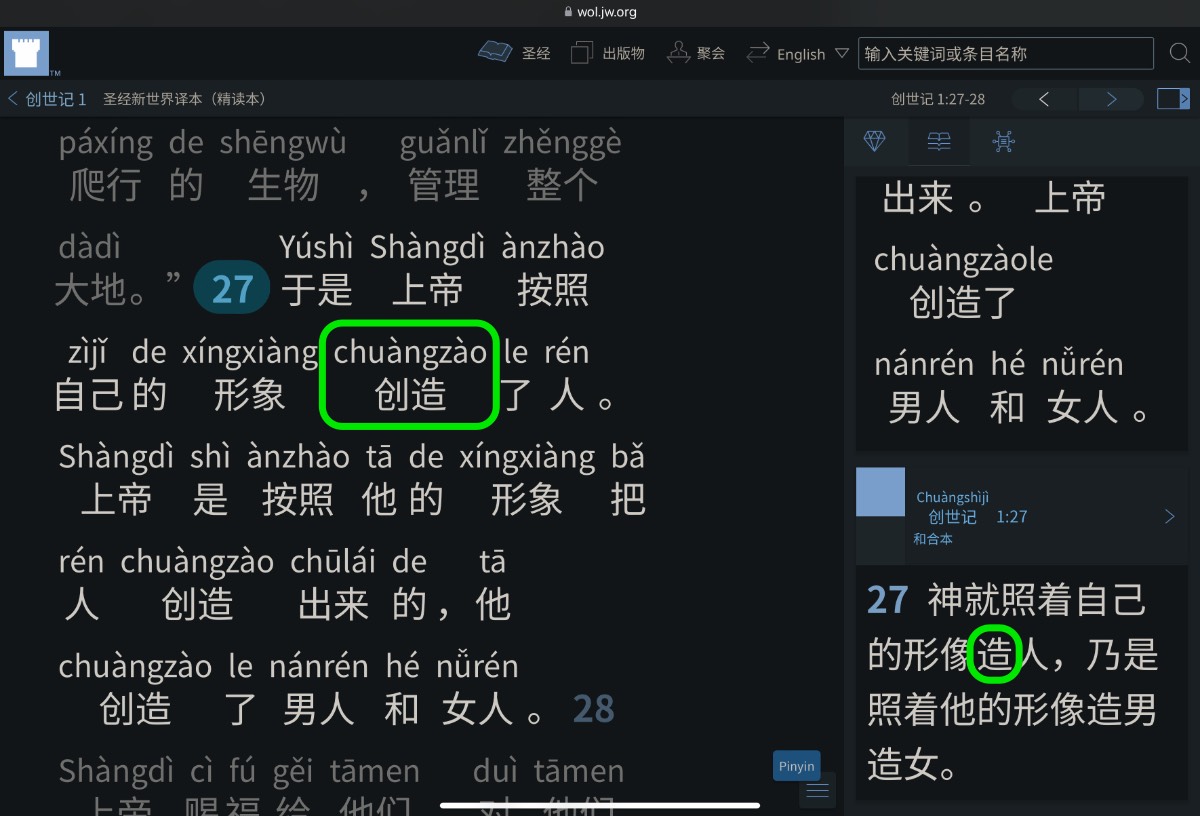
This week’s MEotW, “búyì (bú·yì un·righteous[ness] 不义 不義)”, is used in verse 6 (WOL) of 1 Corinthians 13:

Screenshot of “_búyì_” in 1 Co. 13:6 (nwtsty, CHS+_Pīnyīn_ WOL)

(Dark mode for the Watchtower ONLINE LIBRARY (WOL) website, as shown in the above image, can be enabled in the Safari web browser by using the Noir Safari extension. Other web browsers may also have extensions with similar functionality.)

For comparison, here are the current English and Pīnyīn (Pīn·yīn {Piecing Together of} · Sounds → [Pinyin] 拼音) Plus renderings of 1 Corinthians 13:6:

English:

It does not rejoice over unrighteousness, but rejoices with the truth.

Pīnyīn (Pīn·yīn {Piecing Together of} · Sounds → [Pinyin] 拼音) Plus:

📖 📄 📘 (not 不) yīn ({because of} 因) búyì (bú·yì un·righteousness 不义 不義) ér (thus 而) huānxǐ (huān·xǐ {does be joyful} · {does be happy} 欢喜 歡喜), zhǐ (only只/秖/衹/祇) yīn ({because of} 因) zhēnlǐ (zhēn·lǐ true · reasoning → [the truth] 真理) ér (thus 而) gāoxìng (gāo·xìng (is with) high · enthusiasm → [is glad] 高兴 高興).

In the above examples, “búyì (bú·yì un·righteous[ness] 不义 不義) corresponds to “unrighteousness”, and it does so pretty straightforwardly, right down to the literal meanings of its morphemes. Regarding righteousness, the Insight book’s entry on “Righteousness” says:

the original-language terms are at times translated “justice”

So, “unrighteous” can mean “unjust” or “unfair”.

Don’t Be Unfair

While a certain amount of knowledge about Chinese characters is obviously of some practical benefit in this world in which characters are “everywhere”, remember that ultimately, Chinese characters are only “everywhere” because of human tradition—linguistically speaking, there is actually no technical need for any of the Chinese languages to be written using Chinese characters. With regard to the Mandarin field specifically, this is exemplified by the fact that Pīnyīn (Pīn·yīn {Piecing Together of} · Sounds → [Pinyin] 拼音) works well as a full writing system for Modern Standard Mandarin, meaning that anything that can be said in Modern Standard Mandarin, from the simpest expressions to the deepest, most advanced expressions, can be written with Pīnyīn (Pīn·yīn {Piecing Together of} · Sounds → [Pinyin] 拼音). (In fact, Plan A for modern China was for Pīnyīn (Pīn·yīn {Piecing Together of} · Sounds → [Pinyin] 拼音) to eventually replace Chinese characters, but unfortunately, the B players have gotten their way in China so far.)

With that in mind, and also remembering the scriptural counsel at 1 Corinthians 14:8–11, it follows then that just following the crowd and focusing in our Mandarin field language learning on the traditionally imposed but extraordinarily complex Chinese characters, and thus allowing them to distract from, hinder, and impede our efforts to learn to understand Mandarin speech and to use understandable Mandarin speech to praise Jehovah and help people spiritually, would be unfair in the following ways:

  • It would be unfair to people in the field and at the meetings who lose out on how we could have helped and encouraged them spiritually using understandable Mandarin speech.
  • It would also be unfair to us ourselves, because it makes it much harder than necessary for us to function in the Mandarin field, and we also lose out and get weakened spiritually because of not understanding Mandarin speech at the meetings, assemblies, etc. that we could have been strengthened and encouraged by if we had only understood it!
  • Last but not least, it would be unfair to Jehovah God, to whom we have dedicated our best, but who would not be getting our best, if we are giving our first devotion to the human traditions involving Chinese characters, and then just giving Jehovah whatever’s left over after we’ve let the characters drain us with their unnecessary and self-indulgent difficulties and vagaries.

Indeed, it just wouldn’t be right for us to let devotion to mere human tradition prevent us from serving Jehovah and helping people in the Mandarin field as well as we ought to be able to, based on how Jehovah actually made us to use language!

Categories
Current Events Theocratic

bàolì

bàolì (bào·lì [(is employing)] violent · force → [violence | [is] violent] 暴力) 👈🏼 Tap/click to show/hide the “flashcard”

[Notes: This blog uses “Pīnyīn (Pīn·yīn {Piecing Together of} · Sounds → [Pinyin] 拼音) Plus” technology. Tap/click on a Pīnyīn (Pīn·yīn {Piecing Together of} · Sounds → [Pinyin] 拼音) expression to reveal its “flashcard”, tap/click on a “flashcard” or its Pīnyīn (Pīn·yīn {Piecing Together of} · Sounds → [Pinyin] 拼音) expression to hide the “flashcard”. 📖 📄 📘 icons mean 📖 Reveal All, 📄 Reveal Advanced, and 📘 Reveal None re all the “flashcards” in the paragraph, etc. that they are placed at the beginning of.

This post was adapted from a past MEotW post that was originally posted on July 18, 2022.]

Unfortunately, wars and gun violence have been in the news a lot lately. As of this writing, jw.org is featuring the article “Violence Is Not the Answer”. Also, the articles “Shocking Gun Violence Worldwide—What Does the Bible Say?” and “School Shootings—What Does the Bible Say?” have been featured on jw.org in the past. The Mandarin versions of these articles use the expression “bàolì (bào·lì [(is employing)] violent · force → [violence | [is] violent] 暴力)”, which means “violence” or “violent”.

Usage Examples

Here are some examples of how “bàolì (bào·lì [(is employing)] violent · force → [violence | [is] violent] 暴力)” is used in the above-mentioned articles:

English:

Why is the world becoming more violent?

Mandarin:

📖 📄 📘 Wèi‐shénme ((Wèi for)‐(shén·me what · [suf] 什么 什/甚麼) [why]) rén (people 人) yuè‐lái‐yuè ((yuè {jumping over} 越) (lái coming) (yuè {jumping over} 越)) [more and more]) bàolì (bào·lì violent · force → [are violent] 暴力)?

English:

Is there any hope that the violence will end?

Mandarin:

📖 📄 📘 Zhèyàng (Zhè·yàng this · kind 这样 這樣) de (’s 的) bàolì (bào·lì violent · force → [violent] 暴力) shìjiàn (shì·jiàn incidents · [mw] 事件) huì (will) yǒu (have 有) zhōngzhǐ (zhōng·zhǐ ending · stopping 终止 終止) de (’s 的) (one 一) tiān (sky → [day] 天) ma ([? ptcl for “yes/no” questions])?

English:

The Bible promises a time when violence will end.

Mandarin:

📖 📄 📘 Shèngjīng (Shèng·jīng (the) Holy · Scriptures → [the Bible] 圣经 聖經)shuō (says說/説), bàolì (bào·lì violent · force → [violence] 暴力) huì (will) yǒu (have 有) zhōngzhǐ (zhōng·zhǐ ending · stopping 终止 終止) de (’s 的) (one 一) tiān (sky → [day] 天).

English:

God will eliminate the root causes of violent acts by teaching people to live in peace.

Mandarin:

📖 📄 📘 Shàngdì (Shàng·dì Above’s · {Emperor → [God]} → [God] 上帝) huì (will) jiàodǎo (jiào·dǎo teach · instruct 教导 教導) rén (people 人) zěnyàng (zěn·yàng (in) what · {form → [way]} → [how] 怎样 怎樣) hémù ({to be harmonious} 和睦)xiāngchǔ (xiāng·chǔ {with each other} · {to get along} 相处 相處), cóng (from) gēnběn (gēn·běn {root (of a plant)} · {root or stem of a plant} → [root] 根本) shang (upon 上) xiāochú (xiāo·chú eliminate · {get rid of} 消除) dǎozhì (dǎo·zhì lead · {to extend to} 导致 導致) bàolì (bào·lì violent · force → [violence] 暴力) de (’s 的) yuányīn (yuán·yīn origins · causes 原因).

English:

The Bible promises that Jesus—as the Prince of Peace—will soon bring an end to all violence. (Isaiah 9:6, 7)

Mandarin:

📖 📄 📘 Shèngjīng (Shèng·jīng (the) Holy · Scriptures → [the Bible] 圣经 聖經) bǎozhèng (bǎo·zhèng guarantees · testifies 保证 保證), Hépíng (Hé·píng {Being (Together) with (One Another)} · {Being Flat, Level, Even} → [Peace (nwtsty-CHS Appx. A2 says this term mainly refers to the absence of war or conflict)] 和平) de (’s 的) Lǐngxiù (Lǐng·xiù {Neck → [Collar]} · Sleeves → [Leader] 领袖 領袖) Yēsū (Jesus 耶稣 耶穌) huì (will) hěn (very 很) kuài (quickly → [soon] 快) zhōngzhǐ (zhōng·zhǐ end · stop 终止 終止) yíqiè (yí·qiè {one (whole)} · {corresponding (set of)} → [all] 一切) bàolì (bào·lì violent · force → [violence] 暴力). (Yǐsàiyà‐Shū ((Yǐsàiyà Isaiah 以赛亚 以賽亞)‐(Shū Writing → [Book]) [The Book of Isaiah]) 9:6, 7)

Some Related Mandarin Expressions

Here are some other Mandarin expressions that also include the morphemebào ({[sudden] [and] [violent]} [→ [cruel; savage; fierce]] | {stick/stand out}; bulge 暴)”:

  • bàofā (bào·fā exploding; bursting · {sending out}; issuing → [erupting; bursting/breaking out | explosion; eruption] 爆发 爆發) (a past MEotW)
  • bàofā‐hù ((bào·fā exploded; burst · {sent out}; issued 爆发 爆發)‐(hù door → [household; family | person of a certain status]) [upstart | nouveau riche; newly rich])
  • bàofēng (bào·fēng violent · wind → [storm wind; gale; windstorm; storm] 暴风 暴風)
  • bàoliè (bào·liè violent · intense; fierce 暴烈)
  • bàolóng (bào·lóng {violent → [savage]} · dragon → [Tyrannosaurus species (esp. Tyrannosaurus rex)] 暴龙 暴龍)
  • bàoxíng (bào·xíng {violent [→ [savage]]} · {walking → [doing; deed; act]} → [savage act; outrage; atrocity] 暴行)
  • cánbào (cán·bào {injuring; damaging → [cruel; savage; ferocious]} · violent; brutal 残暴 殘暴)
  • fēngbào (fēng·bào wind · {being violent} → [windstorm; tempest; storm] 风暴 風暴)
  • wǎngbào (wǎng·bào {net → [network] → [Internet]} · {being violent} → [cyberbullying (abbr. for wǎngluò bàolì)] 网暴 網暴)
  • xiōngbào (xiōng·bào {[is] fierce}; {[is] ferocious} · {[is] sudden and violent → [[is] cruel; savage; brutal]} 凶暴 凶/兇暴)