Categories
Culture Language Learning Science Technology Theocratic

zhēnlǐ

zhēnlǐ+ (zhēn·lǐ true · reasoning; logic → [[the] truth] 真理) 👈🏼 Tap/click to show/hide the “flashcard”

[Notes: Tap/click on a Pīnyīn (Pīn·yīn {Piecing Together of} · Sounds → [Pinyin] 拼音) expression to reveal its “flashcard”; tap/click on a “flashcard” or its Pīnyīn (Pīn·yīn {Piecing Together of} · Sounds → [Pinyin] 拼音) expression to hide the “flashcard”. 📖 📄 ➕ icons mean 📖 Reveal All, 📄 Reveal Advanced, and ➕ Reveal + Symbols re all the “flashcards” in the heading, paragraph, etc. that they are placed at the beginning of.]

I have long especially liked 1 Corinthians 13. It contains counsel on what really does and doesn’t matter in life, an extensive description and definition of the most important kind of love, and a sublime discussion about the need to become complete, mature, as a person. As these apply to life in general, so too do they apply to our lives as Mandarin field language learners.

As Mandarin field language learners, it can benefit us greatly to consider what we can learn from 1 Corinthians 13, and along the way, we can also consider some of the Mandarin expressions used in that chapter in the current version of the Mandarin New World Translation Bible (nwtsty).

What Do You Rejoice In?

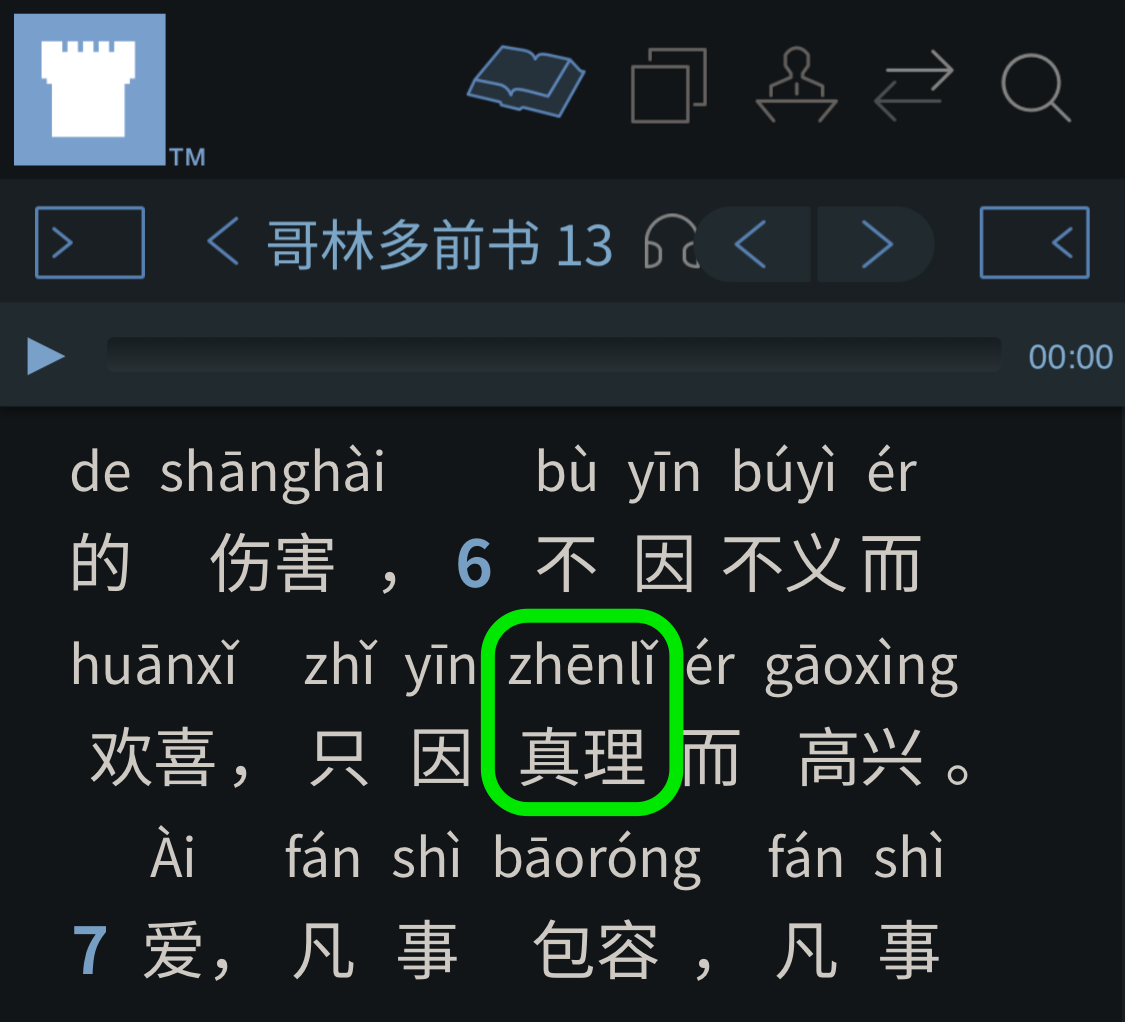
This week’s MEotW, “zhēnlǐ (zhēn·lǐ true · reasoning; logic → [[the] truth] 真理)”, is used in verse 6 (WOL) of 1 Corinthians 13:

Screenshot of “_zhēnlǐ_” in 1 Co. 13:6 (nwtsty, CHS+_Pīnyīn_ WOL)

(Dark mode for the Watchtower ONLINE LIBRARY (WOL) website, as shown in the above image, can be enabled in the Safari web browser by using the Noir Safari extension. Other web browsers may also have extensions with similar functionality.)

For comparison, here are the renderings of 1 Corinthians 13:6 in the current English and Mandarin versions of the New World Translation Bible:

English:

It does not rejoice over unrighteousness, but rejoices with the truth.

Mandarin (WOL, Pīnyīn (Pīn·yīn {Piecing Together of} · Sounds → [Pinyin] 拼音)+ 🔗):

📖 📄 (not 不) yīn ({because of} 因) búyì (bú·yì un·righteousness 不义 不義) ér (thus 而) huānxǐ+ (huān·xǐ {does be joyful} · {does be happy} 欢喜 歡喜), zhǐ (only只/秖/衹/祇) yīn ({because of} 因) zhēnlǐ (zhēn·lǐ true · reasoning → [the truth] 真理) ér (thus 而) gāoxìng (gāo·xìng (is with) high · enthusiasm → [is glad] 高兴 高興).

The individual morphemes in “zhēnlǐ (zhēn·lǐ true · reasoning; logic → [[the] truth] 真理) literally mean “true” and “reasoning; logic”. When these morphemes are put together in “zhēnlǐ (zhēn·lǐ true · reasoning; logic → [[the] truth] 真理)”, the resulting expression effectively means “truth”, or “the truth”.

Linguistic Untruths Fill the “Air”

This world ruled by Satan, “the father of the lie”, is full of linguistic idolatry and mythology (e.g., the myths discussed in the book The Chinese Language: Fact and Fantasy) surrounding Chinese characters, and it is full of misinformation and disinformation about the Chinese languages in general. (Ephesians 2:2; John 8:44) We Mandarin field language learners need to learn the truth about these things that are such huge factors in our Mandarin learning, and we should ‘rejoice with the truth’ about these things, similarly to how we rejoice over spiritual truth.

Yes, godly love doesn’t just know the truth, it rejoices with the truth, so it chooses the truth. Showing that he lacked godly love, the first man Adam knew the truth, but he loved Eve more, and so he chose to join Eve in rebellion against Jehovah. (1 Timothy 2:14) Also, as we have been reminded by the video series The Good News According to Jesus, the scribes and Pharisees of Jesus’ day had every reason and opportunity to know the truth, but consumed by pride, they loved their tradition and position and status more, and so they chose to bitterly oppose Jesus to the point of eventually brutally murdering him.

What Side Are You On?

At John 18:37, Jesus said:

For this I have been born, and for this I have come into the world, that I should bear witness to the truth. Everyone who is on the side of the truth listens to my voice.

In this blog and in other places, I have endeavoured to share the truths that I have learned about the Mandarin language and how to best learn it for use in the Mandarin field. If you as a Mandarin field language learner have come to know some of these truths, what are you going to do about it? Are you “on the side of the truth” regarding these matters? According to 1 Corinthians 13:6, if you are motivated by godly love, you will rejoice with the truth about these things, and you will naturally show your love by happily making use of these Mandarin language-learning truths to better share spiritual truths with Mandarin-speaking people you meet. And as Hebrews 6:10 says, “God is not unrighteous so as to forget your work and the love you showed for his name”.

Categories
Culture Experiences History Language Learning

jī‐tóng‐yā‐jiǎng

jī‐tóng‐yā‐jiǎng+ ((jī chicken雞/鷄)‐(tóng {together with}同/仝)‐(yā duck)‐(jiǎng speaking) [people not understanding each other because of speaking different languages (from Cantonese)]) 👈🏼 Tap/click to show/hide the “flashcard”

[I’m still unusually busy with preparing musical notation + Pīnyīn (Pīn·yīn {Piecing Together of} · Sounds → [Pinyin] 拼音) songbook material for this year’s Mandarin conventions, and now, also with rolling out the next generation Pīnyīn (Pīn·yīn {Piecing Together of} · Sounds → [Pinyin] 拼音)+ format. (See this Links News post for more information on that.) So, here’s a repost of a post from a few years back, on a subject of basic importance to Mandarin field language learners.]

[Yes, this expression comes from Cantonese, but the above Mandarin version does appear in Mandarin dictionaries, so it qualifies as a Mandarin expression!]

Recently, while out to dinner with one of the first families to serve in the local Cantonese congregation, along with the circuit overseer serving the local Chinese circuit and his wife, the subject came up of how Mandarin and Cantonese are actually different languages, not just dialects of the same language.

Chickens Talking with Ducks

The wife of the circuit overseer asked what the difference is between a language and a dialect. So, I proceeded to explain something that is emphasized by American sinologist and University of Pennsylvania Professor of East Asian Languages and Civilizations Victor H. Mair, that a primary way accepted by most linguists to distinguish a language from a dialect is mutual intelligibility, as is discussed in this excerpt from the MEotW post on “fāngyán (fāng·yán {direction → [place]} · speech → [topolect; dialect (common but misleading translation)] 方言)”:

It has been said that “a language is a dialect with an army and navy”, but in his article Professor Mair gives us a more linguistically correct and useful way to distinguish between a language and a dialect:

Regardless of the imprecision of lay usage, we should strive for a consistent means of distinguishing between language and dialect. Otherwise we might as well use the two terms interchangeably. That way lies chaos and the collapse of rational discourse. Mutual intelligibility [emphasis added] is normally accepted by most linguists as the only plausible criterion for making the distinction between language and dialect in the vast majority of cases. Put differently, no more suitable, workable device for distinguishing these two levels of speech has yet been proposed. If there are to be exceptions to the useful principle of mutual intelligibility, there should be compelling reasons for them. Above all, exceptions should not be made the rule.

What is mutual intelligibility? Simply put, in linguistics, two or more speech varieties are said to be mutually intelligible if they are “able to be understood by one another’s speakers”. For example, if one person only knows English, and another person only knows Spanish, they can’t really understand each other if they try to talk to each other—English and Spanish are not mutually intelligible, and are suitably recognized as being different languages, not just different dialects of “European”.

Similarly, if one person only knows Mandarin, and another person only knows Cantonese, they can’t really understand each other if they try to talk to each other—Mandarin and Cantonese are not mutually intelligible. So, while they may be “fāngyán+ (fāng·yán {direction → [place]} · {(patterns of) speech} 方言)”, linguistically, Mandarin and Cantonese should really be considered to be different languages, not just different dialects of “Chinese”.

Indeed, I have heard people use this week’s MEotW, “jī‐tóng‐yā‐jiǎng+ ((jī chicken雞/鷄)‐(tóng {together with}同/仝)‐(yā duck)‐(jiǎng speaking) [people not understanding each other because of speaking different languages (from Cantonese)])”, to specifically describe Mandarin-speakers and Cantonese-speakers trying to talk to each other, and not understanding each other. 🐓 🦆

After I explained the gist of the above, one of the daughters of the family at the dinner—who had been labouring for decades under the misconception that Mandarin and Cantonese are just dialects and that someone who knows one can easily learn the other—said, “Now I don’t feel like an idiot.”

Uncommon Knowledge?

It could be said that ones such as this family and this circuit overseer and his wife, who have all worked so hard and served for so long in the Chinese language fields, should already have known such a basic thing about the Chinese languages. However, the following things are unfortunately true:

  • Even publishers who are learning a language to serve in that language’s field generally consider such linguistic (language science) knowledge to be specialized technical knowledge that is beyond what they need to learn, and possibly beyond what they could even comprehend.
  • Western-educated publishers learning a Chinese language may unwittingly go along with the Western worldly tendency to exoticize things related to China. (John DeFrancis, in his book The Chinese Language: Fact and Fantasy (p. 37), calls this “Exotic East Syndrome”.) They may be content with—or even enjoy—the alluring veil of mystery and mystique surrounding certain things related to China and Chinese culture. Thus, they don’t seek to learn about and understand deeper truths about such things, that may pierce through this obscuring veil, and burst this bubble.—Compare 2 Corinthians 3:14, including the margin note.
  • The central ruling authorities of China have long actively promoted the scientifically incorrect idea that the different varieties of speech in China are just dialects of the one Chinese language. This idea is political propaganda supporting the idea that it’s good for there to be central ruling authorities in China.
  • Traditional worldly Chinese language instructors and others who are knowledgeable about Chinese languages and Chinese characters are eager to promote and perpetuate the traditional thinking about Chinese languages and characters, that they have invested so much time and effort in, and that they are so proud of.
  • Chinese-educated publishers who are already steeped in the traditional ideas about Chinese languages, Chinese characters, etc., and who are thus lauded and deferred to as experts by other publishers, may be eager to simply unquestioningly pass on the cultural knowledge and ideas that they were taught, and that they are lauded and respected for.
  • With so much misinformation “in the air”, including from trusted authority figures, “everyone knows” that there is one Chinese language, with dialects that include Mandarin, Cantonese, etc. Since “everyone knows” this, it’s easy to just go along with it, especially in an Eastern culture like the Chinese culture that emphasizes conforming to the group. As Eastern cultures, Japanese, Korean, etc. cultures are similar in this respect, so publishers from those cultural backgrounds may also generally tend to just go along with what “everyone knows” about there being just one Chinese language that has various dialects.—Ephesians 2:2.
  • The Bible makes it clear that Satan the Devil is “a liar and the father of the lie”. It also describes him as “the great dragon…who is misleading the entire inhabited earth”. So, while we can only speculate about the details of what strings are purposely pulled in the spirit realm by Satan and his demons as opposed to what human folly they simply passively observe, we can be sure that Satan is delighted with all the ways in which people are misled in and about the Chinese culture, in which the dragon is considered a positive, revered symbol.—John 8:44; Revelation 12:9.

So, for reasons such as the above, even the basic linguistic truth that Mandarin, Cantonese, Shanghainese, etc. actually function as different languages is unfortunately not yet common knowledge among those serving in the Chinese fields. As the saying goes, which some say is a Chinese proverb, “error will travel over half the globe, while truth is pulling on her boots”.

Jesus said, though, that true worshippers worship “with spirit and truth”, and that “the truth will set you free”. With regard to Chinese languages, Chinese characters, etc., the truth about them can even set one free from unnecessarily feeling like an “idiot”, as the sister mentioned above so eloquently put it, because of labouring under all the political propaganda, traditions, and other kinds of misinformation and wrong thinking that unfortunately surround Chinese languages, Chinese characters, etc.—John 4:23; 8:32.

Huge Worldwide Effects

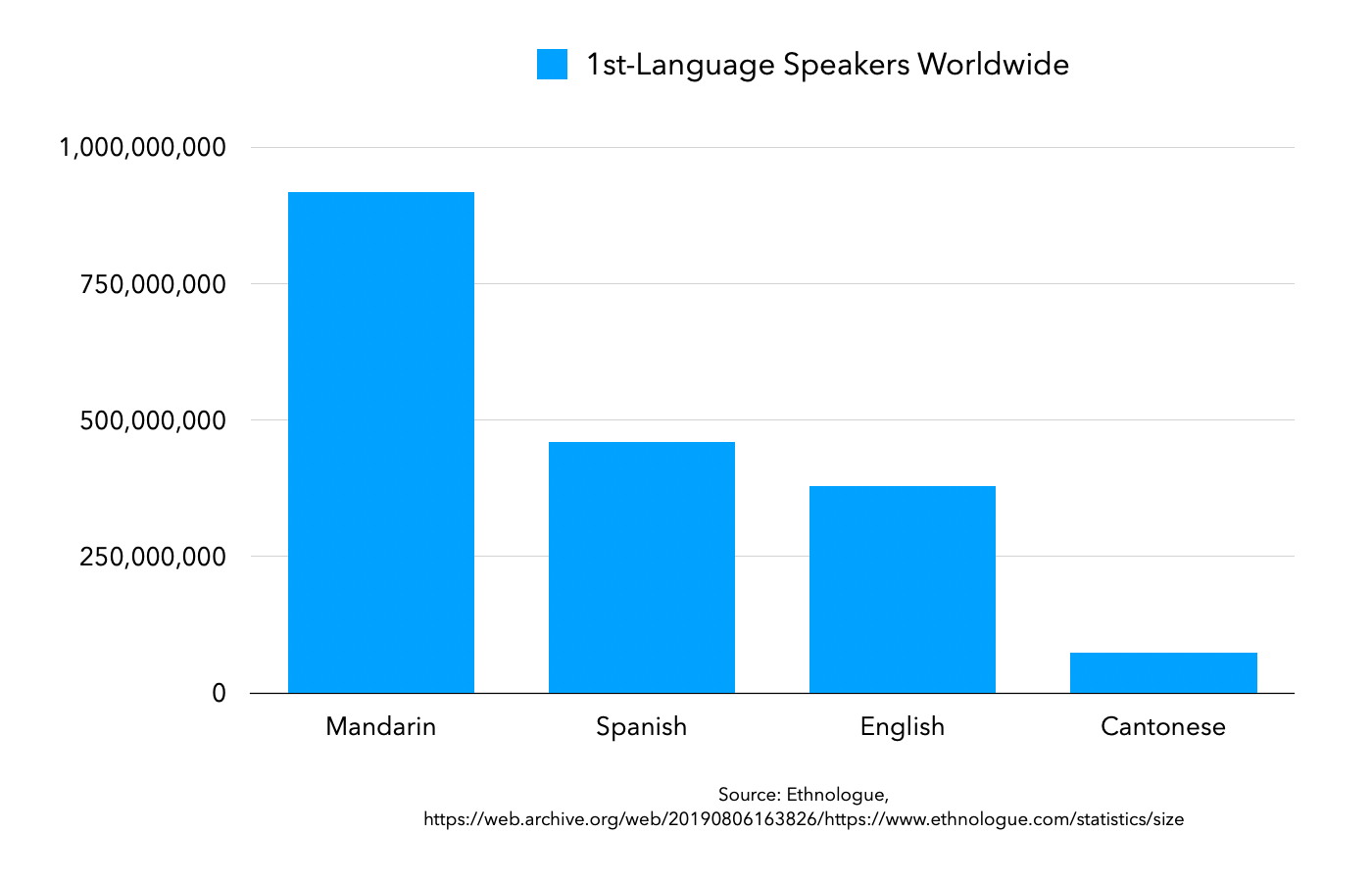
In addition to being hugely freeing for individual language learners, spreading the truth about the Chinese languages, Chinese characters, etc. is also important on a larger scale, since the worldwide Mandarin field, for one, is the largest language field in the world, and probably the largest language field that has ever existed in human history. For comparison, according to Ethnologue, a resource on world languages, the worldwide Mandarin field (those worldwide whose mother tongue is Mandarin) is about twice the size of the second largest worldwide language field, the Spanish field, and it’s about two and a half times the size of the third largest worldwide language field, the English field. Allowing various untruths to continue to divert and bog down the language-learning efforts of those who come to help in the worldwide Mandarin field can have incalculable overall negative effects on the preaching work in this enormous field.

Chart: Languages by First-Language Speakers—2019

So, even as we hang on to Bible truth, let us also hang on to the linguistic truths that we learn, and let us do what we can to share them with our fellow workers in the vast worldwide Chinese fields.
Categories
Culture Experiences History Language Learning Science

Pīnyīn

Pīnyīn+ (Pīn·yīn {Piecing Together of} · Sounds → [Pinyin] 拼音) 👈🏼 Tap/click to show/hide the “flashcard”

[To accompany last week’s repost on “Zhùyīn (Zhù·yīn {Annotating of} · Sounds → [Zhuyin] 注音 註/注音)”, here is a repost of the MEotW post on “Pīnyīn (Pīn·yīn {Piecing Together of} · Sounds → [Pinyin] 拼音)”.]

Pīnyīn (Pīn·yīn {Piecing Together of} · Sounds → [Pinyin] 拼音)” is the expression commonly used to refer to the phonetic alphabet introduced by China in 1958. This system is also known by longer, more official names:

  • Hànyǔ (Hàn·yǔ {Han (Chinese)} · Language → [(Modern Standard) Mandarin] 汉语 漢語) Pīnyīn (Pīn·yīn {Piecing Together of} · Sounds → [Pinyin] 拼音)
  • Hànyǔ (Hàn·yǔ {Han (Chinese)} · Language → [(Modern Standard) Mandarin] 汉语 漢語) Pīnyīn (Pīn·yīn {Piecing Together of} · Sounds → [Pinyin] 拼音) Fāng’àn+ (Fāng’·àn {Direction → [Method]} · {Long, Narrow Table or Desk → [Plan]} 方案)

When thinking of Pīnyīn (Pīn·yīn {Piecing Together of} · Sounds → [Pinyin] 拼音) and its predecessor Zhùyīn (Zhù·yīn Annotating · Sounds → [Zhuyin] 注音 註/注音) (last week’s MEotW), some focus on the superficial differences between them. However, it’s perhaps even more important to note what they have in common, as indicated by the fact that the names of both systems end in “yīn+ (sound [→ [musical note/sound; tone; pronunciation | syllable | news; tidings]] 音)”: Both systems focus on representing the sounds of Mandarin, sounds which make up Mandarin speech and thus represent meanings. In fact, Pīnyīn (Pīn·yīn {Piecing Together of} · Sounds → [Pinyin] 拼音)’s literal meaning tells us that this system helps people to “piece together sounds” to make up Mandarin speech, and thus convey the meanings that Mandarin speech represents.

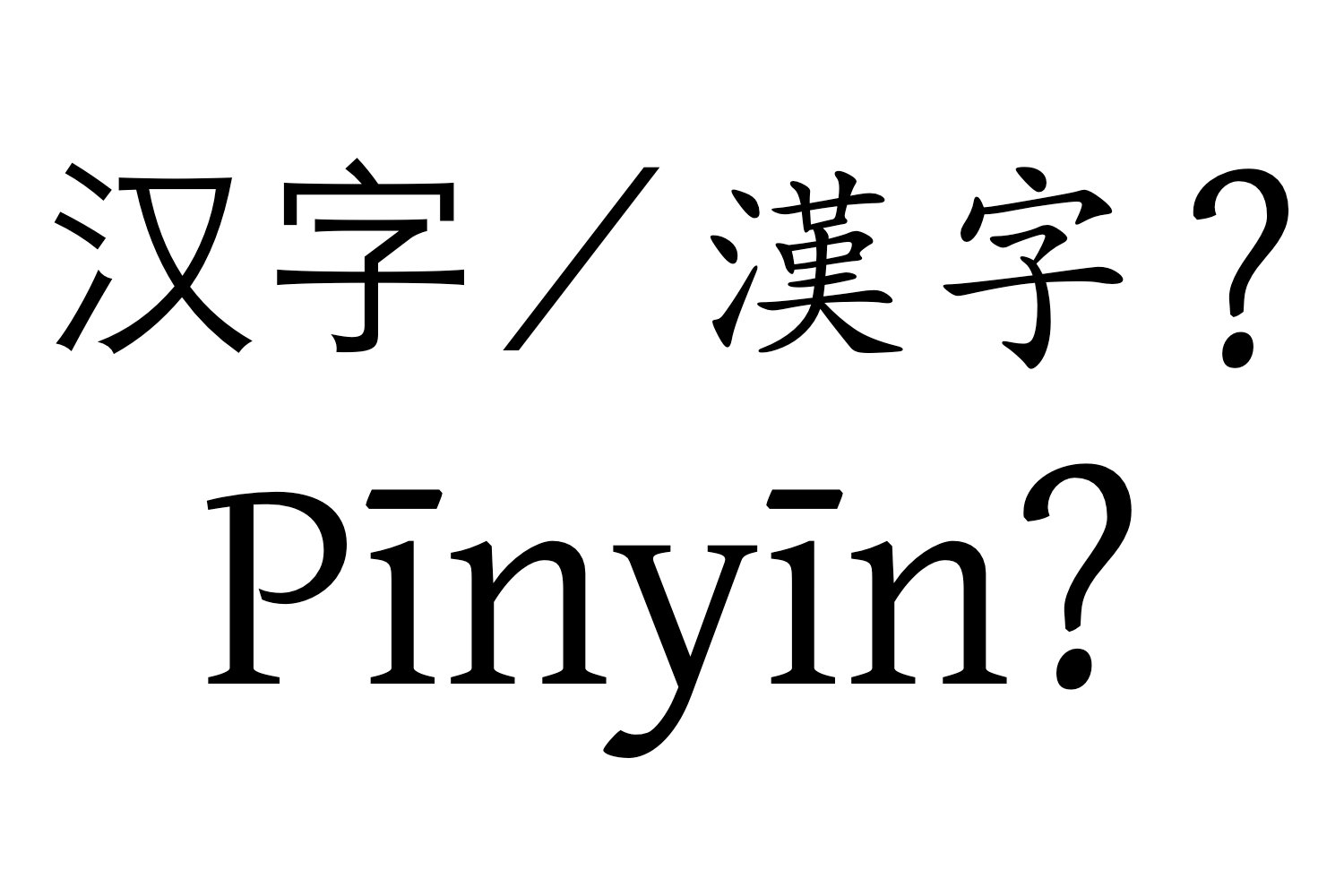
汉字 / 漢字? Pīnyīn?

In contrast, many people believe that the Hànzì+ (Hàn·zì {Han (Chinese)} · Characters 汉字 漢字), the Chinese characters, represent meanings more directly through their own visual design, as opposed to primarily being a system that represents Mandarin, Cantonese, etc., speech sounds which represent meaning. This view of Chinese characters, however, is actually a myth, which has been called the Ideographic Myth—God designed our brains and bodies to primarily represent meaning through speech, some humans in their hubris presumed that it would be better for us humans to represent meaning directly through visual symbols, and of course God was right and these humans were wrong.

There are actually many myths and misconceptions that people believe regarding Chinese characters, and sadly, that is also the case regarding Pīnyīn (Pīn·yīn {Piecing Together of} · Sounds → [Pinyin] 拼音).

Common Myths and Misconceptions

  • Pīnyīn (Pīn·yīn {Piecing Together of} · Sounds → [Pinyin] 拼音) is just a pronunciation aid. It’s not really a writing system like the characters are.”
    • But, is Pīnyīn even really a writing system? Interestingly, the Chinese national standard Zhōngguó Mángwén (中国盲文/中國盲文, Chinese Braille) is basically a transliteration or conversion of Pīnyīn into braille letters. Braille is obviously a writing system, so Pīnyīn must also be a writing system, not just a pronunciation aid.

  • Pīnyīn (Pīn·yīn {Piecing Together of} · Sounds → [Pinyin] 拼音) is just training wheels. Characters are real wheels.”
    • Since Pīnyīn is not just a pronunciation aid, but a full writing system, it is not “training wheels”—it’s regular wheels. On the other hand, Chinese characters are like non-round wheels—more difficult than necessary.

  • Pīnyīn (Pīn·yīn {Piecing Together of} · Sounds → [Pinyin] 拼音) on its own can’t be understood because there are too many homophones (words that sound the same, but have different meanings) in Mandarin.”
    • When people are just speaking Mandarin, with no characters in sight to help them, do they have problems understanding each other because of all the homophones? Can blind Mandarin-speakers, who cannot see characters, still “see” what people mean when those people speak Mandarin? Native Mandarin-speakers have confirmed to me that no, homophones are not a significant problem in spoken Mandarin—people can use the context and understand each other okay. So, people can use the context and understand each other okay when using Pīnyīn too, since Pīnyīn directly represents the sound of spoken Mandarin.

      • The above quote is from the article “Pīnyīn Was Plan A”. Check it out for more on this subject.
  • Pīnyīn (Pīn·yīn {Piecing Together of} · Sounds → [Pinyin] 拼音) is less accurate than Zhùyīn (Zhù·yīn Annotating · Sounds → [Zhuyin] 注音 註/注音).”
    • Some people say that Zhuyin is more accurate or correct than Pinyin. Actually, both Zhuyin and Pinyin represent the same Mandarin sounds, just with different symbols. In fact, it’s not difficult to find tables that directly map the corresponding Zhuyin and Pinyin expressions to each other—a simple Google search for “pinyin zhuyin table” turns up many, many results. Pinyin and Zhuyin are just like different codes for encoding the same Mandarin message, so basically, neither is more accurate or correct than the other.

      • The above quote is from the tiandi.info post “Pinyin and Zhuyin”. (If you need login information for the parts of tiandi.info that require it, request it by email, and include information on who referred you and/or what group/cong. you are in.)
  • Pīnyīn (Pīn·yīn {Piecing Together of} · Sounds → [Pinyin] 拼音) makes your Mandarin sound like English.”
    • This is only true if you are using it wrong. For example, if you read a French word and you make it sound like English when you read it out, the problem is not that the French word is written using the Latin alphabet like English is—the problem is that you are thinking of English sounds when you see the French word, when you should be thinking of French sounds. Similarly, you shouldn’t blame Pīnyīn (Pīn·yīn {Piecing Together of} · Sounds → [Pinyin] 拼音) if you are thinking of English sounds when you see it, because it’s up to you to understand that Pīnyīn (Pīn·yīn {Piecing Together of} · Sounds → [Pinyin] 拼音) represents Mandarin sounds, not English sounds.
    • Don’t worry, it becomes second nature to properly associate Pīnyīn (Pīn·yīn {Piecing Together of} · Sounds → [Pinyin] 拼音) with Mandarin sounds after you get familiar with Mandarin sounds and used to the Pīnyīn (Pīn·yīn {Piecing Together of} · Sounds → [Pinyin] 拼音) system. However, if you, say, prematurely stop using Pīnyīn (Pīn·yīn {Piecing Together of} · Sounds → [Pinyin] 拼音) and instead turn to characters in an effort to avoid the baggage of English sounds, you may actually never really get the hang of Mandarin sounds. Seriously, I’ve seen people who focus on characters remain in this speech Twilight Zone for years and years! That’s because while characters do represent Mandarin speech sounds, they’re just bad at it—it’s just not what characters focus on. In stark contrast, Pīnyīn (Pīn·yīn {Piecing Together of} · Sounds → [Pinyin] 拼音) is all about the sounds of Mandarin. It literally spells out in a simple way how a Mandarin syllable sounds at the beginning, at the end, and in between. Characters, though, represent the complex sound of a Mandarin syllable as one coarse lump, in a complex and often unrelated way—you either get it or you don’t, and many don’t.
      • Yes, characters are like a conceited jerk who convinces you with grand promises to jump from a high place, doesn’t bother to catch you, and then makes you think it’s your fault that you can’t fly. Pīnyīn (Pīn·yīn {Piecing Together of} · Sounds → [Pinyin] 拼音), though, is like a modest and straightforward person who clearly explains each step for you so that you can dependably and confidently get to where you want to go.

For more information regarding Pīnyīn (Pīn·yīn {Piecing Together of} · Sounds → [Pinyin] 拼音) and how we in the Mandarin field should view it, check out these articles:

Pīnyīn is a Good, Workable Writing System On Its Own”
This article is a brief overview of why it’s important for those of us in the Mandarin field to recognize that Pīnyīn (Pīn·yīn {Piecing Together of} · Sounds → [Pinyin] 拼音) is a full writing system, not just a pronunciation aid.

Pīnyīn Was Plan A”
This extensively researched in-depth article discusses how we in the Mandarin field should view Pīnyīn (Pīn·yīn {Piecing Together of} · Sounds → [Pinyin] 拼音).

(Short link: tiandi.info/articles)