Categories
Culture Experiences History Language Learning

jī‐tĂłng‐yā‐jiǎng

jī‐tĂłng‐yā‐jiǎng+ ((jÄ« chicken 鞥 雞/鷄)‐(tĂłng {together with} 㐌 㐌/仝)‐(yā duck éž­ 鎚)‐(jiǎng speaking èźČ èŹ›) → [people not understanding each other because of speaking different languages (from Cantonese)]) đŸ‘ˆđŸŒ Tap/click to show/hide the “flashcard”

[I’m still unusually busy with preparing musical notation + PÄ«nyÄ«n (PÄ«n·yÄ«n {Piecing Together of} · Sounds → [Pinyin] æ‹ŒéŸł) songbook material for this year’s Mandarin conventions, and now, also with rolling out the next generation PÄ«nyÄ«n (PÄ«n·yÄ«n {Piecing Together of} · Sounds → [Pinyin] æ‹ŒéŸł)+ format. (See this Links News post for more information on that.) So, here’s a repost of a post from a few years back, on a subject of basic importance to Mandarin field language learners.]

[Yes, this expression comes from Cantonese, but the above Mandarin version does appear in Mandarin dictionaries, so it qualifies as a Mandarin expression!]

Recently, while out to dinner with one of the first families to serve in the local Cantonese congregation, along with the circuit overseer serving the local Chinese circuit and his wife, the subject came up of how Mandarin and Cantonese are actually different languages, not just dialects of the same language.

Chickens Talking with Ducks

The wife of the circuit overseer asked what the difference is between a language and a dialect. So, I proceeded to explain something that is emphasized by American sinologist and University of Pennsylvania Professor of East Asian Languages and Civilizations Victor H. Mair, that a primary way accepted by most linguists to distinguish a language from a dialect is mutual intelligibility, as is discussed in this excerpt from the MEotW post on “fāngyĂĄn (fāng·yĂĄn {direction → [place]} · speech → [topolect; dialect (common but misleading translation)] æ–č蚀)”:

It has been said that “a language is a dialect with an army and navy”, but in his article Professor Mair gives us a more linguistically correct and useful way to distinguish between a language and a dialect:

Regardless of the imprecision of lay usage, we should strive for a consistent means of distinguishing between language and dialect. Otherwise we might as well use the two terms interchangeably. That way lies chaos and the collapse of rational discourse. Mutual intelligibility [emphasis added] is normally accepted by most linguists as the only plausible criterion for making the distinction between language and dialect in the vast majority of cases. Put differently, no more suitable, workable device for distinguishing these two levels of speech has yet been proposed. If there are to be exceptions to the useful principle of mutual intelligibility, there should be compelling reasons for them. Above all, exceptions should not be made the rule.

What is mutual intelligibility? Simply put, in linguistics, two or more speech varieties are said to be mutually intelligible if they are “able to be understood by one another’s speakers”. For example, if one person only knows English, and another person only knows Spanish, they can’t really understand each other if they try to talk to each other—English and Spanish are not mutually intelligible, and are suitably recognized as being different languages, not just different dialects of “European”.

Similarly, if one person only knows Mandarin, and another person only knows Cantonese, they can’t really understand each other if they try to talk to each other—Mandarin and Cantonese are not mutually intelligible. So, while they may be “fāngyĂĄn+ (fāng·yĂĄn {direction → [place]} · {(patterns of) speech} æ–č蚀)”, linguistically, Mandarin and Cantonese should really be considered to be different languages, not just different dialects of “Chinese”.

Indeed, I have heard people use this week’s MEotW, “jī‐tĂłng‐yā‐jiǎng+ ((jÄ« chicken 鞥 雞/鷄)‐(tĂłng {together with} 㐌 㐌/仝)‐(yā duck éž­ 鎚)‐(jiǎng speaking èźČ èŹ›) → [people not understanding each other because of speaking different languages (from Cantonese)])”, to specifically describe Mandarin-speakers and Cantonese-speakers trying to talk to each other, and not understanding each other. 🐓 🩆

After I explained the gist of the above, one of the daughters of the family at the dinner—who had been labouring for decades under the misconception that Mandarin and Cantonese are just dialects and that someone who knows one can easily learn the other—said, “Now I don’t feel like an idiot.”

Uncommon Knowledge?

It could be said that ones such as this family and this circuit overseer and his wife, who have all worked so hard and served for so long in the Chinese language fields, should already have known such a basic thing about the Chinese languages. However, the following things are unfortunately true:

  • Even publishers who are learning a language to serve in that language’s field generally consider such linguistic (language science) knowledge to be specialized technical knowledge that is beyond what they need to learn, and possibly beyond what they could even comprehend.
  • Western-educated publishers learning a Chinese language may unwittingly go along with the Western worldly tendency to exoticize things related to China. (John DeFrancis, in his book The Chinese Language: Fact and Fantasy (p. 37), calls this “Exotic East Syndrome”.) They may be content with—or even enjoy—the alluring veil of mystery and mystique surrounding certain things related to China and Chinese culture. Thus, they don’t seek to learn about and understand deeper truths about such things, that may pierce through this obscuring veil, and burst this bubble.—Compare 2 Corinthians 3:14, including the margin note.
  • The central ruling authorities of China have long actively promoted the scientifically incorrect idea that the different varieties of speech in China are just dialects of the one Chinese language. This idea is political propaganda supporting the idea that it’s good for there to be central ruling authorities in China.
  • Traditional worldly Chinese language instructors and others who are knowledgeable about Chinese languages and Chinese characters are eager to promote and perpetuate the traditional thinking about Chinese languages and characters, that they have invested so much time and effort in, and that they are so proud of.
  • Chinese-educated publishers who are already steeped in the traditional ideas about Chinese languages, Chinese characters, etc., and who are thus lauded and deferred to as experts by other publishers, may be eager to simply unquestioningly pass on the cultural knowledge and ideas that they were taught, and that they are lauded and respected for.
  • With so much misinformation “in the air”, including from trusted authority figures, “everyone knows” that there is one Chinese language, with dialects that include Mandarin, Cantonese, etc. Since “everyone knows” this, it’s easy to just go along with it, especially in an Eastern culture like the Chinese culture that emphasizes conforming to the group. As Eastern cultures, Japanese, Korean, etc. cultures are similar in this respect, so publishers from those cultural backgrounds may also generally tend to just go along with what “everyone knows” about there being just one Chinese language that has various dialects.—Ephesians 2:2.
  • The Bible makes it clear that Satan the Devil is “a liar and the father of the lie”. It also describes him as “the great dragon
who is misleading the entire inhabited earth”. So, while we can only speculate about the details of what strings are purposely pulled in the spirit realm by Satan and his demons as opposed to what human folly they simply passively observe, we can be sure that Satan is delighted with all the ways in which people are misled in and about the Chinese culture, in which the dragon is considered a positive, revered symbol.—John 8:44; Revelation 12:9.

So, for reasons such as the above, even the basic linguistic truth that Mandarin, Cantonese, Shanghainese, etc. actually function as different languages is unfortunately not yet common knowledge among those serving in the Chinese fields. As the saying goes, which some say is a Chinese proverb, “error will travel over half the globe, while truth is pulling on her boots”.

Jesus said, though, that true worshippers worship “with spirit and truth”, and that “the truth will set you free”. With regard to Chinese languages, Chinese characters, etc., the truth about them can even set one free from unnecessarily feeling like an “idiot”, as the sister mentioned above so eloquently put it, because of labouring under all the political propaganda, traditions, and other kinds of misinformation and wrong thinking that unfortunately surround Chinese languages, Chinese characters, etc.—John 4:23; 8:32.

Huge Worldwide Effects

In addition to being hugely freeing for individual language learners, spreading the truth about the Chinese languages, Chinese characters, etc. is also important on a larger scale, since the worldwide Mandarin field, for one, is the largest language field in the world, and probably the largest language field that has ever existed in human history. For comparison, according to Ethnologue, a resource on world languages, the worldwide Mandarin field (those worldwide whose mother tongue is Mandarin) is about twice the size of the second largest worldwide language field, the Spanish field, and it’s about two and a half times the size of the third largest worldwide language field, the English field. Allowing various untruths to continue to divert and bog down the language-learning efforts of those who come to help in the worldwide Mandarin field can have incalculable overall negative effects on the preaching work in this enormous field.
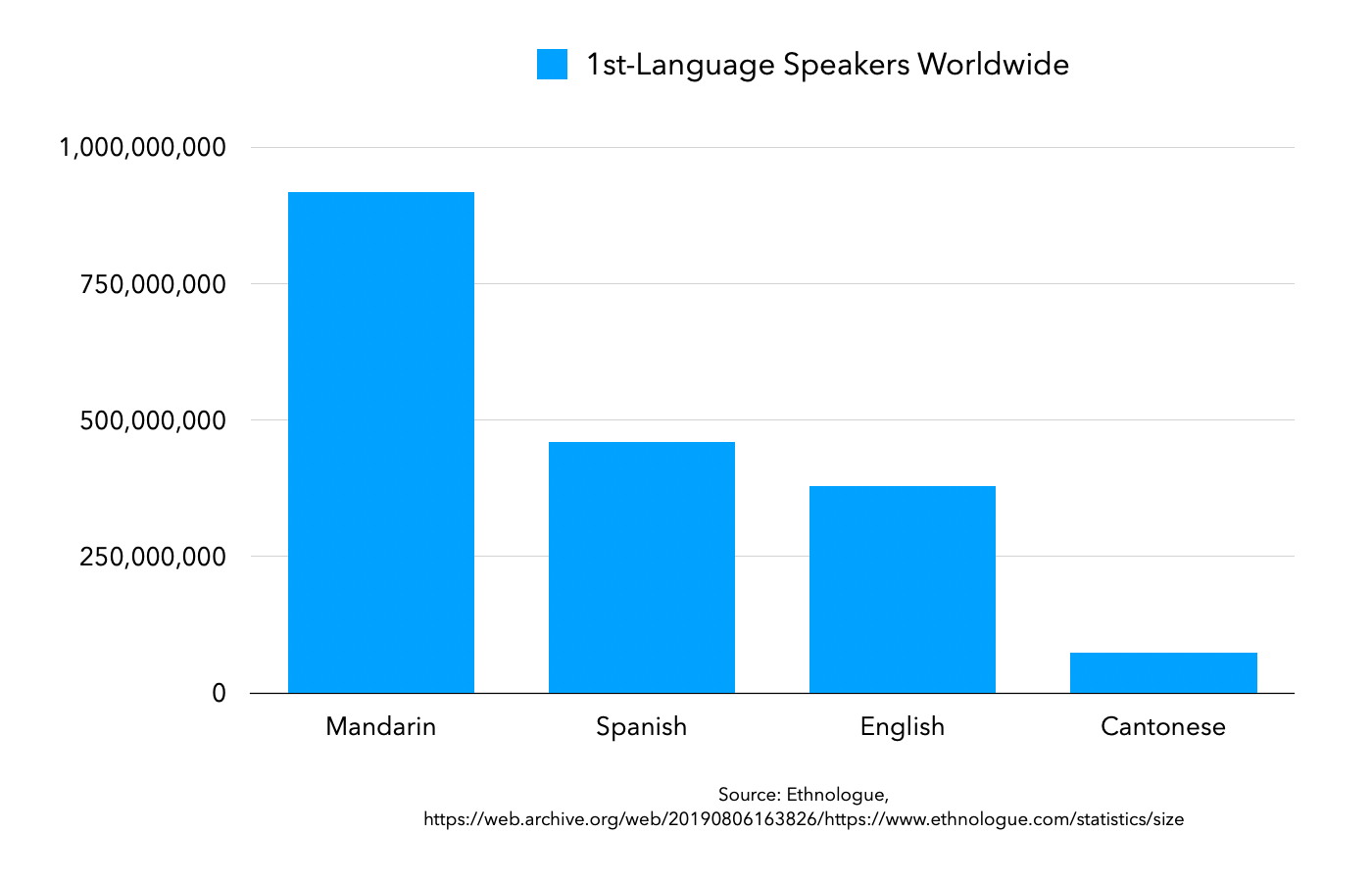
Chart: Languages by First-Language Speakers—2019

So, even as we hang on to Bible truth, let us also hang on to the linguistic truths that we learn, and let us do what we can to share them with our fellow workers in the vast worldwide Chinese fields.
Categories
Culture History Language Learning Science

bĂŹyĂ o

bĂŹyĂ o+ (bÏ·yĂ o certainly · {[being] needed; required; essential} [→ [need | necessary; indispensable]] ćż…èŠ) đŸ‘ˆđŸŒ Tap/click to show/hide the “flashcard”

As part of a series of posts about some common myths about Chinese characters, this post discusses the Indispensability Myth. So, this week’s MEotW is “bĂŹyĂ o (bÏ·yĂ o certainly · {[being] needed; required; essential} [→ [need | necessary; indispensable]] ćż…èŠ)”, which can effectively mean “indispensable”.

Can Chinese Characters Be Replaced?

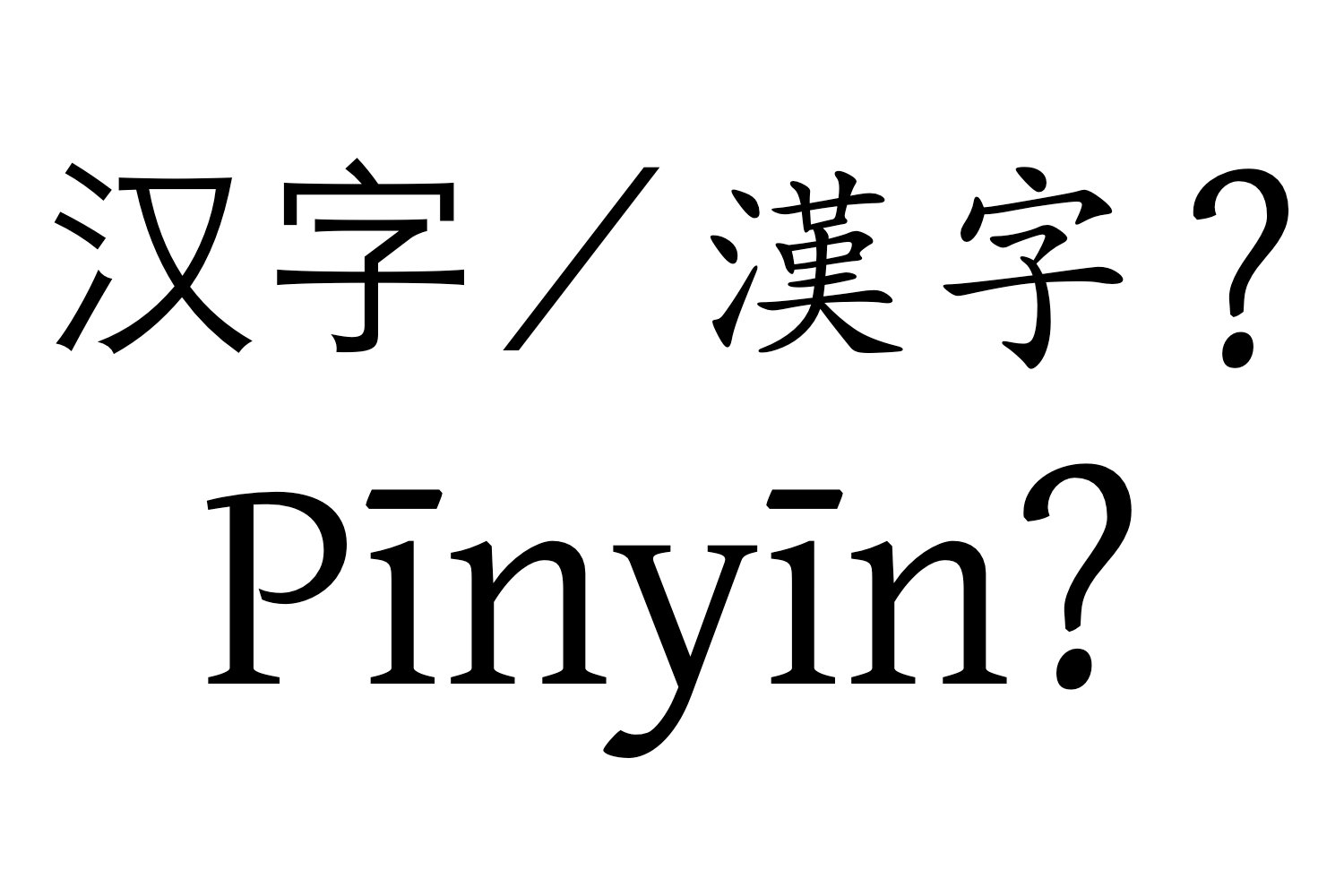
æ±‰ć­— / æŒąć­—? PÄ«nyÄ«n?

In the book The Chinese Language: Fact and Fantasy, linguist and sinologist John DeFrancis introduces the chapter entitled “The Indispensability Myth” with the following:

The belief that Chinese characters are indispensable exists on several levels that range from the most shallow mindlessness to the most serious thoughtfulness. As usual, much of the mythology is based on a confusion of terms and on mixing up speech and writing. In its most general form the Indispensability Myth holds that Chinese cannot be written in an alphabetic script. This seemingly straightforward statement turns out on closer examination to involve a great deal of ambiguity centering on the meaning of the two terms “Chinese” and “cannot.” As I have stressed repeatedly in the previous chapters, the term “Chinese” covers a wide range of meanings. The indispensability thesis needs to be tested against each of them.


scientific linguists have repeatedly demonstrated in actual practice the validity of their thesis that the speech of any individual can be written in an alphabetic script. The overall approach in such an undertaking is the same for all forms of speech in that it involves direct observation and analysis. The specific solutions vary according to the linguistic details (phonemic, morphemic, lexical, syntactical, and so forth) for each form of speech. Any student of linguistics with a modicum of competence can create an alphabetic system of writing for any form of speech in the world. To deny this elementary truth in general or in specific application to Chinese is to reject science and embrace mythology.

DeFrancis goes on to discuss different approaches that have been tried to create alphabetic writing systems for the languages spoken in China. Regarding the most successful approach so far, he writes:

The third solution was adopted in the Latinization movement of the thirties and forties, and by Protestant missionaries and Chinese reformers earlier, to create as many separate schemes of romanization as there are instances of mutually unintelligible forms of speech. The basis for this approach was largely the practical one of creating as simple a system as possible for a given group of speakers in order to facilitate their acquisition of literacy. There was never an overall attempt to determine the exact number of schemes that should be created or to relate the schemes to each other as part of an integrated plan of writing reform. The more or less ad hoc empirical approach is therefore all the more impressive with respect to the results that were actually achieved. Publication in various alphabetic schemes in the century from the initiation of missionary work to the cessation of Latinization activities in the 1940s is significant both for its quantity and for its quality since it includes such diverse items as the Bible, Lewis Carroll’s Through the Looking-glass, Tolstoi’s “The Prisoner of the Caucasus,” Pushkin’s poems, Lu Xun’s “Diary of a Madman” and “Story of Ah Q,” the Soviet Constitution, communist land laws, miscellaneous biographies of Westerners, newpapers and journals, and much additional literature. All this provides practical proof of the theoretical truth that the alleged impossibility of using an alphabetic script in place of Chinese characters to represent spoken Chinese is a bit of unmitigated nonsense. It also provides support for the theoretical assumption that there is in fact no significant limit to the subject matter that can be written in Pinyinized versions of the various regionalects [(the mutually unintelligible varieties of Chinese)].

As the article “Pīnyīn Is a Good, Workable Writing System on Its Own” says:

Pīnyīn can indeed be used to write anything that can be spoken in Modern Standard Mandarin, from the simplest expressions to the most advanced, complex, and deeply meaningful expressions, so it qualifies as a full writing system in that fundamental sense as well—Pīnyīn is indeed “a method of representing the sounds of a language by written or printed symbols”.

Indeed, PÄ«nyÄ«n (PÄ«n·yÄ«n {Piecing Together of} · Sounds → [Pinyin] æ‹ŒéŸł) can be used to represent the key, indispensable factor in communication on spiritual matters, that Mandarin field language learners should be striving for. This key, indispensable factor is explained to us in the Bible itself at 1 Corinthians 14:8–11:

For if the trumpet sounds an indistinct call, who will get ready for battle? In the same way, unless you with the tongue use speech that is easily understood, how will anyone know what is being said? You will, in fact, be speaking into the air. It may be that there are many kinds of speech in the world, and yet no kind is without meaning. For if I do not understand the sense of the speech, I will be a foreigner to the one speaking, and the one speaking will be a foreigner to me.

Yes, while traditional worldly human Mandarin teachers generally say that characters are indispensable, and that extensive knowledge of characters is thus the goal that Mandarin learners should strive for, the Bible itself tells us that the actual key, indispensable factor required for communication on spiritual matters is “speech that is easily understood”. In that regard, we should note that PÄ«nyÄ«n (PÄ«n·yÄ«n {Piecing Together of} · Sounds → [Pinyin] æ‹ŒéŸł) can simply and directly represent any and all understandable modern Mandarin speech, no characters required. Besides “speech that is easily understood”, everything else language-related is of lesser or even little importance, and perhaps even to be actively avoided, in our vital work of praising Jehovah and trying to help save lives in the Mandarin field. We should keep this principle in mind as we consider what DeFrancis calls the Speakability Test, and what he goes on to say about various kinds of traditional Chinese writings.

The Speakability Test

What is the Speakability Test? Note how DeFrancis tells us what he means by that:

The preceding discussion of the Indispensability Myth has been based on a definition of “Chinese” that is limited to its spoken manifestation. Strictly speaking, this is the only acceptable definition of the term. Yet this limitation is very often ignored—sometimes deliberately, sometimes out of sheer ignorance in muddling speech and writing. A popular formulation of the Indispensability Myth holds that because homonyms are so numerous in “Chinese,” characters must be used to avoid the unsupportable ambiguity that would result from writing alphabetically. This view has been advanced in a typically exaggerated form by writers.


Now we are asked to consider quite a different question based on some quite different and not entirely clear definitions of “Chinese.” The term is variously used to refer to such concepts as Chinese characters, Chinese characters in a dictionary, written Chinese, the Chinese language written in characters, perhaps even spoken Chinese written in characters. Our new question is: Can “Chinese” as thus loosely defined be written in an alphabetic script? One possible answer to this question is that it should never have been asked in the first place. “Chinese,” we might insist, must mean spoken Chinese. Whether it has been traditionally written in Chinese characters, cuneiform symbols, hieroglyphics, or anything else is totally irrelevant to the question [of] whether Chinese (that is, current spoken Chinese) can be written in an alphabetic script.

However much we might like to adopt this entirely justifiable stand, the need to confront the Indispensability Myth in its various forms requires further discussion of the issues. Actually the answer to the new question, or rather to the new series of questions, is quite simple. It is based on the eminently practical approach of asking another, quite simple question: Can the “Chinese” you have in mind be understood if spoken aloud? If the answer is yes, then this Chinese can be Pinyinized. If the answer is no, then it cannot. We can test this approach, which consists of what might be called the Speakability Test, by applying it to various kinds of Chinese.

Homophones and Homographs

Continuing on, DeFrancis says:

Those who think of “Chinese” in terms of Chinese characters often invoke such imaginary problems as the ninety words pronounced li (without tone indication) or the more modest thirty-eight words pronounced yì (with tone indication). Most of these “words,” as pointed out in the earlier chapter on the Monosyllabic Myth, exist only in dictionaries. To apply our basic question is in error on two counts. The first is that it is methodologically incorrect to pick out of a dictionary—in any language—a bunch of homophonous expressions and then parade them in isolation to show how ambiguous they are. Such a procedure could also be applied to English to show that it cannot be written alphabetically. See how ambiguous “can” is! On hearing it one cannot tell which of the half dozen or so homophonous words is intended—actually as many as ten or more if we include the slang terms for prison, buttocks, toilet, and the like as well as the standard terms for metal container, to be able to, and so forth.

Yes, the homophones bogeyman that is often trotted out by advocates of characters is an imaginary problem, because in reality, people generally don’t talk in continuous strings of ambiguous homophones (different words that sound the same) because that would be stupid, when the goal of talking to people is generally to communicate understandably! In reality, Mandarin speakers just use sufficient context to clarify the meanings of any homophones and get on with their lives.

DeFrancis continues regarding the second way in which it is in error to question whether Mandarin, with all its homophones, can be written with an alphabet instead of with characters:

The second error in this approach stems from the fact that many entries in Chinese dictionaries, in general contrast to those in English, are not even words. Most of those thirty-eight entries pronounced yĂŹ are not real words. YĂŹ is simply a transcription for thirty-eight characters, and characters in Chinese dictionaries are at best morphemes and at worst might mean nothing at all—as in the case of the two characters 珊瑚 in shānhĂș (“coral”) if we follow Chao and Yang (1962:140) in refusing to give separate meanings to each of the characters. To cite yĂŹ as a problem in Chinese is therefore even more nonsensical than tearing one’s hair over the problem of “can” in English.

Many thus use the Monosyllabic Myth to support the Indispensability Myth, and fall deeper into error. In contrast, as the Bible says at Proverbs 4:18, “the path of the righteous is like the bright morning light that grows brighter and brighter until full daylight.”

Another thing that we can note is that while many have gotten into the habit of using characters as a crutch to disambiguate Mandarin homophones (different words that sound the same), characters have the corresponding problem of homographs, characters that look the same, but that represent different words with different meanings and pronunciations. For example, as the MEotW post on “zhĂĄole huǒ ((zhĂĄo·le {having caught} · {to completion} 着äș† 著äș†) (huǒ fire 火) → [having caught fire; burning; being on fire])” pointed out,

the characters “着/著” can represent 5 different expressions, each with its own pronunciation and set of meanings:

  • zhāo – add; put in | measure word for tricks, devices, moves in chess or martial arts, etc.
  • zhĂĄo – touch; come in contact with [→ [feel; be affected by]] | catch; ignite; light (fire); burn | hitting the mark; accomplishing; succeeding (This is the one used in this week’s MEotW.)
  • zhe – being (indicating continuing progress/state)
  • zhĂč – prominent; outstanding | book; work
  • zhuĂł – apply | put on/wear (clothes)

“Unspeakable Chinese”

What about written Chinese that doesn’t pass the Speakability Test? DeFrancis continues:

Taking up next the somewhat broader and more legitimate question [of] whether “Chinese” defined as written Chinese or as the Chinese language written in characters can be written alphabetically, here too we can apply our simple Speakability Test to discover whether such “Chinese” is intelligible if read aloud. Much of Chinese writing incorporates many elements alien to speech—at times to such an extent as to make it incomprehensible when read orally. For more reasons than one this might be called unspeakable writing. In the case of such unspeakable Chinese, the Chinese characters are indeed indispensable. Only if written Chinese really conforms to the definition of spoken Chinese written in characters is it possible for the characters to be replaced by alphabetic writing.

Why are many Chinese scholars so hung up on “unspeakable Chinese”? DeFrancis goes on to discuss what they really mean when they say that Chinese “cannot” be written alphabetically:

There are doubtless many purists who would insist on the original regardless of whether or not the hoi polloi [the common people] are capable of handling it.


A dilemma exists in the fact that the work of Pinyinization must be undertaken by people who are already literate—which means literate in characters—and Chinese literati, even of the newer generation, have displayed even less capacity than their Western counterparts to write in a style capable of ready comprehension by ordinary people. The contention that materials written in Chinese characters cannot be written alphabetically therefore has a certain sad validity because to date most Chinese scholars cannot accept the notion that the written style should be determined by its capacity for Pinyinization. They cannot bear the thought of the cultural upheaval involved in the transition from character-based to alphabet-based writing.

CANNOT = SHOULD NOT

With these attitudes the notion that Chinese cannot be written alphabetically has now shifted ground to “should not.” It is this interpretation of “cannot” that forms the basis for much of the contention that Chinese characters are indispensable. The shift in emphasis is not always apparent to unwary readers who fail to note that the approach is often based on unwillingness to place speech before writing and to consider the needs of people who might be unable to master the character-based system of writing.

Latin Bibles and Horses

Making an interesting comparison, DeFrancis writes:

Karlgren’s elitist defense not only of characters, but of the classical style as well, has the musty odor of a defense of Latin against such a break with the European cultural past as upstart writing in Italian and French and English.

If we compare traditional Chinese writings to see if they pass the Speakability Test, and to see if they measure up to the Bible-provided standard of corresponding to easily understandable speech, we’ll find that they often don’t. Indeed, because of not a little cultural and nationalistic snobbery and pride, many Chinese scholars, and even many regular Chinese people, like it that way!

However, even if many traditional Chinese writings are revered and highly valued in the world for their cultural or historical value, they show themselves to be of limited or even negative value among us fellow workers with Jehovah in today’s Mandarin field. As an object lesson on this, consider how Jehovah’s organization depicts the false version of Christianity that insisted that Latin Bibles were indispensable, and that viciously persecuted those who tried to translate the Bible into languages like English that the common people could read, and that corresponded well with how they usually spoke.

In contrast to classical Chinese writings and even many modern ones, it is evident that modern Mandarin versions of the publications of Jehovah’s organization seek to represent easily understandable modern Mandarin speech. In fact, much writing that appears in our publications, such as writing from Mandarin versions of The Watchtower and the Bible, is regularly read aloud at our meetings and easily understood. That could not be the case if it were made up of what DeFrancis calls “unspeakable Chinese”!

It’s no wonder then that Jehovah’s organization is evidently successfully proceeding at maximum practical speed to add PÄ«nyÄ«n (PÄ«n·yÄ«n {Piecing Together of} · Sounds → [Pinyin] æ‹ŒéŸł) to its Mandarin writings, since, as DeFrancis points out, writing that corresponds to understandable Mandarin speech can be written in an alphabetic writing system like PÄ«nyÄ«n (PÄ«n·yÄ«n {Piecing Together of} · Sounds → [Pinyin] æ‹ŒéŸł). Also, the unofficial PÄ«nyÄ«n (PÄ«n·yÄ«n {Piecing Together of} · Sounds → [Pinyin] æ‹ŒéŸł) Plus material based on certain Mandarin publications of Jehovah’s organization achieves functional success in using PÄ«nyÄ«n (PÄ«n·yÄ«n {Piecing Together of} · Sounds → [Pinyin] æ‹ŒéŸł) as the default full writing system instead of characters, rather than as just a pronunciation aid for the characters.

Even while it is diligently adding PÄ«nyÄ«n (PÄ«n·yÄ«n {Piecing Together of} · Sounds → [Pinyin] æ‹ŒéŸł) to its Mandarin writings, we can observe that Jehovah’s organization is not getting rid of its writings written in Chinese characters, just as the world in general is not anytime soon getting rid of Chinese characters, an extreme scenario that many supporters of Chinese characters seem to fear. In reality, such an extreme scenario is extremely unlikely to come to pass—people can even still read Latin Bibles if they really want to, and also, people have not killed all the horses even though most now prefer cars. 🐮

Anyway, we can see that when it comes to representing the actual key, indispensable factor for spiritual communication in the Mandarin field—understandable Mandarin speech—and when it comes to the writings that really matter to us Mandarin field language learners, the Indispensability Myth about Chinese characters is
BUSTED!

Categories
Culture History Language Learning Languages Science

fāngyån

fāngyĂĄn+ (fāng·yĂĄn {direction → [place]} · speech → [topolect; dialect (common but misleading translation)] æ–č蚀) ← Tap/click to show/hide the “flashcard”

[This reposting of a post that was originally posted on November 16, 2020 seems to be a fitting companion to the recent repostings of the posts on “yǔxĂŹ (yǔ·xĂŹ language · {tied (things) → [system; family]} èŻ­çł» èȘžçł»)” and “yǔzĂș (yǔ·zĂș language · {ethnic group → [group of things with common characteristics] → [group]} èŻ­æ— èȘžæ—)”. It discusses the important basic issue of whether Mandarin is just a dialect of “Chinese”, a subject about which much political and cultural propaganda has unfortunately been spread.]

The term “fāngyĂĄn (fāng·yĂĄn {direction → [place]} · speech → [topolect; dialect (common but misleading translation)] æ–č蚀)” has been used in the Chinese-speaking world in various ways, but the literal meanings of the words that make it up indicate that it refers to the speech pattern of a place, even a place as small as a village. For reference, the “fāng+ (direction [→ [side; party | place; region | method; way [→ [prescription; recipe]] | power (math.)]] | {[is] square} [→ [[is] upright; honest]] | [mw for square things] æ–č)” in “fāngyĂĄn (fāng·yĂĄn {direction → [place]} · speech → [topolect; dialect (common but misleading translation)] æ–č蚀)” is the “fāng (direction [→ [side; party | place; region | method; way [→ [prescription; recipe]] | power (math.)]] | {[is] square} [→ [[is] upright; honest]] | [mw for square things] æ–č)” in “dĂŹfang (dÏ·fang {(section of) earth → [place]} · {direction → [place]} → [place] 㜰æ–č)”, and the “yĂĄn+ (speech; word; talk; language | say; talk; speak | character; syllable; word 蚀)” in “fāngyĂĄn (fāng·yĂĄn {direction → [place]} · speech → [topolect; dialect (common but misleading translation)] æ–č蚀)” is the “yĂĄn (speech; word; talk; language | say; talk; speak | character; syllable; word 蚀)” in “yǔyĂĄn (yǔ·yĂĄn language · {(type of) speech} èŻ­èš€ èȘžèš€)”.

“FāngyĂĄn (Fāng·yĂĄn {direction → [place]} · speech → [topolect; dialect (common but misleading translation)] æ–č蚀)” has customarily been translated into English as “dialect”, but this practice can be misleading and confusing, because while “fāngyĂĄn (fāng·yĂĄn {direction → [place]} · speech → [topolect; dialect (common but misleading translation)] æ–č蚀)” and “dialect” can sometimes both be applied to a particular speech pattern, the two terms don’t mean exactly the same thing.

What is a Chinese “Dialect”?

American sinologist and University of Pennsylvania Professor of East Asian Languages and Civilizations Victor H. Mair wrote an extensive article on this subject, “What Is a Chinese ‘Dialect/Topolect’? Reflections on Some Key Sino-English Linguistic Terms”, which can be found here (PDF) and here (web page) on his website Sino-Platonic Papers.

It has been said that “a language is a dialect with an army and navy”, but in his article Professor Mair gives us a more linguistically correct and useful way to distinguish between a language and a dialect:

Regardless of the imprecision of lay usage, we should strive for a consistent means of distinguishing between language and dialect. Otherwise we might as well use the two terms interchangeably. That way lies chaos and the collapse of rational discourse. Mutual intelligibility [emphasis added] is normally accepted by most linguists as the only plausible criterion for making the distinction between language and dialect in the vast majority of cases. Put differently, no more suitable, workable device for distinguishing these two levels of speech has yet been proposed. If there are to be exceptions to the useful principle of mutual intelligibility, there should be compelling reasons for them. Above all, exceptions should not be made the rule.

What is mutual intelligibility? Simply put, in linguistics, two or more speech varieties are said to be mutually intelligible if they are “able to be understood by one another’s speakers”. For example, if one person only knows English, and another person only knows Spanish, they can’t really understand each other if they try to talk to each other—English and Spanish are not mutually intelligible, and are suitably recognized as being different languages, not just different dialects of “European”.

Similarly, if one person only knows Mandarin, and another person only knows Cantonese, they can’t really understand each other if they try to talk to each other—Mandarin and Cantonese are not mutually intelligible. So, while they may be “fāngyĂĄn+ (fāng·yĂĄn {direction → [place]} · {(patterns of) speech} æ–č蚀)”, linguistically, Mandarin and Cantonese should really be considered to be different languages, not just different dialects of “Chinese”.

If many of the varieties of speech in China are really different languages, as linguists would refer to them, why have so many people come to think that they are just dialects of a single Chinese language? China’s central government is highly motivated to convince people that China is one unified political and cultural entity which should thus be governed by one central government—them—so they have promoted this idea. In other words, it’s basically political propaganda!

Being Clear on What’s What

Why is it especially important for language-learners in a language field like the Mandarin field to recognize, in spite of the commonly accepted political propaganda, that Chinese varieties of speech like Mandarin and Cantonese really function like different languages, and not different dialects of the same language? Well, as someone who along with many others has come to the Mandarin field from the Cantonese field, I have had the dubious pleasure of observing how some have tried to speak Mandarin by just taking the Cantonese they knew and twisting it a little, since they were relying on the conventional wisdom that Mandarin and Cantonese are just different dialects of the same language. As well-meaning as they may have been, the results were often just as bad as when someone sings badly off-key, or as Star Trek fans may say, they often sounded like the language equivalent of a transporter accident 🙀. Even after decades in the Mandarin field, some publishers who had come over from the Cantonese field still say some Mandarin words with Cantonese-y pronunciations.

In contrast, when one recognizes, for example, that Cantonese is Cantonese and Mandarin is Mandarin, and that neither one is just a slightly mutated version of the other, then that paves the way for language-learning progress that is free of being distorted by untruthful and misleading beliefs. Yes, by recognizing and accepting a variety of speech for what it really is, we can go on to freely learn to speak it well and properly, so that we can be as effective as possible at helping people whose mother tongue is that variety of speech.

As with everything else in life, in language-learning too, the truth matters. As Jehovah’s people, we especially want to “worship the Father with spirit and truth”, and when we seek to do so as we learn a language to use it in Jehovah’s service, we will find that ‘the truth will set us free’ from the distortions and burdens of untruthful and misleading beliefs.—John 4:23; 8:32.

Some Official Recognition

The organization has recently demonstrated that it recognizes the truth about how different many of the Chinese varieties of speech are from one another. For example, whereas before there was one Chinese edition of each publication (using Mandarin wording), now, some publications are available in different Chinese editions for different Chinese languages (including Cantonese), each with different wording.

List of different Chinese languages in which publications are available on jw.org as of 2025-06-02
jw.org now has publications in different Chinese languages.

To help reduce the confusion around the inappropriate use of the English word “dialect” to translate “fāngyĂĄn (fāng·yĂĄn {direction → [place]} · speech → [topolect; dialect (common but misleading translation)] æ–č蚀)”, Professor Mair proposed that the word “topolect” (topo- (“place”) + -lect (“[language] variety”)) be used instead as an exact, neutral English translation of “fāngyĂĄn (fāng·yĂĄn {direction → [place]} · speech → [topolect; dialect (common but misleading translation)] æ–č蚀)”. While not as well-known as “dialect”, the word “topolect” has gained a certain amount of recognition, and it can now be found in several dictionaries, e.g., The American Heritage Dictionary of the English Language, Wordnik, and Wiktionary.