Categories
Culture Experiences History Language Learning

jī‐tóng‐yā‐jiǎng

jī‐tóng‐yā‐jiǎng+ ((jī chicken雞/鷄)‐(tóng {together with}同/仝)‐(yā duck)‐(jiǎng speaking) [people not understanding each other because of speaking different languages (from Cantonese)]) 👈🏼 Tap/click to show/hide the “flashcard”

[I’m still unusually busy with preparing musical notation + Pīnyīn (Pīn·yīn {Piecing Together of} · Sounds → [Pinyin] 拼音) songbook material for this year’s Mandarin conventions, and now, also with rolling out the next generation Pīnyīn (Pīn·yīn {Piecing Together of} · Sounds → [Pinyin] 拼音)+ format. (See this Links News post for more information on that.) So, here’s a repost of a post from a few years back, on a subject of basic importance to Mandarin field language learners.]

[Yes, this expression comes from Cantonese, but the above Mandarin version does appear in Mandarin dictionaries, so it qualifies as a Mandarin expression!]

Recently, while out to dinner with one of the first families to serve in the local Cantonese congregation, along with the circuit overseer serving the local Chinese circuit and his wife, the subject came up of how Mandarin and Cantonese are actually different languages, not just dialects of the same language.

Chickens Talking with Ducks

The wife of the circuit overseer asked what the difference is between a language and a dialect. So, I proceeded to explain something that is emphasized by American sinologist and University of Pennsylvania Professor of East Asian Languages and Civilizations Victor H. Mair, that a primary way accepted by most linguists to distinguish a language from a dialect is mutual intelligibility, as is discussed in this excerpt from the MEotW post on “fāngyán (fāng·yán {direction → [place]} · speech → [topolect; dialect (common but misleading translation)] 方言)”:

It has been said that “a language is a dialect with an army and navy”, but in his article Professor Mair gives us a more linguistically correct and useful way to distinguish between a language and a dialect:

Regardless of the imprecision of lay usage, we should strive for a consistent means of distinguishing between language and dialect. Otherwise we might as well use the two terms interchangeably. That way lies chaos and the collapse of rational discourse. Mutual intelligibility [emphasis added] is normally accepted by most linguists as the only plausible criterion for making the distinction between language and dialect in the vast majority of cases. Put differently, no more suitable, workable device for distinguishing these two levels of speech has yet been proposed. If there are to be exceptions to the useful principle of mutual intelligibility, there should be compelling reasons for them. Above all, exceptions should not be made the rule.

What is mutual intelligibility? Simply put, in linguistics, two or more speech varieties are said to be mutually intelligible if they are “able to be understood by one another’s speakers”. For example, if one person only knows English, and another person only knows Spanish, they can’t really understand each other if they try to talk to each other—English and Spanish are not mutually intelligible, and are suitably recognized as being different languages, not just different dialects of “European”.

Similarly, if one person only knows Mandarin, and another person only knows Cantonese, they can’t really understand each other if they try to talk to each other—Mandarin and Cantonese are not mutually intelligible. So, while they may be “fāngyán+ (fāng·yán {direction → [place]} · {(patterns of) speech} 方言)”, linguistically, Mandarin and Cantonese should really be considered to be different languages, not just different dialects of “Chinese”.

Indeed, I have heard people use this week’s MEotW, “jī‐tóng‐yā‐jiǎng+ ((jī chicken雞/鷄)‐(tóng {together with}同/仝)‐(yā duck)‐(jiǎng speaking) [people not understanding each other because of speaking different languages (from Cantonese)])”, to specifically describe Mandarin-speakers and Cantonese-speakers trying to talk to each other, and not understanding each other. 🐓 🦆

After I explained the gist of the above, one of the daughters of the family at the dinner—who had been labouring for decades under the misconception that Mandarin and Cantonese are just dialects and that someone who knows one can easily learn the other—said, “Now I don’t feel like an idiot.”

Uncommon Knowledge?

It could be said that ones such as this family and this circuit overseer and his wife, who have all worked so hard and served for so long in the Chinese language fields, should already have known such a basic thing about the Chinese languages. However, the following things are unfortunately true:

  • Even publishers who are learning a language to serve in that language’s field generally consider such linguistic (language science) knowledge to be specialized technical knowledge that is beyond what they need to learn, and possibly beyond what they could even comprehend.
  • Western-educated publishers learning a Chinese language may unwittingly go along with the Western worldly tendency to exoticize things related to China. (John DeFrancis, in his book The Chinese Language: Fact and Fantasy (p. 37), calls this “Exotic East Syndrome”.) They may be content with—or even enjoy—the alluring veil of mystery and mystique surrounding certain things related to China and Chinese culture. Thus, they don’t seek to learn about and understand deeper truths about such things, that may pierce through this obscuring veil, and burst this bubble.—Compare 2 Corinthians 3:14, including the margin note.
  • The central ruling authorities of China have long actively promoted the scientifically incorrect idea that the different varieties of speech in China are just dialects of the one Chinese language. This idea is political propaganda supporting the idea that it’s good for there to be central ruling authorities in China.
  • Traditional worldly Chinese language instructors and others who are knowledgeable about Chinese languages and Chinese characters are eager to promote and perpetuate the traditional thinking about Chinese languages and characters, that they have invested so much time and effort in, and that they are so proud of.
  • Chinese-educated publishers who are already steeped in the traditional ideas about Chinese languages, Chinese characters, etc., and who are thus lauded and deferred to as experts by other publishers, may be eager to simply unquestioningly pass on the cultural knowledge and ideas that they were taught, and that they are lauded and respected for.
  • With so much misinformation “in the air”, including from trusted authority figures, “everyone knows” that there is one Chinese language, with dialects that include Mandarin, Cantonese, etc. Since “everyone knows” this, it’s easy to just go along with it, especially in an Eastern culture like the Chinese culture that emphasizes conforming to the group. As Eastern cultures, Japanese, Korean, etc. cultures are similar in this respect, so publishers from those cultural backgrounds may also generally tend to just go along with what “everyone knows” about there being just one Chinese language that has various dialects.—Ephesians 2:2.
  • The Bible makes it clear that Satan the Devil is “a liar and the father of the lie”. It also describes him as “the great dragon…who is misleading the entire inhabited earth”. So, while we can only speculate about the details of what strings are purposely pulled in the spirit realm by Satan and his demons as opposed to what human folly they simply passively observe, we can be sure that Satan is delighted with all the ways in which people are misled in and about the Chinese culture, in which the dragon is considered a positive, revered symbol.—John 8:44; Revelation 12:9.

So, for reasons such as the above, even the basic linguistic truth that Mandarin, Cantonese, Shanghainese, etc. actually function as different languages is unfortunately not yet common knowledge among those serving in the Chinese fields. As the saying goes, which some say is a Chinese proverb, “error will travel over half the globe, while truth is pulling on her boots”.

Jesus said, though, that true worshippers worship “with spirit and truth”, and that “the truth will set you free”. With regard to Chinese languages, Chinese characters, etc., the truth about them can even set one free from unnecessarily feeling like an “idiot”, as the sister mentioned above so eloquently put it, because of labouring under all the political propaganda, traditions, and other kinds of misinformation and wrong thinking that unfortunately surround Chinese languages, Chinese characters, etc.—John 4:23; 8:32.

Huge Worldwide Effects

In addition to being hugely freeing for individual language learners, spreading the truth about the Chinese languages, Chinese characters, etc. is also important on a larger scale, since the worldwide Mandarin field, for one, is the largest language field in the world, and probably the largest language field that has ever existed in human history. For comparison, according to Ethnologue, a resource on world languages, the worldwide Mandarin field (those worldwide whose mother tongue is Mandarin) is about twice the size of the second largest worldwide language field, the Spanish field, and it’s about two and a half times the size of the third largest worldwide language field, the English field. Allowing various untruths to continue to divert and bog down the language-learning efforts of those who come to help in the worldwide Mandarin field can have incalculable overall negative effects on the preaching work in this enormous field.
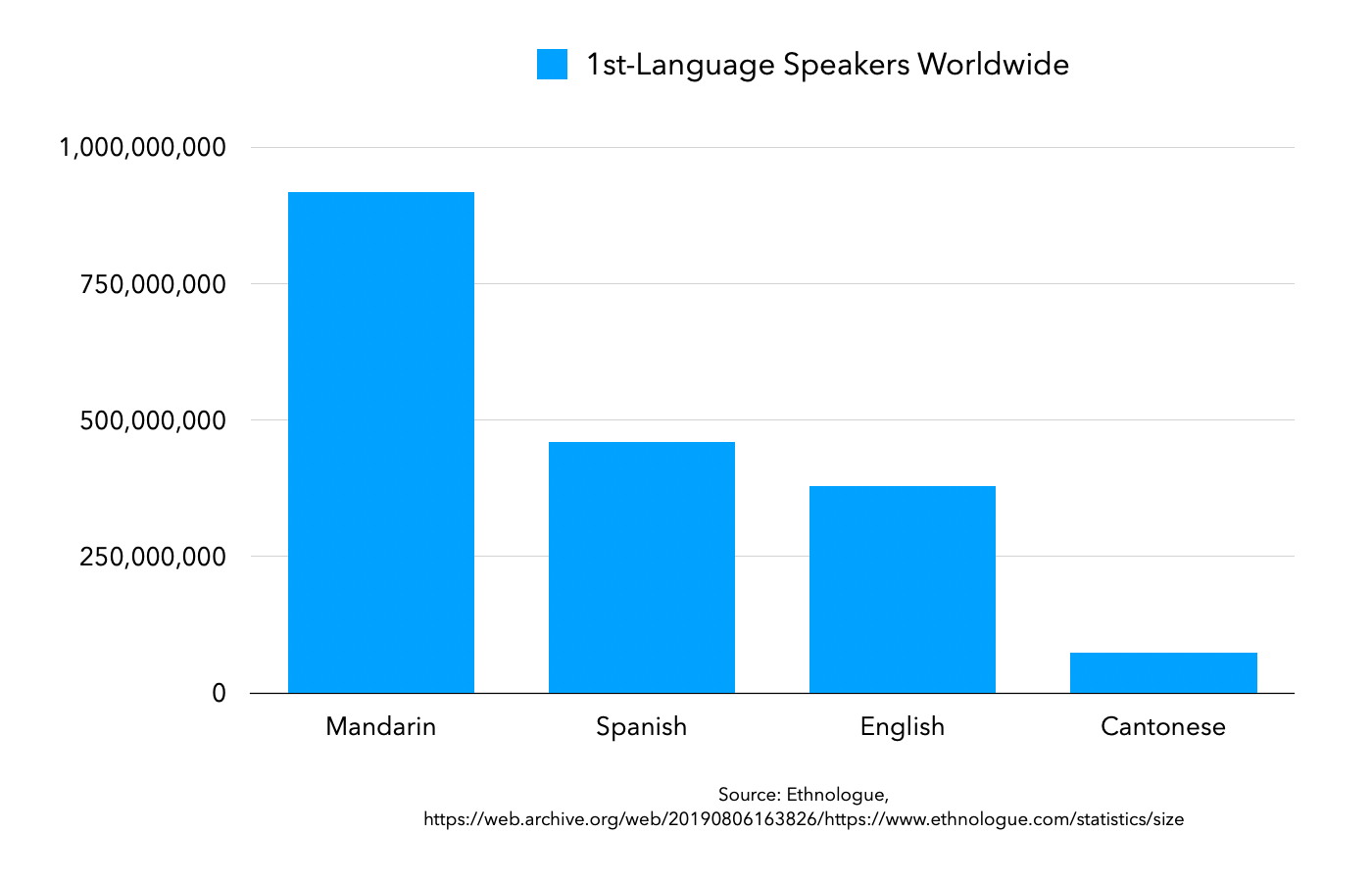
Chart: Languages by First-Language Speakers—2019

So, even as we hang on to Bible truth, let us also hang on to the linguistic truths that we learn, and let us do what we can to share them with our fellow workers in the vast worldwide Chinese fields.
Categories
Culture Experiences History Technology

shūfǎ

shūfǎ+ (shū·fǎ writing · methods; ways → [calligraphy; penmanship] 书法 書法) ← Tap/click to show/hide the “flashcard”

Many know “shū (write | writing [→ [book | letter | document | style of calligraphy; script]]) as the Mandarin word for “book”, but it actually has an old meaning of “write”. From “write” is derived “writing”, and from that, it’s easy to see how “shū (write | writing [→ [book | letter | document | style of calligraphy; script]]) has come to have its modern meanings of “book”, “letter”, and “document”. For example, “shūxiě (shū·xiě write | writing 书写 書寫) means “write” or “writing”, “Yǐsàiyàshū (Yǐsàiyà·shū Isaiah · {Writing → [Book]} 以赛亚书 以賽亞書) is the Book of Isaiah, and a “qíngshū (qíng·shū {feelings; affection; emotion → [love]} · {writing → [letter]} 情书 情書) is a love letter. Yet another effective meaning of “shū (write | writing [→ [book | letter | document | style of calligraphy; script]])”, that can be derived from its meaning of “writing”, is “style of calligraphy”, or “script”.

The “fǎ (law | method; way; mode | standard; model | {magic arts} | {follow; model after} 法) in “fāngfǎ (fāng·fǎ direction · method 方法) can mean “methods; ways”, and when it’s combined with “shū (write | writing [→ [book | letter | document | style of calligraphy; script]])”, we get this week’s MEotW, “shūfǎ (shū·fǎ writing · methods; ways → [calligraphy; penmanship] 书法 書法)”. This expression literally means “writing methods/ways”, and it is used to effectively mean “calligraphy”.

Eastern and Western Calligraphy

Calligraphy that involves the artistic writing of Chinese characters, as practised in Asian cultures, is well-known and highly esteemed. However, does calligraphy only exist in Asian cultures? Are beauty, artistry, and craftsmanship the exclusive province of Chinese characters? Is Pīnyīn (Pīn·yīn {Piecing Together of} · Sounds → [Pinyin] 拼音) only able to be cold, efficient, and artless, since it lacks the arguably self-indulgently complex visual designs of Chinese characters? No, no, and no! The fact is that there is a long history—and yes, tradition—of calligraphy involving the Latin alphabet, the alphabet that was deliberately chosen for Pīnyīn (Pīn·yīn {Piecing Together of} · Sounds → [Pinyin] 拼音) by the Chinese team that developed it.

This reminds us that while the Latin alphabet used by Pīnyīn (Pīn·yīn {Piecing Together of} · Sounds → [Pinyin] 拼音) may have originated outside of China, its adoption for use in Pīnyīn (Pīn·yīn {Piecing Together of} · Sounds → [Pinyin] 拼音) for writing Mandarin Chinese makes it part of Chinese culture. As the article “Pīnyīn (Pīn·yīn {Piecing Together of} · Sounds → [Pinyin] 拼音) Is a Good, Workable Writing System on Its Own” puts it:

While Pīnyīn uses the Latin alphabet, it does so because the Chinese developers of Pīnyīn of their own free will purposely chose to base it on this international alphabet (it’s not just the English alphabet) so that users of Pīnyīn would benefit from its familiarity. This Chinese design decision has caused the international Latin alphabet to be adopted as part of Chinese culture. As Zhōu Ēnlái (the first Premier of the People’s Republic of China) said, ‘When we adopt the Latin alphabet, in which we make necessary adjustments to suit the needs of the Chinese language, it becomes the phonetic alphabet of our language and is no longer the alphabet of ancient Latin, still less the alphabet of any foreign country.’

So, since Pīnyīn (Pīn·yīn {Piecing Together of} · Sounds → [Pinyin] 拼音) has both Eastern and Western aspects, Pīnyīn (Pīn·yīn {Piecing Together of} · Sounds → [Pinyin] 拼音) calligraphy would be both Eastern and Western calligraphy.

Calligraphy and Computer Fonts

In the modern world of computing, handwritten calligraphy has been augmented by computer fonts, which enable the billions of users of desktop and laptop computers and mobile devices to enjoy and benefit from the work of artists and designers who work with text and typography.

Incidentally, some of you may have noticed that there are way fewer fonts available for Chinese characters, compared to the overflowing cornucopia of fonts available for the Latin alphabet. This is undoubtedly yet another negative consequence of the simple fact that there are literally thousands of characters in common use that would have to be supported by any font for Chinese characters that’s intended to be usable in daily life, never mind the tens of thousands of Chinese characters that exist in total.

An interesting thing that some may not know is that calligraphy influenced the development of modern computer font design and technology. Steve Jobs, one of the founders of Apple, maker of the iPhone, the iPad, the Macintosh personal computer, etc., said the following in the Stanford Commencement address that he gave in 2005:

Much of what I stumbled into by following my curiosity and intuition turned out to be priceless later on. Let me give you one example:

Reed College at that time offered perhaps the best calligraphy instruction in the country. Throughout the campus every poster, every label on every drawer, was beautifully hand calligraphed. Because I had dropped out and didn’t have to take the normal classes, I decided to take a calligraphy class to learn how to do this. I learned about serif and sans serif typefaces, about varying the amount of space between different letter combinations, about what makes great typography great. It was beautiful, historical, artistically subtle in a way that science can’t capture, and I found it fascinating.

None of this had even a hope of any practical application in my life. But 10 years later, when we were designing the first Macintosh computer, it all came back to me. And we designed it all into the Mac. It was the first computer with beautiful typography. If I had never dropped in on that single course in college, the Mac would have never had multiple typefaces or proportionally spaced fonts. And since Windows just copied the Mac, it’s likely that no personal computer would have them. If I had never dropped out, I would have never dropped in on this calligraphy class, and personal computers might not have the wonderful typography that they do. Of course it was impossible to connect the dots looking forward when I was in college. But it was very, very clear looking backward 10 years later.

Time-Lapse Videos of Calligraphed MEotWs

Another way in which modern computing has augmented handwritten calligraphy is by supplying new tools for this ancient craft. A while ago, I acquired the app Procreate for my iPad, and more recently, I also bought an Apple Pencil on sale. As time allows, I hope to be able to put my old hobby of calligraphy to use, and use Procreate to create time-lapse videos, like the one near the beginning of this post, of certain MEotWs being hand-calligraphed. Hopefully these amateur efforts of mine will add a little artistry and craftsmanship for readers of this blog to enjoy.

The Truly Precious Things of All the Nations

The calligraphy produced of Chinese characters is a major aspect of what some fear would be lost if the hypothetical total replacement of characters with something as “mundane” as an alphabet were ever to take place. However, first of all, with how proud and stubborn worldly Chinese people are when it comes to their precious characters, there is little likelihood of that actually happening in the little time that this old system has left. (There’s probably just about as much likelihood that all the Catholics or all the Buddhists will come into the truth before the end comes!) As the MEotW post on “Yànwén (Yàn·wén {Proverb (Korean: Vernacular)} · Writing → [Hangul/Hankul (modern Korean writing system)] 谚文 諺文) (the modern Korean writing system) said:

If Hangul took hundreds of years to become the dominant writing system in Korea, even with the added nationalistic motivation of it having been invented in Korea to be used instead of the characters invented in China, then Pīnyīn (Pīn·yīn {Piecing Together of} · Sounds → [Pinyin] 拼音) could take even longer to become the dominant writing system for Mandarin, if it ever does, and if this old system were hypothetically allowed to last that long—the supporters of invented-in-China Chinese characters are even more proudly and stubbornly resistant to the idea of changing away from Chinese characters in China itself.

At this rate, the current government of China, as long as it lasts, will probably never explicitly officially approve of using Pīnyīn (Pīn·yīn {Piecing Together of} · Sounds → [Pinyin] 拼音) as a full writing system for Mandarin in China, even if it’s just as an alternative to the characters instead of as a total replacement for them. Even if it actually wanted to do so, even this government would hesitate to approve of something like this that would probably be opposed by many of the people of China. (As a historic comparison, in 1977, the PRC promulgated a second round of simplified Chinese characters, but this was rescinded in 1986 following widespread opposition.)

The existence of much calligraphy based on the Latin alphabet that is used by Pīnyīn (Pīn·yīn {Piecing Together of} · Sounds → [Pinyin] 拼音) and many other writing systems reminds us that art and beauty do exist apart from Chinese characters. As for the precious things of China and Chinese culture, while humans may point to Chinese characters and the calligraphy based on them, what is truly precious about China in Jehovah God’s eyes? This quote from the September 2021 issue of The Watchtower reveals the answer as it discusses Haggai 2:7–9:

He tells us that as a result of the shaking, “the precious things [honesthearted people] of all the nations will come” to worship Jehovah.

Yes, to Jehovah God, the truly precious things of China are the honesthearted people in it, not the cultural products of any part of this old world that is passing away.—1 John 2:15–17.

While culture can definitely influence the people that are exposed to it, ultimately, people don’t come from culture. Rather, culture comes from people. So, let us focus on helping to save honesthearted Chinese people, not on trying to save the old world’s Chinese culture. Then, we will be able to enjoy the beautiful cultural products that these people will produce for eternity, as they live forever in paradise in God’s new system. Those cultural products will greatly surpass anything ever produced by this old world’s Chinese culture in its relatively brief (compared to eternity) and troubled existence, as the Chinese people who are able to live in the new system join the rest of God’s universal family in being “taught by Jehovah”. (Isaiah 54:13) As Haggai 2:9 says, “the future glory…will be greater than the former”.

Categories
Culture Language Learning Science

jítǐ zhǔyì

jítǐ zhǔyì+ ((jí·tǐ gathered; collected · {body [→ [style; form]]} → [collective] 集体 集體) (zhǔ·yì master · meaning → [-ism] 主义 主義) [collectivism; community spirit]) ← Tap/click to show/hide the “flashcard”

Generally speaking, Western societies are considered to be relatively individualistic, while Eastern societies, like Chinese ones, are considered to be relatively collectivistic, emphasizing the collective, or group, over the individual. This week’s MEotW, “jítǐ zhǔyì ((jí·tǐ gathered; collected · {body [→ [style; form]]} → [collective] 集体 集體) (zhǔ·yì master · meaning → [-ism] 主义 主義) [collectivism; community spirit])”, seems to be the main Mandarin expression referring to such collectivism. (The MEotW post on “kǒngbù huódòng ((kǒng·bù fearing · terror → [terrorist] 恐怖) (huó·dòng living · moving → [activities] 活动 活動) [terrorism; terrorist activities]) contains a brief discussion about some other Mandarin -isms.)

Differences and Possible Causal Factors

While researching this post, I came across a scientific paper that has some interesting information about individualism and collectivism, including some information about measurable regional variations in collectivism that have been found across the Chinese mainland. Here is a quotation from it, regarding individualism and collectivism in general:

The distinction between individualism and collectivism captures important differences in how the relationship between self and others is constructed, as well as whether the individual or the group is understood as the basic unit of analysis (Cross et al., 2011; Hofstede, 2001; Markus & Kitayama, 1991, 2010; Oyserman et al., 2002; Triandis, 1995). People living in individualistic cultural contexts (e.g., the United States and the United Kingdom) tend to pay more attention to the achievement of their own goals and their own uniqueness. They have clear boundaries with others and pursue well-being or life satisfaction by sharing feelings and achieving personal success. In contrast, people living in collectivistic cultural contexts (e.g., China, Japan, and Korea) tend to be more concerned about maintaining harmonious relations with in-group members, and the boundaries between themselves and these others are much less firm. This distinction is reflected in cognition, perception, memory, cultural products, and even brain function (Morling, 2016; Nisbett & Masuda, 2003; Oyserman et al., 2002; Zhu et al., 2007). Many explanations for these differences have been proposed, including cultural heritage (Ma et al., 2016), modernity (Inglehart & Baker, 2000), climato-economic theory (Van de Vliert et al., 2013), the subsistence system (Uskul et al., 2008), the historical risk of infectious disease (Fincher et al., 2008), and geographic and relational mobility (Oishi, 2010).

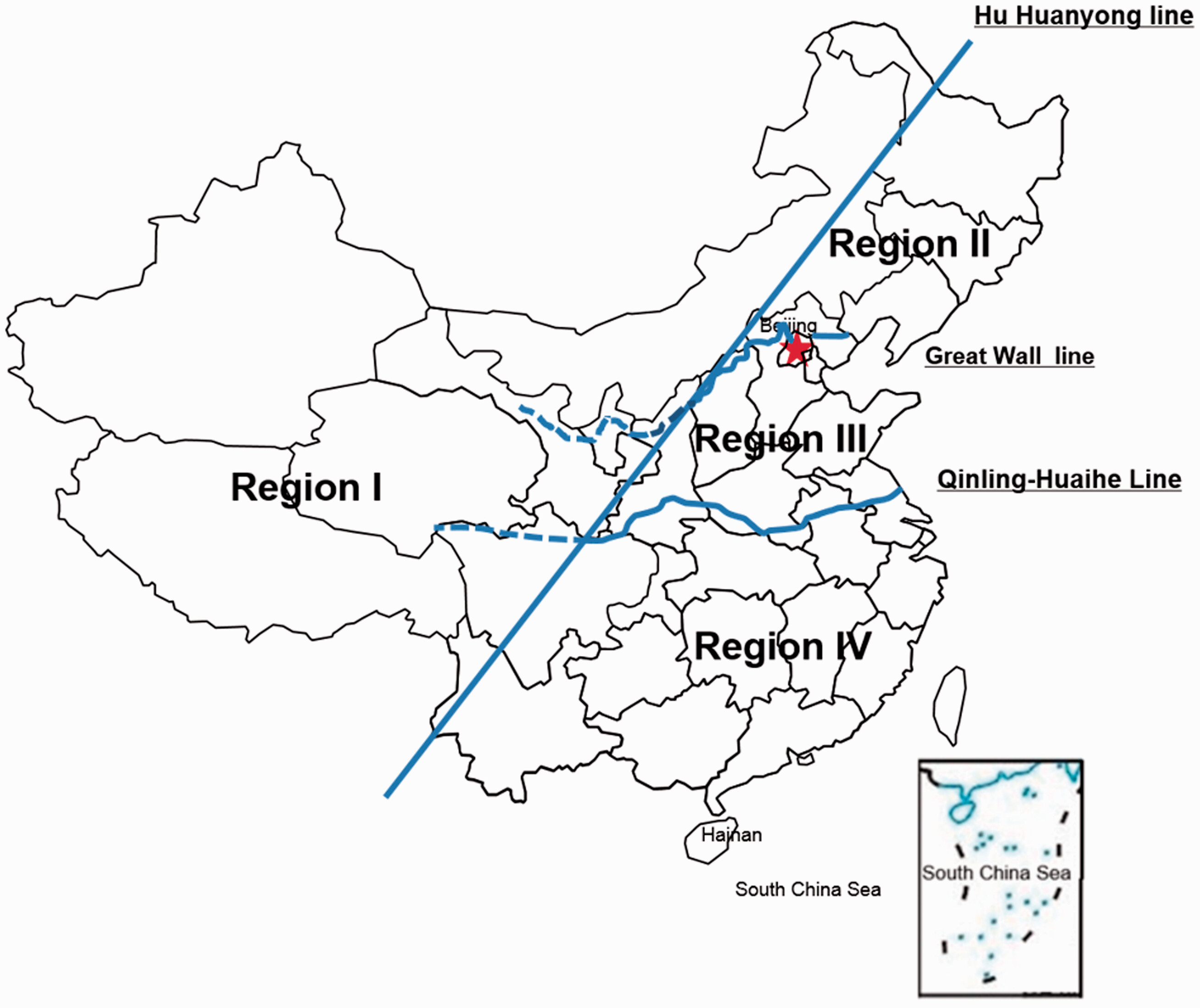
Later in the paper, the authors divide China into four regions, and present a table listing some factors that may have contributed to the varying degrees of collectivism in those regions.

Triple-Line Framework of variations within China.

Table 1. Ecological Factor Differences Among the Four Regions.

Region I Region II Region III Region IV
Collectivism Lowest Lower Higher Highest
Climate Harsh Harsh Comfortable Comfortable
Water Less Enough Less Enough
Rainfall <400 mm 400–800 mm 400–800 mm >800 mm
Subsistence
system
Herder Wheat or herder/wheat-blended Wheat Rice
Voluntary
settlement
No Yes No No
Population
density
Low Low High High

Pluses and Minuses

Collectivistic societies can have certain good aspects, as expressed by this example sentence from the entry for “xūntáo+ (xūn·táo {cure (meat/etc.) with smoke} · {mould (as with clay)} → [influence positively; nurture; edify; train] 熏陶 熏/薰陶) in Pleco’s built-in dictionary:

Zài jítǐ zhǔyì jīngshén de xūntáo xià, háizimen hùxiāng guānxīn, hùxiāng bāngzhù. [Word division was edited.]

Nurtured in the spirit of collectivism, the children care for each other and help each other.

However, recently, some research has come out that shows that some negative ways of thinking, feeling, and acting are more likely to be displayed by those in collectivistic societies.

To clarify, here is a definition of “zero-sum” :

Of any system where all gains are offset by exactly equal losses.

So, a zero-sum game or system is one in which another must lose for one to win—no win-win situations. That means that if you hold zero-sum beliefs, as, according to the studies referred to in the above post, collectivists are more likely to do, then you will think that any goodness that’s enjoyed by someone else is goodness that’s no longer available to you.

Zero-sum thinking makes it difficult to have true empathy for others who are suffering, and it makes it difficult to follow the Bible counsel at Romans 12:15:

Rejoice with those who rejoice; weep with those who weep.

Collectivism and the Obsession with Chinese Characters

It seems, then, that there is a connection between collectivism and China’s obsessive refusal so far to move on from Chinese characters to more reasonable and modern writing systems like Pīnyīn (Pīn·yīn {Piecing Together of} · Sounds → [Pinyin] 拼音). Consider this excerpt from my article “Pīnyīn (Pīn·yīn {Piecing Together of} · Sounds → [Pinyin] 拼音) Was Plan A”:

In addition to those who feel that phasing out the Hànzì [Chinese characters] would be a regrettable cultural loss, I have also noticed that there are some for whom knowledge of Hànzì is a matter of pride and self-identity. They are proud of knowing the Hànzì as they do, and they view their knowledge of the Hànzì as part of what makes them who they are, as something that distinguishes them from those who don’t know the Hànzì. Such ones may defend the Hànzì to the point of irrationality in the face of a more accessible alternative that would make them and their hard-earned knowledge of Hànzì less “special”, that would threaten to render worthless all of the blood, sweat, and tears they have invested into grappling with these “Chinese puzzles”. It’s as if they are saying, “That’s not fair! If I had to go through all this bitter hard work to learn characters before I could read and write Chinese, then everyone else has to too!”

Self-Identity and Balanced Self-Love

Self-identity is one thing that can particularly be a struggle for those raised in collectivistic societies, since the self is relatatively often neglected in such societies. It’s perhaps not surprising then, that, as mentioned above, in the relatively collectivistic Chinese societies, with their relative paucity, or scarcity, of more healthy ways to build and maintain self-identity, so many have such an unhealthy, obsessive attachment to Chinese characters, as something to desperately hang their neglected self-identities on.

As Jehovah’s organization has commented, for us to follow well the command at Matthew 19:19 to “love your neighbor as yourself”, we must first love ourselves in a healthy way. Also, while Romans 12:3 telling each of us “not to think more of himself than it is necessary to think, but to think so as to have a sound mind” is mainly an admonition against the overly self-important thinking that individualistic societies can tend to promote, it also shows that it is necessary to think a certain amount of ourselves to have a balanced, sound mind.

In turn, it seems that our developing a balanced, healthy view of ourselves can contribute to our avoiding things like zero-sum thinking, and to our developing a balanced, healthy view of Chinese characters. From that balanced, healthy place, we can be free to develop a balanced, healthy view of the possible alternative of Pīnyīn (Pīn·yīn {Piecing Together of} · Sounds → [Pinyin] 拼音), which could empower us to serve Jehovah and help others in the Mandarin field as well as we ought to be able to.