zhēnlǐ+ (zhēn·lǐ true · reasoning; logic → [[the] truth] 真理) 👈🏼 Tap/click to show/hide the “flashcard”
[Notes: Tap/click on a Pīnyīn (Pīn·yīn {Piecing Together of} · Sounds → [Pinyin] 拼音) expression to reveal its “flashcard”; tap/click on a “flashcard” or its Pīnyīn (Pīn·yīn {Piecing Together of} · Sounds → [Pinyin] 拼音) expression to hide the “flashcard”. 📖 📄 ➕ icons mean 📖 Reveal All, 📄 Reveal Advanced, and ➕ Reveal + Symbols re all the “flashcards” in the heading, paragraph, etc. that they are placed at the beginning of.]
I have long especially liked 1 Corinthians 13. It contains counsel on what really does and doesn’t matter in life, an extensive description and definition of the most important kind of love, and a sublime discussion about the need to become complete, mature, as a person. As these apply to life in general, so too do they apply to our lives as Mandarin field language learners.
As Mandarin field language learners, it can benefit us greatly to consider what we can learn from 1 Corinthians 13, and along the way, we can also consider some of the Mandarin expressions used in that chapter in the current version of the Mandarin New World Translation Bible (nwtsty).
What Do You Rejoice In?
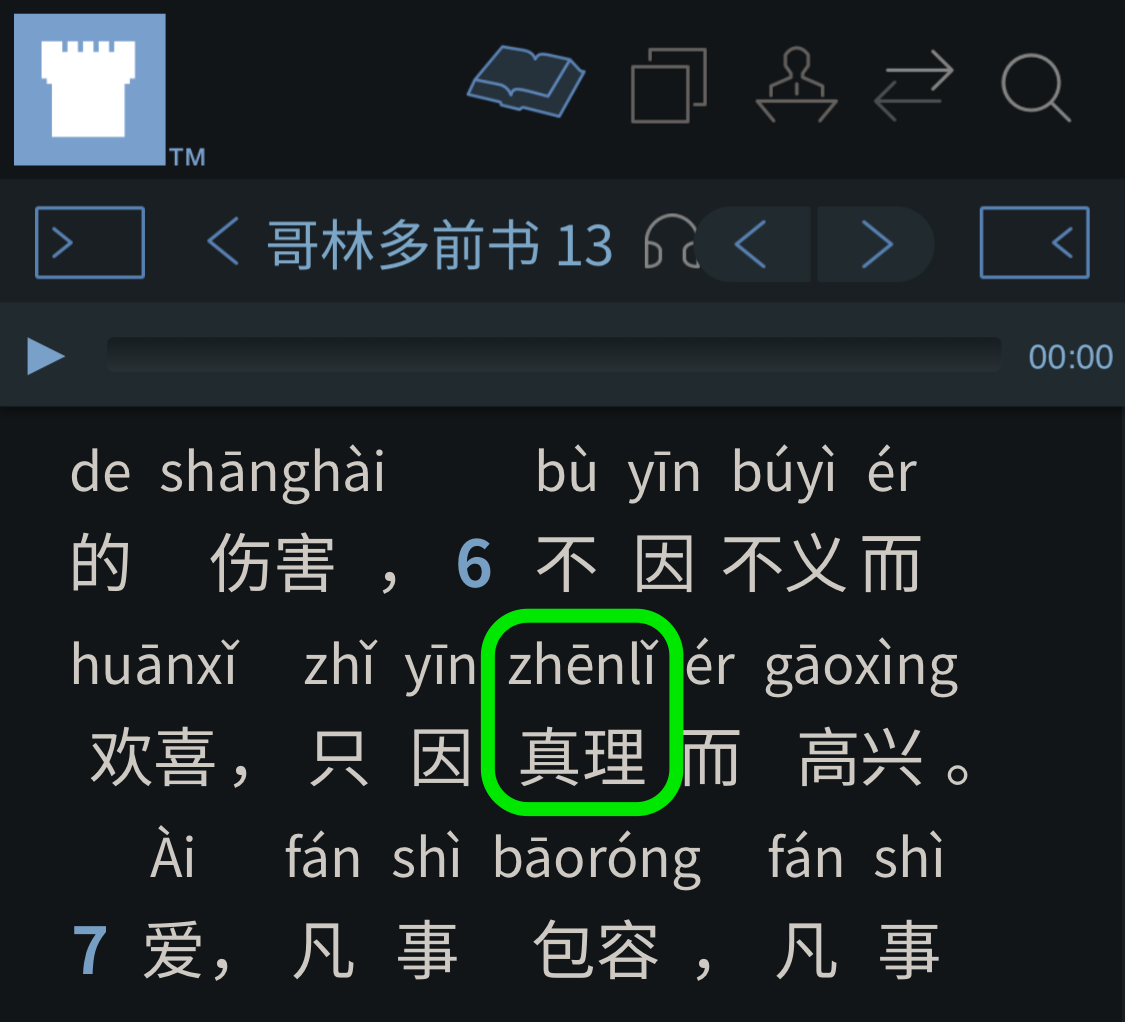
This week’s MEotW, “zhēnlǐ (zhēn·lǐ true · reasoning; logic → [[the] truth] 真理)”, is used in verse 6 (WOL) of 1 Corinthians 13:
(Dark mode for the Watchtower ONLINE LIBRARY (WOL) website, as shown in the above image, can be enabled in the Safari web browser by using the Noir Safari extension. Other web browsers may also have extensions with similar functionality.)
For comparison, here are the renderings of 1 Corinthians 13:6 in the current English and Mandarin versions of the New World Translation Bible:
It does not rejoice over unrighteousness, but rejoices with the truth.
Mandarin (WOL, Pīnyīn (Pīn·yīn {Piecing Together of} · Sounds → [Pinyin] 拼音)+ 🔗):
📖 📄 ➕ bù (not 不) yīn ({because of} 因) búyì (bú·yì un·righteousness 不义 不義) ér (thus 而) huānxǐ+ (huān·xǐ {does be joyful} · {does be happy} 欢喜 歡喜), zhǐ (only 只 只/秖/衹/祇) yīn ({because of} 因) zhēnlǐ (zhēn·lǐ true · reasoning → [the truth] 真理) ér (thus 而) gāoxìng (gāo·xìng (is with) high · enthusiasm → [is glad] 高兴 高興).
The individual morphemes in “zhēnlǐ (zhēn·lǐ true · reasoning; logic → [[the] truth] 真理)” literally mean “true” and “reasoning; logic”. When these morphemes are put together in “zhēnlǐ (zhēn·lǐ true · reasoning; logic → [[the] truth] 真理)”, the resulting expression effectively means “truth”, or “the truth”.
Linguistic Untruths Fill the “Air”
This world ruled by Satan, “the father of the lie”, is full of linguistic idolatry and mythology (e.g., the myths discussed in the book The Chinese Language: Fact and Fantasy) surrounding Chinese characters, and it is full of misinformation and disinformation about the Chinese languages in general. (Ephesians 2:2; John 8:44) We Mandarin field language learners need to learn the truth about these things that are such huge factors in our Mandarin learning, and we should ‘rejoice with the truth’ about these things, similarly to how we rejoice over spiritual truth.
Yes, godly love doesn’t just know the truth, it rejoices with the truth, so it chooses the truth. Showing that he lacked godly love, the first man Adam knew the truth, but he loved Eve more, and so he chose to join Eve in rebellion against Jehovah. (1 Timothy 2:14) Also, as we have been reminded by the video series The Good News According to Jesus, the scribes and Pharisees of Jesus’ day had every reason and opportunity to know the truth, but consumed by pride, they loved their tradition and position and status more, and so they chose to bitterly oppose Jesus to the point of eventually brutally murdering him.
What Side Are You On?
At John 18:37, Jesus said:
For this I have been born, and for this I have come into the world, that I should bear witness to the truth. Everyone who is on the side of the truth listens to my voice.
In this blog and in other places, I have endeavoured to share the truths that I have learned about the Mandarin language and how to best learn it for use in the Mandarin field. If you as a Mandarin field language learner have come to know some of these truths, what are you going to do about it? Are you “on the side of the truth” regarding these matters? According to 1 Corinthians 13:6, if you are motivated by godly love, you will rejoice with the truth about these things, and you will naturally show your love by happily making use of these Mandarin language-learning truths to better share spiritual truths with Mandarin-speaking people you meet. And as Hebrews 6:10 says, “God is not unrighteous so as to forget your work and the love you showed for his name”.