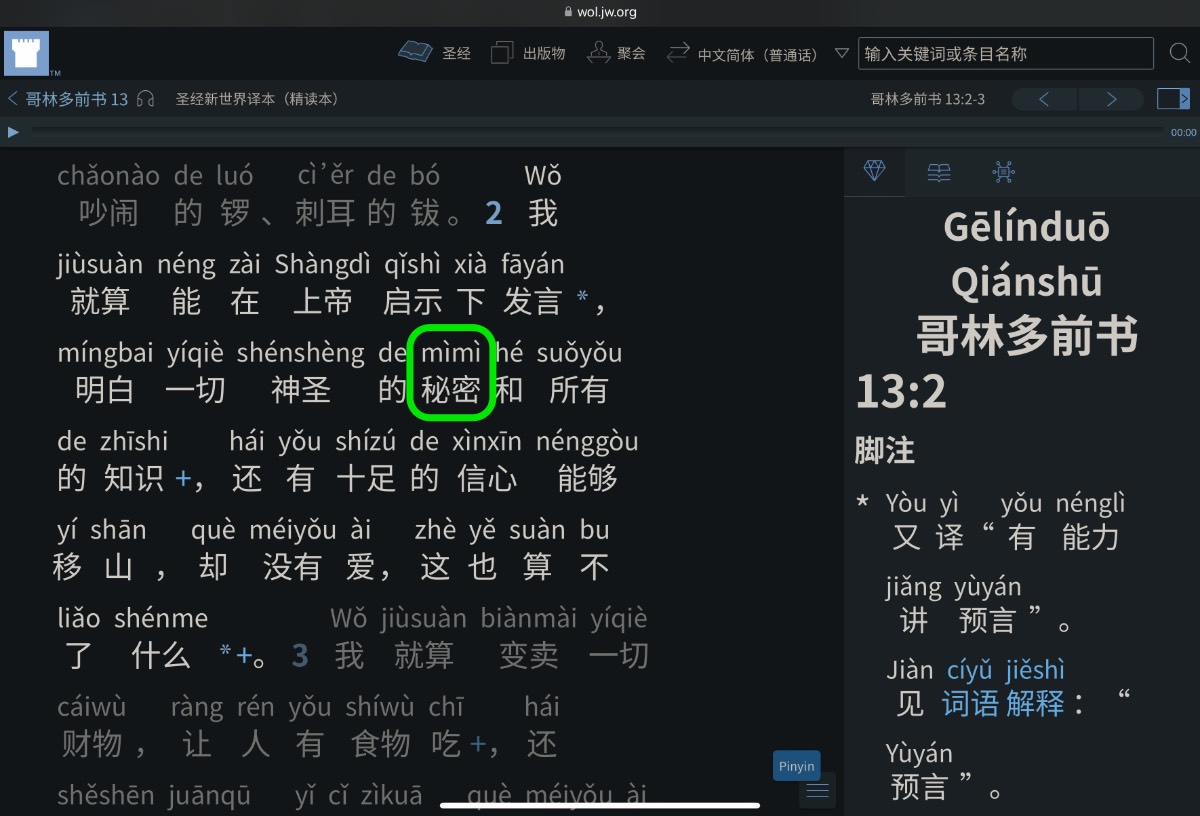
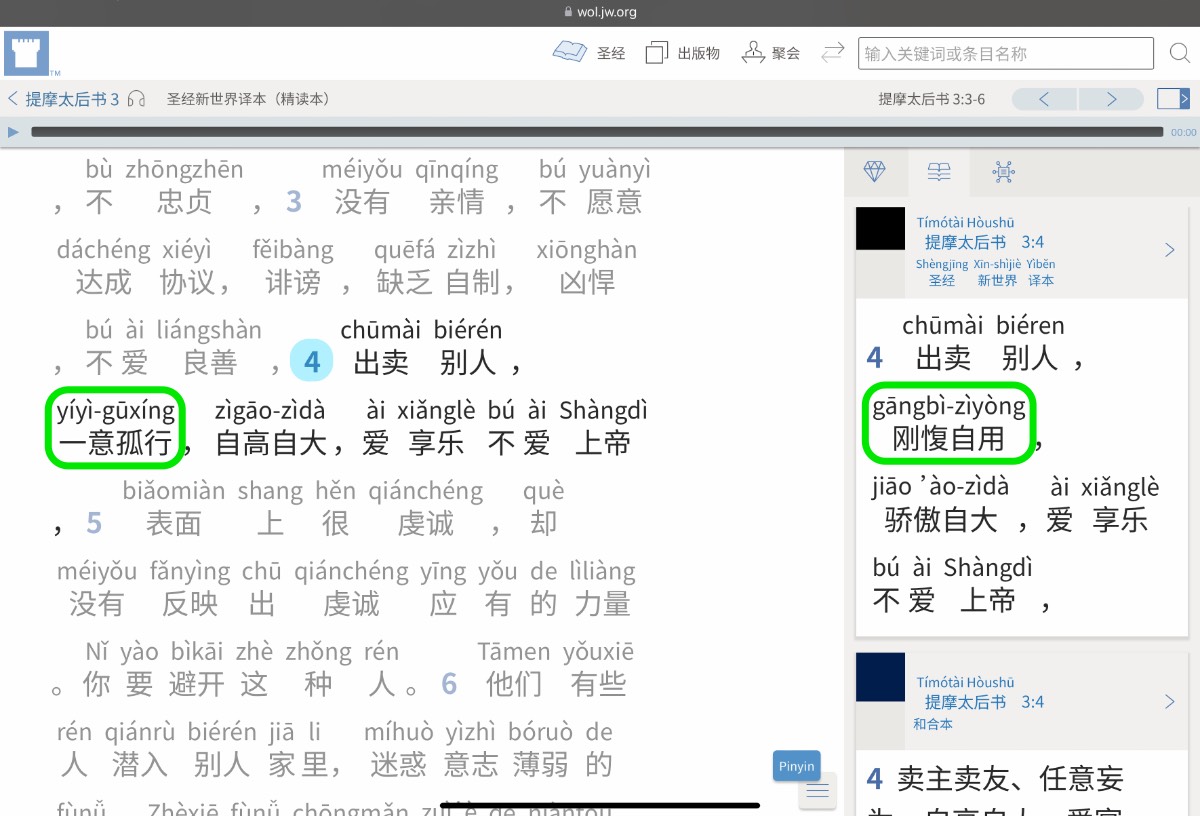
jiéle hūn+ ((jié·le {tied (a knot of)} · {to completion} 结了 結了) (hūn marrying → [marriage] 婚) → [[got] married]) ← Tap/click to show/hide the “flashcard”
[Notes: Tap/click on a Pīnyīn (Pīn·yīn {Piecing Together of} · Sounds → [Pinyin] 拼音) expression to reveal its “flashcard”; tap/click on a “flashcard” or its Pīnyīn (Pīn·yīn {Piecing Together of} · Sounds → [Pinyin] 拼音) expression to hide the “flashcard”. 📖 📄 ➕ icons mean 📖 Reveal All, 📄 Reveal Advanced, and ➕ Reveal + Symbols re all the “flashcards” in the heading, paragraph, etc. that they are placed at the beginning of.]
A few years back, I wrote up a brief web page listing reasons for producing Pīnyīn (Pīn·yīn {Piecing Together of} · Sounds → [Pinyin] 拼音), etc. material for the Imitate (ia) book. Some, especially some who grew up in the West, may have felt that this book is made up of “just stories”, and ones that they were already quite familiar with, at that. However, we must remember that Chinese Bible students may often have a different perspective regarding the Bible accounts that are made to come to life in the Imitate book. As that web page said:
- Many Chinese people in the world have not been exposed to Bible accounts the way many Westerners have.
- Also, I have heard that some, perhaps many, Chinese Bible students tend to approach their Bible studies like intellectual exercises for accumulating chōuxiàng (abstract) head knowledge as if for a school exam, rather than as training for their hearts for their own real lives.
Later, the web page touches on how some of the real-world benefits of good storytelling like that found in the Imitate book involve empathy:
- …
- The actress Natalie Portman once said, “I love acting. I think it’s the most amazing thing to be able to do. Your job is practicing empathy. You walk down the street imagining every person’s life.”
- The Imitate book helps build Bible students’ empathy towards Bible characters, which in turn helps Bible students realize that others would feel empathy towards them as well if they imitated these Bible characters—not everyone will just think they’re crazy, like many worldly friends or family members might think.
While even fictional stories can have the benefits described in the links and the quote above, true stories from the Bible can have even greater benefits, including spiritual ones.
Besides the Imitate book, another book from Jehovah’s organization that relates Bible accounts is the Learn From the Bible (lfb) book. The letter from the Governing Body in this book says that, similarly to the Imitate book, the Learn From the Bible book also “brings the Bible accounts to life and captures the feelings of those depicted”, while, unlike the Imitate book, it “tells the story of the human family from creation onward”. While the Learn From the Bible book is especially suitable for children, the letter from the Governing Body in this book says that “it can also be used to help adults who desire to learn more about the Bible”. So, it would be good to consider on this blog some of the expressions used in the Mandarin Learn From the Bible book.
Moses Tied the Knot
This week’s MEotW, “jiéle hūn ((jié·le {tied (a knot of)} · {to completion} 结了 結了) (hūn marrying → [marriage] 婚) → [[got] married])”, appears at the beginning of Lesson 18 of the Mandarin Learn From the Bible book, which is entitled “Ránshāo (Rán·shāo Ignited · {to Be Burning} 燃烧 燃燒) de (’s 的) Jīngjí‐Cóng+ ((Jīng·jí Brambles · Thorns 荆棘 荊棘)‐(Cóng Clump 丛 叢) → [Bush])” (“The Burning Bush”):
English:
Moses lived in Midian for 40 years. He got married and had children.
Mandarin:
📖 📄 ➕ Móxī+ (Moses 摩西) zài (in 在) Mǐdiàn+ (Midian 米甸) shēnghuóle (shēnghuó·le lived · {to completion} 生活了) 40 nián (years 年 年/秊), tā (he 他) jiéle hūn+ ((jié·le {tied (a knot of)} · {to completion} 结了 結了) (hūn marrying → [marriage] 婚) → [got married]), yě (also 也) yǒule (yǒu·le had · {to completion} 有了) háizi (hái·zi children · [suf for nouns] 孩子).
The Mandarin Learn From the Bible book here uses “jiéle hūn ((jié·le {tied (a knot of)} · {to completion} 结了 結了) (hūn marrying → [marriage] 婚) → [[got] married])” to correspond with the English expression “got married”. “Jiéle hūn ((Jié·le {tied (a knot of)} · {to completion} 结了 結了) (hūn marrying → [marriage] 婚) → [[got] married])” is the past participle of “jiéhūn (jié·hūn {tie (a knot of)} · {marrying → [marriage]} → [marry; get married] 结婚 結婚)”, which corresponds to “get married” in English. Interestingly, while in English “tie the knot” can mean “get married”, “jiéhūn (jié·hūn {tie (a knot of)} · {marrying → [marriage]} → [marry; get married] 结婚 結婚)” literally means “tie (a/the) knot of marrying”.
Morphemic Breakdown
The “jié+ ({tie [(a knot of)]}; knit; weave; [→ [congeal; form; forge; cement | join together; bind; connect; unite | settle; conclude]] | {tying (of a knot)} → [knot | (electrical) junction | node | written guarantee; affidavit; bond] 结 結)” in “jiéle hūn ((jié·le {tied (a knot of)} · {to completion} 结了 結了) (hūn marrying → [marriage] 婚) → [[got] married])” basically means “to tie”, and based on that, it can have a variety of effective meanings in different contexts. For example, a common expression in which it appears is “jiéguǒ (jié·guǒ {tied (into a knot) → [formed]} · fruit → [result | as a result] 结果 結果)”, which literally means “tied (into a knot) (i.e., formed) fruit”, and which effectively means “result”, or “as a result”.
As for the “hūn (wedding; marrying; {getting married} [→ [marriage; wedding]] 婚)” in “jiéle hūn ((jié·le {tied (a knot of)} · {to completion} 结了 結了) (hūn marrying → [marriage] 婚) → [[got] married])”, it’s basically a verb that means “to wed” or “to marry”. It’s often used as a verbal noun, or gerundial noun, as it is in “hūnyīn+ (hūn·yīn {marrying → [marriage]} · marriage → [marriage; matrimony] 婚姻)”.
What About the “Le”?
Okay, but what about the “le+ (-ed | {to completion} | [(at the end of a phrase/sentence) indicates a change] 了)” in “jiéle hūn ((jié·le {tied (a knot of)} · {to completion} 结了 結了) (hūn marrying → [marriage] 婚) → [[got] married])”? The ABC Chinese-English Dictionary, edited by John DeFrancis and Victor H. Mair, among others, says that when “le (-ed | {to completion} | [(at the end of a phrase/sentence) indicates a change] 了)” is used this way, it’s an aspect marker. What’s that? The ABC Chinese-English Dictionary explains it like this:
A.M. (Aspect Marker, Tǐbiāojì 体标记).
Aspect means the stage of completion of an action. Chinese usually uses verbal suffixes as a means of indicating this information. Examples of Chinese aspect include the:
(i) durative (action in progress, much like ‘-ing’ in English), e.g., zhe in kànzhe ‘is watching’;
(ii) perfective (completed action), e.g., le in ànle wǔ ge diànyǐng, ‘saw five movies’; and
(iii) experiential (much like the ‘ever’ in the question ‘Have you ever . . . ?’), e.g., guo in jiànguo tā ‘have met him before’.
Note that aspect is not the same thing as tense. Tense refers to when the action takes place relative to when the utterance is actually spoken, and so at most any language can have only three tenses: past, present and future. Aspect, on the other hand, can occur in any tense, so that even completed action can be spoken of in the
(a) past, e.g., Tā zuótiān dàole Běijn̄g ‘He arrived in Beijing yesterday’;
(b) present, e.g., Tā xiànzài dàole Běijīng ‘He has now arrived in Beijing’; or
(c) future, e.g., Tā míngtiān zhèige shíhou yǐjing dàole Běijīng ‘He will already have arrived in Beijing by this time tomorrow’.
(See also M.P. for usage of le as a sentence-final particle.)
(“M.P.” is this dictionary’s abbreviation for “modal particle”, which is what “le (-ed | {to completion} | [(at the end of a phrase/sentence) indicates a change] 了)” is when it’s at the end of a phrase or sentence (and thus followed immediately by a punctuation mark). More information on modal particles can be found on this list that’s in alphabetical order.)
When Should There Be a Space Before “Le”?
Different publications follow different rules about when to put a space before “le (-ed | {to completion} | [(at the end of a phrase/sentence) indicates a change] 了)” when it appears in Pīnyīn (Pīn·yīn {Piecing Together of} · Sounds → [Pinyin] 拼音) text. Even the PRC government’s official national standard (actually, it’s a set of recommendations) for Pīnyīn (Pīn·yīn {Piecing Together of} · Sounds → [Pinyin] 拼音) orthography, GB/T 16159-2012, is not as clear, precise, and thorough as one might wish in this regard. (GB/T 16159-2012 is discussed in more detail in the MEotW post on “diǎnliàng (diǎn·liàng {dot → [light (v); ignite]} · {to be bright} [→ [illuminate; shine light on]] 点亮 點亮)”.)
When it comes to when to put a space before “le (-ed | {to completion} | [(at the end of a phrase/sentence) indicates a change] 了)” in Pīnyīn (Pīn·yīn {Piecing Together of} · Sounds → [Pinyin] 拼音) text, Pīnyīn (Pīn·yīn {Piecing Together of} · Sounds → [Pinyin] 拼音) Plus material follows the guidelines put forth in this excerpt (available from this page on pinyin.info) from the book Chinese Romanization: Pronunciation and Orthography, by Yin Binyong and Mary Felley:

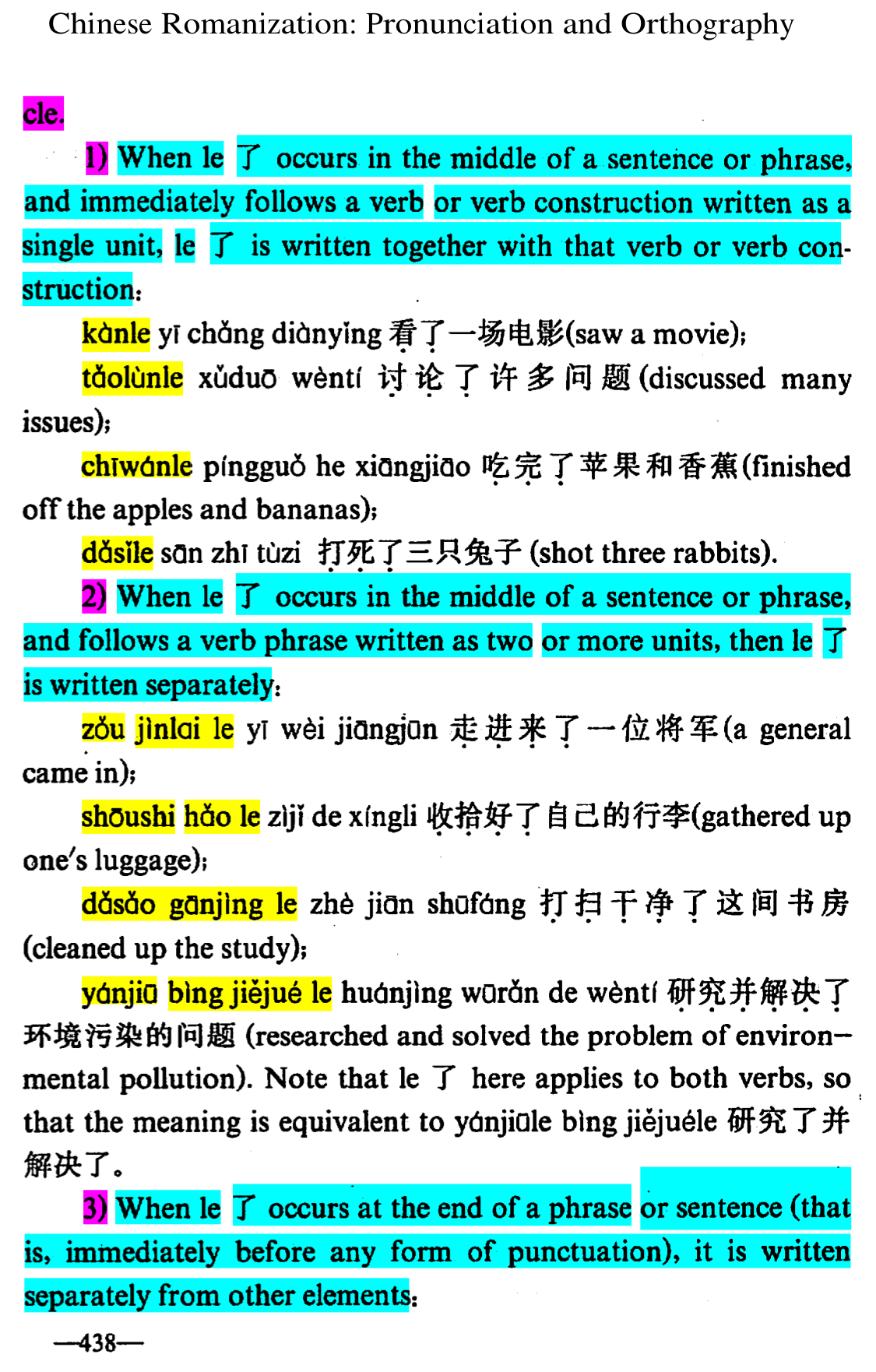
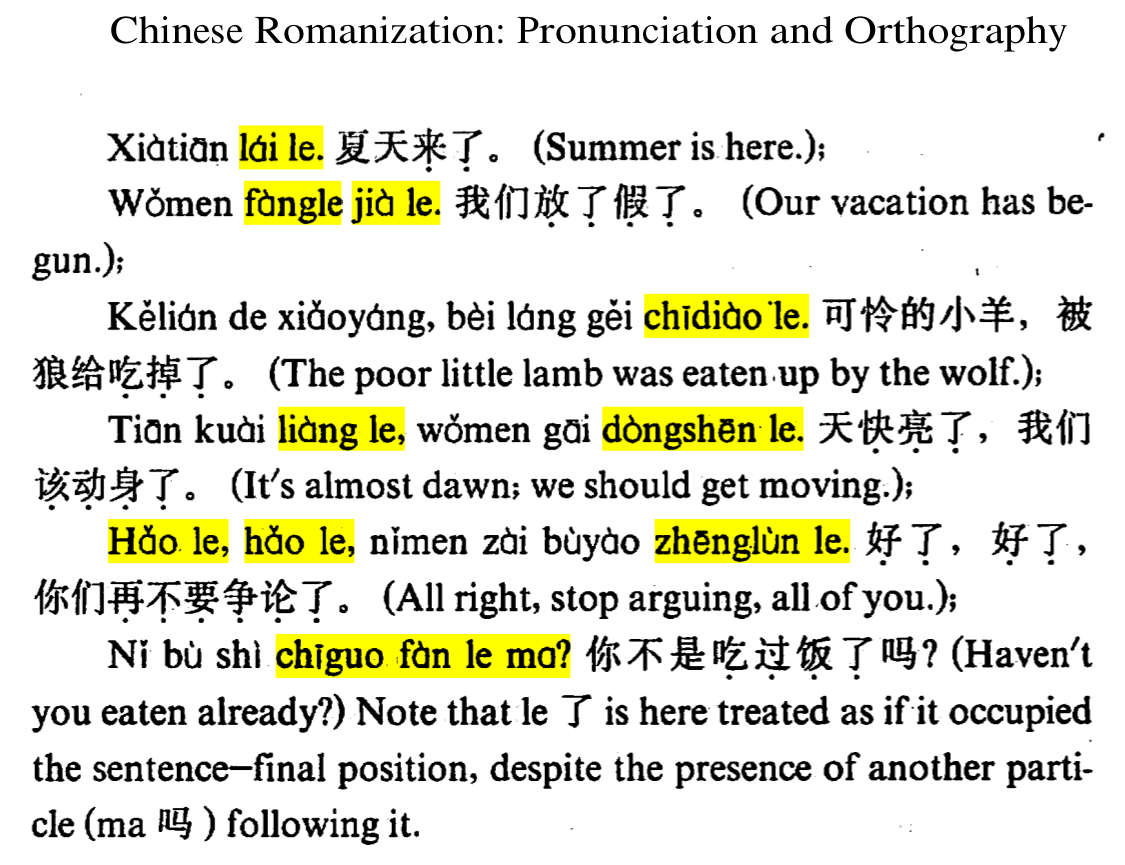
(The highlights were added by me. Note that this book calls “le (-ed | {to completion} | [(at the end of a phrase/sentence) indicates a change] 了)”, as used in “jiéle hūn ((jié·le {tied (a knot of)} · {to completion} 结了 結了) (hūn marrying → [marriage] 婚) → [[got] married])”, a “tense particle”, or a “tense-marking particle”. Also, its term for “modal particle” is “mood particle”.)
For convenience:
The direct link for the Pīnyīn (Pīn·yīn {Piecing Together of} · Sounds → [Pinyin] 拼音) Plus resource for the Learn From the Bible book is:
The short link for Chinese field language-learning links for the Learn From the Bible book is:
More Pīnyīn (Pīn·yīn {Piecing Together of} · Sounds → [Pinyin] 拼音) and Pīnyīn (Pīn·yīn {Piecing Together of} · Sounds → [Pinyin] 拼音) Plus web material based on the Mandarin Learn From the Bible book will be made available in the Pīnyīn (Pīn·yīn {Piecing Together of} · Sounds → [Pinyin] 拼音) Plus web resource as time allows.