Categories
Culture Experiences History Language Learning Names Science Theocratic

Lǎhé

Lǎhé (Raʹhab 喇合) 👈🏼 Tap/click to show/hide the “flashcard”

[Notes: Tap/click on a Pīnyīn (Pīn·yīn {Piecing Together of} · Sounds → [Pinyin] 拼音) expression to reveal its “flashcard”; tap/click on a “flashcard” or its Pīnyīn (Pīn·yīn {Piecing Together of} · Sounds → [Pinyin] 拼音) expression to hide the “flashcard”. 📖 📄 📘 icons mean 📖 Reveal All, 📄 Reveal Advanced, and 📘 Reveal None re all the “flashcards” in the heading, paragraph, etc. that they are placed at the beginning of.]

A few years back, I wrote up a brief web page listing reasons for producing Pīnyīn (Pīn·yīn {Piecing Together of} · Sounds → [Pinyin] 拼音), etc. material for the Imitate (ia) book. Some, especially some who grew up in the West, may have felt that this book is made up of “just stories”, and ones that they were already quite familiar with, at that. However, we must remember that Chinese Bible students may often have a different perspective regarding the Bible accounts that are made to come to life in the Imitate book. As that web page said:

  • Many Chinese people in the world have not been exposed to Bible accounts the way many Westerners have.
  • Also, I have heard that some, perhaps many, Chinese Bible students tend to approach their Bible studies like intellectual exercises for accumulating chōuxiàng (abstract) head knowledge as if for a school exam, rather than as training for their hearts for their own real lives.

Later, the web page touches on how some of the real-world benefits of good storytelling like that found in the Imitate book involve empathy:

    • The actress Natalie Portman once said, “I love acting. I think it’s the most amazing thing to be able to do. Your job is practicing empathy. You walk down the street imagining every person’s life.”
  • The Imitate book helps build Bible students’ empathy towards Bible characters, which in turn helps Bible students realize that others would feel empathy towards them as well if they imitated these Bible characters—not everyone will just think they’re crazy, like many worldly friends or family members might think.

While even fictional stories can have the benefits described in the links and the quote above, true stories from the Bible can have even greater benefits, including spiritual ones.

Besides the Imitate book, another book from Jehovah’s organization that relates Bible accounts is the Learn From the Bible (lfb) book. The letter from the Governing Body in this book says that, similarly to the Imitate book, the Learn From the Bible book also “brings the Bible accounts to life and captures the feelings of those depicted”, while, unlike the Imitate book, it “tells the story of the human family from creation onward”. While the Learn From the Bible book is especially suitable for children, the letter from the Governing Body in this book says that “it can also be used to help adults who desire to learn more about the Bible”. So, it would be good to consider on this blog some of the expressions used in the Mandarin Learn From the Bible book.

Same Characters, Different Pronunciations

This week’s MEotW, “Lǎhé (Raʹhab 喇合)”, appears in the title of Lesson 30 of the Mandarin Learn From the Bible book:

English:

Rahab Hid the Spies

Mandarin (WOL, Pīnyīn (Pīn·yīn {Piecing Together of} · Sounds → [Pinyin] 拼音) Plus):

📖 📄 📘 Lǎhé (Raʹhab 喇合) Ràng (Made) Tànzi (Tàn·zi {(Ones) Trying to Find Sth. Out → [Spies]} · [suf for nouns] 探子) Cáng ({to Be Hidden} 藏) Qilai (Qi·lai Up · {to Come} 起来 起來)

The Mandarin Learn From the Bible book here uses “Lǎhé (Raʹhab 喇合) to correspond with “Rahab” in English. The current Mandarin version of the New World Translation Bible (Study Edition) also uses “Lǎhé (Raʹhab 喇合) this way. For example, here is how it renders Joshua 2:1, which mentions Rahab:
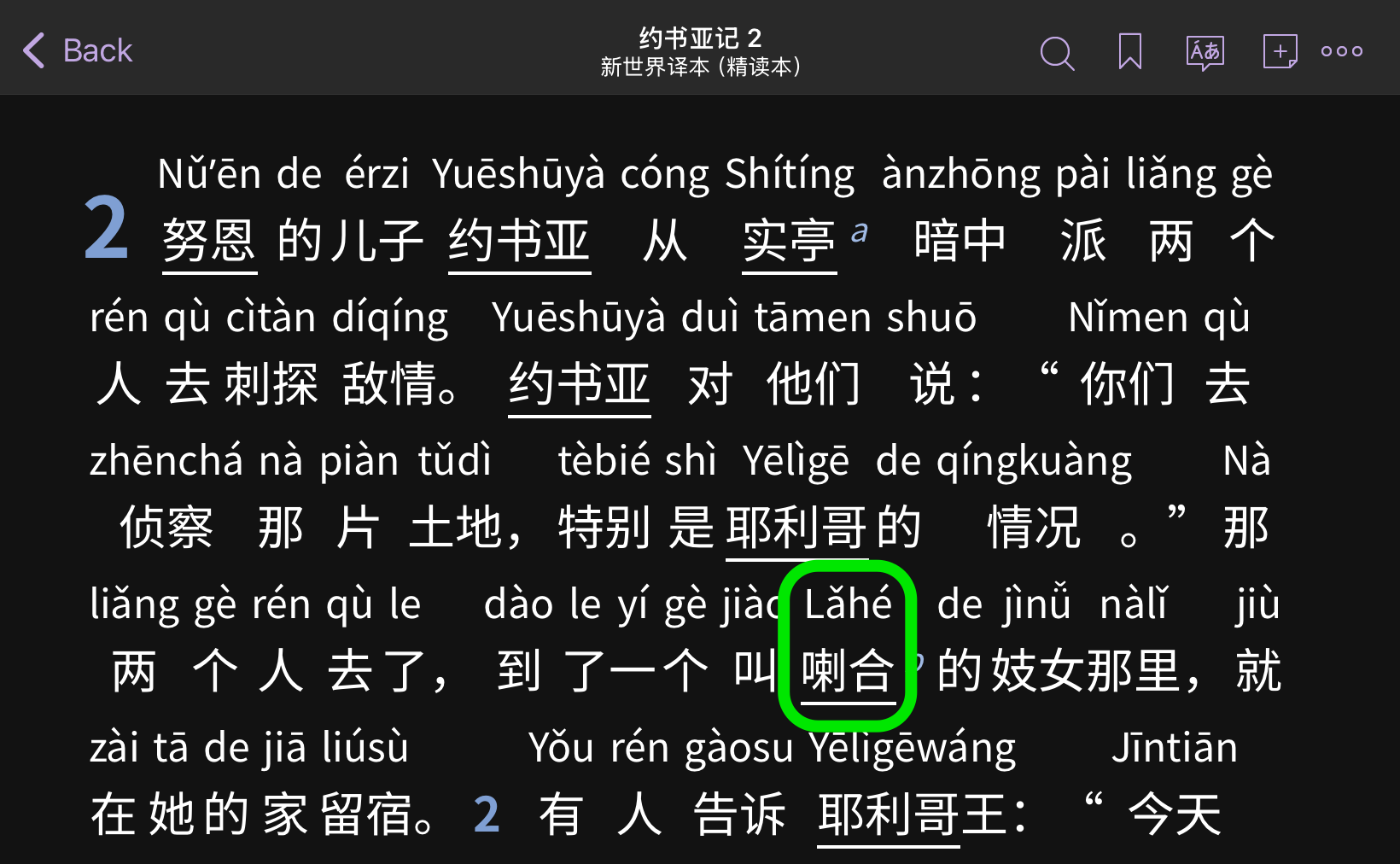
Joshua 2:1 in the Mandarin _NWT_ Study Bible, in the JW Library app

Joshua 2:1 in the Mandarin NWT Study Bible, in the JW Library app

Note, though, that the Pīnyīn (Pīn·yīn {Piecing Together of} · Sounds → [Pinyin] 拼音) for this used to be “Lāhé (Raʹhab (old pronunciation) 喇合)”, with the same characters, as can be seen in this screenshot of Joshua 2:1 in the PDF for the old printed Pīnyīn (Pīn·yīn {Piecing Together of} · Sounds → [Pinyin] 拼音) NWT Bible:
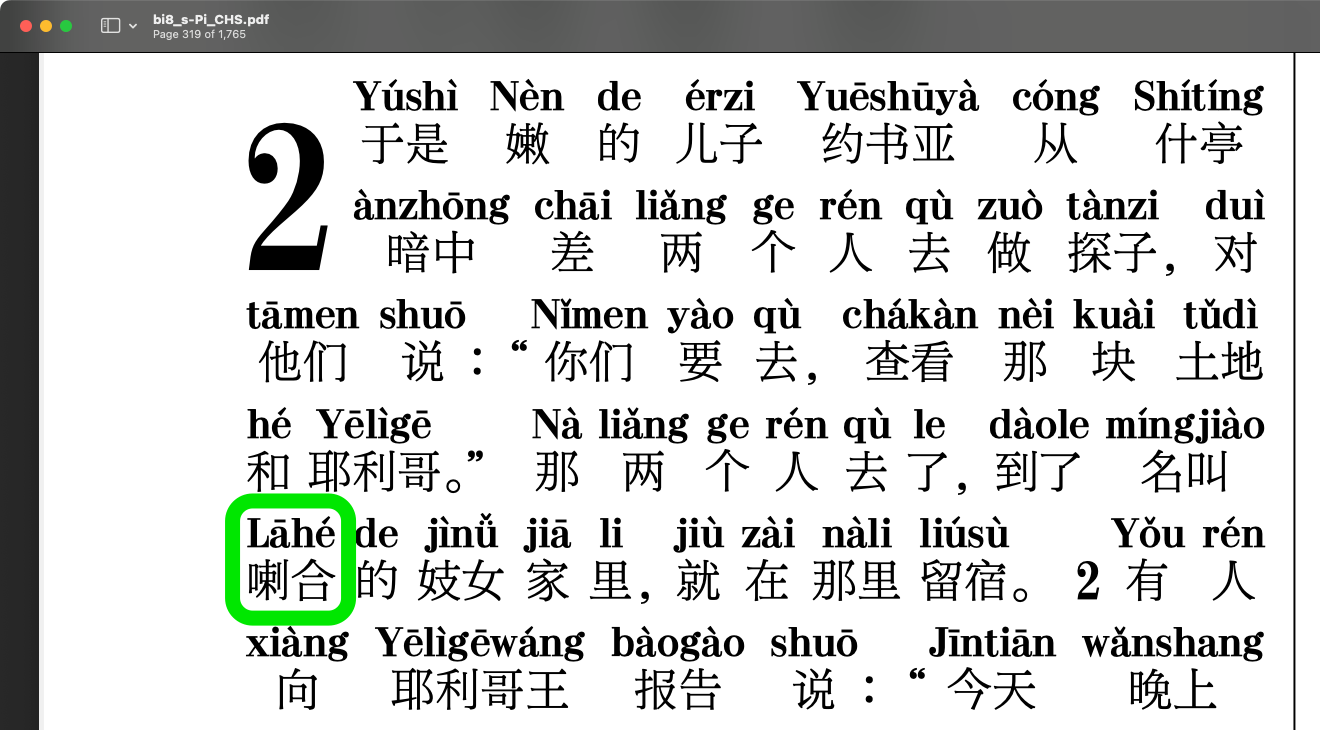
Joshua 2:1 in the PDF for the old printed _Pīnyīn_ _NWT_ Bible

Joshua 2:1 in the PDF for the old printed Pīnyīn (Pīn·yīn {Piecing Together of} · Sounds → [Pinyin] 拼音) NWT Bible

Why was this pronunciation changed, even though the same characters are used? Perhaps this was done to align with the common pronunciation of this name. For example, in CC-CEDICT, a public-domain Chinese-English dictionary, the entry for this expression says that the Pīnyīn (Pīn·yīn {Piecing Together of} · Sounds → [Pinyin] 拼音) for it is “Lǎhé (Raʹhab 喇合)”, and that the definition is “(Protestantism) Rahab, mother of Boaz”. In turn, perhaps there is some connection with the ABC Dictionary’s definition of “lǎ ({prostitute (slang)} | horn; bugle; trumpet; loudspeaker | lama 喇) as “(slang) prostitute”, which, as many know, is what Rahab worked as before she joined Jehovah’s people.

Context Is King, Not Characters

Anyway, what we have here are homographs, different expressions that are written the same way. In fact, my dictionaries say that the character “喇” that’s used in “Lǎhé (Raʹhab 喇合) can represent different expressions which can be pronounced “lā”, “lá”, “lǎ”, or “la”. If one encounters the character “喇” then, which of its multiple possible pronunciations is the right one? And, which of its multiple possible meanings is the right one? It depends on the context, which is the same as the situation with homophones written in Pīnyīn (Pīn·yīn {Piecing Together of} · Sounds → [Pinyin] 拼音). (Actually, in a way, a character like “喇” is more ambiguous than a Pīnyīn (Pīn·yīn {Piecing Together of} · Sounds → [Pinyin] 拼音) expression like “lǎ ({prostitute (slang)} | horn; bugle; trumpet; loudspeaker | lama 喇)”, because at least the Pīnyīn (Pīn·yīn {Piecing Together of} · Sounds → [Pinyin] 拼音) expression literally spells out its pronunciation, whereas with a character like “喇”, both its meaning and its pronunciation are ambiguous, even if one knows and can remember the character.)

So, while advocates of characters often make a fuss about the homophones in Mandarin that Pīnyīn (Pīn·yīn {Piecing Together of} · Sounds → [Pinyin] 拼音) would write the same way, the corresponding problem of homographs plagues the characters!


For convenience:

The direct link for the Pīnyīn (Pīn·yīn {Piecing Together of} · Sounds → [Pinyin] 拼音) Plus resource for the Learn From the Bible book is:

The short link for Chinese field language-learning links for the Learn From the Bible book is:

More Pīnyīn (Pīn·yīn {Piecing Together of} · Sounds → [Pinyin] 拼音) and Pīnyīn (Pīn·yīn {Piecing Together of} · Sounds → [Pinyin] 拼音) Plus web material based on the Mandarin Learn From the Bible book will be made available in the Pīnyīn (Pīn·yīn {Piecing Together of} · Sounds → [Pinyin] 拼音) Plus web resource as time allows.

Categories
Culture Experiences Language Learning Science Theocratic

hǎohāo[r]

hǎohāo[r] (hǎo·hāo[·r] {[is] well} · {[is] well | with care} [· {child | youth | son → [(diminutive) non-syllabic retroflex suffix; pronunciation feature in Beijing dialect]}] [→ [[is] in perfectly good condition; alright | all out; to one’s heart’s content; earnestly]] 好好[儿] 好好[兒]) ← Tap/click to show/hide the “flashcard”

[Notes: Tap/click on a Pīnyīn (Pīn·yīn {Piecing Together of} · Sounds → [Pinyin] 拼音) expression to reveal its “flashcard”; tap/click on a “flashcard” or its Pīnyīn (Pīn·yīn {Piecing Together of} · Sounds → [Pinyin] 拼音) expression to hide the “flashcard”. 📖 📄 📘 icons mean 📖 Reveal All, 📄 Reveal Advanced, and 📘 Reveal None re all the “flashcards” in the heading, paragraph, etc. that they are placed at the beginning of.]

A few years back, I wrote up a brief web page listing reasons for producing Pīnyīn (Pīn·yīn {Piecing Together of} · Sounds → [Pinyin] 拼音), etc. material for the Imitate (ia) book. Some, especially some who grew up in the West, may have felt that this book is made up of “just stories”, and ones that they were already quite familiar with, at that. However, we must remember that Chinese Bible students may often have a different perspective regarding the Bible accounts that are made to come to life in the Imitate book. As that web page said:

  • Many Chinese people in the world have not been exposed to Bible accounts the way many Westerners have.
  • Also, I have heard that some, perhaps many, Chinese Bible students tend to approach their Bible studies like intellectual exercises for accumulating chōuxiàng (abstract) head knowledge as if for a school exam, rather than as training for their hearts for their own real lives.

Later, the web page touches on how some of the real-world benefits of good storytelling like that found in the Imitate book involve empathy:

    • The actress Natalie Portman once said, “I love acting. I think it’s the most amazing thing to be able to do. Your job is practicing empathy. You walk down the street imagining every person’s life.”
  • The Imitate book helps build Bible students’ empathy towards Bible characters, which in turn helps Bible students realize that others would feel empathy towards them as well if they imitated these Bible characters—not everyone will just think they’re crazy, like many worldly friends or family members might think.

While even fictional stories can have the benefits described in the links and the quote above, true stories from the Bible can have even greater benefits, including spiritual ones.

Besides the Imitate book, another book from Jehovah’s organization that relates Bible accounts is the Learn From the Bible (lfb) book. The letter from the Governing Body in this book says that, similarly to the Imitate book, the Learn From the Bible book also “brings the Bible accounts to life and captures the feelings of those depicted”, while, unlike the Imitate book, it “tells the story of the human family from creation onward”. While the Learn From the Bible book is especially suitable for children, the letter from the Governing Body in this book says that “it can also be used to help adults who desire to learn more about the Bible”. So, it would be good to consider on this blog some of the expressions used in the Mandarin Learn From the Bible book.

Same Character, Different Morphemes/Words

This week’s MEotW, “hǎohāo[r] (hǎo·hāo[·r] {[is] well} · {[is] well | with care} [· {child | youth | son → [(diminutive) non-syllabic retroflex suffix; pronunciation feature in Beijing dialect]}] [→ [[is] in perfectly good condition; alright | all out; to one’s heart’s content; earnestly]] 好好[儿] 好好[兒])”, appears in the second paragraph of Lesson 20 of the Mandarin Learn From the Bible book, which is entitled “Jiē ({Came into Contact with} → [Took Hold of] (the Baton Next) 接) Xialai (Xia·lai Down · {to Come} 下来 下來) de (’s 的) Liù (Six 六) Chǎng ([mw for recreational, sports, or other activities]場/塲) Zāiyāng (Calamities → [Plagues] 灾殃 災殃) (“The Next Six Plagues”):

English:

The next day, the animals began to die. But the animals of the Israelites didn’t die.

Mandarin (WOL, Pīnyīn (Pīn·yīn {Piecing Together of} · Sounds → [Pinyin] 拼音) Plus):

📖 📄 📘 Dì‐èr ((Dì (on the) [pref to form ordinal numbers] 第)‐(èr two 二) [(on the) second]) tiān (sky → [day] 天), Āijí (Egypt 埃及) jiù (then 就) sǐle (sǐ·le {had die} · {to completion} 死了) hěn (very 很) duō (many 多) shēngkou (shēng·kou {domestic animal} · mouths → [domestic animals] 牲口), dànshì (dàn·shì but · {(it) was (that)} 但是) Yǐsèliè‐rén ((Yǐsèliè Israel 以色列)‐(rén people 人) [Israelites]) de ( 的) shēngkou (shēng·kou {domestic animal} · mouths → [domestic animals] 牲口) què (however) dōu (all 都) hǎohāor (hǎo·hāo·r {were well} · {were well} · {child → [(diminutive) non-syllabic retroflex suffix; pronunciation feature in Beijing dialect]} [were alright] 好好[儿] 好好[兒]) de ({’s (domestic animals)} 的).

“Hǎohāo[r] (Hǎo·hāo[·r] {[is] well} · {[is] well | with care} [· {child | youth | son → [(diminutive) non-syllabic retroflex suffix; pronunciation feature in Beijing dialect]}] [→ [[is] in perfectly good condition; alright | all out; to one’s heart’s content; earnestly]] 好好[儿] 好好[兒]) has what may seem at first like an unexpected pronunciation. Because its two morphemes are each written with the same familiar character “好”, one may at first expect that they would both have the same basic pronunciation of “hǎo ({[is] good/well} [→ [[is] very [much]]] | {[is] (more) good/well} [→ [[is] better]] | well/{to a good finish} | {(it) is good/well} → [OK; alright] 好)”, and that, in accordance with Mandarin’s tone sandhi rules, the first morpheme would be pronounced with a second tone and the second morpheme would be pronounced with a third tone.* However, actually, in “hǎohāo[r] (hǎo·hāo[·r] {[is] well} · {[is] well | with care} [· {child | youth | son → [(diminutive) non-syllabic retroflex suffix; pronunciation feature in Beijing dialect]}] [→ [[is] in perfectly good condition; alright | all out; to one’s heart’s content; earnestly]] 好好[儿] 好好[兒]) the second “好” character represents a different morpheme compared to the one represented by the first “好” character—while the first “好” character represents the familiar morpheme that is written in Pīnyīn (Pīn·yīn {Piecing Together of} · Sounds → [Pinyin] 拼音) as “hǎo ({[is] good/well} [→ [[is] very [much]]] | {[is] (more) good/well} [→ [[is] better]] | well/{to a good finish} | {(it) is good/well} → [OK; alright] 好) and that means “well” in many contexts, the second “好” character represents a morpheme that is written in Pīnyīn (Pīn·yīn {Piecing Together of} · Sounds → [Pinyin] 拼音) as “hāo ({with care} | {[is] well} 好) and that in some contexts means “well” and in other contexts means “with care”. (E.g., “hǎohāor (hǎo·hāo·r well · with care · {child → [(diminutive) non-syllabic retroflex suffix; pronunciation feature in Beijing dialect]} 好好[儿] 好好[兒]) gōngzuò (gōng·zuò work · do → [work] 工作) means “work well, with care”.)

While some supporters of Chinese characters erroneously claim that Mandarin has too many homophones (different words that have the same pronunciation) for Pīnyīn (Pīn·yīn {Piecing Together of} · Sounds → [Pinyin] 拼音) to be a practical writing system for it, their beloved characters suffer from homographs, different morphemes/words that are written the same way, with the same character. (“Hǎo ({[is] good/well} [→ [[is] very [much]]] | {[is] (more) good/well} [→ [[is] better]] | well/{to a good finish} | {(it) is good/well} → [OK; alright] 好)”, “hāo ({with care} | {[is] well} 好)”, and also “hào (like; {be fond of} [→ [have a tendency to; be likely to]] 好) make up just one set of examples—there are many more.) And, just as characters are one way to help one distinguish homophones from one another (context is a better way), pronunciation, as represented by Pīnyīn (Pīn·yīn {Piecing Together of} · Sounds → [Pinyin] 拼音), can often help one distinguish homographs from one another, as we can see from the examples of “hǎo ({[is] good/well} [→ [[is] very [much]]] | {[is] (more) good/well} [→ [[is] better]] | well/{to a good finish} | {(it) is good/well} → [OK; alright] 好)”, “hāo ({with care} | {[is] well} 好)”, and “hào (like; {be fond of} [→ [have a tendency to; be likely to]] 好)”.

Children of Beijing

Also notable about the pronunciation of hǎohāo[r] (hǎo·hāo[·r] {[is] well} · {[is] well | with care} [· {child | youth | son → [(diminutive) non-syllabic retroflex suffix; pronunciation feature in Beijing dialect]}] [→ [[is] in perfectly good condition; alright | all out; to one’s heart’s content; earnestly]] 好好[儿] 好好[兒]) is that it may be pronounced with “r ({child | youth | son} → [(diminutive) non-syllabic retroflex suffix; pronunciation feature in Beijing dialect]) at the end. While this “r ({child | youth | son} → [(diminutive) non-syllabic retroflex suffix; pronunciation feature in Beijing dialect]) has a literal meaning of “child” or “son”, the well-regarded ABC Chinese-English Dictionary provides this definition for this “r ({child | youth | son} → [(diminutive) non-syllabic retroflex suffix; pronunciation feature in Beijing dialect])”:

((diminutive) non-syllabic retroflex suffix; pronunciation feature in Beijing dialect)

Something that deserves special attention about this “r ({child | youth | son} → [(diminutive) non-syllabic retroflex suffix; pronunciation feature in Beijing dialect]) suffix is that its pronunciation involves one of the sounds of Mandarin that is not exactly like any of the sounds of English. The relatively well-known Sinosplice website has a couple of related pages with good information about this Mandarin sound, including directions on how to use one’s tongue, etc. to properly pronounce it:


For convenience:

The direct link for the Pīnyīn (Pīn·yīn {Piecing Together of} · Sounds → [Pinyin] 拼音) Plus resource for the Learn From the Bible book is:

The short link for Chinese field language-learning links for the Learn From the Bible book is:

More Pīnyīn (Pīn·yīn {Piecing Together of} · Sounds → [Pinyin] 拼音) and Pīnyīn (Pīn·yīn {Piecing Together of} · Sounds → [Pinyin] 拼音) Plus web material based on the Mandarin Learn From the Bible book will be made available in the Pīnyīn (Pīn·yīn {Piecing Together of} · Sounds → [Pinyin] 拼音) Plus web resource as time allows.


* One expression in which this is the case is “hǎohǎo xiānsheng ((hǎo·hǎo {(it) is good/well → [OK; alright]} · {(it) is good/well → [OK; alright]} 好好) (xiān·sheng earlier · born (one) → [mister; Mr.] 先生) [sb. who tries to please everybody/not offend anybody; Mr. Agreeable; yes-man])”. ^

Categories
Experiences Technology Theocratic

chǎojià

chǎojià (chǎo·jià {make noise (of) → [quarrel; squabble]} · {frame → [fight; quarrel]} → [quarrel; have a row/spat] 吵架) ← Tap/click to show/hide the “flashcard”

[Notes: Tap/click on a Pīnyīn (Pīn·yīn {Piecing Together of} · Sounds → [Pinyin] 拼音) expression to reveal its “flashcard”; tap/click on a “flashcard” or its Pīnyīn (Pīn·yīn {Piecing Together of} · Sounds → [Pinyin] 拼音) expression to hide the “flashcard”. 📖 📄 📘 icons mean 📖 Reveal All, 📄 Reveal Advanced, and 📘 Reveal None re all the “flashcards” in the heading, paragraph, etc. that they are placed at the beginning of.]

One of the publications that is now recommended to be used on Bible studies is the Yǒngyuǎn Xiǎngshòu Měihǎo de Shēngmìng—Hùdòng Shì Shèngjīng Kèchéng ((Yǒng·yuǎn Eternally · {Far (in Time)} 永远 永遠) (Xiǎng·shòu Enjoy · Receive 享受) (Měi·hǎo Beautiful · Good 美好) (de ’s 的) (Shēngmìng Life 生命)—(Hù·dòng {Each Other} · Moving → [Interactive] 互动 互動) (Shì (Type 式) (Shèng·jīng Holy · Scriptures → [Bible] 圣经 聖經) (Kè·chéng Lessons · Procedure → [Course] 课程 課程) [Enjoy Life Forever!—An Interactive Bible Course (lff)]) (Enjoy Life Forever! (lff)) book. An outstanding feature of this book is its extensive use of the post-paper technology of video, which enables information to be presented much more vividly than could be done with paper. Also, at this time, one of the unique features of Pīnyīn (Pīn·yīn {Piecing Together of} · Sounds → [Pinyin] 拼音) Plus material is Pīnyīn (Pīn·yīn {Piecing Together of} · Sounds → [Pinyin] 拼音) Plus video transcripts. These can help us Mandarin field language learners to analyze and understand the Mandarin speech used in the many videos referenced in the Mandarin Enjoy Life Forever! book. This in turn can help us make more effective use of these videos while participating in Mandarin Bible discussions using this book.

This week’s MEotW, “chǎojià (chǎo·jià {make noise (of) → [quarrel; squabble]} · {frame → [fight; quarrel]} → [quarrel; have a row/spat] 吵架)”, occurs in subtitle 5 of the transcript for the video for lesson 12, point 5 of the Mandarin Enjoy Life Forever! book:

English:

Because as far back as I remember, they have always argued with each other.

Mandarin:

5
00:00:16,996 → 00:00:20,875
📖 📄 📘 (I 我) jìde (jì·de {to remember} · get → [(get to) remember] 记得 記得) xiǎo ({(when I) was little} → [(when I) was young] 小) shíhou (shí·hou {(particular) time} · season 时候 時候), fùmǔ (fù·mǔ father · mother 父母) chángcháng (cháng·cháng constantly · constantly 常常) chǎojià (chǎo·jià {were making noise (of) → [were quarrelling]} · {frames → [quarrels]} → [were quarrelling] 吵架).

Construction

In “chǎojià (chǎo·jià {make noise (of) → [quarrel; squabble]} · {frame → [fight; quarrel]} → [quarrel; have a row/spat] 吵架)”, “chǎo ({make [a] noise} [→ [quarrel; squabble]] | {[is] noisy} 吵)”, which literally means “make [a] noise”, is used to effectively mean “quarrel” or “squabble”. Another Mandarin expression in which “chǎo ({make [a] noise} [→ [quarrel; squabble]] | {[is] noisy} 吵) is used is “chǎonào ({(disturbing by) making [a] noise} [→ [noisy; raucous | noisily disputing | harassing; disturbing | shouting; screaming | din; hubbub]] 吵闹 吵鬧)”, which means “(disturbing by) making [a] noise”.

The “jià (frame; rack; shelf; stand [→ [fight; quarrel]] | {put up}; erect | support; {prop [up]} 架) in this week’s MEotW can literally mean “frame” or “rack”, as it does in “shízì‐jià ((shí·zì ten · character → [cross-shaped] 十字)‐(jià frame 架) [cross])”. In the context of “chǎojià (chǎo·jià {make noise (of) → [quarrel; squabble]} · {frame → [fight; quarrel]} → [quarrel; have a row/spat] 吵架)”, “jià (frame; rack; shelf; stand [→ [fight; quarrel]] | {put up}; erect | support; {prop [up]} 架) effectively means “fight” or “quarrel”—when two people are squared off against each other and quarrelling, they do indeed assume a kind of framing, a kind of geometry, as shown by the English expression “squared off”.

When put together, the morphemes of “chǎojià (chǎo·jià {make noise (of) → [quarrel; squabble]} · {frame → [fight; quarrel]} → [quarrel; have a row/spat] 吵架) on a certain level of literalness mean “fight a fight” or “quarrel a quarrel”, so this expression is of verb-object construction. The ABC Chinese-English Dictionary, edited by John DeFrancis and Victor H. Mair, among others, says the following about verb-object construction in Mandarin:

V.O. (Verb-Object Construction, Dòng-Bīn Jiégòu 动宾结构).

Many English verbs get translated into natural Chinese as a verb plus an object noun, e.g. chīfàn for ‘eat’, shuōhuà for ‘speak’, etc. It is important for two reasons to know what is merely a verb in Chinese and what is actually a verb-object construction.

First, verb-object constructions can never take a second object, i.e. chīfàn can never be followed directly by something else to be eaten.

Second, a verb and its object can be separated from one another, thus allowing

(i) aspect particles to be placed directly after the verb, e.g. chīle fàn ‘after finishing eating’;
(ii) modification of the object, e.g. chī Zhōngguófàn ‘eat Chinese food’; and
(iii) quantification of the noun, e.g. chīle sān wǎn fàn ‘ate three bowls of rice’. See also Stative Verb (S.V.).

Arguing vs. Bearing Witness

Jesus is “the Prince of Peace”, but on occasion he “squared off” against opposers like the tradition-loving, self-centred Pharisees. (Isaiah 9:6) Note, though, that while “chǎojià (chǎo·jià {make noise (of) → [quarrel; squabble]} · {frame → [fight; quarrel]} → [quarrel; have a row/spat] 吵架) is used in the Enjoy Life Forever! book in relation to parents arguing, it seems that it would not really be appropriate to use “chǎojià (chǎo·jià {make noise (of) → [quarrel; squabble]} · {frame → [fight; quarrel]} → [quarrel; have a row/spat] 吵架) to describe the times when Jesus and the Pharisees, etc. exchanged words. Typically, the English New World Translation Bible just says matter-of-factly that they “said” things to each other, with “said” being translated in the Mandarin version as good old “shuō (say; said; speak; {speak of}; talk | scold說/説)”.—Matthew 15:1–3 (English, Mandarin); Luke 6:9 (English, Mandarin).

Was Jesus wrong to speak up when confronted with such ones? No—Jesus was obligated to “bear witness to the truth”, because ultimately, there is no real peace without the truth. (John 18:37; Ezekiel 13:10) Even if most of the Pharisees and ones like them would not listen to and benefit from what Jesus said, “everyone who is on the side of the truth listens” to voices speaking the truth, including any others present to hear words of truth being spoken or later able to read words of truth recorded in writing. So, sometimes we also may need to speak up or write things down to defend the truth against the attacks and distortions of those who put traditions or their own personal preferences ahead of the truth, although of course, as followers of Christ, we should do so with Christian kindness and tact.—Colossians 4:6.


For convenience:

The direct link for the Pīnyīn (Pīn·yīn {Piecing Together of} · Sounds → [Pinyin] 拼音) Plus resource for the Enjoy Life Forever! book is:

The short link for Chinese field language-learning links for the Enjoy Life Forever! book is:

More Pīnyīn (Pīn·yīn {Piecing Together of} · Sounds → [Pinyin] 拼音) and Pīnyīn (Pīn·yīn {Piecing Together of} · Sounds → [Pinyin] 拼音) Plus web material based on the Mandarin Enjoy Life Forever! book will be made available in the Pīnyīn (Pīn·yīn {Piecing Together of} · Sounds → [Pinyin] 拼音) Plus web resource as time allows.