Categories
Culture Experiences History Language Learning Technology Theocratic

jiāng‐xīn‐bǐ‐xīn

jiāng‐xīn‐bǐ‐xīn ((jiāng take)‐(xīn heart 心)‐(bǐ {to compare} 比)‐(xīn heart[s] 心) [be empathetic; put oneself in sb. else’s shoes; feel for another/others]) 👈🏼 Tap/click to show/hide the “flashcard”

[Notes: Tap/click on a Pīnyīn (Pīn·yīn {Piecing Together of} · Sounds → [Pinyin] 拼音) expression to reveal its “flashcard”; tap/click on a “flashcard” or its Pīnyīn (Pīn·yīn {Piecing Together of} · Sounds → [Pinyin] 拼音) expression to hide the “flashcard”. 📖 📄 📘 icons mean 📖 Reveal All, 📄 Reveal Advanced, and 📘 Reveal None re all the “flashcards” in the heading, paragraph, etc. that they are placed at the beginning of.]

Rather than dismissively thinking to ourselves that the songs produced by the organization are “just songs”, we should remember that the slave class takes seriously its responsibility to provide spiritual food to God’s people, and so it is going to make sure that the lyrics in its songs are spiritually correct, while also being emotionally moving.—Ezekiel 33:32; Matthew 24:45.

Comparing Hearts

“jiāng‐xīn‐bǐ‐xǐn” _Pīnyīn_ Plus info, Song 163 (music+_Pīnyīn_), on iPhone 13 mini (landscape orientation)

This week’s MEotW in the unofficial Pīnyīn (Pīn·yīn {Piecing Together of} · Sounds → [Pinyin] 拼音) Plus resource “Sing Out Joyfully” Bk. (Pīnyīn+Music, Pīnyīn Plus, Web)

This week’s MEotW, “jiāng‐xīn‐bǐ‐xīn ((jiāng take)‐(xīn heart 心)‐(bǐ {to compare} 比)‐(xīn heart[s] 心) [be empathetic; put oneself in sb. else’s shoes; feel for another/others])”, comes from the first verse of song 163, this year’s convention song, which is entitled “Happy Are These Eyes” in English and “Wǒ de ((Wǒ Me 我) (de ’s 的) [My]) Yǎnjing (Yǎn·jing Eyes’ · Eyeballs → [Eyes] 眼睛) Duōme (Duō·me {(How) Much} · [suf] [How] 多么 多麼) Yǒufú (Yǒu·fú Have · Blessings → [Are Happy] 有福) in Mandarin:

English:

With a humble heart, he would pray.
He was kind to all and ready to forgive.

Mandarin (WOL, Pīnyīn (Pīn·yīn {Piecing Together of} · Sounds → [Pinyin] 拼音) Plus):

📖 📄 📘 Dǎogào (Dǎo·gào (when) praying · {requesting | telling} → [(when) praying] 祷告 禱告) yào ((we) must 要) qiānbēi (qiān·bēi {be modest} · {be low} → [be humble] 谦卑 謙卑) yào ((we) must 要) zhēnxīn (zhēn·xīn {be (of) true} · hearts → [be sincere] 真心);
Lèyì (Lè·yì {be (of) happy} · {meaning → [intention]} → [be willing] 乐意 樂意) yuánliàng (yuán·liàng {to pardon} · {to forgive} 原谅 原諒) rén (people 人), nǔlì (nǔ·lì exert · strength 努力) jiāng‐xīn‐bǐ‐xīn ((jiāng {to take})‐(xīn heart 心)‐(bǐ {to compare} 比)‐(xīn hearts 心) [to be empathetic]).

While not being a direct translation, “jiāng‐xīn‐bǐ‐xīn ((jiāng {to take})‐(xīn heart 心)‐(bǐ {to compare} 比)‐(xīn hearts 心) [to be empathetic]) seems to correspond with “was kind to all” in the above example. A more literal translation of “jiāng‐xīn‐bǐ‐xīn ((jiāng {to take})‐(xīn heart 心)‐(bǐ {to compare} 比)‐(xīn hearts 心) [to be empathetic]) as used above would be “to take heart to compare hearts”. Effectively, this is a rather poetic way to say “to be empathetic”.

Other Mandarin expressions related to empathy include:

  • tǐxù (tǐ·xù {bodily → [personally]} · pity; {sympathize [with]} [→ [empathize with]] 体恤 體恤)
  • tǐxù zhī xīn ((tǐ·xù {bodily → [personally]} · pitying; sympathizing [→ [empathizing]] 体恤 體恤) (zhī ’s 之) (xīn heart 心) [empathy])
  • tóngqíng (tóng·qíng {(have the) same} · feeling (as) → [sympathize with; show/have sympathy/empathy for] 同情)
  • tóngqíng‐xīn ((tóng·qíng {(having the) same} · feeling 同情)‐(xīn heart 心) [sympathy; fellow feeling; compassion; empathy])
  • liánxù (lián·xù sympathizing · pitying [→ [[having] compassion]] 怜恤 憐恤)

Empathy and Mandarin Field Language Learning

The importance of empathy with regard to Mandarin field language learning is emphasized in the below excerpt from the article “Pīnyīn (Pīn·yīn {Piecing Together of} · Sounds → [Pinyin] 拼音) Was Plan A”:

Yes, Pīnyīn was Plan A, but China unfortunately let the proud, self-serving B players have their way.

Is that the way we as Jehovah’s people should be? Shouldn’t godly, self-sacrificing love move us to do what’s best for others rather than fulfilling the imperfect human instinct for being self-glorifying, self-justifying, and self-serving? Are we showing pride in the name of love?

In this, I agree with Zhōu Ēnlái (周恩来/周恩來, Zhou Enlai), the first Premier of the People’s Republic of China, who agreed with Lǐ Zhúchén (李烛尘/李燭塵, Li Zhuchen), who said,

Every time the question of the reform of Chinese characters is brought up, somebody raises an objection, or even stubbornly opposes it for this or that reason. Some say that the characters are not difficult. I will say that such a person is like one who, as soon as his wounds are healed, forgets the pain he suffered. …If he will but recall his bitter experience in learning characters, and consider the interests of the children and the illiterates by placing himself in their place, he will not dissent or object so strongly. [This was actually said regarding opposition to the simplification of the characters, but the principle applies to opposition to Pīnyīn as well.—W. W.]

More recently, one commenter pointed out:

It takes a very grown-up person to say “I did this the hard way, but child, I want you to do it the easy way, for the greater good.”

Also, during the 2014 Stanford Commencement address, Bill Gates said:

If we have optimism, but we don’t have empathy, then it doesn’t matter how much we master the secrets of science, we’re not really solving problems—we’re just working on puzzles.

Mr. Gates’ above observation applies to the subject at hand in that while many enjoy trying to solve the puzzles presented by Chinese characters, and while many also enjoy being known for being good at solving these puzzles, empathy should move us to recognize that there are much bigger issues involved than just our personal enjoyment or glorification.

Yes, when even some worldly people can recognize the above points, we Christians should recognize even more the need to show love and empathy rather than being proud, self-glorifying, self-justifying, and self-serving. Also, we should be actively and determinedly following the course of true Christian love and empathy rather than just going along with others who are proud, self-glorifying, self-justifying, and self-serving. We should especially do so when we have scriptures such as this to guide us:

Knowledge puffs up, but love builds up.—1 Corinthians 8:1.

Musical Notation 🎼 and the Mandarin Field

In this post about a Mandarin expression found in our songbook, another subject that I want to touch on is: Is musical notation 🎼 too hard to be worth the trouble of producing it and using it? Are fewer and fewer people able to read it? I was fortunate enough to have been taught how to read musical notation in school. I have never thought of musical notation as being particularly difficult to use (it’s much easier to learn than characters, which many unquestioningly try to learn), and I find that it helps me to sing Kingdom songs more correctly (according to the intended melody, message, etc.) and more confidently more of the time. However, I am aware that not everyone in the Mandarin field has the same experience with musical notation. For example, a while ago, an older brother told me that he didn’t know how to read musical notation. Also, some people in the Mandarin field may have been affected by how education systems in this old world have been facing significant challenges relating to providing music education for younger ones.

Regardless of how the world may be failing in many cases to equitably provide good music education, Jehovah’s organization has pointed out that music is important in Jehovah’s worship. For example, not long ago, a Meeting Workbook said:

Music can have a powerful influence on the mind and body. Singing is an important part of our worship of Jehovah.

In accordance with the importance of music in Jehovah’s worship, Mandarin field language learners used to have available to them official material from the organization containing musical notation with Pīnyīn (Pīn·yīn {Piecing Together of} · Sounds → [Pinyin] 拼音) in the lyrics. However, perhaps at least partially because of the technical difficulty and costliness of producing material with musical notation and both Chinese characters and Pīnyīn (Pīn·yīn {Piecing Together of} · Sounds → [Pinyin] 拼音) in the lyrics, as of this writing, there is no official material currently available from the organization that shows Pīnyīn (Pīn·yīn {Piecing Together of} · Sounds → [Pinyin] 拼音) and musical notation on the same page or screen.
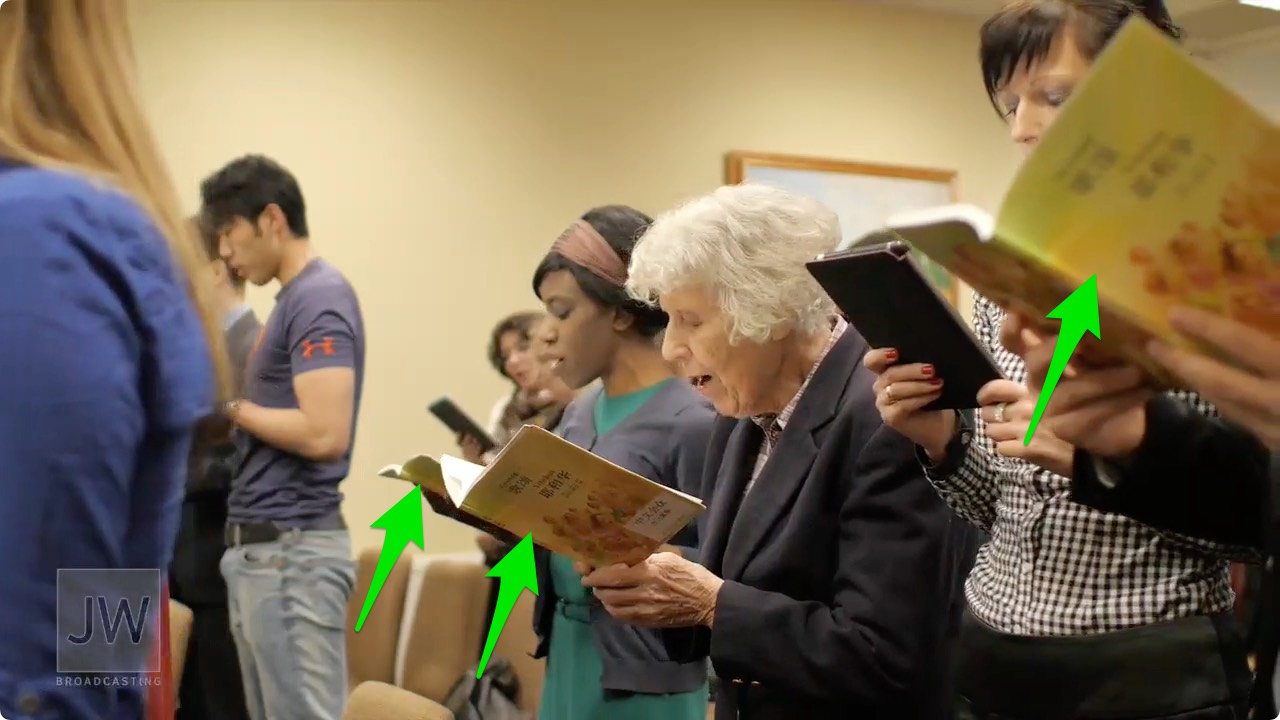
Screenshot of Sis. Margarita Königer and others using official _Pīnyīn_ _Sing to Jehovah_ songbooks with musical notation

A screenshot from an official video, of Sis. Margarita Königer and others using official Pīnyīn (Pīn·yīn {Piecing Together of} · Sounds → [Pinyin] 拼音) Sing to Jehovah songbooks with musical notation

The organization continues to publish official songbook material for different languages in general that contains musical notation, so it evidently still considers musical notation to generally be worthwhile to produce. It continues to produce official material for the current songbook that uses musical notation along with lyrics rendered only in Chinese characters, without Pīnyīn (Pīn·yīn {Piecing Together of} · Sounds → [Pinyin] 拼音), and it has even produced official material that uses jiǎnpǔ (jiǎn·pǔ simple · {register or record for reference → [musical notation]} → [numbered musical notation] 简谱 簡譜) (a kind of musical notation also known as numbered musical notation) and Chinese characters.

For Jehovah’s official organization, continuing to produce musical notation with lyrics rendered in Chinese characters but discontinuing production of musical notation that includes Pīnyīn (Pīn·yīn {Piecing Together of} · Sounds → [Pinyin] 拼音) lyrics when it becomes necessary to conserve time and effort makes sense, when we consider that the primary focus of Jehovah’s official organization is to provide spiritual instruction, not language instruction, even though language instruction can provide significant practical help to people seeking to learn or teach sprititual truths. (Another reminder of this primary focus is the recent discontinuation of the JW Language app.) The way the world is, with its deeply embedded traditions and prejudices, people whose mother tongue is Mandarin—and who thus learn spiritual truths best in Mandarin—mainly still use Chinese characters as their “mother writing system”, even as the game-changing practical benefits of Pīnyīn (Pīn·yīn {Piecing Together of} · Sounds → [Pinyin] 拼音) are obvious to unprejudiced Mandarin language learners.

And, even as the organization has continued to add Pīnyīn (Pīn·yīn {Piecing Together of} · Sounds → [Pinyin] 拼音) ruby text to much of its Mandarin material, in recognition of the value of these practical benefits—even people who have been learning characters since childhood occasionally, perhaps even regularly, suffer from character amnesia, due to the inhuman complexity and number of the characters, and also, there are actually tens of millions of Chinese people who are still illiterate regarding the characters—it seems that when faced with the prospect of producing a version of the current songbook with musical notation, characters, and Pīnyīn (Pīn·yīn {Piecing Together of} · Sounds → [Pinyin] 拼音) ruby text, those in charge, perhaps remembering how difficult and time-consuming it was to do so for the previous songbook, felt that it would just be too much this time.

For those who find it helpful in their Mandarin field activities to put musical notation together with Pīnyīn (Pīn·yīn {Piecing Together of} · Sounds → [Pinyin] 拼音), the unofficial Pīnyīn (Pīn·yīn {Piecing Together of} · Sounds → [Pinyin] 拼音) Plus resource “Sing Out Joyfully” Bk. (Pīnyīn+Music, Pīnyīn Plus, Web) exists and is continuing to be improved. As shown in the screenshot near the beginning of this post, this resource aids Mandarin field language learners by breaking with tradition and featuring lyrics in the musical notation that are only in relatively large-print Pīnyīn (Pīn·yīn {Piecing Together of} · Sounds → [Pinyin] 拼音) by default—characters are relegated to Pīnyīn (Pīn·yīn {Piecing Together of} · Sounds → [Pinyin] 拼音) Plus “flashcards” that are added as time allows.

Unlike the traditionally-used but unnecessarily extraordinarily complex characters that need to be accompanied by Pīnyīn (Pīn·yīn {Piecing Together of} · Sounds → [Pinyin] 拼音) before many are able to read them, Pīnyīn (Pīn·yīn {Piecing Together of} · Sounds → [Pinyin] 拼音) itself is a simple, elegant alphabetical full writing system for Mandarin that is easy to learn and remember. Also, it is no harder to typeset than other alphabetical writing systems with diacritics, such as the writing systems now used for French, Czech, Vietnamese, etc.*

In its Tips: section at the bottom of its home page, the “Sing Out Joyfully” Bk. (Pīnyīn+Music, Pīnyīn Plus, Web) resource contains these links that some may find helpful:


For convenience:

The direct link for the Pīnyīn (Pīn·yīn {Piecing Together of} · Sounds → [Pinyin] 拼音) Plus resource for the “Sing Out Joyfully” book is:

The short link for Chinese field language-learning links for the “Sing Out Joyfully” book is:

More Pīnyīn (Pīn·yīn {Piecing Together of} · Sounds → [Pinyin] 拼音) and Pīnyīn (Pīn·yīn {Piecing Together of} · Sounds → [Pinyin] 拼音) Plus web material based on the Mandarin “Sing Out Joyfully” book will be made available in the Pīnyīn (Pīn·yīn {Piecing Together of} · Sounds → [Pinyin] 拼音) Plus web resource as time allows.


* Thanks to ongoing advancements in personal computing hardware and software, producing material that contains things like musical notation and Pīnyīn (Pīn·yīn {Piecing Together of} · Sounds → [Pinyin] 拼音) text at reasonable cost is quicker and easier than ever. At this time, production of the musical notation in the “Sing Out Joyfully” Bk. (Pīnyīn+Music, Pīnyīn Plus, Web) resource begins in free open source software called MuseScore Studio, running on a Mac. Pīnyīn (Pīn·yīn {Piecing Together of} · Sounds → [Pinyin] 拼音) text for the lyrics in the musical notation is entered using macOS’s ABC – Extended input source (keyboard layout). (Just using Pīnyīn (Pīn·yīn {Piecing Together of} · Sounds → [Pinyin] 拼音) text only here simplifies things so much compared to having to somehow input characters with Pīnyīn (Pīn·yīn {Piecing Together of} · Sounds → [Pinyin] 拼音) ruby text!) When it’s ready, the musical notation for a song is exported from MuseScore Studio into SVG format, which is a plain text format that allows for the inclusion of links that activate Pīnyīn (Pīn·yīn {Piecing Together of} · Sounds → [Pinyin] 拼音) Plus flashcards on webpages. (These SVG links are a bit more involved to produce than “regular” web Pīnyīn (Pīn·yīn {Piecing Together of} · Sounds → [Pinyin] 拼音) Plus material, but at least the procedure for doing so is consistent and dependable, unlike Chinese characters, which have no consistent, dependable system regarding how they are designed compared to how they are pronounced.) The coding for the SVG links is currently done using the text editor BBEdit, in which editing large text files is quite performant. For Pīnyīn (Pīn·yīn {Piecing Together of} · Sounds → [Pinyin] 拼音) Plus web material production in general, my current favourite tool is Nova, but such web material can be produced in any application suitable for web development, such as Visual Studio Code, etc. ^
Categories
Culture Current Events Language Learning Science Technology Theocratic

yì‐nián‐yí‐dù

yì‐nián‐yí‐dù ((yì one 一)‐(nián year年/秊)‐(yí one 一)‐(dù {spending; passing (of time)} → [mw for occasions/times] 度) [once a year; annual | annually]) ← Tap/click to show/hide the “flashcard”

[Notes: Tap/click on a Pīnyīn (Pīn·yīn {Piecing Together of} · Sounds → [Pinyin] 拼音) expression to reveal its “flashcard”; tap/click on a “flashcard” or its Pīnyīn (Pīn·yīn {Piecing Together of} · Sounds → [Pinyin] 拼音) expression to hide the “flashcard”. 📖 📄 📘 icons mean 📖 Reveal All, 📄 Reveal Advanced, and 📘 Reveal None re all the “flashcards” in the heading, paragraph, etc. that they are placed at the beginning of.]

This week’s MEotW, “yì‐nián‐yí‐dù ((yì one 一)‐(nián year年/秊)‐(yí one 一)‐(dù {spending; passing (of time)} → [mw for occasions/times] 度) [once a year; annual | annually])”, occurs in the following sentence, which, at the time of this writing, jw.org is featuring to invite people to attend the Memorial:

English:

We invite you to attend our annual event to remember the death of Jesus Christ.

Mandarin:

📖 📄 📘 Wǒmen (Wǒ·men we · [pl] 我们 我們) yāoqǐng (invite 邀请 邀請) (you 你) cānjiā (cān·jiā {to take part in} · {to add to} → [to attend] 参加 參加) zhèige (zhèi·ge this · [mw] 这个 這個) yì‐nián‐yí‐dù ((yì one 一)‐(nián year年/秊)‐(yí one 一)‐(dù {spending (of time)} → [mw for occasions/times] 度) [annual]) de (’s 的) jìniàn (jì·niàn remembering · {thinking of} → [commemorating] 记/纪念 記/紀念) jùhuì (meeting 聚会 聚會), jìniàn (jì·niàn {to remember} · {to think of} → [to commemorate] 记/纪念 記/紀念) Yēsū (Jesus 耶稣 耶穌) Jīdū (Christ 基督) wèi (for為/爲) rénlèi (rén·lèi human·kind 人类 人類) xīshēng (xī·shēng sacrificed · {(as with a) domestic animal} → [sacrificed] 牺牲 犧牲) shēngmìng (life 生命).

“Yì‐nián‐yí‐dù ((Yì one 一)‐(nián year年/秊)‐(yí one 一)‐(dù {spending; passing (of time)} → [mw for occasions/times] 度) [once a year; annual | annually]) on one level of literalness means “one year one occasion/time”, which effectively means “annual”. Its final morpheme “dù (degree; extent; {degree of intensity} | {spending; passing (of time)} [→ [mw for occasions/times]] 度) in this expression serves as a measure word for occasions or times, which likely derives from its meaning of “spending; passing (of time)”. In other expressions, “dù (degree; extent; {degree of intensity} | {spending; passing (of time)} [→ [mw for occasions/times]] 度) can also mean “degree; extent; degree of intensity”:

  • 📖 📄 📘 dùguò (dù·guò {spend; pass (time)} · pass; cross → [spend; pass (time/etc.) | pull/get through; survive] 度过 度過)
  • 📖 📄 📘 tàidu (tài·du state · degree → [attitude; manner] 态度 態度)
  • 📖 📄 📘 wēndù (wēn·dù {(of) being warm} · {degree of intensity} → [temperature] 温度 溫度)
  • 📖 📄 📘 zhìdù (zhì·dù system · extent → [system] 制度)

Same Character, Different Tones

Note that in “yì‐nián‐yí‐dù ((yì one 一)‐(nián year年/秊)‐(yí one 一)‐(dù {spending; passing (of time)} → [mw for occasions/times] 度) [once a year; annual | annually])”, the morpheme meaning “one” is first pronounced “yì (one 一)”, with a fourth tone, and then it’s pronounced “yí (one 一)”, with a second tone. This is tone sandhi, and as the MEotW post on “diǎnliàng (diǎn·liàng {dot → [light (v); ignite]} · {to be bright} [→ [illuminate; shine light on]] 点亮 點亮) said:

On the other hand, the unofficial Pīnyīn (Pīn·yīn {Piecing Together of} · Sounds → [Pinyin] 拼音) Plus resources join the official Pīnyīn (Pīn·yīn {Piecing Together of} · Sounds → [Pinyin] 拼音) publications, old and new, in explicitly indicating tone sandhi for “bù (not 不) and “yī (one 一) (e.g., “búzài (bú·zài not · again; further; continuing; anymore 不再) instead of the standard “bùzài (bù·zài not · again; further; continuing; anymore 不再)) to make things easier for readers, even though this practice is not included in the GB/T 16159-2012 [PRC national] standard’s recommendations.

In the end, what matters most re how anything is written is not just what is officially recommended or what happens to be popular among changing, imperfect humans. Rather, what matters most is what really works best to accomplish the goal of writing: To communicate to readers. This is especially true when God-honouring and life-saving Bible truths need to be communicated. So, this blog and the other Pīnyīn (Pīn·yīn {Piecing Together of} · Sounds → [Pinyin] 拼音) Plus resources will continue to seek to render Pīnyīn (Pīn·yīn {Piecing Together of} · Sounds → [Pinyin] 拼音) in ways that maximize how clearly, easily, effectively, and appropriately it communicates with readers.

Same Characters, Different Word Boundaries

Another interesting thing to note is that the last two morphemes in “yì‐nián‐yí‐dù ((yì one 一)‐(nián year年/秊)‐(yí one 一)‐(dù {spending; passing (of time)} → [mw for occasions/times] 度) [once a year; annual | annually]) can in some contexts form the expression “yídù (yí·dù [(at)] one · {spending; passing (of time) → [mw for occasions/times]} [once; at one time; on one occasion; for a time] 一度)”, which is appropriately written in Pīnyīn (Pīn·yīn {Piecing Together of} · Sounds → [Pinyin] 拼音) without a space or other word divider between the two morphemes. Why then, does this blog post render “yì‐nián‐yí‐dù ((yì one 一)‐(nián year年/秊)‐(yí one 一)‐(dù {spending; passing (of time)} → [mw for occasions/times] 度) [once a year; annual | annually]) with a hyphen (that acts as a word divider) between its last two morphemes?

The reason for the different renderings of the same two morphemes in the two different expressions is, well, because we are indeed dealing with two different expressions. Whereas “yì‐nián‐yí‐dù ((yì one 一)‐(nián year年/秊)‐(yí one 一)‐(dù {spending; passing (of time)} → [mw for occasions/times] 度) [once a year; annual | annually]) uses its last two morphemes in a “one-[word divider]-[measure word]” pattern, as does “yí (one 一) ge ([mw]個/个)”, “yídù (yí·dù [(at)] one · {spending; passing (of time) → [mw for occasions/times]} [once; at one time; on one occasion; for a time] 一度), treated as one word without a space in it, is used to effectively mean “once; at one time; on one occasion; for a time”. The ABC Chinese-English Dictionary, edited by John DeFrancis and Victor H. Mair, among others, provides these examples of this expression in use:

📖 📄 📘 Wǒmen (Wǒ·men we · [pl] 我们 我們) yídù (yí·dù (at) one · {passing (of time) → [mw for occasions/times]} [once] 一度) shì (were 是) hǎo (good 好) péngyou (friends 朋友).
We were once good friends.

📖 📄 📘 (she 她) yídù (yí·dù (at) one · {passing (of time) → [mw for occasions/times]} [for a time] 一度) duì (towards) huìhuà (huì·huà painting · paintings 绘画 繪畫) gǎn (felt 感) xìngqù (interest 兴趣 興趣).
She was interested in painting for a time.

Context Is the Key, Not Characters

The above points about how the characters “一” and “度” can have different pronunciations or meanings in different contexts remind us that Chinese characters are NOT the ultimate clarifiers of meaning in Mandarin. This excerpt from the MEotW post on “yǔjìng (yǔ·jìng language · {(set of) boundaries → [(bounded) place; area] → [condition; situation; circumstances]} → [context] 语境 語境) explains further:

Context and Mandarin Writing Systems

Research into the importance of context turned up a couple of interesting sayings from the business world:

Content is king.
—Bill Gates

Content is king, but context is God.
—Gary Vaynerchuk

Mandarin field language-learners may hear the assertion from Chinese culture traditionalists that it is necessary to use Chinese characters to clarify the ambiguity that results from Mandarin having so many homophones, words that sound the same but that have different meanings. The insinuation, or even the outright accusation, is that the upstart Pīnyīn (Pīn·yīn {Piecing Together of} · Sounds → [Pinyin] 拼音) system is thus unusable as a writing system for Mandarin, that the Chinese characters writing system is still the rightful king. Besides, there is so much existing content written in Chinese characters, and content is king!

However, a little consideration of the yǔjìng (yǔ·jìng language · {(set of) boundaries → [(bounded) place] → [situation]} → [context] 语境 語境), the language situation or context, shows up the fallacy of this assertion. The Chinese characters writing system exists along with Mandarin speech, and if Chinese characters are truly required to clearly communicate meaning in Mandarin, then that would mean that Mandarin speech on its own, without the help of visible characters, is unusable as a means of communication. That, however, is obviously not true—people who are proficient in spoken Mandarin communicate clearly with each other all the time, undoubtedly pretty much as clearly as proficient English speakers communicate with each other.

The key reason why proficient Mandarin speakers can communicate clearly with each other despite all of the homophones in Mandarin is not that they are constantly referring to Chinese characters, although people do occasionally do that in the current characters-saturated cultural climate. No, the key reason why Mandarin-speakers routinely communicate clearly with each other is because they use sufficient context to clarify any potentially ambiguous homophones. And, since Pīnyīn (Pīn·yīn {Piecing Together of} · Sounds → [Pinyin] 拼音) is a simple and direct representation of Mandarin speech, anything that is understandable when spoken in Mandarin is understandable when written in Pīnyīn (Pīn·yīn {Piecing Together of} · Sounds → [Pinyin] 拼音)1 Corinthians 14:8–11.

So, while Chinese characters-based content may be so predominant in the Chinese world that it’s king there, context is God, relatively and metaphorically speaking, and Mandarin speech and Pīnyīn (Pīn·yīn {Piecing Together of} · Sounds → [Pinyin] 拼音) rightly rely on context, not on Chinese characters, just like we rightly rely on God, not on merely human kings.

Categories
Culture Language Learning Science Technology Theocratic

mìmì

mìmì (mì·mì {[is] secret} · {[is] dense → [[is] intimate; close] → [[is] secret; confidential]} [(thing)] → [[is] secret; confidential; clandestine | secret [(thing)]] 秘密 秘/祕密) ← Tap/click to show/hide the “flashcard”

I have long especially liked 1 Corinthians 13. It contains counsel on what really does and doesn’t matter in life, an extensive description and definition of the most important kind of love, and a sublime discussion about the need to become complete, mature, as a person. As these apply to life in general, so too do they apply to our lives as Mandarin field language learners.

As Mandarin field language learners, it can benefit us greatly to consider what we can learn from 1 Corinthians 13, and along the way, we can also consider some of the Mandarin expressions used in that chapter in the current version of the Mandarin New World Translation Bible (nwtsty).

Secrets

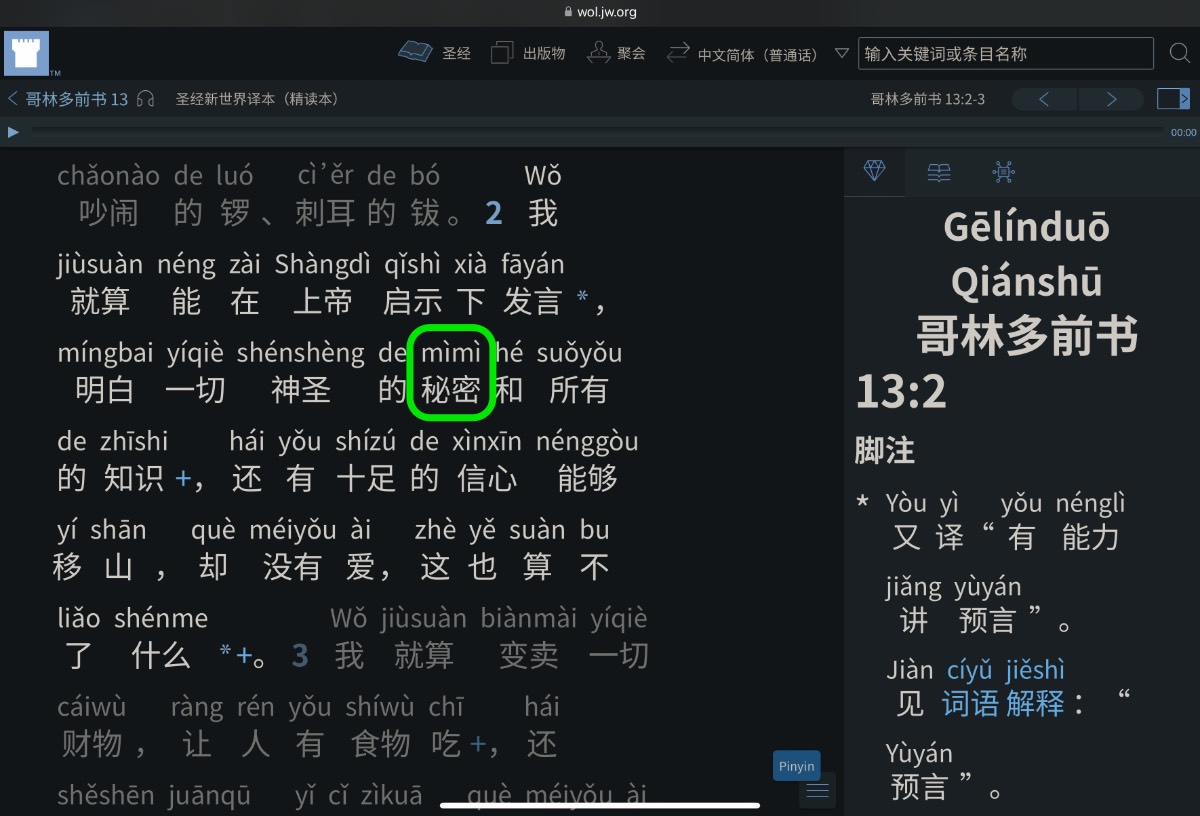
This week’s MEotW, “mìmì (mì·mì {[is] secret} · {[is] dense → [[is] intimate; close] → [[is] secret; confidential]} [(thing)] → [[is] secret; confidential; clandestine | secret [(thing)]] 秘密 秘/祕密), is used in verse 2 (WOL, Pīnyīn (Pīn·yīn {Piecing Together of} · Sounds → [Pinyin] 拼音) Plus) of 1 Corinthians 13:

Screenshot of “mìmì” in 1 Co. 13:2 (nwtsty, CHS+_Pīnyīn_ WOL)

(Dark mode for the Watchtower ONLINE LIBRARY (WOL) website, as shown in the above image, can be enabled in the Safari web browser by using the Noir Safari extension.)

While the two morphemes in “mìmì (mì·mì {[is] secret} · {[is] dense → [[is] intimate; close] → [[is] secret; confidential]} [(thing)] → [[is] secret; confidential; clandestine | secret [(thing)]] 秘密 秘/祕密) sound the same, they are different morphemes, with different meanings. The first one, “mì ({secret (n)} [→ [secretary (abbr.)]] | {[is] secret; mysterious; difficult to understand; obscure} [→ [[is] seldom seen; rare]] | {keep sth. secret; hold sth. back} [→ [block; obstruct]]秘/祕), here means “secret” (used as an adjective). Interestingly, this “mì ({secret (n)} [→ [secretary (abbr.)]] | {[is] secret; mysterious; difficult to understand; obscure} [→ [[is] seldom seen; rare]] | {keep sth. secret; hold sth. back} [→ [block; obstruct]]秘/祕) also appears in “mìshū (mì·shū secret · documents (person) → [secretary] 秘书 秘書), which means “secretary”, and it can be used as an abbreviation for “secretary”. (Yes, in both English and Mandarin, the word for “secretary” is based on the word for “secret”. So, be nice to office secretaries, congregation secretaries, etc. everywhere, since they are literally keepers of secrets!)

The second morpheme in “mìmì (mì·mì {[is] secret} · {[is] dense → [[is] intimate; close] → [[is] secret; confidential]} [(thing)] → [[is] secret; confidential; clandestine | secret [(thing)]] 秘密 秘/祕密), “mì ({[is] dense; thick} [[→ [[is] intimate; close] [→ [[is] secret; confidential]]] | [→ [[is] fine; meticulous]]] 密), literally means “dense; thick”, and can effectively mean “intimate; close”. (Compare the English expression “thick as thieves”.) That meaning, in turn, can effectively mean “secret” (used as an adjective), which is how it is used in “mìmì (mì·mì {[is] secret} · {[is] dense → [[is] intimate; close] → [[is] secret; confidential]} [(thing)] → [[is] secret; confidential; clandestine | secret [(thing)]] 秘密 秘/祕密). Another expression in which it’s used that way is “mìmǎ (mì·mǎ {dense → [intimate] → [secret]} · {sth. indicating a number} → [cipher; code | password; PIN] 密码 密碼), which can mean “code”. For example, the Mandarin Was Life Created? brochure uses “yíchuán (yí·chuán {leaving behind} · {passing on} → [genetic] 遗传 遺傳) mìmǎ (mì·mǎ {dense → [intimate] → [secret]} · {sth. indicating a number} → [code] 密码 密碼) to translate “genetic code”. (Compare: English WOL, CHS+Pīnyīn (Pīn·yīn {Piecing Together of} · Sounds → [Pinyin] 拼音) WOL, Pīnyīn (Pīn·yīn {Piecing Together of} · Sounds → [Pinyin] 拼音) Plus.)

Exotic East Syndrome

Speaking of secrets, some may be fascinated by the seemingly secret knowledge of the Chinese characters. However, 1 Corinthians 13:2 tells us that even understanding “all the sacred secrets and all knowledge” means nothing if one does not have love, and while Chinese characters may seem alluringly secret and mysterious to those looking on from outside the culture, they certainly are not sacred. Only things from God are sacred, and Chinese characters are the unnecessarily complex, haphazardly designed, highly imperfect products of mere imperfect humans.

And if I have the gift of prophecy and understand all the sacred secrets and all knowledge, and if I have all the faith so as to move mountains, but do not have love, I am nothing.
1 Corinthians 13:2.

Regarding this tendency of some to exoticize Chinese characters and other aspects of Chinese culture, the MEotW post on “jī‐tóng‐yā‐jiǎng ((jī chicken雞/鷄)‐(tóng {together with}同/仝)‐(yā duck)‐(jiǎng speaking) [people not understanding each other because of speaking different languages (from Cantonese)]) pointed out:

Western-educated publishers learning a Chinese language may unwittingly go along with the Western worldly tendency to exoticize things related to China. (John DeFrancis, in his book The Chinese Language: Fact and Fantasy (p. 37), calls this “Exotic East Syndrome”.) They may be content with—or even enjoy—the alluring veil of mystery and mystique surrounding certain things related to China and Chinese culture. Thus, they don’t seek to learn about and understand deeper truths about such things, that may pierce through this obscuring veil, and burst this bubble.—Compare 2 Corinthians 3:14, including the margin note.

Secrets and Identities

It is of course possible for one to have a balanced approach to Chinese characters, in which love moves one to seek to acquire whatever knowledge of characters is needed to serve effectively in the Chinese field that one is in. Many take the approach of using a system like Pīnyīn (Pīn·yīn {Piecing Together of} · Sounds → [Pinyin] 拼音) when they can, and learning to use characters when they have to. However, regarding how personally and emotionally important to them their knowledge of the secrets of Chinese characters has become to some people, the article “Pīnyīn (Pīn·yīn {Piecing Together of} · Sounds → [Pinyin] 拼音) Was Plan A” said:

In addition to those who feel that phasing out the Hànzì would be a regrettable cultural loss, I have also noticed that there are some for whom knowledge of Hànzì is a matter of pride and self-identity. They are proud of knowing the Hànzì as they do, and they view their knowledge of the Hànzì as part of what makes them who they are, as something that distinguishes them from those who don’t know the Hànzì. Such ones may defend the Hànzì to the point of irrationality in the face of a more accessible alternative that would make them and their hard-earned knowledge of Hànzì less “special”, that would threaten to render worthless all of the blood, sweat, and tears they have invested into grappling with these “Chinese puzzles”. It’s as if they are saying, “That’s not fair! If I had to go through all this bitter hard work to learn characters before I could read and write Chinese, then everyone else has to too!”

…during the 2014 Stanford Commencement address, Bill Gates said:

If we have optimism, but we don’t have empathy, then it doesn’t matter how much we master the secrets of science, we’re not really solving problems—we’re just working on puzzles.

Mr. Gates’ above observation applies to the subject at hand in that while many enjoy trying to solve the puzzles presented by Chinese characters, and while many also enjoy being known for being good at solving these puzzles, empathy should move us to recognize that there are much bigger issues involved than just our personal enjoyment or glorification.

Yes, when even some worldly people can recognize the above points, we Christians should recognize even more the need to show love and empathy rather than being proud, self-glorifying, self-justifying, and self-serving. Also, we should be actively and determinedly following the course of true Christian love and empathy rather than just going along with others who are proud, self-glorifying, self-justifying, and self-serving. We should especially do so when we have scriptures such as this to guide us:

Knowledge puffs up, but love builds up.—1 Corinthians 8:1.

Love and AI

As touched on in the MEotW post on “réngōng (rén·gōng human · work → [artificial] 人工) zhìnéng (zhì·néng intelligence · ability → [intelligence] 智能), lately there has been much discussion in the media about the recent developments in AI (artificial intelligence). AI systems can now be given access to lots and lots of human knowledge, but I don’t think anyone can reasonably claim that modern AI systems have been taught to have love the way the Bible says we need to have love. And so, many continue to worry about AIs falling out of alignment with humans and maybe even harming humans, maybe even to the point of extinction. Yes, as God’s Word pointed out long ago in 1 Corinthians 13:2, if one has much knowledge, even of secrets, but does not have love (Greek: a·gaʹpe), it is ultimately of no benefit. Indeed, without love to guide its use, that knowledge could actually be used to bring great harm!