Categories
Culture Language Learning Science Technology Theocratic

cì’ěr

cì’ěr (cì’·ěr {stabs; pricks → [irritates; pierces]} · ear → [grating on the ear; jarring; ear-piercing] 刺耳) ← Tap/click to show/hide the “flashcard”

I have long especially liked 1 Corinthians 13. It contains counsel on what really does and doesn’t matter in life, an extensive description and definition of the most important kind of love, and a sublime discussion about the need to become complete, mature, as a person. As these apply to life in general, so too do they apply to our lives as Mandarin field language learners.

As Mandarin field language learners, it can benefit us greatly to consider what we can learn from 1 Corinthians 13, and along the way, we can also consider some of the Mandarin expressions used in that chapter in the current version of the Mandarin New World Translation Bible (nwtsty).

“Clashing”

This week’s MEotW, “cì’ěr (cì’·ěr {stabs; pricks → [irritates; pierces]} · ear → [grating on the ear; jarring; ear-piercing] 刺耳), occurs in verse 1 (WOL, Pīnyīn (Pīn·yīn {Piecing Together of} · Sounds → [Pinyin] 拼音) Plus) of 1 Corinthians 13:
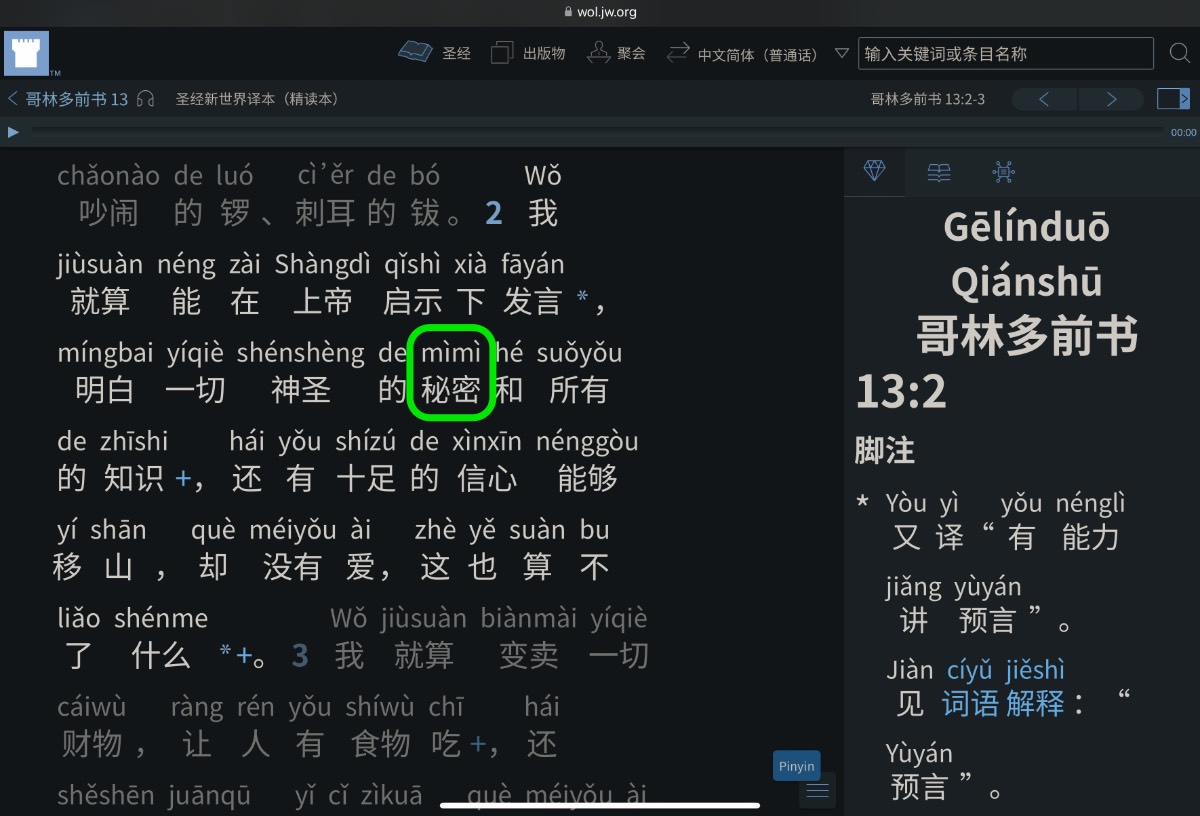
Screenshot of “cì’ěr” in 1 Co. 13:1 (nwtsty, CHS+_Pīnyīn_ WOL)

(Dark mode for the Watchtower ONLINE LIBRARY (WOL) website, as shown in the above image, can be enabled in the Safari web browser by using the Noir Safari extension.)

“Cì’ěr (Cì’·ěr {stabs; pricks → [irritates; pierces]} · ear → [grating on the ear; jarring; ear-piercing] 刺耳) literally means “stabs ear”, and is used in the Mandarin New World Translation Bible’s rendering of 1 Corinthians 13:1 to translate the “clashing” in “clashing cymbal”. In this context, “cì’ěr (cì’·ěr {stabs; pricks → [irritates; pierces]} · ear → [grating on the ear; jarring; ear-piercing] 刺耳) effectively means “grating on the ear; jarring; ear-piercing”.

Mandarin Field Need-Greater? Or Ear-Grater 😬?

First, let me establish that of course Jehovah and we who are in the Mandarin field deeply appreciate those who have been moved by love to come and try to learn Mandarin and help out in the Mandarin field. Given that, sometimes things do happen that can literally and figuratively grate on the ears of those who truly serve in this field out of love, and who have become acquainted with what good Mandarin sounds like.

The Tone Beast…

One time, a brother I know whose mother tongue is English gave a Mandarin talk during which so many of his tones were off that at times I was genuinely having trouble making out what words he was saying, even when I was listening closely. After that meeting, when I tried to kindly advise him that this was the case, he jokingly quipped something like ‘Well, at least I made you listen closely!’

Maybe this brother really did try his best, and maybe his reply was just an attempt to lighten the mood with some humour. He may also have felt safe using some humour because we know each other and generally get along fairly well. However, his words in this case might also be taken to show that he took his responsibility to give a good Mandarin talk a bit lightly. If so, things said with such a flippant attitude could grate on the ears of someone who views with appropriate seriousness the God-honouring and life-saving work that needs to be done in the Mandarin field.

It is true that especially for those whose mother tongue is, say, English, the tones can be one of the most difficult aspects of Mandarin for them to master, since that way of using pitch (how high or low a “note” is) is so different from how they use pitch in English. The sincere efforts of Mandarin field language learners in this regard are much appreciated!

…And How to Tame It

For those of us who are trying to learn Mandarin for the Mandarin field, it should help if we keep the following points in mind regarding Mandarin tones:

  • Tones are just as important to conveying meaning in Mandarin as vowels are to conveying meaning in English. In English, if someone says a wrong vowel, that person is not actually saying the word that person meant to say, and that person is not expressing the meaning that person meant to express. For example, there’s a world of difference between “I love you” and “I leave you”, even though it’s “only” the matter of a single vowel. Similarly, in Mandarin, if someone uses a wrong tone, that person is saying a whole different word from what that person meant to say, as shown by the classic example of “mā (ma; mom; mummy; mother)/ (hemp; flax; linen | (surname) | {[is] pocked; pockmarked; pitted; spotty} [→ [[is] rough; coarse]] | numbed; tingling | sesame麻/蔴)/ (horse [(surname)] [→ [knight chess piece; horse piece in Chinese chess | [is] big; large]])/ ({verally abuse}; curse; swear; {call names} [→ [condemn; rebuke; reprove; scold]]罵/駡)/ma ([? ptcl for “yes/no” questions]).
  • In languages like English, we may change the pitch of what we are saying to do things like add emphasis, ask a question, etc. In Mandarin, though, as explained above, the tone of a syllable—which involves how pitch is used while saying it—is an essential part of how that syllable represents meaning. So, while in English the way we use pitch while saying a word may be negotiable based on how we want to emphasize it, etc., in Mandarin, tones are non-negotiable, like our stand on blood transfusions is non-negotiable. A first tone, for example, must always be recognizable as a first tone and must not be changed into a fourth tone or something, no matter how much we want to emphasize a Mandarin word with a first tone in it!
    • How can we add emphasis in Mandarin, then? Study 10 of the Teaching (th) brocure, entitled “Modulation”, tells us that ‘we can convey ideas clearly and stir emotion by varying our volume, pitch, and pace’. So, while the pitches of Mandarin tones are non-negotiable, we can still add emphasis in Mandarin by varying volume—by speaking softer or louder—and/or by varying pace—by speaking slower or faster.
  • Wrong tones can be really cì’ěr (cì’·ěr {stabbing → [irritating]} · ear → [grating on the ear] 刺耳) because, as mentioned above, tones are made of pitch, and when one speaks with wrong pitches, it’s a lot like singing off-key—very grating to the ears of those who know how the music of the language should sound! 🎵

With the above points in mind, do the following:

  • Practise recognizing the different tones and telling them apart when listening to Mandarin speech. This is especially important if you have just recently started to learn Mandarin, and are not used to what Mandarin tones sound like yet. Such practice is needed to gradually train your hearing. As it is with determining if a musical instrument is in tune or not, eventually, with focus and practice, recognizing Mandarin tones will become easier, even second nature.
    • As you get better at being able to recognize good Mandarin tones when you hear them, that will in turn help you to make sure you speak with good Mandarin tones. Speaking of which…
  • Practise speaking with correct Mandarin tones. This is also especially important if you have just recently started to learn Mandarin, and are not used to speaking with Mandarin tones yet. Such practice is needed to gradually train your body’s system for producing speech. Beware: If you let yourself get into bad habits early on involving the tones, then you’ll have to walk a long, hard road to get rid of these bad habits later. As it is with playing a musical instrument well, eventually, with focus, study, and practice, speaking with correct Mandarin tones will become easier, even second nature. 🎸

The Cantonese Twist

As discussed in the MEotW post on “fāngyán (fāng·yán {direction → [place]} · speech → [topolect; dialect (common but misleading translation)] 方言), to those who know Mandarin well, Cantonese that is twisted to try to make it sound like Mandarin sounds awful:

Well, as someone who along with many others has come to the Mandarin field from the Cantonese field, I have had the dubious pleasure of observing how some have tried to speak Mandarin by just taking the Cantonese they knew and twisting it a little, since they were relying on the conventional wisdom that Mandarin and Cantonese are just different dialects of the same language. As well-meaning as they may have been, the results were often just as bad as when someone sings badly off-key, or as Star Trek fans may say, they often sounded like the language equivalent of a transporter accident 🙀. Even after decades in the Mandarin field, some publishers who had come over from the Cantonese field still say some Mandarin words with Cantonese-y pronunciations.

Any Cantonese-speakers who help out in the Mandarin field are very much appreciated, but it would be good for everyone involved if they realized that, contrary to worldly political propaganda, Mandarin and Cantonese are not just different dialects of the same Chinese language. Rather, as linguists recognize, Mandarin and Cantonese, being mutually unintelligible, are really different languages, like French and English are different languages. So, we should all understand and expect that as different languages, Mandarin and Cantonese have different phonologies. That is, they basically sound different, not just like slightly twisted versions of each other. Some, in fact, have compared how different Mandarin and Cantonese sound to how different chickens and ducks sound.

Avoiding Being “a Clashing Cymbal”

If I speak in the tongues of men and of angels but do not have love, I have become a clanging gong or a clashing cymbal.
1 Corinthians 13:1.

Chinese people are known for being very appreciative of Westerners who try to speak Mandarin or one of the other Chinese languages, and for often praising the spoken results of such efforts as being much better than they actually are. Beginning Chinese language learners especially are often given lots of leeway when it comes to how they sound.

After a few years or even decades, though, does our Mandarin speech, for example, still sound not much better than it did when we started learning Mandarin? Some have observed that those who focus on Chinese characters and pay relatively little attention to Mandarin speech often—unsurprisingly—don’t speak Mandarin very well. Some may say that their focusing on Chinese characters shows their love for Chinese culture, but is it not more important for Christians especially to show love for Chinese people by learning to actually understand what they say and learning to speak to them understandably? And as Witnesses of Jehovah, is it not more important to show love for Jehovah by being able to speak clearly, understandably, and movingly in Mandarin about him and the good news of his Kingdom?

While a lot of leeway is rightly given to beginning Mandarin language leaners, one not progressing after learning Mandarin for a long time might in some cases give at least the impression of a lack of caring, a lack of love on the part of that one. (Hebrews 5:12) As humans, we can often tell if something has not been made, done, or said lovingly, with care, for example, if not much attention to “details” like tones is evident. On the other hand, even if some music is performed or something is said in a way that may show only a modest amount of skill or talent, but that does show a lot of love, people often appreciate that more than if one is displaying great skill or talent, but is only doing so to show off or something. Such a one would indeed seem like “a clanging gong or a clashing cymbal”, or, as the Mandarin NWT Bible says, a “chǎonào ({(disturbing by) making noise} 吵闹 吵鬧) de (’s 的) luó (gong), cì’ěr (cì’·ěr {stabbing → [irritating]} · ear → [grating on the ear] 刺耳) de (’s 的) (cymbal)”.—1 Corinthians 13:1 (English, Mandarin).

Categories
Culture Experiences History Science Technology Theocratic

chuàngzào

chuàngzào (chuàng·zào initiating · {making, creating} → [creating | creation; innovation] 创造 創造) ← Tap/click to show/hide the “flashcard”

The Shēngmìng Láizì Chuàngzào Ma? ((Shēngmìng Life 生命) (Lái·zì Came · From 来自 來自) (Chuàng·zào Initiating · {Making, Creating} → [Creating] 创造 創造) (Ma [? ptcl for “yes/no” questions])? [Was Life Created? (lc)]) (Was Life Created? (lc)) brochure and the Shēngmìng de Qǐyuán—Zhíde Sīkǎo de Wǔ Ge Wèntí ((Shēngmìng Life 生命) (de ’s 的) (Qǐ·yuán {Rising → [Starting]} · Source → [Origin] 起源/原)—(Zhí·de Worth · Getting → [Worth] 值得) (Sī·kǎo {Thinking About} · Examining 思考) (de ’s 的) (Wǔ Five 五) (Ge [mw]個/个) (Wèn·tí Asking · Subjects → [Questions] 问题 問題) [The Origin of Life​—Five Questions Worth Asking (lf)]) (The Origin of Life​—Five Questions Worth Asking (lf)) brochure were originally published back in 2010, but recently, the English version of the Was Life Created? brochure was updated to the December 2022 Printing, and the Mandarin version of it was updated to the February 2023 Printing. Also, the Was Life Created? brochure and the Origin of Life brochure are now in the Teaching Toolbox section in the JW Library app. So, it would be good to consider some of the expressions used in the Mandarin versions of these publications that can be so helpful when discussing whether life was created.

How It Started

This week’s MEotW, which appears right in the title of the Mandarin Was Life Created? brochure, is “chuàngzào (chuàng·zào initiating · {making, creating} → [creating | creation; innovation] 创造 創造). While this is basically a verb meaning “create”, it can also be used as a noun meaning “creation”. Such verbal/gerundial nouns were discussed in the MEotW post on “jiàodǎo (jiào·dǎo teaching · {guiding [→ [instructing]]} 教导 教導)”:

One interesting thing to note about “jiàodǎo (jiào·dǎo teaching · {guiding [→ [instructing]]} 教导 教導)” (and about “jiàoxun (teaching → [reprimanding | knowledge gained from an error] 教训 教訓)”, for that matter) is that their component morphemes seem to basically be verbs. In certain contexts, however, they are used as nouns. An example of this being done in English is that “teach” and “teaching” are verbs (e.g. “Jesus was teaching the crowd.”), but in certain contexts, “teaching” is used as a noun (e.g. “The crowd was amazed at the teaching Jesus shared with them.”). When a word is used this way, it’s called a verbal noun, or a gerundial noun. Verbal nouns are quite common in Mandarin.

How It Breaks Down

The “chuàng (initiate; create; start; originate; {achieve (sth. for the first time)}創/刱/剏/剙) in “chuàngzào (chuàng·zào initiating · {making, creating} → [creating | creation; innovation] 创造 創造) is also used in “Chuàngshìjì (Chuàng·shì·jì {Initiating, Creating of} · {Generation → [World]} · Record → [Genesis] 创世记 創世記), and is associated with originality and creativity. For example, this “chuàng (initiate; create; start; originate; {achieve (sth. for the first time)}創/刱/剏/剙) also occurs in “chuàngzuò (chuàng·zuò initiated; created; originated · {made [→ [written/composed]]} [(thing)] [→ [created; produced; written [(thing)]] [→ [creative work; creation]]] 创作 創作) and in “chuàngzuò lì ((chuàng·zuò {to initiate/create/originate} · {to make [→ [to write/compose]]} → [to create/produce/write] 创作 創作) (lì power → [ability] 力) [creative ability; creativity; originality]), which can respectively mean “creative work” and “creativity”.

As for the “zào (make; build; create 造) in “chuàngzào (chuàng·zào initiating · {making, creating} → [creating | creation; innovation] 创造 創造), it’s more associated with making and building, and it’s the same “zào (make; build; create 造) that’s in “jiànzào (construct; build 建造). “Jiànzào (build 建造) fángwū (houses 房屋), for example, means “build houses”.

How It Comes Together

So, “chuàngzào (chuàng·zào initiating · {making, creating} → [creating | creation; innovation] 创造 創造), being made up of “chuàng (initiate; create; start; originate; {achieve (sth. for the first time)}創/刱/剏/剙) and “zào (make; build; create 造), covers the entire process of coming up with the idea for something, and then actually making or building it. This is in contrast with the idea of theistic evolution, that God somehow got the ball rolling and then sat back and let the process of evolution develop all the wonderful living things in the natural world.

One person in particular whom I remember having such a viewpoint was my grade 7 teacher, who was actually quite smug about how her Catholic/personal beliefs had thus seemingly neatly reconciled the contradictions between the worldly “scientific” theory of evolution and the creation account in the Bible book of Genesis. However, the actual wording of the Genesis account, including how it is often translated into Mandarin, does not really go along with such a seemingly neat reconciliation with evolution.—Genesis 1:27 (English WOL, Mandarin WOL, Pīnyīn (Pīn·yīn {Piecing Together of} · Sounds → [Pinyin] 拼音) Plus).

“_Chuàngzào_” in Genesis 1:27 (NWT (nwtsty), WOL CHS+Pinyin), with “_zào_” in _Héhé Běn_

To represent how God caused humans to come into existence, the Mandarin New World Translation Bible uses “chuàngzào (chuàng·zào initiated · {made, created} → [created] 创造 創造), and the Héhé Běn ((Hé·hé Harmonious · {Closed → [United]} 和合) (Běn {Root or Stem} → [Edition] 本) [Union Version (Chinese Bible)]) uses “zào (made; built; created 造). Both these expressions contain the sense of “made, created”, and perhaps “built”.

How the Py+ Material Is Going

A while ago, I got the feeling that I should shift focus to get to work on producing current-generation Pīnyīn (Pīn·yīn {Piecing Together of} · Sounds → [Pinyin] 拼音) Plus material for the Was Life Created? brochure, which I had last produced older-style material for several years earlier. The official material for this brochure had also not been changed for several years, with the last Mandarin printing of it being dated 2016-12.

However, not long after I had started working on new Pīnyīn (Pīn·yīn {Piecing Together of} · Sounds → [Pinyin] 拼音) Plus material for this brochure, I noticed that a new printing, dated 2022-12, had been put out for the English version of the Was Life Created? brochure, and then, a new printing, dated 2023-02, appeared in the JW Library app for the Mandarin version of this brochure. Also, the Was Life Created? brochure and the Origin of Life brochure were added to the Teaching Toolbox section in the JW Library app at around this time. It seems that Jehovah had decided that the time had come for renewed focus on these brochures, and it seems that the work of producing Pīnyīn (Pīn·yīn {Piecing Together of} · Sounds → [Pinyin] 拼音) Plus material for the Was Life Created? brochure is privileged to be part of this renewed focus.

At the time of this writing, the old 3-line files (iPad-Letter-A4, XLP-iPhone-A5) together with the new Pīnyīn (Pīn·yīn {Piecing Together of} · Sounds → [Pinyin] 拼音) Plus web resource cover the entire Was Life Created? brochure. (The 3-line files were based on an older version of the brochure, though.) Also, the Pīnyīn (Pīn·yīn {Piecing Together of} · Sounds → [Pinyin] 拼音) Plus web resource (which can be used offline in supporting browsers) contains no more Pīnyīn (Pīn·yīn {Piecing Together of} · Sounds → [Pinyin] 拼音)-only material that has only been partially proofread—all the Pīnyīn (Pīn·yīn {Piecing Together of} · Sounds → [Pinyin] 拼音)-only material has now been fully proofread.


For convenience:

The direct link for the current generation Pīnyīn (Pīn·yīn {Piecing Together of} · Sounds → [Pinyin] 拼音) Plus resource for the Was Life Created? brochure is:

The short link for Chinese field language-learning links for the Was Life Created? brochure is:

More Pīnyīn (Pīn·yīn {Piecing Together of} · Sounds → [Pinyin] 拼音) and Pīnyīn (Pīn·yīn {Piecing Together of} · Sounds → [Pinyin] 拼音) Plus web material based on the Mandarin Was Life Created? brochure will be made available in the Pīnyīn (Pīn·yīn {Piecing Together of} · Sounds → [Pinyin] 拼音) Plus web resource as time allows. Work is now underway to produce a Pīnyīn (Pīn·yīn {Piecing Together of} · Sounds → [Pinyin] 拼音) Plus web resource for the Mandarin Origin of Life brochure as well.

Categories
Current Events Science Technology Theocratic

réngōng zhìnéng

réngōng (rén·gōng human · work → [artificial] 人工)
zhìnéng (zhì·néng intelligence · ability → [intelligence] 智能) ← Tap/click to show/hide the “flashcard”

[Notes: Tap/click on a Pīnyīn (Pīn·yīn {Piecing Together of} · Sounds → [Pinyin] 拼音) expression to reveal its “flashcard”; tap/click on a “flashcard” or its Pīnyīn (Pīn·yīn {Piecing Together of} · Sounds → [Pinyin] 拼音) expression to hide the “flashcard”. 📖 📄 📘 icons mean 📖 Reveal All, 📄 Reveal Advanced, and 📘 Reveal None re all the “flashcards” in the heading, paragraph, etc. that they are placed at the beginning of.]

At the time of this writing, jw.org was featuring the article “Artificial Intelligence—A Blessing or a Curse?—What Does the Bible Say?”. Where the English version of this article uses the expression “artificial intelligence”, the Mandarin version uses this week’s MEotW, “réngōng (rén·gōng human · work → [artificial] 人工) zhìnéng (zhì·néng intelligence · ability → [intelligence] 智能):

English:

Recently, world leaders, scientists, and technologists have commented on the power of artificial intelligence (AI). While acknowledging its value, they have also expressed concern over its potential misuse.

Mandarin:

📖 📄 📘 Jìnqī (Jìn·qī {near → [recent]} · {period of time} → [recently] 近期), xǔduō (xǔ·duō numbers · many 许多 許多) guójiā (guó·jiā nation · family → [national] 国家 國家) lǐngdǎorén (lǐngdǎo·rén leading · persons → [leaders] 领导人 領導人), kēxuéjiā (kē·xué·jiā {{branches of study} · learning → [science]} · -ists → [scientists] 科学家 科學家), yǐjí (and 以及) kējì (kē·jì {branches of study → [science]} · {skills → [technology]} → [technology] 科技) jīngyīng (jīng·yīng elite · {flowers → [outstanding persons]} → [elite] 精英) dōu ({all of them} 都) duì (towards) réngōng (rén·gōng human · work → [artificial] 人工) zhìnéng (zhì·néng intelligence · ability → [intelligence] 智能) (AI) de (’s 的) yòngtú (yòng·tú {to be used} · routes → [applications] 用途) shēn (deeply 深) biǎo ({have expressed} 表) guānzhù (guān·zhù {closing with (them) → [being concerned about (them)]} · {pouring into (them) → [concentrating on (them)]} → [paying close attention to (them)] 关注 關注). Suīrán (Suī·rán although · -ly 虽然 雖然) tāmen (tā·men he/she · [pl] → [they] 他们 他們) dōu (all 都) zàntóng (zàn·tóng favour · {are with} → [approve of] 赞同 贊/讚同) réngōng (rén·gōng human · work → [artificial] 人工) zhìnéng (zhì·néng intelligence · ability → [intelligence] 智能) yǒu (having 有) hěn (very 很) duō (many 多) yìchu (yì·chu beneficial · places → [benefits] 益处 益處), dàn (however 但) ((they) also 也) hěn ({very much} 很) dānxīn (dān·xīn {carry on shoulder poles → [bear (heavy)]} · hearts → [worry] 担/耽心 擔/耽心) zhèi (this) xiàng ({item of}) kējì (kē·jì {branches of study → [science]} · {skills → [technology]} → [technology] 科技) huì (will) bèi ([passive signifier] → [be] 被) lànyòng (làn·yòng {overflowingly → [indiscriminately]} · used → [misused] 滥用 濫用).

Related Expressions

The “zhìnéng (zhì·néng wisdom; knowledge; intelligence; resourcefulness; wit; cleverness · ability → [intelligence; intellectual power/ability | smart(phone, etc.)] 智能) in “réngōng (rén·gōng human · work → [artificial] 人工) zhìnéng (zhì·néng intelligence · ability → [intelligence] 智能) also appears in “zhìnéng shǒujī ((zhì·néng intelligence · ability → [smart] 智能) (shǒu·jī hand · machine → [mobile phone] 手机 手機) [smartphone]), which is used in China to mean “smartphone”. As pointed out by the Referenced Theo. Expressions (RTE) resource, this expression appears in the November 2009 issue of Awake! magazine, on page 3.

It’s also noteworthy that the “zhì (wisdom; knowledge; intelligence; resourcefulness; wit; cleverness 智) in “réngōng (rén·gōng human · work → [artificial] 人工) zhìnéng (zhì·néng intelligence · ability → [intelligence] 智能) appears in “zhìhuì (zhì·huì wisdom · intelligence → [wisdom] 智慧), the Mandarin word for “wisdom”. It also appears in “zhōngxìn (zhōng·xìn faithful · {believing → [having faith]} → [faithful] 忠信) ruìzhì (ruì·zhì {having foresight} · {(having) wisdom} 睿智) de (’s 的) núlì (slave 奴隶 奴隸), the Mandarin expression for “faithful and discreet slave”.—Matthew 24:45 (English; Mandarin).

A Beginning? Or Not?

Regarding intelligence, artificial or otherwise, it’s illuminating to consider these verses in Proverbs:

The fear of Jehovah is the beginning of knowledge.
Only fools despise wisdom and discipline.
Proverbs 1:7

The fear of Jehovah is the beginning of wisdom,
And knowledge of the Most Holy One is understanding.
Proverbs 9:10

To show true knowledge and wisdom—and indeed, intelligence—in life, we need to consider all the factors that are relevant in life, and we especially need to not have insufficient regard for the biggest, most relevant factor of all in life—Jehovah God, who created human intelligence (which was perfect in the first human couple, but which that couple caused to become imperfect and corrupted). Humans who do not have fear of (or “reverence for”, as per the footnote for Pr. 1:7) Jehovah—the Creator of human life and human intelligence—do not even begin to have true knowledge or wisdom, and thus are not equipped to develop artificial intelligence with true knowledge or wisdom.

Indeed, while humans can now store, read, and perform some basic processes on data, even huge amounts of data, human researchers have limited understanding about, and disagree about, how a system like the human brain or an artificial intelligence system can truly—not just appear to—know or understand something, or have wisdom (scientific paper, Medium article) about something. This may help to partly explain why a significant percentage of the time, current artificial intelligence systems output incorrect statements with complete confidence, as if they were true.

Yes, while many are now fascinated by, and/or concerned about, the increasing power of artificial intelligence, people should be focusing first on Jehovah God’s divine intelligence, the most powerful intelligence in the entire universe, that thankfully is motivated by love, guided by wisdom, and dedicated to justice.—1 John 4:8; Romans 11:33; Deuteronomy 32: 3, 4.