Categories
Culture Experiences History Language Learning Science Technology Theocratic

jiànshi

jiànshi (jiàn·shi [(getting to be)] {seeing → [meeting with; being exposed to]} · knowing [→ [[widening/enriching] knowledge/experience/sensibleness/insight]] 见识 見識) ← Tap/click to show/hide the “flashcard”

[Notes: Tap/click on a Pīnyīn (Pīn·yīn {Piecing Together of} · Sounds → [Pinyin] 拼音) expression to reveal its “flashcard”; tap/click on a “flashcard” or its Pīnyīn (Pīn·yīn {Piecing Together of} · Sounds → [Pinyin] 拼音) expression to hide the “flashcard”. 📖 📄 📘 icons mean 📖 Reveal All, 📄 Reveal Advanced, and 📘 Reveal None re all the “flashcards” in the heading, paragraph, etc. that they are placed at the beginning of.]

A few years back, I wrote up a brief web page listing reasons for producing Pīnyīn (Pīn·yīn {Piecing Together of} · Sounds → [Pinyin] 拼音), etc. material for the Imitate (ia) book. Some, especially some who grew up in the West, may have felt that this book is made up of “just stories”, and ones that they were already quite familiar with, at that. However, we must remember that Chinese Bible students may often have a different perspective regarding the Bible accounts that are made to come to life in the Imitate book. As that web page said:

  • Many Chinese people in the world have not been exposed to Bible accounts the way many Westerners have.
  • Also, I have heard that some, perhaps many, Chinese Bible students tend to approach their Bible studies like intellectual exercises for accumulating chōuxiàng (abstract) head knowledge as if for a school exam, rather than as training for their hearts for their own real lives.

Later, the web page touches on how some of the real-world benefits of good storytelling like that found in the Imitate book involve empathy:

    • The actress Natalie Portman once said, “I love acting. I think it’s the most amazing thing to be able to do. Your job is practicing empathy. You walk down the street imagining every person’s life.”
  • The Imitate book helps build Bible students’ empathy towards Bible characters, which in turn helps Bible students realize that others would feel empathy towards them as well if they imitated these Bible characters—not everyone will just think they’re crazy, like many worldly friends or family members might think.

While even fictional stories can have the benefits described in the links and the quote above, true stories from the Bible can have even greater benefits, including spiritual ones.

Besides the Imitate book, another book from Jehovah’s organization that relates Bible accounts is the Learn From the Bible (lfb) book. The letter from the Governing Body in this book says that, similarly to the Imitate book, the Learn From the Bible book also “brings the Bible accounts to life and captures the feelings of those depicted”, while, unlike the Imitate book, it “tells the story of the human family from creation onward”. While the Learn From the Bible book is especially suitable for children, the letter from the Governing Body in this book says that “it can also be used to help adults who desire to learn more about the Bible”. So, it would be good to consider on this blog some of the expressions used in the Mandarin Learn From the Bible book.

“I Will Make Them Know”

This week’s MEotW, “jiànshi (jiàn·shi [(getting to be)] {seeing → [meeting with; being exposed to]} · knowing [→ [[widening/enriching] knowledge/experience/sensibleness/insight]] 见识 見識)”, appears in the current Mandarin version of the New World Translation Bible in Jeremiah 16:21, which is quoted in Lesson 19 of the Mandarin Learn From the Bible book (WOL), entitled “Tóu (Head → [First]) Sān (Three 三) Chǎng ([mw for recreational, sports, or other activities]場/塲) Zāiyāng (Calamities → [Plagues] 灾殃 災殃) (“The First Three Plagues”):

English:

“So I will make them know,
At this time I will make them know my power and my might,
And they will have to know that my name is Jehovah.”

Mandarin (WOL, Pīnyīn (Pīn·yīn {Piecing Together of} · Sounds → [Pinyin] 拼音) Plus):

📖 📄 📘Suǒyǐ (Suǒ·yǐ {that which} · {is the reason} → [so] 所以) (I 我) yào (will 要) ràng (make) tāmen (tā·men him/her · [pl] [them] 他们 他們) zhīdào (zhī·dào know · {(the) way (of it)} → [know] 知道),
Zhè (this) (one 一) (time 次), (I 我) yào (will 要) ràng (make) tāmen (tā·men him/her · [pl] [them] 他们 他們)
Jiànshi (Jiàn·shi {see → [be exposed to]} · know 见识 見識) wǒ de ((wǒ me 我) (de ’s 的) [my]) (big → [great] 大)néng (ability 能) (big → [great] 大) (power 力),
Tāmen (Tā·men he/she · [pl] [they] 他们 他們) jiù (then 就) zhīdào (zhī·dào {will know} · {(the) way (of)} → [will know] 知道)
Wǒ de ((Wǒ me 我) (de ’s 的) [my]) míngzi (míng·zi name · word → [name] 名字) shì (is 是) Yēhéhuá (Jehovah 耶和华 耶和華).”

The “jiàn (see [→ [meet with; be exposed to]] | seeing → [view (opinion)]) in “jiànshi (jiàn·shi [(getting to be)] {seeing → [meeting with; being exposed to]} · knowing [→ [[widening/enriching] knowledge/experience/sensibleness/insight]] 见识 見識) is a well-know expression that basically means “see”. It some contexts, it can effectively mean “be exposed to”. The other morpheme in “jiànshi (jiàn·shi [(getting to be)] {seeing → [meeting with; being exposed to]} · knowing [→ [[widening/enriching] knowledge/experience/sensibleness/insight]] 见识 見識) also appears in the well-known expression “rènshi (rèn·shi [(get)] {to recognize} · {to know} 认识 認識)”, and it means “know”. In the context of Jeremiah 16:21, it seems that “jiànshi (jiàn·shi [(getting to be)] {seeing → [meeting with; being exposed to]} · knowing [→ [[widening/enriching] knowledge/experience/sensibleness/insight]] 见识 見識) effectively means “be exposed to, know”.

Imaginary vs. Real Power

The verse just before Jeremiah 16:21 tells us that the false gods that humans make for themselves were at issue:

Can a man make gods for himself
When they are not really gods?

In Moses time, the gods of the Egyptians were powerful in the imaginations of the Egyptian people, but through the plagues that he brought upon the Egyptians, Jehovah showed that actually, he was powerful in reality.

As Mandarin field language learners, we are exposed to the worldly admonition to devote ourselves to Chinese characters, those intricate visible avatars of Chinese language and culture. However, modern linguistics (language science), along with God’s Word the Bible, expose Chinese characters as false linguistic “gods”, mere secondary players at best, compared to speech, which is the true primary aspect of any human language.—1 Corinthians 14:8–11.

Jehovah’s Powerful Gift of Speech

Let us in a positive way get to know Jehovah’s power, including the power he put into his creations, such as the gift of speech. In contrast, writing is merely a human invention that’s based on Jehovah’s gift of speech:

Lauren: I think that is one of the things that makes it really hard for people who grow up in highly literate, highly educated societies to tease writing and reading apart from language. But actually, when you step back, you realise that writing is actually super weird.

Gretchen: It’s so weird! It’s this interesting – it really is a technology. It’s a thing you do on top of language to do stuff with language, but it’s not the language itself. There are thousands and possibly millions of languages that have never been written down in the history of humanity. We have no idea. We’ve never met a society of humans, or heard of a society of humans, without language. But those are spoken and signed languages, which are just kind of there. Writing, by contrast, was invented somewhere between 3 and 4 times in the history of humanity.

Human inventors sometimes have the humility to admit that they were standing on the shoulders of giants. Well, Jehovah, who created human speech, is indeed a giant, upon whose shoulders the puny human inventors of writing were standing!

As an example of the power of Jehovah’s gift of speech, consider what Matthew 7:28 says about how powerfully Jesus spoke to those he taught in his ministry:

When Jesus finished these sayings, the effect was that the crowds were astounded at his way of teaching,

Yes, while the human-invented Chinese characters have captured the imaginations of many people, and while these people imagine characters to be powerful, what most powerfully praises Jehovah and moves people’s hearts in reality is Jehovah’s gift of speech, when wielded skilfully as Jesus wielded it.

Purposefully Focusing on Speech

How can we similarly speak powerfully in Mandarin to those we meet in the Mandarin field? We can be helped to directly and purposefully reach this goal, to personally jiànshi (jiàn·shi {see → [be exposed to]} · know 见识 見識) or know the power of Jehovah’s gift of speech, if we focus on developing the invisible but powerful skill of speaking well in Mandarin, rather than allowing ourselves to fall for the alluring but silencing diversion of the visible Chinese characters.

(Of course, the current reality is that some spiritual information is still only available in characters, although Jehovah’s organization has been making more and more material available with Pīnyīn (Pīn·yīn {Piecing Together of} · Sounds → [Pinyin] 拼音). From my experience, I recommend in general that Mandarin field language learners use Pīnyīn (Pīn·yīn {Piecing Together of} · Sounds → [Pinyin] 拼音) when they can, and that they just use characters when they have to.)

While as a writing system, characters do ultimately represent Mandarin speech, they do so in such an unnecessarily complex and hard-to-deal-with way that the characters end up actually stifling and stultifying Mandarin speech. In contrast, unlike the Chinese characters that demand attention for themselves so that people can admire—and be able to cope with—their complexity and fancy visual designs, Pīnyīn (Pīn·yīn {Piecing Together of} · Sounds → [Pinyin] 拼音) simply and directly helps us to actually focus on the Mandarin manifestation of Jehovah’s powerful gift of speech, and it helps us without distraction to develop our ability to use it well.

So, don’t just privately study Chinese characters. Listen closely to the Mandarin speech of those who speak it well. Try to get a sense of the sound and “feel” of good spoken Mandarin. Practise speaking Mandarin out loud when you can. (It may feel strange and uncomfortable at first, but if you stick with it, you’ll get used to it.) Don’t ignore or neglect Mandarin tones, which are as essential to Mandarin as vowels sounds are to English. Ask for and accept advice from those who speak Mandarin well about how to improve your spoken Mandarin. Don’t let yourself be intimidated by character snobs and traditionalists into not using Pīnyīn (Pīn·yīn {Piecing Together of} · Sounds → [Pinyin] 拼音). Instead, make good use of this modern alphabetic full writing system that lets you focus on Mandarin speech itself. As you take purposeful and practical steps such as these, you will be helped to in the Mandarin field imitate Jesus’ way of using Jehovah’s powerful gift of speech.


For convenience:

The direct link for the Pīnyīn (Pīn·yīn {Piecing Together of} · Sounds → [Pinyin] 拼音) Plus resource for the Learn From the Bible book is:

The short link for Chinese field language-learning links for the Learn From the Bible book is:

More Pīnyīn (Pīn·yīn {Piecing Together of} · Sounds → [Pinyin] 拼音) and Pīnyīn (Pīn·yīn {Piecing Together of} · Sounds → [Pinyin] 拼音) Plus web material based on the Mandarin Learn From the Bible book will be made available in the Pīnyīn (Pīn·yīn {Piecing Together of} · Sounds → [Pinyin] 拼音) Plus web resource as time allows.
Categories
Culture Current Events History Language Learning Theocratic

rénxīn‐huánghuáng

rénxīn (rén·xīn people’s · hearts → [popular/public feeling] 人心)huánghuáng (huáng·huáng {being afraid; fearful; scared; frightened [→ [being anxious; uneasy; nervous]]} · {being afraid; fearful; scared; frightened [→ [being anxious; uneasy; nervous]]} 惶惶) ← Tap/click to show/hide the “flashcard”

[Notes: Tap/click on a Pīnyīn (Pīn·yīn {Piecing Together of} · Sounds → [Pinyin] 拼音) expression to reveal its “flashcard”; tap/click on a “flashcard” or its Pīnyīn (Pīn·yīn {Piecing Together of} · Sounds → [Pinyin] 拼音) expression to hide the “flashcard”. 📖 📄 📘 icons mean 📖 Reveal All, 📄 Reveal Advanced, and 📘 Reveal None re all the “flashcards” in the heading, paragraph, etc. that they are placed at the beginning of.]

As 2023 draws to a close, jw.org is featuring the article “2023: A Year of Anxiety—⁠What Does the Bible Say?”. This week’s MEotW, “rénxīn (rén·xīn people’s · hearts → [popular/public feeling] 人心)huánghuáng (huáng·huáng {being afraid; fearful; scared; frightened [→ [being anxious; uneasy; nervous]]} · {being afraid; fearful; scared; frightened [→ [being anxious; uneasy; nervous]]} 惶惶)”, is used in the title of the Mandarin version of this article:

English:

2023: A Year of Anxiety—⁠What Does the Bible Say?

Mandarin:

📖 📄 📘 2023 Rénxīn (Rén·xīn People’s · Hearts → [Popular/Public Feeling] 人心)Huánghuáng (Huáng·huáng {Being Fearful → [Being Anxious]} · {Being Fearful → [Being Anxious]} 惶惶) de ( 的) (One 一) Nián (Year年/秊): Shìjiè (Shì·jiè {Generation → [World]} · Extent’s → [World’s] 世界) Dàshì (Dà·shì {Big → [Major]} · Events 大事) Zěnyàng (Zěn·yàng (in) What · {Forms → [Ways]} → [How] 怎样 怎樣) Yìngyàn (Yìng·yàn {Respond to} · Verifying (Regarding) → [Fulfil] 应验 應驗) Shèngjīng (Shèng·jīng Holy · Scriptures → [Bible] 圣经 聖經) Yùyán (Yù·yán {In Advance} · Sayings → [Prophecies] 预言 預言)

Breakdown

“Rén (people | person[s] | human[s] | man/men 人) can mean “people”, and “xīn (heart 心) means “heart”. Together, they can literally mean “people’s hearts”, and in the context of “rénxīn (rén·xīn people’s · hearts → [popular/public feeling] 人心)huánghuáng (huáng·huáng {being afraid; fearful; scared; frightened [→ [being anxious; uneasy; nervous]]} · {being afraid; fearful; scared; frightened [→ [being anxious; uneasy; nervous]]} 惶惶),” they effectively mean “popular/public feeling”.

“Huáng ({[is] afraid; fearful; scared; frightened} [→ [[is] anxious; uneasy; nervous]] 惶) seems to basically literally mean “[is] afraid; fearful; scared; frightened”. In some cases, it can effectively mean “[is] anxious; uneasy; nervous”. (In these definitions, the presence of “[is]” means that this expression can sometimes function as a stative verb, i.e., a verb that describes a state of being, rather than an action. Some more information on stative verbs, quoted from the ABC Chinese-English Dictionary, can be found in the MEotW post on “gāowēn (gāo·wēn high · {being warm → [temperature]} 高温 高溫)”.)

Taken together, the morphemes in “rénxīn (rén·xīn people’s · hearts → [popular/public feeling] 人心)huánghuáng (huáng·huáng {being afraid; fearful; scared; frightened [→ [being anxious; uneasy; nervous]]} · {being afraid; fearful; scared; frightened [→ [being anxious; uneasy; nervous]]} 惶惶)”, as used in the above example, effectively mean “popular/public feeling being anxious”.

One More Time

In “rénxīn (rén·xīn people’s · hearts → [popular/public feeling] 人心)huánghuáng (huáng·huáng {being afraid; fearful; scared; frightened [→ [being anxious; uneasy; nervous]]} · {being afraid; fearful; scared; frightened [→ [being anxious; uneasy; nervous]]} 惶惶)”, “huáng ({[is] afraid; fearful; scared; frightened} [→ [[is] anxious; uneasy; nervous]] 惶) is doubled, or repeated. In linguistics, this phenomenon is called reduplication, and it’s quite common in Mandarin. Sometimes, the tone of the duplicated morpheme is kept the same, while other times, the second occurrence’s tone becomes neutral. Off the top of my head, here are some other examples of reduplication in Mandarin:

  • xiǎngxiang (xiǎng·xiang {think about} · {think about} | think · think 想想)
  • chángcháng (cháng·cháng frequently · frequently | often · often | constantly · constantly 常常)
  • mànmàn (màn·màn slowly · slowly [→ [gradually]] 慢慢)
  • kànkan (kàn·kan {look at} · {look at} | look · look | see · see | watch · watch 看看)

Sometimes, one might even come across a Mandarin double double, such as “mǎma‐hūhū ((mǎ·ma horse · horse 马马 馬馬) (hū·hū tiger · tiger 虎虎) [careless; casual | fair; so-so; just passable])”. (Hopefully, this term does not apply to our approach to learning Mandarin, especially if we are doing so for Jehovah’s work in the Mandarin field!)

Idiomatic

Considering its structure, we can say that “rénxīn (rén·xīn people’s · hearts → [popular/public feeling] 人心)huánghuáng (huáng·huáng {being afraid; fearful; scared; frightened [→ [being anxious; uneasy; nervous]]} · {being afraid; fearful; scared; frightened [→ [being anxious; uneasy; nervous]]} 惶惶) is an idiom. However, it does not seem to be a chéngyǔ (chéng·yǔ {(sth. that) has become} · saying → [set phrase (typically of 4 characters); idiom] 成语 成語). This excerpt from the MEotW post on “chéngyǔ (chéng·yǔ {(sth. that) has become} · saying → [set phrase (typically of 4 characters); idiom] 成语 成語) discusses the difference:

So, it appears that while chéngyǔ (chéng·yǔ {(things that) have become} · sayings → [set phrases (typically of 4 characters); idioms] 成语 成語) can be called idioms in English, not all Chinese idioms are chéngyǔ (chéng·yǔ {(things that) have become} · sayings → [set phrases (typically of 4 characters); idioms] 成语 成語). It seems that “chéngyǔ (chéng·yǔ {(things that) have become} · sayings → [set phrases (typically of 4 characters); idioms] 成语 成語)” specifically refers to Chinese idioms that originated in Classical Chinese, or Literary Chinese. This writing style has largely been replaced by written vernacular Chinese, which has been the standard style of writing for Modern Standard Mandarin for about a century now.

Since they originated in Classical Chinese, which hasn’t been current for about a century, chéngyǔ (chéng·yǔ {(things that) have become} · sayings → [set phrases (typically of 4 characters); idioms] 成语 成語) often cannot be fully understood by modern speakers and readers of Mandarin, since knowledge about the source material for chéngyǔ (chéng·yǔ {(things that) have become} · sayings → [set phrases (typically of 4 characters); idioms] 成语 成語) has naturally been fading with the passing of time.

Categories
Culture Language Learning Science Technology Theocratic

cì’ěr

cì’ěr (cì’·ěr {stabs; pricks → [irritates; pierces]} · ear → [grating on the ear; jarring; ear-piercing] 刺耳) ← Tap/click to show/hide the “flashcard”

I have long especially liked 1 Corinthians 13. It contains counsel on what really does and doesn’t matter in life, an extensive description and definition of the most important kind of love, and a sublime discussion about the need to become complete, mature, as a person. As these apply to life in general, so too do they apply to our lives as Mandarin field language learners.

As Mandarin field language learners, it can benefit us greatly to consider what we can learn from 1 Corinthians 13, and along the way, we can also consider some of the Mandarin expressions used in that chapter in the current version of the Mandarin New World Translation Bible (nwtsty).

“Clashing”

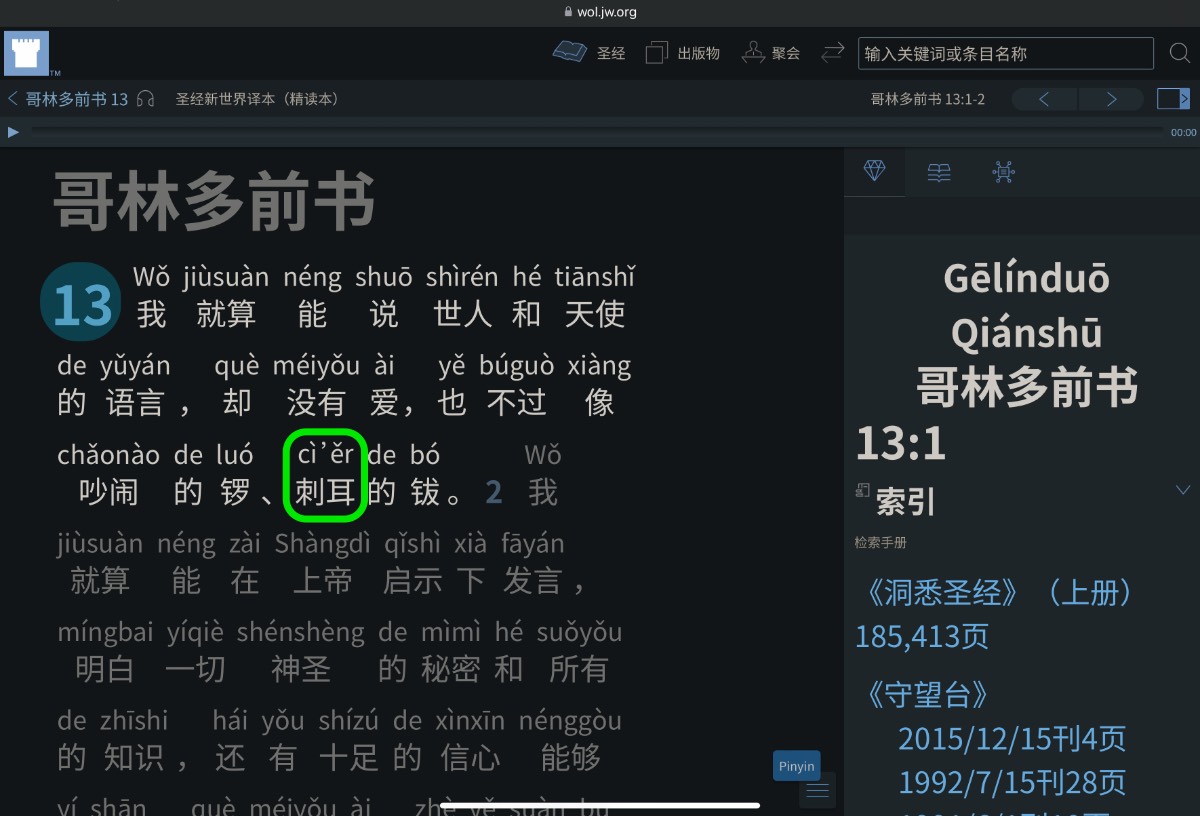
This week’s MEotW, “cì’ěr (cì’·ěr {stabs; pricks → [irritates; pierces]} · ear → [grating on the ear; jarring; ear-piercing] 刺耳), occurs in verse 1 (WOL, Pīnyīn (Pīn·yīn {Piecing Together of} · Sounds → [Pinyin] 拼音) Plus) of 1 Corinthians 13:

Screenshot of “cì’ěr” in 1 Co. 13:1 (nwtsty, CHS+_Pīnyīn_ WOL)

(Dark mode for the Watchtower ONLINE LIBRARY (WOL) website, as shown in the above image, can be enabled in the Safari web browser by using the Noir Safari extension.)

“Cì’ěr (Cì’·ěr {stabs; pricks → [irritates; pierces]} · ear → [grating on the ear; jarring; ear-piercing] 刺耳) literally means “stabs ear”, and is used in the Mandarin New World Translation Bible’s rendering of 1 Corinthians 13:1 to translate the “clashing” in “clashing cymbal”. In this context, “cì’ěr (cì’·ěr {stabs; pricks → [irritates; pierces]} · ear → [grating on the ear; jarring; ear-piercing] 刺耳) effectively means “grating on the ear; jarring; ear-piercing”.

Mandarin Field Need-Greater? Or Ear-Grater 😬?

First, let me establish that of course Jehovah and we who are in the Mandarin field deeply appreciate those who have been moved by love to come and try to learn Mandarin and help out in the Mandarin field. Given that, sometimes things do happen that can literally and figuratively grate on the ears of those who truly serve in this field out of love, and who have become acquainted with what good Mandarin sounds like.

The Tone Beast…

One time, a brother I know whose mother tongue is English gave a Mandarin talk during which so many of his tones were off that at times I was genuinely having trouble making out what words he was saying, even when I was listening closely. After that meeting, when I tried to kindly advise him that this was the case, he jokingly quipped something like ‘Well, at least I made you listen closely!’

Maybe this brother really did try his best, and maybe his reply was just an attempt to lighten the mood with some humour. He may also have felt safe using some humour because we know each other and generally get along fairly well. However, his words in this case might also be taken to show that he took his responsibility to give a good Mandarin talk a bit lightly. If so, things said with such a flippant attitude could grate on the ears of someone who views with appropriate seriousness the God-honouring and life-saving work that needs to be done in the Mandarin field.

It is true that especially for those whose mother tongue is, say, English, the tones can be one of the most difficult aspects of Mandarin for them to master, since that way of using pitch (how high or low a “note” is) is so different from how they use pitch in English. The sincere efforts of Mandarin field language learners in this regard are much appreciated!

…And How to Tame It

For those of us who are trying to learn Mandarin for the Mandarin field, it should help if we keep the following points in mind regarding Mandarin tones:

  • Tones are just as important to conveying meaning in Mandarin as vowels are to conveying meaning in English. In English, if someone says a wrong vowel, that person is not actually saying the word that person meant to say, and that person is not expressing the meaning that person meant to express. For example, there’s a world of difference between “I love you” and “I leave you”, even though it’s “only” the matter of a single vowel. Similarly, in Mandarin, if someone uses a wrong tone, that person is saying a whole different word from what that person meant to say, as shown by the classic example of “mā (ma; mom; mummy; mother)/ (hemp; flax; linen | (surname) | {[is] pocked; pockmarked; pitted; spotty} [→ [[is] rough; coarse]] | numbed; tingling | sesame麻/蔴)/ (horse [(surname)] [→ [knight chess piece; horse piece in Chinese chess | [is] big; large]])/ ({verally abuse}; curse; swear; {call names} [→ [condemn; rebuke; reprove; scold]]罵/駡)/ma ([? ptcl for “yes/no” questions]).
  • In languages like English, we may change the pitch of what we are saying to do things like add emphasis, ask a question, etc. In Mandarin, though, as explained above, the tone of a syllable—which involves how pitch is used while saying it—is an essential part of how that syllable represents meaning. So, while in English the way we use pitch while saying a word may be negotiable based on how we want to emphasize it, etc., in Mandarin, tones are non-negotiable, like our stand on blood transfusions is non-negotiable. A first tone, for example, must always be recognizable as a first tone and must not be changed into a fourth tone or something, no matter how much we want to emphasize a Mandarin word with a first tone in it!
    • How can we add emphasis in Mandarin, then? Study 10 of the Teaching (th) brocure, entitled “Modulation”, tells us that ‘we can convey ideas clearly and stir emotion by varying our volume, pitch, and pace’. So, while the pitches of Mandarin tones are non-negotiable, we can still add emphasis in Mandarin by varying volume—by speaking softer or louder—and/or by varying pace—by speaking slower or faster.
  • Wrong tones can be really cì’ěr (cì’·ěr {stabbing → [irritating]} · ear → [grating on the ear] 刺耳) because, as mentioned above, tones are made of pitch, and when one speaks with wrong pitches, it’s a lot like singing off-key—very grating to the ears of those who know how the music of the language should sound! 🎵

With the above points in mind, do the following:

  • Practise recognizing the different tones and telling them apart when listening to Mandarin speech. This is especially important if you have just recently started to learn Mandarin, and are not used to what Mandarin tones sound like yet. Such practice is needed to gradually train your hearing. As it is with determining if a musical instrument is in tune or not, eventually, with focus and practice, recognizing Mandarin tones will become easier, even second nature.
    • As you get better at being able to recognize good Mandarin tones when you hear them, that will in turn help you to make sure you speak with good Mandarin tones. Speaking of which…
  • Practise speaking with correct Mandarin tones. This is also especially important if you have just recently started to learn Mandarin, and are not used to speaking with Mandarin tones yet. Such practice is needed to gradually train your body’s system for producing speech. Beware: If you let yourself get into bad habits early on involving the tones, then you’ll have to walk a long, hard road to get rid of these bad habits later. As it is with playing a musical instrument well, eventually, with focus, study, and practice, speaking with correct Mandarin tones will become easier, even second nature. 🎸

The Cantonese Twist

As discussed in the MEotW post on “fāngyán (fāng·yán {direction → [place]} · speech → [topolect; dialect (common but misleading translation)] 方言), to those who know Mandarin well, Cantonese that is twisted to try to make it sound like Mandarin sounds awful:

Well, as someone who along with many others has come to the Mandarin field from the Cantonese field, I have had the dubious pleasure of observing how some have tried to speak Mandarin by just taking the Cantonese they knew and twisting it a little, since they were relying on the conventional wisdom that Mandarin and Cantonese are just different dialects of the same language. As well-meaning as they may have been, the results were often just as bad as when someone sings badly off-key, or as Star Trek fans may say, they often sounded like the language equivalent of a transporter accident 🙀. Even after decades in the Mandarin field, some publishers who had come over from the Cantonese field still say some Mandarin words with Cantonese-y pronunciations.

Any Cantonese-speakers who help out in the Mandarin field are very much appreciated, but it would be good for everyone involved if they realized that, contrary to worldly political propaganda, Mandarin and Cantonese are not just different dialects of the same Chinese language. Rather, as linguists recognize, Mandarin and Cantonese, being mutually unintelligible, are really different languages, like French and English are different languages. So, we should all understand and expect that as different languages, Mandarin and Cantonese have different phonologies. That is, they basically sound different, not just like slightly twisted versions of each other. Some, in fact, have compared how different Mandarin and Cantonese sound to how different chickens and ducks sound.

Avoiding Being “a Clashing Cymbal”

If I speak in the tongues of men and of angels but do not have love, I have become a clanging gong or a clashing cymbal.
1 Corinthians 13:1.

Chinese people are known for being very appreciative of Westerners who try to speak Mandarin or one of the other Chinese languages, and for often praising the spoken results of such efforts as being much better than they actually are. Beginning Chinese language learners especially are often given lots of leeway when it comes to how they sound.

After a few years or even decades, though, does our Mandarin speech, for example, still sound not much better than it did when we started learning Mandarin? Some have observed that those who focus on Chinese characters and pay relatively little attention to Mandarin speech often—unsurprisingly—don’t speak Mandarin very well. Some may say that their focusing on Chinese characters shows their love for Chinese culture, but is it not more important for Christians especially to show love for Chinese people by learning to actually understand what they say and learning to speak to them understandably? And as Witnesses of Jehovah, is it not more important to show love for Jehovah by being able to speak clearly, understandably, and movingly in Mandarin about him and the good news of his Kingdom?

While a lot of leeway is rightly given to beginning Mandarin language leaners, one not progressing after learning Mandarin for a long time might in some cases give at least the impression of a lack of caring, a lack of love on the part of that one. (Hebrews 5:12) As humans, we can often tell if something has not been made, done, or said lovingly, with care, for example, if not much attention to “details” like tones is evident. On the other hand, even if some music is performed or something is said in a way that may show only a modest amount of skill or talent, but that does show a lot of love, people often appreciate that more than if one is displaying great skill or talent, but is only doing so to show off or something. Such a one would indeed seem like “a clanging gong or a clashing cymbal”, or, as the Mandarin NWT Bible says, a “chǎonào ({(disturbing by) making noise} 吵闹 吵鬧) de (’s 的) luó (gong), cì’ěr (cì’·ěr {stabbing → [irritating]} · ear → [grating on the ear] 刺耳) de (’s 的) (cymbal)”.—1 Corinthians 13:1 (English, Mandarin).