Categories
Culture History Names

dài

dài ({take the place of}; replace; subsitute | replacing; substituting → [acting; substitute | generation [→ [period; era; age]]] 代) ← Tap/click to show/hide the “flashcard”

This week’s MEotW, “dài ({take the place of}; replace; subsitute | replacing; substituting → [acting; substitute | generation [→ [period; era; age]]] 代)”, basically literally means “take the place of” or “replace”. Why, then, is it used to mean “generation”? This tweet briefly explains:

Yes, the Chinese concept of a “generation” is that it is something that takes the place of or replaces what was there before—the emphasis seems to be on continuation, and a new generation is viewed as having done well if it lived up to or maintained what came before it. In contrast, in the English-speaking world, a “generation” is something new that is generated—the emphasis seems to be more on innovation, progress, and a new generation is viewed as having done well if it improved upon what came before it, and moved things ahead. For example, the English expression “next generation” indeed implies innovation and progress compared to previous generations, such as when applied to vehicles, computers, and other technology.

The Case of Star Trek: The Next Generation

Fans of Star Trek also generally naturally accept that of course in many aspects the world of Star Trek: The Next Generation is more advanced than the world of Star Trek: The Original Series—the ships are faster and more powerful, the special effects are better, etc. (Note that Star Trek: The Original Series was just called Star Trek when it first came out. “Star Trek: The Original Series” is a retronym that was applied to the show after other shows based on it began to appear.)

However, some Star Trek fans prefer Star Trek: The Original Series to Star Trek: The Next Generation, and do not view Star Trek: The Next Generation as better in every way compared to the original show. For example, many fans view original series characters like Captain Kirk, Mr. Spock, and Dr. McCoy as their favourite characters in all the Star Trek shows. Indeed, some would say Mr. Spock is the most iconic Star Trek character of them all.

By the way, the Mandarin translation of “Star Trek: The Next Generation” in mainland China is apparently “Xīngjì Lǚxíng: Xià-Yí-Dài ((Xīng·jì Stars · {Boundaries → [Among]} → [Interstellar] 星际 星際) (Lǚ·xíng Travelling · Going → [Journeying] 旅行): (Xià Below → [Next] 下)-(Yí One 一)-(Dài Replacing → [Generation] 代) [Star Trek: The Next Generation (mainland China translation)])”, according to the mainland Chinese version of Wikipedia. In contrast, “Star Trek: The Next Generation” is apparently called “Yín Hé Fēilóng (((Yín Silver) (Hé River 河) → [Milky Way]) (Fēi·lóng Flying · Dragon [→ [Pterosaur]] 飞龙 飛龍) [Star Trek: The Next Generation (Taiwan translation)])” (obviously not a literal translation) in Taiwan. While Wikipedia is of course not always right, in this case I have not been able to find any better source.

However, in an article on the official Star Trek website, I did find out about a big (literally) Chinese connection to Star Trek:

The building, according to Mashable.com, is the headquarters of NetDragon Websoft, a Chinese gaming and mobile Internet company. And the site notes, “Company Chairman Liu DeJian is reportedly an uberTrekkie, licensing from CBS the rights to build an Enterprise replica. Construction began in 2008 and was finished in 2014; the project cost $160 million total. The building is the only officially licensed Star Trek building on the planet.”

The Case of Pīnyīn (Pīn·yīn {Piecing Together} · Sounds → [Pinyin] 拼音)

Speaking of generations of technology, and of replacings, it’s good for us Mandarin field language learners to remember that writing systems are technologies, and technologies are known to sometimes get replaced by newer generations of technologies. Also, with regard to Pīnyīn (Pīn·yīn {Piecing Together} · Sounds → [Pinyin] 拼音) specifically, the original plan for modern-day China was for Pīnyīn (Pīn·yīn {Piecing Together} · Sounds → [Pinyin] 拼音) to one day replace Chinese characters. As the article “Pīnyīn (Pīn·yīn {Piecing Together} · Sounds → [Pinyin] 拼音) Was Plan A” says:

Pīnyīn was actually Plan A for modern-day China, but Plan A has not been fully followed through on, largely because of old-fashioned selfish pride, nationalism/“culturalism”, and traditionalism, with some intellectual self-indulgence thrown in there for good measure. As Jehovah’s people, we have been trained to recognize that these are very bad reasons for doing something, or for not doing something.

Letter from Mao Zedong re a “basic reform” of Chinese writing, involving a transition from Chinese characters to alphabetic writing

(The above picture is from near the beginning of the book The Chinese Language: Fact and Fantasy, by John DeFrancis.)

Nostalgia, Progress, and Generations

While humans of different cultures and generations disagree as to whether new generations are necessarily better, whether in technology, Star Trek, writing systems, or life in general, God’s Word helps us to understand his view of passing generations of humans and human activity.

Here are a few scriptures that come to mind in that regard:

A generation is going, and a generation is coming,
But the earth remains forever.
Ecclesiastes 1:4

Do not say, “Why were the former days better than these?” for it is not out of wisdom that you ask this.
Ecclesiastes 7:10

Jesus said to him: “No man who has put his hand to a plow and looks at the things behind is well-suited for the Kingdom of God.”
Luke 9:62

Brothers, I do not yet consider myself as having taken hold of it; but one thing is certain: Forgetting the things behind and stretching forward to the things ahead,
Philippians 3:13

“In the days of those kings the God of heaven will set up a kingdom that will never be destroyed. And this kingdom will not be passed on to any other people. It will crush and put an end to all these kingdoms, and it alone will stand forever,
Daniel 2:44

Furthermore, the world is passing away and so is its desire, but the one who does the will of God remains forever.
1 John 2:17

Categories
Culture Theocratic

liángshàn

liángshàn ({[is] good} [→ [goodness]] 良善) ← Tap/click to show/hide the “flashcard”

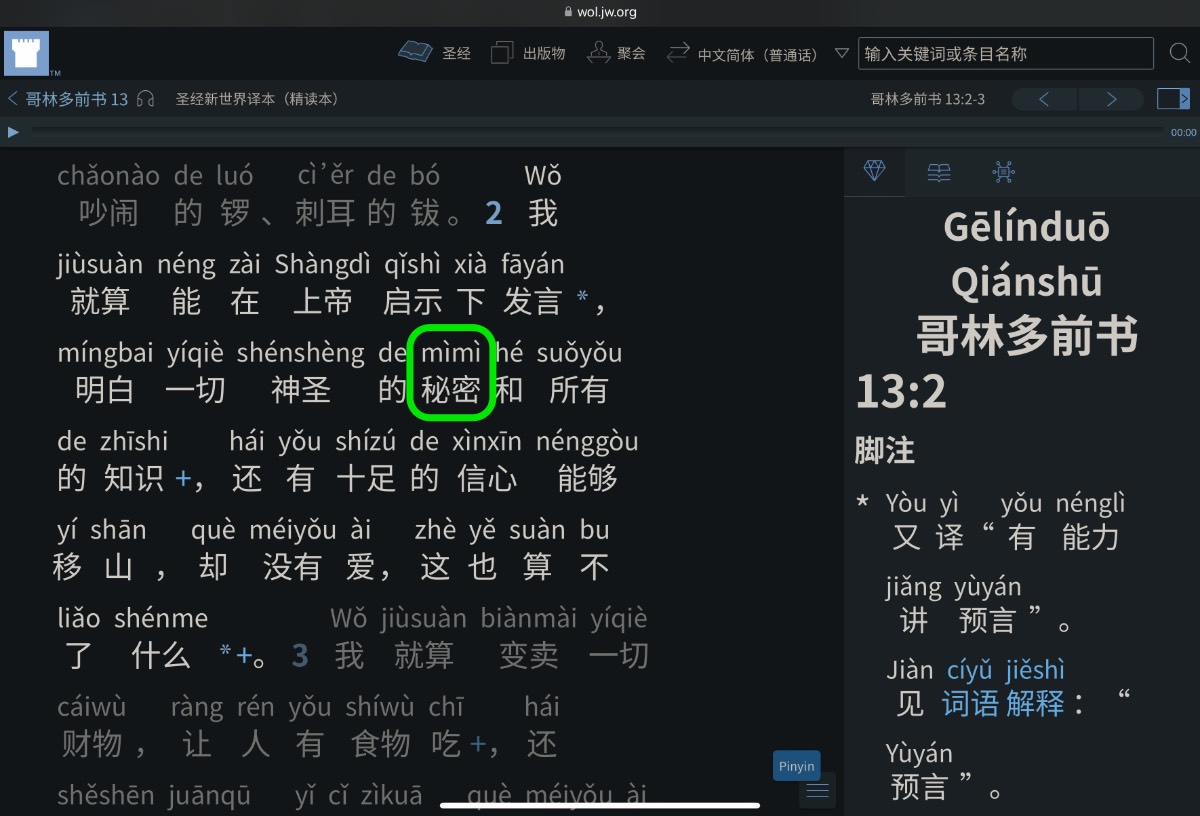
The sixth part of the fruitage of the spirit listed is goodness.— Jiālātàishū (Jiālātài·shū Galatia · Book → [Galatians] 加拉太书 加拉太書) 5:22, 23.

Galatians 5:22, 23 (WOL nwtsty-CHS+Pinyin)

The English word “goodness” is translated into Mandarin in the above scripture as “liángshàn ({[is] good} [→ [goodness]] 良善)”, this week’s MEotW.

Note that the Pīnyīn (Pīn·yīn {Piecing Together} · Sounds → [Pinyin] 拼音) Plus information for “liángshàn ({[is] good} [→ [goodness]] 良善)” (← tap/click to show/hide the “flashcard”) shows that when put together in this context, both of the morphemes that make up “liángshàn ({[is] good} [→ [goodness]] 良善)” individually basically mean “good” or “goodness”, and so the resulting whole word also means “good” or “goodness”.

Of the two morphemes that make up “liángshàn ({[is] good} [→ [goodness]] 良善)”, “shàn ({[is] good [at]} [→ [charitable; kind; friendly; virtuous]] 善)” is sometimes used as a word on its own, but the other morpheme “liáng (good; fine; desirable; virtuous (bound form) 良)” is not used as a word on its own—it’s what’s known as a bound form.

Bound Forms

The ABC Chinese-English Dictionary, edited by John DeFrancis and Victor H. Mair, among others, tells us the following about the entries in it that are marked as bound forms:

B.F. (Bound Form, Niánzhuó Císù 粘着词素).

Morphemes which do not function as free words in a sentence and cannot be handled using one of the other bound category labels, such as prefix, suffix, measure word, or particle. A given character may represent a free word in one or more of its meanings but a bound morpheme in other meanings. E.g. qiǎng 抢 is a bound form meaning ‘take emergency measures’ in qiǎngshòu 抢收 but a free form as a verb meaning ‘pillage’.)

In addition to these meaningful bound forms, which we define and illustrate with one or more examples, there are many characters which have no meaning of their own but simply represent a syllabic sound. E.g. 8 葡 and 6táo 萄 in pútao 葡萄 ‘grapes’. For these entries we provide neither entry label nor definition but simply note words in which the character occurs.

The Monosyllabic Myth

This seems to be a good place to mention the Monosyllabic Myth. This is the mistaken belief that in Chinese, every word is monosyllabic (one syllable), represented by a character, and that conversely, every syllable is a word.

One factor that contributes to this mistaken belief is that unlike how words are obviously separated by spaces in English writing, the Chinese characters writing system puts all characters the same distance apart from each other regardless of word boundaries—the main units below sentences seem to be characters, not words. Another contributing factor is that in good old paper Chinese dictionaries, the main entries are each based on a single character, not on a single word, which may contain more than one syllable—while English dictionaries are dictionaries of words, traditional Chinese dictionaries have been dictionaries of characters.

The Reality of Mandarin Syllables

The reality, though, as newer Chinese dictionary apps like Pleco make obvious, is that in Mandarin there are syllables like “liáng (good; fine; desirable; virtuous (bound form) 良)”, which is not a word on its own, but which combine with other syllables to form words like “liángshàn ({[is] good} [→ [goodness]] 良善)”, which have two or more syllables. While text written in Chinese characters all runs together into a single hard-to-parse mass, Pīnyīn (Pīn·yīn {Piecing Together} · Sounds → [Pinyin] 拼音) text uses word separation to clearly show word boundaries, like how in the above image it’s clear that “liángshàn ({[is] good} [→ [goodness]] 良善)” is a separate word from the words before and after it.

John DeFrancis, in his book The Chinese Language: Fact and Fantasy (pp. 184–185), explains the different types of syllables in Mandarin, with regard to how free they are to stand on their own as words:

DEGREES OF SYLLABIC FREEDOM

Syllables like that are intelligible even in isolation are at the opposite extreme from syllables like , allegedly “butterfly” but actually a mere phonetic element devoid of meaning and tightly bound as part of the two-syllable expression hùdiǎr. Between these two extremes are meaningful syllables that are semibound in the sense that they always occur bound but have a certain flexibility in joining with other syllables. There are thus three types of Chinese syllables:

  1. F: free, meaningful
  2. SB: semibound, meaningful
  3. CB: completely bound, meaningless

These three categories are roughly comparable in English to the free form teach, the semibound form er in “teacher” and “preacher,” and the completely bound forms cor and al in “coral.”

Categories
Culture Language Learning Languages Science

yǔxì

yǔxì (yǔ·xì language · {tied (things) → [system; family]} 语系 語系) ← Tap/click to show/hide the “flashcard”

Last week’s MEotW post mentioned that English and Spanish are generally considered by modern linguists to be in the Indo-European language family. This concept of a language family is used in modern linguistic genealogical (or genetic) language classification:

A language family is a group of languages related through descent from a common ancestral language or parental language, called the proto-language of that family. The term “family” reflects the tree model of language origination in historical linguistics, which makes use of a metaphor comparing languages to people in a biological family tree…Linguists therefore describe the daughter languages within a language family as being genetically related.[source]

The Mandarin Translation

As confirmed by American sinologist and University of Pennsylvania Professor of East Asian Languages and Civilizations Victor H. Mair in his article “The Classification of Sinitic Languages: What Is ‘Chinese’?” (p. 747), an accepted and acceptable Mandarin translation for “language family” is “yǔxì (yǔ·xì language · {tied (things) → [system; family]} 语系 語系)”, this week’s MEotW.

The “ (language; speech | saying; proverb | words; expression | speak; say)” in “yǔxì (yǔ·xì language · {tied (things) → [system; family]} 语系 語系)” means “language”, particularly, the speech of a language, which modern linguists (language scientists) recognize to be the primary aspect of a language.

({tied [(things)]} [→ [system; series | family]] 系)”, as used in “yǔxì (yǔ·xì language · {tied (things) → [system; family]} 语系 語系)”, literally means “tied [(things)]”, and effectively means “system”, “series”, or “family”. Note that in this usage, the character “系” is the same in both simplified and traditional forms. Looking up the character “系” in the dictionary can get tricky, because the simplified character “系” can correspond to the traditional characters “系”, “係”, and also “繫”, all of which have different, though sometimes related, meanings. This is an example of the complexities and vagaries of characters in general, and of how simplified and traditional characters relate to each other, as mentioned in the MEotW post on “jiǎntǐ (jiǎn·tǐ simplified · {body → [style] → [typeface; font]} → [simplified Chinese] 简体 簡體) (characters 字)”.

BTW, an interesting other usage of “ ({tied [(things)]} [→ [system; series | family]] 系)” is in “Yín Hé ((Yín Silver) (Hé River 河) [Milky Way]) ({Tied (Things)} → [System] → [Galaxy] 系)”, in which “ ({tied [(things)]} [→ [system; series | family]] 系)” effectively means “galaxy”.

Pinwheel Galaxy

The Pinwheel Galaxy, another kind of ({tied [(things)]} [→ [system; series | family]] 系)

The Mandarin Connection Is…Complicated

We have discussed that English and Spanish are generally considered by modern linguists to be in different groups in the Indo-European language family. How about Mandarin? What is Mandarin’s place in its language family tree?

Unfortunately, the answer to this seemingly simple question is complicated, by at least two major factors.

One complicating factor is that scientific genetic (or genealogical) language classification itself is not a fully worked out thing. The Encyclopædia Britannica put it this way:

So far, most of the languages of the world have been grouped only tentatively into families, and many of the classificatory schemes that have been proposed will no doubt be radically revised as further progress is made.

Another complicating factor was mentioned in the MEotW post on “fāngyán (fāng·yán {direction → [place]} · speech → [topolect; dialect (common but misleading translation)] 方言)”:

China’s central government is highly motivated to convince people that China is one unified political and cultural entity which should thus be governed by one central government—them

Yes, there is an excess of politics and its propaganda when it comes to the language situation in China, perhaps resulting in a relative dearth of actual scientific research into that situation. Additionally, pervasive political and cultural pressures tend to induce unscientific distortions and self-censorship in whatever research does get done. In his article mentioned above (p. 749), Prof. Mair describes the situation this way:

The contentious, non-scientific nature of the debate over the SLG/F [Sinitic (Chinese) Language Group/Family] is manifest in the circumlocutions used to designate its constituent members: “speech forms,” “varieties,” “styles,” “regionalects,” “dialects” (no matter how far up or down the taxonomic scale one may go), and so forth. At the same time, scholars openly admit that the main reasons why they do not use normal linguistic terminology (family, group, branch, language, dialect) in dealing with the SLG/F are due to sociopolitical and cultural factors. The fallacy of such a bizarre approach is evident when one considers that all nations have special sociopolitical and cultural circumstances, yet an impartial analytical outlook does not allow such circumstances to interfere with pure linguistic research.

The Mandarin Connection—A Common View

In view of the complications mentioned above, what can be said at this time about Mandarin’s place in its language family tree?

At this time, it seems to be traditionally accepted that there is a Sino-Tibetan language family, and that Mandarin is a language (some would unscientifically say “dialect”) in the Sinitic branch of this language family.

It should be noted, however, that even the Wikipedia article on the Sino-Tibetan language family says that there is not yet convincing evidence that the Sino- and Tibetan parts of this hypothetical language family are actually connected in the way that would justify considering them to be together in the same language family:

Several low-level subgroups have been securely reconstructed, but reconstruction of a proto-language for the family as a whole is still at an early stage, so the higher-level structure of Sino-Tibetan remains unclear. Although the family is traditionally presented as divided into Sinitic (i.e. Chinese) and Tibeto-Burman branches, a common origin of the non-Sinitic languages has never been demonstrated.

The Mandarin Connection—Prof. Mair’s View

From my research so far, I have come to consider Prof. Mair, mentioned above, to be the most knowledgeable and trustworthy living authority I know of on the language situation in China.1 The following are some points he made in a relatively recent article, mentioned above, on how Sinitic (Chinese) languages like Mandarin should be classified:

If efforts to link Sinitic with other major language groups continue to be as unconvincing as they have been to date, it may well be that Sinitic will end up being classified as a family unto itself. Because it remains to be determined whether Sinitic is a group or a family, I provisionally style it the Sinitic Language Group/Family (SLG/F). (p. 737)

Cantonese and Mandarin are separate languages. Cantonese is not a ‘dialect’ of Mandarin or of Hanyu, and it is grossly erroneous to refer to it as such. Since Cantonese and Mandarin are separate languages (or, perhaps more accurately, separate branches), it is wrong to refer to them as ‘dialects.’ The same holds for Hokkien, Shanghainese, and so forth. (p. 737)

I…remain agnostic [non-committal] about whether the SLG/F is actually a family unto itself or whether it is more or less closely linked to some other group(s)─such as Tibeto-Burman or Austronesian─in a family (p. 745)

The scientific classification of languages should not be held hostage to extra-linguistic political and cultural prejudices. (p. 746)

In the scientific classification of modern Sinitic languages, as much as possible, data should be drawn from the strikingly different spoken varieties, not from standard written forms. Writing is a second-order linguistic phenomenon. Since most speakers of Sinitic throughout prehistory and history have been illiterate, the nonessentiality of writing for the existence of the SLG/F is self-evident. (pp. 746–747)

The classification of the SLG/F, both internally and externally, is still in the beginning stages; much difficult work remains to be done. (p. 750)

‘Chinese’, ‘dialect’, and other terms in broad popular usage should be employed with extreme caution in technical discussions of the countless varieties of speech forms that currently exist and that have existed at various periods and places during the past in the East Asian Heartland (EAH) and Extended East Asian Heartland (EEAH) (p. 750)

There is an urgent need for the classification of the SLG/F, but this cannot be accomplished satisfactorily without precise, linguistically justifiable terminology. (p. 751)

The people of China have a right to conceive and speak of the languages of their country however they wish; linguists of the world have a duty to study the languages of China according to universal principles. If linguists abandon their scientific duty, the current chaos and lack of consensus concerning the nature of Sinitic will continue, much to the detriment of our understanding not only of the languages of China, but to linguistics as a whole. (p. 751)

Be Wary of What You May Hear About Mandarin

So, as we seek to learn Mandarin, let us keep in mind that while others—including well-meaning ones who are sincerely sharing what they themselves learned—may tell us certain things about Mandarin and how it relates to other varieties of speech, some of what they tell us may not be scientifically verified truth. More research needs to be done in some areas. Also, unfortunately, we need to be wary of the abundant political and cultural propaganda that has been spread about Mandarin and about the language situation in China in general.

1. American linguist, sinologist, author of Chinese language textbooks, lexicographer of Chinese dictionaries, and Professor Emeritus of Chinese Studies at the University of Hawaiʻi at Mānoa John DeFrancis was also an exceptionally knowledgeable and trustworthy authority on the language situation in China. Sadly, he passed away in 2009. He did leave behind many excellent writings, though. I highly recommend his book The Chinese Language: Fact and Fantasy (Honolulu: University of Hawaii Press, 1984). ^