Categories
Culture Experiences Language Learning Science Theocratic

nándào

nándào+ (nán·dào {is (it) difficult} · {to say [→ [to suppose]] (that)} → [can/could it be that; is it possible that; do you really mean to say that; don’t tell me that] 难道 難道) 👈🏼 Tap/click to show/hide the “flashcard”

[Notes: Tap/click on a Pīnyīn (Pīn·yīn {Piecing Together of} · Sounds → [Pinyin] 拼音) expression to reveal its “flashcard”; tap/click on a “flashcard” or its Pīnyīn (Pīn·yīn {Piecing Together of} · Sounds → [Pinyin] 拼音) expression to hide the “flashcard”. 📖 📄 ➕ icons mean 📖 Reveal All, 📄 Reveal Advanced, and ➕ Reveal + Symbols re all the “flashcards” in the heading, paragraph, etc. that they are placed at the beginning of.]

One of the publications that is now recommended to be used on Bible studies is the Yǒngyuǎn Xiǎngshòu Měihǎo de Shēngmìng—Hùdòng Shì Shèngjīng Kèchéng ((Yǒng·yuǎn Eternally · {Far (in Time)} 永远 永遠) (Xiǎng·shòu Enjoy · Receive 享受) (Měi·hǎo Beautiful · Good 美好) (de ’s 的) (Shēngmìng Life 生命)—(Hù·dòng {Each Other} · Moving → [Interactive] 互动 互動) (Shì (Type 式) (Shèng·jīng Holy · Scriptures → [Bible] 圣经 聖經) (Kè·chéng Lessons · Procedure → [Course] 课程 課程) [Enjoy Life Forever!—An Interactive Bible Course (lff)]) (Enjoy Life Forever! (lff)) book. This week’s MEotW, “nándào+ (nán·dào {is (it) difficult} · {to say [→ [to suppose]] (that)} → [can/could it be that; is it possible that; do you really mean to say that; don’t tell me that] 难道 難道)”, appears in subtitle 35 of the video used in point 5 of lesson 15 of this book:

English:

[Jesus’] mother, Mary, lived in Nazareth.
Could he tell her while in the womb,
‘Please take me to Bethlehem because the scriptures say
I must be born there’?

Mandarin (Pīnyīn (Pīn·yīn {Piecing Together of} · Sounds → [Pinyin] 拼音)+ 🔗):

34
00:02:05,141 → 00:02:08,812
📖 📄 Yēsū (Jesus 耶稣 耶穌) de ( 的) mǔqin (mǔ·qin mother · relative 母亲 母親) Mǎlìyà (Mary 马利亚 馬利亞) yuánběn+ (yuán·běn originally · {root or stem → [originally]} 原本) zhù (lived 住) zài (in 在) Násālè+ (Nazʹa·reth 拿撒勒).

35
00:02:08,812 → 00:02:12,882
📖 📄 Nándào+ (Nán·dào {is (it) difficult} · {to say → [to suppose] (that)} → [could it be that] 难道 難道) Yēsū (Jesus 耶稣 耶穌) nénggòu (néng·gòu {was able} · enough 能够 能夠) zài (in 在) māma (mā·ma ma·ma 妈妈 媽媽) de (’s 的) dùzi+ (dù·zi belly · [suf for nouns] 肚子) li (inside裡/裏) gēn (with 跟) māma (mā·ma ma·ma 妈妈 媽媽) shuō ({to say}說/説),

Lesson 15 point 5 video subtitle 36

36
00:02:12,882 → 00:02:14,651
📖 📄 (you 你) yào (must 要) ({go to} 去) Bólìhéng (Bethʹle·hem 伯利恒 伯利恆) shēng+ ({to give birth to} 生) (me 我),

37
00:02:14,651 → 00:02:17,220
📖 📄 (I 我) cái ({only then}才/纔) néng ({will be able} 能) yìngyàn+ (yìng·yàn {to respond to} · verifying (regarding) → [to fulfil] 应验 應驗) Shèngjīng (Shèng·jīng Holy · Scriptures → [Bible] 圣经 聖經) yùyán (yù·yán {in advance} · saying → [prophecy] 预言 預言)ma ([? ptcl for “yes/no” questions])?

It’s Hard to Say?

Over the years, I would occasionally encounter “nándào (nán·dào {is (it) difficult} · {to say [→ [to suppose]] (that)} → [can/could it be that; is it possible that; do you really mean to say that; don’t tell me that] 难道 難道) in my Mandarin field activities, and I would find it hard to say whether my initial impression was correct, that its morphemes literally translated to “is (it) difficult” “to arrive at (that)”. When I finally got around to looking up this expression and analyzing it, it turned out that I was right about the first morpheme, but wrong about the second one—the first morpheme “nán ({[is] difficult}; {[is] hard} | difficultly | {make difficult/difficulties})” is indeed the one that means “difficult” or “hard”, and that also appears in “nántí (nán·tí difficult · topic → [problem] 难题 難題)”, but the second morpheme is actually not the “dào ({arrive [at/in/etc.]}; reaching [→ [[up/out/etc.] to; until]] 到) that means “to arrive at”. Rather, it is the “dào (way; path; road [→ [mw]] | say; speak; talk; chat | think; suppose 道) that is used in “chuándào (chuán·dào spreading · way → [preaching] 传道 傳道) and in “dàoli (dào·li way; path; road · reasoning; logic; doctrine [→ [principle]] 道理)”, where it means “way; path; road”. When it’s used in “nándào (nán·dào {is (it) difficult} · {to say [→ [to suppose]] (that)} → [can/could it be that; is it possible that; do you really mean to say that; don’t tell me that] 难道 難道) though, it seems to have a different meaning that I was not familiar with before, that of “say; speak”.

When the morphemes of “nándào (nán·dào {is (it) difficult} · {to say [→ [to suppose]] (that)} → [can/could it be that; is it possible that; do you really mean to say that; don’t tell me that] 难道 難道) are put together, then, they literally mean “is (it) difficult” “to say [or, to suppose] (that)”, and they can effectively mean “can/could it be that; is it possible that; do you really mean to say that; don’t tell me that”. As Pleco’s built-in dictionary says, this enigmatic expression is used for “giving force to a rhetorical question”.

A Usage Example From the Bible

Here is another example of “nándào (nán·dào {is (it) difficult} · {to say [→ [to suppose]] (that)} → [can/could it be that; is it possible that; do you really mean to say that; don’t tell me that] 难道 難道) in use, from a familiar Bible account:

English:

You are not greater than our forefather Jacob, who gave us the well and who together with his sons and his cattle drank out of it, are you?”

Mandarin (WOL, Pīnyīn (Pīn·yīn {Piecing Together of} · Sounds → [Pinyin] 拼音)+ 🔗):

📖 📄 Zhèi (this) kǒu ({mouth of a} → [mw for things with mouths/openings] 口) jǐng+ (well 井) shì (is 是) wǒmen de ((wǒ·men us · [pl] 我们 我們) (de ’s 的) [our]) zǔxiān (zǔ·xiān forefather · {earlier (person) → [ancestor]} → [forefather] 祖先) Yǎgè+ (Jacob 雅各) liúgěi (liú·gěi {left behind} · {to be given to} 留给 留給) wǒmen (wǒ·men us · [pl] 我们 我們) de ({’s (well)} 的), (he 他) zìjǐ (himself 自己) ({(together) with} → [and]和/龢) érzi (ér·zi {(his) children → [his sons]} · [suf for nouns] 儿子 兒子), jiāchù+ (jiā·chù (his) household · livestock → [his cattle] 家畜) dōu (all 都) (drank 喝) zhèi (this) kǒu ({mouth of a} → [mw for things with mouths/openings] 口) jǐng (well 井) de (’s 的) shuǐ (water 水), nándào+ (nán·dào {is (it) difficult} · {to say → [to suppose] (that)} → [can it be that] 难道 難道) (you 你) ({compared to} 比) (him 他) hái ({still more}) ({are big} → [are great] 大) ma ([? ptcl for “yes/no” questions])?”

A Question for the Mandarin Field

Here is a rhetorical question for Mandarin field language learners to consider:

English:

Is learning Chinese characters really the most important aspect of learning Mandarin?

Mandarin:

📖 📄 Nándào+ (Nán·dào {is (it) difficult} · {to say → [to suppose] (that)} → [can it be that] 难道 難道) xué (learning) Hànzì+ (Hàn·zì {Han (Chinese)} · Characters 汉字 漢字) zhēnde (zhēn·de {being real} · {’s (thing)} → [really] 真的) shì (is 是) xué (learning) pǔtōng‐huà+ ((pǔ·tōng common · {through(out) → [common]} 普通)‐(huà speech) [(Modern Standard) Mandarin (term commonly used in China)]) de (’s 的) zuì (most最/㝡) zhòngyào (zhòng·yào weighty · important 重要) de (’s 的) (one 一) fāngmiàn (fāng·miàn {direction → [side]} · face → [aspect] 方面) ma ([? ptcl for “yes/no” questions])?

For an answer to this question that’s based, not on human tradition or cultural pride, but rather on the Bible, The Watchtower, and linguistics (language science), check out the article “SPEECH is Top Priority, Not Characters”.

Here is an excerpt:

Just like it’s an established fact that the earth is round, according to modern linguistics (the scientific study of language) this is also an established fact: “Speech is primary, writing is secondary and is always derivative of speech.” This scientific truth about language, that Jehovah built us and wired us to primarily communicate meaning through speech, supports what 1 Corinthians 14:8–11 (quoted above) says about understandable speech being of prime importance to Christian evangelizers.


For convenience:

The direct link for the Pīnyīn (Pīn·yīn {Piecing Together of} · Sounds → [Pinyin] 拼音) Plus / Pīnyīn (Pīn·yīn {Piecing Together of} · Sounds → [Pinyin] 拼音)+ resource for the Enjoy Life Forever! book is:

The short link for Chinese field language-learning links for the Enjoy Life Forever! book is:

More Pīnyīn (Pīn·yīn {Piecing Together of} · Sounds → [Pinyin] 拼音)+ web material based on the Mandarin Enjoy Life Forever! book will be made available in the Pīnyīn (Pīn·yīn {Piecing Together of} · Sounds → [Pinyin] 拼音) Plus / Pīnyīn (Pīn·yīn {Piecing Together of} · Sounds → [Pinyin] 拼音)+ web resource as time allows.
Categories
Culture History Language Learning Science Technology Theocratic

zìkuā

zìkuā+ (zì·kuā {[(about)] self} · {exaggerate; overstate; boast; brag | praise; compliment} 自夸 自誇) ← Tap/click to show/hide the “flashcard”

[Notes: Tap/click on a Pīnyīn (Pīn·yīn {Piecing Together of} · Sounds → [Pinyin] 拼音) expression to reveal its “flashcard”; tap/click on a “flashcard” or its Pīnyīn (Pīn·yīn {Piecing Together of} · Sounds → [Pinyin] 拼音) expression to hide the “flashcard”. 📖 📄 ➕ icons mean 📖 Reveal All, 📄 Reveal Advanced, and ➕ Reveal + Symbols re all the “flashcards” in the heading, paragraph, etc. that they are placed at the beginning of.]

I have long especially liked 1 Corinthians 13. It contains counsel on what really does and doesn’t matter in life, an extensive description and definition of the most important kind of love, and a sublime discussion about the need to become complete, mature, as a person. As these apply to life in general, so too do they apply to our lives as Mandarin field language learners.

As Mandarin field language learners, it can benefit us greatly to consider what we can learn from 1 Corinthians 13, and along the way, we can also consider some of the Mandarin expressions used in that chapter in the current version of the Mandarin New World Translation Bible (nwtsty).

“…So That I May Boast”

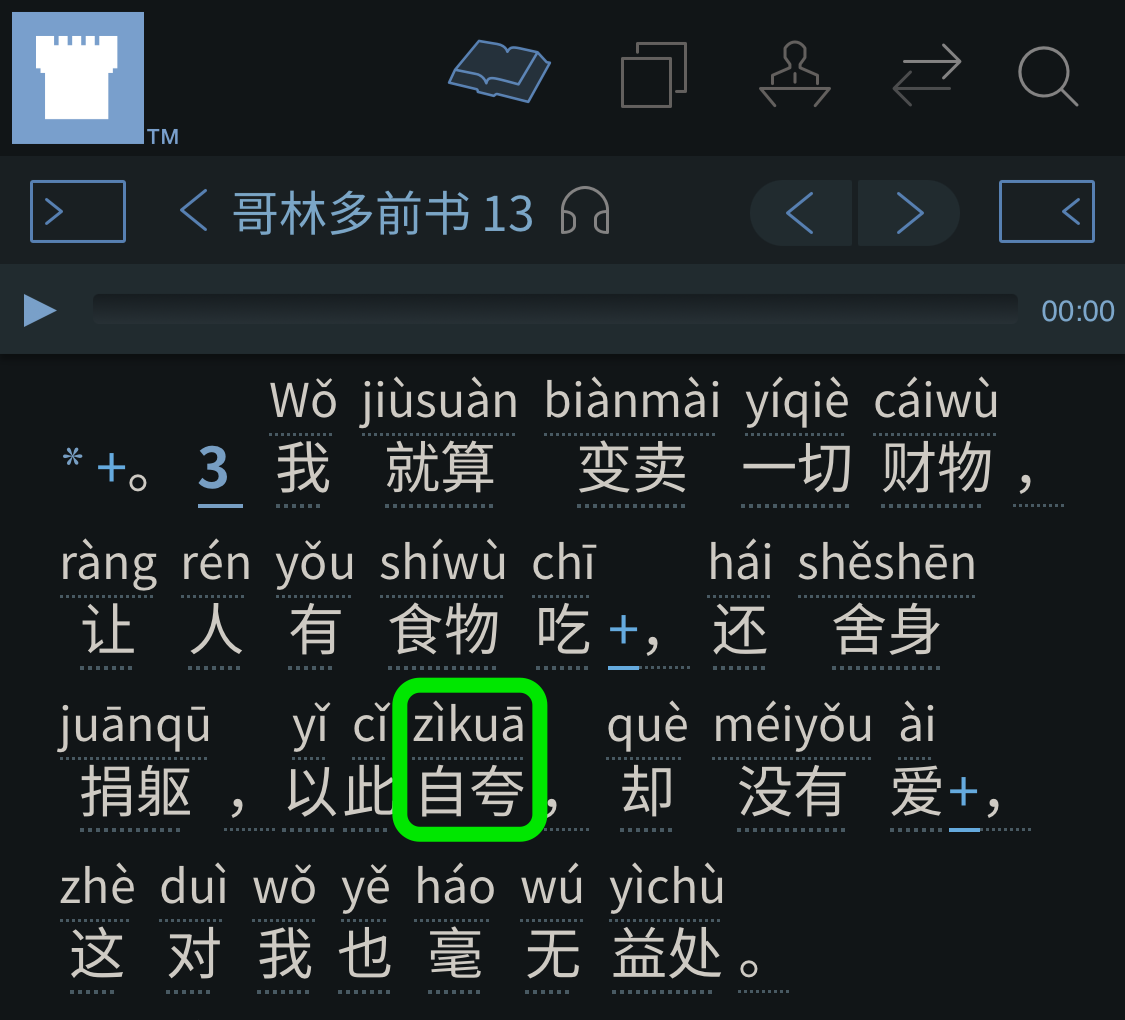
This week’s MEotW, “zìkuā (zì·kuā {[(about)] self} · {exaggerate; overstate; boast; brag | praise; compliment} 自夸 自誇)”, is used in verse 3 (WOL, Pīnyīn (Pīn·yīn {Piecing Together of} · Sounds → [Pinyin] 拼音) Plus) of 1 Corinthians 13:

Screenshot of “_zìkuā_” in 1 Co. 13:3 (nwtsty, CHS+_Pīnyīn_ WOL)

(Dark mode for the Watchtower ONLINE LIBRARY (WOL) website, as shown in the above image, can be enabled in the Safari web browser by using the Noir Safari extension.)

In “zìkuā (zì·kuā {[(about)] self} · {exaggerate; overstate; boast; brag | praise; compliment} 自夸 自誇)”, “zì (self | from; since 自) can mean “(about) self”. (In other expressions, such as “zìjǐ (self[’s] 自己) or “zìyóu+ (zì·yóu self-·determining → [free | freedom] 自由)”, it just means “self”.) As for “kuā ({exaggerate; overstate; boast; brag | praise; compliment}誇/夸)”, it means “exaggerate; overstate; boast; brag” or “praise; compliment”. So, “zìkuā (zì·kuā {[(about)] self} · {exaggerate; overstate; boast; brag | praise; compliment} 自夸 自誇) can effectively mean “boast/brag/etc. about oneself”.

Below are English and Pīnyīn (Pīn·yīn {Piecing Together of} · Sounds → [Pinyin] 拼音) Plus renditions showing how “zìkuā (zì·kuā {[(about)] self} · {exaggerate; overstate; boast; brag | praise; compliment} 自夸 自誇) is used in 1 Corinthians 13:3 in the current version of the Mandarin NWT Bible to correspond to “boast”, which is used in that verse in the current version of the English NWT Bible:

English:

And if I give all my belongings to feed others, and if I hand over my body so that I may boast, but do not have love, I do not benefit at all.

Mandarin (WOL, Pīnyīn (Pīn·yīn {Piecing Together of} · Sounds → [Pinyin] 拼音) Plus):

📖 📄 📘 (I 我) jiùsuàn (jiù·suàn {even if} · {figuring → [considering]} 就算) biànmài (biàn·mài changing · sell → [sell off] 变卖 變賣) yíqiè (yí·qiè {one (whole)} · {corresponding (set of)} → [all] 一切) cáiwù (cái·wù wealth · things → [belongings] 财物 財物), ràng ({to allow}) rén (people 人) yǒu ({to have} 有) shíwù (shí·wù eating · matter → [food] 食物) chī ({to eat}吃/喫), hái (also) shěshēn (shě·shēn {give up} · {(my) body} 舍身 捨身) juānqū (juān·qū {relinquish → [contribute]} · {(my) human body} 捐躯 捐軀), yǐcǐ (yǐ·cǐ using · this 以此) zìkuā+ (zì·kuā {(about) self} · {to boast} 自夸 自誇), què (but) méiyǒu (méi·yǒu not · {do have} 没有 沒有) ài (love), zhè (this) duì (towards → [to]) (me 我) (even 也) háowú (háo·wú {(even) a fine hair (of)} · {does not have} → [does not have even a little] 毫无 毫無) yìchu (yì·chu beneficial · place → [benefit] 益处 益處).

“Your Boasting Is Not Good”

Jehovah designed us, including specific parts of our bodies, such that the primary way we use language to communicate is with speech. (1 Corinthians 14:8–11) In contrast, writing is a human-invented technology, useful in some ways, but secondary at best compared to the gift of speech that Jehovah gave us.

So, if you are boasting, whether out loud or to yourself in your heart, about your knowledge of Chinese characters, which are particularly deeply problematic products of a worldly human culture, while neglecting to praise and appreciate Jehovah’s gift of speech, is it not so that, as 1 Corinthians 5:6 says, “your boasting is not good”? This is especially so because, as 1 John 2:15–17 tells us, we should “not love either the world or the things in the world”.

That scripture also warns us about “the desire of the eyes”. Chinese characters certainly have visually intricate designs that dazzle the eyes of many. The thing is, though, that language is not primarily about what’s visible to the eye. Rather, speech, the actual primary aspect of human language, is something that’s invisible to the eye. If we were to prioritize or even glamourize fancy visible writing over invisible speech that is actually what really matters language-wise, that could be considered linguistic idolatry—literal idolatry similarly involves worshipping visible idols of false gods rather than properly only worshipping the invisible true God.

Sure, in some situations characters are still the only form in which certain spiritually relevant information is written, so in such situations we must use characters to access and use that information in Jehovah’s service. However, that doesn’t mean that we need to love the characters for their own sake, or boast about our knowledge of them. Indeed, it is entirely appropriate to be dismayed by how the unnecessarily extraordinarily complex Chinese characters can make accessing and using important spiritual information much harder than necessary! While it’s still true that Pīnyīn (Pīn·yīn {Piecing Together of} · Sounds → [Pinyin] 拼音) is not yet everywhere that characters are in the Mandarin field, we should ask ourselves why Jehovah’s organization—which we understand to be directed by Jehovah and Jesus—has over time been making Pīnyīn (Pīn·yīn {Piecing Together of} · Sounds → [Pinyin] 拼音) available in more and more places that used to be characters-only.

Similarly, for a long time, the only Bibles available in England were ones written in Latin. While it was not totally impossible for people who lived in England at that time to learn Latin so as to be able to read and understand the Bible for themselves, it was very difficult for most, and practically impossible for many. (Many today similarly find Chinese characters very difficult, or even practically impossible, to deal with, and so they never join a Chinese field, or they may feel forced to leave after a time even if they do join a Chinese field.) In that not-so-merry old England, a privileged few may have boasted about their knowledge of Latin, but Jehovah’s organization has expressed clearly how it views that dark time.

“Glory from One Another”

Something to consider about boasting about characters is: Whom is one doing such boasting trying to impress? Is it Jehovah God? Is Jehovah really impressed by deep worldly knowledge of the culture of the proudly named “Zhōngguó (Zhōng·guó Central · Nation → [China] 中国 中國) (“Central Kingdom”) that he will soon destroy and replace with his own Kingdom? (Daniel 2:44) Really, one who boasts about his knowledge of characters is generally boasting before other humans, is that not so? That being the case, such a one should take care to avoid becoming like the ones to whom Jesus directed the words at John 5:41–44:

I do not accept glory from men, but I well know that you do not have the love of God in you. I have come in the name of my Father, but you do not receive me. If someone else came in his own name, you would receive that one. How can you believe, when you are accepting glory from one another and you are not seeking the glory that is from the only God?

Jesus’ words above join the words at 1 Corinthians 13:3 to tell us that if certain ones do things so that they may boast, so that they may receive “glory from men”, “glory from one another”, such ones “do not have the love of God” in them, and so, they “do not benefit at all”.

“Boast in Jehovah”

Especially as ones who are dedicated to Jehovah God, we should focus on what brings glory to him, and on what brings us “the glory that is from the only God”. We should not seek the fading glories of some worldly human culture, even if that culture is as old and storied—from a human viewpoint, at least—as Chinese culture is. (To Jehovah, for whom ‘a thousand years is as one day’, Chinese civilization has only been around for a few days.—2 Peter 3:8.)

As 1 Corinthians 1:26–31 says, we should boast in Jehovah, not in needlessly and self-indulgently complex knowledge relating to a mere worldly human culture:

For you see his calling of you, brothers, that there are not many wise in a fleshly way, not many powerful, not many of noble birth, but God chose the foolish things of the world to put the wise men to shame; and God chose the weak things of the world to put the strong things to shame; and God chose the insignificant things of the world and the things looked down on, the things that are not, to bring to nothing the things that are, so that no one might boast in the sight of God. But it is due to him that you are in union with Christ Jesus, who has become to us wisdom from God, also righteousness and sanctification and release by ransom, so that it may be just as it is written: “The one who boasts, let him boast in Jehovah.”