Categories
Culture Language Learning Science Technology Theocratic

jīngmíng

jīngmíng (jīng·míng {[is] sharp; clever; shrewd; smart} · {[is] bright → [[is] understanding]} → [[is] shrewd; astute] 精明) ← Tap/click to show/hide the “flashcard”

[Notes: Tap/click on a Pīnyīn (Pīn·yīn {Piecing Together of} · Sounds → [Pinyin] 拼音) expression to reveal its “flashcard”; tap/click on a “flashcard” or its Pīnyīn (Pīn·yīn {Piecing Together of} · Sounds → [Pinyin] 拼音) expression to hide the “flashcard”. 📖 📄 📘 icons mean 📖 Reveal All, 📄 Reveal Advanced, and 📘 Reveal None re all the “flashcards” in the heading, paragraph, etc. that they are placed at the beginning of.]

The Shēngmìng Láizì Chuàngzào Ma? ((Shēngmìng Life 生命) (Lái·zì Came · From 来自 來自) (Chuàng·zào Initiating · {Making, Creating} → [Creating] 创造 創造) (Ma [? ptcl for “yes/no” questions])? [Was Life Created? (lc)]) (Was Life Created? (lc)) brochure and the Shēngmìng de Qǐyuán—Zhíde Sīkǎo de Wǔ Ge Wèntí ((Shēngmìng Life 生命) (de ’s 的) (Qǐ·yuán {Rising → [Starting]} · Source → [Origin] 起源/原)—(Zhí·de Worth · Getting → [Worth] 值得) (Sī·kǎo {Thinking About} · Examining 思考) (de ’s 的) (Wǔ Five 五) (Ge [mw]個/个) (Wèn·tí Asking · Subjects → [Questions] 问题 問題) [The Origin of Life—Five Questions Worth Asking (lf)]) (The Origin of Life—Five Questions Worth Asking (lf)) brochure were originally published back in 2010, but recently, the English version of the Was Life Created? brochure was updated to the December 2022 Printing, and the Mandarin version of it was updated to the February 2023 Printing. Also, the Was Life Created? brochure and the Origin of Life brochure are now in the Teaching Toolbox section in the JW Library app. So, it would be good to consider some of the expressions used in the Mandarin versions of these publications that can be so helpful when discussing whether life was created.

Be Shrewd, not Naive

Like past MEotW “tiānzhēn (tiān·zhēn {(of) heaven → [natural]} · {(following) natural instincts} → [innocent; naive; simple and unaffected | (human) nature] 天真)”, this week’s MEotW, “jīngmíng (jīng·míng {[is] sharp; clever; shrewd; smart} · {[is] bright → [[is] understanding]} → [[is] shrewd; astute] 精明)”, occurs in Proverbs 14:15, which is quoted in the introductory section of the Origin of Life brochure, entitled, in English, “A Student’s Dilemma”. While the Origin of Life brochure, published in 2010, quotes older versions of the New World Translation Bible in its text, let us consider how this scripture is rendered in the current English and Mandarin translations of the NWT Bible:

English:

The naive person believes every word,
But the shrewd one ponders each step.

Mandarin (WOL, Pīnyīn (Pīn·yīn {Piecing Together of} · Sounds → [Pinyin] 拼音) Plus):

📖 📄 📘 Tiānzhēn (Tiān·zhēn {(of) heaven → [natural]} · {(following) natural instincts} → [naive] 天真) wúzhī (wú·zhī without · {knowing → [knowledge]} → [ignorant] 无知 無知) de (’s 的) rén (person 人), fán (every凡/凢) huà (word) dōu ({every one} 都) xìn (believes 信);
Jīngmíng (Jīng·míng shrewd · {bright → [understanding]} → [shrewd] 精明) shěnshèn (shěn·shèn {examining → [careful]} · cautious 审慎 審慎) de ( 的) rén (person 人), bùbù (bù·bù step · step → [at every step] 步步) liúxīn (liú·xīn {makes to stay} · {heart} → [is careful] 留心).

Looking at the morphemes in “jīngmíng (jīng·míng {[is] sharp; clever; shrewd; smart} · {[is] bright → [[is] understanding]} → [[is] shrewd; astute] 精明)”, “jīng ({[(having)] energy; spirit} [→ [refined; excellent]] | {[is] sharp; clever; shrewd; smart} | {[is] skilled; proficient} | {[is] meticulous; precise} | essence | sperm; semen; seed 精) here means “[is] sharp; clever; shrewd; smart”. In other contexts, it can have other meanings, as it does in “jīngdú (jīng·dú meticulous · reading 精读 精讀) běn ({root or stem} → [edition] 本) (used in the name of the Mandarin New World Translation of the Holy Scriptures (Study Edition)), “jīngshén (spirit [→ [mind; mental state; psycho-; -ism]] 精神)”, “shòujīng luǎn ((shòu·jīng received · sperm; semen; seed → [fertilized] 受精) (luǎn ovum; egg 卵) [fertilized egg/ovum; zygote])”, etc.

As for “míng ({[is] bright} [→ [[is] understanding]] | {[make] clear; distinct [→ [sense of vision; sight | sharp-eyed; clear-sighted]]} | next (day/year…) 明)”, its basic literal meaning is “[is] bright”, and it also often has an effective meaning of “[is] understanding”, as it does in “jīngmíng (jīng·míng {[is] sharp; clever; shrewd; smart} · {[is] bright → [[is] understanding]} → [[is] shrewd; astute] 精明) as well as in the well-known expression “míngbai (míng·bai {[is] bright [(about)] → [[is] understanding]} · clearly 明白)”.

Taken together, the morphemes in “jīngmíng (jīng·míng {[is] sharp; clever; shrewd; smart} · {[is] bright → [[is] understanding]} → [[is] shrewd; astute] 精明) are used to effectively mean “[is] shrewd; astute”.

Being Shrewd with Regard to Evolution and Creation

Those who are truly shrewd will not be swayed by the prevailing winds blowing through the “air” of this world, “the spirit that is now at work in the sons of disobedience”. These prevailing winds constantly push people in the direction of believing, among other things, the baseless fairy tales of evolution, which serve “the ruler of the authority of the air”, Satan the Devil, and distance us from our loving Creator Jehovah God.—Ephesians 2:2.

Rather than just going along with the fēngqì (fēng·qì {winds → [common practices]} · {airs → [attitudes]} 风气 風氣) of Satan’s world, let us take to heart the counsel at Ephesians 4:14:

So we should no longer be children, tossed about as by waves and carried here and there by every wind of teaching by means of the trickery of men, by means of cunning in deceptive schemes.

Being Shrewd with Regard to Learning Mandarin

Us Mandarin field language learners will also show ourselves to be shrewd if we stand firm against the prevailing winds of characters-first thinking that comes from traditional worldly Chinese culture. Such thinking serves to glorify and glamourize a vain and proud part of Satan’s world, the only nation that names itself the “Central Nation” (past MEotW Zhōngguó (Zhōng·guó Central · Nation → [China] 中国 中國)) of the world, and this kind of thinking’s focus on the extraordinarily and unnecessarily complex square wheels that are Chinese characters can end up bogging down our efforts in the Mandarin field to glorify Jehovah and give spiritual assistance to right-hearted Mandarin-speaking people.

Instead of going along with the world’s focus on the self-indulgently complex Chinese characters, let us focus in the Mandarin field on learning to be able to hear with comprehension and produce with clarity understandable speech, as the Bible itself emphasizes at 1 Corinthians 14:8–11:

For if the trumpet sounds an indistinct call, who will get ready for battle? In the same way, unless you with the tongue use speech that is easily understood [emphasis added—Ed.], how will anyone know what is being said? You will, in fact, be speaking into the air. It may be that there are many kinds of speech in the world, and yet no kind is without meaning. For if I do not understand the sense of the speech, I will be a foreigner to the one speaking, and the one speaking will be a foreigner to me.

Remember, while the Chinese people of times past may have invented Chinese characters, Jehovah God, who inspired the above passage of scripture, invented human language itself, and he knows way more than the ancient Chinese did about how us humans should learn and use language. Also, Jehovah is ultimately who we are working for in the Mandarin field, so that’s yet another reason to follow his direction over that of worldly Chinese people when it comes to how we should learn and use the Mandarin language in his service.


For convenience:

The direct link for the current generation Pīnyīn (Pīn·yīn {Piecing Together of} · Sounds → [Pinyin] 拼音) Plus resource for the Origin of Life brochure is:

The short link for Chinese field language-learning links for the Origin of Life brochure is:

More Pīnyīn (Pīn·yīn {Piecing Together of} · Sounds → [Pinyin] 拼音) and Pīnyīn (Pīn·yīn {Piecing Together of} · Sounds → [Pinyin] 拼音) Plus web material based on the Mandarin Origin of Life brochure will be made available in the Pīnyīn (Pīn·yīn {Piecing Together of} · Sounds → [Pinyin] 拼音) Plus web resource as time allows.
Categories
Culture Language Learning Science Technology Theocratic

cì’ěr

cì’ěr (cì’·ěr {stabs; pricks → [irritates; pierces]} · ear → [grating on the ear; jarring; ear-piercing] 刺耳) ← Tap/click to show/hide the “flashcard”

I have long especially liked 1 Corinthians 13. It contains counsel on what really does and doesn’t matter in life, an extensive description and definition of the most important kind of love, and a sublime discussion about the need to become complete, mature, as a person. As these apply to life in general, so too do they apply to our lives as Mandarin field language learners.

As Mandarin field language learners, it can benefit us greatly to consider what we can learn from 1 Corinthians 13, and along the way, we can also consider some of the Mandarin expressions used in that chapter in the current version of the Mandarin New World Translation Bible (nwtsty).

“Clashing”

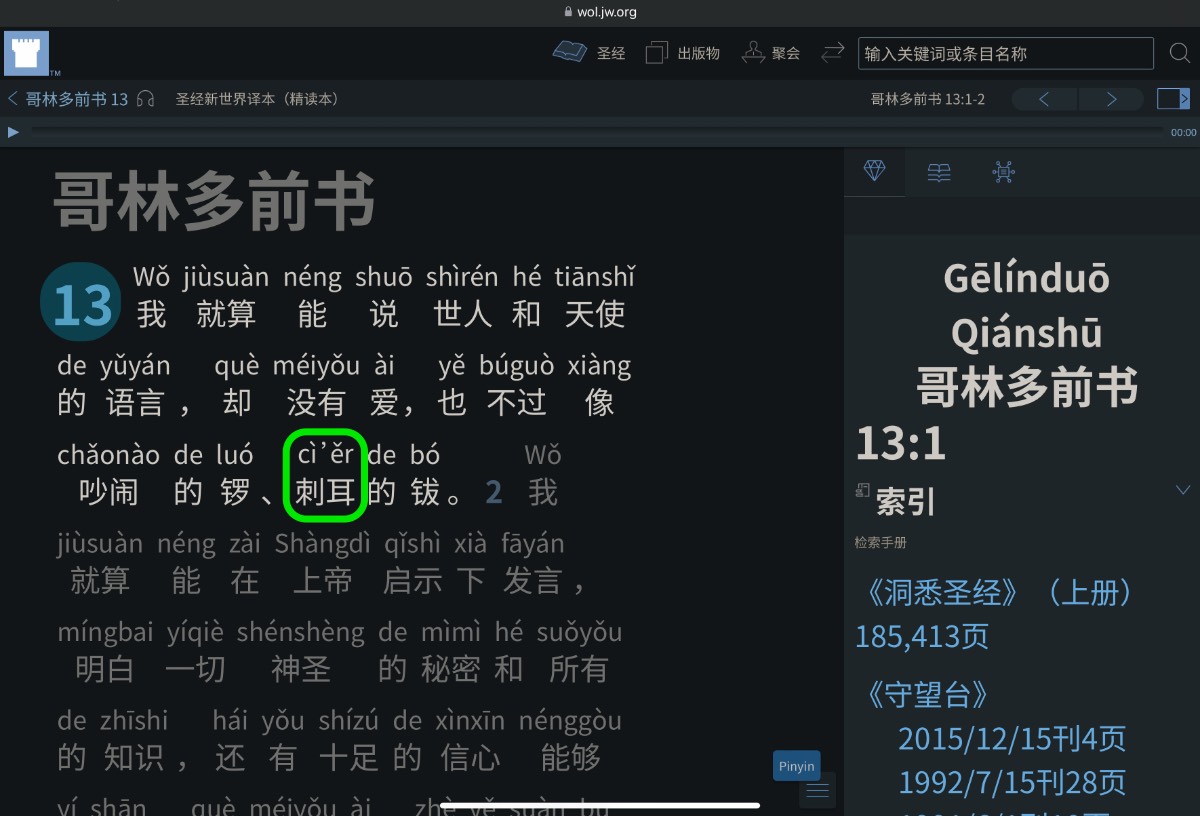
This week’s MEotW, “cì’ěr (cì’·ěr {stabs; pricks → [irritates; pierces]} · ear → [grating on the ear; jarring; ear-piercing] 刺耳), occurs in verse 1 (WOL, Pīnyīn (Pīn·yīn {Piecing Together of} · Sounds → [Pinyin] 拼音) Plus) of 1 Corinthians 13:

Screenshot of “cì’ěr” in 1 Co. 13:1 (nwtsty, CHS+_Pīnyīn_ WOL)

(Dark mode for the Watchtower ONLINE LIBRARY (WOL) website, as shown in the above image, can be enabled in the Safari web browser by using the Noir Safari extension.)

“Cì’ěr (Cì’·ěr {stabs; pricks → [irritates; pierces]} · ear → [grating on the ear; jarring; ear-piercing] 刺耳) literally means “stabs ear”, and is used in the Mandarin New World Translation Bible’s rendering of 1 Corinthians 13:1 to translate the “clashing” in “clashing cymbal”. In this context, “cì’ěr (cì’·ěr {stabs; pricks → [irritates; pierces]} · ear → [grating on the ear; jarring; ear-piercing] 刺耳) effectively means “grating on the ear; jarring; ear-piercing”.

Mandarin Field Need-Greater? Or Ear-Grater 😬?

First, let me establish that of course Jehovah and we who are in the Mandarin field deeply appreciate those who have been moved by love to come and try to learn Mandarin and help out in the Mandarin field. Given that, sometimes things do happen that can literally and figuratively grate on the ears of those who truly serve in this field out of love, and who have become acquainted with what good Mandarin sounds like.

The Tone Beast…

One time, a brother I know whose mother tongue is English gave a Mandarin talk during which so many of his tones were off that at times I was genuinely having trouble making out what words he was saying, even when I was listening closely. After that meeting, when I tried to kindly advise him that this was the case, he jokingly quipped something like ‘Well, at least I made you listen closely!’

Maybe this brother really did try his best, and maybe his reply was just an attempt to lighten the mood with some humour. He may also have felt safe using some humour because we know each other and generally get along fairly well. However, his words in this case might also be taken to show that he took his responsibility to give a good Mandarin talk a bit lightly. If so, things said with such a flippant attitude could grate on the ears of someone who views with appropriate seriousness the God-honouring and life-saving work that needs to be done in the Mandarin field.

It is true that especially for those whose mother tongue is, say, English, the tones can be one of the most difficult aspects of Mandarin for them to master, since that way of using pitch (how high or low a “note” is) is so different from how they use pitch in English. The sincere efforts of Mandarin field language learners in this regard are much appreciated!

…And How to Tame It

For those of us who are trying to learn Mandarin for the Mandarin field, it should help if we keep the following points in mind regarding Mandarin tones:

  • Tones are just as important to conveying meaning in Mandarin as vowels are to conveying meaning in English. In English, if someone says a wrong vowel, that person is not actually saying the word that person meant to say, and that person is not expressing the meaning that person meant to express. For example, there’s a world of difference between “I love you” and “I leave you”, even though it’s “only” the matter of a single vowel. Similarly, in Mandarin, if someone uses a wrong tone, that person is saying a whole different word from what that person meant to say, as shown by the classic example of “mā (ma; mom; mummy; mother)/ (hemp; flax; linen | (surname) | {[is] pocked; pockmarked; pitted; spotty} [→ [[is] rough; coarse]] | numbed; tingling | sesame麻/蔴)/ (horse [(surname)] [→ [knight chess piece; horse piece in Chinese chess | [is] big; large]])/ ({verally abuse}; curse; swear; {call names} [→ [condemn; rebuke; reprove; scold]]罵/駡)/ma ([? ptcl for “yes/no” questions]).
  • In languages like English, we may change the pitch of what we are saying to do things like add emphasis, ask a question, etc. In Mandarin, though, as explained above, the tone of a syllable—which involves how pitch is used while saying it—is an essential part of how that syllable represents meaning. So, while in English the way we use pitch while saying a word may be negotiable based on how we want to emphasize it, etc., in Mandarin, tones are non-negotiable, like our stand on blood transfusions is non-negotiable. A first tone, for example, must always be recognizable as a first tone and must not be changed into a fourth tone or something, no matter how much we want to emphasize a Mandarin word with a first tone in it!
    • How can we add emphasis in Mandarin, then? Study 10 of the Teaching (th) brocure, entitled “Modulation”, tells us that ‘we can convey ideas clearly and stir emotion by varying our volume, pitch, and pace’. So, while the pitches of Mandarin tones are non-negotiable, we can still add emphasis in Mandarin by varying volume—by speaking softer or louder—and/or by varying pace—by speaking slower or faster.
  • Wrong tones can be really cì’ěr (cì’·ěr {stabbing → [irritating]} · ear → [grating on the ear] 刺耳) because, as mentioned above, tones are made of pitch, and when one speaks with wrong pitches, it’s a lot like singing off-key—very grating to the ears of those who know how the music of the language should sound! 🎵

With the above points in mind, do the following:

  • Practise recognizing the different tones and telling them apart when listening to Mandarin speech. This is especially important if you have just recently started to learn Mandarin, and are not used to what Mandarin tones sound like yet. Such practice is needed to gradually train your hearing. As it is with determining if a musical instrument is in tune or not, eventually, with focus and practice, recognizing Mandarin tones will become easier, even second nature.
    • As you get better at being able to recognize good Mandarin tones when you hear them, that will in turn help you to make sure you speak with good Mandarin tones. Speaking of which…
  • Practise speaking with correct Mandarin tones. This is also especially important if you have just recently started to learn Mandarin, and are not used to speaking with Mandarin tones yet. Such practice is needed to gradually train your body’s system for producing speech. Beware: If you let yourself get into bad habits early on involving the tones, then you’ll have to walk a long, hard road to get rid of these bad habits later. As it is with playing a musical instrument well, eventually, with focus, study, and practice, speaking with correct Mandarin tones will become easier, even second nature. 🎸

The Cantonese Twist

As discussed in the MEotW post on “fāngyán (fāng·yán {direction → [place]} · speech → [topolect; dialect (common but misleading translation)] 方言), to those who know Mandarin well, Cantonese that is twisted to try to make it sound like Mandarin sounds awful:

Well, as someone who along with many others has come to the Mandarin field from the Cantonese field, I have had the dubious pleasure of observing how some have tried to speak Mandarin by just taking the Cantonese they knew and twisting it a little, since they were relying on the conventional wisdom that Mandarin and Cantonese are just different dialects of the same language. As well-meaning as they may have been, the results were often just as bad as when someone sings badly off-key, or as Star Trek fans may say, they often sounded like the language equivalent of a transporter accident 🙀. Even after decades in the Mandarin field, some publishers who had come over from the Cantonese field still say some Mandarin words with Cantonese-y pronunciations.

Any Cantonese-speakers who help out in the Mandarin field are very much appreciated, but it would be good for everyone involved if they realized that, contrary to worldly political propaganda, Mandarin and Cantonese are not just different dialects of the same Chinese language. Rather, as linguists recognize, Mandarin and Cantonese, being mutually unintelligible, are really different languages, like French and English are different languages. So, we should all understand and expect that as different languages, Mandarin and Cantonese have different phonologies. That is, they basically sound different, not just like slightly twisted versions of each other. Some, in fact, have compared how different Mandarin and Cantonese sound to how different chickens and ducks sound.

Avoiding Being “a Clashing Cymbal”

If I speak in the tongues of men and of angels but do not have love, I have become a clanging gong or a clashing cymbal.
1 Corinthians 13:1.

Chinese people are known for being very appreciative of Westerners who try to speak Mandarin or one of the other Chinese languages, and for often praising the spoken results of such efforts as being much better than they actually are. Beginning Chinese language learners especially are often given lots of leeway when it comes to how they sound.

After a few years or even decades, though, does our Mandarin speech, for example, still sound not much better than it did when we started learning Mandarin? Some have observed that those who focus on Chinese characters and pay relatively little attention to Mandarin speech often—unsurprisingly—don’t speak Mandarin very well. Some may say that their focusing on Chinese characters shows their love for Chinese culture, but is it not more important for Christians especially to show love for Chinese people by learning to actually understand what they say and learning to speak to them understandably? And as Witnesses of Jehovah, is it not more important to show love for Jehovah by being able to speak clearly, understandably, and movingly in Mandarin about him and the good news of his Kingdom?

While a lot of leeway is rightly given to beginning Mandarin language leaners, one not progressing after learning Mandarin for a long time might in some cases give at least the impression of a lack of caring, a lack of love on the part of that one. (Hebrews 5:12) As humans, we can often tell if something has not been made, done, or said lovingly, with care, for example, if not much attention to “details” like tones is evident. On the other hand, even if some music is performed or something is said in a way that may show only a modest amount of skill or talent, but that does show a lot of love, people often appreciate that more than if one is displaying great skill or talent, but is only doing so to show off or something. Such a one would indeed seem like “a clanging gong or a clashing cymbal”, or, as the Mandarin NWT Bible says, a “chǎonào ({(disturbing by) making noise} 吵闹 吵鬧) de (’s 的) luó (gong), cì’ěr (cì’·ěr {stabbing → [irritating]} · ear → [grating on the ear] 刺耳) de (’s 的) (cymbal)”.—1 Corinthians 13:1 (English, Mandarin).

Categories
Culture History Science

kǎlā’OK

kǎlā’OK (karaoke 卡拉OK) ← Tap/click to show/hide the “flashcard”

The selection of this week’s MEotW, “kǎlā’OK (karaoke 卡拉OK)”, was inspired by a Twitter thread of epic linguistic and etymological nerdery that I recently came across, which begins with this tweet:

Here are some of the tweets in this thread, which summarize how “kǎlā’OK (karaoke 卡拉OK)” became a word in Mandarin:

Borrowed Culture

In addition to “kǎlā’OK (karaoke 卡拉OK)”, another Mandarin word which borrowed from Japanese culture, which borrowed from Western culture, is “wénhuà (wén·huà {(with) writing} · transformed (system) → [culture] | {(with) writing} · transformed → [cultural] 文化)”, the Mandarin word for culture itself. As the MEotW post about that word says:

To translate the Western concept of culture, the Japanese coined the word bunka, which is written 文化 (see Liu, Zhengtan et al. 1984, s.v. wenhua). The Chinese imported this character combination from Japan and pronounced it according to the rules of their own language: wénhuà.
“Two Steps Toward Digraphia in China”, by Xieyan Hincha

So, people going on about “pure” Chinese culture are ignorant or in denial about the reality of how other cultures have influenced Chinese culture, and about what a great, enriching thing that can be. Anyone who has been in a group or congregation with people predominantly from a single cultural background, and who has also had the pleasure of being in a group or congregation with people from a variety of cultural backgrounds, has had the opportunity to see how the atmosphere of the latter situation can be a breath of fresh air compared to the relatively narrow—and potentially narrow-minded—cultural worldview that is sometimes allowed to be present in the former situation. Some parts of the world too are starting to realize the advantages of considering various cultural inputs, compared to trying to be productive or creative in a monocultural bubble.

Indeed, the proud “not invented here” logic of Chinese cultural purists who would, for example, reject Pīnyīn (Pīn·yīn {Piecing Together} · Sounds → [Pinyin] 拼音) because it uses letters from the Latin alphabet would also require us to reject things like European-style punctuation, Arabic numerals, and kǎlā’OK (karaoke 卡拉OK) because of their foreign-to-China origins. But, Chinese culture without kǎlā’OK (karaoke 卡拉OK)? How dreary! Next, they’ll be wanting us to do long division using Chinese characters—十一, 九十九, 一千八百三十六, …—instead of Arabic numbers, and they’ll be wanting us to read and decipher Chinese writings the old-fashioned way, without the “crutch” of those decadent European punctuation marks! 😱

(Of course, with kǎlā’OK (karaoke 卡拉OK), as with anything that may involve worldly culture and music—which can possibly include some bad things along with the good things—Christians must be selective, exercising good spiritual judgement and following their Bible-trained consciences.)

As members of the international brotherhood of Jehovah’s people, and as ones “taught by Jehovah” himself, we need not be content with, let alone proud of, a particular way of doing things prescribed by human, worldly Chinese cultural tradition.—1 Peter 5:9; Isaiah 54:13; 1 Corinthians 1:31; 1 John 2:17; Mark 7:1–13.