Categories
Culture Experiences History Language Learning Technology Theocratic

zìxué‐chéngcái

zìxué‐chéngcái ((zì·xué self · learned; studied 自学 自學)‐(chéng·cái became · {capable person} 成才) [[be] self-taught]) 👈🏼 Tap/click to show/hide the “flashcard”

[Notes: Tap/click on a Pīnyīn (Pīn·yīn {Piecing Together of} · Sounds → [Pinyin] 拼音) expression to reveal its “flashcard”; tap/click on a “flashcard” or its Pīnyīn (Pīn·yīn {Piecing Together of} · Sounds → [Pinyin] 拼音) expression to hide the “flashcard”. 📖 📄 📘 icons mean 📖 Reveal All, 📄 Reveal Advanced, and 📘 Reveal None re all the “flashcards” in the heading, paragraph, etc. that they are placed at the beginning of.]

Recently, jw.org featured the video “Benjamin Boothroyd—A Self-Taught Bible Scholar”. Where the English title of this video uses the expression “self-taught”, the title of the Mandarin version uses this week’s MEotW, “zìxué‐chéngcái ((zì·xué self · learned; studied 自学 自學)‐(chéng·cái became · {capable person} 成才) [[be] self-taught])”:

English:

Benjamin Boothroyd—A Self-Taught Bible Scholar

Mandarin:

📖 📄 📘 Běnjiémíng (Benjamin 本杰明 本傑明) Bùsīluóyīdé (Boothroyd 布思罗伊德 布思羅伊德): Zìxué‐Chéngcái ((Zì·xué Self · Learned 自学 自學)‐(Chéng·cái Became · {Capable Person} 成才) [Self-Taught]) de (’s 的) Shèngjīng (Shèng·jīng Holy · Scriptures → [Bible] 圣经 聖經) Xuézhě (Xué·zhě Studying · Person → [Scholar] 学者 學者)

The Morphemes

The first morpheme in this week’s MEotW, “zì (self | from; since 自)”, here means “self”, as it does in “zìjǐ (self[’s] 自己)”. The next morpheme, “xué (learn/learning | study [→ [imitate]])”, here means “learned; studied”. Another expression in which it appears is “xuésheng (xué·sheng learning · {growing (one) → [student]} → [student; pupil] 学生 學生)”, which means “student”. These first two morphemes, when put together to form “zìxué (zì·xué self · learn; study 自学 自學)”, refer to learning or studying by oneself.

The third morpheme in this week’s MEotW, “chéng (become; {come to be}; {to turn into}; {to complete}; accomplish; succeed; {fully developed/grown}; {assume [the shape of]}; {to fill} | {to completion} 成)”, here means “became”. It also appears in many other expressions, including “chéngwéi (chéng·wéi become · {to be} 成为 成為) and “chénggōng (chéng·gōng {becoming [of]}; {accomplishing [of]} · {meritorious service/deed}; achievement → [succeed | success | successful[ly]] 成功)”. The final morpheme “cái ({only then} | {only (before a number)} | actually; really; very | talent; ability; gift | {capable person} | {person of a certain type}才/纔) in this context means “capable person”. So, “chéngcái (chéng·cái become · {capable person} 成才) here means “became capable person”, and the entire expression “zìxué‐chéngcái ((zì·xué self · learned; studied 自学 自學)‐(chéng·cái became · {capable person} 成才) [[be] self-taught]) literally means “self-learned/studied, became capable person”, and effectively means “self-taught”.

Being Self-Taught in the Mandarin Field

Apart from the introductory organization-sponsored language classes that many of us took, we Mandarin field language learners are pretty much all self-taught with regard to Mandarin, especially when it comes to the somewhat specialized Mandarin that we must use in the Mandarin field. But does being largely self-taught mean that none of us can really be any good at Mandarin? Are we doomed to plateau at a mediocre level at best?

One thing I appreciated from the video mentioned above is that Benjamin Boothroyd, who was self-taught but became a world-class Bible scholar and translator, was motivated only to pursue the truth. As he wrote (as mentioned in the English video starting at the 6:38 mark):

I have no interest to serve but that of truth.

Regarding those with such a focus on the truth, at John 18:37, Jesus said:

For this I have been born, and for this I have come into the world, that I should bear witness to the truth. Everyone who is on the side of the truth listens to my voice.

Those who are “on the side of the truth” and who listen to Jesus’ voice open themselves up to receiving the most important education we can get. This best possible education comes from Jehovah God himself, not any worldly or human source. As Isaiah 54:13 says:

And all your sons will be taught by Jehovah,
And the peace of your sons will be abundant.

Even when it comes to nontrivial technical matters, Jehovah can help certain ones develop the technical knowledge, skills, and expertise that are needed to accomplish his will. For example, as Exodus 35:30–35 tells us, he did so when some specialized technical work needed to be done when Moses and the Israelites were in the wilderness:

30 Then Moses said to the Israelites: “See, Jehovah has chosen Bezʹal·el the son of Uʹri the son of Hur of the tribe of Judah. 31 He has filled him with the spirit of God, giving him wisdom, understanding, and knowledge of every sort of craftsmanship 32 for making artistic designs, for working with gold, silver, and copper, 33 for cutting and setting stones, and for making all kinds of artistic wood products. 34 And he has put it into his heart to teach, he and O·hoʹli·ab the son of A·hisʹa·mach of the tribe of Dan. 35 He has filled them with skill to do all the work of a craftsman, an embroiderer, and a weaver using blue thread, purple wool, scarlet material, and fine linen, and of a loom worker. These men will do every sort of work and prepare every sort of design.

Yes, if we focus on the truth and stay open to Jehovah’s direction, we can make “self-taught” also mean “taught by Jehovah”! And since Jehovah created this universe that human scientists, technicians, artists, musicians, etc. are just trying to figure out and work in, he can, if he wants to, even potentially teach us to become more knowledgeable and skilled in certain fields than many worldly humans are, as he may have done with Bezʹal·el and O·hoʹli·ab.—Psalm 119:98–100.

Modern Resources for Mandarin Self-Learning

In support of our efforts to be successfully self-taught in effectively using Mandarin to praise and serve Jehovah, we today are blessed with many available resources, the likes of which Bezʹal·el, O·hoʹli·ab, and Mr. Boothroyd would undoubtedly have loved to have had access to. For example, one of the basic things that teaching and learning require is the transfer of information to those seeking to learn, and in that regard, we humans today generally have access to, at reasonable cost, computing—i.e., information-processing—devices that can easily be carried by hand, but that are, in some ways, millions of times more capable than the Apollo Guidance Computer (AGC) that guided the Apollo 11 spacecraft to the moon.

In addition to these mobile devices themselves, we should also consider the apps and the text, audio, video, etc. content that they enable us to use to help us learn Mandarin. These include the JW Language app, as well as the JW Library app that now allows for content that displays Pīnyīn (Pīn·yīn {Piecing Together of} · Sounds → [Pinyin] 拼音). Here are a couple of short links listing some of the resources available for Mandarin field language learners:

No Need to Have Impostor Syndrome in the Mandarin Field

In view of the above, if Jehovah has guided us to serve in the Mandarin field, we need not allow ourselves to be burdened with impostor syndrome, even if we haven’t received extensive worldly training in the Mandarin language. If we let ourselves be “taught by Jehovah” instead of just relying on our own talent or abilities or on mere worldly knowledge or human traditions, and if we resolutely make good use of the available resources and apply ourselves to learn whatever we need to learn in order to do Jehovah’s work well, Jehovah can and will bless our efforts and help us succeed. Also, if we follow Boothroyd’s example and pursue truth rather than “glory from men”, then the truth will be able to set us free from the unnecessary burdens imposed by proud but fallacious human traditions such as those involving Chinese characters. (John 5:41–44; 8:32) As the apostle Paul said at 1 Corinthians 1:26–31:

26 For you see his calling of you, brothers, that there are not many wise in a fleshly way, not many powerful, not many of noble birth, 27 but God chose the foolish things of the world to put the wise men to shame; and God chose the weak things of the world to put the strong things to shame; 28 and God chose the insignificant things of the world and the things looked down on, the things that are not, to bring to nothing the things that are, 29 so that no one might boast in the sight of God. 30 But it is due to him that you are in union with Christ Jesus, who has become to us wisdom from God, also righteousness and sanctification and release by ransom, 31 so that it may be just as it is written: “The one who boasts, let him boast in Jehovah.”

Categories
Culture Experiences History Language Learning Science Technology Theocratic

jídù

jídù ({being jealous [of]}; envying 嫉妒) 👈🏼 Tap/click to show/hide the “flashcard”

[Notes: Tap/click on a Pīnyīn (Pīn·yīn {Piecing Together of} · Sounds → [Pinyin] 拼音) expression to reveal its “flashcard”; tap/click on a “flashcard” or its Pīnyīn (Pīn·yīn {Piecing Together of} · Sounds → [Pinyin] 拼音) expression to hide the “flashcard”. 📖 📄 📘 icons mean 📖 Reveal All, 📄 Reveal Advanced, and 📘 Reveal None re all the “flashcards” in the heading, paragraph, etc. that they are placed at the beginning of.]

I have long especially liked 1 Corinthians 13. It contains counsel on what really does and doesn’t matter in life, an extensive description and definition of the most important kind of love, and a sublime discussion about the need to become complete, mature, as a person. As these apply to life in general, so too do they apply to our lives as Mandarin field language learners.

As Mandarin field language learners, it can benefit us greatly to consider what we can learn from 1 Corinthians 13, and along the way, we can also consider some of the Mandarin expressions used in that chapter in the current version of the Mandarin New World Translation Bible (nwtsty).

Two Ways About It

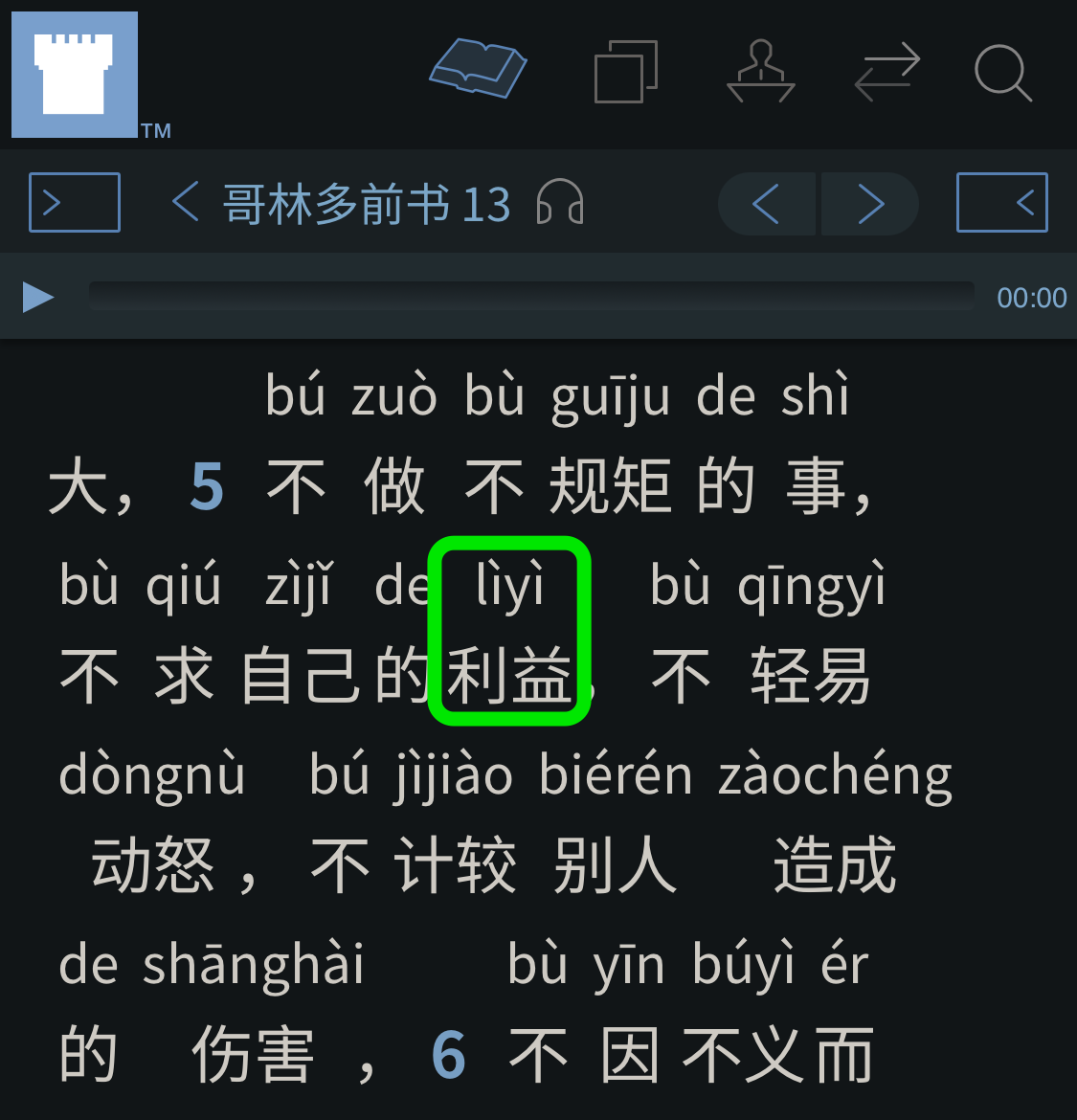
This week’s MEotW, “jídù ({being jealous [of]}; envying 嫉妒)”, is used in verse 4 (WOL) of 1 Corinthians 13:

Screenshot of “_jídù_” in 1 Co. 13:4 (nwtsty, CHS+_Pīnyīn_ WOL)

(Dark mode for the Watchtower ONLINE LIBRARY (WOL) website, as shown in the above image, can be enabled in the Safari web browser by using the Noir Safari extension. Other web browsers may also have extensions with similar functionality.)

For comparison, here are the current English and Pīnyīn (Pīn·yīn {Piecing Together of} · Sounds → [Pinyin] 拼音) Plus renderings of 1 Corinthians 13:4:

English:

Love is patient and kind. Love is not jealous. It does not brag, does not get puffed up,

Pīnyīn (Pīn·yīn {Piecing Together of} · Sounds → [Pinyin] 拼音) Plus:

📖 📄 📘 Ài (love), yǒu (has 有) nàixīn (nài·xīn {being (of/with) enduring} · heart → [patience] 耐心), yòu (also 又) réncí (rén·cí {is kind} 仁慈). Ài (love), (not 不) jídù ({is jealous} 嫉妒), (not 不) chuīxū (chuī·xū {does puff → [does brag]} · {does sigh → [does praise]} → [does brag] 吹嘘 吹噓), (not 不) zìdà (zì·dà {(does consider) self} · {to be big → [to be great]} 自大),

Both of the morphemes in “jídù ({being jealous [of]}; envying 嫉妒) mean “be jealous of” or “envy”. Interestingly, these morphemes can be reversed to produce “dùjí ({being jealous [of]}; envying 妒嫉)”, which means the same thing as “jídù ({being jealous [of]}; envying 嫉妒)”. In this respect, these expressions are like “fǎlǜ (law 法律) and “lǜfǎ (law 律法)”. The MEotW post on “fǎlǜ (law 法律) had this to say about this situation:

But, Why?

If “lǜfǎ (law 律法)” and “fǎlǜ (law 法律)” both mean basically the same thing, why did the world’s Mandarin-speaking population bother to switch the order of “ (law; statute; rule; regulation 律)” and “ (law | method; way; mode | standard; model | {magic arts} | {follow; model after} 法)” in popular usage? Who knows? Appendix A2 of the Mandarin NWT Bible, probably wisely, does not get into the why of it, just mentioning that “fǎlǜ (law 法律)” is now the more common usage. Even if it turns out that there was a reason, it may not be what most would consider a good reason. Sometimes people are just weird, and, speaking as a Chinese person myself, that includes Chinese people—just look at some of the arbitrary ways in which Chinese characters have been designed, that have turned trying to figure out the pronunciations and meanings of unfamiliar Chinese characters into a guessing game.

Speaking of what’s commonplace or popular and why, I am reminded of this quote from William Goldman, who wrote the screenplay for The Princess Bride as well as the screenplays for several other successful, well-known movies:

Nobody knows anything…Not one person in the entire motion picture field knows for a certainty what’s going to work. Every time out it’s a guess

Regarding which Mandarin expression for “be jealous of” is better to use in the Mandarin field, in the Chinese Mandarin (Simplified) version of the Watchtower Online Library (WOL), searching yielded only 6 occurrences of “妒嫉” (“dùjí ({being jealous [of]}; envying 妒嫉)”), occurring between 1960 and 1974 and fitting on a single page, while there were multiple pages of results for “嫉妒” (“jídù ({being jealous [of]}; envying 嫉妒)”), including many occurrences in the current Mandarin New World Translation Study Bible (nwtsty). So, clearly, the organization now uses “jídù ({being jealous [of]}; envying 嫉妒) regularly, and no longer uses “dùjí ({being jealous [of]}; envying 妒嫉)”.

No Way to Live, or Love

While there may be two ways of saying “being jealous” in Mandarin, being jealous is no way to live, or love. Regarding jealousy, the recent MEotW post on “shíjí (shí·jí ten · {(stair)step [→ [level; rank; grade; class]]} [→ [master/expert level (coll)]] 十级 十級) said:

Speaking of being an expert, is that a bad thing? Some of those around us, perhaps out of insecurity or jealousy, may seek to “keep us in our place” if we get “uppity”, exhibit “pretensions of grandeur”, and actually try to be good at something, perhaps better at it than they are. (Matthew 13:54–58)…

However, God’s Word…encourages us to actually give Jehovah the best “sacrifice of praise” that we can. (Malachi 1:6–8; Hebrews 11:4; 13:15) So, ignore any insecure or jealous naysayers around you, and as Jesus said, “let your light shine” in the Mandarin field, even at shíjí (shí·jí ten · {(stair)step → [level]} → [expert level (coll)] 十级 十級) if you can, not to glorify yourself, but to glorify our heavenly Father Jehovah.—Matthew 5:16.

Also, the MEotW post on “guīju (guī·ju [([is] following)] {compasses; dividers → [rules; regulations]} · {carpenter’s squares → [rules; regulations]} → [[[is] following] rules; customs; established practices/standards | [[is] following] social etiquette; manners | [is] well-behaved; well-disciplined] 规矩 規矩) contains the following:

“Strife and Jealousy”

In the New World Translation Bible in the Watchtower Online Library, one of the scriptures linked to 1 Corinthians 13:5 with regard to “indecently” is Romans 13:13:

Let us walk decently as in the daytime, not in wild parties and drunkenness, not in immoral intercourse and brazen conduct, not in strife and jealousy.

Note that among the things that God’s Word lists as being indecent, along with things like drunkenness and sexual immorality, are “strife and jealousy”.

If someone makes an issue of a Mandarin field language learner who, say, uses Pīnyīn (Pīn·yīn {Piecing Together of} · Sounds → [Pinyin] 拼音) instead of following tradition and exclusively focusing on characters, is that person not being like those who made an issue of Jesus healing on the Sabbath? Instead of being happy and joyful because of the good that Jesus was doing, those opposers of Jesus were jealous of how “the entire crowd began to rejoice at all the glorious things he did”. (Luke 13:17) Opposers of Pīnyīn (Pīn·yīn {Piecing Together of} · Sounds → [Pinyin] 拼音) use today may similarly be jealous of how those who make good use of Pīnyīn (Pīn·yīn {Piecing Together of} · Sounds → [Pinyin] 拼音) can accomplish much in Jehovah’s service without having to put the kind of blood, sweat, and tears into learning characters the traditional way that they did. In their tradition-loving eyes, breaking from tradition and using innovative and game-changingly effective new tools like Pīnyīn (Pīn·yīn {Piecing Together of} · Sounds → [Pinyin] 拼音) may seem “indecent”, but in God’s eyes, it is the jealousy-motivated strife such ones cause over people doing good in his service that is truly indecent.

In God's organization, our unity is based on God's truth, not on human tradition.

[image or embed]

— tiandi, Links News (@tiandilinksnews.bsky.social) February 2, 2025 at 8:27 AM

Those who are motivated by true Christian love, as described in 1 Corinthians 13, would rejoice over how Pīnyīn (Pīn·yīn {Piecing Together of} · Sounds → [Pinyin] 拼音) helps Mandarin field language learners to bear witness to the truth more effectively, instead of considering it “cheating”, since love “rejoices with the truth”. (John 18:37; 1 Corinthians 13:6) Also, those who are motivated by true Christian love would not be jealous of how game-changing tools like Pīnyīn (Pīn·yīn {Piecing Together of} · Sounds → [Pinyin] 拼音) help Mandarin field language learners to more easily get more done, since “love is not jealous”. (1 Corinthians 13:4)…

The Needs of the Many, the Needs of the One

Interestingly, the collectivism of worldly Chinese culture may tend to drive people to be jealous, to hold zero-sum beliefs (that one person’s gain must mean another person’s loss), and to “feel bad about themselves when their friends succeed”. In contrast, real Christian love and true empathy move people to “rejoice with those who rejoice”. (Romans 12:15) The MEotW post on “jítǐ zhǔyì ((jí·tǐ gathered; collected · {body [→ [style; form]]} → [collective] 集体 集體) (zhǔ·yì master · meaning → [-ism] 主义 主義) [collectivism; community spirit]) touched on this:

Self-Identity and Balanced Self-Love

Self-identity is one thing that can particularly be a struggle for those raised in collectivistic societies, since the self is relatatively often neglected in such societies. It’s perhaps not surprising then, that, as mentioned above, in the relatively collectivistic Chinese societies, with their relative paucity, or scarcity, of more healthy ways to build and maintain self-identity, so many have such an unhealthy, obsessive attachment to Chinese characters, as something to desperately hang their neglected self-identities on.

Categories
Culture Current Events Experiences Language Learning Science Technology Theocratic

cōnghuì

cōnghuì (cōng·huì {[is] quick at hearing → [[is] intelligent; bright; clever; sharp-witted]} · {[is] intelligent; bright} → [[is] intelligent; bright; witty] 聪慧 聰慧) 👈🏼 Tap/click to show/hide the “flashcard”

[Notes: Tap/click on a Pīnyīn (Pīn·yīn {Piecing Together of} · Sounds → [Pinyin] 拼音) expression to reveal its “flashcard”; tap/click on a “flashcard” or its Pīnyīn (Pīn·yīn {Piecing Together of} · Sounds → [Pinyin] 拼音) expression to hide the “flashcard”. 📖 📄 📘 icons mean 📖 Reveal All, 📄 Reveal Advanced, and 📘 Reveal None re all the “flashcards” in the heading, paragraph, etc. that they are placed at the beginning of.]

The Shēngmìng Láizì Chuàngzào Ma? ((Shēngmìng Life 生命) (Lái·zì Came · From 来自 來自) (Chuàng·zào Initiating · {Making, Creating} → [Creating] 创造 創造) (Ma [? ptcl for “yes/no” questions])? [Was Life Created? (lc)]) (Was Life Created? (lc)) brochure and the Shēngmìng de Qǐyuán—Zhíde Sīkǎo de Wǔ Ge Wèntí ((Shēngmìng Life 生命) (de ’s 的) (Qǐ·yuán {Rising → [Starting]} · Source → [Origin] 起源/原)—(Zhí·de Worth · Getting → [Worth] 值得) (Sī·kǎo {Thinking About} · Examining 思考) (de ’s 的) (Wǔ Five 五) (Ge [mw]個/个) (Wèn·tí Asking · Subjects → [Questions] 问题 問題) [The Origin of Life—Five Questions Worth Asking (lf)]) (The Origin of Life—Five Questions Worth Asking (lf)) brochure were originally published back in 2010, but relatively recently, the English version of the Was Life Created? brochure was updated to the December 2022 Printing, and the Mandarin version of it was updated to the February 2023 Printing. Also, the Was Life Created? brochure and the Origin of Life brochure are now in the Teaching Toolbox section in the JW Library app. So, it would be good to consider some of the expressions used in the Mandarin versions of these publications that can be so helpful when discussing whether life was created.

“There Is No Intelligent Creator”?

This week’s MEotW, which appears in the section of the Mandarin Was Life Created? brochure entitled “Nǐ (You 你) Xiāngxìn (Xiāng·xìn It · {Do Believe} → [Do Believe] 相信) Shénme (Shén·me What · [suf] 什么 什/甚麼) Ne ([? ptcl] 呢)?” (“What Do You Believe?”), is “cōnghuì (cōng·huì {[is] quick at hearing → [[is] intelligent; bright; clever; sharp-witted]} · {[is] intelligent; bright} → [[is] intelligent; bright; witty] 聪慧 聰慧)”:

English:

Will you trust the claims of those who say that there is no intelligent Creator and that the Bible is unreliable? Or will you examine what the Bible actually says?

Mandarin (WOL; Pīnyīn (Pīn·yīn {Piecing Together of} · Sounds → [Pinyin] 拼音) Plus)

📖 📄 📘 Yǒuxiē (Yǒu·xiē {(there) are having → [(there) are]} · some 有些) rén (people 人) shuō (saying說/説) méiyǒu (méi·yǒu (there) not · {is having → [is]} → [(there) does not exist] 没有 沒有) cōnghuì (cōng·huì {quick at hearing → [intelligent]} · intelligent → [intelligent] 聪慧 聰慧) de (’s 的) Zàowù‐Zhǔ ((Zào·wù Created · Things 造物)‐(Zhǔ Master 主) [Creator]), Shèngjīng (Shèng·jīng (the) Holy · Scriptures → [the Bible] 圣经 聖經) (also 也) (not 不) kěkào (kě·kào {is able} · {to be leaned on → [to be relied on]} → [is reliable] 可靠), (you 你) xiāngxìn (xiāng·xìn them · {do believe} → [do believe] 相信) tāmen de ((tā·men him/her · [pl] → [them] 他们 他們) (de ’s 的) [their]) huà (words) ma ([? ptcl for “yes/no” questions])? Háishi (Hái·shi {still more → [or]} · {is (it) that} 还是 還是) huì ((you) will) qīnzì (qīn·zì {in person} · self 亲自 親自) kànkan (kàn·kan {look at} · {look at} 看看) Shèngjīng (Shèng·jīng (the) Holy · Scriptures → [the Bible] 圣经 聖經) dàodǐ (dào·dǐ to · bottom → [in the final analysis] 到底) zěnme (zěn·me what · [suf] 怎么 怎麼/麽) shuō (says說/説) ne ([? ptcl] 呢)?

As can be seen from the above quotes, the Mandarin Was Life Created? brochure uses “cōnghuì (cōng·huì {[is] quick at hearing → [[is] intelligent; bright; clever; sharp-witted]} · {[is] intelligent; bright} → [[is] intelligent; bright; witty] 聪慧 聰慧) to effectively mean “intelligent”. Related expressions include “cōngming (cōng·ming {[is] quick at hearing → [[is] intelligent; bright; clever; sharp-witted]} · {[is] bright → [[is] understanding]} 聪明 聰明)”, which has the same first morpheme as “cōnghuì (cōng·huì {[is] quick at hearing → [[is] intelligent; bright; clever; sharp-witted]} · {[is] intelligent; bright} → [[is] intelligent; bright; witty] 聪慧 聰慧)”, and “zhìhuì (zhì·huì wisdom · intelligence → [wisdom] 智慧)”, which has the same second morpheme.

Note that the first morpheme in “cōnghuì (cōng·huì {[is] quick at hearing → [[is] intelligent; bright; clever; sharp-witted]} · {[is] intelligent; bright} → [[is] intelligent; bright; witty] 聪慧 聰慧) literally means “quick at hearing”. This may remind us of the scripture at James 1:19:

Know this, my beloved brothers: Everyone must be quick to listen, slow to speak, slow to anger,

Brains and Brawn

These days, people in the world are making a big deal about what artificial intelligence can do, but in many ways, current artificial intelligence is not even as intelligent and sensible as an average human child, so of course it cannot compare with the original Divine Intelligence, the Almighty God Jehovah. Is madly pursuing artificial intelligence—that in many ways is not really that intelligent, that does not love humans back, and that could prove to be beyond humans’ ability to control—really an intelligent thing to be doing? Are the feverish efforts to develop ever more powerful artificial intelligence really about intelligence, or the blind pursuit of power?

Many in this world, including dictators (and wannabe dictators) and their supporters, certain varieties of technology enthusiasts, people intent on climbing the corporate ladder, etc., have shown that they simple-mindedly and hard-heartedly worship power above all else, and that they dismiss the value of intelligence (and also dismiss such vital things as love and justice as being inconsequential).

Regarding how many view knowledge and intelligence, famous science fiction writer and professor Isaac Asimov said this about a common attitude he observed in the USA:

There is a cult of ignorance in the United States, and there has always been. The strain of anti-intellectualism has been a constant thread winding its way through our political and cultural life, nurtured by the false notion that democracy means that “my ignorance is just as good as your knowledge.”

Actually, though, in many situations, sufficient intelligence can make all the difference. What difference can intelligence make? I remember that when I watched the movie Jurassic Park (which is about dinosaurs that humans recreate, and that then prove to be beyond the humans’ ability to control), the time I found the predatory velociraptors most scary was not when they were using their teeth, claws, or speed, or otherwise showing how powerful they were. Rather, it was when one of them showed considerable intelligence and figured out how to turn a door handle to open the door that children it was chasing were hiding behind.

Yes, sufficient intelligence, or wisdom, can be the difference between whether something gets done—even something as simple as opening a door—and if it never gets done. This is so even if much power is involved, and it is so no matter how long random chance is allowed to “work” on it. Jehovah God’s creative wisdom and intelligence, in addition to his almighty power, are certainly evident all around us in the natural world, in things that could never have come into existence without them. As Psalm 104:24 and Jeremiah 10:12 say:

How many your works are, O Jehovah!
You have made all of them in wisdom.
The earth is full of what you have made.

He is the Maker of the earth by his power,
The One who established the productive land by his wisdom
And who stretched out the heavens by his understanding.

Working Hard and Working Smart

Speaking of intelligence, sometimes Mandarin learners who work smart by using Pīnyīn (Pīn·yīn {Piecing Together of} · Sounds → [Pinyin] 拼音) whenever they can are accused by Chinese character chauvinists (masochists?) of being unwilling to work hard. However, does working smart necessarily mean not working hard? The best results actually come from doing both—working hard and working smart—not just doing one or the other.

And really, are we not showing an anti-intelligence and anti-wisdom attitude if we oppose doing God’s work the easy way in order to support doing things the hard way, just for the sake of preserving human tradition? Do we want to be part of the “cult of ignorance”?


For convenience:

The direct link for the current-generation Pīnyīn (Pīn·yīn {Piecing Together of} · Sounds → [Pinyin] 拼音) Plus resource for the Was Life Created? brochure is:

The short link for Chinese field language-learning links for the Was Life Created? brochure is:

More Pīnyīn (Pīn·yīn {Piecing Together of} · Sounds → [Pinyin] 拼音) and Pīnyīn (Pīn·yīn {Piecing Together of} · Sounds → [Pinyin] 拼音) Plus web material based on the Mandarin Was Life Created? brochure will be made available in the Pīnyīn (Pīn·yīn {Piecing Together of} · Sounds → [Pinyin] 拼音) Plus web resource as time allows.