dòngnù+
(dòng·nù
{have moved} · anger; rage; fury →[get angry; lose temper; fly into a rage]
动怒
動怒) 👈🏼 Tap/click to show/hide the “flashcard”
[Notes:Tap/click on a Pīnyīn
(Pīn·yīn
{Piecing Together of} · Sounds →[Pinyin]
拼音) expression to reveal its “flashcard”; tap/click on a “flashcard”or its Pīnyīn
(Pīn·yīn
{Piecing Together of} · Sounds →[Pinyin]
拼音) expression to hide the“flashcard”. 📖📄 ➕ icons mean 📖Reveal All, 📄Reveal Advanced, and ➕ Reveal + Symbols re all the “flashcards” in the heading, paragraph, etc. that they are placed at the beginning of.]
I have long especially liked 1 Corinthians 13. It contains counsel on what really does and doesn’t matter in life, an extensive description and definition of the most important kind of love, and a sublime discussion about the need to become complete, mature, as a person. As these apply to life in general, so too do they apply to our lives as Mandarin field language learners.
As Mandarin field language learners, it can benefit us greatly to consider what we can learn from 1 Corinthians 13, and along the way, we can also consider some of the Mandarin expressions used in that chapter in the current version of the Mandarin New World Translation Bible (nwtsty).
Moved to Anger
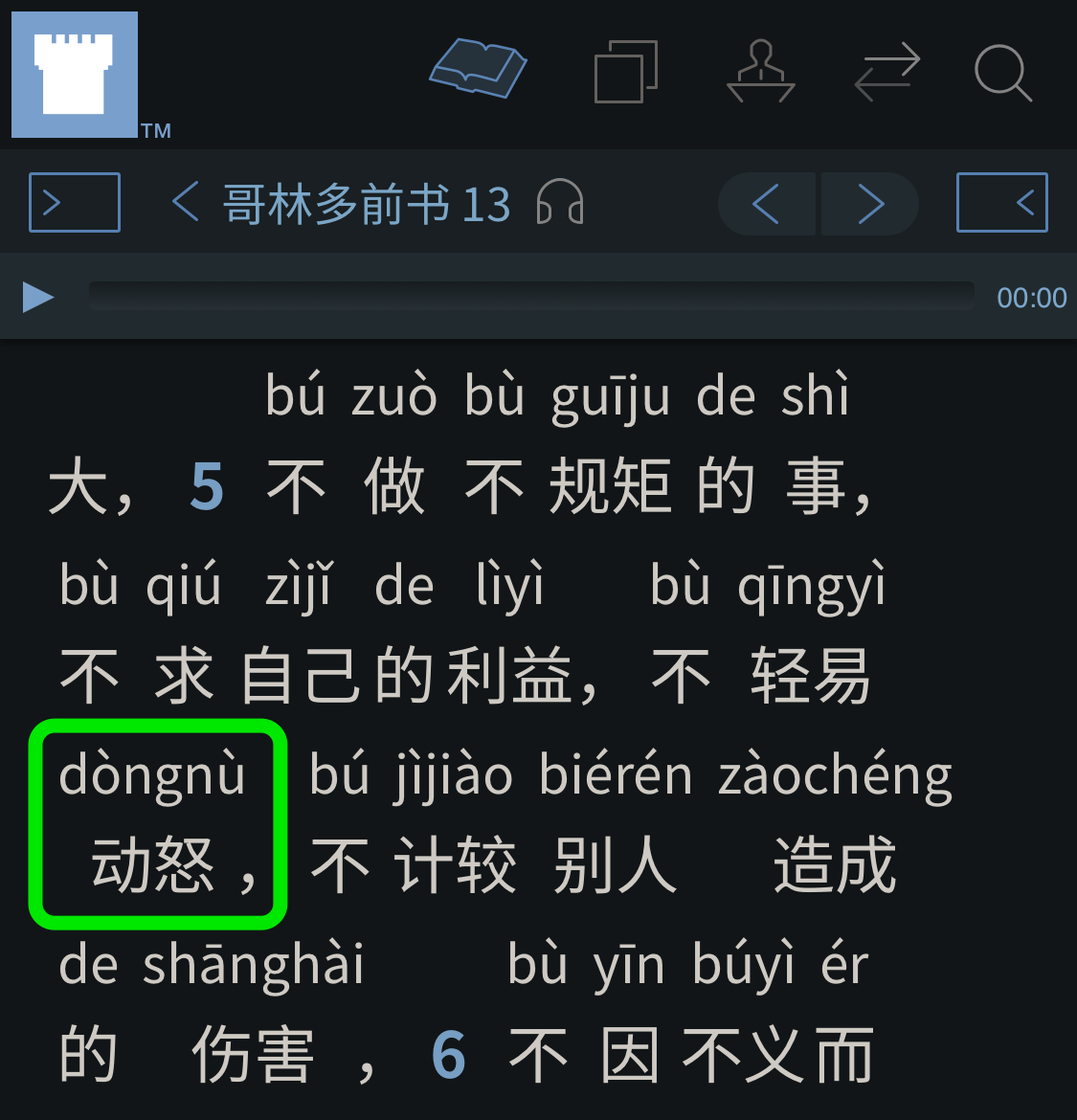
This week’s MEotW, “dòngnù
(dòng·nù
{have moved} · anger; rage; fury →[get angry; lose temper; fly into a rage]
动怒
動怒)”, is used in verse 5 (WOL) of 1 Corinthians 13:
(Dark mode for the Watchtower ONLINE LIBRARY (WOL) website, as shown in the above image, can be enabled in the Safari web browser by using the Noir Safari extension. Other web browsers may also have extensions with similar functionality.)
For comparison, here are the current English and Pīnyīn
(Pīn·yīn
{Piecing Together of} · Sounds →[Pinyin]
拼音) Plus renderings of 1 Corinthians 13:5:
In the example above, the Mandarin phrase “bù
(not
不)qīngyì
(qīng·yì
lightly · easily
轻易
輕易)dòngnù
(dòng·nù
{does have moved} · anger →[does get angry]
动怒
動怒)” corresponds with the English phrase “does not become provoked”. As for the morphemes in “dòngnù
(dòng·nù
{have moved} · anger; rage; fury →[get angry; lose temper; fly into a rage]
动怒
動怒)”, they literally mean “have moved anger/rage/fury”, and effectively mean “get angry; lose one’s temper; fly into a rage”.
Angrily Holding On to Tradition
I remember more than one Mandarin field language learner who reacted angrily when I suggested that using Pīnyīn
(Pīn·yīn
{Piecing Together of} · Sounds →[Pinyin]
拼音) more and deemphasizing characters would help them progress in learning Mandarin. Rather than appreciating the evident truth of what I was saying, or being thankful that I was trying to help them, they seemed offended and upset that I had dared to suggest something so out of step with the human traditions that they had been taught all their lives, and, perhaps, indignant that I had, in their estimation, dismissed and invalidated the blood, sweat, and tears that they had personally invested for years and years into the long, hard, bitter struggle that is learning characters.
On the one hand, some may say that such reactions are only human, but on the other hand, the words of 1 Corinthians 13:5 that love “does not become provoked” show that actually, such ones are not completely acting out of Christian love when they react that way. As the Insight book says:
Love “does not become provoked.” It does not look for an occasion or an excuse for provocation. It is not moved to outbursts of anger, which is a work of the flesh. (Ga 5:19, 20) One having love is not easily offended by what others say or do. He is not afraid that his personal “dignity” may be injured.
Happily, not all Mandarin field language learners react as mentioned above. Rather than reacting out of personal indignation, cultural pride, traditionalism, and chauvinism, or the tribalism of the embattled few in “the club” who have long endured together the difficult burdens of dealing with the unnecessarily extraordinarily complex characters, even some long-time Mandarin field language learners who have worked hard for a long time to learn characters listen humbly to the information I share with them about the linguistictruths that apply to our Mandarin field language learning, and are appreciative that these truths help to set them free from the unnecessary burdens imposed by mere human tradition.—John 8:32.
Hànzì+
(Hàn·zì
{Han (Chinese)} · Characters
汉字
漢字) ← Tap/click to show/hide the “flashcard”
[This is a reposting of a post that was originally posted on November 23, 2020. It discusses how, in the big picture, we Mandarin field language learners should view Chinese characters, those seemingly essential but maddeningly difficult-to-learn-and-remember icons of worldly Chinese culture.]
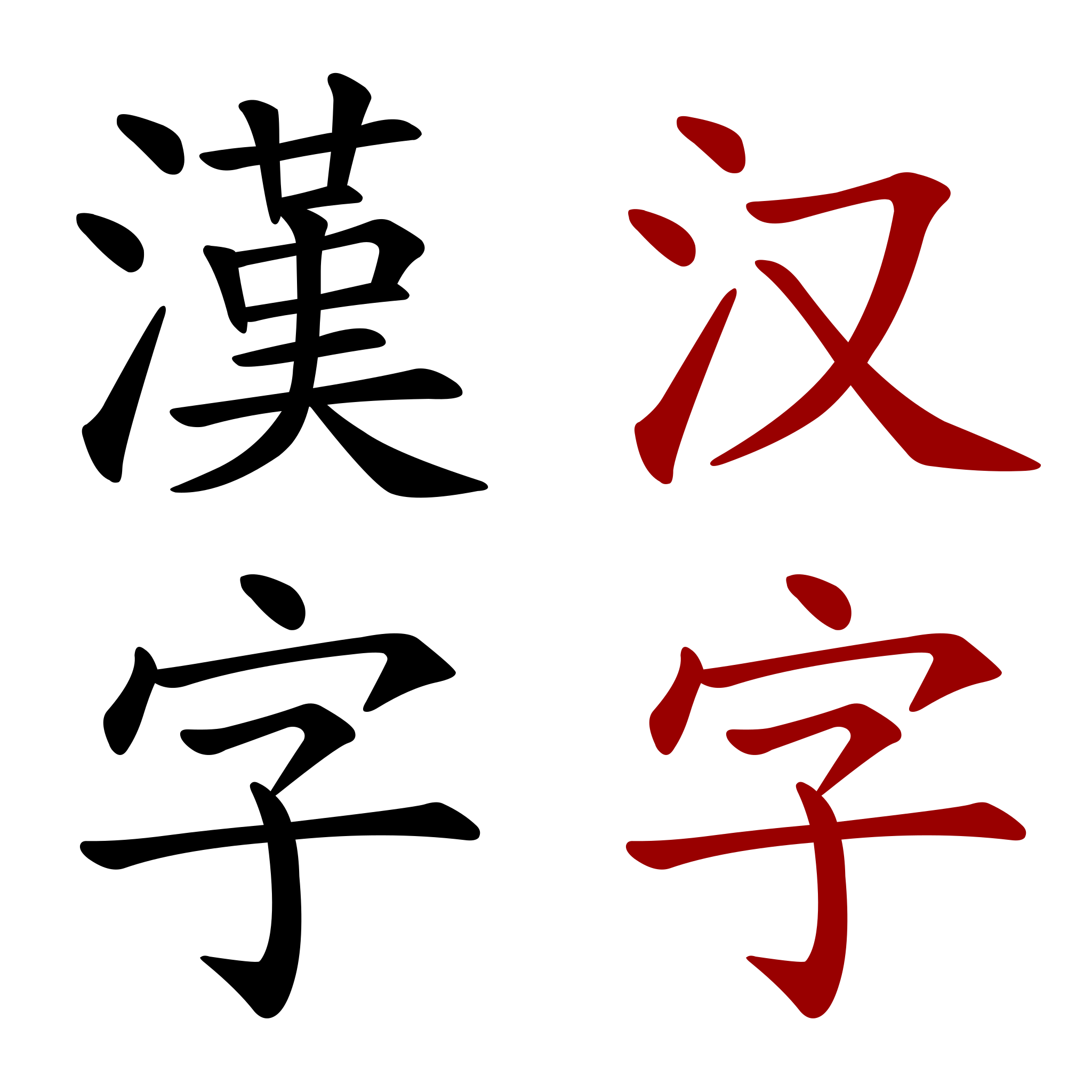
“Hànzì
(Hàn·zì
{Han (Chinese)} · Characters
汉字
漢字)” is what Chinese characters are called in Mandarin. Actually, “Hànzì+
(Hàn·zì
{Han (Chinese)} · Characters
汉字
漢字)” literally means “Han characters”, but as discussed in the MEotW post on “Hànyǔ
(Hàn·yǔ
{Han (Chinese)} · Language [→ [(Modern Standard) Mandarin]]
汉语
漢語)”, the Han are by far the largest ethnic group in China, and they are the dominant cultural force in China. Thus, Han characters are, in effect, Chinese characters.
Han culture has affected not only China, but also many of the surrounding nations. The words used by some of these nations to refer to “Chinese characters” are obvious echoes of “Hànzì
(Hàn·zì
{Han (Chinese)} · Characters
汉字
漢字)”:
Japanese:kanji
Korean:Hanja
Vietnamese:hán tự
Hànzì
(Hàn·zì
{Han (Chinese)} · Characters
汉字
漢字) are still used a lot in modern Japanese writing. However, although Hànzì
(Hàn·zì
{Han (Chinese)} · Characters
汉字
漢字) used to be the dominant writing system in Korea and in Vietnam, those nations have moved on to mainly use alphabetic writing systems.
BEFORE Hankul [or Hangul] was created, the Korean language did not have its own script. For more than a thousand years, educated Koreans wrote their language using Chinese characters. Over the years, however, various attempts were made to devise a better writing system. But since all of them were based on Chinese characters, only the well-educated could use them.
…
King Sejong spearheaded the creation of an alphabet that would both suit spoken Korean and be easy to learn and use.
…
Sadly, some scholars opposed Hankul, precisely because it was so easy to learn! They derisively called it Amkul, meaning “women’s letters.” They disdained a system that could be learned even by women, who back then were not taught to read in the schools. This prejudice against Hankul persisted among upper-class Koreans for some time. In fact, more than 400 years elapsed before the Korean government declared that Hankul could be used in official documents.
The Chinese Conundrum
How about the writing system situation in China itself? Do the Chinese languages need to be written using Hànzì
(Hàn·zì
{Han (Chinese)} · Characters
汉字
漢字)? Chinese traditionalists have influenced many people to assume so, but there is actually no technical linguistic requirement that any Chinese language be written using Hànzì
(Hàn·zì
{Han (Chinese)} · Characters
汉字
漢字)—writing Chinese languages using Hànzì
(Hàn·zì
{Han (Chinese)} · Characters
汉字
漢字) is purely and merely a deeply embedded tradition.
Proof that the use of Hànzì
(Hàn·zì
{Han (Chinese)} · Characters
汉字
漢字) is merely a tradition and not a technical requirement comes from the fact that Pīnyīn
(Pīn·yīn
{Piecing Together of} · Sounds → [Pinyin]
拼音), a phonetic alphabetic system designed by a Chinese government team, is a good, workable full writing system for Modern Standard Mandarin.
Why has China held on to its traditional use of Hànzì
(Hàn·zì
{Han (Chinese)} · Characters
汉字
漢字) when other nations have moved on to alphabetic writing systems? As mentioned in the MEotW post on “Zhōngguó
(Zhōng·guó
Central · Nation → [China | Chinese]
中国
中國)”,
Some wonder why China has held on to its archaic characters writing system instead of moving on to using a modern alphabetic writing system like almost every other nation does, even though outstanding native sons like Lǔ Xùn+
((Lǔ
Stupid; Rash (surname)
鲁
魯)
(Xùn
Fast; Quick; Swift
迅)
(pen name of Zhōu Shùrén, the greatest Chinese writer of the 20th cent. and a strong advocate of alphabetic writing)) have advocated strongly for that. Perhaps the proud self-centredness of the only nation to name itself the centre of the world provides a clue….
When the Communists took over China a few years after World War II, their Plan A for China’s writing system situation actually did involve eventually moving on from the characters to an alphabetic writing system that would be developed, which turned out to be Pīnyīn
(Pīn·yīn
{Piecing Together of} · Sounds → [Pinyin]
拼音). However, the government needed the help of the people already educated in Hànzì
(Hàn·zì
{Han (Chinese)} · Characters
汉字
漢字), and many of these people opposed this plan that they feared would involve leaving behind, or at least de-emphasizing, a cultural tradition that they were very proud of, that they had invested very much time and effort into mastering, and that gave them much prestige in the existing environment.1 In other words, the pride and prejudice of those who had already been educated in the Hànzì
(Hàn·zì
{Han (Chinese)} · Characters
汉字
漢字) caused them to disparage and oppose the idea of a simpler alternative writing system, just as had been the case in Korea, as noted above. So, the simplification of the Hànzì
(Hàn·zì
{Han (Chinese)} · Characters
汉字
漢字) is the farthest China has gotten so far with regard to official writing system reform, and even that has only been achieved in the face of much criticism and opposition.
Chairman Máo Zédōng+
((Máo
Hair (surname)
毛)
(Zé·dōng
Marsh · East
泽东
澤東)
(the founder of the People’s Republic of China)) (Wikipedia article) himself supported continuing to move on, from simplification of the characters to actually adopting Pīnyīn
(Pīn·yīn
{Piecing Together of} · Sounds → [Pinyin]
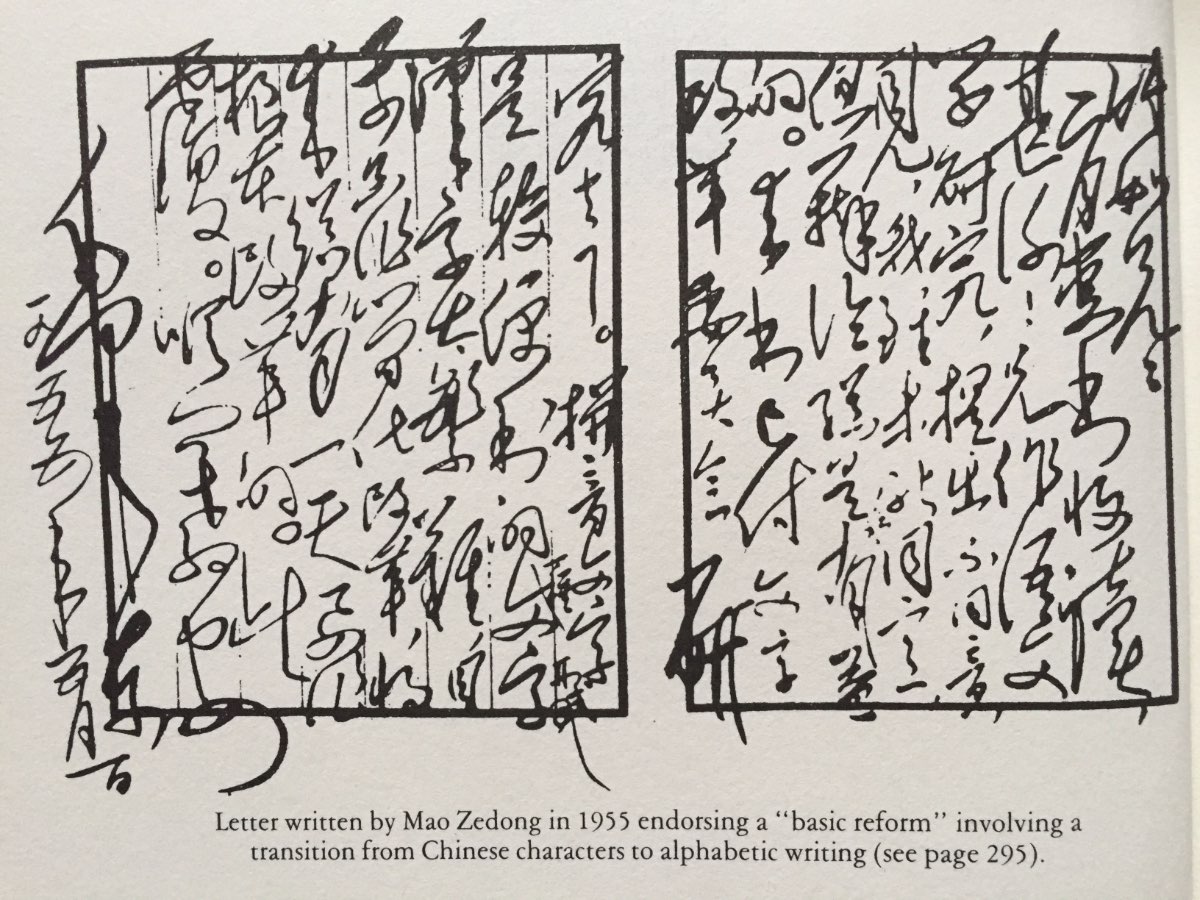
拼音) as a writing system. In a letter to an old schoolmate, he wrote:
…Pinyin writing is a form of writing that is relatively convenient. Chinese characters are too complicated and difficult. At present we are only engaged in reform along the lines of simplification, but some day in the future we must inevitably carry out a basic reform.2
So, those who are in favor of HP [Hànyǔ
(Hàn·yǔ
{Han (Chinese)} · Language → [(Modern Standard) Mandarin]
汉语
漢語)Pīnyīn
(Pīn·yīn
{Piecing Together of} · Sounds → [Pinyin]
拼音)] don’t need to be concerned, and those who are opposed to HP don’t need to be frightened. HP is ineluctably playing a greater and greater role in the educational, cultural, social, political, and every other aspect of the lives of Chinese citizens, and this is occurring without regard to anyone pushing it as a governmental program. It is happening because of the wishes of those who actually use it for a wide variety of helpful purposes.
Digraphia [the use of more than one writing system for the same language, in this case the use of both Hànzì
(Hàn·zì
{Han (Chinese)} · Characters
汉字
漢字) and Pīnyīn
(Pīn·yīn
{Piecing Together of} · Sounds → [Pinyin]
拼音) for writing Modern Standard Mandarin] is emerging before our very eyes, enabling people to use the alphabet and the characters for whatever purposes they deem suitable. Nobody needs to take a vote or carry out a survey for this to happen.
Tourists or Missionaries?
Regardless of how worldly Chinese people view the Hànzì
(Hàn·zì
{Han (Chinese)} · Characters
汉字
漢字), how should we dedicated Mandarin field language-learners view them? It would be easy to fall back on the commonly accepted view, the tourist’s view, that the Hànzì
(Hàn·zì
{Han (Chinese)} · Characters
汉字
漢字) are an integral and fascinating part of China’s precious cultural heritage that we should duly respect and even heap adulation upon.
However, as Mandarin field language-learners, we are not in the Mandarin field to be tourists just enjoying the exotic foreign culture. On the contrary, we must be more like missionaries or spiritual rescue workers involved in an urgent life-saving work, because lives are indeed involved. As ones involved in an urgent, life-saving work, we need tools, technologies, and systems that efficiently and effectively help us to get this work done without wasting time and effort when people’s everlasting lives are at stake. From this sober and pragmatic angle, the extraordinarily difficult-to-learn-and-remember Hànzì
(Hàn·zì
{Han (Chinese)} · Characters
汉字
漢字) are far from ideal. Thus, while there is obviously value in learning as many Hànzì
(Hàn·zì
{Han (Chinese)} · Characters
汉字
漢字) as one is reasonably able to, it is fortunate that Pīnyīn
(Pīn·yīn
{Piecing Together of} · Sounds → [Pinyin]
拼音) exists and is available as a simple, effective alternative writing system for Mandarin, for the many times when it is not necessary to use Hànzì
(Hàn·zì
{Han (Chinese)} · Characters
汉字
漢字).
zhǐyǐn+
(zhǐ·yǐn
{(pointing with) finger → [pointing]} · guiding; leading
指引) 👈🏼 Tap/click to show/hide the “flashcard”
[Notes:Tap/click on a Pīnyīn
(Pīn·yīn
{Piecing Together of} · Sounds →[Pinyin]
拼音) expression to reveal its “flashcard”; tap/click on a “flashcard”or its Pīnyīn
(Pīn·yīn
{Piecing Together of} · Sounds →[Pinyin]
拼音) expression to hide the“flashcard”. 📖📄 ➕ icons mean 📖Reveal All, 📄Reveal Advanced, and ➕ Reveal + Symbols re all the “flashcards” in the heading, paragraph, etc. that they are placed at the beginning of.]
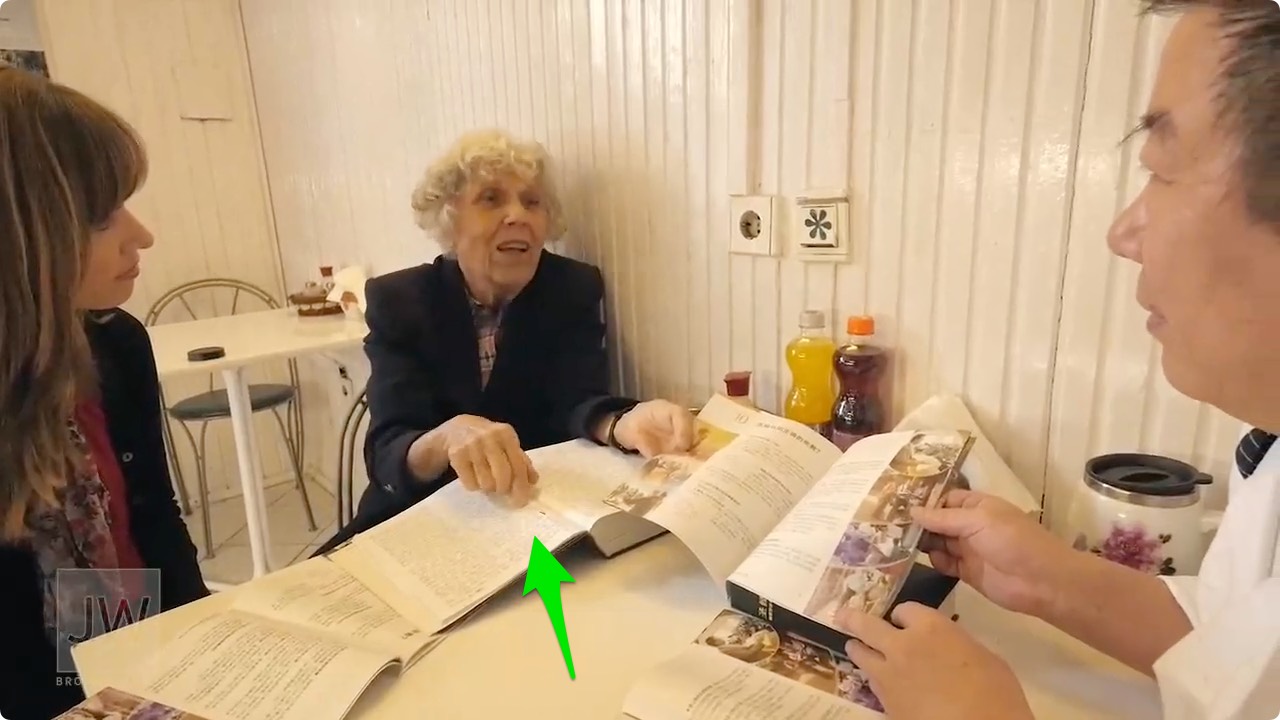
Recently, I came across a video entitled “Margarita Königer: Glad I Chose This Career”. (This Watchtower article briefly discusses Sis. Königer’s experience coming into the truth, and her service up to about 1995. The video, which has a copyright date of 2016, is more up-to-date. In the video, we learn that Sis. Königer began serving as a missionary in 1966, and that at the time of her video interview, she had been a missionary in the Chinese field in Budapest, Hungary for nine years.)
Because of what I have seen and experienced in the Mandarin field for over three decades, what Sis. Königer said starting at about the 5:10 mark of the video really resonates with me:
English:
If you are in the full-time service, I think it’s like you are travelling and Jehovah is directing you.
As can be seen above, this week’s MEotW, “zhǐyǐn
(zhǐ·yǐn
{(pointing with) finger → [pointing]} · guiding; leading
指引)”, is used in the Mandarin version of the above-mentioned video to correspond to the English word “directing”.
I have often felt like a fly on the wall observing Jehovah’s hand at work in the establishment and development of several Mandarin groups and congregations in my local area, and I have also seen much evidence that Jehovah has been directing things in the worldwide Mandarin field.
Photocopies and Handwriting
Specifically with regard to the development of material based on the organization’s official Chinese publications, but that includes Pīnyīn
(Pīn·yīn
{Piecing Together of} · Sounds →[Pinyin]
拼音) or Zhùyīn
(Zhù·yīn
{Annotating of} · Sounds →[Zhuyin]
注音
註/注音) to help Mandarin field language learners get past the imposing Great Wall of Chinese characters, I saw how things started in the 1980s or 1990s. Somewhere around that time, Chinese congregation elders on the West Coast of North America began directing teams of publishers who would make enlarged photocopies of official Chinese publications, and then painstakingly handwrite Pīnyīn
(Pīn·yīn
{Piecing Together of} · Sounds →[Pinyin]
拼音) or Zhùyīn
(Zhù·yīn
{Annotating of} · Sounds →[Zhuyin]
注音
註/注音)ruby text between the lines of characters. (In those days, many of the publishers involved were from Taiwan, where they were taught Zhùyīn
(Zhù·yīn
{Annotating of} · Sounds →[Zhuyin]
注音
註/注音) in school.) Photocopies would then be made of these handwritten “originals”, for distribution to hungry Mandarin field language learners at the local meetings and to be sent via snail mail, etc. to those in other places.
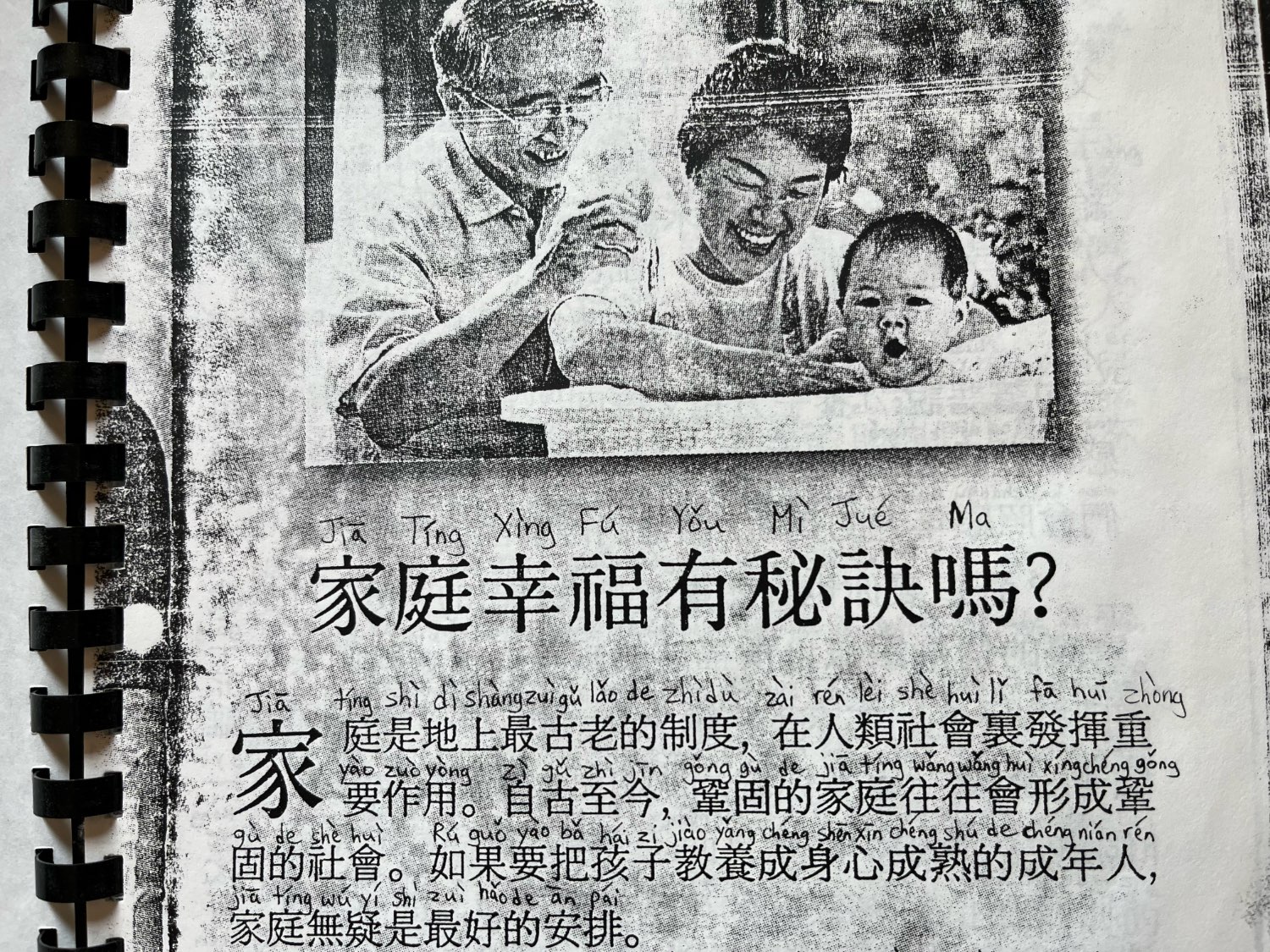
Photocopied and handwritten Pīnyīn
(Pīn·yīn
{Piecing Together of} · Sounds →[Pinyin]
拼音) material from 1997, based on the book The Secret of Family Happiness
PCs, Email, and Printers
A few years afterwards, in the early 2000s, I was serving where the need was great in the burgeoning Mandarin field in Calgary, where I was assigned by an unusually pragmatic and open-minded Chinese elder to develop similar Pīnyīn
(Pīn·yīn
{Piecing Together of} · Sounds →[Pinyin]
拼音)-containing material for the local Mandarin field language learners—the brothers in Calgary at the time felt far from the West Coast, and had decided that they would be more comfortable with a local supply of such material.
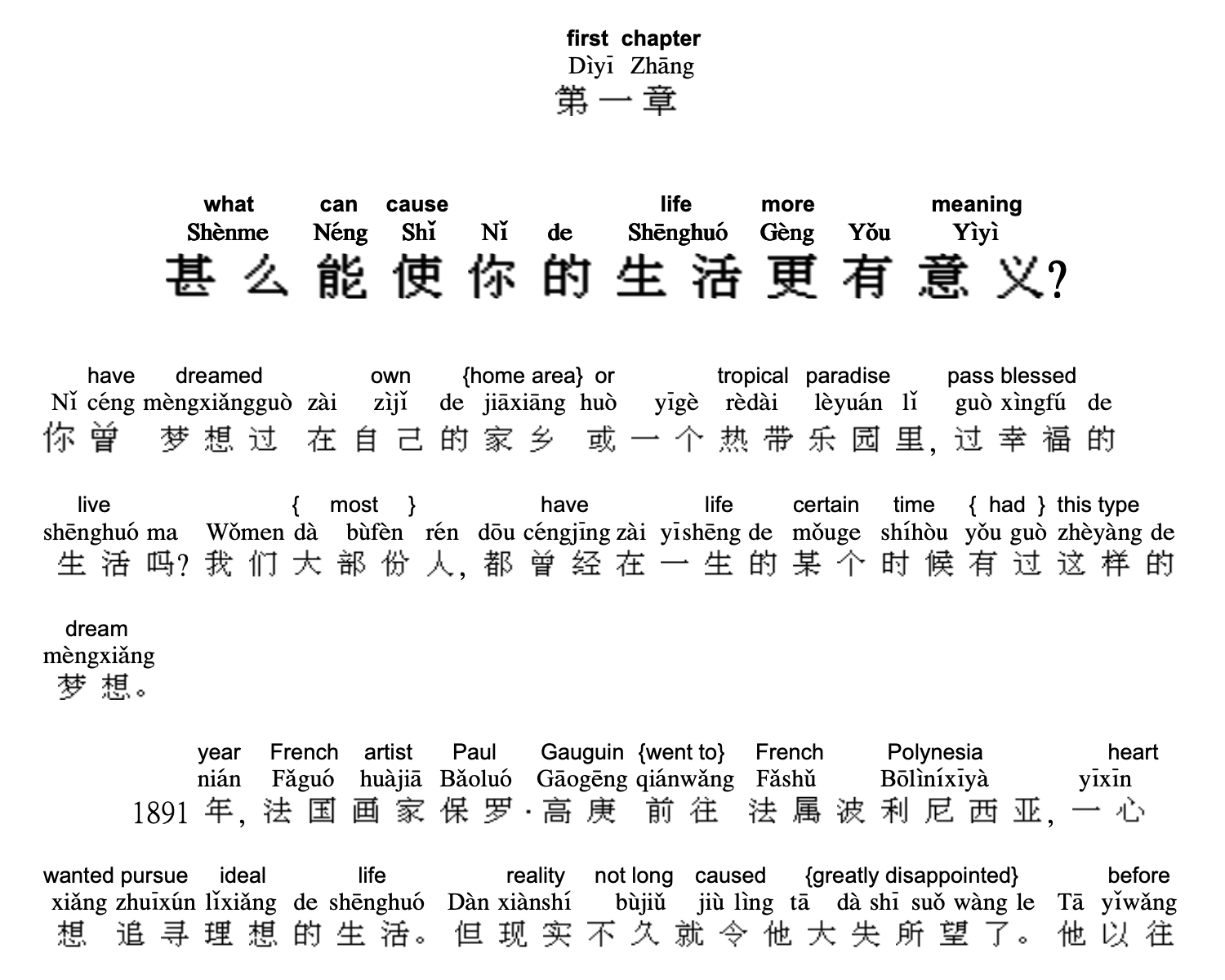
Starting with a “clean sheet of paper” and using the personal computer technology that had become available and reasonably inexpensive at the time, I designed and started producing what was evidently the first material of the kind that eventually came to be commonly known as 3-line material. When the above-mentioned elder suggested adding English to the material that had up to this point only contained characters and Pīnyīn
(Pīn·yīn
{Piecing Together of} · Sounds →[Pinyin]
拼音), I balked at first—it was already going to be so much work just to enter the characters and add the Pīnyīn
(Pīn·yīn
{Piecing Together of} · Sounds →[Pinyin]
拼音)! However, I decided to make some prototype material that included English, and when one of the local brothers who was learning Mandarin saw a printout of it, his eyes seemed to pop out of his head, and he practically grabbed the printout out of my hands to get a closer look at it! That helped me to decide that the additional time and work needed for me to add the English translations would be a worthwhile investment that would greatly benefit the multiple people who would use the material to help them learn the Mandarin they need in the Mandarin field.
Whereas the photocopied material mentioned above that was produced starting in the 1980s or 1990s was produced and distributed entirely in the paper realm, this new material was produced in the digital realm in word processing programs, and distributed as digital files (albeit ones still meant to be printed out on paper). Thus, I was able to email the files to whoever asked for them, after I emailed a few acquaintances I had in the nearby Canadian and American Mandarin fields about them.
A screenshot of early 3-line PDF material from 2001, based on the book Is There a Creator Who Cares About You?
And boy, did people start asking for them! Amazingly, people in the Mandarin field began telling their friends and fellow workers about the files, and I began to get emails from all around the world—from every continent except Antarctica—requesting them. I remember getting a bit emotional after getting an email from the UK requesting the files and telling me about the growing Chinese fields there—it felt like finding out about a part of your family that before, you had no idea existed. I also remember feeling amazed and doing a double take after seeing that I had gotten an email from someone in the Chinese group in Budapest, Hungary, where the above-mentioned Sis. Königer later served for a long time.
For those who weren’t around then, let me provide a bit more background information about the situation in the worldwide Mandarin field at the time, to help put this enthusiastic worldwide response in perspective. At the time, jw.org was still many years away from coming online and becoming a place on the web where one could just go and view or download abundant material based on official publications and containing Pīnyīn
(Pīn·yīn
{Piecing Together of} · Sounds →[Pinyin]
拼音). This was also before the iPhone came out in 2007, before Android was introduced in 2008, and before the iPad came out in 2010. What many people in the worldwide Mandarin field did have at that time, though, were personal computers (PCs and Macs), email, printers, and an organizationally existentially urgent situation caused by the frustratingly complex and difficult-to-learn-and-remember Chinese characters, which can take years, even decades, for a language learner to get functionally proficient with.
Pinyin Material or Bust
Many of the Mandarin pregroups, groups, and congregations around the world at that time were quite new, with zero or very few publishers who were native Mandarin-speakers, and thus zero or very few people, especially brothers, who could function effectively in the Mandarin field with publications that contained only Chinese characters. So, they really, really needed material like that early 3-line material. Especially for many Mandarin pregroups and groups around the world at that time, getting the Pīnyīn
(Pīn·yīn
{Piecing Together of} · Sounds →[Pinyin]
拼音)-containing material or not literally meant the difference between being able to conduct their Mandarin meetings or not being able to do so.
And so, email requests came pouring in from around the world for the early 3-line unofficial material that I was producing, with only a few occasional helpers, in my little rented basement suite in a territory far from the home where I grew up. That was a hard time to go through—the material, while no longer having to be painstakingly handwritten, still took a lot of time and effort to produce, week after week, and many of those around me did not understand or appreciate this highly unusual, pressure-filled, high-stakes situation that I found myself in. During that time, I learned and lived the Mandarin saying “qí+
({(if one) rides}
骑
騎)‐hǔ+
(tiger
虎)‐nán+
({(it) is difficult}
难
難)‐xià+
({to get down}
下)”. However, like Sis. Königer said, ultimately I could feel Jehovah directing things and helping me through it all.
3lines.org and Official Pinyin Resources
After about two and a half years in Calgary, difficulty in finding secular work caused me to move back to the city I grew up in, where, on reflection, the project in Calgary that produced that early 3-line material would probably never have gotten going, due to the relatively complacent—and, perhaps, proud—acceptance of the status quo among those in the local Mandarin field, which by then had become relatively well-established. (Actually, on reflection, the development and distribution of unofficial and official Pīnyīn
(Pīn·yīn
{Piecing Together of} · Sounds →[Pinyin]
拼音)-containing material for the Mandarin field seems, as a whole, like what in physical warfare is known as a flanking manoeuvre, as opposed to a conventional frontal assault on the status quo of the world’s Mandarin language situation that we Mandarin field language learners must deal with, i.e., just having everyone learn Mandarin the established hard way, focusing exclusively on the traditionally mandated Chinese characters.) Eventually, I was invited to work with the international team of publishers that ran the 3lines.org website, and that began producing 3-line material on an industrial scale.
Meanwhile, on the official side of things, the organization eventually started to produce official printed Pīnyīn
(Pīn·yīn
{Piecing Together of} · Sounds →[Pinyin]
拼音) versions of a few selected publications. These contained Simplified Chinese characters with Pīnyīn
(Pīn·yīn
{Piecing Together of} · Sounds →[Pinyin]
拼音) ruby text—no English. (I suppose the official team[s] involved decided that it was not worthwhile to include English translations, due to the tremendous additional ongoing investments in time, effort, and contributed funds that would be required to produce them on an ongoing basis to the quality level required of official material, which after all is primarily spiritual food, not language-learning material like the unofficial 3-line, etc. material is.)
Being printed on paper, though, these official Pīnyīn
(Pīn·yīn
{Piecing Together of} · Sounds →[Pinyin]
拼音) publications had to be physically printed and trucked/moved by rail/flown/literally shipped/etc. to the various Mandarin pregroups, groups, and congregations around the world that needed them. Generally these shipments would arrive in time for them to be used at the meetings in which they were scheduled to be used, but unfortunately, in spite of the best efforts of those involved, sometimes they would not—that was just the challenging nature at the time of producing and distributing paper publications on an ongoing tight schedule.
Over time, the organization got better at producing and delivering paper Pīnyīn
(Pīn·yīn
{Piecing Together of} · Sounds →[Pinyin]
拼音) publications on time, and it also eventually began to make digital Pīnyīn
(Pīn·yīn
{Piecing Together of} · Sounds →[Pinyin]
拼音)-containing material widely available for viewing on the web and downloading. Thanks to reader SB, here is some information on when these official resources became available:
Official Pinyin Watchtower started in 2002.
Other dates: jw.org with PDFs was 2010, WOL was 2012…, WOL expanded to pre-2000 publications in 2018
(English in April, Trad. Chinese in August, Simplified in November)
and official pinyin added in 2019. Official pinyin then came
to the JW Library app in 2024.
These developments, along with the collective Brobdingnagian efforts of others on the 3lines.org team, helped a lot to provide numerous powerfully enabling resources for Mandarin field language learners. Meanwhile, there continued to be a lot of work for me to do in this regard as well.
Mobile Devices, the Web, and Linguistics
In the early-2010s, with the post-PC mobile revolution in full swing after the iPad was introduced and became “the most quickly adopted non-phone electronic product” ever, I found myself working on my iPhone/iPad app Pinyin Typist, and doing deep research on Pīnyīn
(Pīn·yīn
{Piecing Together of} · Sounds →[Pinyin]
拼音), Chinese characters, and writing systems and linguistics in general. After all that I had gone through trying to learn characters and trying to help others to deal with the difficulties caused by characters, when I figured out from my research that actually, Pīnyīn
(Pīn·yīn
{Piecing Together of} · Sounds →[Pinyin]
拼音) is a good, workable writing system on its own for Mandarin, and that characters are thus not a technical necessity, but rather, just an unusually deeply rooted cultural tradition, that was a mind-blowing moment for me.
To share the potentially game-changing things I had learned with my fellow Mandarin field language learners, I eventually wrote and posted articles including “Pīnyīn
(Pīn·yīn
{Piecing Together of} · Sounds →[Pinyin]
拼音)Was Plan A”, which it seems many in the Mandarin field have read and benefitted from. Also, I eventually took the learnings from my experience in the Mandarin field and from my research into linguistics and into web and mobile technologies and began producing Pīnyīn
(Pīn·yīn
{Piecing Together of} · Sounds →[Pinyin]
拼音) Plus material. This new generation of mobile-first, speech-first material works well on the mobile devices so prevalent now among Mandarin field language learners. Also, rather than going along with the common practice in Satan’s world of diverting Mandarin learners into the deep, dark rabbit hole that is the Chinese characters, Pīnyīn
(Pīn·yīn
{Piecing Together of} · Sounds →[Pinyin]
拼音) Plus material focuses on helping Mandarin field language learners to learn to speak understandably and persuasively in Mandarin so that they can reach the hearts of Mandarin-speaking people with Bible truth.—1 Corinthians 14:8–11.
After a few years, in the late 2010s, as the official Pīnyīn
(Pīn·yīn
{Piecing Together of} · Sounds →[Pinyin]
拼音)-containing resources became established, the unofficial team of publishers running 3lines.org was directed by the organization to fundamentally change their unofficial operation, resulting in that website scaling down drastically. However, even though I know the organization is aware of my activities—outside of 3lines.org—producing materials for Mandarin field language learners, I have not received any similar direction from it. So, I have continued doing what I can to provide resources for Mandarin field language learners, including several Pīnyīn
(Pīn·yīn
{Piecing Together of} · Sounds →[Pinyin]
拼音)Plus resources based on official publications (with deeply researched and extensive disclaimers about them not being spiritual food, but rather, Mandarin field language-learning resources), and this MEotW blog that you are now reading.
“It’s Like You Are Travelling and Jehovah Is Directing You”
Looking back now in 2025, it is evident that in spite of temporarily limited technology and the ongoing traditional cultural inertia and disdainful dismissiveness of those brainwashed by a world that glamourizes and practically idolizes Chinese characters, abundant official (and unofficial) Pīnyīn
(Pīn·yīn
{Piecing Together of} · Sounds →[Pinyin]
拼音)-containing resources have become widely and easily available to Mandarin field language learners around the world. Besides those already mentioned above, other significant Pīnyīn
(Pīn·yīn
{Piecing Together of} · Sounds →[Pinyin]
拼音)-containing Mandarin field resources that many have found helpful include theocratic Mandarin courses, such as that included in the official JW Language app, and also the various resources mentioned on the Referenced Theo. Expressions (RTE) website, such as the phonetic WOL apps. The Pīnyīn
(Pīn·yīn
{Piecing Together of} · Sounds →[Pinyin]
拼音)-containing resources that are available for Mandarin field language learners help them to be able to powerfully and effectively glorify Jehovah and save lives in the vast worldwide Mandarin field, without being egregiously obstructed by burdensome unnecessary difficulties imposed by the human traditions surrounding Chinese characters.
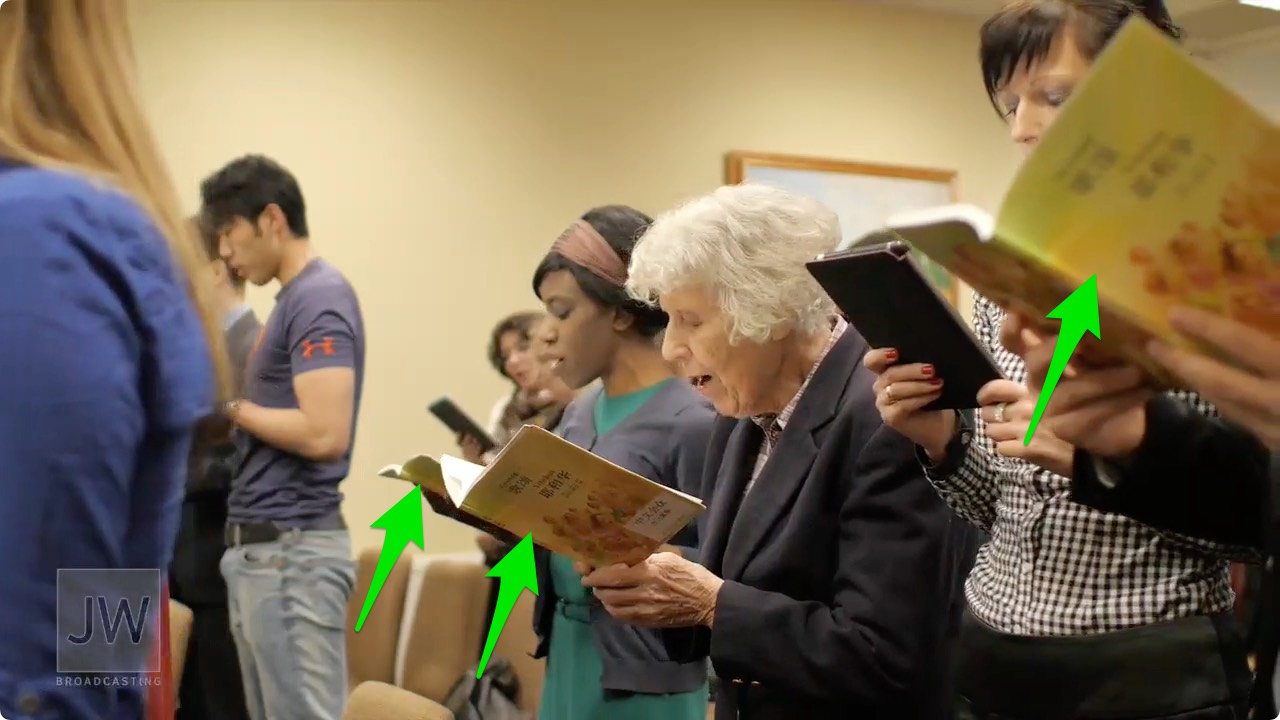
Also, starting at about the 4:43 mark, she and others can be seen using the old printed Pīnyīn
(Pīn·yīn
{Piecing Together of} · Sounds →[Pinyin]
拼音)Sing to Jehovah songbook, which included musical notation:
Yes, in view of what I have witnessed and experienced in the Mandarin field, I heartily agree with Sis. Königer’s conclusion that she states starting at about the above video’s 5:10 mark, that ultimately, Jehovah directs the work of his faithful servants:
If you are in the full-time service, I think it’s like you are travelling and Jehovah is directing you. So I don’t worry. The responsibility is with Jehovah. I mean, we have to be faithful. That is our responsibility. But, what is happening is: Jehovah knows what he lets happen. It’s OK. And I hope everybody who is young, they will do the same because they will miss something, because it’s very satisfying. And working with Jehovah, you cannot compare it to anything else.