Categories
Culture Experiences History Language Learning Science

yīnwei

yīnwei (yīn·wei because · for | {because of} · for/{on account of} | {is because} · {is for} 因为 因為) 👈🏼 Tap/click to show/hide the “flashcard”

This week’s MEotW, “yīnwei (yīn·wei because · for | {because of} · for/{on account of} | {is because} · {is for} 因为 因為)”, was discussed in a podcast episode that I listened to recently. Here’s a clip from it, with the part in which this expression was discussed:

Here’s a transcript of this video clip:

David: You’re a good sport. Thank you for doing this. So you are a native speaker. This question is very important because if you pronounce a character with the wrong tone, you can be fined as much as 50 kuài (pieces → [mw for Renminbi]) at CCTV if you’re an announcer. So what I want you to do is just very slowly pronounce for us the word that in Chinese would be the equivalent of “because”.

Yajun: “Yīnwéi (Yīn·wéi because · for | {because of} · for/{on account of} | {is because} · {is for} 因为 因為)”.

David: Say again?

Yajun: “Yīnwéi (Yīn·wéi because · for | {because of} · for/{on account of} | {is because} · {is for} 因为 因為)”.

David: So I hear that the “wéi (為/爲) is second tone. Is that right?

Yajun: Yeah…

David: That’s Northern Mandarin. That’s also Běijīng (Běi·jīng North · {Country Capital} → [Beijing] 北京)huà (speech). [With] the actual pǔtōng‐huà ((pǔ·tōng common · {through(out) → [common]} 普通)‐(huà speech) [(Modern Standard) Mandarin (term commonly used in China)]) citation version of that word, in 90% of the dictionaries that you will see, the second character is pronounced with fourth tone, as “yīnwèi (yīn·wèi because · for | {because of} · for/{on account of} | {is because} · {is for} 因为 因為)”.

Yajun: Sure…?

David: Yeah, well if you ask most Chinese, they’re very unsure about it, just like you.

Yajun: I was quite sure it’s “yīnwéi (yīn·wéi because · for | {because of} · for/{on account of} | {is because} · {is for} 因为 因為)”, something like that. Now I’m not so sure…and I don’t want to lose 50 kuài (pieces → [mw for Renminbi]).

David: Don’t worry, there are many examples like that and you are not actually wrong. This is an artificial standard that has been imposed and actually, few people, or, not everyone, actually follows it.

By the way, the David Moser speaking in the above clip is indeed the same one who wrote the relatively well-known essay “Why Chinese Is So D- Hard”, which has given many people a lot to think about regarding how Chinese characters make learning Mandarin much harder than it otherwise would be. (I’m not providing a link to this essay because the full title and an example used in the text are a bit less than family-friendly. However, for anyone who’s interested, here is a link to a family-friendly version of this essay that’s been translated into Mandarin and written in Pīnyīn (Pīn·yīn {Piecing Together of} · Sounds → [Pinyin] 拼音).)

Getting back to “yīnwei (yīn·wei because · for | {because of} · for/{on account of} | {is because} · {is for} 因为 因為)”, there’s also a relatively detailed entry on this expression in the excellent Referenced Theo. Expressions resource.

Dealing With Different Right Pronunciations

The different pronunciations of “yīnwei (yīn·wei because · for | {because of} · for/{on account of} | {is because} · {is for} 因为 因為) are an example showing us that, while they have a lot of overlap, pǔtōng‐huà ((pǔ·tōng common · {through(out) → [common]} 普通)‐(huà speech) [(Modern Standard) Mandarin (term commonly used in China)]), Northern Mandarin and Beijing Mandarin, and, for that matter, the Guóyǔ (Guó·yǔ National · Language → [(Modern Standard) Mandarin (term commonly used in Taiwan)] 国语 國語) spoken in Taiwan are not exactly the same. (More information on how pǔtōng‐huà ((pǔ·tōng common · {through(out) → [common]} 普通)‐(huà speech) [(Modern Standard) Mandarin (term commonly used in China)]) has been artificially constructed from various parts and promoted to be a national standard can be found in David Moser’s book “A Billion Voices: China’s Search for a Common Language”.)

So, when we get to a word like “yīnwei (yīn·wei because · for | {because of} · for/{on account of} | {is because} · {is for} 因为 因為)”, which pronunciation should we say it with? Well, considering that the basic principle regarding why language groups and congregations even exist is that Bible truth best reaches a person’s heart in that person’s mother tongue, the logical conclusion is that we should try, as much as we are reasonably able to, to use whichever pronunciation is used by whomever we are talking to. The apostle Paul said “to the Jews I became as a Jew in order to gain Jews”, so we should similarly seek to become as the Mandarin-speaking people we meet in the ministry. (1 Corinthians 9:20) And since tones are an essential part of Mandarin pronunciation, that would include trying to use whichever tone is used by whomever we are talking to.

That may be relatively straightforward—although it may not be easy—when speaking to an individual, but when speaking to a large, mixed audience, perhaps at a meeting or even a convention, we will have to use good judgement to try to speak so as to be understood without distraction by the majority of the audience. It helps, then, to know the audience.

The Accents of Network News Announcers

Speaking of the audience, the clip above mentions that CCTV announcers are required to speak in a particular standard way, and that they are actually fined when they deviate from this standard. CCTV (China Central Television) is the national television broadcaster of China (which, naturally in China, is ultimately controlled by the Chinese Communist Party), and as such, has an audience that includes all of mainland China, with all its various languages, dialects, and accents. As we can see, those calling the shots at CCTV, and indeed, in China in general, have decided to approach this situation by seeking to impose and promote a standard way of speaking, from the top down.

American network news announcers face a sort-of similar challenge—while English is understood throughout the USA, people in different parts of the USA have come to speak with different regional accents.

The article “Why Do So Many News Anchors Sound Alike?”, on the Mental Floss website, says the following about how American news announcers have historically approached this situation:

No matter which channel you tune into or what local broadcast you receive, news anchors share one common trait beyond professional attire and perfect hair. They tend to sound exactly the same, from their cadence to enunciation to a completely curious lack of a regional accent. How does that happen?

Broadcasters didn’t always sound so geographically neutral. In the early part of the 20th century, many radio personalities and performers adopted what was known as a Mid-Atlantic accent, or a blend of mannered British and the East Coast dialect of the United States. This polished, proper method of speaking was popular in Hollywood movies of the 1930s and on radio because it signaled some kind of upper-class education and erudition. Thanks to America’s infatuation with England, sounding even vaguely British made people sound intelligent. Pundits like William F. Buckley Jr. carried the Mid-Atlantic torch even as it fell out of favor in entertainment.

The more contemporary practice of sounding linguistically neutral is often referred to as having a General American accent—which is a bit misleading, since there’s really not much of an accent at all. Also referred to as Standard American, Broadcast English, or Network English, General American was a term first used in the 1920s and ’30s by linguists who wanted to isolate a more widespread accent than the New England or Southern dialects.

Balancing Authenticity with Avoiding Distraction

A relatively recent Business Insider article points out, though, that what American people expect of their media personalities has evolved over time:

“There is something called a broadcast news type voice,” Brice told Insider. “And I really try to coach people to not have that voice. In fact, I coach routinely people to sound more like themselves. People try to emulate other anchors and reporters, and in my opinion, it gets them in trouble.”

“We’ve definitely evolved, just as the news industry has evolved, into a different mindset,” Cairns told Insider, adding that listeners now look for signs of authenticity from their media personalities. “With people being flooded with content, their expectations have changed. People don’t want the typical woman with the big head of hair and the perfect voice, looking a certain way.”

Instead of trying to eliminate regional accents like Fleming’s Boston pronunciations [heard in the post embedded above], Cairns told Insider, speakers who speak with accents should focus only on making sure their speech patterns aren’t distracting from what they’re trying to say.

“It’s just like your hairstyle—you have your own voice style.” Cairns told Insider. “Use it. It’s part of what identifies you. Just don’t let it distract from the message.”

Considering the above and coming back to the Mandarin field, we can see that when speaking to Mandarin-speaking people in the field, there are at least three ways of speaking that we need to mentally juggle:

  • The way we ouselves normally speak Mandarin
  • Modern Standard Mandarin/pǔtōng‐huà ((pǔ·tōng common · {through(out) → [common]} 普通)‐(huà speech) [(Modern Standard) Mandarin (term commonly used in China)])/Taiwanese Guóyǔ (Guó·yǔ National · Language → [(Modern Standard) Mandarin (term commonly used in Taiwan)] 国语 國語)
  • The kind of Mandarin best understood by whomever we are speaking to

In the Mandarin field, we want to speak authentically, sincerely, in a way that other people can tell is coming from our hearts, while avoiding speaking in a way that is so different from what others expect that it distracts from our God-honouring and life-saving message—it’s a balancing act, that may involve juggling! The standard forms of Mandarin that have been promoted by governments, widely broadcast in the media, etc. may heavily influence people’s expectations of the kind of Mandarin we speak, but different situations may require different approaches. So, we should do our best to adapt accordingly, so as to speak in the way that best helps others and glorifies, not any human entity, but rather, our great God Jehovah.


Note: Pīnyīn (Pīn·yīn {Piecing Together of} · Sounds → [Pinyin] 拼音) Plus material is aimed at and made available to the worldwide Mandarin field, and so as far as possible, it is based on how most people seem to actually speak pǔtōng‐huà ((pǔ·tōng common · {through(out) → [common]} 普通)‐(huà speech) [(Modern Standard) Mandarin (term commonly used in China)]), the artificial standard mentioned in the clip at the beginning of this post, that is the standard language promoted in mainland China, where about 95% of the world’s Chinese people are. (As Mr. Moser pointed out in the clip, people don’t always follow the pronunciations found in many dictionaries. E.g., many seem to use more neutral tones than many dictionaries indicate.) Since Taiwan is also a relatively big presence in the Mandarin-speaking world, Pīnyīn (Pīn·yīn {Piecing Together of} · Sounds → [Pinyin] 拼音) Plus material also contains notes indicating when Taiwan Mandarin has different pronunciations. (Offhand, the only Mandarin dictionary mentions that I can recall that refer to Northern or Beijing pronunciations involve the “r” ({child | youth | son} → [(diminutive) non-syllabic retroflex suffix; pronunciation feature in Beijing dialect]) that Beijingers add to the ends of many words. Pīnyīn (Pīn·yīn {Piecing Together of} · Sounds → [Pinyin] 拼音) Plus material includes notes about this.)
Categories
Culture Experiences Language Learning Science Theocratic

({register or record for reference} [→ [musical notation [→ [set to music; compose (music)]] | sth. to base oneself on | table; chart; list | guide; manual | standards | airs; pretensions | spectrum (physics)]]) ← Tap/click to show/hide the “flashcard”

[Notes: Tap/click on a Pīnyīn (Pīn·yīn {Piecing Together of} · Sounds → [Pinyin] 拼音) expression to reveal its “flashcard”; tap/click on a “flashcard” or its Pīnyīn (Pīn·yīn {Piecing Together of} · Sounds → [Pinyin] 拼音) expression to hide the “flashcard”. 📖 📄 📘 icons mean 📖 Reveal All, 📄 Reveal Advanced, and 📘 Reveal None re all the “flashcards” in the heading, paragraph, etc. that they are placed at the beginning of.]

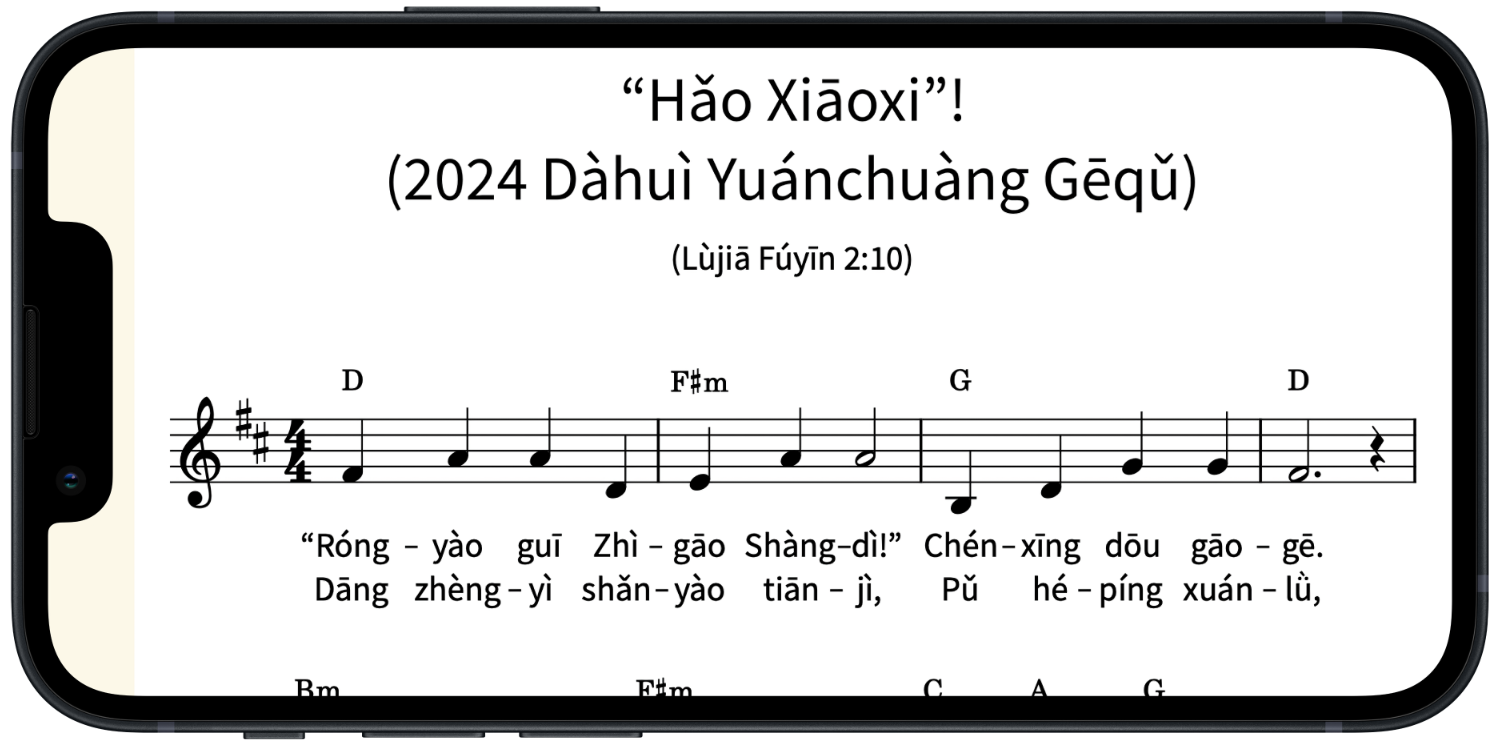
Summer is nearing, and soon, many of us will be singing together in Mandarin at our Mandarin conventions. Unfortunately, at the time of this writing, there was no official Pīnyīn (Pīn·yīn {Piecing Together of} · Sounds → [Pinyin] 拼音) available on the official page for the Mandarin version of this year’s convention song, but I am happy to report that proofread Pīnyīn (Pīn·yīn {Piecing Together of} · Sounds → [Pinyin] 拼音) lyrics or better and proofread musical notation 🎼 with Pīnyīn (Pīn·yīn {Piecing Together of} · Sounds → [Pinyin] 拼音) lyrics for this year’s convention song, and for all the other songs scheduled to be sung at this year’s Mandarin conventions, are now available at this unofficial Pīnyīn (Pīn·yīn {Piecing Together of} · Sounds → [Pinyin] 拼音) Plus resource:

2024 convention song “‘Hǎo Xiāoxi’!” (music+_Pīnyīn_), on iPhone 13 mini (landscape orientation)

[Note: As with all the other Pīnyīn (Pīn·yīn {Piecing Together of} · Sounds → [Pinyin] 拼音) Plus resources, the above-mentioned Pīnyīn (Pīn·yīn {Piecing Together of} · Sounds → [Pinyin] 拼音) Plus resource is made to be supplementary language-learning material for those learning the Mandarin language to help others in the Mandarin field. For spiritual food (which is for you yourself to learn spiritual things from, and which ideally should be in your own mother tongue), please go to jw.org.]

Very Lyrical Mandarin Lyrics

This week’s MEotW, “pǔ ({register or record for reference} [→ [musical notation [→ [set to music; compose (music)]] | sth. to base oneself on | table; chart; list | guide; manual | standards | airs; pretensions | spectrum (physics)]])”, comes from the second verse of the Mandarin version of this year’s convention song:

English:

He will reign for righteousness.
Peace he will provide.
Jesus is the way to endless life.

Mandarin (jw.org, Pīnyīn (Pīn·yīn {Piecing Together of} · Sounds → [Pinyin] 拼音) Plus):

📖 📄 📘 Dāng (when) zhèngyì (zhèng·yì {being upright} · righteousness 正义 正義) shǎnyào (shǎn·yào shines · {to be bright} (on) → [shines on] 闪耀 閃耀) tiānjì (tiān·jì sky · boundary → [horizon] 天际 天際),
({register or record for reference} → [musical notation] → [compose]) hépíng (hé·píng {being (together) with (one another)}’s · {being flat, level, even}’s → [peace’s (nwtsty-CHS Appx. A2 says this term mainly refers to the absence of war or conflict)] 和平) xuánlǜ (xuán·lǜ looping · {regulation → [style of poetry]} → [melody] 旋律),
Qīngchūn (Qīng·chūn {being green → [youth]} · spring → [youth] 青春) huì (will) xiàng (like 像/象) (river 河) bēnliú (bēn·liú rush · flow 奔流) bùxī (bù·xī not · {being ceasing} → [unceasingly] 不息).

Interestingly, this passage of the Mandarin lyrics is more poetic—or lyrical, since we are dealing with lyrics—than is strictly required to correspond to the original English lyrics in meaning. Here is a translation of these Mandarin lyrics back into English:

When righteousness shines on the horizon,
Compose peace’s melody,
Youth will like a rushing river flow unceasingly.

“Pǔ ({register or record for reference} [→ [musical notation [→ [set to music; compose (music)]] | sth. to base oneself on | table; chart; list | guide; manual | standards | airs; pretensions | spectrum (physics)]]) corresponds with “compose” in the above back translation. This Mandarin expression seems to basically mean “register or record for reference”, and it also has several effective meanings other than “compose”, depending on the context. One of these effective meanings is “musical notation”, such as when it’s used in “jiǎnpǔ (jiǎn·pǔ simple · {register or record for reference → [musical notation]} → [numbered musical notation] 简谱 簡譜)”, which refers to a type of simple numbered musical notation that many Chinese people are familiar with. (In fact, a jiǎnpǔ (jiǎn·pǔ simple · {register or record for reference → [musical notation]} → [numbered musical notation] 简谱 簡譜) version of the “Sing Out Joyfully” to Jehovah book is available on jw.org.)

Music and Mandarin Tones

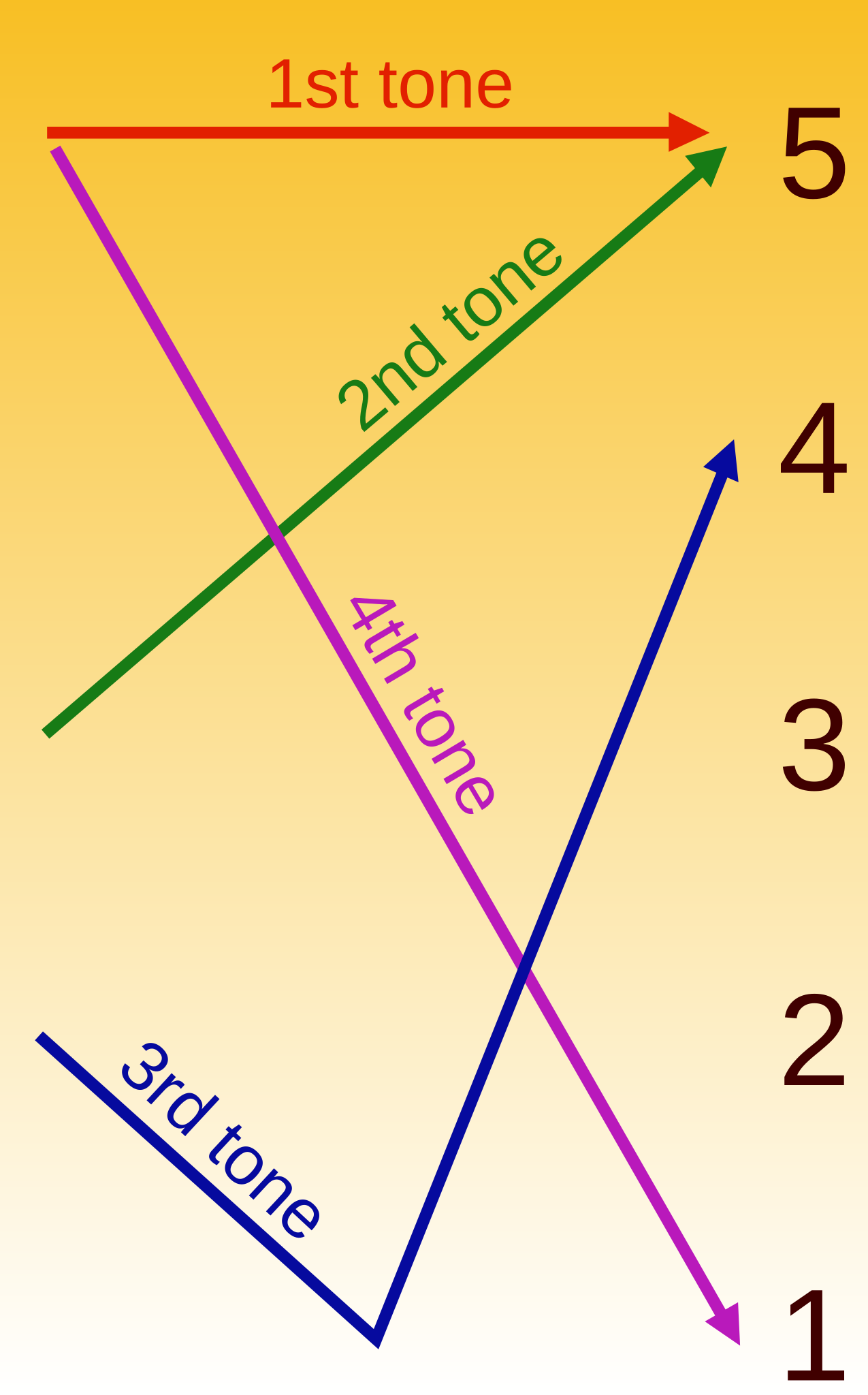
Another effective meaning that “pǔ ({register or record for reference} [→ [musical notation [→ [set to music; compose (music)]] | sth. to base oneself on | table; chart; list | guide; manual | standards | airs; pretensions | spectrum (physics)]]) can have is “spectrum”. So, it seems that this can also be considered a kind of ({register or record for reference} [→ [musical notation [→ [set to music; compose (music)]] | sth. to base oneself on | table; chart; list | guide; manual | standards | airs; pretensions | spectrum (physics)]]):

Chart showing the relative changes in pitch for the four tones of Mandarin Chinese

Chart showing the relative changes in pitch for the four tones of Mandarin Chinese
Creative Commons Attribution-ShareAlike License logo Wereon

Tones in Mandarin are made of pitch, something that is also an important concept in music. It is not surprising, then, that being musically inclined can help one in learning Mandarin. Does that mean that one must be a musical genius to master Mandarin? Not at all! There are about a billion people in China who speak Mandarin just fine, and they can’t all be musical geniuses.

Music, Tones, and Talent

While some are definitely more naturally talented with music or with languages (or with both) than others, talent is far from being the only factor in how well one can come to make music, or learn a tonal language like Mandarin.

As an example, many years ago, early in my own musical journey, I was in a music store trying to tune a guitar by myself. I was trying my best, but I was having a hard time telling which pitches were higher and which were lower—my pitch-discriminating “muscles” were still quite undeveloped. I was doing so poorly that a nearby employee of the music store was imploring me to just let him tune the guitar! Because of my love of music and my determination, though, over time I kept working on improving my ability to distinguish different pitches, and eventually I improved greatly.

I also remember that when I was a young kid in the local Cantonese congregation in an English-speaking country, there was a time when my Bible teacher was putting me through exercises in recognizing different Cantonese tones, and I was doing terribly, not being able to tell which tones were which. Now, though, after acquiring information such as that in the graph above about the nature of the tones, and after ongoing effort and practice over time, my tone-discriminating abilities are much more highly developed, and I can instantly tell which Cantonese or Mandarin tones are which.

Propaganda and Misinformation vs. Truth

Keep in mind, though, that improving the sound of your Mandarin requires focusing on exactly that—the sound of your Mandarin. I have observed that many, influenced by worldly propaganda and misinformation, unfortunately focus instead on the visible Chinese characters, resulting in the invisible sound of their spoken Mandarin being neglected. However, modern linguistics (language science) and God’s Word the Bible both testify that the truth is that speech is actually the real primary aspect of language.—1 Corinthians 14:8–11.

In contrast to the time when I was following the crowd and focusing on characters, I have found that switching to using Pīnyīn (Pīn·yīn {Piecing Together of} · Sounds → [Pinyin] 拼音) as much as possible has helped me to properly focus on the sound of Mandarin. (Matthew 7:13, 14) After I made that switch, people began saying that I sound like a native Mandarin-speaker, whereas no one had ever said that back when I was focused on characters.

Moving Forward Surprisingly Much

So, while I know that others are more talented at music and at Mandarin than I am, I have been able to put whatever talent I have to good use and improve greatly at both music and Mandarin, by continuing to study them and to work at them with the help of the available tools and resources. Regarding Mandarin specifically, I have also been helped to greatly improve by learning to recognize worldly propaganda and misinformation about it, which enables me to avoid being misled by these.

If you continue to study Mandarin and to work on learning it for the Mandarin field out of love, if you continue to take advantage of the available resources and tools like Pīnyīn (Pīn·yīn {Piecing Together of} · Sounds → [Pinyin] 拼音), and if you avoid being misled by worldly propaganda and misinformation, then with the blessing and the help of Jehovah, the Source of music, language, talent, etc., you can also greatly improve, perhaps even to an extent that would surprise your past self!


For convenience:

The direct link for the Pīnyīn (Pīn·yīn {Piecing Together of} · Sounds → [Pinyin] 拼音) Plus resource for the “Sing Out Joyfully” book is:

The short link for Chinese field language-learning links for the “Sing Out Joyfully” book is:

More Pīnyīn (Pīn·yīn {Piecing Together of} · Sounds → [Pinyin] 拼音) and Pīnyīn (Pīn·yīn {Piecing Together of} · Sounds → [Pinyin] 拼音) Plus web material based on the Mandarin “Sing Out Joyfully” book will be made available in the Pīnyīn (Pīn·yīn {Piecing Together of} · Sounds → [Pinyin] 拼音) Plus web resource as time allows.

Categories
Culture Experiences History Language Learning Science Technology Theocratic

jiànshi

jiànshi (jiàn·shi [(getting to be)] {seeing → [meeting with; being exposed to]} · knowing [→ [[widening/enriching] knowledge/experience/sensibleness/insight]] 见识 見識) ← Tap/click to show/hide the “flashcard”

[Notes: Tap/click on a Pīnyīn (Pīn·yīn {Piecing Together of} · Sounds → [Pinyin] 拼音) expression to reveal its “flashcard”; tap/click on a “flashcard” or its Pīnyīn (Pīn·yīn {Piecing Together of} · Sounds → [Pinyin] 拼音) expression to hide the “flashcard”. 📖 📄 📘 icons mean 📖 Reveal All, 📄 Reveal Advanced, and 📘 Reveal None re all the “flashcards” in the heading, paragraph, etc. that they are placed at the beginning of.]

A few years back, I wrote up a brief web page listing reasons for producing Pīnyīn (Pīn·yīn {Piecing Together of} · Sounds → [Pinyin] 拼音), etc. material for the Imitate (ia) book. Some, especially some who grew up in the West, may have felt that this book is made up of “just stories”, and ones that they were already quite familiar with, at that. However, we must remember that Chinese Bible students may often have a different perspective regarding the Bible accounts that are made to come to life in the Imitate book. As that web page said:

  • Many Chinese people in the world have not been exposed to Bible accounts the way many Westerners have.
  • Also, I have heard that some, perhaps many, Chinese Bible students tend to approach their Bible studies like intellectual exercises for accumulating chōuxiàng (abstract) head knowledge as if for a school exam, rather than as training for their hearts for their own real lives.

Later, the web page touches on how some of the real-world benefits of good storytelling like that found in the Imitate book involve empathy:

    • The actress Natalie Portman once said, “I love acting. I think it’s the most amazing thing to be able to do. Your job is practicing empathy. You walk down the street imagining every person’s life.”
  • The Imitate book helps build Bible students’ empathy towards Bible characters, which in turn helps Bible students realize that others would feel empathy towards them as well if they imitated these Bible characters—not everyone will just think they’re crazy, like many worldly friends or family members might think.

While even fictional stories can have the benefits described in the links and the quote above, true stories from the Bible can have even greater benefits, including spiritual ones.

Besides the Imitate book, another book from Jehovah’s organization that relates Bible accounts is the Learn From the Bible (lfb) book. The letter from the Governing Body in this book says that, similarly to the Imitate book, the Learn From the Bible book also “brings the Bible accounts to life and captures the feelings of those depicted”, while, unlike the Imitate book, it “tells the story of the human family from creation onward”. While the Learn From the Bible book is especially suitable for children, the letter from the Governing Body in this book says that “it can also be used to help adults who desire to learn more about the Bible”. So, it would be good to consider on this blog some of the expressions used in the Mandarin Learn From the Bible book.

“I Will Make Them Know”

This week’s MEotW, “jiànshi (jiàn·shi [(getting to be)] {seeing → [meeting with; being exposed to]} · knowing [→ [[widening/enriching] knowledge/experience/sensibleness/insight]] 见识 見識)”, appears in the current Mandarin version of the New World Translation Bible in Jeremiah 16:21, which is quoted in Lesson 19 of the Mandarin Learn From the Bible book (WOL), entitled “Tóu (Head → [First]) Sān (Three 三) Chǎng ([mw for recreational, sports, or other activities]場/塲) Zāiyāng (Calamities → [Plagues] 灾殃 災殃) (“The First Three Plagues”):

English:

“So I will make them know,
At this time I will make them know my power and my might,
And they will have to know that my name is Jehovah.”

Mandarin (WOL, Pīnyīn (Pīn·yīn {Piecing Together of} · Sounds → [Pinyin] 拼音) Plus):

📖 📄 📘Suǒyǐ (Suǒ·yǐ {that which} · {is the reason} → [so] 所以) (I 我) yào (will 要) ràng (make) tāmen (tā·men him/her · [pl] [them] 他们 他們) zhīdào (zhī·dào know · {(the) way (of it)} → [know] 知道),
Zhè (this) (one 一) (time 次), (I 我) yào (will 要) ràng (make) tāmen (tā·men him/her · [pl] [them] 他们 他們)
Jiànshi (Jiàn·shi {see → [be exposed to]} · know 见识 見識) wǒ de ((wǒ me 我) (de ’s 的) [my]) (big → [great] 大)néng (ability 能) (big → [great] 大) (power 力),
Tāmen (Tā·men he/she · [pl] [they] 他们 他們) jiù (then 就) zhīdào (zhī·dào {will know} · {(the) way (of)} → [will know] 知道)
Wǒ de ((Wǒ me 我) (de ’s 的) [my]) míngzi (míng·zi name · word → [name] 名字) shì (is 是) Yēhéhuá (Jehovah 耶和华 耶和華).”

The “jiàn (see [→ [meet with; be exposed to]] | seeing → [view (opinion)]) in “jiànshi (jiàn·shi [(getting to be)] {seeing → [meeting with; being exposed to]} · knowing [→ [[widening/enriching] knowledge/experience/sensibleness/insight]] 见识 見識) is a well-know expression that basically means “see”. It some contexts, it can effectively mean “be exposed to”. The other morpheme in “jiànshi (jiàn·shi [(getting to be)] {seeing → [meeting with; being exposed to]} · knowing [→ [[widening/enriching] knowledge/experience/sensibleness/insight]] 见识 見識) also appears in the well-known expression “rènshi (rèn·shi [(get)] {to recognize} · {to know} 认识 認識)”, and it means “know”. In the context of Jeremiah 16:21, it seems that “jiànshi (jiàn·shi [(getting to be)] {seeing → [meeting with; being exposed to]} · knowing [→ [[widening/enriching] knowledge/experience/sensibleness/insight]] 见识 見識) effectively means “be exposed to, know”.

Imaginary vs. Real Power

The verse just before Jeremiah 16:21 tells us that the false gods that humans make for themselves were at issue:

Can a man make gods for himself
When they are not really gods?

In Moses time, the gods of the Egyptians were powerful in the imaginations of the Egyptian people, but through the plagues that he brought upon the Egyptians, Jehovah showed that actually, he was powerful in reality.

As Mandarin field language learners, we are exposed to the worldly admonition to devote ourselves to Chinese characters, those intricate visible avatars of Chinese language and culture. However, modern linguistics (language science), along with God’s Word the Bible, expose Chinese characters as false linguistic “gods”, mere secondary players at best, compared to speech, which is the true primary aspect of any human language.—1 Corinthians 14:8–11.

Jehovah’s Powerful Gift of Speech

Let us in a positive way get to know Jehovah’s power, including the power he put into his creations, such as the gift of speech. In contrast, writing is merely a human invention that’s based on Jehovah’s gift of speech:

Lauren: I think that is one of the things that makes it really hard for people who grow up in highly literate, highly educated societies to tease writing and reading apart from language. But actually, when you step back, you realise that writing is actually super weird.

Gretchen: It’s so weird! It’s this interesting – it really is a technology. It’s a thing you do on top of language to do stuff with language, but it’s not the language itself. There are thousands and possibly millions of languages that have never been written down in the history of humanity. We have no idea. We’ve never met a society of humans, or heard of a society of humans, without language. But those are spoken and signed languages, which are just kind of there. Writing, by contrast, was invented somewhere between 3 and 4 times in the history of humanity.

Human inventors sometimes have the humility to admit that they were standing on the shoulders of giants. Well, Jehovah, who created human speech, is indeed a giant, upon whose shoulders the puny human inventors of writing were standing!

As an example of the power of Jehovah’s gift of speech, consider what Matthew 7:28 says about how powerfully Jesus spoke to those he taught in his ministry:

When Jesus finished these sayings, the effect was that the crowds were astounded at his way of teaching,

Yes, while the human-invented Chinese characters have captured the imaginations of many people, and while these people imagine characters to be powerful, what most powerfully praises Jehovah and moves people’s hearts in reality is Jehovah’s gift of speech, when wielded skilfully as Jesus wielded it.

Purposefully Focusing on Speech

How can we similarly speak powerfully in Mandarin to those we meet in the Mandarin field? We can be helped to directly and purposefully reach this goal, to personally jiànshi (jiàn·shi {see → [be exposed to]} · know 见识 見識) or know the power of Jehovah’s gift of speech, if we focus on developing the invisible but powerful skill of speaking well in Mandarin, rather than allowing ourselves to fall for the alluring but silencing diversion of the visible Chinese characters.

(Of course, the current reality is that some spiritual information is still only available in characters, although Jehovah’s organization has been making more and more material available with Pīnyīn (Pīn·yīn {Piecing Together of} · Sounds → [Pinyin] 拼音). From my experience, I recommend in general that Mandarin field language learners use Pīnyīn (Pīn·yīn {Piecing Together of} · Sounds → [Pinyin] 拼音) when they can, and that they just use characters when they have to.)

While as a writing system, characters do ultimately represent Mandarin speech, they do so in such an unnecessarily complex and hard-to-deal-with way that the characters end up actually stifling and stultifying Mandarin speech. In contrast, unlike the Chinese characters that demand attention for themselves so that people can admire—and be able to cope with—their complexity and fancy visual designs, Pīnyīn (Pīn·yīn {Piecing Together of} · Sounds → [Pinyin] 拼音) simply and directly helps us to actually focus on the Mandarin manifestation of Jehovah’s powerful gift of speech, and it helps us without distraction to develop our ability to use it well.

So, don’t just privately study Chinese characters. Listen closely to the Mandarin speech of those who speak it well. Try to get a sense of the sound and “feel” of good spoken Mandarin. Practise speaking Mandarin out loud when you can. (It may feel strange and uncomfortable at first, but if you stick with it, you’ll get used to it.) Don’t ignore or neglect Mandarin tones, which are as essential to Mandarin as vowels sounds are to English. Ask for and accept advice from those who speak Mandarin well about how to improve your spoken Mandarin. Don’t let yourself be intimidated by character snobs and traditionalists into not using Pīnyīn (Pīn·yīn {Piecing Together of} · Sounds → [Pinyin] 拼音). Instead, make good use of this modern alphabetic full writing system that lets you focus on Mandarin speech itself. As you take purposeful and practical steps such as these, you will be helped to in the Mandarin field imitate Jesus’ way of using Jehovah’s powerful gift of speech.


For convenience:

The direct link for the Pīnyīn (Pīn·yīn {Piecing Together of} · Sounds → [Pinyin] 拼音) Plus resource for the Learn From the Bible book is:

The short link for Chinese field language-learning links for the Learn From the Bible book is:

More Pīnyīn (Pīn·yīn {Piecing Together of} · Sounds → [Pinyin] 拼音) and Pīnyīn (Pīn·yīn {Piecing Together of} · Sounds → [Pinyin] 拼音) Plus web material based on the Mandarin Learn From the Bible book will be made available in the Pīnyīn (Pīn·yīn {Piecing Together of} · Sounds → [Pinyin] 拼音) Plus web resource as time allows.