Categories
Culture Current Events Experiences Language Learning Technology Theocratic

qiānqiū‐wàndài

qiānqiū+ (qiān·qiū thousand · autumns 千秋)‐wàndài+ (wàn·dài {ten thousand} · {replacings → [generations]} 万代 萬代) 👈🏼 Tap/click to show/hide the “flashcard”

[Notes: Tap/click on a Pīnyīn (Pīn·yīn {Piecing Together of} · Sounds → [Pinyin] 拼音) expression to reveal its “flashcard”; tap/click on a “flashcard” or its Pīnyīn (Pīn·yīn {Piecing Together of} · Sounds → [Pinyin] 拼音) expression to hide the “flashcard”. 📖 📄 ➕ icons mean 📖 Reveal All, 📄 Reveal Advanced, and ➕ Reveal + Symbols re all the “flashcards” in the heading, paragraph, etc. that they are placed at the beginning of.]

Rather than dismissively thinking to ourselves that the songs produced by the organization are “just songs”, we should remember that the slave class takes seriously its responsibility to provide spiritual food to God’s people, and so it is going to make sure that the lyrics in its songs are spiritually correct, while also being emotionally moving.—Ezekiel 33:32; Matthew 24:45.

“In Ev’ry Generation”
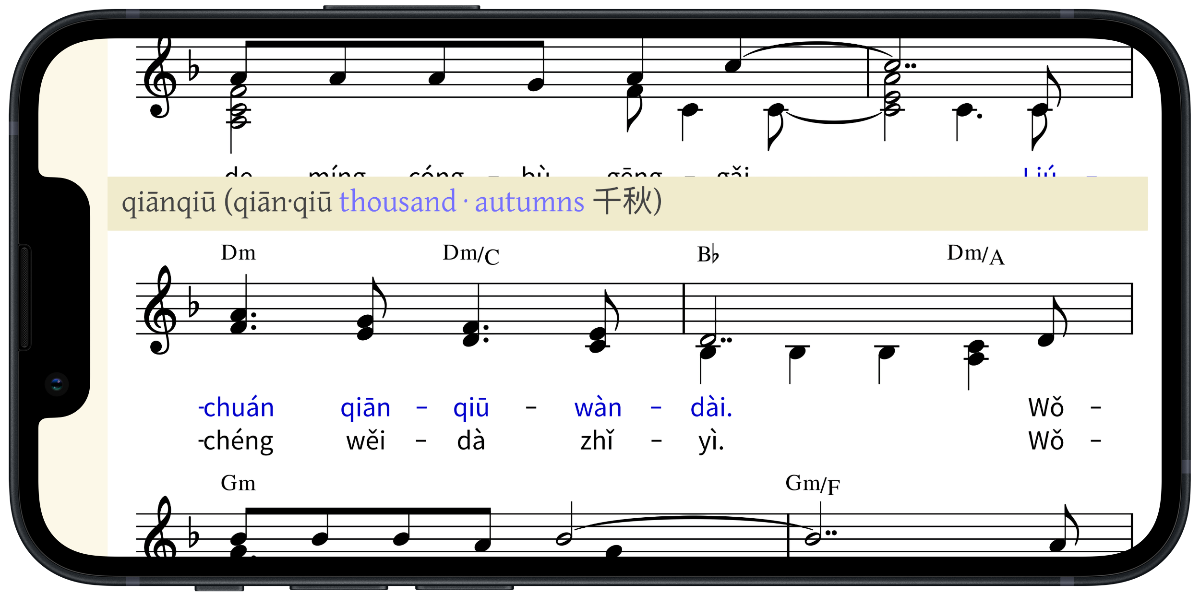
“qiānqiū” _Pīnyīn_ Plus info, Song 2 (music+_Pīnyīn_), on iPhone 13 mini (landscape orientation)

This week’s MEotW in the unofficial Pīnyīn (Pīn·yīn {Piecing Together of} · Sounds → [Pinyin] 拼音) Plus resource “Sing Out Joyfully” Bk. (Pīnyīn+Music, Pīnyīn Plus, Web)

This week’s MEotW, “qiānqiū (qiān·qiū thousand · autumns 千秋)‐wàndài (wàn·dài {ten thousand} · {replacings → [generations]} 万代 萬代)”, comes from the first verse of song 2, which is entitled “Jehovah Is Your Name” in English and “Nǐ de ((Nǐ You 你) (de ’s 的) → [Your]) Míng (Name 名) Shì (Is 是) Yēhéhuá (Jehovah 耶和华 耶和華)” in Mandarin:

English:

In ev’ry generation—
Jehovah is your name.

Mandarin (WOL, Pīnyīn (Pīn·yīn {Piecing Together of} · Sounds → [Pinyin] 拼音) Plus):

📖 📄 ➕ Nǐ de ((Nǐ you 你) (de ’s 的) → [your]) míng (name 名) cóngbù (cóng·bù ever · not → [never] 从不 從不) gēnggǎi (gēng·gǎi {does change} · {does alter} 更改),
Liúchuán (Liú·chuán {flows → [circulates]} · {is handed down} (for) 流传 流傳) qiānqiū (qiān·qiū thousand · autumns 千秋)‐wàndài (wàn·dài {ten thousand} · {replacings → [generations]} 万代 萬代).

“Qiānqiū (Qiān·qiū thousand · autumns 千秋)‐wàndài (wàn·dài {ten thousand} · {replacings → [generations]} 万代 萬代)” literally means “thousand autumns ten thousand replacings”. However, as explained in the MEotW post on “dài ({take the place of}; replace; subsitute | replacing; substituting → [acting; substitute | generation [→ [period; era; age]]] 代)”, this expression, while literally meaning “replacing”, can effectively mean “generation”:

Yes, the Chinese concept of a “generation” is that it is something that takes the place of or replaces what was there before—the emphasis seems to be on continuation, and a new generation is viewed as having done well if it lived up to or maintained what came before it. In contrast, in the English-speaking world, a “generation” is something new that is generated—the emphasis seems to be more on innovation, progress, and a new generation is viewed as having done well if it improved upon what came before it, and moved things ahead. For example, the English expression “next generation” indeed implies innovation and progress compared to previous generations, such as when applied to vehicles, computers, and other technology.

So, on a certain level of literalness, “qiānqiū (qiān·qiū thousand · autumns 千秋)‐wàndài (wàn·dài {ten thousand} · {replacings → [generations]} 万代 萬代)” means “thousand autumns ten thousand generations”. As shown in the example above from song 2, this is basically a poetic way to refer to “ev’ry generation”, or “forever”. Another expression that means basically the same thing is “qiānqiū (qiān·qiū thousand · autumns 千秋)‐wànshì+ (wàn·shì {ten thousand} · generations 万世 萬世)”.

Also, another example of “wàn ({ten thousand} [→ [all; a very great number of]] 万 萬/万)” (“ten thousand”) being used in Mandarin to effectively mean “all” or “every” occurs in “wànwù (wàn·wù {ten thousand → [all]} · things 万物 萬物)”, which literally means “ten thousand things” and effectively means “all things”.

Is Everyone Replaceable?

This talk of replacing reminds me: It’s a pet peeve of mine that people sometimes use the expression “no one is irreplaceable”. While it’s true that each of us should maintain appropriate modesty and humility, I suspect that this expression really reflects worldly human corporate culture that treats people like fungible, disposable widgets instead of as individual human beings that each have different qualities and abilities. Such thinking that justifies exploiting people for small-minded short-term profit without having to appropriately recognize and reward them for their individual contributions and potential is in stark contrast to the Bible’s depiction of how Jehovah God knows and values each one of us as individuals. As Jesus said at Matthew 10:29–31:

Two sparrows sell for a coin of small value, do they not? Yet not one of them will fall to the ground without your Father’s knowledge. But even the hairs of your head are all numbered. So have no fear; you are worth more than many sparrows.

Musical Notation 🎼 and the Mandarin Field

In this post about a Mandarin expression found in our songbook, another subject that I want to touch on is: Is musical notation 🎼 too hard to be worth the trouble of producing it and using it? Are fewer and fewer people able to read it? I was fortunate enough to have been taught how to read musical notation in school. I have never thought of musical notation as being particularly difficult to use (it’s much easier to learn than characters, which many unquestioningly try to learn), and I find that it helps me to sing Kingdom songs more correctly (according to the intended melody, message, etc.) and more confidently more of the time. However, I am aware that not everyone in the Mandarin field has the same experience with musical notation. For example, a while ago, an older brother told me that he didn’t know how to read musical notation. Also, some people in the Mandarin field may have been affected by how education systems in this old world have been facing significant challenges relating to providing music education for younger ones.

Regardless of how the world may be failing in many cases to equitably provide good music education, Jehovah’s organization has pointed out that music is important in Jehovah’s worship. For example, not long ago, a Meeting Workbook said:

Music can have a powerful influence on the mind and body. Singing is an important part of our worship of Jehovah.

In accordance with the importance of music in Jehovah’s worship, Mandarin field language learners used to have available to them official material from the organization containing musical notation with Pīnyīn (Pīn·yīn {Piecing Together of} · Sounds → [Pinyin] 拼音) in the lyrics. However, perhaps at least partially because of the technical difficulty and costliness of producing material with musical notation and both Chinese characters and Pīnyīn (Pīn·yīn {Piecing Together of} · Sounds → [Pinyin] 拼音) in the lyrics, as of this writing, late in 2024, there is no official material currently available from the organization that shows Pīnyīn (Pīn·yīn {Piecing Together of} · Sounds → [Pinyin] 拼音) and musical notation on the same page or screen.

The organization continues to publish official songbook material for different languages in general that contains musical notation, so it evidently still considers musical notation to generally be worthwhile to produce. It continues to produce official material for the current songbook that uses musical notation along with lyrics rendered only in Chinese characters, without Pīnyīn (Pīn·yīn {Piecing Together of} · Sounds → [Pinyin] 拼音), and it has even produced official material that uses jiǎnpǔ+ (jiǎn·pǔ simple · {register or record for reference → [musical notation]} → [numbered musical notation] 简谱 簡譜) (a kind of musical notation also known as numbered musical notation) and Chinese characters.

For those who find it helpful in their Mandarin field activities to put musical notation together with Pīnyīn (Pīn·yīn {Piecing Together of} · Sounds → [Pinyin] 拼音), the unofficial Pīnyīn (Pīn·yīn {Piecing Together of} · Sounds → [Pinyin] 拼音) Plus resource “Sing Out Joyfully” Bk. (Pīnyīn+Music, Pīnyīn Plus, Web) exists and is continuing to be improved. As shown in the screenshot above, this resource aids Mandarin field language learners by breaking with tradition and featuring lyrics in the musical notation that are only in relatively large-print Pīnyīn (Pīn·yīn {Piecing Together of} · Sounds → [Pinyin] 拼音) by default—characters are relegated to Pīnyīn (Pīn·yīn {Piecing Together of} · Sounds → [Pinyin] 拼音) Plus “flashcards” that are added as time allows.

Unlike the traditionally-used but unnecessarily extraordinarily complex characters that need to be accompanied by Pīnyīn (Pīn·yīn {Piecing Together of} · Sounds → [Pinyin] 拼音) before many are able to read them, Pīnyīn (Pīn·yīn {Piecing Together of} · Sounds → [Pinyin] 拼音) itself is a simple, elegant alphabetical full writing system for Mandarin that is easy to learn and remember. Also, it is no harder to typeset than other alphabetical writing systems with diacritics, such as the writing systems now used for French, Czech, Vietnamese, etc.*

In its Tips: section at the bottom of its home page, the “Sing Out Joyfully” Bk. (Pīnyīn+Music, Pīnyīn Plus, Web) resource contains these links that some may find helpful:


For convenience:

The direct link for the Pīnyīn (Pīn·yīn {Piecing Together of} · Sounds → [Pinyin] 拼音) Plus resource for the “Sing Out Joyfully” book is:

The short link for Chinese field language-learning links for the “Sing Out Joyfully” book is:

More Pīnyīn (Pīn·yīn {Piecing Together of} · Sounds → [Pinyin] 拼音) and Pīnyīn (Pīn·yīn {Piecing Together of} · Sounds → [Pinyin] 拼音) Plus web material based on the Mandarin “Sing Out Joyfully” book will be made available in the Pīnyīn (Pīn·yīn {Piecing Together of} · Sounds → [Pinyin] 拼音) Plus web resource as time allows.


* Thanks to ongoing advancements in personal computing hardware and software, producing material that contains things like musical notation and Pīnyīn (Pīn·yīn {Piecing Together of} · Sounds → [Pinyin] 拼音) text at reasonable cost is quicker and easier than ever. At this time, production of the musical notation in the “Sing Out Joyfully” Bk. (Pīnyīn+Music, Pīnyīn Plus, Web) resource begins in free open source software called MuseScore Studio, running on a Mac. Pīnyīn (Pīn·yīn {Piecing Together of} · Sounds → [Pinyin] 拼音) text for the lyrics in the musical notation is entered using macOS’s ABC – Extended input source (keyboard layout). (Just using Pīnyīn (Pīn·yīn {Piecing Together of} · Sounds → [Pinyin] 拼音) text only here simplifies things so much compared to having to somehow input characters with Pīnyīn (Pīn·yīn {Piecing Together of} · Sounds → [Pinyin] 拼音) ruby text!) When it’s ready, the musical notation for a song is exported from MuseScore Studio into SVG format, which is a plain text format that allows for the inclusion of links that activate Pīnyīn (Pīn·yīn {Piecing Together of} · Sounds → [Pinyin] 拼音) Plus flashcards on webpages. The coding for the SVG links is currently mostly done using the text editor BBEdit, in which editing large text files is quite performant. For Pīnyīn (Pīn·yīn {Piecing Together of} · Sounds → [Pinyin] 拼音) Plus web material production in general, my current favourite tool is Nova, but such web material can be produced in any application suitable for web development, such as Visual Studio Code, etc. ^

Categories
Science Technology Theocratic

miǎománg

miǎománg+ (miǎo·máng {(as if lost on or in a) vast expanse (of water) → [distant; indistinct; vague | tiny; insignificant]} · {vast; borderless (as an expanse of water); indistinct} → [distant and indistinct; remote and vague | uncertain] 渺茫 渺/淼茫) ← Tap/click to show/hide the “flashcard”

[Notes: Tap/click on a Pīnyīn (Pīn·yīn {Piecing Together of} · Sounds → [Pinyin] 拼音) expression to reveal its “flashcard”; tap/click on a “flashcard” or its Pīnyīn (Pīn·yīn {Piecing Together of} · Sounds → [Pinyin] 拼音) expression to hide the “flashcard”. 📖 📄 ➕ icons mean 📖 Reveal All, 📄 Reveal Advanced, and ➕ Reveal + Symbols re all the “flashcards” in the heading, paragraph, etc. that they are placed at the beginning of.]

The Shēngmìng Láizì Chuàngzào Ma? ((Shēngmìng Life 生命) (Lái·zì Came · From 来自 來自) (Chuàng·zào Initiating · {Making, Creating} → [Creating] 创造 創造) (Ma [? ptcl for “yes/no” questions] 吗 嗎)? → [Was Life Created? (lc)]) (Was Life Created? (lc)) brochure and the Shēngmìng de Qǐyuán—Zhíde Sīkǎo de Wǔ Ge Wèntí ((Shēngmìng Life 生命) (de ’s 的) (Qǐ·yuán {Rising → [Starting]} · Source → [Origin] 起源/原)—(Zhí·de Worth · Getting → [Worth] 值得) (Sī·kǎo {Thinking About} · Examining 思考) (de ’s 的) (Wǔ Five 五) (Ge [mw] 个 個/个) (Wèn·tí Asking · Subjects → [Questions] 问题 問題) → [The Origin of Life—Five Questions Worth Asking (lf)]) (The Origin of Life—Five Questions Worth Asking (lf)) brochure were originally published back in 2010, but relatively recently, the English version of the Was Life Created? brochure was updated to the December 2022 Printing, and the Mandarin version of it was updated to the February 2023 Printing. Also, the Was Life Created? brochure and the Origin of Life brochure are now in the Teaching Toolbox section in the JW Library app. So, it would be good to consider some of the expressions used in the Mandarin versions of these publications that can be so helpful when discussing whether life was created.

Compounding Improbabilities

This week’s MEotW, “miǎománg (miǎo·máng {(as if lost on or in a) vast expanse (of water) → [distant and indistinct; vague | tiny; insignificant]} · {vast; borderless (as an expanse of water); indistinct} → [distant and indistinct; remote and vague | uncertain] 渺茫 渺/淼茫)”, occurs a couple of times in the QUESTION 1 section of the Origin of Life brochure, entitled, in English, “How Did Life Begin?”. For example, it occurs in the final Fact: item mentioned in the box at the end of the section:

English:

Fact: Protein and RNA molecules must work together for a cell to survive. Scientists admit that it is highly unlikely that RNA formed by chance. The odds against even one protein forming by chance are astronomical. It is exceedingly improbable that RNA and proteins should form by chance in the same place at the same time and be able to work together.

Mandarin (WOL, Pīnyīn (Pīn·yīn {Piecing Together of} · Sounds → [Pinyin] 拼音) Plus):

📖 📄 ➕ Shìshí (Shì·shí Matter · {Being Solid} → [Fact] 事实 事實): Xìbāo (Xì·bāo tiny · womb → [cell] 细胞 細胞) yào (if 要) néng ({is to be able} 能) cúnhuó (cún·huó {to survive} · {to live} → [to survive] 存活), dànbái‐zhì+ ((dàn·bái egg · white → [protein] 蛋白)‐(zhì substance 质 質) → [protein]) hé ({(together) with} → [and] 和 和/龢) RNA fēnzǐ (fēn·zǐ {divided (off)} · {small and hard things} → [molecules] 分子) bìxū (must 必须 必須) hézuò (hé·zuò {closing → [joining]} · do → [work together] 合作). Kēxué‐jiā ((Kē·xué {branches of study} · learning → [science] 科学 科學)‐(jiā -ists 家) → [scientists]) chéngrèn (chéng·rèn undertake · {to recognize} → [admit] 承认 承認) RNA shì (is 是) jí (extremely 极 極) bù (not 不) kěnéng (kě·néng maybe · {being able} → [possibly] 可能) pèngqiǎo (pèng·qiǎo {having bumped into} · {being coincidental} → [by chance] 碰巧) chǎnshēng (chǎn·shēng {given birth to → [produced]} · {given birth to → [caused to exist]} → [brought into being] 产生 產生) de ({’s (thing)} 的), yí (one 一) ge ([mw] 个 個/个) dànbái‐zhì ((dàn·bái egg · white → [protein] 蛋白)‐(zhì substance 质 質) → [protein]) pèngqiǎo (pèng·qiǎo {having bumped into} · {being coincidental} → [by chance] 碰巧) chǎnshēng (chǎn·shēng {being given birth to → [being produced]} · {being given birth to → [being caused to exist]} → [being brought into being] 产生 產生) de (’s 的) kěnéng‐xìng ((kě·néng {being able} · {to be able to be} → [being probable] 可能)‐(xìng nature → [property] 性) → [probability]) yě (also 也) wēihū‐qí‐wēi+ ((wēi·hū {is tiny} · {with regard to} 微乎)‐(qí its 其)‐(wēi {being tiny} 微) → [is the tiniest of tiny]), ér (and 而) RNA hé ({(together) with} → [and] 和 和/龢) dànbái‐zhì ((dàn·bái egg · white → [protein] 蛋白)‐(zhì substances 质 質) → [proteins]) yào ({being supposed} 要) tóngshí (tóng·shí {(at the) same} · {(particular) time} 同时 同時) tóngdì (tóng·dì {(at the) same} · {ground → [place]} 同地) chǎnshēng (chǎn·shēng {to be given birth to → [to be produced]} · {to be given birth to → [to be caused to exist]} → [to be brought into being] 产生 產生) bìngqiě+ (bìng·qiě equally · also 并且 並且) néng ({to be able} 能) hùxiāng ({with each other} 互相) hézuò (hé·zuò {closing → [joining]} · {to do} → [to work together] 合作), jīhuì (opportunity → [chance] 机会 機會) jiù (then 就) gèngjiā (gèng·jiā {even more} · {adding → [additionally]} 更加) miǎománg+ (miǎo·máng {(is as if lost on or in a) vast expanse (of water) → [is distant and indistinct]} · {is borderless (as an expanse of water)} → [is remote and vague] 渺茫 渺/淼茫).

Looking at the morphemes in “miǎománg (miǎo·máng {(as if lost on or in a) vast expanse (of water) → [distant and indistinct; vague | tiny; insignificant]} · {vast; borderless (as an expanse of water); indistinct} → [distant and indistinct; remote and vague | uncertain] 渺茫 渺/淼茫)”, the first one seems to literally mean “vast expanse (of water)”, with an implied meaning of “as if lost on or in a vast expanse of water”. This can lead to effective meanings such as “distant and indistinct; vague” and “tiny; insignificant”. As for the second morpheme, it means “vast; borderless (as an expanse of water); indistinct”—again, an expanse of water is implied. Taken together, the morphemes in “miǎománg (miǎo·máng {(as if lost on or in a) vast expanse (of water) → [distant and indistinct; vague | tiny; insignificant]} · {vast; borderless (as an expanse of water); indistinct} → [distant and indistinct; remote and vague | uncertain] 渺茫 渺/淼茫)” on a certain level of literalness mean “as if lost on or in a vast, borderless expanse of water”, and effectively mean “distant and indistinct; remote and vague” or “uncertain”.

Isn’t It Ironic?

So, while at first glance, “miǎománg (miǎo·máng {(as if lost on or in a) vast expanse (of water) → [distant and indistinct; vague | tiny; insignificant]} · {vast; borderless (as an expanse of water); indistinct} → [distant and indistinct; remote and vague | uncertain] 渺茫 渺/淼茫)” may seem to directly mean something like “vast (and obvious) like an expanse of water”, it’s actually used to mean just about the opposite. Rather than being like, “Look! I found this great, big ocean! Easy!”, it’s more like, “Oh, no! I have to find a specific thing, but it’s somewhere on/in this vast, boundless ocean! Is that really even possible?”

Similarly, sort of, the English word “inflammable” may seem at first to mean “not catching fire easily”, but it actually means the opposite. Also, while “infinitesimal” may have come from the same Latin word that “infinite” came from, “infinitesimal” and “infinite” have almost opposite meanings.

Accuarate, and Also Illustrative

While the wording of “exceedingly improbable” in the above-quoted section of the English Origin of Life brochure is technically correct, the morphemes in “miǎománg (miǎo·máng {(as if lost on or in a) vast expanse (of water) → [distant and indistinct; vague | tiny; insignificant]} · {vast; borderless (as an expanse of water); indistinct} → [distant and indistinct; remote and vague | uncertain] 渺茫 渺/淼茫)” additionally provide an illustration that can help us comprehend the reality, the scale, of what is being discussed.

NASA photo of the Pacific Ocean, as seen from space

NASA photo of the Pacific Ocean, as seen from space (Talk about vast—the Pacific Ocean takes up about a third of the earth’s surface! It’s also the deepest of the earth’s oceans.)

Imagine if you had to find a particular drop of water in the Pacific Ocean. Or, imagine if even something as “big” as your iPhone or other smartphone fell out of a plane that was crossing the Pacific Ocean. How big is the likelihood that you could find it the way evolution supposedly functions—completely by chance, without the application of any intelligence? While it’s theoretically not totally impossible that you could do so, would you bet your life on it? Would you use that vague, insignificant possibility as “just” the basis of your whole way of thinking about life and the world? The use of “miǎománg (miǎo·máng {(as if lost on or in a) vast expanse (of water) → [distant and indistinct; vague | tiny; insignificant]} · {vast; borderless (as an expanse of water); indistinct} → [distant and indistinct; remote and vague | uncertain] 渺茫 渺/淼茫)” in the above-quoted section of the Mandarin Origin of Life brochure expresses to us that that is in effect what those who believe in evolution are doing.—John 3:36; 17:3; Proverbs 9:10.


For convenience:

The direct link for the current-generation Pīnyīn (Pīn·yīn {Piecing Together of} · Sounds → [Pinyin] 拼音) Plus resource for the Origin of Life brochure is:

The short link for Chinese field language-learning links for the Origin of Life brochure is:

More Pīnyīn (Pīn·yīn {Piecing Together of} · Sounds → [Pinyin] 拼音) and Pīnyīn (Pīn·yīn {Piecing Together of} · Sounds → [Pinyin] 拼音) Plus web material based on the Mandarin Origin of Life brochure will be made available in the Pīnyīn (Pīn·yīn {Piecing Together of} · Sounds → [Pinyin] 拼音) Plus web resource as time allows.

Categories
Culture Current Events History Science Technology Theocratic

app

app (a-p-p)

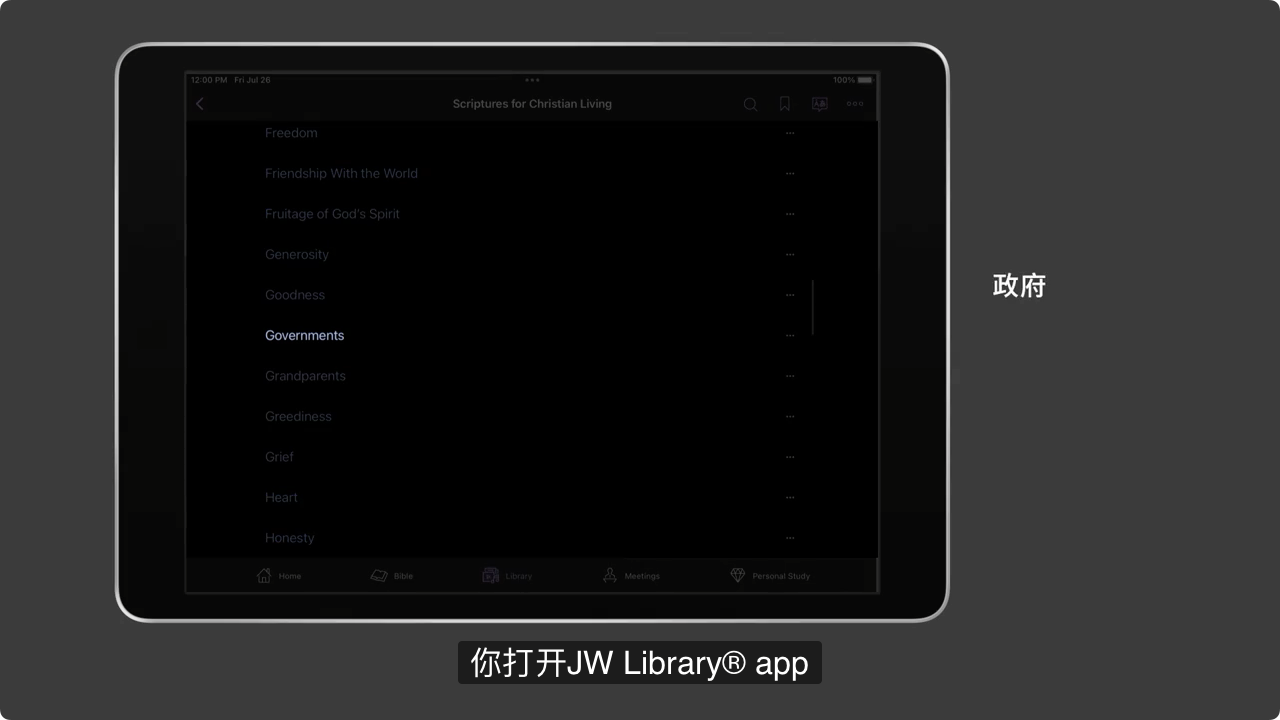
This week’s MEotW, “app” (sometimes written as “APP”), is now the organization’s official way to translate “app” in Mandarin, as much as there is an official way to do so. For example, it’s used in the Mandarin version of the 2024 Governing Body Update #5 video, at around the 11:06 mark—the subtitles say “app”, while the narrator says what sounds like “ay pee pee”.

“app” used in the Mandarin version of the 2024 Governing Body Update #5 video

(By the way, note that in this screenshot, the JW Library app is shown in Dark Mode—afters many years of people being used to using computer displays with white backgrounds that mimick paper, the organization is showing that there is nothing objectionable about the dark or black backgrounds enabled by computing device displays, backgrounds which can be easier on the eyes in some situations. After all, the default mode of the universe that Jehovah created is dark mode!)

An Unexpected Pronunciation

Yes, interestingly, as we can hear from the aforementioned video, when one refers to the JW Library app in Mandarin, in addition to using the English app name “JW Library” instead of a corresponding native Mandarin expression, one spells out the letters of “app” instead of just saying the English word “app”.

Why use three syllables to pronounce this exceedingly simple one-syllable English word in such an unusual and unexpected way? An Internet search turned up a Quora page discussing this question, which page contains the following excerpt that seems to summarize the points made in many of the replies:

Since the the original form “application” is not widely known, app is thought to be an acronym. In the aspect of pronunciation, closed syllables ending with p do not meet the Chinese pronunciation habit.

So, in other words, some believe that:

  • Being unfamiliar with the English word “application” that “app” is an abbreviation for, many Mandarin-speaking people erroneously thought that “app” is an acronym/initialism like “USA” or “PRC”, and acronyms are pronounced by saying the names of the letters in them. [2024-08-21: Thanks to reader SB for bringing up the matter of acronyms vs. initialisms. It seems that there is agreement that initialisms are, or can be, pronounced letter by letter, like “USA” and the Mandarin “app” are. However, there is not agreement about whether expressions pronounced that way count as acronyms, since some hold that only expressions like “NASA” that are pronounced as words should be considered acronyms.]
    • The fact that the Mandarin “app” is sometimes written in all upper case letters as “APP”, like an acronym/initialism would be written, lends credence to this theory.
  • Because Mandarin does not have words that end with a “p” sound, people who have only ever spoken Mandarin are not used to saying such words, and thus were naturally inclined to not just pronounce “app” like it is pronounced in English.
    • Some drag Chinese characters and Pīnyīn (Pīn·yīn {Piecing Together of} · Sounds → [Pinyin] 拼音) into discussion of this question, but these writing systems are just secondary visual representations of the actual primary factor relating to this issue, which is the system of sounds used in Mandarin speech. (I believe that technically, this is referred to as Mandarin phonology.)
    • Personally, I have doubts about this proposed factor, since other one-syllable English words ending with a “p” sound, like “jeep” (“jípǔ (jeep 吉普)”) and “Trump” (“Tèlǎngpǔ (Trump 特朗普)/Chuānpǔ (Trump (Tw) 川普)”), have been borrowed by Mandarin without requiring Mandarin-speakers to spell out their letters. I suppose it’s possible, as some have said, that putting “app” through this process results in a Mandarin expression that sounds confusingly similar to other expressions.

It’s also interesting that “app”, with its spelled-out letters, is used in Mandarin to correspond with the English word “app”, including in official media published by the organization, even though a native Mandarin expression meaning “app” does indeed exist. As shown in dictionaries, “yìngyòng (yìng·yòng apply · use | applied · used [(instance/etc.)] [→ [applied; for practical application; practical | application; practical use | (computing) app]] 应用 應用)” may be used to mean “app”, and just as “app” is short for “application”, “yìngyòng (yìng·yòng apply · use | applied · used [(instance/etc.)] [→ [applied; for practical application; practical | application; practical use | (computing) app]] 应用 應用)” is short for “yìngyòng chéngxù+ ((yìng·yòng applied · used (instance) → [application] 应用 應用) (chéng·xù {journey → [procedure]} · order; sequence → [(computer) programme] 程序) → [application programme])” (or “yìngyòng chéngshì ((yìng·yòng applied · used (instance) → [application] 应用 應用) (chéng·shì {journey → [procedure]} · pattern → [(computer) programme (Tw)] 程式) → [application programme (Tw)])” in Taiwan).

“Resistance Is Futile”

While Chinese traditionalists may futilely carry on about keeping Chinese culture “pure”, the common use of “app” in Mandarin is yet another example of Chinese culture naturally being influenced by Western culture, since the phenomenon of the modern mobile app followed on from the Western invention of the iPhone. Regarding the influence of Western culture on Chinese people, I have also noticed that some Chinese people seem to consider it “cool” to sprinkle in some English words here and there when they are speaking Mandarin, Cantonese, etc., even when they know the corresponding native Mandarin, Cantonese, etc. expressions.

Speaking of “cool”, a recent Language Log blog post written by Victor Mair and entitled “The Englishization of Chinese enters a new phase” said the following about “cool”, and about our MEotW “app”:

He takes the well-known example of “cool” (I’ll summarize what he says here). Before the year 2000, if somebody mentioned in a praiseworthy way that something was “kù 酷”, which at that time literally meant “cruel; ruthless; brutal; oppressive; savage”, people would consider that he was mixing English “coo[l]” in his Chinese speech, because at that time English “cool” was still in the early stages of being absorbed into Chinese. Standard dictionaries listed only the negative, pejorative meanings of “kù 酷”; there was not a trace of the positive meaning of “neat; nifty” and so forth. However, with the passage of time and with more and more saying “coo[l]” in a positive, approbatory sense, it gradually became a Chinese word. Now, if you say that someone or something is “kù 酷” (i.e., “cool”), no one would think that you’re mixing English in your speech. The positive meanings “cool; neat; nifty” have now become the primary definitions for “kù 酷”.

…people are no longer feeling the need to syllabize, much less hanziize, English words. They just say them flat out, and nobody blinks an eye that they are English words in Chinese. They have already instantly become Chinese terms — at least in speech. Nobody has cared to figure out how they should be written in hanzi [Chinese characters]. Even if you write them, you write them with roman letters…the roman alphabet has become an integral part of the Chinese writing system

…

There are hundreds of such words in current Chinese discourse, and they are at diverse stages of absorption into Chinese, e.g., “app”, “logo”, and “Ptú P图” (lit. “P picture/image”).

Yes, along with the “JW Library” app name, “app” is yet another example of how English words and Latin alphabet letters—like those used in Pīnyīn (Pīn·yīn {Piecing Together of} · Sounds → [Pinyin] 拼音)—are being incorporated into how people speak and write Mandarin Chinese “in the wild”, in the real world.

Anyway, as discussed in the 2024 Governing Body Update #5 video mentioned above, we stay neutral with regard to the world’s conflicts. While this obviously includes the world’s wars and political conflicts, in principle, this also applies to the world’s culture wars and its cultural conflicts and competitions. Our focus should be on how we can advance the interests of God’s Kingdom, and promote God’s righteous ways of doing things.—Matthew 6:33.