Categories
Culture Experiences History Language Learning Science Technology Theocratic

jídù

jídù ({being jealous [of]}; envying 嫉妒) 👈🏼 Tap/click to show/hide the “flashcard”

[Notes: Tap/click on a Pīnyīn (Pīn·yīn {Piecing Together of} · Sounds → [Pinyin] 拼音) expression to reveal its “flashcard”; tap/click on a “flashcard” or its Pīnyīn (Pīn·yīn {Piecing Together of} · Sounds → [Pinyin] 拼音) expression to hide the “flashcard”. 📖 📄 📘 icons mean 📖 Reveal All, 📄 Reveal Advanced, and 📘 Reveal None re all the “flashcards” in the heading, paragraph, etc. that they are placed at the beginning of.]

I have long especially liked 1 Corinthians 13. It contains counsel on what really does and doesn’t matter in life, an extensive description and definition of the most important kind of love, and a sublime discussion about the need to become complete, mature, as a person. As these apply to life in general, so too do they apply to our lives as Mandarin field language learners.

As Mandarin field language learners, it can benefit us greatly to consider what we can learn from 1 Corinthians 13, and along the way, we can also consider some of the Mandarin expressions used in that chapter in the current version of the Mandarin New World Translation Bible (nwtsty).

Two Ways About It

This week’s MEotW, “jídù ({being jealous [of]}; envying 嫉妒)”, is used in verse 4 (WOL) of 1 Corinthians 13:
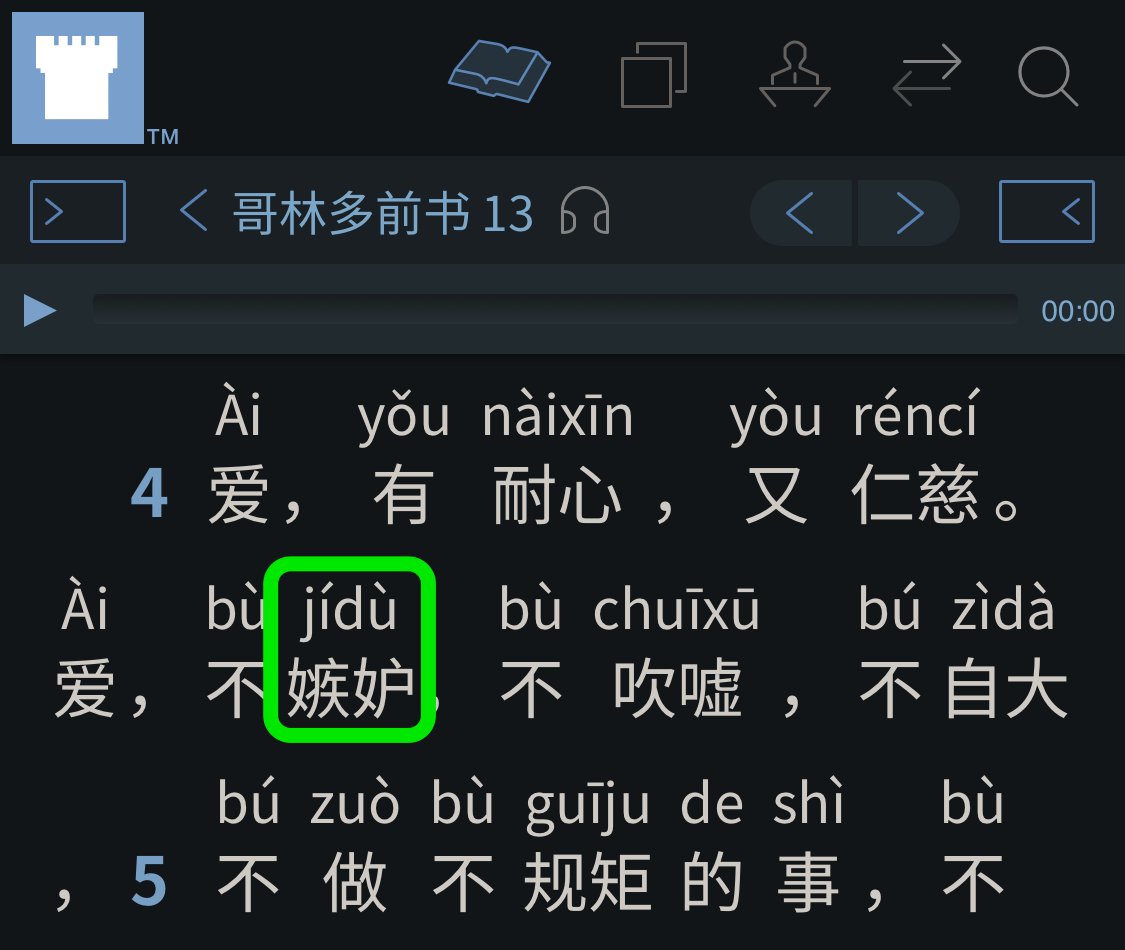
Screenshot of “_jídù_” in 1 Co. 13:4 (nwtsty, CHS+_Pīnyīn_ WOL)

(Dark mode for the Watchtower ONLINE LIBRARY (WOL) website, as shown in the above image, can be enabled in the Safari web browser by using the Noir Safari extension. Other web browsers may also have extensions with similar functionality.)

For comparison, here are the current English and Pīnyīn (Pīn·yīn {Piecing Together of} · Sounds → [Pinyin] 拼音) Plus renderings of 1 Corinthians 13:4:

English:

Love is patient and kind. Love is not jealous. It does not brag, does not get puffed up,

Pīnyīn (Pīn·yīn {Piecing Together of} · Sounds → [Pinyin] 拼音) Plus:

📖 📄 📘 Ài (love), yǒu (has 有) nàixīn (nài·xīn {being (of/with) enduring} · heart → [patience] 耐心), yòu (also 又) réncí (rén·cí {is kind} 仁慈). Ài (love), (not 不) jídù ({is jealous} 嫉妒), (not 不) chuīxū (chuī·xū {does puff → [does brag]} · {does sigh → [does praise]} → [does brag] 吹嘘 吹噓), (not 不) zìdà (zì·dà {(does consider) self} · {to be big → [to be great]} 自大),

Both of the morphemes in “jídù ({being jealous [of]}; envying 嫉妒) mean “be jealous of” or “envy”. Interestingly, these morphemes can be reversed to produce “dùjí ({being jealous [of]}; envying 妒嫉)”, which means the same thing as “jídù ({being jealous [of]}; envying 嫉妒)”. In this respect, these expressions are like “fǎlǜ (law 法律) and “lǜfǎ (law 律法)”. The MEotW post on “fǎlǜ (law 法律) had this to say about this situation:

But, Why?

If “lǜfǎ (law 律法)” and “fǎlǜ (law 法律)” both mean basically the same thing, why did the world’s Mandarin-speaking population bother to switch the order of “ (law; statute; rule; regulation 律)” and “ (law | method; way; mode | standard; model | {magic arts} | {follow; model after} 法)” in popular usage? Who knows? Appendix A2 of the Mandarin NWT Bible, probably wisely, does not get into the why of it, just mentioning that “fǎlǜ (law 法律)” is now the more common usage. Even if it turns out that there was a reason, it may not be what most would consider a good reason. Sometimes people are just weird, and, speaking as a Chinese person myself, that includes Chinese people—just look at some of the arbitrary ways in which Chinese characters have been designed, that have turned trying to figure out the pronunciations and meanings of unfamiliar Chinese characters into a guessing game.

Speaking of what’s commonplace or popular and why, I am reminded of this quote from William Goldman, who wrote the screenplay for The Princess Bride as well as the screenplays for several other successful, well-known movies:

Nobody knows anything…Not one person in the entire motion picture field knows for a certainty what’s going to work. Every time out it’s a guess

Regarding which Mandarin expression for “be jealous of” is better to use in the Mandarin field, in the Chinese Mandarin (Simplified) version of the Watchtower Online Library (WOL), searching yielded only 6 occurrences of “妒嫉” (“dùjí ({being jealous [of]}; envying 妒嫉)”), occurring between 1960 and 1974 and fitting on a single page, while there were multiple pages of results for “嫉妒” (“jídù ({being jealous [of]}; envying 嫉妒)”), including many occurrences in the current Mandarin New World Translation Study Bible (nwtsty). So, clearly, the organization now uses “jídù ({being jealous [of]}; envying 嫉妒) regularly, and no longer uses “dùjí ({being jealous [of]}; envying 妒嫉)”.

No Way to Live, or Love

While there may be two ways of saying “being jealous” in Mandarin, being jealous is no way to live, or love. Regarding jealousy, the recent MEotW post on “shíjí (shí·jí ten · {(stair)step [→ [level; rank; grade; class]]} [→ [master/expert level (coll)]] 十级 十級) said:

Speaking of being an expert, is that a bad thing? Some of those around us, perhaps out of insecurity or jealousy, may seek to “keep us in our place” if we get “uppity”, exhibit “pretensions of grandeur”, and actually try to be good at something, perhaps better at it than they are. (Matthew 13:54–58)…

However, God’s Word…encourages us to actually give Jehovah the best “sacrifice of praise” that we can. (Malachi 1:6–8; Hebrews 11:4; 13:15) So, ignore any insecure or jealous naysayers around you, and as Jesus said, “let your light shine” in the Mandarin field, even at shíjí (shí·jí ten · {(stair)step → [level]} → [expert level (coll)] 十级 十級) if you can, not to glorify yourself, but to glorify our heavenly Father Jehovah.—Matthew 5:16.

Also, the MEotW post on “guīju (guī·ju [([is] following)] {compasses; dividers → [rules; regulations]} · {carpenter’s squares → [rules; regulations]} → [[[is] following] rules; customs; established practices/standards | [[is] following] social etiquette; manners | [is] well-behaved; well-disciplined] 规矩 規矩) contains the following:

“Strife and Jealousy”

In the New World Translation Bible in the Watchtower Online Library, one of the scriptures linked to 1 Corinthians 13:5 with regard to “indecently” is Romans 13:13:

Let us walk decently as in the daytime, not in wild parties and drunkenness, not in immoral intercourse and brazen conduct, not in strife and jealousy.

Note that among the things that God’s Word lists as being indecent, along with things like drunkenness and sexual immorality, are “strife and jealousy”.

If someone makes an issue of a Mandarin field language learner who, say, uses Pīnyīn (Pīn·yīn {Piecing Together of} · Sounds → [Pinyin] 拼音) instead of following tradition and exclusively focusing on characters, is that person not being like those who made an issue of Jesus healing on the Sabbath? Instead of being happy and joyful because of the good that Jesus was doing, those opposers of Jesus were jealous of how “the entire crowd began to rejoice at all the glorious things he did”. (Luke 13:17) Opposers of Pīnyīn (Pīn·yīn {Piecing Together of} · Sounds → [Pinyin] 拼音) use today may similarly be jealous of how those who make good use of Pīnyīn (Pīn·yīn {Piecing Together of} · Sounds → [Pinyin] 拼音) can accomplish much in Jehovah’s service without having to put the kind of blood, sweat, and tears into learning characters the traditional way that they did. In their tradition-loving eyes, breaking from tradition and using innovative and game-changingly effective new tools like Pīnyīn (Pīn·yīn {Piecing Together of} · Sounds → [Pinyin] 拼音) may seem “indecent”, but in God’s eyes, it is the jealousy-motivated strife such ones cause over people doing good in his service that is truly indecent.

In God's organization, our unity is based on God's truth, not on human tradition.

[image or embed]

— tiandi, Links News (@tiandilinksnews.bsky.social) February 2, 2025 at 8:27 AM

Those who are motivated by true Christian love, as described in 1 Corinthians 13, would rejoice over how Pīnyīn (Pīn·yīn {Piecing Together of} · Sounds → [Pinyin] 拼音) helps Mandarin field language learners to bear witness to the truth more effectively, instead of considering it “cheating”, since love “rejoices with the truth”. (John 18:37; 1 Corinthians 13:6) Also, those who are motivated by true Christian love would not be jealous of how game-changing tools like Pīnyīn (Pīn·yīn {Piecing Together of} · Sounds → [Pinyin] 拼音) help Mandarin field language learners to more easily get more done, since “love is not jealous”. (1 Corinthians 13:4)…

The Needs of the Many, the Needs of the One

Interestingly, the collectivism of worldly Chinese culture may tend to drive people to be jealous, to hold zero-sum beliefs (that one person’s gain must mean another person’s loss), and to “feel bad about themselves when their friends succeed”. In contrast, real Christian love and true empathy move people to “rejoice with those who rejoice”. (Romans 12:15) The MEotW post on “jítǐ zhǔyì ((jí·tǐ gathered; collected · {body [→ [style; form]]} → [collective] 集体 集體) (zhǔ·yì master · meaning → [-ism] 主义 主義) [collectivism; community spirit]) touched on this:

Self-Identity and Balanced Self-Love

Self-identity is one thing that can particularly be a struggle for those raised in collectivistic societies, since the self is relatatively often neglected in such societies. It’s perhaps not surprising then, that, as mentioned above, in the relatively collectivistic Chinese societies, with their relative paucity, or scarcity, of more healthy ways to build and maintain self-identity, so many have such an unhealthy, obsessive attachment to Chinese characters, as something to desperately hang their neglected self-identities on.
Categories
Culture Experiences History Language Learning Science Technology Theocratic

gāo’ào

gāo’ào (gāo’·ào {[is] (considering self to be of) high (status)} · {[is] proud; haughty; arrogant} 高傲) ← Tap/click to show/hide the “flashcard”

[Notes: Tap/click on a Pīnyīn (Pīn·yīn {Piecing Together of} · Sounds → [Pinyin] 拼音) expression to reveal its “flashcard”; tap/click on a “flashcard” or its Pīnyīn (Pīn·yīn {Piecing Together of} · Sounds → [Pinyin] 拼音) expression to hide the “flashcard”. 📖 📄 📘 icons mean 📖 Reveal All, 📄 Reveal Advanced, and 📘 Reveal None re all the “flashcards” in the heading, paragraph, etc. that they are placed at the beginning of.]

A few years back, I wrote up a brief web page listing reasons for producing Pīnyīn (Pīn·yīn {Piecing Together of} · Sounds → [Pinyin] 拼音), etc. material for the Imitate (ia) book. Some, especially some who grew up in the West, may have felt that this book is made up of “just stories”, and ones that they were already quite familiar with, at that. However, we must remember that Chinese Bible students may often have a different perspective regarding the Bible accounts that are made to come to life in the Imitate book. As that web page said:

  • Many Chinese people in the world have not been exposed to Bible accounts the way many Westerners have.
  • Also, I have heard that some, perhaps many, Chinese Bible students tend to approach their Bible studies like intellectual exercises for accumulating chōuxiàng (abstract) head knowledge as if for a school exam, rather than as training for their hearts for their own real lives.

Later, the web page touches on how some of the real-world benefits of good storytelling like that found in the Imitate book involve empathy:

    • The actress Natalie Portman once said, “I love acting. I think it’s the most amazing thing to be able to do. Your job is practicing empathy. You walk down the street imagining every person’s life.”
  • The Imitate book helps build Bible students’ empathy towards Bible characters, which in turn helps Bible students realize that others would feel empathy towards them as well if they imitated these Bible characters—not everyone will just think they’re crazy, like many worldly friends or family members might think.

While even fictional stories can have the benefits described in the links and the quote above, true stories from the Bible can have even greater benefits, including spiritual ones.

Besides the Imitate book, another book from Jehovah’s organization that relates Bible accounts is the Learn From the Bible (lfb) book. The letter from the Governing Body in this book says that, similarly to the Imitate book, the Learn From the Bible book also “brings the Bible accounts to life and captures the feelings of those depicted”, while, unlike the Imitate book, it “tells the story of the human family from creation onward”. While the Learn From the Bible book is especially suitable for children, the letter from the Governing Body in this book says that “it can also be used to help adults who desire to learn more about the Bible”. So, it would be good to consider on this blog some of the expressions used in the Mandarin Learn From the Bible book.

Proud Pharaoh

This week’s MEotW, “gāo’ào (gāo’·ào {[is] (considering self to be of) high (status)} · {[is] proud; haughty; arrogant} 高傲)”, appears near the beginning of Lesson 19 of the Mandarin Learn From the Bible book (WOL), which is entitled “Tóu (Head → [First]) Sān (Three 三) Chǎng ([mw for recreational, sports, or other activities]場/塲) Zāiyāng (Calamities → [Plagues] 灾殃 災殃) (“The First Three Plagues”):

English:

Jehovah sent Moses and Aaron to Pharaoh with this message: ‘Let my people go so that they can worship me in the wilderness.’ Pharaoh proudly replied: ‘I do not care what Jehovah says, and I will not let the Israelites go.’

Mandarin (Pīnyīn (Pīn·yīn {Piecing Together of} · Sounds → [Pinyin] 拼音) Plus):

📖 📄 📘 Yēhéhuá (Jehovah 耶和华 耶和華) pài ({river branched} → [sent] 派) Móxī (Moses 摩西) (and 和) Yàlún (Aaron 亚伦 亞倫) ({to go} 去) jiàn (see) Fǎlǎo (Pharaoh 法老), duì (towards → [to]) (him 他) shuō ({to say}說/説): “ (you 你) yào (must 要) fàng ({let go} 放) wǒ de ((wǒ me 我) (de ’s 的) [my]) zǐmín (zǐ·mín persons · people 子民) zǒu ({to be walking} → [to be leaving] 走), ràng ({to allow}) tāmen (tā·men him/her · [pl] [them] 他们 他們) zài (in 在) kuàngyě (kuàng·yě spacious · {open country} → [wilderness] 旷野 曠野) chóngbài ({to worship} 崇拜) (me 我).” Fǎlǎo (Pharaoh 法老) què (however) gāo’ào (gāo’·ào {(considering self to be of) high (status)} · proud 高傲) de (-ly 地) shuō (said說/説): “Yēhéhuá (Jehovah 耶和华 耶和華) shuō (says說/説) shénme (shén·me what · [suf] 什么 什/甚麼) (I 我) bùguǎn (bù·guǎn not · {am managing → [am bothering about]} 不管), (I 我) jiùshì (jiù·shì exactly · am 就是) (not 不) fàng ({letting go} 放) rén (people 人).”

The Mandarin Learn From the Bible book here uses “gāo’ào (gāo’·ào {[is] (considering self to be of) high (status)} · {[is] proud; haughty; arrogant} 高傲) to correspond with the English word “proud”. A related expression, which also uses the morphemes in “gāo’ào (gāo’·ào {[is] (considering self to be of) high (status)} · {[is] proud; haughty; arrogant} 高傲)”, is “xīngāo (xīn·gāo heart · {[is] high} [→ [[is] proud | [is] having high aspirations/ambitions]] 心高)qì’ào (qì’·ào {air → [spirit | manner; attitude]} · {[is] proud; haughty [→ [[is] unyielding]]} 气傲 氣/气傲)”. This expression occurs in Proverbs 16:18 (WOL, Pīnyīn (Pīn·yīn {Piecing Together of} · Sounds → [Pinyin] 拼音) Plus), which is quoted in Lesson 62 of the Learn From the Bible book (WOL, Pīnyīn (Pīn·yīn {Piecing Together of} · Sounds → [Pinyin] 拼音) Plus).

Pharaoh Was a Bozo

The below quote was recently added to the article “Pīnyīn (Pīn·yīn {Piecing Together of} · Sounds → [Pinyin] 拼音) Was Plan A”:

This tendency of many to prioritize their own pride and position over what’s really better for everyone is also described in this quote from Guy Kawasaki about something he learned from Steve Jobs:

A players hire A+ players. Actually, Steve believed that A players hire A players—that is people who are as good as they are. I refined this slightly—my theory is that A players hire people even better than themselves. It’s clear, though, that B players hire C players so they can feel superior to them, and C players hire D players. If you start hiring B players, expect what Steve called “the bozo explosion” to happen in your organization.

Yes, Pīnyīn was Plan A, but China unfortunately let the proud, self-serving B players have their way.

Note that what makes someone a B player or worse is not necessarily that person’s level of intelligence, skill, talent, etc. What characterizes B players or worse is their proud, self-serving rejection of others who are better in some way, their need to feel superior to others.

Pharaoh encountered Jehovah God, an A+ player if ever there was one, and rather than humbly recognizing that, working along with Jehovah, and putting himself in a position to learn from him, Pharaoh in his pride stubbornly rejected Jehovah and his request. He didn’t have to be that way—when the king of Nineveh heard the judgement message from Jehovah that Jonah declared (as discussed in Lesson 54 of the Learn From the Bible book), he and his people repented. Unfortunately, the Pharaoh whom Moses and Aaron faced instead proved himself a bozo.

Psalm 2 prophesies that “the kings of the earth” in general would also “take their stand” against Jehovah and his King Jesus, instead of welcoming and honouring them as they deserve. What a bunch of bozos!

Instead of Following Plan A, China Went with the B Players

Again, as quoted above:

Yes, Pīnyīn was Plan A, but China unfortunately let the proud, self-serving B players have their way.

This is a major reason why China continues to mainly use Chinese characters, when Pīnyīn (Pīn·yīn {Piecing Together of} · Sounds → [Pinyin] 拼音) was introduced decades ago as a simple, elegant full writing system for Mandarin that was meant to eventually replace characters as the main writing system of China, to provide relief for the masses of people who were struggling with the unnecessarily inhumanly complex characters. As the above-quoted article explains:

In addition to those who feel that phasing out the Hànzì would be a regrettable cultural loss, I have also noticed that there are some for whom knowledge of Hànzì is a matter of pride and self-identity. They are proud of knowing the Hànzì as they do, and they view their knowledge of the Hànzì as part of what makes them who they are, as something that distinguishes them from those who don’t know the Hànzì. Such ones may defend the Hànzì to the point of irrationality in the face of a more accessible alternative that would make them and their hard-earned knowledge of Hànzì less “special”, that would threaten to render worthless all of the blood, sweat, and tears they have invested into grappling with these “Chinese puzzles”. It’s as if they are saying, “That’s not fair! If I had to go through all this bitter hard work to learn characters before I could read and write Chinese, then everyone else has to too!”

This is probably a big reason why, as noted above, “opposition [to Chinese writing reform] ‘comes primarily from intellectuals, especially from high level intellectuals.’ ” Lǔ Xùn (鲁迅/魯迅, Lu Xun), considered by many to be the greatest Chinese writer of the twentieth century (he wrote “The True Story of Ah-Q”, “Diary of a Madman”, and “My Old Hometown”), had this to say about the matter:

In addition to the limitations of social status and economic means, our Chinese characters present another high threshold to the masses: their difficulty. If you don’t spend ten or so years on them, it’s not easy to cross this threshold alone. Those who cross over it are the scholar-officials, and these same scholar-officials do their utmost to make writing as difficult as possible because it makes them especially dignified, surpassing all other ordinary scholar-officials.

Chinese characters and the Chinese literary language are already difficult enough by their own nature. On top of that, the scholar-officials have purposely devised all of these additional difficulties that get added on. Such being the case, how could anyone hope that the masses would have any affinity for the Chinese writing system? But the scholar-officials precisely want it to be this way. If the characters were easy to recognize and everybody could master them, then they would not be dignified, and the scholar-officials would lose their dignity along with them.

Let Us Allow Ourselves to Be Taught by Jehovah

Let us not be proud B players/bozos like those “dignified” scholar-officials, or like Pharaoh. Instead, let us humbly be open to learning from others, especially from Jehovah God himself. Isaiah 54:13 tells us of the good that can result:

And all your sons will be taught by Jehovah,
And the peace of your sons will be abundant.


For convenience:

The direct link for the Pīnyīn (Pīn·yīn {Piecing Together of} · Sounds → [Pinyin] 拼音) Plus resource for the Learn From the Bible book is:

The short link for Chinese field language-learning links for the Learn From the Bible book is:

More Pīnyīn (Pīn·yīn {Piecing Together of} · Sounds → [Pinyin] 拼音) and Pīnyīn (Pīn·yīn {Piecing Together of} · Sounds → [Pinyin] 拼音) Plus web material based on the Mandarin Learn From the Bible book will be made available in the Pīnyīn (Pīn·yīn {Piecing Together of} · Sounds → [Pinyin] 拼音) Plus web resource as time allows.

Categories
Culture Language Learning Science Technology Theocratic

mìmì

mìmì (mì·mì {[is] secret} · {[is] dense → [[is] intimate; close] → [[is] secret; confidential]} [(thing)] → [[is] secret; confidential; clandestine | secret [(thing)]] 秘密 秘/祕密) ← Tap/click to show/hide the “flashcard”

I have long especially liked 1 Corinthians 13. It contains counsel on what really does and doesn’t matter in life, an extensive description and definition of the most important kind of love, and a sublime discussion about the need to become complete, mature, as a person. As these apply to life in general, so too do they apply to our lives as Mandarin field language learners.

As Mandarin field language learners, it can benefit us greatly to consider what we can learn from 1 Corinthians 13, and along the way, we can also consider some of the Mandarin expressions used in that chapter in the current version of the Mandarin New World Translation Bible (nwtsty).

Secrets

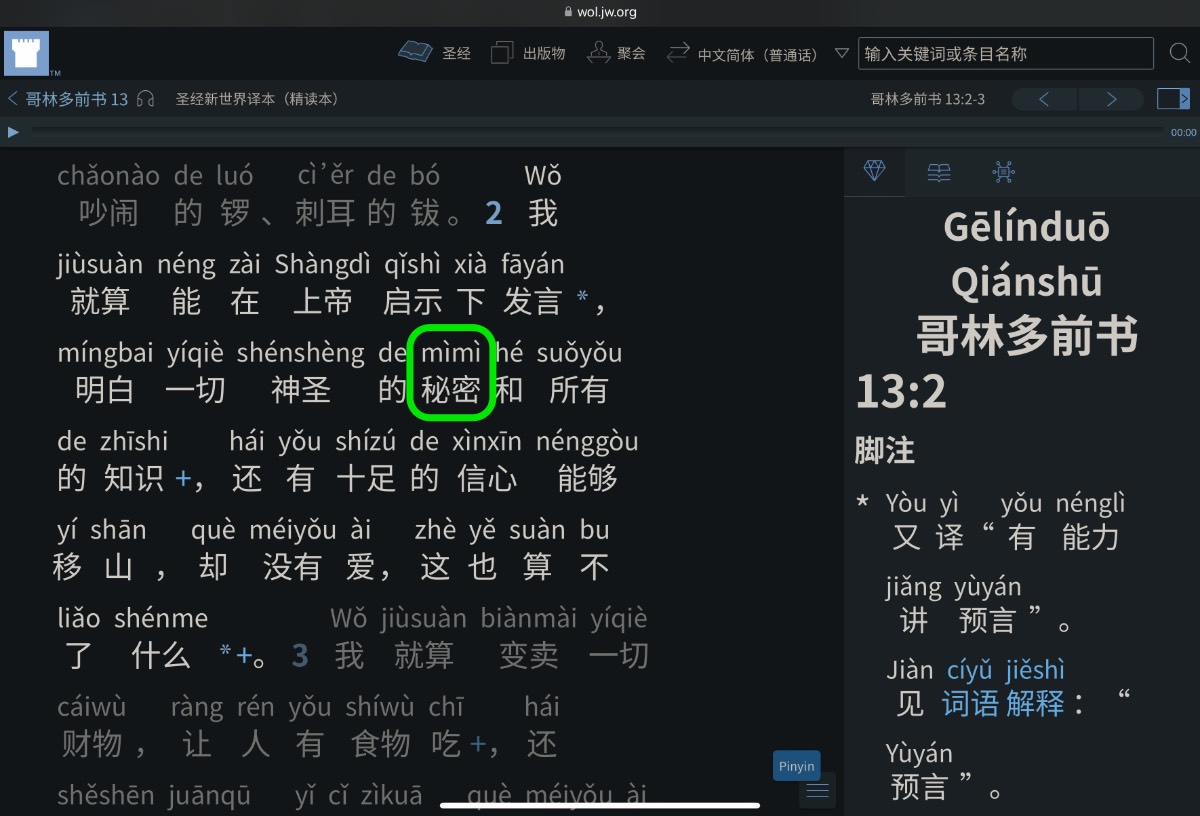
This week’s MEotW, “mìmì (mì·mì {[is] secret} · {[is] dense → [[is] intimate; close] → [[is] secret; confidential]} [(thing)] → [[is] secret; confidential; clandestine | secret [(thing)]] 秘密 秘/祕密), is used in verse 2 (WOL, Pīnyīn (Pīn·yīn {Piecing Together of} · Sounds → [Pinyin] 拼音) Plus) of 1 Corinthians 13:

Screenshot of “mìmì” in 1 Co. 13:2 (nwtsty, CHS+_Pīnyīn_ WOL)

(Dark mode for the Watchtower ONLINE LIBRARY (WOL) website, as shown in the above image, can be enabled in the Safari web browser by using the Noir Safari extension.)

While the two morphemes in “mìmì (mì·mì {[is] secret} · {[is] dense → [[is] intimate; close] → [[is] secret; confidential]} [(thing)] → [[is] secret; confidential; clandestine | secret [(thing)]] 秘密 秘/祕密) sound the same, they are different morphemes, with different meanings. The first one, “mì ({secret (n)} [→ [secretary (abbr.)]] | {[is] secret; mysterious; difficult to understand; obscure} [→ [[is] seldom seen; rare]] | {keep sth. secret; hold sth. back} [→ [block; obstruct]]秘/祕), here means “secret” (used as an adjective). Interestingly, this “mì ({secret (n)} [→ [secretary (abbr.)]] | {[is] secret; mysterious; difficult to understand; obscure} [→ [[is] seldom seen; rare]] | {keep sth. secret; hold sth. back} [→ [block; obstruct]]秘/祕) also appears in “mìshū (mì·shū secret · documents (person) → [secretary] 秘书 秘書), which means “secretary”, and it can be used as an abbreviation for “secretary”. (Yes, in both English and Mandarin, the word for “secretary” is based on the word for “secret”. So, be nice to office secretaries, congregation secretaries, etc. everywhere, since they are literally keepers of secrets!)

The second morpheme in “mìmì (mì·mì {[is] secret} · {[is] dense → [[is] intimate; close] → [[is] secret; confidential]} [(thing)] → [[is] secret; confidential; clandestine | secret [(thing)]] 秘密 秘/祕密), “mì ({[is] dense; thick} [[→ [[is] intimate; close] [→ [[is] secret; confidential]]] | [→ [[is] fine; meticulous]]] 密), literally means “dense; thick”, and can effectively mean “intimate; close”. (Compare the English expression “thick as thieves”.) That meaning, in turn, can effectively mean “secret” (used as an adjective), which is how it is used in “mìmì (mì·mì {[is] secret} · {[is] dense → [[is] intimate; close] → [[is] secret; confidential]} [(thing)] → [[is] secret; confidential; clandestine | secret [(thing)]] 秘密 秘/祕密). Another expression in which it’s used that way is “mìmǎ (mì·mǎ {dense → [intimate] → [secret]} · {sth. indicating a number} → [cipher; code | password; PIN] 密码 密碼), which can mean “code”. For example, the Mandarin Was Life Created? brochure uses “yíchuán (yí·chuán {leaving behind} · {passing on} → [genetic] 遗传 遺傳) mìmǎ (mì·mǎ {dense → [intimate] → [secret]} · {sth. indicating a number} → [code] 密码 密碼) to translate “genetic code”. (Compare: English WOL, CHS+Pīnyīn (Pīn·yīn {Piecing Together of} · Sounds → [Pinyin] 拼音) WOL, Pīnyīn (Pīn·yīn {Piecing Together of} · Sounds → [Pinyin] 拼音) Plus.)

Exotic East Syndrome

Speaking of secrets, some may be fascinated by the seemingly secret knowledge of the Chinese characters. However, 1 Corinthians 13:2 tells us that even understanding “all the sacred secrets and all knowledge” means nothing if one does not have love, and while Chinese characters may seem alluringly secret and mysterious to those looking on from outside the culture, they certainly are not sacred. Only things from God are sacred, and Chinese characters are the unnecessarily complex, haphazardly designed, highly imperfect products of mere imperfect humans.

And if I have the gift of prophecy and understand all the sacred secrets and all knowledge, and if I have all the faith so as to move mountains, but do not have love, I am nothing.
1 Corinthians 13:2.

Regarding this tendency of some to exoticize Chinese characters and other aspects of Chinese culture, the MEotW post on “jī‐tóng‐yā‐jiǎng ((jī chicken雞/鷄)‐(tóng {together with}同/仝)‐(yā duck)‐(jiǎng speaking) [people not understanding each other because of speaking different languages (from Cantonese)]) pointed out:

Western-educated publishers learning a Chinese language may unwittingly go along with the Western worldly tendency to exoticize things related to China. (John DeFrancis, in his book The Chinese Language: Fact and Fantasy (p. 37), calls this “Exotic East Syndrome”.) They may be content with—or even enjoy—the alluring veil of mystery and mystique surrounding certain things related to China and Chinese culture. Thus, they don’t seek to learn about and understand deeper truths about such things, that may pierce through this obscuring veil, and burst this bubble.—Compare 2 Corinthians 3:14, including the margin note.

Secrets and Identities

It is of course possible for one to have a balanced approach to Chinese characters, in which love moves one to seek to acquire whatever knowledge of characters is needed to serve effectively in the Chinese field that one is in. Many take the approach of using a system like Pīnyīn (Pīn·yīn {Piecing Together of} · Sounds → [Pinyin] 拼音) when they can, and learning to use characters when they have to. However, regarding how personally and emotionally important to them their knowledge of the secrets of Chinese characters has become to some people, the article “Pīnyīn (Pīn·yīn {Piecing Together of} · Sounds → [Pinyin] 拼音) Was Plan A” said:

In addition to those who feel that phasing out the Hànzì would be a regrettable cultural loss, I have also noticed that there are some for whom knowledge of Hànzì is a matter of pride and self-identity. They are proud of knowing the Hànzì as they do, and they view their knowledge of the Hànzì as part of what makes them who they are, as something that distinguishes them from those who don’t know the Hànzì. Such ones may defend the Hànzì to the point of irrationality in the face of a more accessible alternative that would make them and their hard-earned knowledge of Hànzì less “special”, that would threaten to render worthless all of the blood, sweat, and tears they have invested into grappling with these “Chinese puzzles”. It’s as if they are saying, “That’s not fair! If I had to go through all this bitter hard work to learn characters before I could read and write Chinese, then everyone else has to too!”

…during the 2014 Stanford Commencement address, Bill Gates said:

If we have optimism, but we don’t have empathy, then it doesn’t matter how much we master the secrets of science, we’re not really solving problems—we’re just working on puzzles.

Mr. Gates’ above observation applies to the subject at hand in that while many enjoy trying to solve the puzzles presented by Chinese characters, and while many also enjoy being known for being good at solving these puzzles, empathy should move us to recognize that there are much bigger issues involved than just our personal enjoyment or glorification.

Yes, when even some worldly people can recognize the above points, we Christians should recognize even more the need to show love and empathy rather than being proud, self-glorifying, self-justifying, and self-serving. Also, we should be actively and determinedly following the course of true Christian love and empathy rather than just going along with others who are proud, self-glorifying, self-justifying, and self-serving. We should especially do so when we have scriptures such as this to guide us:

Knowledge puffs up, but love builds up.—1 Corinthians 8:1.

Love and AI

As touched on in the MEotW post on “réngōng (rén·gōng human · work → [artificial] 人工) zhìnéng (zhì·néng intelligence · ability → [intelligence] 智能), lately there has been much discussion in the media about the recent developments in AI (artificial intelligence). AI systems can now be given access to lots and lots of human knowledge, but I don’t think anyone can reasonably claim that modern AI systems have been taught to have love the way the Bible says we need to have love. And so, many continue to worry about AIs falling out of alignment with humans and maybe even harming humans, maybe even to the point of extinction. Yes, as God’s Word pointed out long ago in 1 Corinthians 13:2, if one has much knowledge, even of secrets, but does not have love (Greek: a·gaʹpe), it is ultimately of no benefit. Indeed, without love to guide its use, that knowledge could actually be used to bring great harm!