jídù+ ({being jealous [of]}; envying 嫉妒) 👈🏼 Tap/click to show/hide the “flashcard”
[Notes: Tap/click on a Pīnyīn (Pīn·yīn {Piecing Together of} · Sounds → [Pinyin] 拼音) expression to reveal its “flashcard”; tap/click on a “flashcard” or its Pīnyīn (Pīn·yīn {Piecing Together of} · Sounds → [Pinyin] 拼音) expression to hide the “flashcard”. 📖 📄 ➕ icons mean 📖 Reveal All, 📄 Reveal Advanced, and ➕ Reveal + Symbols re all the “flashcards” in the heading, paragraph, etc. that they are placed at the beginning of.]
I have long especially liked 1 Corinthians 13. It contains counsel on what really does and doesn’t matter in life, an extensive description and definition of the most important kind of love, and a sublime discussion about the need to become complete, mature, as a person. As these apply to life in general, so too do they apply to our lives as Mandarin field language learners.
As Mandarin field language learners, it can benefit us greatly to consider what we can learn from 1 Corinthians 13, and along the way, we can also consider some of the Mandarin expressions used in that chapter in the current version of the Mandarin New World Translation Bible (nwtsty).
Two Ways About It
This week’s MEotW, “jídù ({being jealous [of]}; envying 嫉妒)”, is used in verse 4 (WOL) of 1 Corinthians 13:
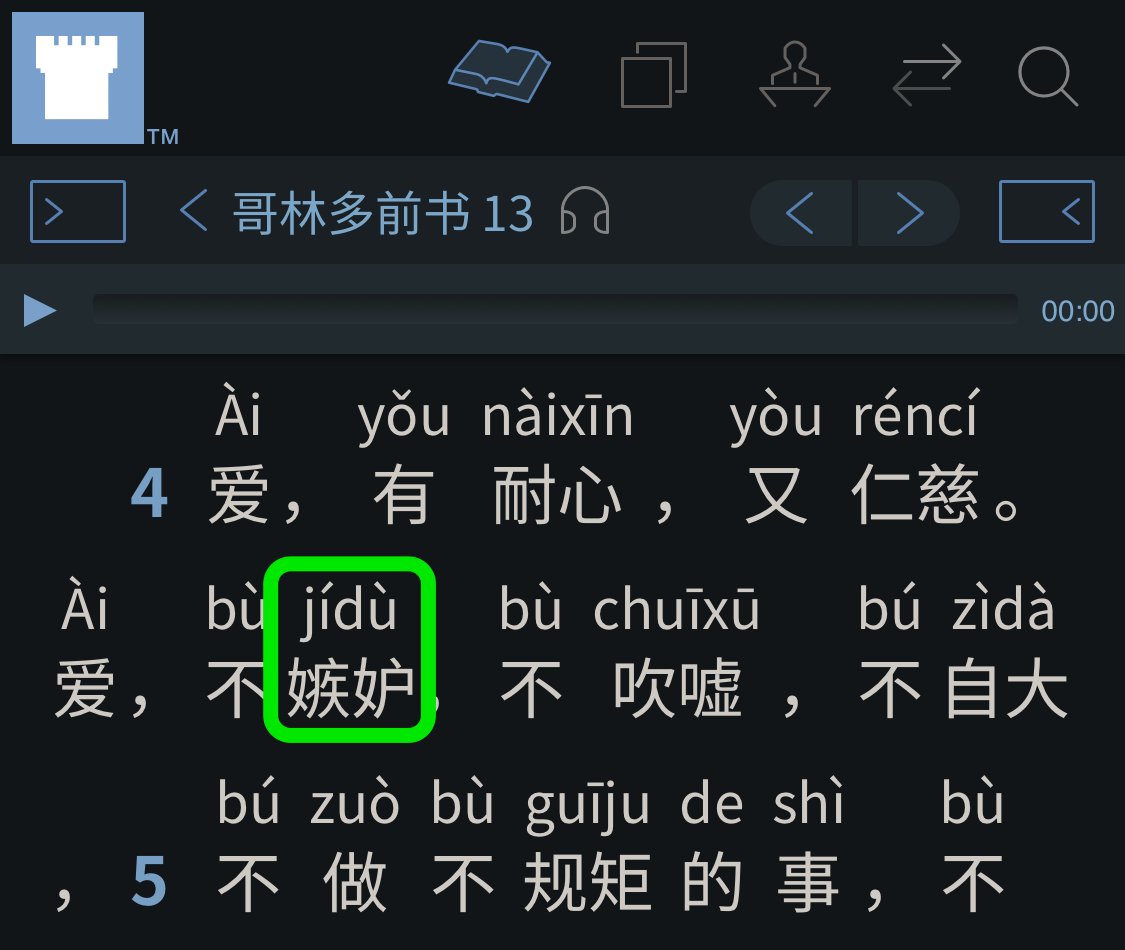
(Dark mode for the Watchtower ONLINE LIBRARY (WOL) website, as shown in the above image, can be enabled in the Safari web browser by using the Noir Safari extension. Other web browsers may also have extensions with similar functionality.)
For comparison, here are the current English and Pīnyīn (Pīn·yīn {Piecing Together of} · Sounds → [Pinyin] 拼音) Plus renderings of 1 Corinthians 13:4:
Love is patient and kind. Love is not jealous. It does not brag, does not get puffed up,
Pīnyīn (Pīn·yīn {Piecing Together of} · Sounds → [Pinyin] 拼音) Plus:
📖 📄 ➕ Ài (love 爱 愛), yǒu (has 有) nàixīn (nài·xīn {being (of/with) enduring} · heart → [patience] 耐心), yòu (also 又) réncí (rén·cí {is kind} 仁慈). Ài (love 爱 愛), bù (not 不) jídù ({is jealous} 嫉妒), bù (not 不) chuīxū+ (chuī·xū {does puff → [does brag]} · {does sigh → [does praise]} → [does brag] 吹嘘 吹噓), bú (not 不) zìdà (zì·dà {(does consider) self} · {to be big → [to be great]} 自大),
Both of the morphemes in “jídù ({being jealous [of]}; envying 嫉妒)” mean “be jealous of” or “envy”. Interestingly, these morphemes can be reversed to produce “dùjí ({being jealous [of]}; envying 妒嫉)”, which means the same thing as “jídù ({being jealous [of]}; envying 嫉妒)”. In this respect, these expressions are like “fǎlǜ+ (law 法律)” and “lǜfǎ+ (law 律法)”. The MEotW post on “fǎlǜ (law 法律)” had this to say about this situation:
But, Why?
If “lǜfǎ (law 律法)” and “fǎlǜ (law 法律)” both mean basically the same thing, why did the world’s Mandarin-speaking population bother to switch the order of “lǜ (law; statute; rule; regulation 律)” and “fǎ (law | method; way; mode | standard; model | {magic arts} | {follow; model after} 法)” in popular usage? Who knows? Appendix A2 of the Mandarin NWT Bible, probably wisely, does not get into the why of it, just mentioning that “fǎlǜ (law 法律)” is now the more common usage. Even if it turns out that there was a reason, it may not be what most would consider a good reason. Sometimes people are just weird, and, speaking as a Chinese person myself, that includes Chinese people—just look at some of the arbitrary ways in which Chinese characters have been designed, that have turned trying to figure out the pronunciations and meanings of unfamiliar Chinese characters into a guessing game.
Speaking of what’s commonplace or popular and why, I am reminded of this quote from William Goldman, who wrote the screenplay for The Princess Bride as well as the screenplays for several other successful, well-known movies:
Nobody knows anything…Not one person in the entire motion picture field knows for a certainty what’s going to work. Every time out it’s a guess
Regarding which Mandarin expression for “be jealous of” is better to use in the Mandarin field, in the Chinese Mandarin (Simplified) version of the Watchtower Online Library (WOL), searching yielded only 6 occurrences of “妒嫉” (“dùjí ({being jealous [of]}; envying 妒嫉)”), occurring between 1960 and 1974 and fitting on a single page, while there were multiple pages of results for “嫉妒” (“jídù ({being jealous [of]}; envying 嫉妒)”), including many occurrences in the current Mandarin New World Translation Study Bible (nwtsty). So, clearly, the organization now uses “jídù ({being jealous [of]}; envying 嫉妒)” regularly, and no longer uses “dùjí ({being jealous [of]}; envying 妒嫉)”.
No Way to Live, or Love
While there may be two ways of saying “being jealous” in Mandarin, being jealous is no way to live, or love. Regarding jealousy, the recent MEotW post on “shíjí (shí·jí ten · {(stair)step [→ [level; rank; grade; class]]} [→ [master/expert level (coll)]] 十级 十級)” said:
Speaking of being an expert, is that a bad thing? Some of those around us, perhaps out of insecurity or jealousy, may seek to “keep us in our place” if we get “uppity”, exhibit “pretensions of grandeur”, and actually try to be good at something, perhaps better at it than they are. (Matthew 13:54–58)…
However, God’s Word…encourages us to actually give Jehovah the best “sacrifice of praise” that we can. (Malachi 1:6–8; Hebrews 11:4; 13:15) So, ignore any insecure or jealous naysayers around you, and as Jesus said, “let your light shine” in the Mandarin field, even at shíjí+ (shí·jí ten · {(stair)step → [level]} → [expert level (coll)] 十级 十級) if you can, not to glorify yourself, but to glorify our heavenly Father Jehovah.—Matthew 5:16.
Also, the MEotW post on “guīju (guī·ju [([is] following)] {compasses; dividers → [rules; regulations]} · {carpenter’s squares → [rules; regulations]} → [[[is] following] rules; customs; established practices/standards | [[is] following] social etiquette; manners | [is] well-behaved; well-disciplined] 规矩 規矩)” contains the following:
“Strife and Jealousy”
In the New World Translation Bible in the Watchtower Online Library, one of the scriptures linked to 1 Corinthians 13:5 with regard to “indecently” is Romans 13:13:
Let us walk decently as in the daytime, not in wild parties and drunkenness, not in immoral intercourse and brazen conduct, not in strife and jealousy.
Note that among the things that God’s Word lists as being indecent, along with things like drunkenness and sexual immorality, are “strife and jealousy”.
If someone makes an issue of a Mandarin field language learner who, say, uses Pīnyīn (Pīn·yīn {Piecing Together of} · Sounds → [Pinyin] 拼音) instead of following tradition and exclusively focusing on characters, is that person not being like those who made an issue of Jesus healing on the Sabbath? Instead of being happy and joyful because of the good that Jesus was doing, those opposers of Jesus were jealous of how “the entire crowd began to rejoice at all the glorious things he did”. (Luke 13:17) Opposers of Pīnyīn (Pīn·yīn {Piecing Together of} · Sounds → [Pinyin] 拼音) use today may similarly be jealous of how those who make good use of Pīnyīn (Pīn·yīn {Piecing Together of} · Sounds → [Pinyin] 拼音) can accomplish much in Jehovah’s service without having to put the kind of blood, sweat, and tears into learning characters the traditional way that they did. In their tradition-loving eyes, breaking from tradition and using innovative and game-changingly effective new tools like Pīnyīn (Pīn·yīn {Piecing Together of} · Sounds → [Pinyin] 拼音) may seem “indecent”, but in God’s eyes, it is the jealousy-motivated strife such ones cause over people doing good in his service that is truly indecent.
In God's organization, our unity is based on God's truth, not on human tradition.
— tiandi, Links News (@tiandilinksnews.bsky.social) February 2, 2025 at 8:27 AM
Those who are motivated by true Christian love, as described in 1 Corinthians 13, would rejoice over how Pīnyīn (Pīn·yīn {Piecing Together of} · Sounds → [Pinyin] 拼音) helps Mandarin field language learners to bear witness to the truth more effectively, instead of considering it “cheating”, since love “rejoices with the truth”. (John 18:37; 1 Corinthians 13:6) Also, those who are motivated by true Christian love would not be jealous of how game-changing tools like Pīnyīn (Pīn·yīn {Piecing Together of} · Sounds → [Pinyin] 拼音) help Mandarin field language learners to more easily get more done, since “love is not jealous”. (1 Corinthians 13:4)…
The Needs of the Many, the Needs of the One
Interestingly, the collectivism of worldly Chinese culture may tend to drive people to be jealous, to hold zero-sum beliefs (that one person’s gain must mean another person’s loss), and to “feel bad about themselves when their friends succeed”. In contrast, real Christian love and true empathy move people to “rejoice with those who rejoice”. (Romans 12:15) The MEotW post on “jítǐ zhǔyì ((jí·tǐ gathered; collected · {body [→ [style; form]]} → [collective] 集体 集體) (zhǔ·yì master · meaning → [-ism] 主义 主義) → [collectivism; community spirit])” touched on this:
Maybe this is connected to why so many Chinese people seem to think,
“I suffered with Chinese characters, so you must suffer with them too!”
rather than,
“I want you to use _Pīnyīn_ so you won’t have to suffer with Chinese characters like I did.” https://t.co/rgv337FoFi
— Troubadour WW (@troubadourww) April 13, 2024
If individuals are only valued for their contribution to the collective and are insufficiently appreciated and cared for as individuals, it’s perhaps unsurprising that such individuals would feel driven to seek their own individual interests in covert ways.
— Troubadour WW (@troubadourww) April 14, 2024
Individuals and collectives both exist and both matter, so there needs to be a good balance between collectivism and individualism.
Perhaps “collectivistic societies” and “individualistic societies” are both unbalanced, just in different ways.
— Troubadour WW (@troubadourww) April 14, 2024
Self-Identity and Balanced Self-Love
Self-identity is one thing that can particularly be a struggle for those raised in collectivistic societies, since the self is relatatively often neglected in such societies. It’s perhaps not surprising then, that, as mentioned above, in the relatively collectivistic Chinese societies, with their relative paucity, or scarcity, of more healthy ways to build and maintain self-identity, so many have such an unhealthy, obsessive attachment to Chinese characters, as something to desperately hang their neglected self-identities on.