zuìchū+ (zuì·chū most · {at the beginning} [→ [initial[ly]; prime; [at] first; original[ly]]] 最初) ← Tap/click to show/hide the “flashcard”
[Notes: “PyP” is short for “Pīnyīn (Pīn·yīn {Piecing Together} · Sounds → [Pinyin] 拼音) Plus”. Tap/click on a Pīnyīn (Pīn·yīn {Piecing Together} · Sounds → [Pinyin] 拼音) expression to reveal its “flashcard”, tap/click on a “flashcard” or its Pīnyīn (Pīn·yīn {Piecing Together} · Sounds → [Pinyin] 拼音) expression to hide the “flashcard”. 📖 📄 ➕ icons mean 📖 Reveal All, 📄 Reveal Advanced, and ➕ Reveal + Symbols re all the “flashcards” in the heading, paragraph, etc. that they are placed at the beginning of.]
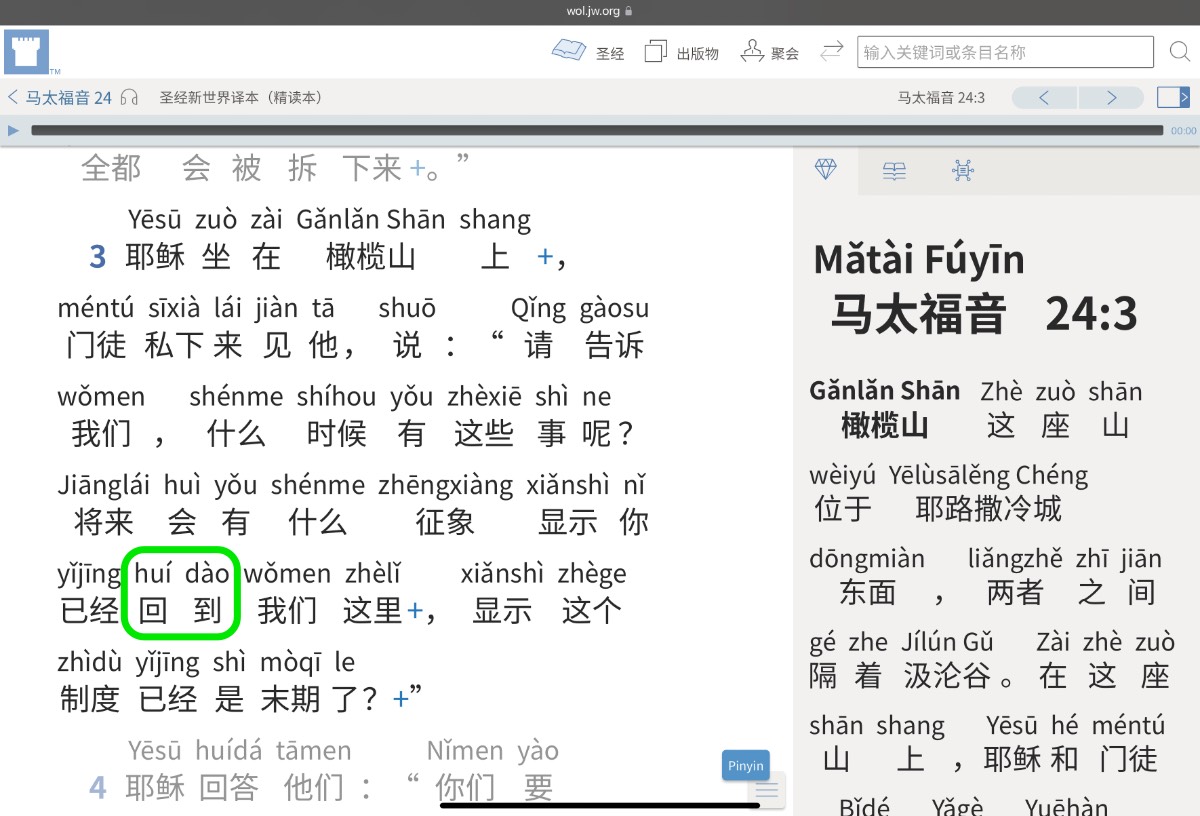
“Zuìchū (Zuì·chū most · {at the beginning} [→ [initial[ly]; prime; [at] first; original[ly]]] 最初)” is the very first expression that occurs in the current Mandarin New World Translation Bible, at Genesis 1:1 (WOL; PyP):
📖 📄 ➕ Zuìchū+ (Zuì·chū most · {at the beginning} 最初), Shàngdì (Shàng·dì Above’s · {Emperor → [God]} → [God] 上帝) chuàngzàole (chuàng·zào·le {initiated · made, created → [created]} · [indicates a change] 创造了 創造了) tiāndì (tiān·dì heavens · earth 天地).
At Revelation 2:4 (WOL; PyP), the current Mandarin NWT Bible also uses “zuìchū (zuì·chū most · {at the beginning} [→ [initial[ly]; prime; [at] first; original[ly]]] 最初)” when it talks about not leaving “the love you had at first”:
📖 📄 ➕ Búguò (Bú·guò not · {do pass} → [however] 不过 不過), yǒu ({(there) is having} 有) yì (one 一) diǎn (point (regarding which) 点 點) wǒ (I 我) yào (must 要) zébèi+ (zé·bèi reprove · prepare → [reprove] 责备 責備) nǐ (you 你), jiùshì (jiù·shì (which) exactly · is 就是) nǐ (you 你) ràng ({have allowed} 让 讓) zìjǐ (selves’ 自己) zuìchū+ (zuì·chū most · {at the beginning} → [at first] 最初) de (’s 的) nèi (that 那) fèn ({portion of} 份) ài (love 爱 愛) lěngdàn (lěng·dàn {to be(come) cold} · {to be(come) bland → [to be(come) indifferent]} 冷淡) xialai (xia·lai down · {to come} 下来 下來).
“Original Intention”? “Beginner’s Mind”?
While “zuìchū (zuì·chū most · {at the beginning} [→ [initial[ly]; prime; [at] first; original[ly]]] 最初)” appears multiple times in the current Mandarin NWT Bible, the expression “chūxīn (chū·xīn beginning; original; initial; {first (in order)} · heart; mind → [original desire/aspiration/intention | (Zen Buddhism) beginner’s mind (attitude of openness, free of preconceptions, when studying a subject)] 初心)”, which may seem somewhat related, does not appear in the current Mandarin NWT Bible.
In normal Mandarin usage, “chūxīn (chū·xīn beginning; original; initial; {first (in order)} · heart; mind → [original desire/aspiration/intention] 初心)” effectively means “original desire/aspiration/intention”. We should be aware, though, that the expression “chūxīn (chū·xīn beginning; original; initial; {first (in order)} · heart; mind → [original desire/aspiration/intention | (Zen Buddhism) beginner’s mind (attitude of openness, free of preconceptions, when studying a subject)] 初心)” (shoshin in Japanese) is also used in Zen Buddhism to mean “beginner’s mind”, an attitude of openness, free of preconceptions, when studying a subject.
While “chūxīn (chū·xīn beginning; original; initial; {first (in order)} · heart; mind → [(Zen Buddhism) beginner’s mind (attitude of openness, free of preconceptions, when studying a subject)] 初心)”, as used in Zen Buddhism, apparently refers to one’s own unprejudiced mental approach to learning about a reality, “zuìchū (zuì·chū most · {at the beginning} [→ [initial[ly]; prime; [at] first; original[ly]]] 最初)”, as used in the Bible, refers to the very beginning of a reality itself, prior to any possible subsequent deviation or corruption. It seems that following the Bible’s example of focusing on the truth of the original reality of something naturally produces the beneficial openness and freedom from preconceptions referred to by the Zen Buddhist usage of “chūxīn (chū·xīn beginning; original; initial; {first (in order)} · heart; mind → [(Zen Buddhism) beginner’s mind (attitude of openness, free of preconceptions, when studying a subject)] 初心)”, especially when we do so with the courage and humility that the Bible often encourages us to cultivate.—2 Timothy 1:7; Joshua 1:9; Proverbs 18:12; 22:4.
Remembering where Zen Buddhism came from and where the Bible came from can help us to understand the difference between the Zen Buddhist concept of chūxīn (chū·xīn beginning; original; initial; {first (in order)} · heart; mind → [(Zen Buddhism) beginner’s mind (attitude of openness, free of preconceptions, when studying a subject)] 初心) and the concept of zuìchū (zuì·chū most · {at the beginning} [→ [initial[ly]; prime; [at] first; original[ly]]] 最初) that is often mentioned in the Bible. Having come from imperfect, limited humans, the Zen Buddhist concept of chūxīn (chū·xīn beginning; original; initial; {first (in order)} · heart; mind → [(Zen Buddhism) beginner’s mind (attitude of openness, free of preconceptions, when studying a subject)] 初心) is unsurprisingly about how an imperfect, limited human can view something—that’s ultimately all it can really be about anyway. On the other hand, the Bible shares with us God’s views of things, and God was actually there at the zuìchū (zuì·chū most · {at the beginning} 最初) time of literally everything in the universe. Also, he has seen how everything has developed since that zuìchū (zuì·chū most · {at the beginning} 最初) time, and he can also perfectly foresee how everything will turn out in the future.
Holding On to Mandarin Field First Love
How might someone leave ‘the love he had at first’ in the Mandarin field? A publisher may have originally entered the Mandarin field with pure motivations, out of love for God and neighbour. Over time, though, with repeated exposure to proud worldly Chinese traditional culture, might some self-glorifying pride creep in regarding knowledge of that worldly Chinese culture, and regarding having gone far down the rabbit hole of the notoriously complex Chinese characters? If so, then the original love that had motivated that publisher may eventually get corrupted, and perhaps even left behind, leaving pride as his main motivation. May we never let that happen to us!
First Things First in Language Learning
The way God made us, zuìchū (zuì·chū most · {at the beginning} 最初), language-wise, there was speech. Only later did imperfect humans eventually come up with some writing systems to visually represent and record some forms of speech. Indeed, there have been, and there still are, many speech-only languages, with no corresponding writing system. Ethnologue, a resource on world languages, says:
Ethnologue (24th edition) has data to indicate that of the currently listed 7,139 living languages, 4,065 have a developed writing system. We don’t always know, however, if the existing writing systems are widely used. That is, while an alphabet may exist there may not be very many people who are literate and actually using the alphabet. The remaining 3,074 are likely unwritten.
Technological First Priority
Writing systems are technologies. About writing, linguist Gretchen McCulloch says:
It really is a technology. It’s a thing you do on top of language to do stuff with language, but it’s not the language itself. There are thousands and possibly millions of languages that have never been written down in the history of humanity. We have no idea. We’ve never met a society of humans, or heard of a society of humans, without language. But those are spoken and signed languages, which are just kind of there. Writing, by contrast, was invented somewhere between 3 and 4 times in the history of humanity.
As with any technology, under-engineering and over-engineering in writing systems are by definition bad. Chinese characters are obviously over-engineered—full of “ceremony”, way more complicated than necessary to fulfil their original purpose of representing Chinese speech. In fact, in the minds of many, Chinese characters have culturally become a thing on their own, the most important thing about Chinese languages, even. Thus, characters have been allowed to improperly overshadow Mandarin, etc. speech, which is actually of primary importance. As the English saying goes, that’s putting the cart before the horse.
Ben Cohen, manager of the Swift team at Apple, speaks of their core design goal of making the Swift programming language ceremony-free.
Chinese characters have lots and lots and lots of ceremony, especially compared to _Pīnyīn_.https://t.co/vPLUThxUYp pic.twitter.com/aDOlKOIbWt
— Troubadour WW (@troubadourww) June 25, 2022
Pīnyīn (Pīn·yīn {Piecing Together} · Sounds → [Pinyin] 拼音) is sometimes ridiculed for being just for beginners, but the simplicity and elegance with which it fulfils its zuìchū (zuì·chū most · {at the beginning} → [original] 最初), original purpose of representing Mandarin speech are actually very good things. As Leonardo da Vinci is alleged to have said, simplicity is the ultimate sophistication.