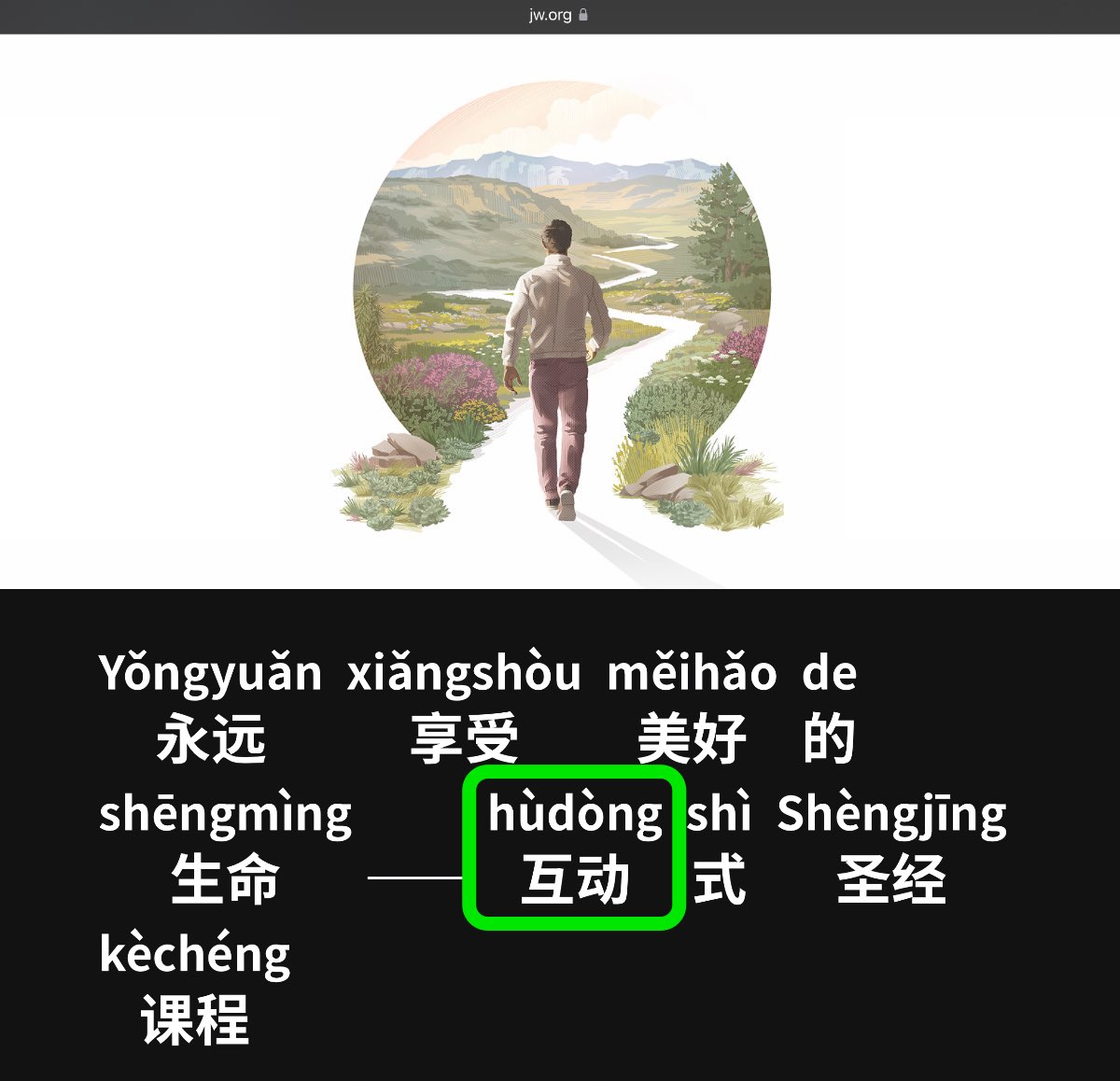
hùdòng+ (hù·dòng {each other} · moving → [interactive] 互动 互動)‐shì+ (type 式) 👈🏼 Tap/click to show/hide the “flashcard”
[This post was adapted from the February 21, 2022 post on “hùdòng+ (hù·dòng mutually; {[(with)] each other} · moving → [interacting; interaction; interactive] 互动 互動).]
[Notes: Tap/click on a Pīnyīn (Pīn·yīn {Piecing Together of} · Sounds → [Pinyin] 拼音) expression to reveal its “flashcard”; tap/click on a “flashcard” or its Pīnyīn (Pīn·yīn {Piecing Together of} · Sounds → [Pinyin] 拼音) expression to hide the “flashcard”. 📖 📄 ➕ icons mean 📖 Reveal All, 📄 Reveal Advanced, and ➕ Reveal + Symbols re all the “flashcards” in the heading, paragraph, etc. that they are placed at the beginning of.]
At the time of this writing, jw.org is featuring the free Bible course that we are offering. To do so, it is using the following text:
English:
Try our interactive Bible course Enjoy Life Forever!
Mandarin:
📖 📄 ➕ Lái (come 来 來) tǐyàn+ (tǐ·yàn {bodily → [personally]} · test → [personally experience] 体验 體驗) yíxià (yí·xià one · {going down → [time]} → [a bit] 一下) xīn (newly 新) tuīchū (tuī·chū {pushed → [recommended]} · out → [introduced] 推出) de (’s 的) hùdòng+ (hù·dòng {each other} · moving → [interactive] 互动 互動)‐shì+ (type 式) Shèngjīng (Shèng·jīng Holy · Scriptures → [Bible] 圣经 聖經) kèchéng (kè·chéng lessons · {journey → [procedure]} → [course] 课程 課程) Yǒngyuǎn Xiǎngshòu Měihǎo de Shēngmìng ((Yǒng·yuǎn Eternally · {Far (in Time)} 永远 永遠) (Xiǎng·shòu Enjoy · Receive 享受) (Měi·hǎo Beautiful · Good 美好) (de ’s 的) (Shēngmìng Life 生命) → [Enjoy Life Forever!]).
Of course, besides being used above, this week’s MEotW “hùdòng (hù·dòng {each other} · moving → [interactive] 互动 互動)‐shì (type 式)” also appears in Yǒngyuǎn Xiǎngshòu Měihǎo de Shēngmìng—Hùdòng‐Shì Shèngjīng Kèchéng ((Yǒng·yuǎn Eternally · {Far (in Time)} 永远 永遠) (Xiǎng·shòu Enjoy · Receive 享受) (Měi·hǎo Beautiful · Good 美好) (de ’s 的) (Shēngmìng Life 生命)—(Hù·dòng {Each Other} · Moving → [Interactive] 互动 互動)‐(Shì (Type 式) (Shèng·jīng Holy · Scriptures → [Bible] 圣经 聖經) (Kè·chéng Lessons · Procedure → [Course] 课程 課程) → [Enjoy Life Forever!—An Interactive Bible Course (lff)]), the title of the Mandarin version of the book used in the above-mentioned course. Looking at this Mandarin title, you may have wondered: What does “hùdòng (hù·dòng {each other} · moving → [interactive] 互动 互動)‐shì (type 式)” mean?
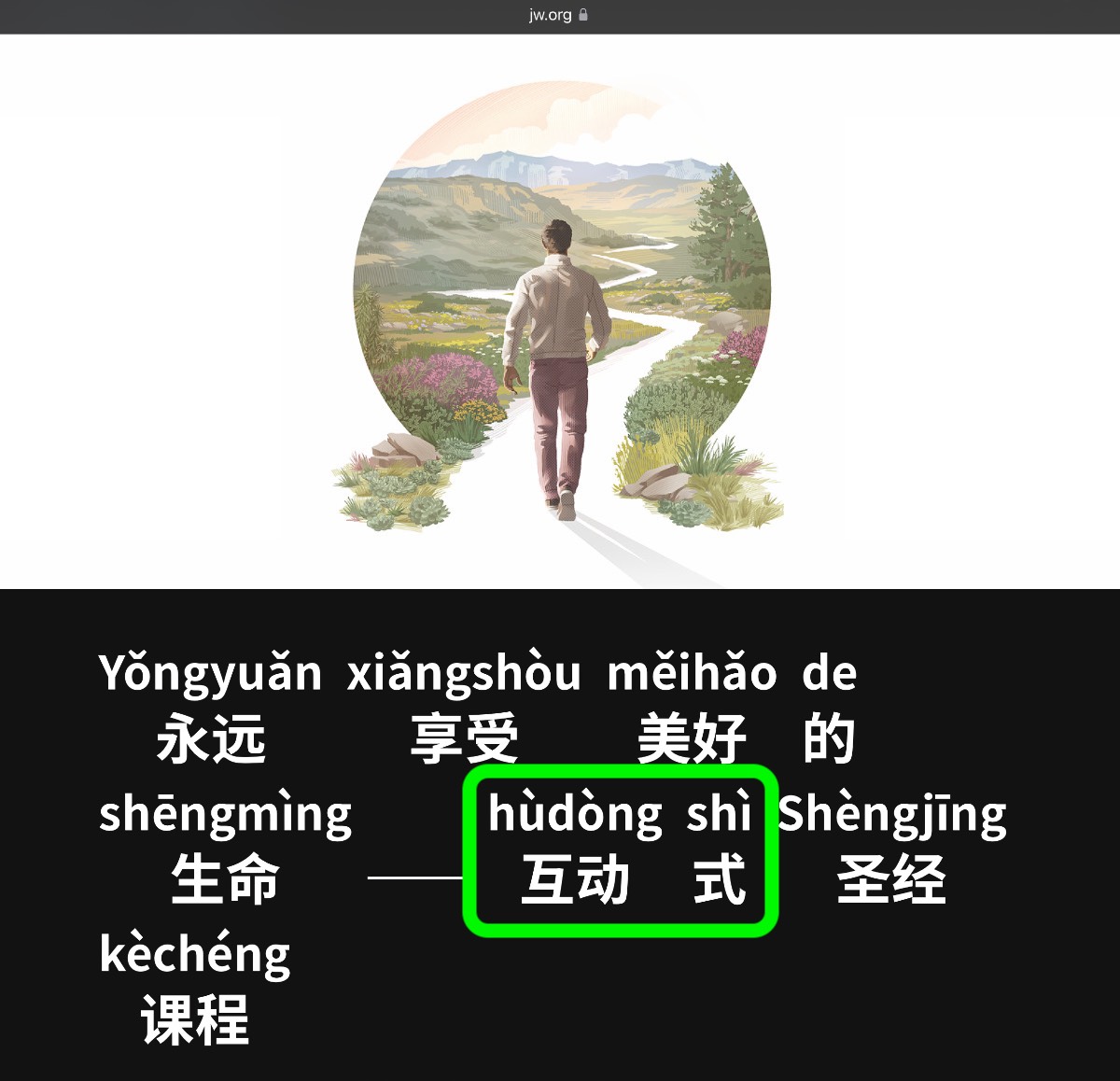
(The above screenshot from jw.org shows light-coloured text on a dark background because I have set jw.org’s Appearance Settings to do so. As the related JW News article says, “some users prefer this setting because the screen is less bright. This may help reduce eyestrain, especially at night or in other low-light environments.” Most Pīnyīn (Pīn·yīn {Piecing Together of} · Sounds → [Pinyin] 拼音) Plus / Pīnyīn (Pīn·yīn {Piecing Together of} · Sounds → [Pinyin] 拼音)+ web resources (short link: tiandi.info/pyp) can also be set to dark mode.)
You may surmise that “hùdòng (hù·dòng {each other} · moving → [interactive] 互动 互動)‐shì (type 式)” corresponds with the “Interactive” in Enjoy Life Forever!—An Interactive Bible Course, and you would be right. Now, let’s take a closer look at the morphemes in “hùdòng (hù·dòng {each other} · moving → [interactive] 互动 互動)‐shì (type 式)” to see how they work in a way that makes “hùdòng (hù·dòng {each other} · moving → [interactive] 互动 互動)‐shì (type 式)” correspond as well as it does with the English word “interactive”, which means “acting upon or influencing each other”.
Morphemic Breakdown
As the Pīnyīn (Pīn·yīn {Piecing Together of} · Sounds → [Pinyin] 拼音)+ information for “hùdòng (hù·dòng {each other} · moving → [interactive] 互动 互動)‐shì (type 式)” shows us, its first morpheme “hù- (mutually; {[(with)] each other} 互)” means “mutually; [(with)] each other”. It’s the “hù- (mutually; {[(with)] each other} 互)” in “hùxiāng ({each other} 互相) gǔlì (gǔ·lì {drum → [rouse]} · encourage → [encourage] 鼓励 鼓勵)”, which means “encourage one another”.
The next morpheme “dòng (move [→ [stir | arouse | change; alter]] 动 動)” basically means “move”. In some contexts, it means to move physically, as it does in “dòngwù (dòng·wù moving · thing → [animal] 动物 動物)”, which literally means “moving thing”, and is used to mean “animal”. (Interestingly, the English word “animal” is related to the word “animate”, which can mean “bring into action or movement”.) In other contexts, “dòng (move [→ [stir | arouse | change; alter]] 动 動)” means to move emotionally, as it does in “gǎndòng+ (gǎn·dòng feeling · moved | {make to feel} · move 感动 感動)”. In yet other contexts, “dòng (move [→ [stir | arouse | change; alter]] 动 動)” is used to effectively mean “change; alter”.
Breaking down “hùdòng (hù·dòng {each other} · moving → [interactive] 互动 互動)‐shì (type 式)” into its morphemes helps us to see that “hù- (mutually; {[(with)] each other} 互)” corresponds with the “inter-” part of “interactive”, and that “dòng (move [→ [stir | arouse | change; alter]] 动 動)” corresponds with the “active” (“acting [up]on”) part. As for “shì (type; style; pattern; form; formula; mode 式)”, here it means “type” or “style”.
Interactive Indeed
The English word “interactive” has a particular meaning in the world of computing, which is “responds to user activity”.
Interestingly, the Enjoy Life Forever! book even has some interactivity in its paper form, with its “Lesson completed on:” and “Goal” sections allowing room for a user to write in them with a pencil or pen. This is in addition to the limited interactivity that any paper publication offers a user, such as being able to write notes in the margins or to highlight or underline text.
The Enjoy Life Forever! book in the PDF file format—a computer file format that is conceptually rooted in the world of paper—adds the ability for a user to tap/click on links to do things like load the web pages (or the JW Library app) where the videos mentioned in the book can be played. As we move on to more computer-native formats, we find that in the Enjoy Life Forever! book material on the jw.org website and in the JW Library app, where of course links are available for playing the videos, a user can tap/click on text fields in the “Lesson completed on:” and “Goal” sections and type text into them that will be “remembered”. Also, a user can tap/click on the checkboxes in the “Goal” section, and those checkboxes will “remember” and show whether they are checked or unchecked.
As discussed in the JW Broadcasting—January 2021 program, when it comes to the more general meaning of the English word “interactive”, “acting upon or influencing each other”, the Enjoy Life Forever! book in every format is designed to engage and involve people more than past Bible study textbooks did. It indeed qualifies as “interactive”, or as we say in Mandarin, “hùdòng+ (hù·dòng {each other} · moving → [interactive] 互动 互動)‐shì+ (type 式)”.
(By the way, just as is possible on this blog, in the unofficial Pīnyīn (Pīn·yīn {Piecing Together of} · Sounds → [Pinyin] 拼音) Plus / Pīnyīn (Pīn·yīn {Piecing Together of} · Sounds → [Pinyin] 拼音)+ material for the Enjoy Life Forever! book, users can interactively tap/click on Pīnyīn (Pīn·yīn {Piecing Together of} · Sounds → [Pinyin] 拼音) expressions to show/hide, as desired, flashcards showing English meanings, Simplified character(s), Traditional character(s) (if they’re different), etc. for these expressions.)
For convenience:
The direct link for the Pīnyīn (Pīn·yīn {Piecing Together of} · Sounds → [Pinyin] 拼音) Plus / Pīnyīn (Pīn·yīn {Piecing Together of} · Sounds → [Pinyin] 拼音)+ resource for the Enjoy Life Forever! book is:
The short link for Chinese field language-learning links for the Enjoy Life Forever! book is:
More Pīnyīn (Pīn·yīn {Piecing Together of} · Sounds → [Pinyin] 拼音)+ web material based on the Mandarin Enjoy Life Forever! book will be made available in the Pīnyīn (Pīn·yīn {Piecing Together of} · Sounds → [Pinyin] 拼音) Plus / Pīnyīn (Pīn·yīn {Piecing Together of} · Sounds → [Pinyin] 拼音)+ web resource as time allows.