Categories
Technology Theocratic

hùdòng‐shì

hùdòng+ (hù·dòng {each other} · moving → [interactive] 互动 互動)‐shì+ (type 式) 👈🏼 Tap/click to show/hide the “flashcard”

[This post was adapted from the February 21, 2022 post on “hùdòng+ (hù·dòng mutually; {[(with)] each other} · moving → [interacting; interaction; interactive] 互动 互動).]

[Notes: Tap/click on a Pīnyīn (Pīn·yīn {Piecing Together of} · Sounds → [Pinyin] 拼音) expression to reveal its “flashcard”; tap/click on a “flashcard” or its Pīnyīn (Pīn·yīn {Piecing Together of} · Sounds → [Pinyin] 拼音) expression to hide the “flashcard”. 📖 📄 ➕ icons mean 📖 Reveal All, 📄 Reveal Advanced, and ➕ Reveal + Symbols re all the “flashcards” in the heading, paragraph, etc. that they are placed at the beginning of.]

At the time of this writing, jw.org is featuring the free Bible course that we are offering. To do so, it is using the following text:

English:

Try our interactive Bible course Enjoy Life Forever!

Mandarin:

📖 📄 ➕ Lái (come 来 來) tǐyàn+ (tǐ·yàn {bodily → [personally]} · test → [personally experience] 体验 體驗) yíxià (yí·xià one · {going down → [time]} → [a bit] 一下) xīn (newly 新) tuīchū (tuī·chū {pushed → [recommended]} · out → [introduced] 推出) de (’s 的) hùdòng+ (hù·dòng {each other} · moving → [interactive] 互动 互動)‐shì+ (type 式) Shèngjīng (Shèng·jīng Holy · Scriptures → [Bible] 圣经 聖經) kèchéng (kè·chéng lessons · {journey → [procedure]} → [course] 课程 課程) Yǒngyuǎn Xiǎngshòu Měihǎo de Shēngmìng ((Yǒng·yuǎn Eternally · {Far (in Time)} 永远 永遠) (Xiǎng·shòu Enjoy · Receive 享受) (Měi·hǎo Beautiful · Good 美好) (de ’s 的) (Shēngmìng Life 生命) → [Enjoy Life Forever!]).

Of course, besides being used above, this week’s MEotW “hùdòng (hù·dòng {each other} · moving → [interactive] 互动 互動)‐shì (type 式)” also appears in Yǒngyuǎn Xiǎngshòu Měihǎo de Shēngmìng—Hùdòng‐Shì Shèngjīng Kèchéng ((Yǒng·yuǎn Eternally · {Far (in Time)} 永远 永遠) (Xiǎng·shòu Enjoy · Receive 享受) (Měi·hǎo Beautiful · Good 美好) (de ’s 的) (Shēngmìng Life 生命)—(Hù·dòng {Each Other} · Moving → [Interactive] 互动 互動)‐(Shì (Type 式) (Shèng·jīng Holy · Scriptures → [Bible] 圣经 聖經) (Kè·chéng Lessons · Procedure → [Course] 课程 課程) → [Enjoy Life Forever!—An Interactive Bible Course (lff)]), the title of the Mandarin version of the book used in the above-mentioned course. Looking at this Mandarin title, you may have wondered: What does “hùdòng (hù·dòng {each other} · moving → [interactive] 互动 互動)‐shì (type 式)” mean?
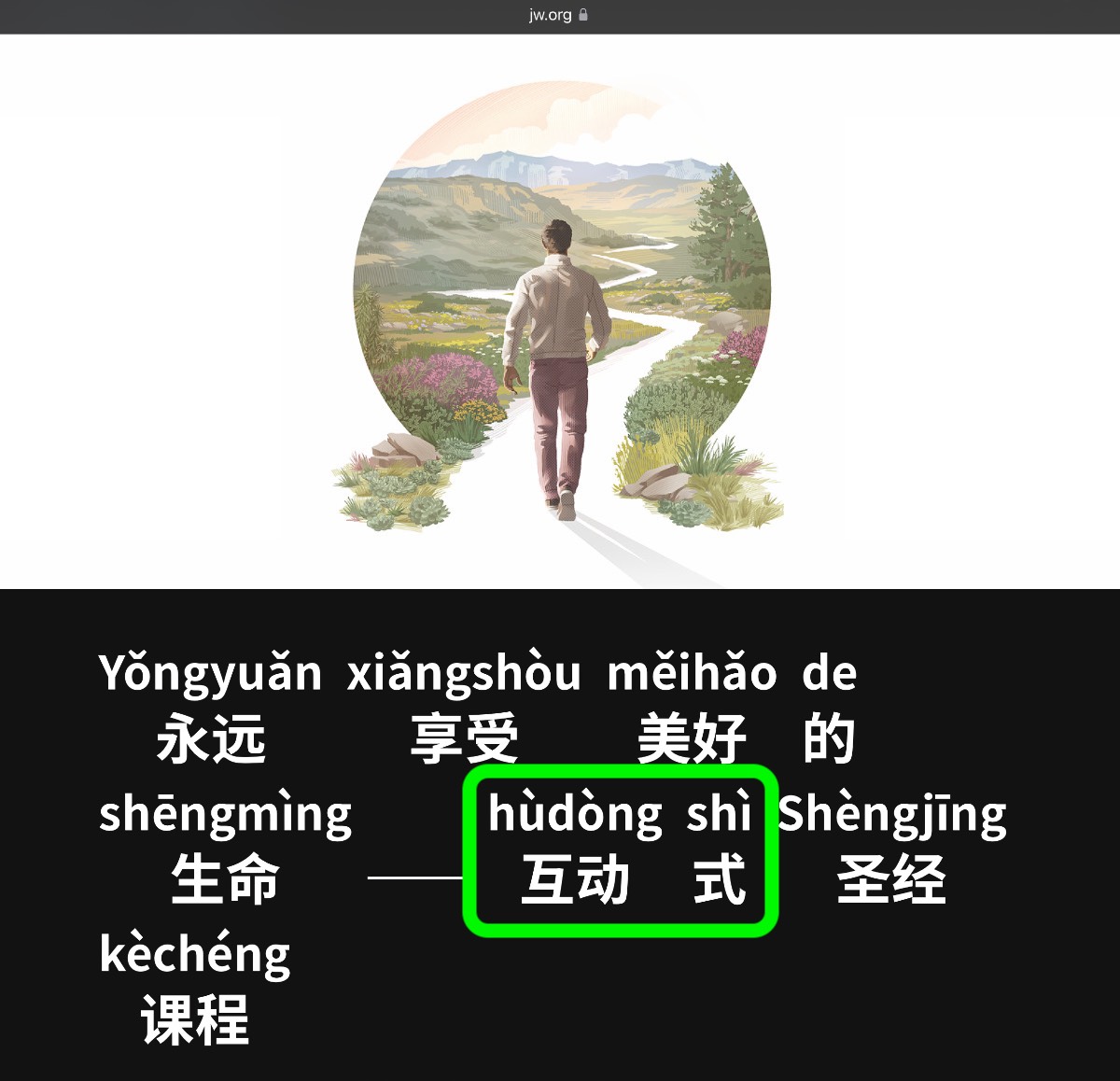
“hùdòng shì” on _Enjoy Life Forever!_ bk. title page (jw.org CHS+Pinyin)

(The above screenshot from jw.org shows light-coloured text on a dark background because I have set jw.org’s Appearance Settings to do so. As the related JW News article says, “some users prefer this setting because the screen is less bright. This may help reduce eyestrain, especially at night or in other low-light environments.” Most Pīnyīn (Pīn·yīn {Piecing Together of} · Sounds → [Pinyin] 拼音) Plus / Pīnyīn (Pīn·yīn {Piecing Together of} · Sounds → [Pinyin] 拼音)+ web resources (short link: tiandi.info/pyp) can also be set to dark mode.)

You may surmise that “hùdòng (hù·dòng {each other} · moving → [interactive] 互动 互動)‐shì (type 式)” corresponds with the “Interactive” in Enjoy Life Forever!—An Interactive Bible Course, and you would be right. Now, let’s take a closer look at the morphemes in “hùdòng (hù·dòng {each other} · moving → [interactive] 互动 互動)‐shì (type 式)” to see how they work in a way that makes “hùdòng (hù·dòng {each other} · moving → [interactive] 互动 互動)‐shì (type 式)” correspond as well as it does with the English word “interactive”, which means “acting upon or influencing each other”.

Morphemic Breakdown

As the Pīnyīn (Pīn·yīn {Piecing Together of} · Sounds → [Pinyin] 拼音)+ information for “hùdòng (hù·dòng {each other} · moving → [interactive] 互动 互動)‐shì (type 式)” shows us, its first morpheme “hù- (mutually; {[(with)] each other} 互)” means “mutually; [(with)] each other”. It’s the “hù- (mutually; {[(with)] each other} 互)” in “hùxiāng ({each other} 互相) gǔlì (gǔ·lì {drum → [rouse]} · encourage → [encourage] 鼓励 鼓勵)”, which means “encourage one another”.

The next morpheme “dòng (move [→ [stir | arouse | change; alter]] 动 動)” basically means “move”. In some contexts, it means to move physically, as it does in “dòngwù (dòng·wù moving · thing → [animal] 动物 動物)”, which literally means “moving thing”, and is used to mean “animal”. (Interestingly, the English word “animal” is related to the word “animate”, which can mean “bring into action or movement”.) In other contexts, “dòng (move [→ [stir | arouse | change; alter]] 动 動)” means to move emotionally, as it does in “gǎndòng+ (gǎn·dòng feeling · moved | {make to feel} · move 感动 感動)”. In yet other contexts, “dòng (move [→ [stir | arouse | change; alter]] 动 動)” is used to effectively mean “change; alter”.

Breaking down “hùdòng (hù·dòng {each other} · moving → [interactive] 互动 互動)‐shì (type 式)” into its morphemes helps us to see that “hù- (mutually; {[(with)] each other} 互)” corresponds with the “inter-” part of “interactive”, and that “dòng (move [→ [stir | arouse | change; alter]] 动 動)” corresponds with the “active” (“acting [up]on”) part. As for “shì (type; style; pattern; form; formula; mode 式)”, here it means “type” or “style”.

Interactive Indeed

The English word “interactive” has a particular meaning in the world of computing, which is “responds to user activity”.

Interestingly, the Enjoy Life Forever! book even has some interactivity in its paper form, with its “Lesson completed on:” and “Goal” sections allowing room for a user to write in them with a pencil or pen. This is in addition to the limited interactivity that any paper publication offers a user, such as being able to write notes in the margins or to highlight or underline text.

The Enjoy Life Forever! book in the PDF file format—a computer file format that is conceptually rooted in the world of paper—adds the ability for a user to tap/click on links to do things like load the web pages (or the JW Library app) where the videos mentioned in the book can be played. As we move on to more computer-native formats, we find that in the Enjoy Life Forever! book material on the jw.org website and in the JW Library app, where of course links are available for playing the videos, a user can tap/click on text fields in the “Lesson completed on:” and “Goal” sections and type text into them that will be “remembered”. Also, a user can tap/click on the checkboxes in the “Goal” section, and those checkboxes will “remember” and show whether they are checked or unchecked.

As discussed in the JW Broadcasting—January 2021 program, when it comes to the more general meaning of the English word “interactive”, “acting upon or influencing each other”, the Enjoy Life Forever! book in every format is designed to engage and involve people more than past Bible study textbooks did. It indeed qualifies as “interactive”, or as we say in Mandarin, “hùdòng+ (hù·dòng {each other} · moving → [interactive] 互动 互動)‐shì+ (type 式)”.

(By the way, just as is possible on this blog, in the unofficial Pīnyīn (Pīn·yīn {Piecing Together of} · Sounds → [Pinyin] 拼音) Plus / Pīnyīn (Pīn·yīn {Piecing Together of} · Sounds → [Pinyin] 拼音)+ material for the Enjoy Life Forever! book, users can interactively tap/click on Pīnyīn (Pīn·yīn {Piecing Together of} · Sounds → [Pinyin] 拼音) expressions to show/hide, as desired, flashcards showing English meanings, Simplified character(s), Traditional character(s) (if they’re different), etc. for these expressions.)


For convenience:

The direct link for the Pīnyīn (Pīn·yīn {Piecing Together of} · Sounds → [Pinyin] 拼音) Plus / Pīnyīn (Pīn·yīn {Piecing Together of} · Sounds → [Pinyin] 拼音)+ resource for the Enjoy Life Forever! book is:

The short link for Chinese field language-learning links for the Enjoy Life Forever! book is:

More Pīnyīn (Pīn·yīn {Piecing Together of} · Sounds → [Pinyin] 拼音)+ web material based on the Mandarin Enjoy Life Forever! book will be made available in the Pīnyīn (Pīn·yīn {Piecing Together of} · Sounds → [Pinyin] 拼音) Plus / Pīnyīn (Pīn·yīn {Piecing Together of} · Sounds → [Pinyin] 拼音)+ web resource as time allows.
Categories
Culture Language Learning Technology

yǔyán

yǔyán+ (yǔ·yán language; tongue · {(type of) speech} 语言 語言) ← Tap/click to show/hide the “flashcard”

The Mandarin field is an example of a language field. What though, is a language? For a long time, the production output of the earthly part of Jehovah’s organization was exclusively or mainly paper publications. So, when it would count the languages it was supporting in its production, it was really counting the writing systems that it printed on paper. Meanwhile, in worldly Chinese culture, there is an obsession with the Chinese characters writing system, which has become a proud and deeply embedded cultural tradition. Such factors may influence people serving in the Mandarin field to focus on the Chinese characters writing system when they think of the Mandarin language.

However, linguists, people who study language scientifically, hold that when it comes to languages, speech is primary, and writing is secondary. This excerpt from the MEotW post on “zuìchū (zuì·chū most · {at the beginning} [→ [initial[ly]; prime; [at] first; original[ly]]] 最初)” summarizes the scientific evidence in this regard:

First Things First in Language Learning

The way God made us, zuìchū (zuì·chū most · {at the beginning} 最初), language-wise, there was speech. Only later did imperfect humans eventually come up with some writing systems to visually represent and record some forms of speech. Indeed, there have been, and there still are, many speech-only languages, with no corresponding writing system. Ethnologue, a resource on world languages, says:

Ethnologue (24th edition) has data to indicate that of the currently listed 7,139 living languages, 4,065 have a developed writing system. We don’t always know, however, if the existing writing systems are widely used. That is, while an alphabet may exist there may not be very many people who are literate and actually using the alphabet. The remaining 3,074 are likely unwritten.

Technological First Priority

Writing systems are technologies. About writing, linguist Gretchen McCulloch says:

It really is a technology. It’s a thing you do on top of language to do stuff with language, but it’s not the language itself. There are thousands and possibly millions of languages that have never been written down in the history of humanity. We have no idea. We’ve never met a society of humans, or heard of a society of humans, without language. But those are spoken and signed languages, which are just kind of there. Writing, by contrast, was invented somewhere between 3 and 4 times in the history of humanity.

What Do the Words Actually Mean?

It’s also worth considering the actual root meanings contained in the words used in English and Mandarin to mean “language”. Regarding the etymology of the English word “language”, the Online Etymology Dictionary says:

late 13c., langage “words, what is said, conversation, talk,” from Old French langage “speech, words, oratory; a tribe, people, nation” (12c.), from Vulgar Latin *linguaticum, from Latin lingua “tongue,” also “speech, language,” from PIE [Proto-Indo-European] root *dnghu- “tongue.”

Clearly, the focus of the root meanings above is on speech and the tongue, which is used for speech—writing is not even mentioned.

Consider also this week’s MEotW, the Mandarin word generally used to mean “language”, “yǔyán+ (yǔ·yán language; tongue · {(type of) speech} 语言 語言)”. As can be seen from this expression’s Pīnyīn (Pīn·yīn {Piecing Together of} · Sounds → [Pinyin] 拼音) Plus information, the morphemes used in this Mandarin expression also focus on speech and the tongue, which is used for speech—writing is not even mentioned.

So, when we think of a language, a yǔyán (yǔ·yán language; tongue · {(type of) speech} 语言 語言), even a Chinese one, we should really be thinking about a way of speaking, a variety of speech, not any writing system, even one as traditionally revered and glamourized as Chinese characters are. Thus, the Mandarin language field is not the field in which we preach to and teach people who read and write with Chinese characters. After all, if people speak Mandarin but cannot read or write the Chinese characters, they still count as being among those we are trying to help in the Mandarin field. That’s because the Mandarin language field is actually the field in which we preach to and teach people whose mother tongue—their first language or way of speaking—is Mandarin.

Categories
Technology Theocratic

hùdòng

hùdòng+ (hù·dòng mutually; {[(with)] each other} · moving → [interacting; interaction; interactive] 互动 互動) ← Tap/click to show/hide the “flashcard”

One of the publications that is now recommended to be used on Bible studies is the Yǒngyuǎn Xiǎngshòu Měihǎo de Shēngmìng—Hùdòng‐Shì Shèngjīng Kèchéng ((Yǒng·yuǎn Eternally · {Far (in Time)} 永远 永遠) (Xiǎng·shòu Enjoy · Receive 享受) (Měi·hǎo Beautiful · Good 美好) (de ’s 的) (Shēngmìng Life 生命)—(Hù·dòng {Each Other} · Moving → [Interactive] 互动 互動)‐(Shì (Type 式) (Shèng·jīng Holy · Scriptures → [Bible] 圣经 聖經) (Kè·chéng Lessons · Procedure → [Course] 课程 課程) → [Enjoy Life Forever!—An Interactive Bible Course (lff)]) (Enjoy Life Forever! (lff)) book. Looking at the Mandarin title of this book, you may have wondered: What does “hùdòng (hù·dòng mutually; {[(with)] each other} · moving → [interacting; interaction; interactive] 互动 互動)” mean?

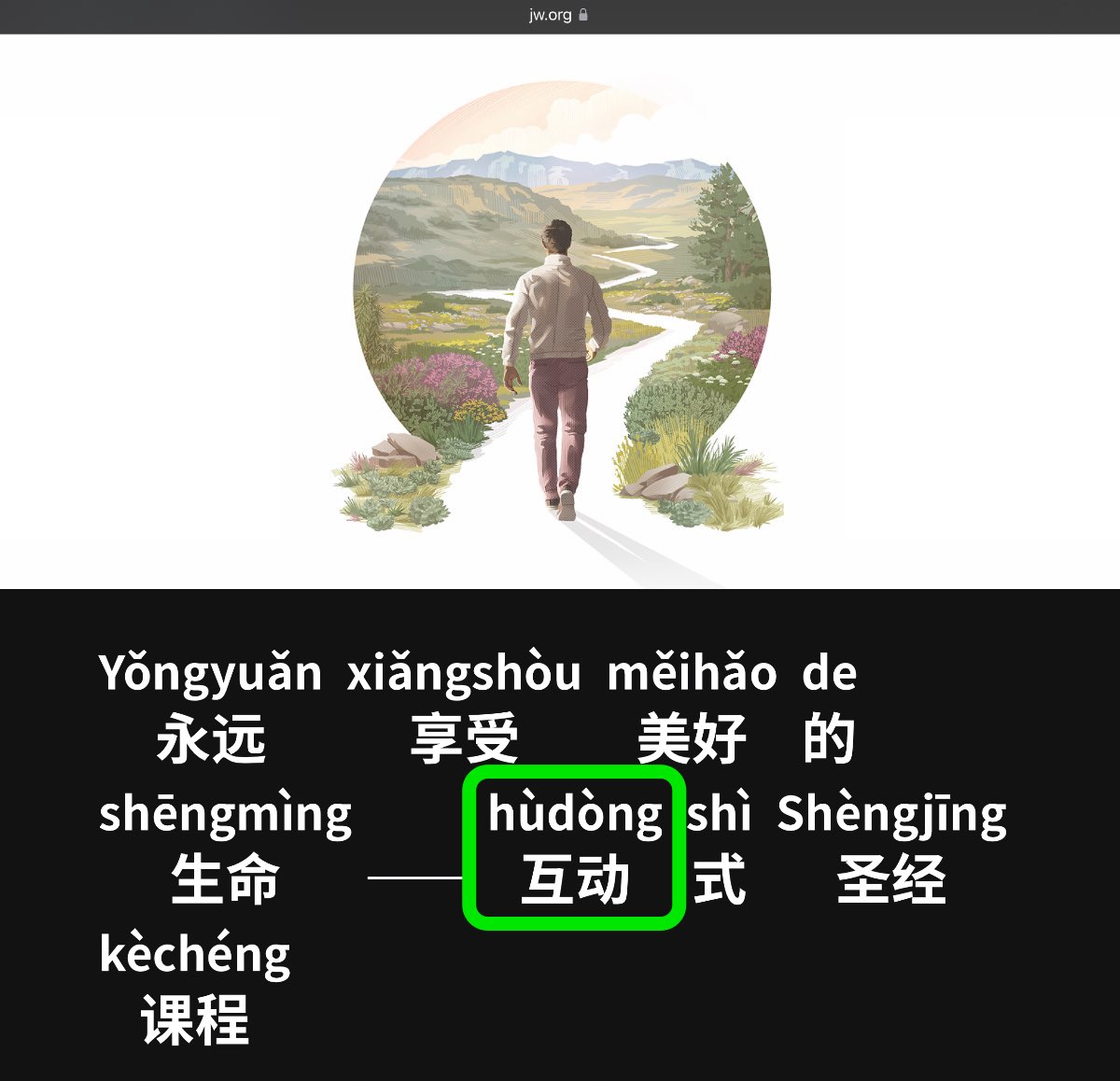
_Enjoy Life Forever!_ bk. title page (jw.org CHS+Pinyin)

(The above screenshot from jw.org shows light-coloured text on a dark background because I have set jw.org’s relatively new Appearance Settings to do so. As the related JW News article says, “some users prefer this setting because the screen is less bright. This may help reduce eyestrain, especially at night or in other low-light environments.” Most Pīnyīn (Pīn·yīn {Piecing Together} · Sounds → [Pinyin] 拼音) Plus web resources (short link: tiandi.info/pyp) also have a Night Theme available, that can be turned on or off using the ☀️/🌙 button on their web pages.)

You may surmise that “hùdòng (hù·dòng mutually; {[(with)] each other} · moving → [interacting; interaction; interactive] 互动 互動)” corresponds with the “Interactive” in Enjoy Life Forever!​—An Interactive Bible Course, and you would be right. Now, let’s take a closer look at the morphemes in “hùdòng (hù·dòng mutually; {[(with)] each other} · moving → [interacting; interaction; interactive] 互动 互動)” to see how they work in a way that makes “hùdòng (hù·dòng mutually; {[(with)] each other} · moving → [interacting; interaction; interactive] 互动 互動)” correspond as well as it does with the English word “interactive”, which means “acting upon or influencing each other”.

Morphemic Breakdown

As the Pīnyīn (Pīn·yīn {Piecing Together} · Sounds → [Pinyin] 拼音) Plus information for “hùdòng+ (hù·dòng mutually; {[(with)] each other} · moving → [interacting; interaction; interactive] 互动 互動)” shows us, its first morpheme “hù- (mutually; {[(with)] each other} 互)” means “mutually; [(with)] each other”. It’s the “hù- (mutually; {[(with)] each other} 互)” in “hùxiāng ({each other} 互相) gǔlì (gǔ·lì {drum → [rouse]} · encourage → [encourage] 鼓励 鼓勵)”, which means “encourage one another”.

The other morpheme “dòng (move [→ [stir | arouse | change; alter]] 动 動)” basically means “move”. In some contexts, it means to move physically, as it does in “dòngwù (dòng·wù moving · thing → [animal] 动物 動物)”, which literally means “moving thing”, and is used to mean “animal”. (Interestingly, the English word “animal” is related to the word “animate”, which can mean “bring into action or movement”.) In other contexts, “dòng (move [→ [stir | arouse | change; alter]] 动 動)” means to move emotionally, as it does in “gǎndòng+ (gǎn·dòng feeling · moved | {make to feel} · move 感动 感動)”. In yet other contexts, “dòng (move [→ [stir | arouse | change; alter]] 动 動)” is used to effectively mean “change; alter”.

Breaking down “hùdòng (hù·dòng mutually; {[(with)] each other} · moving → [interacting; interaction; interactive] 互动 互動)” into its morphemes helps us to see that “hù- (mutually; {[(with)] each other} 互)” corresponds with the “inter-” part of “interactive”, and that “dòng (move [→ [stir | arouse | change; alter]] 动 動)” corresponds with the “active” (“acting [up]on”) part.

Interactive Indeed

The English word “interactive” has a particular meaning in the world of computing, which is “responds to user activity”.

Interestingly, the Enjoy Life Forever! book even has some interactivity in its paper form, with its “Lesson completed on:” and “Goal” sections allowing room for a user to write in them with a pencil or pen. This is in addition to the limited interactivity that any paper publication offers a user, such as being able to write notes in the margins or to highlight or underline text.

The Enjoy Life Forever! book in the PDF file format—a computer file format that is conceptually rooted in the world of paper—adds the ability for a user to tap/click on links to load the web pages on which the videos mentioned in the book can be played. As we move on to more computer-native formats, we find that on the jw.org website and in the JW Library app, where of course links are available for playing the videos, a user can tap/click on text fields in the “Lesson completed on:” and “Goal” sections and type text into them that will be “remembered”. Also, a user can tap/click on the checkboxes in the “Goal” section, and those checkboxes will “remember” and show whether they are checked or unchecked.

As discussed in the JW Broadcasting—January 2021 program, when it comes to the more general meaning of the English word “interactive”, “acting upon or influencing each other”, the Enjoy Life Forever! book in every format is designed to engage and involve people more than past Bible study textbooks did. It indeed qualifies as “interactive”, or as we say in Mandarin, “hùdòng+ (hù·dòng {each other} · moving → [interactive] 互动 互動)‐shì+ (type 式)”.

(By the way, just as is possible on this blog, in the unofficial Pīnyīn (Pīn·yīn {Piecing Together} · Sounds → [Pinyin] 拼音) Plus material for the Enjoy Life Forever! book, users can interactively tap/click on Pīnyīn (Pīn·yīn {Piecing Together} · Sounds → [Pinyin] 拼音) expressions to show/hide, as desired, flashcards showing English meanings, Simplified character(s), Traditional character(s) (if they’re different), etc. for these expressions.)


For convenience:

The direct link for the current generation Pīnyīn (Pīn·yīn {Piecing Together of} · Sounds → [Pinyin] 拼音) Plus resource for the Enjoy Life Forever! book is:

The short link for Chinese field language-learning links for the Enjoy Life Forever! book is:

More Pīnyīn (Pīn·yīn {Piecing Together of} · Sounds → [Pinyin] 拼音) and Pīnyīn (Pīn·yīn {Piecing Together of} · Sounds → [Pinyin] 拼音) Plus web material based on the Mandarin Enjoy Life Forever! book will be made available in the Pīnyīn (Pīn·yīn {Piecing Together of} · Sounds → [Pinyin] 拼音) Plus web resource as time allows.