zìdà+ (zì·dà {(consider) self} · {to be big → [to be great]} 自大) 👈🏼 Tap/click to show/hide the “flashcard”
[Notes: Tap/click on a Pīnyīn (Pīn·yīn {Piecing Together of} · Sounds → [Pinyin] 拼音) expression to reveal its “flashcard”; tap/click on a “flashcard” or its Pīnyīn (Pīn·yīn {Piecing Together of} · Sounds → [Pinyin] 拼音) expression to hide the “flashcard”. 📖 📄 ➕ icons mean 📖 Reveal All, 📄 Reveal Advanced, and ➕ Reveal + Symbols re all the “flashcards” in the heading, paragraph, etc. that they are placed at the beginning of.]
I have long especially liked 1 Corinthians 13. It contains counsel on what really does and doesn’t matter in life, an extensive description and definition of the most important kind of love, and a sublime discussion about the need to become complete, mature, as a person. As these apply to life in general, so too do they apply to our lives as Mandarin field language learners.
As Mandarin field language learners, it can benefit us greatly to consider what we can learn from 1 Corinthians 13, and along the way, we can also consider some of the Mandarin expressions used in that chapter in the current version of the Mandarin New World Translation Bible (nwtsty).
How Do We View Ourselves?
This week’s MEotW, “zìdà (zì·dà {(consider) self} · {to be big → [to be great]} 自大)”, is used in verse 4 (WOL) of 1 Corinthians 13:
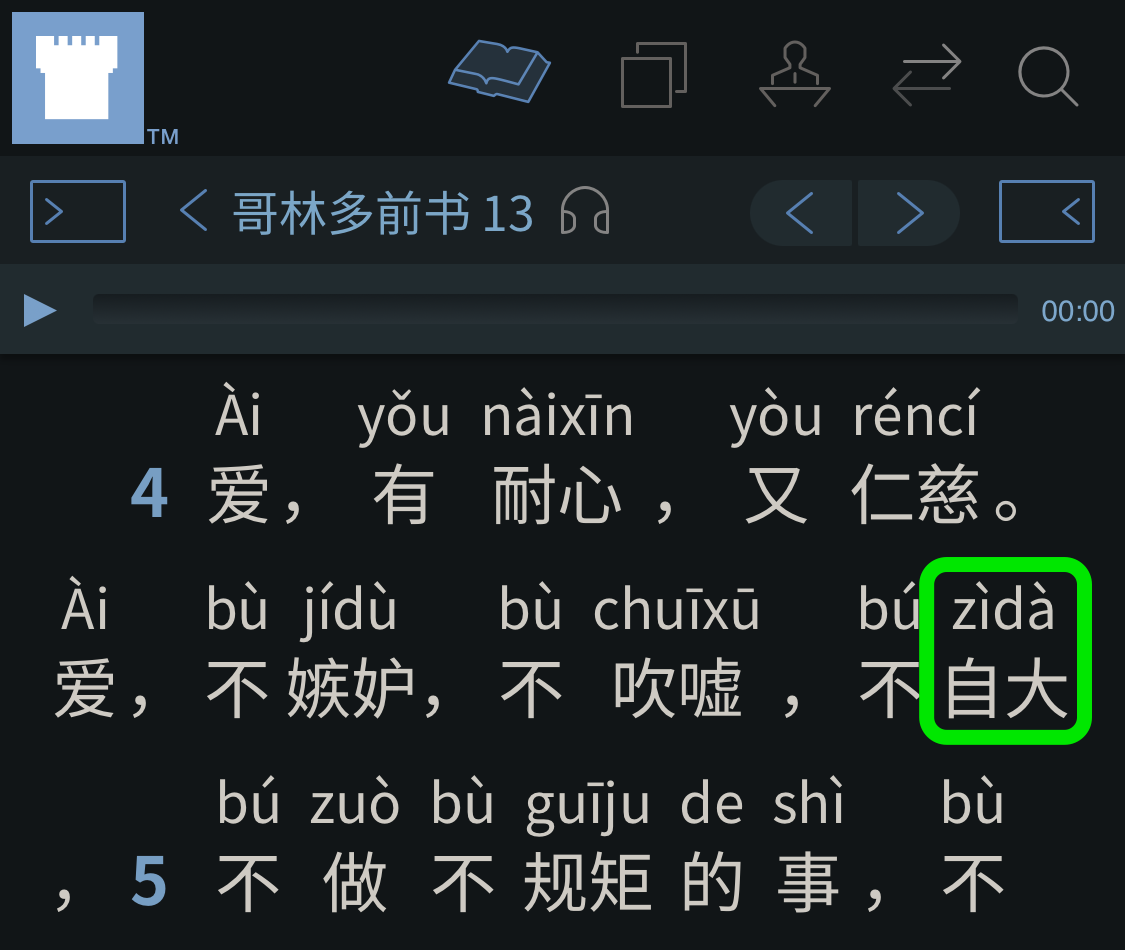
(Dark mode for the Watchtower ONLINE LIBRARY (WOL) website, as shown in the above image, can be enabled in the Safari web browser by using the Noir Safari extension. Other web browsers may also have extensions with similar functionality.)
For comparison, here are the current English and Pīnyīn (Pīn·yīn {Piecing Together of} · Sounds → [Pinyin] 拼音) Plus renderings of 1 Corinthians 13:4:
Love is patient and kind. Love is not jealous. It does not brag, does not get puffed up,
Pīnyīn (Pīn·yīn {Piecing Together of} · Sounds → [Pinyin] 拼音) Plus:
📖 📄 ➕ Ài (love 爱 愛), yǒu (has 有) nàixīn (nài·xīn {being (of/with) enduring} · heart → [patience] 耐心), yòu (also 又) réncí (rén·cí {is kind} 仁慈). Ài (love 爱 愛), bù (not 不) jídù ({is jealous} 嫉妒), bù (not 不) chuīxū+ (chuī·xū {does puff → [does brag]} · {does sigh → [does praise]} → [does brag] 吹嘘 吹噓), bú (not 不) zìdà (zì·dà {(does consider) self} · {to be big → [to be great]} 自大),
The individual morphemes in “zìdà (zì·dà {(consider) self} · {to be big → [to be great]} 自大)”, which are relatively simple and well-known, literally mean “self” and “big”. When these morphemes are put together in “zìdà (zì·dà {(consider) self} · {to be big → [to be great]} 自大)”, the resulting expression effectively means “(consider) self to be great”, corresponding, in 1 Corinthians 13:4 in the current English and Mandarin versions of the New World Translation Bible, with the English expression “puffed up”.
A Nation That Calls Itself “Central Nation”
As discussed in the MEotW post on “Zhōngguó (Zhōng·guó Central · Nation → [China | Chinese] 中国 中國)”, “the people of China have long viewed their nation as central to the world that they knew, or cared most about, to the point that ‘China was the only culture to use the concept for its name’ ”:
The English translation of Zhongyuan as the “Middle Kingdom” entered European languages through the Portuguese in the 16th century and became popular in the mid-19th century. By the mid-20th century, the term was thoroughly entrenched in the English language, reflecting the Western view of China as the inward-looking Middle Kingdom, or more accurately, the Central Kingdom or Central State. Endymion Wilkinson points out that the Chinese were not unique in thinking of their country as central, although China was the only culture to use the concept for its name.[source]
This cultural trait is such a thing that there are several words and concepts related to it, including “Sinocentrism”.
While many worldly Chinese people think nothing of calling their nation “Central Nation”, or think that this is only natural considering China’s history, many cultures consider calling oneself the centre of the world to be puffed up, overly and offputtingly self-important. As a Chinese person, I find this proud, self-centred aspect of worldly Chinese culture to be regrettable. Note that this characteristic should not be taken as a stereotype to be applied to all individual Chinese people, since each individual is different. However, it does tell us something about part of the true nature of worldly Chinese culture.
The Mark of B Players and Bozos
When it comes to writing systems, the zìdà (zì·dà {(consider) selves} · {to be big → [to be great]} 自大) attitudes of many people in China unfortunately motivated them to act as B players, as described by Steve Jobs. The MEotW post on “gāo’ào (gāo’·ào {[is] (considering self to be of) high (status)} · {[is] proud; haughty; arrogant} 高傲)” discusses this:
The below quote was recently added to the article “Pīnyīn (Pīn·yīn {Piecing Together of} · Sounds → [Pinyin] 拼音) Was Plan A”:
This tendency of many to prioritize their own pride and position over what’s really better for everyone is also described in this quote from Guy Kawasaki about something he learned from Steve Jobs:
A players hire A+ players. Actually, Steve believed that A players hire A players—that is people who are as good as they are. I refined this slightly—my theory is that A players hire people even better than themselves. It’s clear, though, that B players hire C players so they can feel superior to them, and C players hire D players. If you start hiring B players, expect what Steve called “the bozo explosion” to happen in your organization.
Yes, Pīnyīn was Plan A, but China unfortunately let the proud, self-serving B players have their way.
Note that what makes someone a B player or worse is not necessarily that person’s level of intelligence, skill, talent, etc. What characterizes B players or worse is their proud, self-serving rejection of others who are better in some way, their need to feel superior to others.
Yes, rather than embracing Pīnyīn (Pīn·yīn {Piecing Together of} · Sounds → [Pinyin] 拼音) as the way forward for the benefit of all, as it deserves to be embraced based on its technical merits, many worldly Chinese people showed a zìdà (zì·dà {(consider) selves} · {to be big → [to be great]} 自大) attitude and stuck with the characters that they had personally invested heavily in, and that brought them status and glory in the status quo.
China relegating _Pīnyīn_ to being just a pronunciation aid for characters is like a company hiring a talented A player executive and then making that person just get coffee for the CEO, because the established power base’s top priority is to preserve itself—B players in action. https://t.co/fNHsBWEsWO
— Troubadour WW (@troubadourww) May 15, 2024
Jesus Loves Those Who Are Humble Like Children
At Luke 22:25, 26, Jesus himself explained what it takes for one to be viewed by him and his Father as a truly great A player, and not an inferior B player:
But he said to them: “The kings of the nations lord it over them, and those having authority over them are called Benefactors. You, though, are not to be that way. But let the one who is the greatest among you become as the youngest, and the one taking the lead as the one ministering.
Also, Luke 9:46–48 says this about Jesus:
Then a dispute arose among them about which one of them was the greatest. Jesus, knowing the reasoning of their hearts, took a young child, stood him beside him, and said to them: “Whoever receives this young child on the basis of my name receives me also; and whoever receives me also receives the One who sent me. For the one who conducts himself as a lesser one among all of you is the one who is great.”
Chinese character chauvinists often say that Pīnyīn (Pīn·yīn {Piecing Together of} · Sounds → [Pinyin] 拼音) is for children. Well, according to Jesus’ words above, that would be fine with him, even if that were true! When this matter is examined in the light of first principles of linguistics (language science), though, it becomes obvious that it’s categorically not true that Pīnyīn (Pīn·yīn {Piecing Together of} · Sounds → [Pinyin] 拼音) is just for children—Pīnyīn (Pīn·yīn {Piecing Together of} · Sounds → [Pinyin] 拼音) works fine for people of all ages as a full writing system for Modern Standard Mandarin, including its most complex and advanced expressions. So, anything that can be spoken and understood in Modern Standard Mandarin can be written and understood in Pīnyīn (Pīn·yīn {Piecing Together of} · Sounds → [Pinyin] 拼音), regardless of the ages of those involved.
As Mandarin field language learners who are dedicated to, and who glorify, the true God Jehovah, let us not unthinkingly adopt the thinking and attitudes of proud, self-centred, self-glorifying worldly people, regardless of what human nation they come from. Remember, we are here in the Mandarin field, not to be gullible, unquestioningly admiring tourists (email me for login information, and include information on who referred you and/or what group/cong. you are in), but to be missionaries and spiritual rescue workers in this world that Jehovah God views as a spiritual disaster area.