Categories
Culture Experiences History Language Learning Technology Theocratic

jiāng‐xīn‐bǐ‐xīn

jiāng‐xīn‐bǐ‐xīn ((jiāng take)‐(xīn heart 心)‐(bǐ {to compare} 比)‐(xīn heart[s] 心) [be empathetic; put oneself in sb. else’s shoes; feel for another/others]) 👈🏼 Tap/click to show/hide the “flashcard”

[Notes: Tap/click on a Pīnyīn (Pīn·yīn {Piecing Together of} · Sounds → [Pinyin] 拼音) expression to reveal its “flashcard”; tap/click on a “flashcard” or its Pīnyīn (Pīn·yīn {Piecing Together of} · Sounds → [Pinyin] 拼音) expression to hide the “flashcard”. 📖 📄 📘 icons mean 📖 Reveal All, 📄 Reveal Advanced, and 📘 Reveal None re all the “flashcards” in the heading, paragraph, etc. that they are placed at the beginning of.]

Rather than dismissively thinking to ourselves that the songs produced by the organization are “just songs”, we should remember that the slave class takes seriously its responsibility to provide spiritual food to God’s people, and so it is going to make sure that the lyrics in its songs are spiritually correct, while also being emotionally moving.—Ezekiel 33:32; Matthew 24:45.

Comparing Hearts

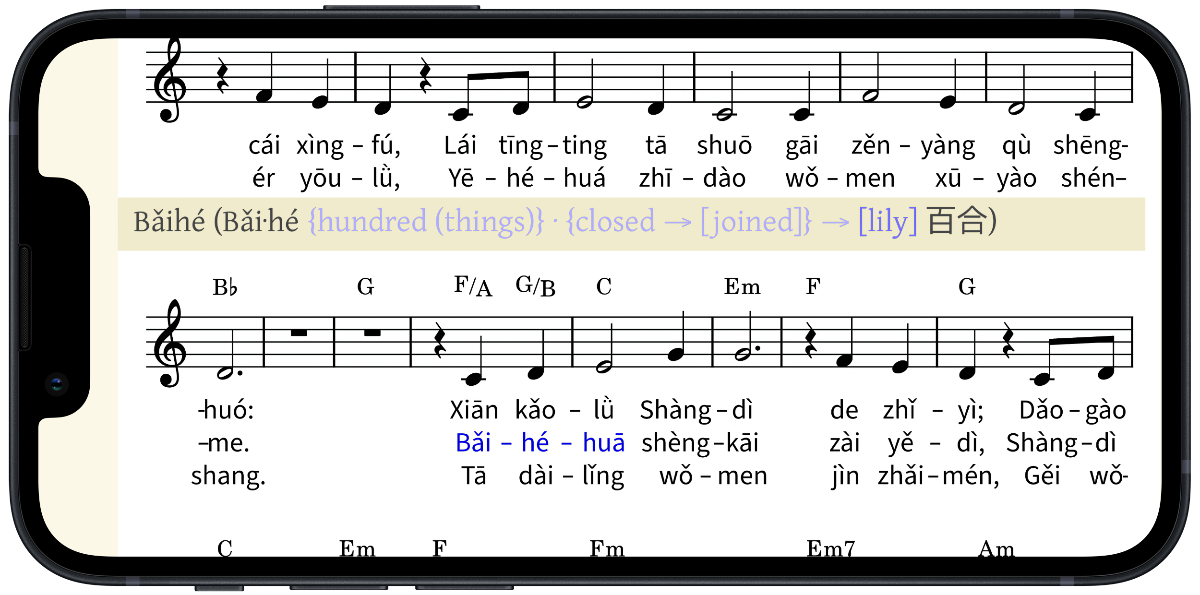
“jiāng‐xīn‐bǐ‐xǐn” _Pīnyīn_ Plus info, Song 163 (music+_Pīnyīn_), on iPhone 13 mini (landscape orientation)

This week’s MEotW in the unofficial Pīnyīn (Pīn·yīn {Piecing Together of} · Sounds → [Pinyin] 拼音) Plus resource “Sing Out Joyfully” Bk. (Pīnyīn+Music, Pīnyīn Plus, Web)

This week’s MEotW, “jiāng‐xīn‐bǐ‐xīn ((jiāng take)‐(xīn heart 心)‐(bǐ {to compare} 比)‐(xīn heart[s] 心) [be empathetic; put oneself in sb. else’s shoes; feel for another/others])”, comes from the first verse of song 163, this year’s convention song, which is entitled “Happy Are These Eyes” in English and “Wǒ de ((Wǒ Me 我) (de ’s 的) [My]) Yǎnjing (Yǎn·jing Eyes’ · Eyeballs → [Eyes] 眼睛) Duōme (Duō·me {(How) Much} · [suf] [How] 多么 多麼) Yǒufú (Yǒu·fú Have · Blessings → [Are Happy] 有福) in Mandarin:

English:

With a humble heart, he would pray.
He was kind to all and ready to forgive.

Mandarin (WOL, Pīnyīn (Pīn·yīn {Piecing Together of} · Sounds → [Pinyin] 拼音) Plus):

📖 📄 📘 Dǎogào (Dǎo·gào (when) praying · {requesting | telling} → [(when) praying] 祷告 禱告) yào ((we) must 要) qiānbēi (qiān·bēi {be modest} · {be low} → [be humble] 谦卑 謙卑) yào ((we) must 要) zhēnxīn (zhēn·xīn {be (of) true} · hearts → [be sincere] 真心);
Lèyì (Lè·yì {be (of) happy} · {meaning → [intention]} → [be willing] 乐意 樂意) yuánliàng (yuán·liàng {to pardon} · {to forgive} 原谅 原諒) rén (people 人), nǔlì (nǔ·lì exert · strength 努力) jiāng‐xīn‐bǐ‐xīn ((jiāng {to take})‐(xīn heart 心)‐(bǐ {to compare} 比)‐(xīn hearts 心) [to be empathetic]).

While not being a direct translation, “jiāng‐xīn‐bǐ‐xīn ((jiāng {to take})‐(xīn heart 心)‐(bǐ {to compare} 比)‐(xīn hearts 心) [to be empathetic]) seems to correspond with “was kind to all” in the above example. A more literal translation of “jiāng‐xīn‐bǐ‐xīn ((jiāng {to take})‐(xīn heart 心)‐(bǐ {to compare} 比)‐(xīn hearts 心) [to be empathetic]) as used above would be “to take heart to compare hearts”. Effectively, this is a rather poetic way to say “to be empathetic”.

Other Mandarin expressions related to empathy include:

  • tǐxù (tǐ·xù {bodily → [personally]} · pity; {sympathize [with]} [→ [empathize with]] 体恤 體恤)
  • tǐxù zhī xīn ((tǐ·xù {bodily → [personally]} · pitying; sympathizing [→ [empathizing]] 体恤 體恤) (zhī ’s 之) (xīn heart 心) [empathy])
  • tóngqíng (tóng·qíng {(have the) same} · feeling (as) → [sympathize with; show/have sympathy/empathy for] 同情)
  • tóngqíng‐xīn ((tóng·qíng {(having the) same} · feeling 同情)‐(xīn heart 心) [sympathy; fellow feeling; compassion; empathy])
  • liánxù (lián·xù sympathizing · pitying [→ [[having] compassion]] 怜恤 憐恤)

Empathy and Mandarin Field Language Learning

The importance of empathy with regard to Mandarin field language learning is emphasized in the below excerpt from the article “Pīnyīn (Pīn·yīn {Piecing Together of} · Sounds → [Pinyin] 拼音) Was Plan A”:

Yes, Pīnyīn was Plan A, but China unfortunately let the proud, self-serving B players have their way.

Is that the way we as Jehovah’s people should be? Shouldn’t godly, self-sacrificing love move us to do what’s best for others rather than fulfilling the imperfect human instinct for being self-glorifying, self-justifying, and self-serving? Are we showing pride in the name of love?

In this, I agree with Zhōu Ēnlái (周恩来/周恩來, Zhou Enlai), the first Premier of the People’s Republic of China, who agreed with Lǐ Zhúchén (李烛尘/李燭塵, Li Zhuchen), who said,

Every time the question of the reform of Chinese characters is brought up, somebody raises an objection, or even stubbornly opposes it for this or that reason. Some say that the characters are not difficult. I will say that such a person is like one who, as soon as his wounds are healed, forgets the pain he suffered. …If he will but recall his bitter experience in learning characters, and consider the interests of the children and the illiterates by placing himself in their place, he will not dissent or object so strongly. [This was actually said regarding opposition to the simplification of the characters, but the principle applies to opposition to Pīnyīn as well.—W. W.]

More recently, one commenter pointed out:

It takes a very grown-up person to say “I did this the hard way, but child, I want you to do it the easy way, for the greater good.”

Also, during the 2014 Stanford Commencement address, Bill Gates said:

If we have optimism, but we don’t have empathy, then it doesn’t matter how much we master the secrets of science, we’re not really solving problems—we’re just working on puzzles.

Mr. Gates’ above observation applies to the subject at hand in that while many enjoy trying to solve the puzzles presented by Chinese characters, and while many also enjoy being known for being good at solving these puzzles, empathy should move us to recognize that there are much bigger issues involved than just our personal enjoyment or glorification.

Yes, when even some worldly people can recognize the above points, we Christians should recognize even more the need to show love and empathy rather than being proud, self-glorifying, self-justifying, and self-serving. Also, we should be actively and determinedly following the course of true Christian love and empathy rather than just going along with others who are proud, self-glorifying, self-justifying, and self-serving. We should especially do so when we have scriptures such as this to guide us:

Knowledge puffs up, but love builds up.—1 Corinthians 8:1.

Musical Notation 🎼 and the Mandarin Field

In this post about a Mandarin expression found in our songbook, another subject that I want to touch on is: Is musical notation 🎼 too hard to be worth the trouble of producing it and using it? Are fewer and fewer people able to read it? I was fortunate enough to have been taught how to read musical notation in school. I have never thought of musical notation as being particularly difficult to use (it’s much easier to learn than characters, which many unquestioningly try to learn), and I find that it helps me to sing Kingdom songs more correctly (according to the intended melody, message, etc.) and more confidently more of the time. However, I am aware that not everyone in the Mandarin field has the same experience with musical notation. For example, a while ago, an older brother told me that he didn’t know how to read musical notation. Also, some people in the Mandarin field may have been affected by how education systems in this old world have been facing significant challenges relating to providing music education for younger ones.

Regardless of how the world may be failing in many cases to equitably provide good music education, Jehovah’s organization has pointed out that music is important in Jehovah’s worship. For example, not long ago, a Meeting Workbook said:

Music can have a powerful influence on the mind and body. Singing is an important part of our worship of Jehovah.

In accordance with the importance of music in Jehovah’s worship, Mandarin field language learners used to have available to them official material from the organization containing musical notation with Pīnyīn (Pīn·yīn {Piecing Together of} · Sounds → [Pinyin] 拼音) in the lyrics. However, perhaps at least partially because of the technical difficulty and costliness of producing material with musical notation and both Chinese characters and Pīnyīn (Pīn·yīn {Piecing Together of} · Sounds → [Pinyin] 拼音) in the lyrics, as of this writing, there is no official material currently available from the organization that shows Pīnyīn (Pīn·yīn {Piecing Together of} · Sounds → [Pinyin] 拼音) and musical notation on the same page or screen.

Screenshot of Sis. Margarita Königer and others using official _Pīnyīn_ _Sing to Jehovah_ songbooks with musical notation

A screenshot from an official video, of Sis. Margarita Königer and others using official Pīnyīn (Pīn·yīn {Piecing Together of} · Sounds → [Pinyin] 拼音) Sing to Jehovah songbooks with musical notation

The organization continues to publish official songbook material for different languages in general that contains musical notation, so it evidently still considers musical notation to generally be worthwhile to produce. It continues to produce official material for the current songbook that uses musical notation along with lyrics rendered only in Chinese characters, without Pīnyīn (Pīn·yīn {Piecing Together of} · Sounds → [Pinyin] 拼音), and it has even produced official material that uses jiǎnpǔ (jiǎn·pǔ simple · {register or record for reference → [musical notation]} → [numbered musical notation] 简谱 簡譜) (a kind of musical notation also known as numbered musical notation) and Chinese characters.

For Jehovah’s official organization, continuing to produce musical notation with lyrics rendered in Chinese characters but discontinuing production of musical notation that includes Pīnyīn (Pīn·yīn {Piecing Together of} · Sounds → [Pinyin] 拼音) lyrics when it becomes necessary to conserve time and effort makes sense, when we consider that the primary focus of Jehovah’s official organization is to provide spiritual instruction, not language instruction, even though language instruction can provide significant practical help to people seeking to learn or teach sprititual truths. (Another reminder of this primary focus is the recent discontinuation of the JW Language app.) The way the world is, with its deeply embedded traditions and prejudices, people whose mother tongue is Mandarin—and who thus learn spiritual truths best in Mandarin—mainly still use Chinese characters as their “mother writing system”, even as the game-changing practical benefits of Pīnyīn (Pīn·yīn {Piecing Together of} · Sounds → [Pinyin] 拼音) are obvious to unprejudiced Mandarin language learners.

And, even as the organization has continued to add Pīnyīn (Pīn·yīn {Piecing Together of} · Sounds → [Pinyin] 拼音) ruby text to much of its Mandarin material, in recognition of the value of these practical benefits—even people who have been learning characters since childhood occasionally, perhaps even regularly, suffer from character amnesia, due to the inhuman complexity and number of the characters, and also, there are actually tens of millions of Chinese people who are still illiterate regarding the characters—it seems that when faced with the prospect of producing a version of the current songbook with musical notation, characters, and Pīnyīn (Pīn·yīn {Piecing Together of} · Sounds → [Pinyin] 拼音) ruby text, those in charge, perhaps remembering how difficult and time-consuming it was to do so for the previous songbook, felt that it would just be too much this time.

For those who find it helpful in their Mandarin field activities to put musical notation together with Pīnyīn (Pīn·yīn {Piecing Together of} · Sounds → [Pinyin] 拼音), the unofficial Pīnyīn (Pīn·yīn {Piecing Together of} · Sounds → [Pinyin] 拼音) Plus resource “Sing Out Joyfully” Bk. (Pīnyīn+Music, Pīnyīn Plus, Web) exists and is continuing to be improved. As shown in the screenshot near the beginning of this post, this resource aids Mandarin field language learners by breaking with tradition and featuring lyrics in the musical notation that are only in relatively large-print Pīnyīn (Pīn·yīn {Piecing Together of} · Sounds → [Pinyin] 拼音) by default—characters are relegated to Pīnyīn (Pīn·yīn {Piecing Together of} · Sounds → [Pinyin] 拼音) Plus “flashcards” that are added as time allows.

Unlike the traditionally-used but unnecessarily extraordinarily complex characters that need to be accompanied by Pīnyīn (Pīn·yīn {Piecing Together of} · Sounds → [Pinyin] 拼音) before many are able to read them, Pīnyīn (Pīn·yīn {Piecing Together of} · Sounds → [Pinyin] 拼音) itself is a simple, elegant alphabetical full writing system for Mandarin that is easy to learn and remember. Also, it is no harder to typeset than other alphabetical writing systems with diacritics, such as the writing systems now used for French, Czech, Vietnamese, etc.*

In its Tips: section at the bottom of its home page, the “Sing Out Joyfully” Bk. (Pīnyīn+Music, Pīnyīn Plus, Web) resource contains these links that some may find helpful:


For convenience:

The direct link for the Pīnyīn (Pīn·yīn {Piecing Together of} · Sounds → [Pinyin] 拼音) Plus resource for the “Sing Out Joyfully” book is:

The short link for Chinese field language-learning links for the “Sing Out Joyfully” book is:

More Pīnyīn (Pīn·yīn {Piecing Together of} · Sounds → [Pinyin] 拼音) and Pīnyīn (Pīn·yīn {Piecing Together of} · Sounds → [Pinyin] 拼音) Plus web material based on the Mandarin “Sing Out Joyfully” book will be made available in the Pīnyīn (Pīn·yīn {Piecing Together of} · Sounds → [Pinyin] 拼音) Plus web resource as time allows.


* Thanks to ongoing advancements in personal computing hardware and software, producing material that contains things like musical notation and Pīnyīn (Pīn·yīn {Piecing Together of} · Sounds → [Pinyin] 拼音) text at reasonable cost is quicker and easier than ever. At this time, production of the musical notation in the “Sing Out Joyfully” Bk. (Pīnyīn+Music, Pīnyīn Plus, Web) resource begins in free open source software called MuseScore Studio, running on a Mac. Pīnyīn (Pīn·yīn {Piecing Together of} · Sounds → [Pinyin] 拼音) text for the lyrics in the musical notation is entered using macOS’s ABC – Extended input source (keyboard layout). (Just using Pīnyīn (Pīn·yīn {Piecing Together of} · Sounds → [Pinyin] 拼音) text only here simplifies things so much compared to having to somehow input characters with Pīnyīn (Pīn·yīn {Piecing Together of} · Sounds → [Pinyin] 拼音) ruby text!) When it’s ready, the musical notation for a song is exported from MuseScore Studio into SVG format, which is a plain text format that allows for the inclusion of links that activate Pīnyīn (Pīn·yīn {Piecing Together of} · Sounds → [Pinyin] 拼音) Plus flashcards on webpages. (These SVG links are a bit more involved to produce than “regular” web Pīnyīn (Pīn·yīn {Piecing Together of} · Sounds → [Pinyin] 拼音) Plus material, but at least the procedure for doing so is consistent and dependable, unlike Chinese characters, which have no consistent, dependable system regarding how they are designed compared to how they are pronounced.) The coding for the SVG links is currently done using the text editor BBEdit, in which editing large text files is quite performant. For Pīnyīn (Pīn·yīn {Piecing Together of} · Sounds → [Pinyin] 拼音) Plus web material production in general, my current favourite tool is Nova, but such web material can be produced in any application suitable for web development, such as Visual Studio Code, etc. ^

Categories
Science Technology Theocratic

hélí

hélí (hé·lí river · {raccoon dog} → [beaver] 河狸) 👈🏼 Tap/click to show/hide the “flashcard”

[Notes: Tap/click on a Pīnyīn (Pīn·yīn {Piecing Together of} · Sounds → [Pinyin] 拼音) expression to reveal its “flashcard”; tap/click on a “flashcard” or its Pīnyīn (Pīn·yīn {Piecing Together of} · Sounds → [Pinyin] 拼音) expression to hide the “flashcard”. 📖 📄 📘 icons mean 📖 Reveal All, 📄 Reveal Advanced, and 📘 Reveal None re all the “flashcards” in the heading, paragraph, etc. that they are placed at the beginning of.]

At the time of this writing, jw.org had recently featured the article “The Beaver’s Construction Ability”. The Mandarin version of this article uses this week’s MEotW, “hélí (hé·lí river · {raccoon dog} → [beaver] 河狸),” as the Mandarin word for “beaver”.

Screenshot of article “The Beaver’s Construction Ability” on jw.org

“River Raccoon Dog”

In “hélí (hé·lí river · {raccoon dog} → [beaver] 河狸),” “hé (river; stream 河) means “river” or “stream”, and “lí ({raccoon dog | leopard cat} 狸) probably means “raccoon dog”.

Readers who did not grow up in Asia or Europe are probably wondering what a raccoon dog is, so here is a picture of one from Wikipedia:

A common raccoon dog in Ukraine

Creative Commons Attribution-Share Alike License logo Ryzhkov Sergey [source]

“Ecosystem Engineers”

Reading the description of beaver dams and looking at the picture of one in the above-mentioned jw.org article, one may well be struck by how complex and involved these structures are. As the article says:

English:

In one study, researchers concluded that “beaver dams resemble engineered structures.” In fact, researchers have built many imitation beaver dams in North America. For good reason, beavers are often called ecosystem engineers.

What do you think? Did the beaver’s construction ability evolve? Or was it designed?

Mandarin:

📖 📄 📘 (one 一) xiàng ({item of}) yánjiū (yán·jiū {grinding → [studying]} · investigating → [study] 研究) tídào (tí·dào {carries (hanging down from the hand) → [raises} · {arriving at} → [mentions] 提到), hélí (hé·lí river · {raccoon dogs} → [beavers] 河狸) jiànzào (build 建造) de (’s 的) shuǐbà (shuǐ·bà water · dams → [dams] 水坝 水壩) jiù (exactly 就) xiàng ({are like} 像/象) shì (were (by) 是) gōngchéng‐shī ((gōng·chéng work · {journeys → [procedures]} → [engineering] 工程)‐(shī masters → [specialists]) [engineers]) shèjì (shè·jì {set up} · planned → [designed] 设计 設計) de ({’s (things)} 的) yíyàng (yí·yàng {(of) one} · {pattern → [way]} → [the same] 一样 一樣). Dàn (but 但) qíshí (qí·shí its · {being solid → [actuality]} → [actually] 其实 其實), zài (in 在) Běi‐Měizhōu ((Běi North 北)‐(Měi·zhōu American · continent (abbr. for Yàměilìjiā Zhōu) 美洲) [North America]), hěn (very 很) duō (many 多) shuǐbà (shuǐ·bà water · dams → [dams] 水坝 水壩) dōu (even 都) shì (are 是) rénlèi (rén·lèi human·kind 人类 人類) mófǎng (mó·fǎng {having imitated} · {having copied} 模仿) hélí (hé·lí river · {raccoon dogs} → [beavers] 河狸) de ( 的) fāngfǎ (fāng·fǎ directions · methods 方法) jiànzào ({to build} 建造) ér (thus 而) chéng ({came to be} 成) de ({’s (dams)} 的). Nánguài (Nán·guài {(it) is difficult} · {(to find it) strange that} → [it’s understandable that] 难怪 難怪) hélí (hé·lí river · {raccoon dogs} → [beavers] 河狸) chángcháng (cháng·cháng often · often 常常) bèi ([passive signifier] [are] 被) chēngwéi (chēng·wéi called · as 称为 稱為)shēngtài xìtǒng ((shēng·tài {living (things’)} · condition → [ecological] 生态 生態) (xì·tǒng {tied (things) → [system]} · {gathered together (things) → [interconnected system]} → [system] 系统 系統) [ecosystem]) gōngchéng‐shī ((gōng·chéng work · {journeys → [procedures]} → [engineering] 工程)‐(shī masters → [specialists]) [engineers])”.

📖 📄 📘 (you 你) rènwéi (rèn·wéi identify · {(it) to be} 认为 認為) ne ([? ptcl] 呢)? Hélí (Hé·lí river · {raccoon dog} → [the beaver] 河狸) jiànzào ({to build} 建造) shuǐbà (shuǐ·bà water · dams → [dams] 水坝 水壩) de ( 的) nénglì (néng·lì ability · power 能力) shì (is 是) jìnhuà (jìn·huà {to advance} · {having transformed} → [having evolved] 进化 進化) (yǎnhuà (yǎn·huà {having performed} · transforming → [having evolved] 演化)) ér (thus 而) lái ({came to be}) de ({’s (thing)} 的), háishi (hái·shi {still more → [or]} · is 还是 還是) jīngguò (jīng·guò {having passed through} · {having passed} → [having undergone] 经过 經過) shèjì (shè·jì {setting up} · planning → [design] 设计 設計) de ({’s (thing)} 的) ne ([? ptcl] 呢)?

We may find it beneficial to share the above comments with interested ones in the Mandarin field. Maybe the impressive industriousness and construction ability (and yes, cuteness) of “river raccoon dogs” will help bypass the prejudice that some may have towards the idea that life was created.


By the way, I came across this video on YouTube about what effects beavers can have on the ecosystem:

Categories
Culture Current Events Experiences Language Learning Names Science Technology

Lǐ Huá

({Plum (surname)} 李)
Huá (Flower → [Magnificence; Glory; Splendour; Florescence | Best Part; Cream | Times; Years | China] | Flowery → [Magnificent; Splendid; Glorious; Florescent | Prosperous; Flourishing | Flashy; Extravagant | Chinese]) 👈🏼 Tap/click to show/hide the “flashcard”

Citing national security concerns, the American government recently passed a law banning the popular social media app TikTok. Ironically (some would say hilariously), many American TikTok users, whom many are calling “TikTok refugees” (“TikTok nànmín (nàn·mín calamity · {persons of a certain occupation} → [refugees] 难民 難民)”), have defiantly responded in protest by migrating to an even more overtly Chinese social media app, Xiǎohóngshū (Xiǎo·hóng·shū Little · Red · Book → [a Chinese social networking platform, commonly known in English as RedNote] 小红书 小紅書) (also called RedNote), in such numbers (more than 700,000 in just two days) that Xiǎohóngshū (Xiǎo·hóng·shū Little · Red · Book → [a Chinese social networking platform, commonly known in English as RedNote] 小红书 小紅書) became the most-downloaded free app on Apple’s US App Store for a while.

On Xiǎohóngshū (Xiǎo·hóng·shū Little · Red · Book → [a Chinese social networking platform, commonly known in English as RedNote] 小红书 小紅書), many regular Chinese people have found it moving and rewarding to be able to make friends with regular American people, and vice versa. Many Americans have even expressed and shown interest in learning Mandarin to better connect with their new Chinese wǎngyǒu (wǎng·yǒu {net → [network] → [Internet]} · friends 网友 網/网友) (Internet friends).

With all this happening on Xiǎohóngshū (Xiǎo·hóng·shū Little · Red · Book → [a Chinese social networking platform, commonly known in English as RedNote] 小红书 小紅書), the topic of “Lǐ ({Plum (surname)} 李) Huá (Flower → [Magnificence; Glory; Splendour; Florescence | Best Part; Cream | Times; Years | China] | Flowery → [Magnificent; Splendid; Glorious; Florescent | Prosperous; Flourishing | Flashy; Extravagant | Chinese])”, this week’s MEotW, has come up. This expression is a person’s name, with “Lǐ ({Plum (surname)} 李)”, which literally means “Plum”, being the surname, and a very common one at that. “Huá (Flower → [Magnificence; Glory; Splendour; Florescence | Best Part; Cream | Times; Years | China] | Flowery → [Magnificent; Splendid; Glorious; Florescent | Prosperous; Flourishing | Flashy; Extravagant | Chinese]) is an interesting expression that is discussed in the MEotW post on “Huáyǔ (Huá·yǔ {Magnificent; Splendid; Flowery; Florescent → [Chinese]} · Language → [(Modern Standard) Mandarin (term commonly used in Singapore)] 华语 華語)”.

So, why are people on Xiǎohóngshū (Xiǎo·hóng·shū Little · Red · Book → [a Chinese social networking platform, commonly known in English as RedNote] 小红书 小紅書) talking about ({Plum (surname)} 李) Huá (Flower → [Magnificence; Glory; Splendour; Florescence | Best Part; Cream | Times; Years | China] | Flowery → [Magnificent; Splendid; Glorious; Florescent | Prosperous; Flourishing | Flashy; Extravagant | Chinese])?

Imaginary Pen Pals Magically Coming to Life

Here is a TikTok video containing this week’s MEotW, that explains how many Chinese Xiǎohóngshū (Xiǎo·hóng·shū Little · Red · Book → [a Chinese social networking platform, commonly known in English as RedNote] 小红书 小紅書) users feel about all the American people who have recently joined the app:

@jasmeizhang As a Chinese, what do we feel about foreigners joining RedNote? #tiktokrefugee #rednote #xiaohongshu #chinese ♬ original sound – jasmeizhang

(For any who cannot access this video, the gist is that when taking exams, students in China often encounter a question that asks them to assume the role of ({Plum (surname)} 李) Huá (Flower → [Magnificence; Glory; Splendour; Florescence | Best Part; Cream | Times; Years | China] | Flowery → [Magnificent; Splendid; Glorious; Florescent | Prosperous; Flourishing | Flashy; Extravagant | Chinese]) and write a letter in English to an imaginary foreign pen pal, perhaps about Chinese cuisine or some other topic related to China. So, for many Chinese people, encountering so many Americans and their comments on Xiǎohóngshū (Xiǎo·hóng·shū Little · Red · Book → [a Chinese social networking platform, commonly known in English as RedNote] 小红书 小紅書) recently feels like the imaginary foreign pen pals they wrote to so many times over the years as ({Plum (surname)} 李) Huá (Flower → [Magnificence; Glory; Splendour; Florescence | Best Part; Cream | Times; Years | China] | Flowery → [Magnificent; Splendid; Glorious; Florescent | Prosperous; Flourishing | Flashy; Extravagant | Chinese]) magically came to life and finally wrote back. She concludes by saying, “Thank you for coming over, trying to post in our language, talking to us, interacting with everyone. It makes us feel like we’re not alone in this world. After all, we’re all human, and deep down, humans are more alike than we’re different.”)

After a while, I was also able to find the same video on Xiǎohóngshū (Xiǎo·hóng·shū Little · Red · Book → [a Chinese social networking platform, commonly known in English as RedNote] 小红书 小紅書), so here it is coming from there, as a backup in case TikTok really ends up going away and not coming back for users in America or other places:

Here are some of the comments on TikTok in response to this video:

Many of us spent our childhoods “digging to China” in sandboxes, on beaches and in backyards. We were always meant to be friends, Li Hua. 🩵 so much love from all of us

Dear Li Hua, sorry we couldn’t write back sooner! Our bosses are kinda jerks. But we’re working on that! We’re all really happy to see your lives and pets and culture! Love, your American pen pal ❤️

Why am I crying so much at this story 🤧 I felt it would be disrespectful to invade your space but hearing this other side of things, I’m gonna join rednote now and start learning mandarin.

I’m learning mandarin on Duolingo. So far, I can only order hot water and soup. I’m so excited to one day be able to speak your language as beautifully as you speak mine. 🥲

Here is a video I found on Xiǎohóngshū (Xiǎo·hóng·shū Little · Red · Book → [a Chinese social networking platform, commonly known in English as RedNote] 小红书 小紅書), with a reply from the American side to ({Plum (surname)} 李) Huá (Flower → [Magnificence; Glory; Splendour; Florescence | Best Part; Cream | Times; Years | China] | Flowery → [Magnificent; Splendid; Glorious; Florescent | Prosperous; Flourishing | Flashy; Extravagant | Chinese]):

[The original post can be found here.]

As an example of the cross-cultural exchange taking place, here is another video that I found on Xiǎohóngshū (Xiǎo·hóng·shū Little · Red · Book → [a Chinese social networking platform, commonly known in English as RedNote] 小红书 小紅書), by a fellow who very likely had often written letters as ({Plum (surname)} 李) Huá (Flower → [Magnificence; Glory; Splendour; Florescence | Best Part; Cream | Times; Years | China] | Flowery → [Magnificent; Splendid; Glorious; Florescent | Prosperous; Flourishing | Flashy; Extravagant | Chinese]) when he was in school:

[The original post can be found here. Here is a rough translation of the introductory blurb: “40-year-old middle-aged retired military officer’s only post-retirement joy; among family members who understands?”]

Wild Beasts and a Great Wall

Unfortunately, as alluded to above, the politics of this Devil-ruled world, with its bitter and sometimes murderous power struggles, work to divide people, in spite of how people naturally desire to make friends and live in peace (and enjoy music). While many Chinese people on Xiǎohóngshū (Xiǎo·hóng·shū Little · Red · Book → [a Chinese social networking platform, commonly known in English as RedNote] 小红书 小紅書) feel like a ({Plum (surname)} 李) Huá (Flower → [Magnificence; Glory; Splendour; Florescence | Best Part; Cream | Times; Years | China] | Flowery → [Magnificent; Splendid; Glorious; Florescent | Prosperous; Flourishing | Flashy; Extravagant | Chinese]) who after many years actually got replies from foreign pen pals, and while many American people who just joined Xiǎohóngshū (Xiǎo·hóng·shū Little · Red · Book → [a Chinese social networking platform, commonly known in English as RedNote] 小红书 小紅書) feel like they finally got to China and met some really nice, friendly people after digging holes to China as kids, their respective governments are in God’s eyes like wild beasts competing for territory and influence, warily circling each other, and preparing for vicious, bloody battle. (Indeed, even in the world, the USA is often symbolically portrayed as an eagle, and China is often symbolically portrayed as a dragon.)

The proud human cultural tradition mandating the use of the abnormally difficult-to-learn-and-remember Chinese characters to write Mandarin also puts a Great Wall between Chinese people and Mandarin learners in other nations who would like to write text messages to each other, leave comments on social media posts, etc. Many turn to tools like Google Translate for help, but these are really just coping mechanisms, band-aid solutions, while the basic problem of the characters remains.

The Great Wall of China

Chinese characters continue to act as a Great Wall dividing people who naturally want to be friends.

Pīnyīn (Pīn·yīn {Piecing Together of} · Sounds → [Pinyin] 拼音) technically works as a simple, easy-to-learn full writing system for reading and writing Mandarin, so it is technically ideally suited for texting, commenting, etc. Unfortunately, though, the stubbornly embedded traditional cultural primacy of characters and the related cultural prejudice against Pīnyīn (Pīn·yīn {Piecing Together of} · Sounds → [Pinyin] 拼音) will dissuade most people from beneficially using Pīnyīn (Pīn·yīn {Piecing Together of} · Sounds → [Pinyin] 拼音) in these ways. (Question: As Mandarin field language learners who are trying to walk on the narrow road to life, and who are doing a life-saving work to help other people also get on this narrow road, should we always limit ourselves to being like most people?—Matthew 7:13, 14.)

(In my limited time so far on Xiǎohóngshū (Xiǎo·hóng·shū Little · Red · Book → [a Chinese social networking platform, commonly known in English as RedNote] 小红书 小紅書), I have happened to come across a couple of comments containing Pīnyīn (Pīn·yīn {Piecing Together of} · Sounds → [Pinyin] 拼音). One of these comments (from a user in the United States) renders the same message in English on one line, in simplified Chinese characters on another line, and then in Pīnyīn (Pīn·yīn {Piecing Together of} · Sounds → [Pinyin] 拼音) on yet another line, Rosetta Stone-style. The Pīnyīn (Pīn·yīn {Piecing Together of} · Sounds → [Pinyin] 拼音) is even well-formatted, not just as with a pronunciation aid, but as with a full writing system, with tone marks, word separation, and punctuation.)

As shown above, audio and video technology also now enable people to just talk (and sing!) to communicate across distance and time. However, even in this regard, many Mandarin learners have allowed the visually intricate characters to stunt their Mandarin speech skills by distracting them from properly focusing on invisible sound, which is what Mandarin speech (and singing!) is actually made of. As discussed in other MEotW posts, this is effectively linguistic idolatry.

Spiritual Family in the Mandarin Field

As Mandarin field language learners, this whole situation with regular Chinese and American people enjoying meeting and making friends with each other on Xiǎohóngshū (Xiǎo·hóng·shū Little · Red · Book → [a Chinese social networking platform, commonly known in English as RedNote] 小红书 小紅書) may remind us of all the wonderful new friends we made when we joined the Mandarin field. As Jehovah’s people serving in the Mandarin field, or in any congregation or group with people from different cultural backgrounds, we are not only aware of the possibility of making friends with people of other nations and cultures, we also know that every human being is really part of the one human family descended from the same ancestors and created by God. Additionally, we know that Jehovah has assigned us to help people from all the nations to join us in his spiritual paradise, in which they can become our spiritual brothers and sisters and live in peace with us forever on a paradise earth. (Matthew 28:19, 20) Let us, then, not let the world’s politics or human traditions prevent us from doing this life-saving, uniting, God-assigned work as well as we ought to.