Categories
Culture Current Events Language Learning Science Technology Theocratic

jiǎ xiāoxi

jiǎ (false; fake假/叚)
xiāoxi (xiāo·xi disappearing · news → [news; information] 消息) ← Tap/click to show/hide the “flashcard”

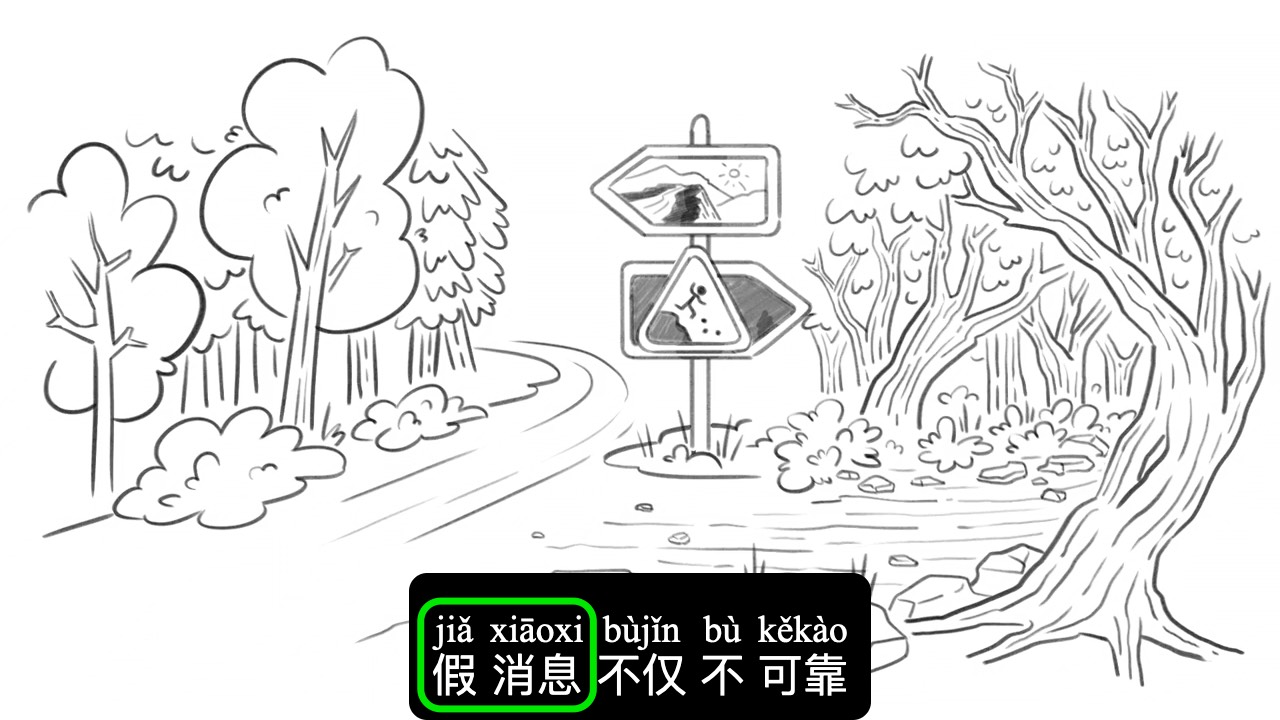
At the time of this writing, jw.org was featuring the whiteboard animation video “Protect Yourself From Misinformation”. The English and Mandarin versions of this video match the English word “misinformation” with this week’s MEotW, “jiǎ (false; fake假/叚) xiāoxi (xiāo·xi disappearing · news → [news; information] 消息)”:
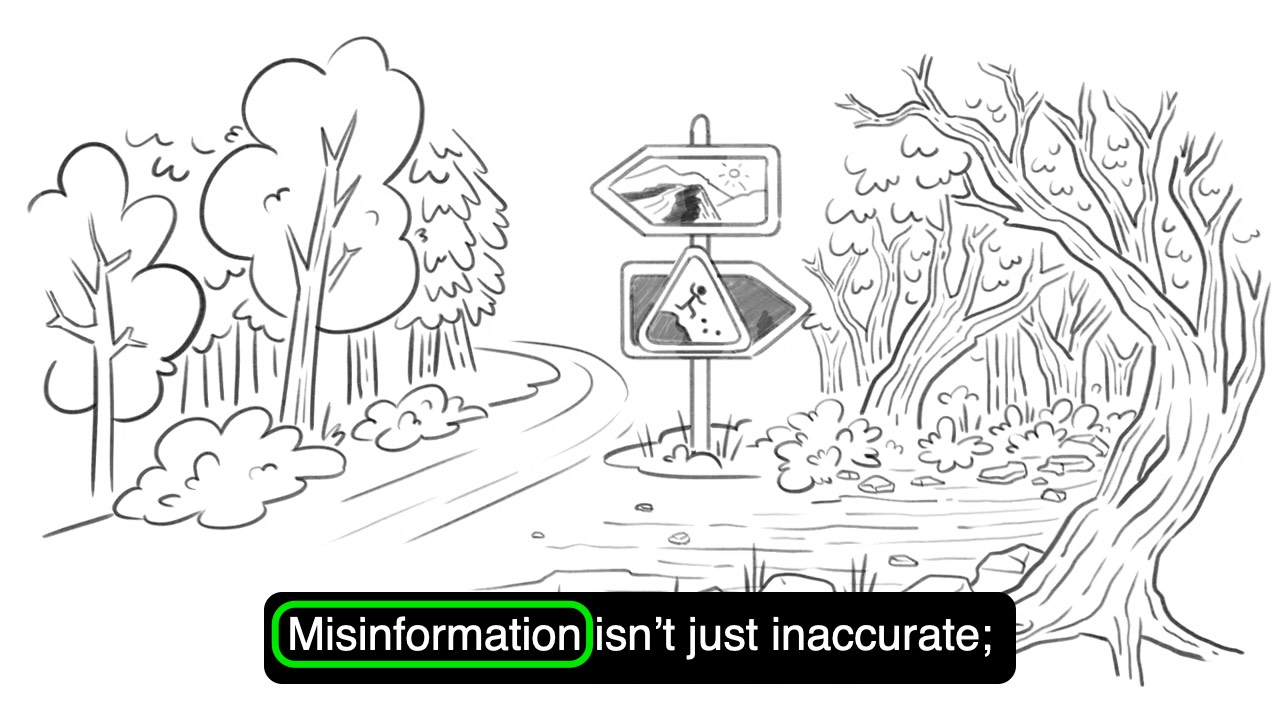
Screenshot from the video “Protect Yourself From Misinformation”, 0:32 mark, showing “Misinformation” in the subtitle

Screenshot from the video “消息满天飞,如何辨真假”, 0:32 mark, showing “假消息 (jiǎ xiāoxi)” in the subtitle

[Note: The MEotW post on “shèjiāo wǎngzhàn ((shè·jiāo {god of the land → [society] → [social]} · {meeting → [associating]} → [social contact/interaction] 社交) (wǎng·zhàn {net → [web]} · {stand → [station]} → [website] 网站 網站) [social networking website; social network]) contains information about how to add unproofread computer-generated Pīnyīn (Pīn·yīn {Piecing Together of} · Sounds → [Pinyin] 拼音) to the subtitles of Mandarin videos on jw.org in most browsers.]

“Jiǎ (false; fake假/叚) xiāoxi (xiāo·xi disappearing · news → [news; information] 消息) can also be translated as “false news”, “false information”, or perhaps even “fake news”, as confirmed by the entry for this expression in the excellent Referenced Theo. Expressions (RTE) resource.

Disappearing?

“Jiǎ ({[is] false; fake; phony; artificial} | if; supposing; assume; presume | borrow; {avail oneself of}假/叚) means “false” or “fake”, and “xiāoxi (xiāo·xi disappearing · news → [news; information] 消息)”, while used to effectively mean “news” or “information”, actually literally means “disappearing news”. Why “disappearing”? Perhaps that is a nod to the fleeting nature of news—relatively quickly, when it’s not new anymore, it’s not news anymore.

The Wiktionary entry for “xiāoxi (xiāo·xi disappearing · news → [news; information] 消息) seems to bear this out, as it says:

消息 (xiāoxi) refers to news as in new information; to express the meaning of news as in reports of current events, use 新聞/新闻 (xīnwén).

“Xiāoxi (Xiāo·xi disappearing · news → [news; information] 消息) also appears in the expression “hǎo (good 好) xiāoxi (xiāo·xi disappearing · news → [news] 消息)”, meaning “good news”, which we use often in the Mandarin field. In fact, “Hǎo (Good 好) Xiāoxi (Xiāo·xi Disappearing · News → [News] 消息)”! is the title of the concluding song for this year’s Mandarin conventions! (English, Mandarin, Pīnyīn (Pīn·yīn {Piecing Together of} · Sounds → [Pinyin] 拼音) Plus) Also, we will say “Wángguó (Wáng·guó King’s · Nation → [Kingdom] 王国 王國) de (’s 的) hǎo (good 好) xiāoxi (xiāo·xi disappearing · news → [news] 消息) when we want to refer to “the good news of the Kingdom”. Of course, while the message of this good news will “disappear” as news when it is not news anymore, the Kingdom itself “will stand forever”!—Daniel 2:44.

Myths and Misinformation About Chinese Characters, Etc.

As Mandarin field language learners, we need to be aware that many myths and much misinformation have been spread about the Chinese languages, especially when it comes to Chinese characters. Indeed, there is so much misinformation about Chinese characters that Victor Mair wrote the following in the foreword of the book Ideogram: Chinese Characters and the Myth of Disembodied Meaning, by J. Marshall Unger:

There is probably no subject on earth concerning which more misinformation is purveyed and more misunderstandings circulated than Chinese characters (漢字, Chinese hanzi, Japanese kanji, Korean hanja), or sinograms.

Also, in his book The Chinese Language: Fact and Fantasy, John DeFrancis lists the following myths regarding Chinese characters, that many believe:

  • The Ideographic Myth
    • The MEotW post on “Hāmǐjíduōdùn (Armageddon 哈米吉多顿 哈米吉多頓) contains a discussion of this myth, with some selected excerpts on this subject from DeFrancis’ book.
  • The Universality Myth
  • The Emulatability Myth
  • The Monosyllabic Myth
  • The Indispensability Myth
  • The Successfulness Myth

Regarding these myths, in p. 2–3 of his aforementioned book, J. Marshall Unger provides this summary:

Passing for the moment over the history of how the hunt for the perfect language unfolded, let us jump ahead to the result: the intellectual baggage about Chinese characters that we have inherited from the Renaissance and Enlightenment. John DeFrancis, in his classic book The Chinese Language (1984), sums up that weighty legacy under six headings, and a better summary would be hard to find. The source of all the confusion is what DeFrancis calls the Ideographic Myth, the notion that Chinese characters represent meaning directly, without reference to language (that is, speech) in any way. Its logical extension is the Universality Myth, according to which Chinese script allows for communication between mutually uninteligible dialects and languages. This leads in turn to the Emulatability Myth, which holds that Chinese script can serve as a model for a general system of signs that transcends natural language. These first three myths have little to do with the actual structure or history of the Chinese language or its writing system, in contrast with the remaining three: the Monosyllabic Myth, Indispensability Myth, and Successfulness Myth. Each of these—the names are more or less self-explanatory—makes a strong claim about language and the writing system, claims that have had significant social and political consequences.

At least some of the political consequences referred to above have been deliberate, meaning that at least some of the myths and misinformation spread about Chinese languages and Chinese characters qualify as political propaganda. If we’re not careful, we could end up parroting this political propaganda. (We could also end up parroting worldly human cultural propaganda, which is also a bad thing for people who seek to be no part of the world.) Also, all the difficulties and confusion caused by all the myths and misinformation surrounding Chinese languages and Chinese characters massively hinder the efforts of Mandarin field language learners to stay spiritually strong and to reach the hearts of Mandarin-speakers with Bible truth. This can result in deeply negative spiritual consequences that should be of great concern to us. To complete the sentence quoted from the video mentioned at the beginning of this post:

Misinformation isn’t just inaccurate; it can also be dangerous!

Categories
Culture Language Learning Technology Theocratic

xīndé

xīndé (xīn·dé heart · {got/obtained(’s things)} → [(things) learned from work/study/experience/etc.] 心得) ← Tap/click to show/hide the “flashcard”

[Notes: Tap/click on a Pīnyīn (Pīn·yīn {Piecing Together of} · Sounds → [Pinyin] 拼音) expression to reveal its “flashcard”; tap/click on a “flashcard” or its Pīnyīn (Pīn·yīn {Piecing Together of} · Sounds → [Pinyin] 拼音) expression to hide the “flashcard”. 📖 📄 📘 icons mean 📖 Reveal All, 📄 Reveal Advanced, and 📘 Reveal None re all the “flashcards” in the heading, paragraph, etc. that they are placed at the beginning of.]

One of the publications that is now recommended to be used on Bible studies is the Yǒngyuǎn Xiǎngshòu Měihǎo de Shēngmìng—Hùdòng Shì Shèngjīng Kèchéng ((Yǒng·yuǎn Eternally · {Far (in Time)} 永远 永遠) (Xiǎng·shòu Enjoy · Receive 享受) (Měi·hǎo Beautiful · Good 美好) (de ’s 的) (Shēngmìng Life 生命)—(Hù·dòng {Each Other} · Moving → [Interactive] 互动 互動) (Shì (Type 式) (Shèng·jīng Holy · Scriptures → [Bible] 圣经 聖經) (Kè·chéng Lessons · Procedure → [Course] 课程 課程) [Enjoy Life Forever!—An Interactive Bible Course (lff)]) (Enjoy Life Forever! (lff)) book. An outstanding feature of this book is its extensive use of the post-paper technology of video, which enables information to be presented much more vividly than could be done with paper. Also, at this time, one of the unique features of Pīnyīn (Pīn·yīn {Piecing Together of} · Sounds → [Pinyin] 拼音) Plus material is Pīnyīn (Pīn·yīn {Piecing Together of} · Sounds → [Pinyin] 拼音) Plus video transcripts. These can help us Mandarin field language learners to analyze and understand the Mandarin speech used in the many videos referenced in the Mandarin Enjoy Life Forever! book. This in turn can help us make more effective use of these videos while participating in Mandarin Bible discussions using this book.

This week’s MEotW, “xīndé (xīn·dé heart · {got/obtained(’s things)} → [(things) learned from work/study/experience/etc.] 心得)”, occurs in subtitle 44 of the transcript for the video for lesson 11, point 4 of the Mandarin Enjoy Life Forever! book:

English:

You can better relate to the brothers’ and sisters’ comments

because you’ve read the material yourself, and I can comment too.

Mandarin:

43
00:01:41,503 → 00:01:44,799
📖 📄 📘 Tíqián (Tí·qián {carried (hanging down from the hand) → [raised] → [shifted to an earlier time]} · ahead → [beforehand] 提前) yùxí (yù·xí {in advance} · {having reviewed} → [having prepared] 预习 預習), jiù ({(I) then} 就) néng (can 能) cóng (from) dàjiā (dà·jiā big · family → [everyone] 大家) fēnxiǎng (fēn·xiǎng {divides → [distributes]} · {enjoying of} → [shares] 分享) de ( 的) yàodiǎn (yào·diǎn important · points 要点 要點) huòyì (huò·yì {capture → [obtain]} · benefits 获益 獲益),

44
00:01:44,799 → 00:01:47,343
📖 📄 📘 (I 我) (also 也) néng (can 能) fābiǎo (fā·biǎo {issue → [utter]} · express 发表 發表) zìjǐ (self 自己) de (’s 的) xīndé (xīn·dé heart · {has obtained(’s things)} → [(things) learned from work/study/experience/etc.] 心得) tǐhuì (tǐ·huì {bodily → [personally]} · {has come to understand(’s things)} 体会 體會).

Morphemic Breakdown and Interaction

The morphemes in “xīndé (xīn·dé heart · {got/obtained(’s things)} → [(things) learned from work/study/experience/etc.] 心得) are probably quite familiar to even beginning students of Mandarin—“xīn (heart 心) means “heart”, and “dé (get; obtain 得) literally means “get” or “obtain”. When we put these two simple and well known expressions together, though, they mean “heart got/obtained(’s things)”, and we end up with an effective meaning that’s greater than the sum of its parts: “(things) learned from work/study/experience/etc.”

(By the way, note that the sister quoted in the video said that advance preparation helps her to be able to effectively share her xīndé (xīn·dé heart · {has obtained(’s things)} → [(things) learned from work/study/experience/etc.] 心得). As Mandarin field language learners, we may especially benefit from advance preparation so that we can more effectively use Mandarin to share with Mandarin-speaking people the things our hearts have learned. Yes, as boring and unglamorous as it may seem, our Mandarin abilities can be significantly enhanced by good old preparation and practice!)

Matters of the Heart

Going back to “xīn (heart 心)”, which means “heart”, it’s good to remember how important the heart is to our Mandarin field ministry. While the mind has much to do when one is learning Mandarin for the Mandarin field, and while some like to focus on how much knowledge of Chinese characters their minds have soaked up, the MEotW post on “xìnxīn (xìn·xīn believing · heart → [faith; confidence] 信心) points out the following about speaking to Mandarin-speaking people about spiritual things:

The Mandarin culture and language correctly recognize that the heart is deeply involved in spirituality. In fact, as mentioned in Appendix A2 of the current Mandarin version of the New World Translation Bible (nwtsty), one of the expressions that the current version of the Mandarin NWT Bible uses to translate the English word “spiritual” is “xīnlíng (xīn·líng heart · spirit [→ [spiritual]] 心灵 心靈)”, which is a past MEotW. This expression literally means “heart spirit”.

So, let us not be quick, in our pride, to dismiss talk of the heart as sentimental nonsense. As expressed by the Mandarin expression “àixīn (ài·xīn loving · heart → [love] 爱心 愛心) (a past MEotW), we love with our hearts, and as God’s Word tells us in 1 Corinthians 13, if we don’t have love, then any knowledge, skills, abilities, etc. that we have, and that we may be proud of, are meaningless.

Serving in the Mandarin field—or any language field, really—is not just a matter of sharing knowledge and applying language or other mental skills. As this week’s MEotW reminds us, it’s also about sharing our hearts and the things our hearts have learned. And as we age, even if our physical and mental abilities may not be what they used to be, we naturally come to have more and more experience and heart lessons to share. Let us Mandarin field language learners apply ourselves out of love, not to glorify ourselves or anything like that, but so that we can share with Mandarin-speaking people the valuable things that Jehovah has helped our hearts to learn, in a way that they can tell is from the heart.


For convenience:

The direct link for the Pīnyīn (Pīn·yīn {Piecing Together of} · Sounds → [Pinyin] 拼音) Plus resource for the Enjoy Life Forever! book is:

The short link for Chinese field language-learning links for the Enjoy Life Forever! book is:

More Pīnyīn (Pīn·yīn {Piecing Together of} · Sounds → [Pinyin] 拼音) and Pīnyīn (Pīn·yīn {Piecing Together of} · Sounds → [Pinyin] 拼音) Plus web material based on the Mandarin Enjoy Life Forever! book will be made available in the Pīnyīn (Pīn·yīn {Piecing Together of} · Sounds → [Pinyin] 拼音) Plus web resource as time allows.

Categories
Theocratic

shēn‐lín‐qí‐jìng

shēn (body → [self] 身)lín ({being present (in)}) (his/her/its/their… 其)jìng ({(set of) boundaries → [(bounded) place; area] → [condition; situation; circumstances]} 境) ← Tap/click to show/hide the “flashcard”

[Notes: Tap/click on a Pīnyīn (Pīn·yīn {Piecing Together of} · Sounds → [Pinyin] 拼音) expression to reveal its “flashcard”; tap/click on a “flashcard” or its Pīnyīn (Pīn·yīn {Piecing Together of} · Sounds → [Pinyin] 拼音) expression to hide the “flashcard”. 📖 📄 📘 icons mean 📖 Reveal All, 📄 Reveal Advanced, and 📘 Reveal None re all the “flashcards” in the heading, paragraph, etc. that they are placed at the beginning of.]

One of the publications that is now recommended to be used on Bible studies is the Yǒngyuǎn Xiǎngshòu Měihǎo de Shēngmìng—Hùdòng Shì Shèngjīng Kèchéng ((Yǒng·yuǎn Eternally · {Far (in Time)} 永远 永遠) (Xiǎng·shòu Enjoy · Receive 享受) (Měi·hǎo Beautiful · Good 美好) (de ’s 的) (Shēngmìng Life 生命)—(Hù·dòng {Each Other} · Moving → [Interactive] 互动 互動) (Shì (Type 式) (Shèng·jīng Holy · Scriptures → [Bible] 圣经 聖經) (Kè·chéng Lessons · Procedure → [Course] 课程 課程) [Enjoy Life Forever!—An Interactive Bible Course (lff)]) (Enjoy Life Forever! (lff)) book. An outstanding feature of this book is its extensive use of the post-paper technology of video, which enables information to be presented much more vividly than could be done with paper. Also, at this time, one of the unique features of Pīnyīn (Pīn·yīn {Piecing Together of} · Sounds → [Pinyin] 拼音) Plus material is Pīnyīn (Pīn·yīn {Piecing Together of} · Sounds → [Pinyin] 拼音) Plus video transcripts. These can help us Mandarin field language learners to analyze and understand the Mandarin speech used in the many videos referenced in the Mandarin Enjoy Life Forever! book. This in turn can help us make more effective use of these videos while participating in Mandarin Bible discussions using this book.

This week’s MEotW, “shēn (body → [self] 身)lín ({being present (in)}) (his/her/its/their… 其)jìng ({(set of) boundaries → [(bounded) place; area] → [condition; situation; circumstances]} 境)”, occurs in subtitle 35 of the transcript for the video for lesson 11, point 4 of the Mandarin Enjoy Life Forever! book:

English:

My favourite Bible book is Esther.

And because I think she was a very special person,

it was especially then that I could imagine

what her situation was like and what kind of a person she was

and I could see myself in the account.

Mandarin:

32
00:01:15,309 → 00:01:18,187
📖 📄 📘 (I 我) zuì (most最/㝡) xǐhuan (xǐ·huan like · enjoy 喜欢 喜歡) de ({’s (Bible book)} 的) shì (is 是) Yǐsītiējì (Yǐsītiē·jì Esther · Record → [Esther] 以斯帖记 以斯帖記).

33
00:01:18,187 → 00:01:21,357
📖 📄 📘 Yīnwei (Yīn·wei because · for 因为 因為) (I 我) juéde (jué·de {to wake to → [to feel]} · get → [get to feel] 觉得 覺得) Yǐsītiē (Esther 以斯帖) hěn ({very much} 很) yǔ‐zhòng‐bùtóng ((yǔ with與/与)‐(zhòng crowd眾/衆)‐(bùtóng not · {was the same} → [was different] 不同) [stood out from the crowd]),

34
00:01:21,357 → 00:01:23,901
📖 📄 📘 suǒyǐ (suǒ·yǐ {that which} · {is the reason} → [so] 所以) zài (at 在) ({(I) read}) zhèige (zhèi·ge this · [mw] 这个 這個) jìzǎi (jì·zǎi recorded · writing → [account] 记载 記載) de (’s 的) shíhou ({(particular) times} 时候 時候),

35
00:01:23,901 → 00:01:26,696
📖 📄 📘 (I 我) gèng (more 更) róngyì (róng·yì {containing → [allowing]} · {being easy} → [easily] 容易) shēn (body → [self] 身)lín ({being present (in)}) (her 其)jìng ({(set of) boundaries → [(bounded) place] → [situation]} 境) de ({in that way} 地) xiǎngxiàng (xiǎng·xiàng {think of} · {(instances of) being like → [images]} → [imagine] 想象 想象/像)

36
00:01:26,696 → 00:01:28,782
📖 📄 📘 dāngshí (dāng·shí {at that} · {(particular) time} 当时 當時) (she 她) suǒ ({that which (she)} 所) chǔ ({was dwelling in} → [was situated in]) de (’s 的) huánjìng (huán·jìng surrounding · {(set of) boundaries → [(bounded) place] → [situation]} → [situation] 环境 環境),

37
00:01:28,782 → 00:01:30,867
📖 📄 📘 háiyǒu (hái·yǒu also · {(there) is having → [(there) is]} 还有 還有) (she 她) shì (was 是) ge ([mw]個/个) zěnyàng (zěn·yàng what · kind 怎样 怎樣) de (’s 的) rén (person 人).

Morphemic Breakdown

In “shēn (body → [self] 身)lín ({being present (in)}) (his/her/its/their… 其)jìng ({(set of) boundaries → [(bounded) place; area] → [condition; situation; circumstances]} 境)”, “shēn (body [→ [self]] 身)”, which literally means “body”, is used to effectively mean “self”. Another Mandarin expression in which “shēn (body [→ [self]] 身) is used this way is “xiànshēn (xiàn·shēn {offer → [dedicate]} · {body → [self]} | {offering of → [dedicating of]} · {body → [self]} → [dedication] 献身 獻身)”, which literally means “offer body”, but which effectively means “dedicate self”, as one does before getting baptized.

The “lín (face; overlook; {be near to} | arrive; {be present} | approach; {draw near} | {on the point of}; {just before}; {[be] about to}) in this week’s MEotW can have several possible meanings, as can be seen from its Pīnyīn (Pīn·yīn {Piecing Together of} · Sounds → [Pinyin] 拼音) Plus “flashcard”. In the context of “shēn (body → [self] 身)lín ({being present (in)}) (his/her/its/their… 其)jìng ({(set of) boundaries → [(bounded) place; area] → [condition; situation; circumstances]} 境)”, “lín (face; overlook; {be near to} | arrive; {be present} | approach; {draw near} | {on the point of}; {just before}; {[be] about to}) evidently means “being present (in)”.

Long-time Mandarin field language learners may recall that this “lín (face; overlook; {be near to} | arrive; {be present} | approach; {draw near} | {on the point of}; {just before}; {[be] about to}) also appears in the expression “línzài (lín·zài {having arrived} · {being present} 临在 臨在)”, which was used in older versions of the Mandarin New World Translation Bible to translate the Greek word pa·rou·siʹa in scriptures such as Matthew 24:3. However, as explained in Appendix A2 of the current version of the Mandarin NWT Bible, “línzài (lín·zài {having arrived} · {being present} 临在 臨在) is no longer used to translate pa·rou·siʹa because many readers found this Mandarin expression to be unfamiliar—indeed, out of the several dictionaries loaded in my Pleco app, this expression only appears in the Referenced Theo. Expressions (RTE) one.

Moving on to “qí (he/she/it/they/his/her/its/their/that/such… 其)”, this morpheme seems to function in “shēn (body → [self] 身)lín ({being present (in)}) (his/her/its/their… 其)jìng ({(set of) boundaries → [(bounded) place; area] → [condition; situation; circumstances]} 境) as a possessive determiner, determiners being a part of speech that many modern grammar theorists see as distinct from adjectives, pronouns, etc. Regarding that, Wikipedia provides this summary:

Most determiners have been traditionally classed either as adjectives or pronouns, and this still occurs in traditional grammars: for example, demonstrative and possessive determiners are sometimes described as demonstrative adjectives and possessive adjectives or as (adjectival) demonstrative pronouns and (adjectival) possessive pronouns respectively. …However, modern theorists of grammar tend to distinguish determiners as a separate word class from adjectives, which are simple modifiers of nouns, expressing attributes of the thing referred to.[source][source] This distinction applies particularly in languages, such as English, that use definite and indefinite articles frequently as a necessary component of noun phrases—the determiners may then be taken to be a class of words that includes the articles as well as other words that function in the place of articles.

Finally, the “jìng ({[(set of)] boundaries; borders} [→ [[(bounded)] place; area; territory] [→ [condition; situation; circumstances]]] 境) in “shēn (body → [self] 身)lín ({being present (in)}) (his/her/its/their… 其)jìng ({(set of) boundaries → [(bounded) place; area] → [condition; situation; circumstances]} 境) literally means “boundaries; borders”, which here effectively means “(set of) boundaries”, which in turn effectively means “(bounded) place; area”, which in turn effectively means “condition; situation; circumstances”. Another expression in which this “jìng ({[(set of)] boundaries; borders} [→ [[(bounded)] place; area; territory] [→ [condition; situation; circumstances]]] 境) appears is “huánjìng (huán·jìng surrounding; encircling · {(set of) boundaries → [(bounded) place; area] → [condition; situation; circumstances]} → [environment; surroundings; circumstances; situation; context | environmental] 环境 環境)”, which appears in subtitle 36 of the above Pīnyīn (Pīn·yīn {Piecing Together of} · Sounds → [Pinyin] 拼音) Plus video transcript excerpt.

Non-“Standard” Hyphenation?

Four-syllable/character expressions like “shēn (body → [self] 身)lín ({being present (in)}) (his/her/its/their… 其)jìng ({(set of) boundaries → [(bounded) place; area] → [condition; situation; circumstances]} 境) have often been written in Pīnyīn (Pīn·yīn {Piecing Together of} · Sounds → [Pinyin] 拼音) with a hyphen between the middle syllables, or as one whole word. These formats are really just general stylistic conventions, since even the PRC government’s official standard for Pīnyīn (Pīn·yīn {Piecing Together of} · Sounds → [Pinyin] 拼音) orthography is at most a set of recommendations.

Pīnyīn (Pīn·yīn {Piecing Together of} · Sounds → [Pinyin] 拼音) Plus material renders such multi-morpheme expressions with hyphens at the actual word boundaries, which should make it easy for readers to parse how these expressions are constructed and thus make sense of them.

Just Like Being There

Interestingly, while it’s obviously relatively easy to get immersed in a good video, with its sights and sounds, the sister quoted in the above-mentioned video from the Enjoy Life Forever! book said that the Bible’s true-life written account about Esther was so compelling to her that she could see herself being there. This week’s MEotW can help us to talk with our Mandarin-speaking Bible students about that kind of Bible-reading experience.


For convenience:

The direct link for the Pīnyīn (Pīn·yīn {Piecing Together of} · Sounds → [Pinyin] 拼音) Plus resource for the Enjoy Life Forever! book is:

The short link for Chinese field language-learning links for the Enjoy Life Forever! book is:

More Pīnyīn (Pīn·yīn {Piecing Together of} · Sounds → [Pinyin] 拼音) and Pīnyīn (Pīn·yīn {Piecing Together of} · Sounds → [Pinyin] 拼音) Plus web material based on the Mandarin Enjoy Life Forever! book will be made available in the Pīnyīn (Pīn·yīn {Piecing Together of} · Sounds → [Pinyin] 拼音) Plus web resource as time allows.