Categories
Current Events Experiences History Language Learning Technology Theocratic

lìliang

lìliang (lì·liang power; strength; force · quantity 力量) 👈🏼 Tap/click to show/hide the “flashcard”

[Notes: Tap/click on a Pīnyīn (Pīn·yīn {Piecing Together of} · Sounds → [Pinyin] 拼音) expression to reveal its “flashcard”; tap/click on a “flashcard” or its Pīnyīn (Pīn·yīn {Piecing Together of} · Sounds → [Pinyin] 拼音) expression to hide the “flashcard”. 📖 📄 📘 icons mean 📖 Reveal All, 📄 Reveal Advanced, and 📘 Reveal None re all the “flashcards” in the heading, paragraph, etc. that they are placed at the beginning of.]

One of the publications that is now recommended to be used on Bible studies is the Yǒngyuǎn Xiǎngshòu Měihǎo de Shēngmìng—Hùdòng Shì Shèngjīng Kèchéng ((Yǒng·yuǎn Eternally · {Far (in Time)} 永远 永遠) (Xiǎng·shòu Enjoy · Receive 享受) (Měi·hǎo Beautiful · Good 美好) (de ’s 的) (Shēngmìng Life 生命)—(Hù·dòng {Each Other} · Moving → [Interactive] 互动 互動) (Shì (Type 式) (Shèng·jīng Holy · Scriptures → [Bible] 圣经 聖經) (Kè·chéng Lessons · Procedure → [Course] 课程 課程) [Enjoy Life Forever!—An Interactive Bible Course (lff)]) (Enjoy Life Forever! (lff)) book. An outstanding feature of this book is its extensive use of the post-paper technology of video, which enables information to be presented much more vividly than could be done with paper. Also, at this time, one of the unique features of Pīnyīn (Pīn·yīn {Piecing Together of} · Sounds → [Pinyin] 拼音) Plus material is Pīnyīn (Pīn·yīn {Piecing Together of} · Sounds → [Pinyin] 拼音) Plus video transcripts. These can help us Mandarin field language learners to analyze and understand the Mandarin speech used in the many videos referenced in the Mandarin Enjoy Life Forever! book. This in turn can help us make more effective use of these videos while participating in Mandarin Bible discussions using this book.

This week’s MEotW, “lìliang (lì·liang power; strength; force · quantity 力量)”, occurs in subtitle 69 of the transcript for the video for lesson 16, point 6 of the Mandarin Enjoy Life Forever! book:

English:

Someone touched me,

for I know that power went out of me.

Mandarin:

68
00:03:30,620 → 00:03:32,038
📖 📄 📘 Yídìng (Yí·dìng {(with) one} · {setting fixedly} → [definitely] 一定) yǒurén (yǒu·rén {(there) was having → [(there) was]} · person (who) 有人) (touched 摸) (me 我)

69
00:03:32,038 → 00:03:34,207
📖 📄 📘 (I 我) juéde (jué·de {to wake to → [to feel]} · got → [got to feel] 觉得 覺得) yǒu ({(there) was having} → [(there) was] 有) lìliang (lì·liang power · quantity 力量) cóng (from) (me 我) shēnshang (shēn·shang {body → [self]} · upon 身上) chūqu (chū·qu {having gone out} · {to go} 出去).

Here, “lìliang (lì·liang power; strength; force · quantity 力量) is used as the Mandarin word for “power”. Speaking of God’s power and the vocabulary used to talk about it in Mandarin, “lìliang (lì·liang power; strength; force · quantity 力量) appears in “shénshèng lìliang ((shén·shèng godly · holy 神圣 神聖) (lì·liang force · quantity 力量) [holy spirit])”, the expression currently used in the publications of Jehovah’s organization to translate “holy spirit”. (Interestingly, comparing the English and Mandarin (WOL, Pīnyīn (Pīn·yīn {Piecing Together of} · Sounds → [Pinyin] 拼音) Plus) versions of song 112 in the “Sing Out Joyfully” book, we see that there, “we ask you for your spirit” is translated as “kěnqiú (kěn·qiú (we) earnestly · request 恳求 懇求) (you 你) cìyǔ ({to give} 赐予/与 賜予/與) lìliang (lì·liang force · quantity → [(as per the English lyrics, this may be an abbr. for shénshèng lìliang (holy spirit))] 力量)”. I suppose it’s possible, though, that this apparent abbreviation of “shénshèng lìliang ((shén·shèng godly · holy 神圣 神聖) (lì·liang force · quantity 力量) [holy spirit]) to “lìliang (lì·liang force · quantity → [(this may be an abbr. for shénshèng lìliang (holy spirit), e.g., in the lyrics for song 112)] 力量) was just something done to fit the song’s rhythm.)

“Power Had Gone Out of Him”

The above-mentioned video—and the Bible account it was based on—simply refers to “power”, translated into Mandarin as “lìliang (lì·liang power; strength; force · quantity 力量)”. However, considering the miraculously beneficial results of this flow of “power”, much more must have been involved than what humans typically think of when they think of power.

Power flowing out of Jesus may make some imagine something happening like what happens when contact is made that completes a circuit with a battery, like when one tries to jump-start a car. When that’s done properly and the power flows, the result can be the safe and gratifying starting up of the previously unstartable car. I once had an experience, though, that didn’t go as expected, when I helped to jump-start an old Nissan that for some reason had the colours on its battery posts reversed from the usual practice, such that the post that I thought was the negative post was actually the positive post, and vice versa. The result in that case was a runaway flow of power that caused the jumper cable to rapidly heat up and catch fire! (Fortunately, I was able to grab a long wooden stick I had in the trunk of my car for chipping away at road ice, and use it to forcibly break the cable, which by then had been weakened by the extreme heat.)

So, power alone is not enough to ensure good results. Indeed, power alone can destroy rather than make things better. Besides my misadventure with that confusingly designed car battery, another obvious example is what happened when huge amounts of power were released by the explosions of the atomic bombs dropped on Hiroshima and Nagasaki.

In the case of the sick woman who touched Jesus’ outer garments, Jesus only knew that “power had gone out of him”—he didn’t know this woman and didn’t understand her situation until she explained things to him after the fact. So, even without Jesus’ active participation and direction, the “power” that went out from him displayed

  • recognition of the woman’s faith and of the rightness of helping her, even if she was technically in violation of the Mosaic Law,
  • understanding of the nature of her sickness and of the technical process required to completely and immediately heal her of it,
  • and willingness to help her in this way.

Power, Beneficially Applied

It is evident from what happened in this situation that, as corroborated by the rest of God’s Word, God’s almighty power is always used along with his abundant justice, wisdom, and love—it never runs amok on its own, like a runaway electric current or an exploding bomb.

While humans in Satan’s world continue to fight wars and otherwise hungrily seek power for its own sake, it’s good to know of Jehovah God’s unmatched power, and of how he always uses it justly, wisely, and lovingly. In the Mandarin field, we have the privilege of helping people in what’s probably the largest language field ever to also come to an appreciation of the impressive and moving ways in which Jehovah God uses power.

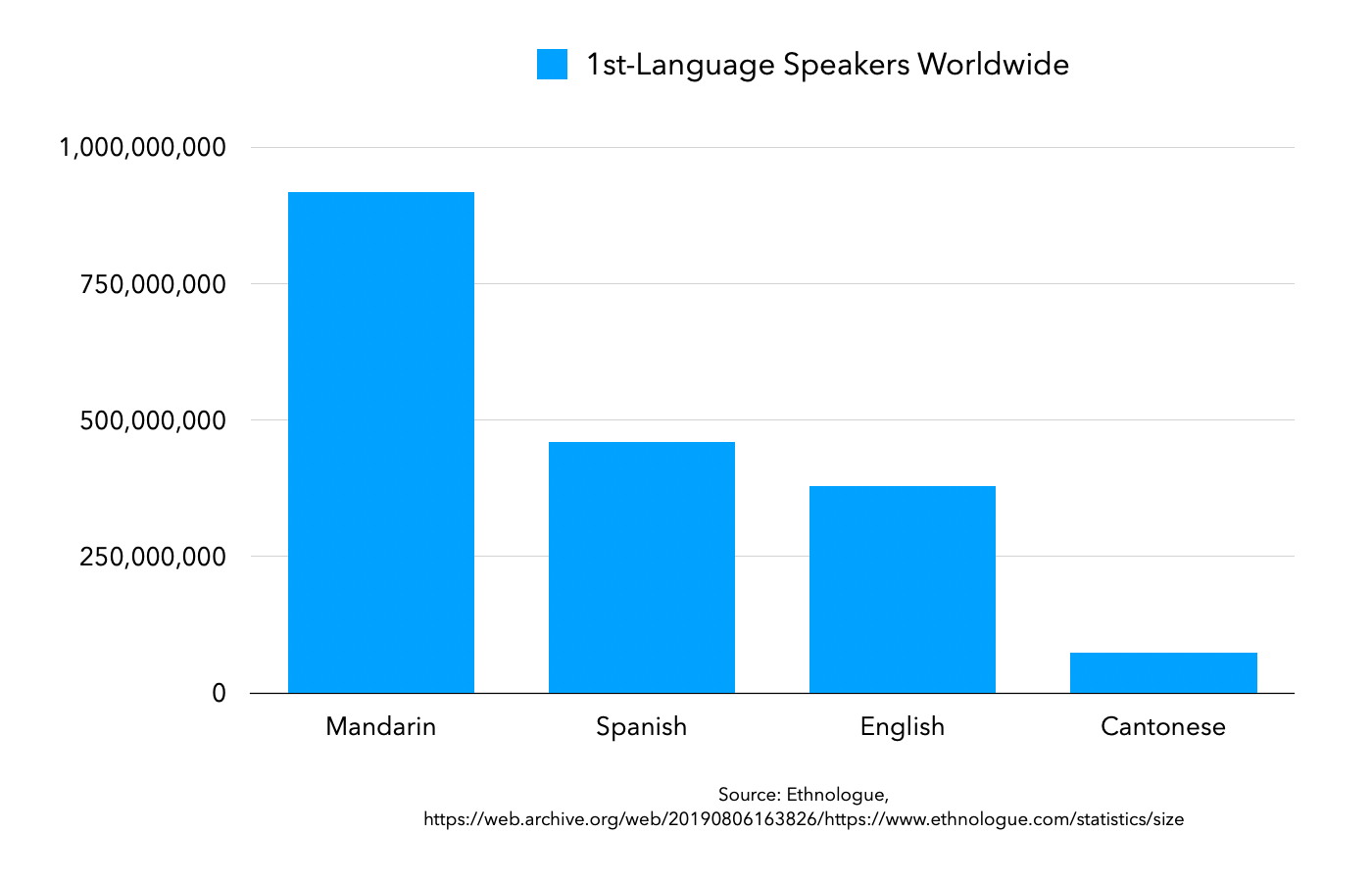
Chart: Languages by First-Language Speakers—2019


For convenience:

The direct link for the Pīnyīn (Pīn·yīn {Piecing Together of} · Sounds → [Pinyin] 拼音) Plus resource for the Enjoy Life Forever! book is:

The short link for Chinese field language-learning links for the Enjoy Life Forever! book is:

More Pīnyīn (Pīn·yīn {Piecing Together of} · Sounds → [Pinyin] 拼音) and Pīnyīn (Pīn·yīn {Piecing Together of} · Sounds → [Pinyin] 拼音) Plus web material based on the Mandarin Enjoy Life Forever! book will be made available in the Pīnyīn (Pīn·yīn {Piecing Together of} · Sounds → [Pinyin] 拼音) Plus web resource as time allows.

Categories
Culture History Language Learning Languages Science

fāngyán

fāngyán (fāng·yán {direction → [place]} · speech → [topolect; dialect (common but misleading translation)] 方言) ← Tap/click to show/hide the “flashcard”

[This reposting of a post that was originally posted on November 16, 2020 seems to be a fitting companion to the recent repostings of the posts on “yǔxì (yǔ·xì language · {tied (things) → [system; family]} 语系 語系) and “yǔzú (yǔ·zú language · {ethnic group → [group of things with common characteristics] → [group]} 语族 語族)”. It discusses the important basic issue of whether Mandarin is just a dialect of “Chinese”, a subject about which much political and cultural propaganda has unfortunately been spread.]

The term “fāngyán (fāng·yán {direction → [place]} · speech → [topolect; dialect (common but misleading translation)] 方言)” has been used in the Chinese-speaking world in various ways, but the literal meanings of the words that make it up indicate that it refers to the speech pattern of a place, even a place as small as a village. For reference, the “fāng (direction [→ [side; party | place; region | method; way [→ [prescription; recipe]] | power (math.)]] | {[is] square} [→ [[is] upright; honest]] | [mw for square things] 方)” in “fāngyán (fāng·yán {direction → [place]} · speech → [topolect; dialect (common but misleading translation)] 方言)” is the “fāng (direction [→ [side; party | place; region | method; way [→ [prescription; recipe]] | power (math.)]] | {[is] square} [→ [[is] upright; honest]] | [mw for square things] 方)” in “dìfang (dì·fang {(section of) earth → [place]} · {direction → [place]} → [place] 地方)”, and the “yán (speech; word; talk; language | say; talk; speak | character; syllable; word 言)” in “fāngyán (fāng·yán {direction → [place]} · speech → [topolect; dialect (common but misleading translation)] 方言)” is the “yán (speech; word; talk; language | say; talk; speak | character; syllable; word 言)” in “yǔyán (yǔ·yán language · {(type of) speech} 语言 語言)”.

Fāngyán (Fāng·yán {direction → [place]} · speech → [topolect; dialect (common but misleading translation)] 方言)” has customarily been translated into English as “dialect”, but this practice can be misleading and confusing, because while “fāngyán (fāng·yán {direction → [place]} · speech → [topolect; dialect (common but misleading translation)] 方言)” and “dialect” can sometimes both be applied to a particular speech pattern, the two terms don’t mean exactly the same thing.

What is a Chinese “Dialect”?

American sinologist and University of Pennsylvania Professor of East Asian Languages and Civilizations Victor H. Mair wrote an extensive article on this subject, “What Is a Chinese ‘Dialect/Topolect’? Reflections on Some Key Sino-English Linguistic Terms”, which can be found here (PDF) and here (web page) on his website Sino-Platonic Papers.

It has been said that “a language is a dialect with an army and navy”, but in his article Professor Mair gives us a more linguistically correct and useful way to distinguish between a language and a dialect:

Regardless of the imprecision of lay usage, we should strive for a consistent means of distinguishing between language and dialect. Otherwise we might as well use the two terms interchangeably. That way lies chaos and the collapse of rational discourse. Mutual intelligibility [emphasis added] is normally accepted by most linguists as the only plausible criterion for making the distinction between language and dialect in the vast majority of cases. Put differently, no more suitable, workable device for distinguishing these two levels of speech has yet been proposed. If there are to be exceptions to the useful principle of mutual intelligibility, there should be compelling reasons for them. Above all, exceptions should not be made the rule.

What is mutual intelligibility? Simply put, in linguistics, two or more speech varieties are said to be mutually intelligible if they are “able to be understood by one another’s speakers”. For example, if one person only knows English, and another person only knows Spanish, they can’t really understand each other if they try to talk to each other—English and Spanish are not mutually intelligible, and are suitably recognized as being different languages, not just different dialects of “European”.

Similarly, if one person only knows Mandarin, and another person only knows Cantonese, they can’t really understand each other if they try to talk to each other—Mandarin and Cantonese are not mutually intelligible. So, while they may be “fāngyán (fāng·yán {direction → [place]} · {(patterns of) speech} 方言)”, linguistically, Mandarin and Cantonese should really be considered to be different languages, not just different dialects of “Chinese”.

If many of the varieties of speech in China are really different languages, as linguists would refer to them, why have so many people come to think that they are just dialects of a single Chinese language? China’s central government is highly motivated to convince people that China is one unified political and cultural entity which should thus be governed by one central government—them—so they have promoted this idea. In other words, it’s basically political propaganda!

Being Clear on What’s What

Why is it especially important for language-learners in a language field like the Mandarin field to recognize, in spite of the commonly accepted political propaganda, that Chinese varieties of speech like Mandarin and Cantonese really function like different languages, and not different dialects of the same language? Well, as someone who along with many others has come to the Mandarin field from the Cantonese field, I have had the dubious pleasure of observing how some have tried to speak Mandarin by just taking the Cantonese they knew and twisting it a little, since they were relying on the conventional wisdom that Mandarin and Cantonese are just different dialects of the same language. As well-meaning as they may have been, the results were often just as bad as when someone sings badly off-key, or as Star Trek fans may say, they often sounded like the language equivalent of a transporter accident 🙀. Even after decades in the Mandarin field, some publishers who had come over from the Cantonese field still say some Mandarin words with Cantonese-y pronunciations.

In contrast, when one recognizes, for example, that Cantonese is Cantonese and Mandarin is Mandarin, and that neither one is just a slightly mutated version of the other, then that paves the way for language-learning progress that is free of being distorted by untruthful and misleading beliefs. Yes, by recognizing and accepting a variety of speech for what it really is, we can go on to freely learn to speak it well and properly, so that we can be as effective as possible at helping people whose mother tongue is that variety of speech.

As with everything else in life, in language-learning too, the truth matters. As Jehovah’s people, we especially want to “worship the Father with spirit and truth”, and when we seek to do so as we learn a language to use it in Jehovah’s service, we will find that ‘the truth will set us free’ from the distortions and burdens of untruthful and misleading beliefs.—John 4:23; 8:32.

Some Official Recognition

The organization has recently demonstrated that it recognizes the truth about how different many of the Chinese varieties of speech are from one another. For example, whereas before there was one Chinese edition of each publication (using Mandarin wording), now, some publications are available in different Chinese editions for different Chinese languages (including Cantonese), each with different wording.

List of different Chinese languages in which publications are available on jw.org as of 2025-06-02
jw.org now has publications in different Chinese languages.

To help reduce the confusion around the inappropriate use of the English word “dialect” to translate “fāngyán (fāng·yán {direction → [place]} · speech → [topolect; dialect (common but misleading translation)] 方言)”, Professor Mair proposed that the word “topolect” (topo- (“place”) + -lect (“[language] variety”)) be used instead as an exact, neutral English translation of “fāngyán (fāng·yán {direction → [place]} · speech → [topolect; dialect (common but misleading translation)] 方言)”. While not as well-known as “dialect”, the word “topolect” has gained a certain amount of recognition, and it can now be found in several dictionaries, e.g., The American Heritage Dictionary of the English Language, Wordnik, and Wiktionary.

Categories
Culture Language Learning Science Technology Theocratic

róngyào

róngyào (róng·yào glory; honour · {being bright; dazzling; brilliant; shining → [honour; glory]} → [glory; honour] | glorify · {to be bright; dazzling; brilliant; shining → [to be glorious]} → [glorify] | honourable; glorious · {bright; dazzling; brilliant; shining → [glorious]} → [honourable; glorious] 荣耀 榮耀) 👈🏼 Tap/click to show/hide the “flashcard”

Rather than dismissively thinking to ourselves that the songs produced by the organization are “just songs”, we should remember that the slave class takes seriously its responsibility to provide spiritual food to God’s people, and so it is going to make sure that the lyrics in its songs are spiritually correct, while also being emotionally moving.—Ezekiel 33:32; Matthew 24:45.

“Give Jehovah Glory”

“Róngyào” _Pīnyīn_ Plus info, Song 159 (music+_Pīnyīn_), on iPhone 13 mini (landscape orientation)

This week’s MEotW in the unofficial Pīnyīn (Pīn·yīn {Piecing Together of} · Sounds → [Pinyin] 拼音) Plus resource “Sing Out Joyfully” Bk. (Pīnyīn+Music, Pīnyīn Plus, Web)

This week’s MEotW, “róngyào (róng·yào glory; honour · {being bright; dazzling; brilliant; shining → [honour; glory]} → [glory; honour] | glorify · {to be bright; dazzling; brilliant; shining → [to be glorious]} → [glorify] | honourable; glorious · {bright; dazzling; brilliant; shining → [glorious]} → [honourable; glorious] 荣耀 榮耀)”, comes from the relatively new song 159, which is entitled “Give Jehovah Glory” in English and “Róngyào (Róng·yào Glory · {Being Shining → [Glory]} → [Glory] 荣耀 榮耀) Guīgěi (Guī·gěi {Give Back} · {to Be Given to} 归给 歸給) Yēhéhuá (Jehovah 耶和华 耶和華) in Mandarin (WOL, Pīnyīn (Pīn·yīn {Piecing Together of} · Sounds → [Pinyin] 拼音) Plus).

“Róngyào (Róng·yào glory; honour · {being bright; dazzling; brilliant; shining → [honour; glory]} → [glory; honour] | glorify · {to be bright; dazzling; brilliant; shining → [to be glorious]} → [glorify] | honourable; glorious · {bright; dazzling; brilliant; shining → [glorious]} → [honourable; glorious] 荣耀 榮耀) is flexible regarding what part of speech it can be—it can mean “glory; honour”, “glorify”, or “honourable; glorious”. In the Mandarin field, what kinds of glory should we be mindful of? Whom should we seek to glorify? What kind of glory is truly glorious?

“Glory from Men” Who Glorify Worldly Human Chinese Culture

Some in the Mandarin field may focus on gaining knowledge of Chinese characters so as to obtain glory from certain humans. Ones who do this are taking a different approach from that of Jesus, who said at John 5:41–44:

I do not accept glory from men, but I well know that you do not have the love of God in you. I have come in the name of my Father, but you do not receive me. If someone else came in his own name, you would receive that one. How can you believe, when you are accepting glory from one another and you are not seeking the glory that is from the only God?

Why do some humans heap praise and glory on those who have acquired extensive knowledge of Chinese characters? For one thing, Chinese characters are famously extraordinarily hard to learn and remember (unnecessarily so, actually), and so there is the natural glory given to those who have been able to accomplish a hard thing. Also, though, Chinese characters are glamourized by many as distinctive symbols of worldly human Chinese culture, and many are proud of them, and proud of worldly human Chinese culture. This is a big reason why traditional Mandarin language instruction and traditional Mandarin language teachers in general focus on Chinese characters so much and encourage Mandarin learners to prioritize them.

It is only natural for a student of Mandarin to want to receive glory from his teacher and others like him. Unfortunately, though, experience has shown that going along with a traditional Mandarin language teacher’s focus on characters may lead to a Mandarin learner actually being diverted into a deep rabbit hole and hindered from actually learning how speak Mandarin well. While such ones may, after many years of intense effort, come to be able to recognize many Chinese characters, they may not be able to, say, glorify Jehovah while speaking powerfully and persuasively to Mandarin-speaking people, the way Jesus spoke to people. (Mark 1:22) That’s because this traditional focus on characters has all along been mainly meant, not to help Mandarin learners actually learn to speak Mandarin, but to perpetuate and glorify worldly human Chinese culture.

Glory for Worldly Chinese Political Systems

In this world, certain aspects of Chinese culture can unfortunately get politicized. For example, Simplified characters and Pīnyīn (Pīn·yīn {Piecing Together of} · Sounds → [Pinyin] 拼音) were created in mainland China, so some may promote these systems so as to glorify the political system of mainland China. On the other hand, Traditional characters and Zhùyīn (Zhù·yīn {Annotating of} · Sounds → [Zhuyin] 注音 註/注音) continued to be used in Taiwan after the mainland pivoted away from them, so some may promote these systems so as to glorify the political system of Taiwan. Even the Mandarin expression that people use to refer to the Mandarin language (Guóyǔ (Guó·yǔ National · Language → [(Modern Standard) Mandarin (term commonly used in Taiwan)] 国语 國語)/pǔtōnghuà (pǔ·tōng·huà common; universal · {through(out) → [common]} · speech → [(Modern Standard) Mandarin (term commonly used in China)] 普通话 普通話)/Huáyǔ (Huá·yǔ {Magnificent; Splendid; Flowery; Florescent → [Chinese]} · Language → [(Modern Standard) Mandarin (term commonly used in Singapore)] 华语 華語)/etc.) can be made to take on political connotations. Of course, as Jehovah’s politically neutral servants, we must avoid doing things just to glorify one human political system over another.

Another thing that we Mandarin field language learners must beware of is the erroneous idea that Mandarin, Cantonese, Shanghainese, etc. are just “dialects” of “Chinese”. This misconception has been widely spread as political propaganda, to bolster the idea that China should be united under one political system. So, if we parrot that erroneous view regarding so-called Chinese “dialects” that in reality function like distinct languages, then we are actually parroting political propaganda that is designed to glorify China’s central government regardless of any confusion or other negative effects that may result from such spreading of falsehood.

Glory for Jehovah

Rather than allowing ourselves to be used to glorify humans or things in this worldly human system, we can show that we seek to glorify Jehovah, the God of truth. (John 17:17; 4:23, 24) One way we can do so in the Chinese language fields is by rejecting the many untruths that have been spread about the Chinese languages. Also, we can do so by seeking to choose and use systems and methods based on what really works best to help us to praise and glorify Jehovah, not based on what serves to glorify ourselves or worldly humans, and not based on what serves to perpetuate and glorify worldly human cultures, traditions, and political systems.

As Jesus’ words above showed, Jehovah gives “the glory that is from the only God” to those who seek to give glory to him, rather than to mere humans. So, let us follow song 159’s simple but profound admonition, and give glory to Jehovah!