Categories
Culture Science Technology Theocratic

diǎnliàng

diǎnliàng+ (diǎn·liàng {dot → [light (v); ignite]} · {to be bright} [→ [illuminate; shine light on]] 点亮 點亮) ← Tap/click to show/hide the “flashcard”

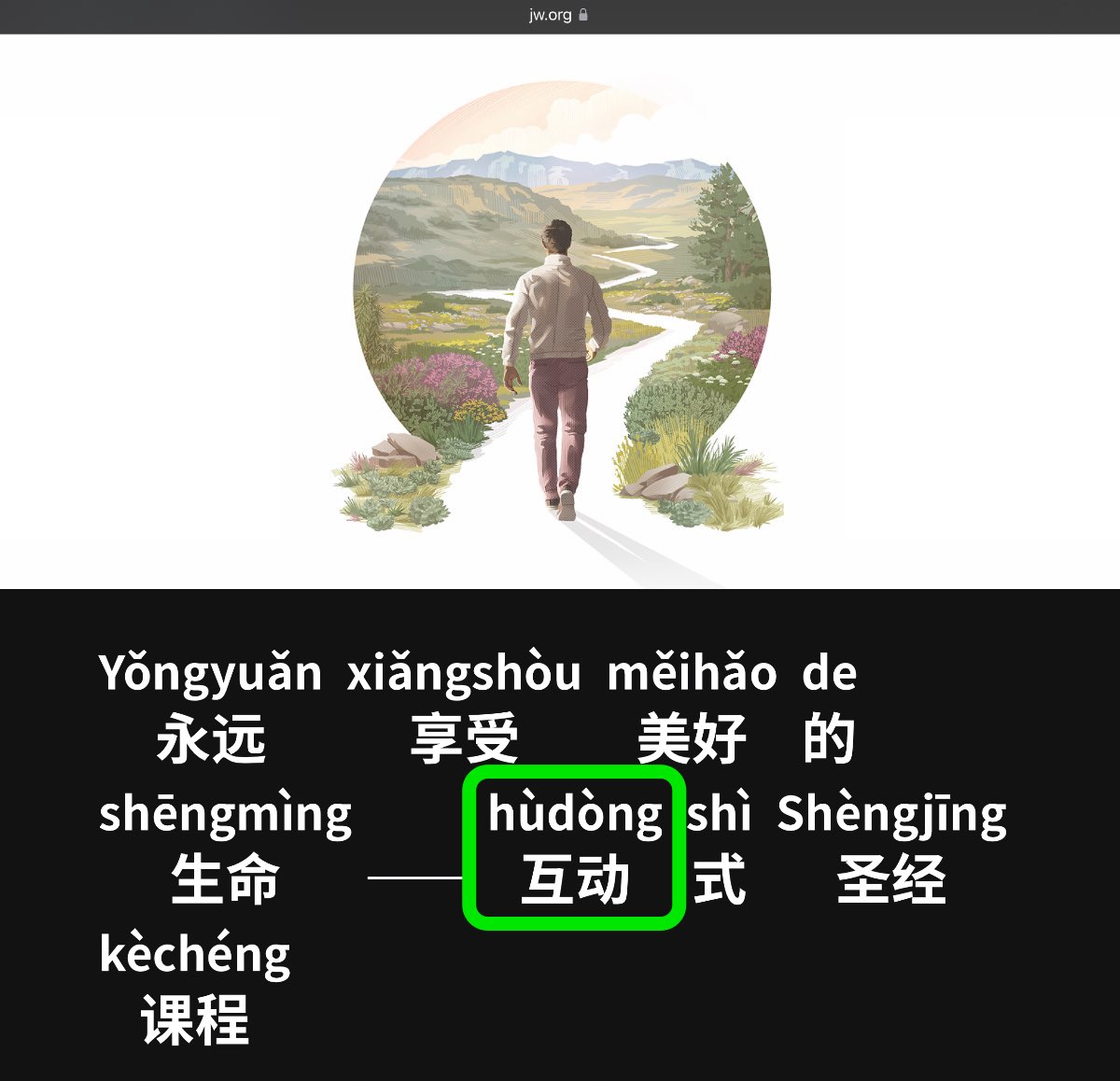
This week’s MEotW, “diǎnliàng (diǎn·liàng {dot → [light (v); ignite]} · {to be bright} [→ [illuminate; shine light on]] 点亮 點亮)”, is used to good effect in lesson 02 point 5 (WOL, Pīnyīn (Pīn·yīn {Piecing Together} · Sounds → [Pinyin] 拼音) Plus) of the Mandarin Enjoy Life Forever! (lffi) brochure (and of the Mandarin Enjoy Life Forever! (lff) book).

“Diǎnliàng” in _Enjoy Life Forever!_ br., lesson 02 point 5 (WOL CHS+Pinyin, _Pīnyīn_ Plus)

Translating the English text “The Bible’s hope can make a difference”, the Mandarin text means ‘The Bible’s hope shines a light on human life’.

What’s a Word?

Note that the Watchtower ONLINE LIBRARY currently renders the morphemes “”diǎn (dots → [lights (v)])” and “liàng ({to be bright} 亮)” as two separate words, whereas the unofficial Pīnyīn (Pīn·yīn {Piecing Together} · Sounds → [Pinyin] 拼音) Plus resource renders them together as one word, as many past official Pīnyīn (Pīn·yīn {Piecing Together} · Sounds → [Pinyin] 拼音) publications would likely have done. Is one of these renderings “right” and the other “wrong”? Is one better and the other worse? How much does it matter?

These seemingly simple questions turn out to actually be not that simple to answer. Especially in languages like Mandarin that have historically been written using the Chinese characters writing system—a system that probably for traditional stylistic reasons neglects to clearly and conveniently put spaces between words like alphabetic writing systems generally do—there is not always a consensus regarding the answers to the questions of “What’s a word?” and “What morphemes should be put together as words?” As the Wikipedia article on “Word” says:

There still remains no consensus among linguists about the proper definition of “word” in a spoken language that is independent of its writing system, nor about the precise distinction between it and “morpheme”.[source] This issue is particularly debated for Chinese and other languages of East Asia,[source]

Standards and Conventions

Unlike the Chinese characters writing system, the Pīnyīn (Pīn·yīn {Piecing Together} · Sounds → [Pinyin] 拼音) alphabetic writing system does clearly and conveniently put spaces between words—such word separation is in fact a big advantage of Pīnyīn (Pīn·yīn {Piecing Together} · Sounds → [Pinyin] 拼音) compared to the Chinese characters writing system. However, the question of what constitutes a word that is to be separated from other words by spaces remains one that may be answered differently by different people.

The technical linguistic term that relates to such matters is orthography. The Wikipedia article on that provides this summary of what that means:

An orthography is a set of conventions for writing a language, including norms of spelling, hyphenation, capitalization, word breaks, emphasis, and punctuation.

One might wonder whether there are official rules and standards regarding Pīnyīn (Pīn·yīn {Piecing Together} · Sounds → [Pinyin] 拼音) orthography, and indeed there are. In fact, the PRC government has an official national standard for Pīnyīn (Pīn·yīn {Piecing Together} · Sounds → [Pinyin] 拼音) orthography, with the designation GB/T 16159-2012. (A convenient annotated web version (rendered in Simplified Chinese characters) has been made available here on the independent website Pīnyīn.info.)

What the letters “GB/T” stand for is significant. Wikipedia provides this summary:

GB stands for Guobiao (simplified Chinese: 国标; traditional Chinese: 國標; pinyin: Guóbiāo), Chinese for national standard.

Mandatory standards are prefixed “GB”. Recommended standards are prefixed “GB/T” (T from Chinese language 推荐; tuījiàn; ‘recommended’).

(The above summary is confirmed elsewhere on the web, e.g. here on legal analysis website Lexology.)

So, while the PRC’s GB/T 16159-2012 provides many basic rules regarding Pīnyīn (Pīn·yīn {Piecing Together} · Sounds → [Pinyin] 拼音) orthography, even within China it is not a mandatory standard—the “T” in “GB/T 16159-2012” indicates that even within China, it is at most a set of recommendations.

(An interesting contrast is the mandatory PRC standard GB 18030, which relates to software support for the PRC’s Chinese characters, both simplified and traditional, and which, for example, Microsoft makes its Windows software comply with.)

Regarding standards and conventions, even officially recommended ones, for things like language and writing, views and practices vary in different places, and at different times. For example, Chinese writing in the past didn’t have punctuation, and now it has punctuation largely modeled after European punctuation. (For reference: Chinese punctuation – Wikipedia, Q&A: When were punctuation marks first used? – HistoryExtra, history – When was punctuation introduced into Chinese? – Chinese Language Stack Exchange)

Even today, within the same time frame, there are differing views and practices regarding how things should be written. For example, in English, there are differing views and practices regarding British vs. American spellings, whether or not to use the Oxford (serial) comma, how titles should be capitalized, what should be italicized/bolded/underlined, etc.

When it comes to Pīnyīn (Pīn·yīn {Piecing Together} · Sounds → [Pinyin] 拼音), another factor to keep in mind is that due primarily to cultural prejudice, Pīnyīn (Pīn·yīn {Piecing Together} · Sounds → [Pinyin] 拼音) has simply not been used much overall, relatively speaking, especially as a full writing system on its own. So, it has not really gone through much of the process of receiving the widely agreed upon tweaks and refinements that a system typically receives as it gets tried out and put to extensive use by many people.

Verb-Complement Togetherness

Getting back to the MEotW “diǎnliàng+ (diǎn·liàng {dot → [light (v); ignite]} · {to be bright} [→ [illuminate; shine light on]] 点亮 點亮)”, the PRC national standard GB/T 16159-2012 recommends that, being made up of a single-syllable verb and its single-syllable complement, this expression should be written together. Recent official Pīnyīn (Pīn·yīn {Piecing Together} · Sounds → [Pinyin] 拼音) publications such as those on the Watchtower ONLINE LIBRARY often do not follow this recommendation regarding single-syllable verbs and their single-syllable complements, whereas older official Pīnyīn (Pīn·yīn {Piecing Together} · Sounds → [Pinyin] 拼音) publications did follow this recommendation, and as do the unofficial Pīnyīn (Pīn·yīn {Piecing Together} · Sounds → [Pinyin] 拼音) Plus resources.

On the other hand, the unofficial Pīnyīn (Pīn·yīn {Piecing Together} · Sounds → [Pinyin] 拼音) Plus resources join the official Pīnyīn (Pīn·yīn {Piecing Together} · Sounds → [Pinyin] 拼音) publications, old and new, in explicitly indicating tone sandhi for “ (not 不)” and “ (one 一)” (e.g., “zài (bú·zài not · again; further; continuing; anymore 不再)” instead of the standard “zài (bù·zài not · again; further; continuing; anymore 不再)”) to make things easier for readers, even though this practice is not included in the GB/T 16159-2012 standard’s recommendations.

In the end, what matters most re how anything is written is not just what is officially recommended or what happens to be popular among changing, imperfect humans. Rather, what matters most is what really works best to accomplish the goal of writing: To communicate to readers. This is especially true when God-honouring and life-saving Bible truths need to be communicated. So, this blog and the other Pīnyīn (Pīn·yīn {Piecing Together} · Sounds → [Pinyin] 拼音) Plus resources will continue to seek to render Pīnyīn (Pīn·yīn {Piecing Together} · Sounds → [Pinyin] 拼音) in ways that maximize how clearly, easily, effectively, and appropriately it communicates with readers.


For convenience:

The direct link for the current generation Pīnyīn (Pīn·yīn {Piecing Together of} · Sounds → [Pinyin] 拼音) Plus resource for the Enjoy Life Forever! brochure is:

The direct link for the current generation Pīnyīn (Pīn·yīn {Piecing Together of} · Sounds → [Pinyin] 拼音) Plus resource for the Enjoy Life Forever! book is:

The short link for Chinese field language-learning links for the Enjoy Life Forever! brochure is:
The short link for Chinese field language-learning links for the Enjoy Life Forever! book is:

More Pīnyīn (Pīn·yīn {Piecing Together of} · Sounds → [Pinyin] 拼音) and Pīnyīn (Pīn·yīn {Piecing Together of} · Sounds → [Pinyin] 拼音) Plus web material based on the Mandarin Enjoy Life Forever! brochure and the Mandarin Enjoy Life Forever! book will be made available in the above-mentioned Pīnyīn (Pīn·yīn {Piecing Together of} · Sounds → [Pinyin] 拼音) Plus web resources as time allows.

Categories
Culture History Language Learning Science

Pīnyīn

Pīnyīn+ (Pīn·yīn {Piecing Together} · Sounds → [Pinyin] 拼音) ← Tap/click to show/hide the “flashcard”

Pīnyīn (Pīn·yīn {Piecing Together} · Sounds → [Pinyin] 拼音)” is the expression commonly used to refer to the phonetic alphabet introduced by China in 1958. This system is also known by longer, more official names:

  • Hànyǔ (Hàn·yǔ {Han (Chinese)} · Language → [(Modern Standard) Mandarin] 汉语 漢語) Pīnyīn (Pīn·yīn {Piecing Together} · Sounds → [Pinyin] 拼音)
  • Hànyǔ (Hàn·yǔ {Han (Chinese)} · Language → [(Modern Standard) Mandarin] 汉语 漢語) Pīnyīn (Pīn·yīn {Piecing Together} · Sounds → [Pinyin] 拼音) Fāng’àn+ (Fāng’·àn {Direction → [Method]} · {Long, Narrow Table or Desk → [Plan]} 方案)

When thinking of Pīnyīn (Pīn·yīn {Piecing Together} · Sounds → [Pinyin] 拼音) and its predecessor Zhùyīn (Zhù·yīn Annotating · Sounds → [Zhuyin] 注音 註/注音) (last week’s MEotW), some focus on the superficial differences between them. However, it’s perhaps even more important to note what they have in common, as indicated by the fact that the names of both systems end in “yīn+ (sound [→ [musical note/sound; tone; pronunciation | syllable | news; tidings]] 音)”: Both systems focus on representing the sounds of Mandarin, sounds which make up Mandarin speech and thus represent meanings. In fact, Pīnyīn (Pīn·yīn {Piecing Together} · Sounds → [Pinyin] 拼音)’s literal meaning tells us that this system helps people to “piece together sounds” to make up Mandarin speech, and thus convey the meanings that Mandarin speech represents.

汉字 / 漢字? Pīnyīn?

In contrast, many people believe that the Hànzì+ (Hàn·zì {Han (Chinese)} · Characters 汉字 漢字), the Chinese characters, represent meanings more directly through their own visual design, as opposed to primarily being a system that represents Mandarin, Cantonese, etc., speech sounds which represent meaning. This view of Chinese characters, however, is actually a myth, which has been called the ideographic myth—God designed our brains and bodies to primarily represent meaning through speech, some humans in their hubris presumed that it would be better for us humans to represent meaning directly through visual symbols, and of course God was right and these humans were wrong.

There are actually many myths and misconceptions that people believe regarding Chinese characters, and sadly, that is also the case regarding Pīnyīn (Pīn·yīn {Piecing Together} · Sounds → [Pinyin] 拼音).

Common Myths and Misconceptions

  • Pīnyīn (Pīn·yīn {Piecing Together} · Sounds → [Pinyin] 拼音) is just a pronunciation aid. It’s not really a writing system like the characters are.”
    • But, is Pīnyīn even really a writing system? Interestingly, the Chinese national standard Zhōngguó Mángwén (中国盲文/中國盲文, Chinese Braille) is basically a transliteration or conversion of Pīnyīn into braille letters. Braille is obviously a writing system, so Pīnyīn must also be a writing system, not just a pronunciation aid.

  • Pīnyīn (Pīn·yīn {Piecing Together} · Sounds → [Pinyin] 拼音) is just training wheels. Characters are real wheels.”
    • Since Pīnyīn is not just a pronunciation aid, but a full writing system, it is not “training wheels”—it’s regular wheels. On the other hand, Chinese characters are like non-round wheels—more difficult than necessary.

  • Pīnyīn (Pīn·yīn {Piecing Together} · Sounds → [Pinyin] 拼音) on its own can’t be understood because there are too many homophones (words that sound the same, but have different meanings) in Mandarin.”
    • When people are just speaking Mandarin, with no characters in sight to help them, do they have problems understanding each other because of all the homophones? Can blind Mandarin-speakers, who cannot see characters, still “see” what people mean when those people speak Mandarin? Native Mandarin-speakers have confirmed to me that no, homophones are not a significant problem in spoken Mandarin—people can use the context and understand each other okay. So, people can use the context and understand each other okay when using Pīnyīn too, since Pīnyīn directly represents the sound of spoken Mandarin.

      • The above quote is from the article “Pīnyīn Was Plan A”. Check it out for more on this subject.
  • Pīnyīn (Pīn·yīn {Piecing Together} · Sounds → [Pinyin] 拼音) is less accurate than Zhùyīn (Zhù·yīn Annotating · Sounds → [Zhuyin] 注音 註/注音).”
    • Some people say that Zhuyin is more accurate or correct than Pinyin. Actually, both Zhuyin and Pinyin represent the same Mandarin sounds, just with different symbols. In fact, it’s not difficult to find tables that directly map the corresponding Zhuyin and Pinyin expressions to each other—a simple Google search for “pinyin zhuyin table” turns up many, many results. Pinyin and Zhuyin are just like different codes for encoding the same Mandarin message, so basically, neither is more accurate or correct than the other.

      • The above quote is from the tiandi.info post “Pinyin and Zhuyin”. (If you need login information for the parts of tiandi.info that require it, request it by email, and include information on who referred you and/or what group/cong. you are in.)
  • Pīnyīn (Pīn·yīn {Piecing Together} · Sounds → [Pinyin] 拼音) makes your Mandarin sound like English.”
    • This is only true if you are using it wrong. For example, if you read a French word and you make it sound like English when you read it out, the problem is not that the French word is written using the Latin alphabet like English is—the problem is that you are thinking of English sounds when you see the French word, when you should be thinking of French sounds. Similarly, you shouldn’t blame Pīnyīn (Pīn·yīn {Piecing Together} · Sounds → [Pinyin] 拼音) if you are thinking of English sounds when you see it, because it’s up to you to understand that Pīnyīn (Pīn·yīn {Piecing Together} · Sounds → [Pinyin] 拼音) represents Mandarin sounds, not English sounds.
    • Don’t worry, it becomes second nature to properly associate Pīnyīn (Pīn·yīn {Piecing Together} · Sounds → [Pinyin] 拼音) with Mandarin sounds after you get familiar with Mandarin sounds and used to the Pīnyīn (Pīn·yīn {Piecing Together} · Sounds → [Pinyin] 拼音) system. However, if you, say, prematurely stop using Pīnyīn (Pīn·yīn {Piecing Together} · Sounds → [Pinyin] 拼音) and instead turn to characters in an effort to avoid the baggage of English sounds, you may actually never really get the hang of Mandarin sounds. Seriously, I’ve seen people who focus on characters remain in this speech Twilight Zone for years and years! That’s because while characters do represent Mandarin speech sounds, they’re just bad at it—it’s just not what characters focus on. In stark contrast, Pīnyīn (Pīn·yīn {Piecing Together} · Sounds → [Pinyin] 拼音) is all about the sounds of Mandarin. It literally spells out in a simple way how a Mandarin syllable sounds at the beginning, at the end, and in between. Characters, though, represent the complex sound of a Mandarin syllable as one coarse lump, in a complex and often unrelated way—you either get it or you don’t, and many don’t.
      • Yes, characters are like a conceited jerk who convinces you with grand promises to jump from a high place, doesn’t bother to catch you, and then makes you think it’s your fault that you can’t fly. Pīnyīn (Pīn·yīn {Piecing Together} · Sounds → [Pinyin] 拼音), though, is like a modest and straightforward person who clearly explains each step for you so that you can dependably and confidently get to where you want to go.

For more information regarding Pīnyīn (Pīn·yīn {Piecing Together} · Sounds → [Pinyin] 拼音) and how we in the Mandarin field should view it, check out these articles:

Pīnyīn is a Good, Workable Writing System On Its Own”
This article is a brief overview of why it’s important for those of us in the Mandarin field to recognize that Pīnyīn (Pīn·yīn {Piecing Together} · Sounds → [Pinyin] 拼音) is a full writing system, not just a pronunciation aid.

Pīnyīn Was Plan A”
This extensively researched in-depth article discusses how we in the Mandarin field should view Pīnyīn (Pīn·yīn {Piecing Together} · Sounds → [Pinyin] 拼音).

(Short link: tiandi.info/articles)