Categories
Culture Current Events Experiences Language Learning Science Technology Theocratic

cōnghuì

cōnghuì (cōng·huì {[is] quick at hearing → [[is] intelligent; bright; clever; sharp-witted]} · {[is] intelligent; bright} → [[is] intelligent; bright; witty] 聪慧 聰慧) 👈🏼 Tap/click to show/hide the “flashcard”

[Notes: Tap/click on a Pīnyīn (Pīn·yīn {Piecing Together of} · Sounds → [Pinyin] 拼音) expression to reveal its “flashcard”; tap/click on a “flashcard” or its Pīnyīn (Pīn·yīn {Piecing Together of} · Sounds → [Pinyin] 拼音) expression to hide the “flashcard”. 📖 📄 📘 icons mean 📖 Reveal All, 📄 Reveal Advanced, and 📘 Reveal None re all the “flashcards” in the heading, paragraph, etc. that they are placed at the beginning of.]

The Shēngmìng Láizì Chuàngzào Ma? ((Shēngmìng Life 生命) (Lái·zì Came · From 来自 來自) (Chuàng·zào Initiating · {Making, Creating} → [Creating] 创造 創造) (Ma [? ptcl for “yes/no” questions])? [Was Life Created? (lc)]) (Was Life Created? (lc)) brochure and the Shēngmìng de Qǐyuán—Zhíde Sīkǎo de Wǔ Ge Wèntí ((Shēngmìng Life 生命) (de ’s 的) (Qǐ·yuán {Rising → [Starting]} · Source → [Origin] 起源/原)—(Zhí·de Worth · Getting → [Worth] 值得) (Sī·kǎo {Thinking About} · Examining 思考) (de ’s 的) (Wǔ Five 五) (Ge [mw]個/个) (Wèn·tí Asking · Subjects → [Questions] 问题 問題) [The Origin of Life—Five Questions Worth Asking (lf)]) (The Origin of Life—Five Questions Worth Asking (lf)) brochure were originally published back in 2010, but relatively recently, the English version of the Was Life Created? brochure was updated to the December 2022 Printing, and the Mandarin version of it was updated to the February 2023 Printing. Also, the Was Life Created? brochure and the Origin of Life brochure are now in the Teaching Toolbox section in the JW Library app. So, it would be good to consider some of the expressions used in the Mandarin versions of these publications that can be so helpful when discussing whether life was created.

“There Is No Intelligent Creator”?

This week’s MEotW, which appears in the section of the Mandarin Was Life Created? brochure entitled “Nǐ (You 你) Xiāngxìn (Xiāng·xìn It · {Do Believe} → [Do Believe] 相信) Shénme (Shén·me What · [suf] 什么 什/甚麼) Ne ([? ptcl] 呢)?” (“What Do You Believe?”), is “cōnghuì (cōng·huì {[is] quick at hearing → [[is] intelligent; bright; clever; sharp-witted]} · {[is] intelligent; bright} → [[is] intelligent; bright; witty] 聪慧 聰慧)”:

English:

Will you trust the claims of those who say that there is no intelligent Creator and that the Bible is unreliable? Or will you examine what the Bible actually says?

Mandarin (WOL; Pīnyīn (Pīn·yīn {Piecing Together of} · Sounds → [Pinyin] 拼音) Plus)

📖 📄 📘 Yǒuxiē (Yǒu·xiē {(there) are having → [(there) are]} · some 有些) rén (people 人) shuō (saying說/説) méiyǒu (méi·yǒu (there) not · {is having → [is]} → [(there) does not exist] 没有 沒有) cōnghuì (cōng·huì {quick at hearing → [intelligent]} · intelligent → [intelligent] 聪慧 聰慧) de (’s 的) Zàowù‐Zhǔ ((Zào·wù Created · Things 造物)‐(Zhǔ Master 主) [Creator]), Shèngjīng (Shèng·jīng (the) Holy · Scriptures → [the Bible] 圣经 聖經) (also 也) (not 不) kěkào (kě·kào {is able} · {to be leaned on → [to be relied on]} → [is reliable] 可靠), (you 你) xiāngxìn (xiāng·xìn them · {do believe} → [do believe] 相信) tāmen de ((tā·men him/her · [pl] → [them] 他们 他們) (de ’s 的) [their]) huà (words) ma ([? ptcl for “yes/no” questions])? Háishi (Hái·shi {still more → [or]} · {is (it) that} 还是 還是) huì ((you) will) qīnzì (qīn·zì {in person} · self 亲自 親自) kànkan (kàn·kan {look at} · {look at} 看看) Shèngjīng (Shèng·jīng (the) Holy · Scriptures → [the Bible] 圣经 聖經) dàodǐ (dào·dǐ to · bottom → [in the final analysis] 到底) zěnme (zěn·me what · [suf] 怎么 怎麼/麽) shuō (says說/説) ne ([? ptcl] 呢)?

As can be seen from the above quotes, the Mandarin Was Life Created? brochure uses “cōnghuì (cōng·huì {[is] quick at hearing → [[is] intelligent; bright; clever; sharp-witted]} · {[is] intelligent; bright} → [[is] intelligent; bright; witty] 聪慧 聰慧) to effectively mean “intelligent”. Related expressions include “cōngming (cōng·ming {[is] quick at hearing → [[is] intelligent; bright; clever; sharp-witted]} · {[is] bright → [[is] understanding]} 聪明 聰明)”, which has the same first morpheme as “cōnghuì (cōng·huì {[is] quick at hearing → [[is] intelligent; bright; clever; sharp-witted]} · {[is] intelligent; bright} → [[is] intelligent; bright; witty] 聪慧 聰慧)”, and “zhìhuì (zhì·huì wisdom · intelligence → [wisdom] 智慧)”, which has the same second morpheme.

Note that the first morpheme in “cōnghuì (cōng·huì {[is] quick at hearing → [[is] intelligent; bright; clever; sharp-witted]} · {[is] intelligent; bright} → [[is] intelligent; bright; witty] 聪慧 聰慧) literally means “quick at hearing”. This may remind us of the scripture at James 1:19:

Know this, my beloved brothers: Everyone must be quick to listen, slow to speak, slow to anger,

Brains and Brawn

These days, people in the world are making a big deal about what artificial intelligence can do, but in many ways, current artificial intelligence is not even as intelligent and sensible as an average human child, so of course it cannot compare with the original Divine Intelligence, the Almighty God Jehovah. Is madly pursuing artificial intelligence—that in many ways is not really that intelligent, that does not love humans back, and that could prove to be beyond humans’ ability to control—really an intelligent thing to be doing? Are the feverish efforts to develop ever more powerful artificial intelligence really about intelligence, or the blind pursuit of power?

Many in this world, including dictators (and wannabe dictators) and their supporters, certain varieties of technology enthusiasts, people intent on climbing the corporate ladder, etc., have shown that they simple-mindedly and hard-heartedly worship power above all else, and that they dismiss the value of intelligence (and also dismiss such vital things as love and justice as being inconsequential).

Regarding how many view knowledge and intelligence, famous science fiction writer and professor Isaac Asimov said this about a common attitude he observed in the USA:

There is a cult of ignorance in the United States, and there has always been. The strain of anti-intellectualism has been a constant thread winding its way through our political and cultural life, nurtured by the false notion that democracy means that “my ignorance is just as good as your knowledge.”

Actually, though, in many situations, sufficient intelligence can make all the difference. What difference can intelligence make? I remember that when I watched the movie Jurassic Park (which is about dinosaurs that humans recreate, and that then prove to be beyond the humans’ ability to control), the time I found the predatory velociraptors most scary was not when they were using their teeth, claws, or speed, or otherwise showing how powerful they were. Rather, it was when one of them showed considerable intelligence and figured out how to turn a door handle to open the door that children it was chasing were hiding behind.

Yes, sufficient intelligence, or wisdom, can be the difference between whether something gets done—even something as simple as opening a door—and if it never gets done. This is so even if much power is involved, and it is so no matter how long random chance is allowed to “work” on it. Jehovah God’s creative wisdom and intelligence, in addition to his almighty power, are certainly evident all around us in the natural world, in things that could never have come into existence without them. As Psalm 104:24 and Jeremiah 10:12 say:

How many your works are, O Jehovah!
You have made all of them in wisdom.
The earth is full of what you have made.

He is the Maker of the earth by his power,
The One who established the productive land by his wisdom
And who stretched out the heavens by his understanding.

Working Hard and Working Smart

Speaking of intelligence, sometimes Mandarin learners who work smart by using Pīnyīn (Pīn·yīn {Piecing Together of} · Sounds → [Pinyin] 拼音) whenever they can are accused by Chinese character chauvinists (masochists?) of being unwilling to work hard. However, does working smart necessarily mean not working hard? The best results actually come from doing both—working hard and working smart—not just doing one or the other.

And really, are we not showing an anti-intelligence and anti-wisdom attitude if we oppose doing God’s work the easy way in order to support doing things the hard way, just for the sake of preserving human tradition? Do we want to be part of the “cult of ignorance”?


For convenience:

The direct link for the current-generation Pīnyīn (Pīn·yīn {Piecing Together of} · Sounds → [Pinyin] 拼音) Plus resource for the Was Life Created? brochure is:

The short link for Chinese field language-learning links for the Was Life Created? brochure is:

More Pīnyīn (Pīn·yīn {Piecing Together of} · Sounds → [Pinyin] 拼音) and Pīnyīn (Pīn·yīn {Piecing Together of} · Sounds → [Pinyin] 拼音) Plus web material based on the Mandarin Was Life Created? brochure will be made available in the Pīnyīn (Pīn·yīn {Piecing Together of} · Sounds → [Pinyin] 拼音) Plus web resource as time allows.

Categories
Culture Experiences History Language Learning Technology Theocratic

guīju

guīju (guī·ju [([is] following)] {compasses; dividers → [rules; regulations]} · {carpenter’s squares → [rules; regulations]} → [[[is] following] rules; customs; established practices/standards | [[is] following] social etiquette; manners | [is] well-behaved; well-disciplined] 规矩 規矩) 👈🏼 Tap/click to show/hide the “flashcard”

[Notes: Tap/click on a Pīnyīn (Pīn·yīn {Piecing Together of} · Sounds → [Pinyin] 拼音) expression to reveal its “flashcard”; tap/click on a “flashcard” or its Pīnyīn (Pīn·yīn {Piecing Together of} · Sounds → [Pinyin] 拼音) expression to hide the “flashcard”. 📖 📄 📘 icons mean 📖 Reveal All, 📄 Reveal Advanced, and 📘 Reveal None re all the “flashcards” in the heading, paragraph, etc. that they are placed at the beginning of.]

I have long especially liked 1 Corinthians 13. It contains counsel on what really does and doesn’t matter in life, an extensive description and definition of the most important kind of love, and a sublime discussion about the need to become complete, mature, as a person. As these apply to life in general, so too do they apply to our lives as Mandarin field language learners.

As Mandarin field language learners, it can benefit us greatly to consider what we can learn from 1 Corinthians 13, and along the way, we can also consider some of the Mandarin expressions used in that chapter in the current version of the Mandarin New World Translation Bible (nwtsty).

“Does Not Behave Indecently”

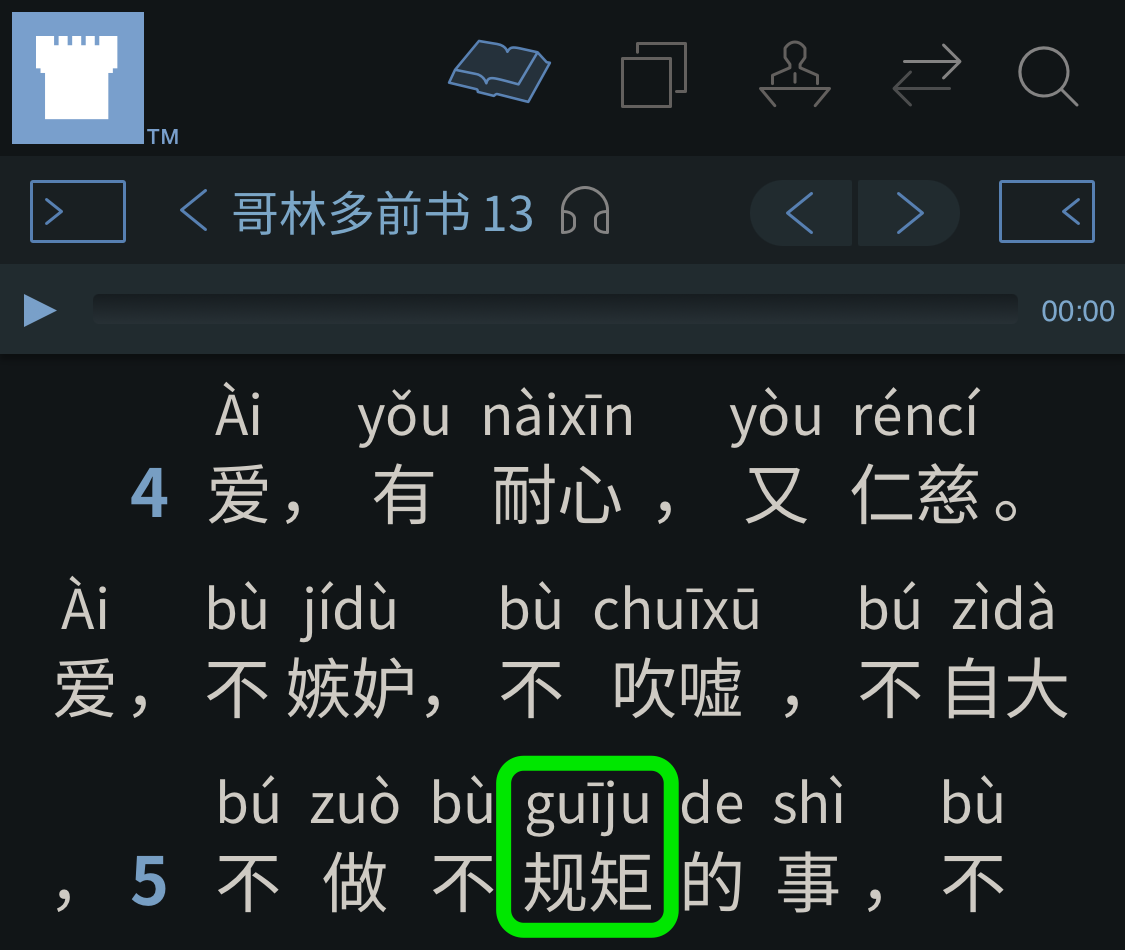
This week’s MEotW, “guīju (guī·ju [([is] following)] {compasses; dividers → [rules; regulations]} · {carpenter’s squares → [rules; regulations]} → [[[is] following] rules; customs; established practices/standards | [[is] following] social etiquette; manners | [is] well-behaved; well-disciplined] 规矩 規矩)”, is used in verse 5 (WOL) of 1 Corinthians 13:

Screenshot of “_guīju_” in 1 Co. 13:5 (nwtsty, CHS+_Pīnyīn_ WOL)

(Dark mode for the Watchtower ONLINE LIBRARY (WOL) website, as shown in the above image, can be enabled in the Safari web browser by using the Noir Safari extension. Other web browsers may also have extensions with similar functionality.)

For comparison, here are the current English and Pīnyīn (Pīn·yīn {Piecing Together of} · Sounds → [Pinyin] 拼音) Plus renderings of 1 Corinthians 13:4, 5:

English:

4 Love is patient and kind. Love is not jealous. It does not brag, does not get puffed up, 5does not behave indecently, does not look for its own interests, does not become provoked. It does not keep account of the injury.

Pīnyīn (Pīn·yīn {Piecing Together of} · Sounds → [Pinyin] 拼音) Plus:

📖 📄 📘 4 Ài (love), yǒu (has 有) nàixīn (nài·xīn {being (of/with) enduring} · heart → [patience] 耐心), yòu (also 又) réncí (rén·cí {is kind} 仁慈). Ài (love), (not 不) jídù ({is jealous} 嫉妒), (not 不) chuīxū (chuī·xū {does puff → [does brag]} · {does sigh → [does praise]} → [does brag] 吹嘘 吹噓), (not 不) zìdà (zì·dà {(does consider) self} · {to be big → [to be great]} 自大), 5 (not 不) zuò ({does do} 做) (not 不) guīju (guī·ju (following) {dividers → [rules]} · {carpenter’s squares → [regulations]} → [following established standards] 规矩 規矩) de ( 的) shì (things 事), (not 不) qiú ({does seek} 求) zìjǐ (self 自己) de (’s 的) lìyì (lì·yì {sharpening → [advantage]} · benefit → [benefit] 利益), (not 不) qīngyì (qīng·yì lightly · easily 轻易 輕易) dòngnù (dòng·nù {does have moved} · anger → [does get angry] 动怒 動怒), (not 不) jìjiào (jì·jiào {does count} · {does dispute about} 计较 計較) biéren (bié·ren other · people 别人 別人) zàochéng (zào·chéng {have created} · {to come to be} 造成) de (’s 的) shānghài (injuring → [injury] 伤害 傷害),

The individual morphemes in “guīju (guī·ju [([is] following)] {compasses; dividers → [rules; regulations]} · {carpenter’s squares → [rules; regulations]} → [[[is] following] rules; customs; established practices/standards | [[is] following] social etiquette; manners | [is] well-behaved; well-disciplined] 规矩 規矩) literally mean “compasses; dividers” “carpenter’s squares”, and they both can effectively mean “rules; regulations”. When these morphemes are put together in “guīju (guī·ju [([is] following)] {compasses; dividers → [rules; regulations]} · {carpenter’s squares → [rules; regulations]} → [[[is] following] rules; customs; established practices/standards | [[is] following] social etiquette; manners | [is] well-behaved; well-disciplined] 规矩 規矩)”, the resulting expression effectively means “[[is] following] rules; customs; established practices/standards | [[is] following] social etiquette; manners | [is] well-behaved; well-disciplined”, corresponding, in the usage of 1 Corinthians 13:5 in the current English and Mandarin versions of the New World Translation Bible, with the English expression “decent”.

Decent According to Whom?

Especially since we are considering this expression as it’s used in God’s Word the Bible as part of direction from God that he inspired the apostle Paul to write down, we must understand that what is meant here by “decent” is determined from God’s point of view, not necessarily with regard to human traditions or conventions.

As followers of Christ, we should keep in mind that Jesus himself said and did some things that did not conform with the traditions and conventions of his time. For example, rather than just going along with the draconian* human traditions of the time regarding the Sabbath, Jesus, knowing the real purpose of the Sabbath, did God’s work on the Sabbath, including healing people. If you had been present, how would you have felt about what Jesus did? Would you have been glad that Jesus had accomplished such good things? Or, would you have been dismayed and offended by how Jesus broke tradition?

The Bible records that some people took issue with the healing that Jesus performed on the Sabbath, basically accusing Jesus of behaving indecently in their eyes. However, Jesus knew that it was more important to keep doing what was right and decent in God’s eyes than it was to follow the traditions and customs of mere humans.—Luke 13:10–17; John 5:1–17.

“Strife and Jealousy”

In the New World Translation Bible in the Watchtower Online Library, one of the scriptures linked to 1 Corinthians 13:5 with regard to “indecently” is Romans 13:13:

Let us walk decently as in the daytime, not in wild parties and drunkenness, not in immoral intercourse and brazen conduct, not in strife and jealousy.

Note that among the things that God’s Word lists as being indecent, along with things like drunkenness and sexual immorality, are “strife and jealousy”.

If someone makes an issue of a Mandarin field language learner who, say, uses Pīnyīn (Pīn·yīn {Piecing Together of} · Sounds → [Pinyin] 拼音) instead of following tradition and exclusively focusing on characters, is that person not being like those who made an issue of Jesus healing on the Sabbath? Instead of being happy and joyful because of the good that Jesus was doing, those opposers of Jesus were jealous of how “the entire crowd began to rejoice at all the glorious things he did”. (Luke 13:17) Opposers of Pīnyīn (Pīn·yīn {Piecing Together of} · Sounds → [Pinyin] 拼音) use today may similarly be jealous of how those who make good use of Pīnyīn (Pīn·yīn {Piecing Together of} · Sounds → [Pinyin] 拼音) can accomplish much in Jehovah’s service without having to put the kind of blood, sweat, and tears into learning characters the traditional way that they did. In their tradition-loving eyes, breaking from tradition and using innovative and game-changingly effective new tools like Pīnyīn (Pīn·yīn {Piecing Together of} · Sounds → [Pinyin] 拼音) may seem “indecent”, but in God’s eyes, it is the jealousy-motivated strife such ones cause over people doing good in his service that is truly indecent.

In God's organization, our unity is based on God's truth, not on human tradition.

[image or embed]

— tiandi, Links News (@tiandilinksnews.bsky.social) February 2, 2025 at 8:27 AM

Those who are motivated by true Christian love, as described in 1 Corinthians 13, would rejoice over how Pīnyīn (Pīn·yīn {Piecing Together of} · Sounds → [Pinyin] 拼音) helps Mandarin field language learners to bear witness to the truth more effectively, instead of considering it “cheating”, since love “rejoices with the truth”. (John 18:37; 1 Corinthians 13:6) Also, those who are motivated by true Christian love would not be jealous of how game-changing tools like Pīnyīn (Pīn·yīn {Piecing Together of} · Sounds → [Pinyin] 拼音) help Mandarin field language learners to more easily get more done, since “love is not jealous”. (1 Corinthians 13:4) Additionally, as per this week’s MEotW, those who are motivated by true Christian love would not stir up strife and make an issue of Mandarin field language learners beneficially using innovative new tools like Pīnyīn (Pīn·yīn {Piecing Together of} · Sounds → [Pinyin] 拼音) instead of just following human traditions involving characters, since love “does not behave indecently” in God’s eyes.—1 Corinthians 13:5.


* “Draconian” means “very severe, cruel, or harsh”, and it comes from an ancient word that means “dragon”. Guess what culture is one of the only ones to consider the dragon a good, positive symbol, in contrast to how the Bible uses the dragon to represent Satan the Devil. (Revelation 12:9) That’s right, it’s the worldly Chinese culture, the same one that improperly places primary emphasis on the proudly, perversely, abnormally difficult-to-learn-and-remember Chinese characters. ^

Categories
Culture Current Events Experiences Language Learning Names Science Technology

Lǐ Huá

({Plum (surname)} 李)
Huá (Flower → [Magnificence; Glory; Splendour; Florescence | Best Part; Cream | Times; Years | China] | Flowery → [Magnificent; Splendid; Glorious; Florescent | Prosperous; Flourishing | Flashy; Extravagant | Chinese]) 👈🏼 Tap/click to show/hide the “flashcard”

Citing national security concerns, the American government recently passed a law banning the popular social media app TikTok. Ironically (some would say hilariously), many American TikTok users, whom many are calling “TikTok refugees” (“TikTok nànmín (nàn·mín calamity · {persons of a certain occupation} → [refugees] 难民 難民)”), have defiantly responded in protest by migrating to an even more overtly Chinese social media app, Xiǎohóngshū (Xiǎo·hóng·shū Little · Red · Book → [a Chinese social networking platform, commonly known in English as RedNote] 小红书 小紅書) (also called RedNote), in such numbers (more than 700,000 in just two days) that Xiǎohóngshū (Xiǎo·hóng·shū Little · Red · Book → [a Chinese social networking platform, commonly known in English as RedNote] 小红书 小紅書) became the most-downloaded free app on Apple’s US App Store for a while.

On Xiǎohóngshū (Xiǎo·hóng·shū Little · Red · Book → [a Chinese social networking platform, commonly known in English as RedNote] 小红书 小紅書), many regular Chinese people have found it moving and rewarding to be able to make friends with regular American people, and vice versa. Many Americans have even expressed and shown interest in learning Mandarin to better connect with their new Chinese wǎngyǒu (wǎng·yǒu {net → [network] → [Internet]} · friends 网友 網/网友) (Internet friends).

With all this happening on Xiǎohóngshū (Xiǎo·hóng·shū Little · Red · Book → [a Chinese social networking platform, commonly known in English as RedNote] 小红书 小紅書), the topic of “Lǐ ({Plum (surname)} 李) Huá (Flower → [Magnificence; Glory; Splendour; Florescence | Best Part; Cream | Times; Years | China] | Flowery → [Magnificent; Splendid; Glorious; Florescent | Prosperous; Flourishing | Flashy; Extravagant | Chinese])”, this week’s MEotW, has come up. This expression is a person’s name, with “Lǐ ({Plum (surname)} 李)”, which literally means “Plum”, being the surname, and a very common one at that. “Huá (Flower → [Magnificence; Glory; Splendour; Florescence | Best Part; Cream | Times; Years | China] | Flowery → [Magnificent; Splendid; Glorious; Florescent | Prosperous; Flourishing | Flashy; Extravagant | Chinese]) is an interesting expression that is discussed in the MEotW post on “Huáyǔ (Huá·yǔ {Magnificent; Splendid; Flowery; Florescent → [Chinese]} · Language → [(Modern Standard) Mandarin (term commonly used in Singapore)] 华语 華語)”.

So, why are people on Xiǎohóngshū (Xiǎo·hóng·shū Little · Red · Book → [a Chinese social networking platform, commonly known in English as RedNote] 小红书 小紅書) talking about ({Plum (surname)} 李) Huá (Flower → [Magnificence; Glory; Splendour; Florescence | Best Part; Cream | Times; Years | China] | Flowery → [Magnificent; Splendid; Glorious; Florescent | Prosperous; Flourishing | Flashy; Extravagant | Chinese])?

Imaginary Pen Pals Magically Coming to Life

Here is a TikTok video containing this week’s MEotW, that explains how many Chinese Xiǎohóngshū (Xiǎo·hóng·shū Little · Red · Book → [a Chinese social networking platform, commonly known in English as RedNote] 小红书 小紅書) users feel about all the American people who have recently joined the app:

@jasmeizhang As a Chinese, what do we feel about foreigners joining RedNote? #tiktokrefugee #rednote #xiaohongshu #chinese ♬ original sound – jasmeizhang

(For any who cannot access this video, the gist is that when taking exams, students in China often encounter a question that asks them to assume the role of ({Plum (surname)} 李) Huá (Flower → [Magnificence; Glory; Splendour; Florescence | Best Part; Cream | Times; Years | China] | Flowery → [Magnificent; Splendid; Glorious; Florescent | Prosperous; Flourishing | Flashy; Extravagant | Chinese]) and write a letter in English to an imaginary foreign pen pal, perhaps about Chinese cuisine or some other topic related to China. So, for many Chinese people, encountering so many Americans and their comments on Xiǎohóngshū (Xiǎo·hóng·shū Little · Red · Book → [a Chinese social networking platform, commonly known in English as RedNote] 小红书 小紅書) recently feels like the imaginary foreign pen pals they wrote to so many times over the years as ({Plum (surname)} 李) Huá (Flower → [Magnificence; Glory; Splendour; Florescence | Best Part; Cream | Times; Years | China] | Flowery → [Magnificent; Splendid; Glorious; Florescent | Prosperous; Flourishing | Flashy; Extravagant | Chinese]) magically came to life and finally wrote back. She concludes by saying, “Thank you for coming over, trying to post in our language, talking to us, interacting with everyone. It makes us feel like we’re not alone in this world. After all, we’re all human, and deep down, humans are more alike than we’re different.”)

After a while, I was also able to find the same video on Xiǎohóngshū (Xiǎo·hóng·shū Little · Red · Book → [a Chinese social networking platform, commonly known in English as RedNote] 小红书 小紅書), so here it is coming from there, as a backup in case TikTok really ends up going away and not coming back for users in America or other places:

Here are some of the comments on TikTok in response to this video:

Many of us spent our childhoods “digging to China” in sandboxes, on beaches and in backyards. We were always meant to be friends, Li Hua. 🩵 so much love from all of us

Dear Li Hua, sorry we couldn’t write back sooner! Our bosses are kinda jerks. But we’re working on that! We’re all really happy to see your lives and pets and culture! Love, your American pen pal ❤️

Why am I crying so much at this story 🤧 I felt it would be disrespectful to invade your space but hearing this other side of things, I’m gonna join rednote now and start learning mandarin.

I’m learning mandarin on Duolingo. So far, I can only order hot water and soup. I’m so excited to one day be able to speak your language as beautifully as you speak mine. 🥲

Here is a video I found on Xiǎohóngshū (Xiǎo·hóng·shū Little · Red · Book → [a Chinese social networking platform, commonly known in English as RedNote] 小红书 小紅書), with a reply from the American side to ({Plum (surname)} 李) Huá (Flower → [Magnificence; Glory; Splendour; Florescence | Best Part; Cream | Times; Years | China] | Flowery → [Magnificent; Splendid; Glorious; Florescent | Prosperous; Flourishing | Flashy; Extravagant | Chinese]):

[The original post can be found here.]

As an example of the cross-cultural exchange taking place, here is another video that I found on Xiǎohóngshū (Xiǎo·hóng·shū Little · Red · Book → [a Chinese social networking platform, commonly known in English as RedNote] 小红书 小紅書), by a fellow who very likely had often written letters as ({Plum (surname)} 李) Huá (Flower → [Magnificence; Glory; Splendour; Florescence | Best Part; Cream | Times; Years | China] | Flowery → [Magnificent; Splendid; Glorious; Florescent | Prosperous; Flourishing | Flashy; Extravagant | Chinese]) when he was in school:

[The original post can be found here. Here is a rough translation of the introductory blurb: “40-year-old middle-aged retired military officer’s only post-retirement joy; among family members who understands?”]

Wild Beasts and a Great Wall

Unfortunately, as alluded to above, the politics of this Devil-ruled world, with its bitter and sometimes murderous power struggles, work to divide people, in spite of how people naturally desire to make friends and live in peace (and enjoy music). While many Chinese people on Xiǎohóngshū (Xiǎo·hóng·shū Little · Red · Book → [a Chinese social networking platform, commonly known in English as RedNote] 小红书 小紅書) feel like a ({Plum (surname)} 李) Huá (Flower → [Magnificence; Glory; Splendour; Florescence | Best Part; Cream | Times; Years | China] | Flowery → [Magnificent; Splendid; Glorious; Florescent | Prosperous; Flourishing | Flashy; Extravagant | Chinese]) who after many years actually got replies from foreign pen pals, and while many American people who just joined Xiǎohóngshū (Xiǎo·hóng·shū Little · Red · Book → [a Chinese social networking platform, commonly known in English as RedNote] 小红书 小紅書) feel like they finally got to China and met some really nice, friendly people after digging holes to China as kids, their respective governments are in God’s eyes like wild beasts competing for territory and influence, warily circling each other, and preparing for vicious, bloody battle. (Indeed, even in the world, the USA is often symbolically portrayed as an eagle, and China is often symbolically portrayed as a dragon.)

The proud human cultural tradition mandating the use of the abnormally difficult-to-learn-and-remember Chinese characters to write Mandarin also puts a Great Wall between Chinese people and Mandarin learners in other nations who would like to write text messages to each other, leave comments on social media posts, etc. Many turn to tools like Google Translate for help, but these are really just coping mechanisms, band-aid solutions, while the basic problem of the characters remains.

The Great Wall of China

Chinese characters continue to act as a Great Wall dividing people who naturally want to be friends.

Pīnyīn (Pīn·yīn {Piecing Together of} · Sounds → [Pinyin] 拼音) technically works as a simple, easy-to-learn full writing system for reading and writing Mandarin, so it is technically ideally suited for texting, commenting, etc. Unfortunately, though, the stubbornly embedded traditional cultural primacy of characters and the related cultural prejudice against Pīnyīn (Pīn·yīn {Piecing Together of} · Sounds → [Pinyin] 拼音) will dissuade most people from beneficially using Pīnyīn (Pīn·yīn {Piecing Together of} · Sounds → [Pinyin] 拼音) in these ways. (Question: As Mandarin field language learners who are trying to walk on the narrow road to life, and who are doing a life-saving work to help other people also get on this narrow road, should we always limit ourselves to being like most people?—Matthew 7:13, 14.)

(In my limited time so far on Xiǎohóngshū (Xiǎo·hóng·shū Little · Red · Book → [a Chinese social networking platform, commonly known in English as RedNote] 小红书 小紅書), I have happened to come across a couple of comments containing Pīnyīn (Pīn·yīn {Piecing Together of} · Sounds → [Pinyin] 拼音). One of these comments (from a user in the United States) renders the same message in English on one line, in simplified Chinese characters on another line, and then in Pīnyīn (Pīn·yīn {Piecing Together of} · Sounds → [Pinyin] 拼音) on yet another line, Rosetta Stone-style. The Pīnyīn (Pīn·yīn {Piecing Together of} · Sounds → [Pinyin] 拼音) is even well-formatted, not just as with a pronunciation aid, but as with a full writing system, with tone marks, word separation, and punctuation.)
As shown above, audio and video technology also now enable people to just talk (and sing!) to communicate across distance and time. However, even in this regard, many Mandarin learners have allowed the visually intricate characters to stunt their Mandarin speech skills by distracting them from properly focusing on invisible sound, which is what Mandarin speech (and singing!) is actually made of. As discussed in other MEotW posts, this is effectively linguistic idolatry.

Spiritual Family in the Mandarin Field

As Mandarin field language learners, this whole situation with regular Chinese and American people enjoying meeting and making friends with each other on Xiǎohóngshū (Xiǎo·hóng·shū Little · Red · Book → [a Chinese social networking platform, commonly known in English as RedNote] 小红书 小紅書) may remind us of all the wonderful new friends we made when we joined the Mandarin field. As Jehovah’s people serving in the Mandarin field, or in any congregation or group with people from different cultural backgrounds, we are not only aware of the possibility of making friends with people of other nations and cultures, we also know that every human being is really part of the one human family descended from the same ancestors and created by God. Additionally, we know that Jehovah has assigned us to help people from all the nations to join us in his spiritual paradise, in which they can become our spiritual brothers and sisters and live in peace with us forever on a paradise earth. (Matthew 28:19, 20) Let us, then, not let the world’s politics or human traditions prevent us from doing this life-saving, uniting, God-assigned work as well as we ought to.