Categories
Culture Experiences History Language Learning Science Technology Theocratic

jiànshi

jiànshi+ (jiàn·shi [(getting to be)] {seeing → [meeting with; being exposed to]} · knowing [→ [[widening/enriching] knowledge/experience/sensibleness/insight]] 见识 見識) ← Tap/click to show/hide the “flashcard”

[Notes: Tap/click on a Pīnyīn (Pīn·yīn {Piecing Together of} · Sounds → [Pinyin] 拼音) expression to reveal its “flashcard”; tap/click on a “flashcard” or its Pīnyīn (Pīn·yīn {Piecing Together of} · Sounds → [Pinyin] 拼音) expression to hide the “flashcard”. 📖 📄 ➕ icons mean 📖 Reveal All, 📄 Reveal Advanced, and ➕ Reveal + Symbols re all the “flashcards” in the heading, paragraph, etc. that they are placed at the beginning of.]

A few years back, I wrote up a brief web page listing reasons for producing Pīnyīn (Pīn·yīn {Piecing Together of} · Sounds → [Pinyin] 拼音), etc. material for the Imitate (ia) book. Some, especially some who grew up in the West, may have felt that this book is made up of “just stories”, and ones that they were already quite familiar with, at that. However, we must remember that Chinese Bible students may often have a different perspective regarding the Bible accounts that are made to come to life in the Imitate book. As that web page said:

  • Many Chinese people in the world have not been exposed to Bible accounts the way many Westerners have.
  • Also, I have heard that some, perhaps many, Chinese Bible students tend to approach their Bible studies like intellectual exercises for accumulating chōuxiàng (abstract) head knowledge as if for a school exam, rather than as training for their hearts for their own real lives.

Later, the web page touches on how some of the real-world benefits of good storytelling like that found in the Imitate book involve empathy:

  • …
    • The actress Natalie Portman once said, “I love acting. I think it’s the most amazing thing to be able to do. Your job is practicing empathy. You walk down the street imagining every person’s life.”
  • The Imitate book helps build Bible students’ empathy towards Bible characters, which in turn helps Bible students realize that others would feel empathy towards them as well if they imitated these Bible characters—not everyone will just think they’re crazy, like many worldly friends or family members might think.

While even fictional stories can have the benefits described in the links and the quote above, true stories from the Bible can have even greater benefits, including spiritual ones.

Besides the Imitate book, another book from Jehovah’s organization that relates Bible accounts is the Learn From the Bible (lfb) book. The letter from the Governing Body in this book says that, similarly to the Imitate book, the Learn From the Bible book also “brings the Bible accounts to life and captures the feelings of those depicted”, while, unlike the Imitate book, it “tells the story of the human family from creation onward”. While the Learn From the Bible book is especially suitable for children, the letter from the Governing Body in this book says that “it can also be used to help adults who desire to learn more about the Bible”. So, it would be good to consider on this blog some of the expressions used in the Mandarin Learn From the Bible book.

“I Will Make Them Know”

This week’s MEotW, “jiànshi (jiàn·shi [(getting to be)] {seeing → [meeting with; being exposed to]} · knowing [→ [[widening/enriching] knowledge/experience/sensibleness/insight]] 见识 見識)”, appears in the current Mandarin version of the New World Translation Bible in Jeremiah 16:21, which is quoted in Lesson 19 of the Mandarin Learn From the Bible book (WOL), entitled “Tóu (Head → [First] 头 頭) Sān (Three 三) Chǎng ([mw for recreational, sports, or other activities] 场 場/塲) Zāiyāng+ (Calamities → [Plagues] 灾殃 災殃)” (“The First Three Plagues”):

English:

“So I will make them know,
At this time I will make them know my power and my might,
And they will have to know that my name is Jehovah.”

Mandarin (WOL, Pīnyīn (Pīn·yīn {Piecing Together of} · Sounds → [Pinyin] 拼音) Plus):

📖 📄 ➕ “Suǒyǐ (Suǒ·yǐ {that which} · {is the reason} → [so] 所以) wǒ (I 我) yào (will 要) ràng (make 让 讓) tāmen (tā·men him/her · [pl] → [them] 他们 他們) zhīdào (zhī·dào know · {(the) way (of it)} → [know] 知道),
Zhè (this 这 這) yí (one 一) cì (time 次), wǒ (I 我) yào (will 要) ràng (make 让 讓) tāmen (tā·men him/her · [pl] → [them] 他们 他們)
Jiànshi+ (Jiàn·shi {see → [be exposed to]} · know 见识 見識) wǒ de ((wǒ me 我) (de ’s 的) → [my]) dà (big → [great] 大)‐néng (ability 能)‐dà (big → [great] 大)‐lì (power 力),
Tāmen (Tā·men he/she · [pl] → [they] 他们 他們) jiù (then 就) zhīdào (zhī·dào {will know} · {(the) way (of)} → [will know] 知道)
Wǒ de ((Wǒ me 我) (de ’s 的) → [my]) míngzi (míng·zi name · word → [name] 名字) shì (is 是) Yēhéhuá (Jehovah 耶和华 耶和華).”

The “jiàn (see [→ [meet with; be exposed to]] | seeing → [view (opinion)] 见 見)” in “jiànshi (jiàn·shi [(getting to be)] {seeing → [meeting with; being exposed to]} · knowing [→ [[widening/enriching] knowledge/experience/sensibleness/insight]] 见识 見識)” is a well-know expression that basically means “see”. It some contexts, it can effectively mean “be exposed to”. The other morpheme in “jiànshi (jiàn·shi [(getting to be)] {seeing → [meeting with; being exposed to]} · knowing [→ [[widening/enriching] knowledge/experience/sensibleness/insight]] 见识 見識)” also appears in the well-known expression “rènshi (rèn·shi [(get)] {to recognize} · {to know} 认识 認識)”, and it means “know”. In the context of Jeremiah 16:21, it seems that “jiànshi (jiàn·shi [(getting to be)] {seeing → [meeting with; being exposed to]} · knowing [→ [[widening/enriching] knowledge/experience/sensibleness/insight]] 见识 見識)” effectively means “be exposed to, know”.

Imaginary vs. Real Power

The verse just before Jeremiah 16:21 tells us that the false gods that humans make for themselves were at issue:

Can a man make gods for himself
When they are not really gods?

In Moses time, the gods of the Egyptians were powerful in the imaginations of the Egyptian people, but through the plagues that he brought upon the Egyptians, Jehovah showed that actually, he was powerful in reality.

As Mandarin field language learners, we are exposed to the worldly admonition to devote ourselves to Chinese characters, those intricate visible avatars of Chinese language and culture. However, modern linguistics (language science), along with God’s Word the Bible, expose Chinese characters as false linguistic “gods”, mere secondary players at best, compared to speech, which is the true primary aspect of any human language.—1 Corinthians 14:8–11.

Jehovah’s Powerful Gift of Speech

Let us in a positive way get to know Jehovah’s power, including the power he put into his creations, such as the gift of speech. In contrast, writing is merely a human invention that’s based on Jehovah’s gift of speech:

Lauren: I think that is one of the things that makes it really hard for people who grow up in highly literate, highly educated societies to tease writing and reading apart from language. But actually, when you step back, you realise that writing is actually super weird.

Gretchen: It’s so weird! It’s this interesting – it really is a technology. It’s a thing you do on top of language to do stuff with language, but it’s not the language itself. There are thousands and possibly millions of languages that have never been written down in the history of humanity. We have no idea. We’ve never met a society of humans, or heard of a society of humans, without language. But those are spoken and signed languages, which are just kind of there. Writing, by contrast, was invented somewhere between 3 and 4 times in the history of humanity.

Human inventors sometimes have the humility to admit that they were standing on the shoulders of giants. Well, Jehovah, who created human speech, is indeed a giant, upon whose shoulders the puny human inventors of writing were standing!

As an example of the power of Jehovah’s gift of speech, consider what Matthew 7:28 says about how powerfully Jesus spoke to those he taught in his ministry:

When Jesus finished these sayings, the effect was that the crowds were astounded at his way of teaching,

Yes, while the human-invented Chinese characters have captured the imaginations of many people, and while these people imagine characters to be powerful, what most powerfully praises Jehovah and moves people’s hearts in reality is Jehovah’s gift of speech, when wielded skilfully as Jesus wielded it.

Purposefully Focusing on Speech

How can we similarly speak powerfully in Mandarin to those we meet in the Mandarin field? We can be helped to directly and purposefully reach this goal, to personally jiànshi (jiàn·shi {see → [be exposed to]} · know 见识 見識) or know the power of Jehovah’s gift of speech, if we focus on developing the invisible but powerful skill of speaking well in Mandarin, rather than allowing ourselves to fall for the alluring but silencing diversion of the visible Chinese characters.

(Of course, the current reality is that some spiritual information is still only available in characters, although Jehovah’s organization has been making more and more material available with Pīnyīn (Pīn·yīn {Piecing Together of} · Sounds → [Pinyin] 拼音). From my experience, I recommend in general that Mandarin field language learners use Pīnyīn (Pīn·yīn {Piecing Together of} · Sounds → [Pinyin] 拼音) when they can, and that they just use characters when they have to.)

While as a writing system, characters do ultimately represent Mandarin speech, they do so in such an unnecessarily complex and hard-to-deal-with way that the characters end up actually stifling and stultifying Mandarin speech. In contrast, unlike the Chinese characters that demand attention for themselves so that people can admire—and be able to cope with—their complexity and fancy visual designs, Pīnyīn (Pīn·yīn {Piecing Together of} · Sounds → [Pinyin] 拼音) simply and directly helps us to actually focus on the Mandarin manifestation of Jehovah’s powerful gift of speech, and it helps us without distraction to develop our ability to use it well.

So, don’t just privately study Chinese characters. Listen closely to the Mandarin speech of those who speak it well. Try to get a sense of the sound and “feel” of good spoken Mandarin. Practise speaking Mandarin out loud when you can. (It may feel strange and uncomfortable at first, but if you stick with it, you’ll get used to it.) Don’t ignore or neglect Mandarin tones, which are as essential to Mandarin as vowels sounds are to English. Ask for and accept advice from those who speak Mandarin well about how to improve your spoken Mandarin. Don’t let yourself be intimidated by character snobs and traditionalists into not using Pīnyīn (Pīn·yīn {Piecing Together of} · Sounds → [Pinyin] 拼音). Instead, make good use of this modern alphabetic full writing system that lets you focus on Mandarin speech itself. As you take purposeful and practical steps such as these, you will be helped to in the Mandarin field imitate Jesus’ way of using Jehovah’s powerful gift of speech.


For convenience:

The direct link for the Pīnyīn (Pīn·yīn {Piecing Together of} · Sounds → [Pinyin] 拼音) Plus resource for the Learn From the Bible book is:

The short link for Chinese field language-learning links for the Learn From the Bible book is:

More Pīnyīn (Pīn·yīn {Piecing Together of} · Sounds → [Pinyin] 拼音) and Pīnyīn (Pīn·yīn {Piecing Together of} · Sounds → [Pinyin] 拼音) Plus web material based on the Mandarin Learn From the Bible book will be made available in the Pīnyīn (Pīn·yīn {Piecing Together of} · Sounds → [Pinyin] 拼音) Plus web resource as time allows.
Categories
Culture History Language Learning Science Technology Theocratic

zìkuā

zìkuā+ (zì·kuā {[(about)] self} · {exaggerate; overstate; boast; brag | praise; compliment} 自夸 自誇) ← Tap/click to show/hide the “flashcard”

[Notes: Tap/click on a Pīnyīn (Pīn·yīn {Piecing Together of} · Sounds → [Pinyin] 拼音) expression to reveal its “flashcard”; tap/click on a “flashcard” or its Pīnyīn (Pīn·yīn {Piecing Together of} · Sounds → [Pinyin] 拼音) expression to hide the “flashcard”. 📖 📄 ➕ icons mean 📖 Reveal All, 📄 Reveal Advanced, and ➕ Reveal + Symbols re all the “flashcards” in the heading, paragraph, etc. that they are placed at the beginning of.]

I have long especially liked 1 Corinthians 13. It contains counsel on what really does and doesn’t matter in life, an extensive description and definition of the most important kind of love, and a sublime discussion about the need to become complete, mature, as a person. As these apply to life in general, so too do they apply to our lives as Mandarin field language learners.

As Mandarin field language learners, it can benefit us greatly to consider what we can learn from 1 Corinthians 13, and along the way, we can also consider some of the Mandarin expressions used in that chapter in the current version of the Mandarin New World Translation Bible (nwtsty).

“…So That I May Boast”

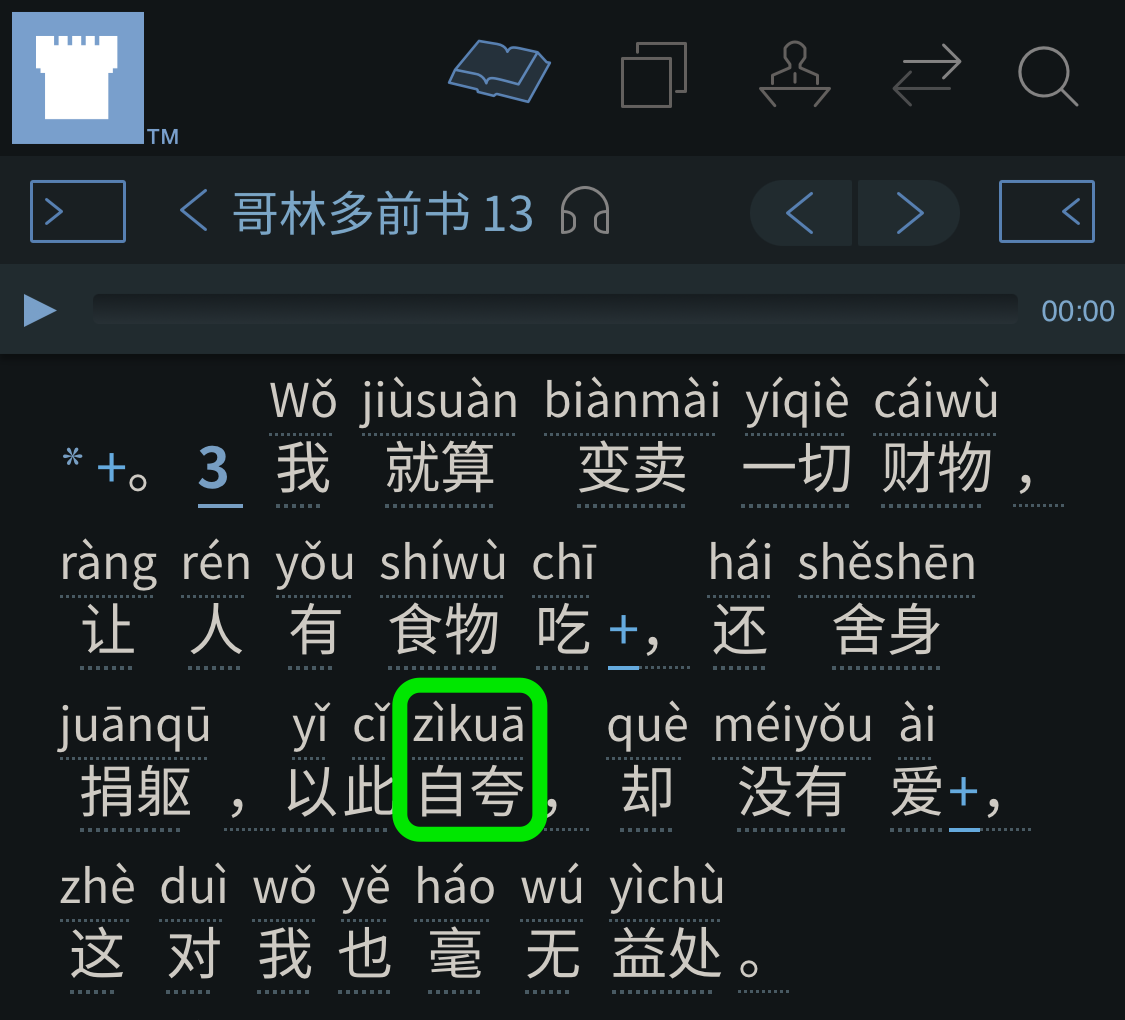
This week’s MEotW, “zìkuā (zì·kuā {[(about)] self} · {exaggerate; overstate; boast; brag | praise; compliment} 自夸 自誇)”, is used in verse 3 (WOL, Pīnyīn (Pīn·yīn {Piecing Together of} · Sounds → [Pinyin] 拼音) Plus) of 1 Corinthians 13:

Screenshot of “_zìkuā_” in 1 Co. 13:3 (nwtsty, CHS+_Pīnyīn_ WOL)

(Dark mode for the Watchtower ONLINE LIBRARY (WOL) website, as shown in the above image, can be enabled in the Safari web browser by using the Noir Safari extension.)

In “zìkuā (zì·kuā {[(about)] self} · {exaggerate; overstate; boast; brag | praise; compliment} 自夸 自誇)”, “zì (self | from; since 自)” can mean “(about) self”. (In other expressions, such as “zìjǐ (self[’s] 自己)” or “zìyóu+ (zì·yóu self-·determining → [free | freedom] 自由)”, it just means “self”.) As for “kuā ({exaggerate; overstate; boast; brag | praise; compliment} 夸 誇/夸)”, it means “exaggerate; overstate; boast; brag” or “praise; compliment”. So, “zìkuā (zì·kuā {[(about)] self} · {exaggerate; overstate; boast; brag | praise; compliment} 自夸 自誇)” can effectively mean “boast/brag/etc. about oneself”.

Below are English and Pīnyīn (Pīn·yīn {Piecing Together of} · Sounds → [Pinyin] 拼音) Plus renditions showing how “zìkuā (zì·kuā {[(about)] self} · {exaggerate; overstate; boast; brag | praise; compliment} 自夸 自誇)” is used in 1 Corinthians 13:3 in the current version of the Mandarin NWT Bible to correspond to “boast”, which is used in that verse in the current version of the English NWT Bible:

English:

And if I give all my belongings to feed others, and if I hand over my body so that I may boast, but do not have love, I do not benefit at all.

Mandarin (WOL, Pīnyīn (Pīn·yīn {Piecing Together of} · Sounds → [Pinyin] 拼音) Plus):

📖 📄 ➕ Wǒ (I 我) jiùsuàn (jiù·suàn {even if} · {figuring → [considering]} 就算) biànmài (biàn·mài changing · sell → [sell off] 变卖 變賣) yíqiè (yí·qiè {one (whole)} · {corresponding (set of)} → [all] 一切) cáiwù (cái·wù wealth · things → [belongings] 财物 財物), ràng ({to allow} 让 讓) rén (people 人) yǒu ({to have} 有) shíwù (shí·wù eating · matter → [food] 食物) chī ({to eat} 吃 吃/喫), hái (also 还 還) shěshēn (shě·shēn {give up} · {(my) body} 舍身 捨身) juānqū (juān·qū {relinquish → [contribute]} · {(my) human body} 捐躯 捐軀), yǐcǐ (yǐ·cǐ using · this 以此) zìkuā+ (zì·kuā {(about) self} · {to boast} 自夸 自誇), què (but 却 卻) méiyǒu (méi·yǒu not · {do have} 没有 沒有) ài (love 爱 愛), zhè (this 这 這) duì (towards → [to] 对 對) wǒ (me 我) yě (even 也) háowú (háo·wú {(even) a fine hair (of)} · {does not have} → [does not have even a little] 毫无 毫無) yìchu (yì·chu beneficial · place → [benefit] 益处 益處).

“Your Boasting Is Not Good”

Jehovah designed us, including specific parts of our bodies, such that the primary way we use language to communicate is with speech. (1 Corinthians 14:8–11) In contrast, writing is a human-invented technology, useful in some ways, but secondary at best compared to the gift of speech that Jehovah gave us.

So, if you are boasting, whether out loud or to yourself in your heart, about your knowledge of Chinese characters, which are particularly deeply problematic products of a worldly human culture, while neglecting to praise and appreciate Jehovah’s gift of speech, is it not so that, as 1 Corinthians 5:6 says, “your boasting is not good”? This is especially so because, as 1 John 2:15–17 tells us, we should “not love either the world or the things in the world”.

That scripture also warns us about “the desire of the eyes”. Chinese characters certainly have visually intricate designs that dazzle the eyes of many. The thing is, though, that language is not primarily about what’s visible to the eye. Rather, speech, the actual primary aspect of human language, is something that’s invisible to the eye. If we were to prioritize or even glamourize fancy visible writing over invisible speech that is actually what really matters language-wise, that could be considered linguistic idolatry—literal idolatry similarly involves worshipping visible idols of false gods rather than properly only worshipping the invisible true God.

Sure, in some situations characters are still the only form in which certain spiritually relevant information is written, so in such situations we must use characters to access and use that information in Jehovah’s service. However, that doesn’t mean that we need to love the characters for their own sake, or boast about our knowledge of them. Indeed, it is entirely appropriate to be dismayed by how the unnecessarily extraordinarily complex Chinese characters can make accessing and using important spiritual information much harder than necessary! While it’s still true that Pīnyīn (Pīn·yīn {Piecing Together of} · Sounds → [Pinyin] 拼音) is not yet everywhere that characters are in the Mandarin field, we should ask ourselves why Jehovah’s organization—which we understand to be directed by Jehovah and Jesus—has over time been making Pīnyīn (Pīn·yīn {Piecing Together of} · Sounds → [Pinyin] 拼音) available in more and more places that used to be characters-only.

Similarly, for a long time, the only Bibles available in England were ones written in Latin. While it was not totally impossible for people who lived in England at that time to learn Latin so as to be able to read and understand the Bible for themselves, it was very difficult for most, and practically impossible for many. (Many today similarly find Chinese characters very difficult, or even practically impossible, to deal with, and so they never join a Chinese field, or they may feel forced to leave after a time even if they do join a Chinese field.) In that not-so-merry old England, a privileged few may have boasted about their knowledge of Latin, but Jehovah’s organization has expressed clearly how it views that dark time.

“Glory from One Another”

Something to consider about boasting about characters is: Whom is one doing such boasting trying to impress? Is it Jehovah God? Is Jehovah really impressed by deep worldly knowledge of the culture of the proudly named “Zhōngguó (Zhōng·guó Central · Nation → [China] 中国 中國)” (“Central Kingdom”) that he will soon destroy and replace with his own Kingdom? (Daniel 2:44) Really, one who boasts about his knowledge of characters is generally boasting before other humans, is that not so? That being the case, such a one should take care to avoid becoming like the ones to whom Jesus directed the words at John 5:41–44:

I do not accept glory from men, but I well know that you do not have the love of God in you. I have come in the name of my Father, but you do not receive me. If someone else came in his own name, you would receive that one. How can you believe, when you are accepting glory from one another and you are not seeking the glory that is from the only God?

Jesus’ words above join the words at 1 Corinthians 13:3 to tell us that if certain ones do things so that they may boast, so that they may receive “glory from men”, “glory from one another”, such ones “do not have the love of God” in them, and so, they “do not benefit at all”.

“Boast in Jehovah”

Especially as ones who are dedicated to Jehovah God, we should focus on what brings glory to him, and on what brings us “the glory that is from the only God”. We should not seek the fading glories of some worldly human culture, even if that culture is as old and storied—from a human viewpoint, at least—as Chinese culture is. (To Jehovah, for whom ‘a thousand years is as one day’, Chinese civilization has only been around for a few days.—2 Peter 3:8.)

As 1 Corinthians 1:26–31 says, we should boast in Jehovah, not in needlessly and self-indulgently complex knowledge relating to a mere worldly human culture:

For you see his calling of you, brothers, that there are not many wise in a fleshly way, not many powerful, not many of noble birth, but God chose the foolish things of the world to put the wise men to shame; and God chose the weak things of the world to put the strong things to shame; and God chose the insignificant things of the world and the things looked down on, the things that are not, to bring to nothing the things that are, so that no one might boast in the sight of God. But it is due to him that you are in union with Christ Jesus, who has become to us wisdom from God, also righteousness and sanctification and release by ransom, so that it may be just as it is written: “The one who boasts, let him boast in Jehovah.”

Categories
Culture Current Events Language Learning

xiǎnyǎn bāo

xiǎnyǎn bāo+ ((xiǎn·yǎn {appears; shows; displays; manifests; {[is] obvious; evident; clear; apparent; noticeable} (to)} · eye → [conspicuous; showy; eye-catching; glamorous] 显眼 顯/顕眼) (bāo wrapping → [bun (food)] 包) → [attention-seeker; goofball; one who stands out from the crowd to get attention]) ← Tap/click to show/hide the “flashcard”

With 2023 having just recently receded into history, it’s a good time to check out collections of some of the top Mandarin slang expressions used during 2023. A couple of articles that I found that discuss some of these expressions are:

The only expression that appears on both of these lists is “xiǎnyǎn bāo ((xiǎn·yǎn {appears; shows; displays; manifests; {[is] obvious; evident; clear; apparent; noticeable} (to)} · eye → [conspicuous; showy; eye-catching; glamorous] 显眼 顯/顕眼) (bāo wrapping → [bun (food)] 包) → [attention-seeker; goofball; one who stands out from the crowd to get attention])”, this week’s MEotW.

Its Constituent Morphemes

The first morpheme in this expression is “xiǎn (appear; show; display; manifest; {[is] obvious; evident; clear; apparent; noticeable [→ [[is] illustrious; powerful; influential]} 显 顯/顕)”, which here means “appears; shows; displays; manifests; [is] obvious/evident/clear/apparent/noticeable (to)”. Some other expressions that include this morpheme are:

  • míngxiǎn+ (míng·xiǎn {[is] clear; distinct} · {[is] obvious; evident; clear; apparent; noticeable} → [[is] clear; obvious; evident; distinct; manifest] 明显 明顯)
  • xiǎnrán+ (xiǎn·rán {[is] evident; obvious; clear}·ly 显然 顯然)
  • xiǎnshì+ (xiǎn·shì {to be evident/obvious} · show 显示 顯示)

When “xiǎn (appear; show; display; manifest; {[is] obvious; evident; clear; apparent; noticeable [→ [[is] illustrious; powerful; influential]} 显 顯/顕)” is put together with “yǎn (eye 眼)”, which means “eye”, the resulting expression “xiǎnyǎn+ (xiǎn·yǎn {appears; shows; displays; manifests; {[is] obvious; evident; clear; apparent; noticeable} (to)} · eye → [conspicuous; showy; eye-catching; glamorous] 显眼 顯/顕眼)” effectively means “conspicuous; showy; eye-catching; glamorous”.

The last morpheme of this expression, “bāo (wrapping [→ [including; containing | assuring; guaranteeing | bundle; package; pack; packet; parcel | bag; sack | bun (food)]] 包)”, literally means “to wrap”, but one of its effective meanings is “bun”, that is, a bun that’s food, as opposed to, say, a hair bun. Some other expressions that include this morpheme are:

  • bāokuò+ (bāo·kuò wrap · {draw together} → [include; consist of; comprise; incorporate] 包括)
  • miànbāo+ (miàn·bāo {[wheat] flour} · {wrapping [→ [bun]]} → [bread] 面包 麵包)
  • bāozi+ (bāo·zi {wrapping → [bun]} · [suf for nouns] → [steamed stuffed bun] 包子)

It’s evident that “bāo (wrapping [→ [including; containing | assuring; guaranteeing | bundle; package; pack; packet; parcel | bag; sack | bun (food)]] 包)”, with its meaning of “bun”, is used as a term of endearment in “xiǎnyǎn bāo ((xiǎn·yǎn {appears; shows; displays; manifests; {[is] obvious; evident; clear; apparent; noticeable} (to)} · eye → [conspicuous; showy; eye-catching; glamorous] 显眼 顯/顕眼) (bāo wrapping → [bun (food)] 包) → [attention-seeker; goofball; one who stands out from the crowd to get attention])”.

As a Whole

What are the constituent morphemes of “xiǎnyǎn bāo ((xiǎn·yǎn {appears; shows; displays; manifests; {[is] obvious; evident; clear; apparent; noticeable} (to)} · eye → [conspicuous; showy; eye-catching; glamorous] 显眼 顯/顕眼) (bāo wrapping → [bun (food)] 包) → [attention-seeker; goofball; one who stands out from the crowd to get attention])” being used to mean when they’re put together in this expression? The article in The World of Chinese that’s mentioned above says:

One type of dazi [shallow friend] many prefer these days is the 显眼包 (xiǎnyǎnbāo), or goofball. The term refers to people who stand out from the crowd and constantly seek attention. Although once considered a neutral term, it has gained a positive connotation recently, as many appreciate their vibrant energy in an often ultra-competitive society.

As for the article in Sixth Tone that’s mentioned above, it says this regarding this expression as a whole:

显眼包

Class Clown

Literally meaning “eye-catching,” 显眼包 (xiǎn yǎn bāo) and its variations appear in a number of Chinese dialects. The term became widespread online after Guo Beibei — a phenomenally popular internet celebrity who later lost her account for violating short video platform Kuaishou’s rules on “vulgar” content — began using it to describe herself. Now, it’s become a byword for attention-seekers, goofballs, and anyone who is willing to get weird for a like.

[Regarding the person mentioned in the above quote, I found an article about her on the website of The China Project. The article says that she has many fans who are homosexuals, although it does not mention whether she herself is homosexual. For what it’s worth, I remember that a sister who grew up in San Francisco (which famously has a significant homosexual population) once commented that she has observed that many homosexuals are quite self-centred. Perhaps that contributes to such ones liking standing out and getting attention.]

Good and Bad Ways to Stand Out

The world—which we know is ruled behind the scenes by Satan the Devil—has its celebrity culture, and it has an attention economy. (1 John 5:19) In contrast, in 1 Thessalonians 4:11, the apostle Paul gave Christians this advice:

Make it your aim to live quietly and to mind your own business

So, generally, Christians should not seek to stand out or get attention for themselves. Sometimes, though, true Christians naturally stand out because of being no part of Satan’s world, e.g., when avoiding celebrating holidays with pagan roots, or when refusing to participate in politics or war. More positively, in a world permeated by Satan’s spirit, Christians may also naturally stand out because of reflecting God’s spirit, applying God’s principles, and sticking to God’s standards. As Jesus, said, his true disciples should ‘let their light shine’.—Matthew 5:16.

Standing out because of not following human conventions and traditions is not necessarily a bad thing. Indeed, it’s sometimes necessary, and exactly the right thing to do, with Jesus himself setting the perfect example by his not following the traditions of the scribes and Pharisees of his day, which went beyond God’s requirements. However, actually going beyond God’s standards and requirements, as Satan, the demons, Adam and Eve, the Pharisees, and others who show a similar spirit have done, is indeed bad. So, it’s vitally important for us to cultivate the wisdom to be able to tell the difference.

Standing Out in the Mandarin Field

Comparing the two articles linked to above, I noticed that the The World of Chinese article renders Pīnyīn (Pīn·yīn {Piecing Together of} · Sounds → [Pinyin] 拼音) in a much better way than the Sixth Tone article does—the The World of Chinese article properly treats Pīnyīn (Pīn·yīn {Piecing Together of} · Sounds → [Pinyin] 拼音) as a separate, alternate full writing system with spaces between whole words rather than between every syllable, while the Sixth Tone article just treats Pīnyīn (Pīn·yīn {Piecing Together of} · Sounds → [Pinyin] 拼音) like a mere pronunciation aid for the characters. Still, in a Language Log blog post of his own, Prof. Victor H. Mair made the following interesting comment regarding the expressions presented in the Sixth Tone article:

Three of the ten items either feature roman letters or consist entirely of English. Remember what Mark Hansell said years ago about roman letters becoming a part of the Chinese writing system:

Mark Hansell, “The Sino-Alphabet: The Assimilation of Roman Letters into the Chinese Writing System,” Sino-Platonic Papers, 45 (May, 1994), 1-28 (pdf)

Roman letters certainly stand out among Chinese characters.

As for characters themselves, one of the possible meanings of “xiǎnyǎn (xiǎn·yǎn {appears; shows; displays; manifests; {[is] obvious; evident; clear; apparent; noticeable} (to)} · eye → [conspicuous; showy; eye-catching; glamorous] 显眼 顯/顕眼)” is “glamorous”, and Chinese characters are considered glamorous by some. With their eye-catching visual designs, they are by nature—and probably by design—xiǎnyǎn+ (xiǎn·yǎn {noticeable (to)} · eye → [glamorous] 显眼 顯/顕眼), as are idols and images used in idolatrous worship.

In the Mandarin field, is it going too far to use Pīnyīn (Pīn·yīn {Piecing Together of} · Sounds → [Pinyin] 拼音) at times instead of always using characters? Is that being too xiǎnyǎn+ (xiǎn·yǎn {noticeable (to)} · eye → [conspicuous] 显眼 顯/顕眼) in a world where so many people use and promote characters? Should we just go along to get along? Well, as has been discussed on this blog and elsewhere, Chinese characters are from humans, not from God, and thus the traditions surrounding characters are no more binding on God’s true servants today than the traditions of the Pharisees were on Jesus, and I hope none of us would have told Jesus to “go along to get along”! (As I recall, the apostle Peter tried to tell Jesus something similar once, and Jesus, um, didn’t respond positively.) So, it is fine to take advantage of the practical benefits of Pīnyīn (Pīn·yīn {Piecing Together of} · Sounds → [Pinyin] 拼音) when you can to help you serve God more effectively, and to just use characters when you have to.