Categories
Culture Current Events Experiences Language Learning Science Technology Theocratic

cōnghuì

cōnghuì (cōng·huì {[is] quick at hearing → [[is] intelligent; bright; clever; sharp-witted]} · {[is] intelligent; bright} → [[is] intelligent; bright; witty] 聪慧 聰慧) 👈🏼 Tap/click to show/hide the “flashcard”

[Notes: Tap/click on a Pīnyīn (Pīn·yīn {Piecing Together of} · Sounds → [Pinyin] 拼音) expression to reveal its “flashcard”; tap/click on a “flashcard” or its Pīnyīn (Pīn·yīn {Piecing Together of} · Sounds → [Pinyin] 拼音) expression to hide the “flashcard”. 📖 📄 📘 icons mean 📖 Reveal All, 📄 Reveal Advanced, and 📘 Reveal None re all the “flashcards” in the heading, paragraph, etc. that they are placed at the beginning of.]

The Shēngmìng Láizì Chuàngzào Ma? ((Shēngmìng Life 生命) (Lái·zì Came · From 来自 來自) (Chuàng·zào Initiating · {Making, Creating} → [Creating] 创造 創造) (Ma [? ptcl for “yes/no” questions])? [Was Life Created? (lc)]) (Was Life Created? (lc)) brochure and the Shēngmìng de Qǐyuán—Zhíde Sīkǎo de Wǔ Ge Wèntí ((Shēngmìng Life 生命) (de ’s 的) (Qǐ·yuán {Rising → [Starting]} · Source → [Origin] 起源/原)—(Zhí·de Worth · Getting → [Worth] 值得) (Sī·kǎo {Thinking About} · Examining 思考) (de ’s 的) (Wǔ Five 五) (Ge [mw]個/个) (Wèn·tí Asking · Subjects → [Questions] 问题 問題) [The Origin of Life—Five Questions Worth Asking (lf)]) (The Origin of Life—Five Questions Worth Asking (lf)) brochure were originally published back in 2010, but relatively recently, the English version of the Was Life Created? brochure was updated to the December 2022 Printing, and the Mandarin version of it was updated to the February 2023 Printing. Also, the Was Life Created? brochure and the Origin of Life brochure are now in the Teaching Toolbox section in the JW Library app. So, it would be good to consider some of the expressions used in the Mandarin versions of these publications that can be so helpful when discussing whether life was created.

“There Is No Intelligent Creator”?

This week’s MEotW, which appears in the section of the Mandarin Was Life Created? brochure entitled “Nǐ (You 你) Xiāngxìn (Xiāng·xìn It · {Do Believe} → [Do Believe] 相信) Shénme (Shén·me What · [suf] 什么 什/甚麼) Ne ([? ptcl] 呢)?” (“What Do You Believe?”), is “cōnghuì (cōng·huì {[is] quick at hearing → [[is] intelligent; bright; clever; sharp-witted]} · {[is] intelligent; bright} → [[is] intelligent; bright; witty] 聪慧 聰慧)”:

English:

Will you trust the claims of those who say that there is no intelligent Creator and that the Bible is unreliable? Or will you examine what the Bible actually says?

Mandarin (WOL; Pīnyīn (Pīn·yīn {Piecing Together of} · Sounds → [Pinyin] 拼音) Plus)

📖 📄 📘 Yǒuxiē (Yǒu·xiē {(there) are having → [(there) are]} · some 有些) rén (people 人) shuō (saying說/説) méiyǒu (méi·yǒu (there) not · {is having → [is]} → [(there) does not exist] 没有 沒有) cōnghuì (cōng·huì {quick at hearing → [intelligent]} · intelligent → [intelligent] 聪慧 聰慧) de (’s 的) Zàowù‐Zhǔ ((Zào·wù Created · Things 造物)‐(Zhǔ Master 主) [Creator]), Shèngjīng (Shèng·jīng (the) Holy · Scriptures → [the Bible] 圣经 聖經) (also 也) (not 不) kěkào (kě·kào {is able} · {to be leaned on → [to be relied on]} → [is reliable] 可靠), (you 你) xiāngxìn (xiāng·xìn them · {do believe} → [do believe] 相信) tāmen de ((tā·men him/her · [pl] → [them] 他们 他們) (de ’s 的) [their]) huà (words) ma ([? ptcl for “yes/no” questions])? Háishi (Hái·shi {still more → [or]} · {is (it) that} 还是 還是) huì ((you) will) qīnzì (qīn·zì {in person} · self 亲自 親自) kànkan (kàn·kan {look at} · {look at} 看看) Shèngjīng (Shèng·jīng (the) Holy · Scriptures → [the Bible] 圣经 聖經) dàodǐ (dào·dǐ to · bottom → [in the final analysis] 到底) zěnme (zěn·me what · [suf] 怎么 怎麼/麽) shuō (says說/説) ne ([? ptcl] 呢)?

As can be seen from the above quotes, the Mandarin Was Life Created? brochure uses “cōnghuì (cōng·huì {[is] quick at hearing → [[is] intelligent; bright; clever; sharp-witted]} · {[is] intelligent; bright} → [[is] intelligent; bright; witty] 聪慧 聰慧) to effectively mean “intelligent”. Related expressions include “cōngming (cōng·ming {[is] quick at hearing → [[is] intelligent; bright; clever; sharp-witted]} · {[is] bright → [[is] understanding]} 聪明 聰明)”, which has the same first morpheme as “cōnghuì (cōng·huì {[is] quick at hearing → [[is] intelligent; bright; clever; sharp-witted]} · {[is] intelligent; bright} → [[is] intelligent; bright; witty] 聪慧 聰慧)”, and “zhìhuì (zhì·huì wisdom · intelligence → [wisdom] 智慧)”, which has the same second morpheme.

Note that the first morpheme in “cōnghuì (cōng·huì {[is] quick at hearing → [[is] intelligent; bright; clever; sharp-witted]} · {[is] intelligent; bright} → [[is] intelligent; bright; witty] 聪慧 聰慧) literally means “quick at hearing”. This may remind us of the scripture at James 1:19:

Know this, my beloved brothers: Everyone must be quick to listen, slow to speak, slow to anger,

Brains and Brawn

These days, people in the world are making a big deal about what artificial intelligence can do, but in many ways, current artificial intelligence is not even as intelligent and sensible as an average human child, so of course it cannot compare with the original Divine Intelligence, the Almighty God Jehovah. Is madly pursuing artificial intelligence—that in many ways is not really that intelligent, that does not love humans back, and that could prove to be beyond humans’ ability to control—really an intelligent thing to be doing? Are the feverish efforts to develop ever more powerful artificial intelligence really about intelligence, or the blind pursuit of power?

Many in this world, including dictators (and wannabe dictators) and their supporters, certain varieties of technology enthusiasts, people intent on climbing the corporate ladder, etc., have shown that they simple-mindedly and hard-heartedly worship power above all else, and that they dismiss the value of intelligence (and also dismiss such vital things as love and justice as being inconsequential).

Regarding how many view knowledge and intelligence, famous science fiction writer and professor Isaac Asimov said this about a common attitude he observed in the USA:

There is a cult of ignorance in the United States, and there has always been. The strain of anti-intellectualism has been a constant thread winding its way through our political and cultural life, nurtured by the false notion that democracy means that “my ignorance is just as good as your knowledge.”

Actually, though, in many situations, sufficient intelligence can make all the difference. What difference can intelligence make? I remember that when I watched the movie Jurassic Park (which is about dinosaurs that humans recreate, and that then prove to be beyond the humans’ ability to control), the time I found the predatory velociraptors most scary was not when they were using their teeth, claws, or speed, or otherwise showing how powerful they were. Rather, it was when one of them showed considerable intelligence and figured out how to turn a door handle to open the door that children it was chasing were hiding behind.

Yes, sufficient intelligence, or wisdom, can be the difference between whether something gets done—even something as simple as opening a door—and if it never gets done. This is so even if much power is involved, and it is so no matter how long random chance is allowed to “work” on it. Jehovah God’s creative wisdom and intelligence, in addition to his almighty power, are certainly evident all around us in the natural world, in things that could never have come into existence without them. As Psalm 104:24 and Jeremiah 10:12 say:

How many your works are, O Jehovah!
You have made all of them in wisdom.
The earth is full of what you have made.

He is the Maker of the earth by his power,
The One who established the productive land by his wisdom
And who stretched out the heavens by his understanding.

Working Hard and Working Smart

Speaking of intelligence, sometimes Mandarin learners who work smart by using Pīnyīn (Pīn·yīn {Piecing Together of} · Sounds → [Pinyin] 拼音) whenever they can are accused by Chinese character chauvinists (masochists?) of being unwilling to work hard. However, does working smart necessarily mean not working hard? The best results actually come from doing both—working hard and working smart—not just doing one or the other.

And really, are we not showing an anti-intelligence and anti-wisdom attitude if we oppose doing God’s work the easy way in order to support doing things the hard way, just for the sake of preserving human tradition? Do we want to be part of the “cult of ignorance”?


For convenience:

The direct link for the current-generation Pīnyīn (Pīn·yīn {Piecing Together of} · Sounds → [Pinyin] 拼音) Plus resource for the Was Life Created? brochure is:

The short link for Chinese field language-learning links for the Was Life Created? brochure is:

More Pīnyīn (Pīn·yīn {Piecing Together of} · Sounds → [Pinyin] 拼音) and Pīnyīn (Pīn·yīn {Piecing Together of} · Sounds → [Pinyin] 拼音) Plus web material based on the Mandarin Was Life Created? brochure will be made available in the Pīnyīn (Pīn·yīn {Piecing Together of} · Sounds → [Pinyin] 拼音) Plus web resource as time allows.
Categories
Culture History Language Learning Science Technology Theocratic

zìdà

zìdà (zì·dà {(consider) self} · {to be big → [to be great]} 自大) 👈🏼 Tap/click to show/hide the “flashcard”

[Notes: Tap/click on a Pīnyīn (Pīn·yīn {Piecing Together of} · Sounds → [Pinyin] 拼音) expression to reveal its “flashcard”; tap/click on a “flashcard” or its Pīnyīn (Pīn·yīn {Piecing Together of} · Sounds → [Pinyin] 拼音) expression to hide the “flashcard”. 📖 📄 📘 icons mean 📖 Reveal All, 📄 Reveal Advanced, and 📘 Reveal None re all the “flashcards” in the heading, paragraph, etc. that they are placed at the beginning of.]

I have long especially liked 1 Corinthians 13. It contains counsel on what really does and doesn’t matter in life, an extensive description and definition of the most important kind of love, and a sublime discussion about the need to become complete, mature, as a person. As these apply to life in general, so too do they apply to our lives as Mandarin field language learners.

As Mandarin field language learners, it can benefit us greatly to consider what we can learn from 1 Corinthians 13, and along the way, we can also consider some of the Mandarin expressions used in that chapter in the current version of the Mandarin New World Translation Bible (nwtsty).

How Do We View Ourselves?

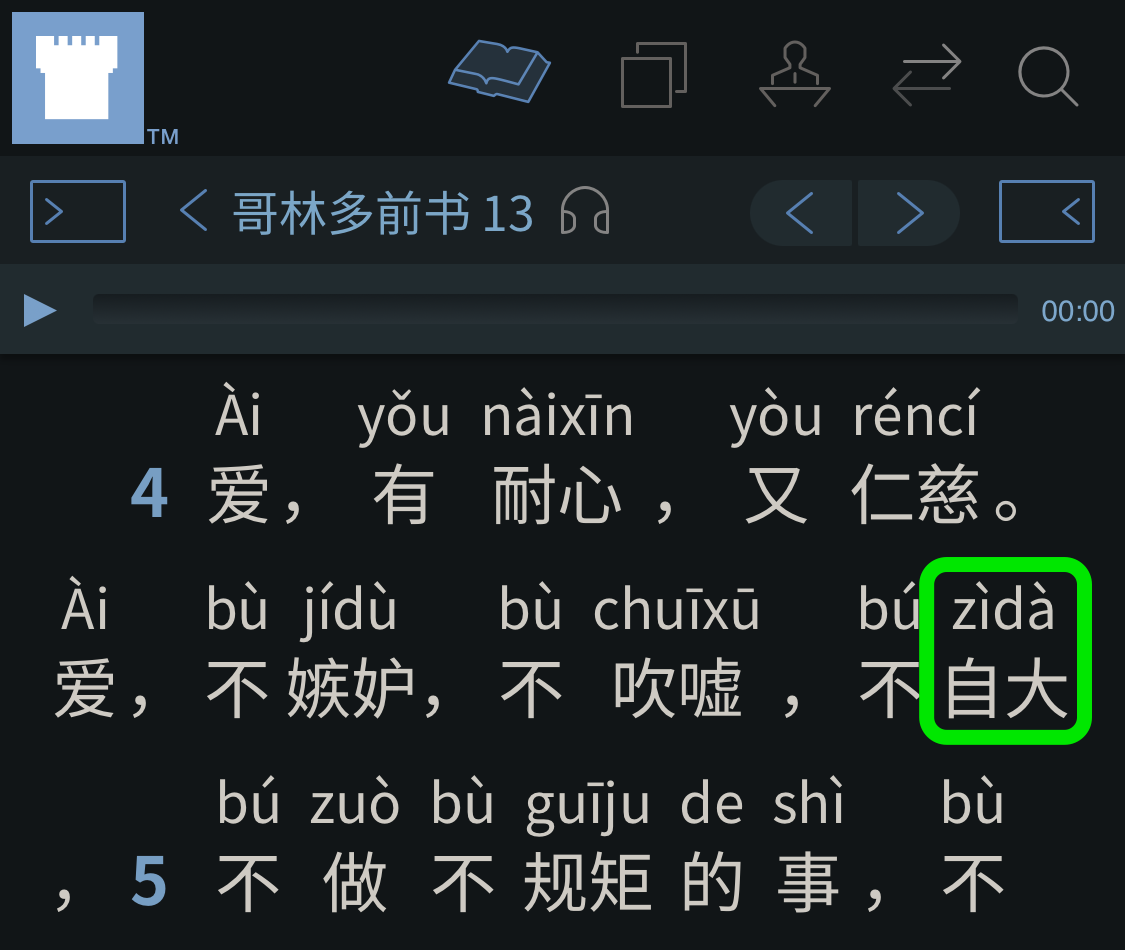
This week’s MEotW, “zìdà (zì·dà {(consider) self} · {to be big → [to be great]} 自大)”, is used in verse 4 (WOL) of 1 Corinthians 13:

Screenshot of “_zìdà_” in 1 Co. 13:4 (nwtsty, CHS+_Pīnyīn_ WOL)

(Dark mode for the Watchtower ONLINE LIBRARY (WOL) website, as shown in the above image, can be enabled in the Safari web browser by using the Noir Safari extension. Other web browsers may also have extensions with similar functionality.)

For comparison, here are the current English and Pīnyīn (Pīn·yīn {Piecing Together of} · Sounds → [Pinyin] 拼音) Plus renderings of 1 Corinthians 13:4:

English:

Love is patient and kind. Love is not jealous. It does not brag, does not get puffed up,

Pīnyīn (Pīn·yīn {Piecing Together of} · Sounds → [Pinyin] 拼音) Plus:

📖 📄 📘 Ài (love), yǒu (has 有) nàixīn (nài·xīn {being (of/with) enduring} · heart → [patience] 耐心), yòu (also 又) réncí (rén·cí {is kind} 仁慈). Ài (love), (not 不) jídù ({is jealous} 嫉妒), (not 不) chuīxū (chuī·xū {does puff → [does brag]} · {does sigh → [does praise]} → [does brag] 吹嘘 吹噓), (not 不) zìdà (zì·dà {(does consider) self} · {to be big → [to be great]} 自大),

The individual morphemes in “zìdà (zì·dà {(consider) self} · {to be big → [to be great]} 自大)”, which are relatively simple and well-known, literally mean “self” and “big”. When these morphemes are put together in “zìdà (zì·dà {(consider) self} · {to be big → [to be great]} 自大)”, the resulting expression effectively means “(consider) self to be great”, corresponding, in 1 Corinthians 13:4 in the current English and Mandarin versions of the New World Translation Bible, with the English expression “puffed up”.

A Nation That Calls Itself “Central Nation”

As discussed in the MEotW post on “Zhōngguó (Zhōng·guó Central · Nation → [China | Chinese] 中国 中國)”, “the people of China have long viewed their nation as central to the world that they knew, or cared most about, to the point that ‘China was the only culture to use the concept for its name’ ”:

The English translation of Zhongyuan as the “Middle Kingdom” entered European languages through the Portuguese in the 16th century and became popular in the mid-19th century. By the mid-20th century, the term was thoroughly entrenched in the English language, reflecting the Western view of China as the inward-looking Middle Kingdom, or more accurately, the Central Kingdom or Central State. Endymion Wilkinson points out that the Chinese were not unique in thinking of their country as central, although China was the only culture to use the concept for its name.[source]

This cultural trait is such a thing that there are several words and concepts related to it, including “Sinocentrism”.

While many worldly Chinese people think nothing of calling their nation “Central Nation”, or think that this is only natural considering China’s history, many cultures consider calling oneself the centre of the world to be puffed up, overly and offputtingly self-important. As a Chinese person, I find this proud, self-centred aspect of worldly Chinese culture to be regrettable. Note that this characteristic should not be taken as a stereotype to be applied to all individual Chinese people, since each individual is different. However, it does tell us something about part of the true nature of worldly Chinese culture.

The Mark of B Players and Bozos

When it comes to writing systems, the zìdà (zì·dà {(consider) selves} · {to be big → [to be great]} 自大) attitudes of many people in China unfortunately motivated them to act as B players, as described by Steve Jobs. The MEotW post on “gāo’ào (gāo’·ào {[is] (considering self to be of) high (status)} · {[is] proud; haughty; arrogant} 高傲) discusses this:

The below quote was recently added to the article “Pīnyīn (Pīn·yīn {Piecing Together of} · Sounds → [Pinyin] 拼音) Was Plan A”:

This tendency of many to prioritize their own pride and position over what’s really better for everyone is also described in this quote from Guy Kawasaki about something he learned from Steve Jobs:

A players hire A+ players. Actually, Steve believed that A players hire A players—that is people who are as good as they are. I refined this slightly—my theory is that A players hire people even better than themselves. It’s clear, though, that B players hire C players so they can feel superior to them, and C players hire D players. If you start hiring B players, expect what Steve called “the bozo explosion” to happen in your organization.

Yes, Pīnyīn was Plan A, but China unfortunately let the proud, self-serving B players have their way.

Note that what makes someone a B player or worse is not necessarily that person’s level of intelligence, skill, talent, etc. What characterizes B players or worse is their proud, self-serving rejection of others who are better in some way, their need to feel superior to others.

Yes, rather than embracing Pīnyīn (Pīn·yīn {Piecing Together of} · Sounds → [Pinyin] 拼音) as the way forward for the benefit of all, as it deserves to be embraced based on its technical merits, many worldly Chinese people showed a zìdà (zì·dà {(consider) selves} · {to be big → [to be great]} 自大) attitude and stuck with the characters that they had personally invested heavily in, and that brought them status and glory in the status quo.

Jesus Loves Those Who Are Humble Like Children

At Luke 22:25, 26, Jesus himself explained what it takes for one to be viewed by him and his Father as a truly great A player, and not an inferior B player:

But he said to them: “The kings of the nations lord it over them, and those having authority over them are called Benefactors. You, though, are not to be that way. But let the one who is the greatest among you become as the youngest, and the one taking the lead as the one ministering.

Also, Luke 9:46–48 says this about Jesus:

Then a dispute arose among them about which one of them was the greatest. Jesus, knowing the reasoning of their hearts, took a young child, stood him beside him, and said to them: “Whoever receives this young child on the basis of my name receives me also; and whoever receives me also receives the One who sent me. For the one who conducts himself as a lesser one among all of you is the one who is great.”

Chinese character chauvinists often say that Pīnyīn (Pīn·yīn {Piecing Together of} · Sounds → [Pinyin] 拼音) is for children. Well, according to Jesus’ words above, that would be fine with him, even if that were true! When this matter is examined in the light of first principles of linguistics (language science), though, it becomes obvious that it’s categorically not true that Pīnyīn (Pīn·yīn {Piecing Together of} · Sounds → [Pinyin] 拼音) is just for children—Pīnyīn (Pīn·yīn {Piecing Together of} · Sounds → [Pinyin] 拼音) works fine for people of all ages as a full writing system for Modern Standard Mandarin, including its most complex and advanced expressions. So, anything that can be spoken and understood in Modern Standard Mandarin can be written and understood in Pīnyīn (Pīn·yīn {Piecing Together of} · Sounds → [Pinyin] 拼音), regardless of the ages of those involved.

As Mandarin field language learners who are dedicated to, and who glorify, the true God Jehovah, let us not unthinkingly adopt the thinking and attitudes of proud, self-centred, self-glorifying worldly people, regardless of what human nation they come from. Remember, we are here in the Mandarin field, not to be gullible, unquestioningly admiring tourists (email me for login information, and include information on who referred you and/or what group/cong. you are in), but to be missionaries and spiritual rescue workers in this world that Jehovah God views as a spiritual disaster area.

Categories
Culture Language Learning Languages Science

Zhōngwén

Zhōngwén (Zhōng·wén {Central → [Chinese]} · Writing 中文) ← Tap/click to show/hide the “flashcard”

As discussed in last week’s MEotW, the expression “Zhōngguó (Zhōng·guó Central · Nation → [China] 中国 中國)” is commonly used to refer to China, since historically, China views itself as the centre of the world, so much so, in fact, that it is the only nation to name itself as such. We can see then that Mandarin expressions starting with “Zhōng (Central → [Chinese] 中)-” can refer to things related to China.

In that case then, are “Zhōnghuà (Zhōng·huà {Central → [Chinese]} · Speech 中话 中話)” or “Zhōngyǔ (Zhōng·yǔ {Central → [Chinese]} · Language 中语 中語)” used to refer to any Chinese language, similarly to how “pǔtōnghuà (pǔ·tōng·huà common; universal · {through(out) → [common]} · speech → [(Modern Standard) Mandarin (term commonly used in China)] 普通话 普通話)” and “Guóyǔ (Guó·yǔ National · Language → [(Modern Standard) Mandarin (term commonly used in Taiwan)] 国语 國語)” are used to refer to Mandarin? Apparently not, according to my dictionaries.

Instead, Chinese people commonly use “Zhōngwén (Zhōng·wén {Central → [Chinese]} · Writing 中文)”—this week’s MEotW—to mean “Chinese language”. It should be noted, though, that although “Zhōngwén (Zhōng·wén {Central → [Chinese]} · Writing 中文)” is often used to refer to Chinese speech (e.g., in “shuō (speak說/説) Zhōngwén (Zhōng·wén {Central → [Chinese]} · Writing 中文)” (“speak Chinese”)), “wén (writing; script [→ [language | culture]] 文)” really means “writing”.

Why do so many Chinese people thus conflate writing with speech and language, when they, while related, are really distinctly different things? This seems to be a symptom of the deeply ingrained Chinese cultural conceit that the Chinese characters are the primary aspect of the Chinese languages—to many Chinese people, the characters are the language. This is contrary to the principle recognized by modern linguists (language scientists) that speech is the primary aspect of any language, not writing. The truth of this basic linguistic principle is shown by the fact that many languages don’t even have a writing system, showing that the required foundation of a language is its speech, not its writing.

Our Creator himself touches on this matter in his Word the Bible:

8 For if the trumpet sounds an indistinct call, who will get ready for battle? 9 In the same way, unless you with the tongue use speech that is easily understood, how will anyone know what is being said? You will, in fact, be speaking into the air. 10 It may be that there are many kinds of speech in the world, and yet no kind is without meaning. 11 For if I do not understand the sense of the speech, I will be a foreigner to the one speaking, and the one speaking will be a foreigner to me.—1 Corinthians 14:8–11.

Yes, Jehovah God himself, the One who designed us with our ability to use language, emphasizes the primary importance of understandable speech when it comes to communicating with people, especially when communicating about the potentially life-saving good news of the Kingdom.

Chinese people, however, often have the mistaken view, based on nothing more than deeply ingrained human tradition and not a little cultural pride, that their characters writing system is the primary aspect of the Chinese languages. So, we must take that into consideration when they or people deferring to them erroneously tell us, with all sincerity, that we need to focus first on Chinese characters in our efforts to learn one or more of the Chinese languages. The truth, as testified to by both real language experts among humans and by the Creator himself, is that speech—both understanding speech and speaking understandably—should be our primary focus as Chinese field language-learners.

Regarding the expression “Zhōngwén (Zhōng·wén {Central → [Chinese]} · Writing 中文)”, another thing I have noticed is that when Mandarin-speakers say “Zhōngwén (Zhōng·wén {Central → [Chinese]} · Writing 中文)”, they mean Mandarin speech, but when Cantonese-speakers say “Zhōngwén (Zhōng·wén {Central → [Chinese]} · Writing 中文)”, they mean Cantonese speech. As a Chinese person, I must reluctantly admit that with such habits, and with naming their nation “Zhōngguó (Zhōng·guó Central · Nation → [China] 中国 中國)”, the central nation of the world, many Chinese people have taken quite far the tendency of imperfect humans to consider themselves the centre of the universe!