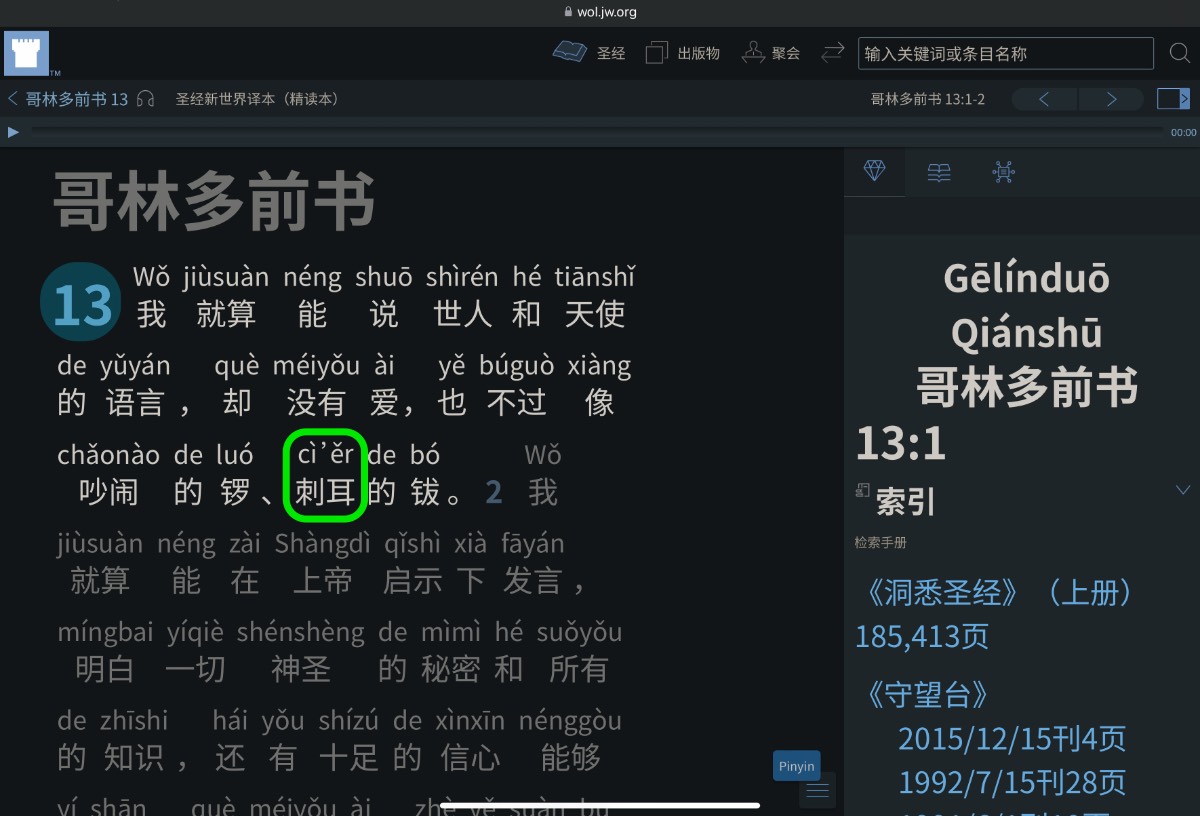
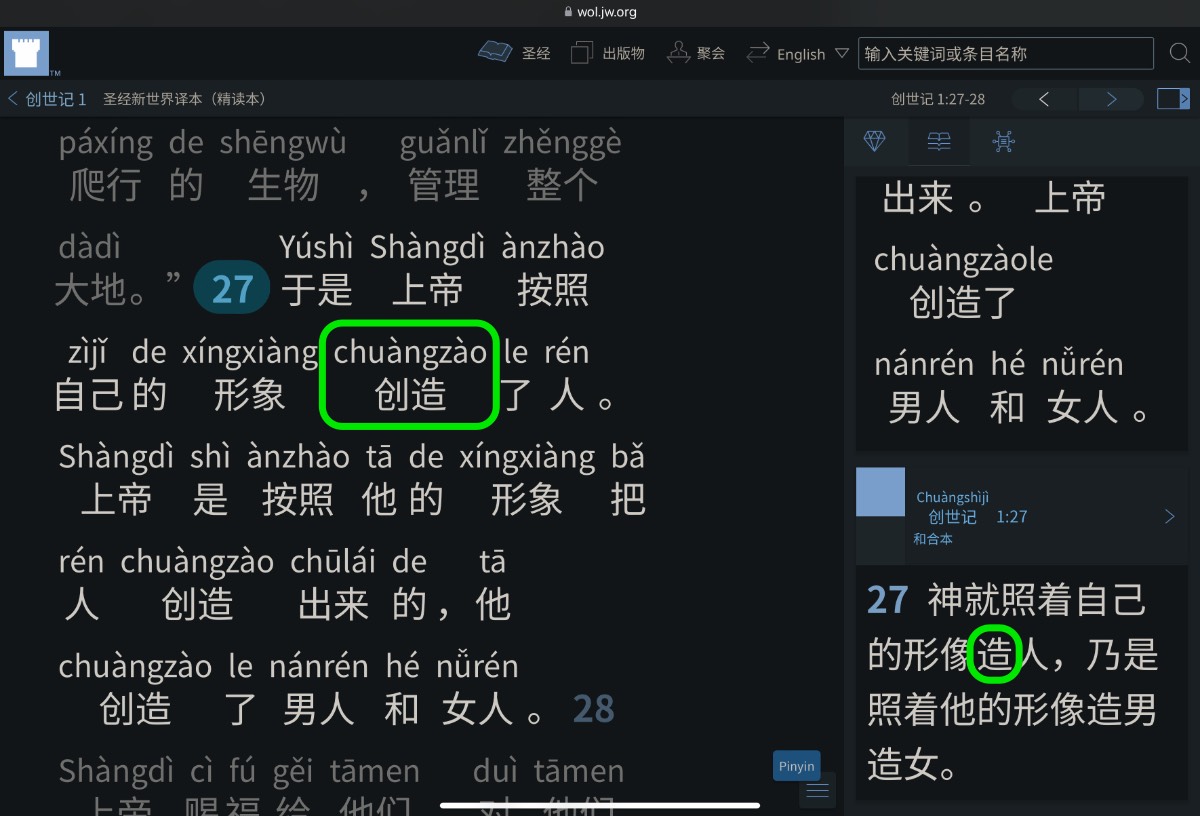
cuò+ ({[is] alternating; staggered} [→ [[is] wrong; mistaken; incorrect; erroneous | missed | grinding; rubbing | moving to the side | mistake; error; blunder [→ [fault]]]] | {[is] interlocked and jagged} [→ [intricate]] 错 錯) ← Tap/click to show/hide the “flashcard”
[Notes: Tap/click on a Pīnyīn (Pīn·yīn {Piecing Together of} · Sounds → [Pinyin] 拼音) expression to reveal its “flashcard”; tap/click on a “flashcard” or its Pīnyīn (Pīn·yīn {Piecing Together of} · Sounds → [Pinyin] 拼音) expression to hide the “flashcard”. 📖 📄 ➕ icons mean 📖 Reveal All, 📄 Reveal Advanced, and ➕ Reveal + Symbols re all the “flashcards” in the heading, paragraph, etc. that they are placed at the beginning of.]
One of the publications that is now recommended to be used on Bible studies is the Yǒngyuǎn Xiǎngshòu Měihǎo de Shēngmìng—Hùdòng Shì Shèngjīng Kèchéng ((Yǒng·yuǎn Eternally · {Far (in Time)} 永远 永遠) (Xiǎng·shòu Enjoy · Receive 享受) (Měi·hǎo Beautiful · Good 美好) (de ’s 的) (Shēngmìng Life 生命)—(Hù·dòng {Each Other} · Moving → [Interactive] 互动 互動) (Shì (Type 式) (Shèng·jīng Holy · Scriptures → [Bible] 圣经 聖經) (Kè·chéng Lessons · Procedure → [Course] 课程 課程) → [Enjoy Life Forever!—An Interactive Bible Course (lff)]) (Enjoy Life Forever! (lff)) book. This week’s MEotW, “cuò ({[is] alternating; staggered} [→ [[is] wrong; mistaken; incorrect; erroneous | missed | grinding; rubbing | moving to the side | mistake; error; blunder [→ [fault]]]] | {[is] interlocked and jagged} [→ [intricate]] 错 錯)”, occurs at about the 18 second mark of the video for lesson 08, point 6 of this book:
📖 📄 ➕ Wǒ (I 我) zǒng+ (always 总 總/縂) juéde (jué·de {to wake to → [to feel]} · got → [got to feel] 觉得 覺得), fāshēng (fā·shēng {issued forth} · {came to life} → [happened] 发生 發生) zài (on 在) wǒ (me 我) shēnshang (shēn·shang {body → [self]} · upon 身上) de (’s 的) shì (things 事) dōu (all 都) shì (were 是) wǒ de ((wǒ me 我) (de ’s 的) → [my]) cuò+ ({being staggered} → [error] → [fault] 错 錯).
Many undoubtedly already know this word to mean “wrong” or “mistaken”. However, examination of the various meanings provided for it in various dictionaries, perhaps with an app like Pleco that allows one to quickly check multiple dictionaries, seems to reveal that there is an extra layer of meaning underneath the meaning of “wrong” or “mistaken” that many at first think of for “cuò ({[is] alternating; staggered} [→ [[is] wrong; mistaken; incorrect; erroneous | missed | grinding; rubbing | moving to the side | mistake; error; blunder [→ [fault]]]] | {[is] interlocked and jagged} [→ [intricate]] 错 錯)”. This more basic meaning seems to be that of “alternating”, or “staggered”—basically, not lining up.
As I have continued to research into the meanings of Mandarin expressions as part of my work on this blog, my work on Pīnyīn (Pīn·yīn {Piecing Together of} · Sounds → [Pinyin] 拼音) Plus material, and just as part of my overall Mandarin language-learning journey, I have come across many such expressions that seem to have turned out to have extra layers of meaning underneath the ones I was at first familiar with.
Digging Deeper
The historical roots of Mandarin Chinese stretch far back in time. As the Wikipedia article on Old Mandarin summarizes:
Old Mandarin or Early Mandarin was the speech of northern China during the Jurchen-ruled Jin dynasty and the Mongol-led Yuan dynasty (12th to 14th centuries).
So, it’s not surprising that there may be etymological layers of meaning underneath the meanings of Mandarin expressions that we are familiar with today. It’s much like how occasionally physical things from the past get discovered in places where people lived and did things in the past, like how so many artifacts have been discovered in places like Egypt or the lands that are now where ancient Mesopotamia used to be, or like how workers excavating the site of the current World Trade Centre building complex came across the remains of a wooden ship.
An Old Chinese Alphabet!
Interestingly, the above-mentioned Wikipedia article on Old Mandarin mentions an alphabet:
The phonology of Old Mandarin has been inferred from the ‘Phags-pa script, an alphabet created in 1269 for several languages of the Mongol empire, including Chinese…
The Wikipedia article on the ʼPhags-pa script provides some further summarized information:
The Phagspa script or ʼPhags-pa script[source] is an alphabet designed by the Tibetan monk and State Preceptor (later Imperial Preceptor) Drogön Chögyal Phagpa for Kublai Khan, the founder of the Yuan dynasty, as a unified script for the written languages within the Yuan. The actual use of this script was limited to about a hundred years during the Mongol-led Yuan dynasty, and it fell out of use with the advent of the Ming dynasty.[source][source]
It was used to write and transcribe varieties of Chinese, the Tibetic languages, Mongolian, the Uyghur language, Sanskrit, probably Persian,[source][source][source][source] and other neighboring languages[citation needed] during the Yuan era.
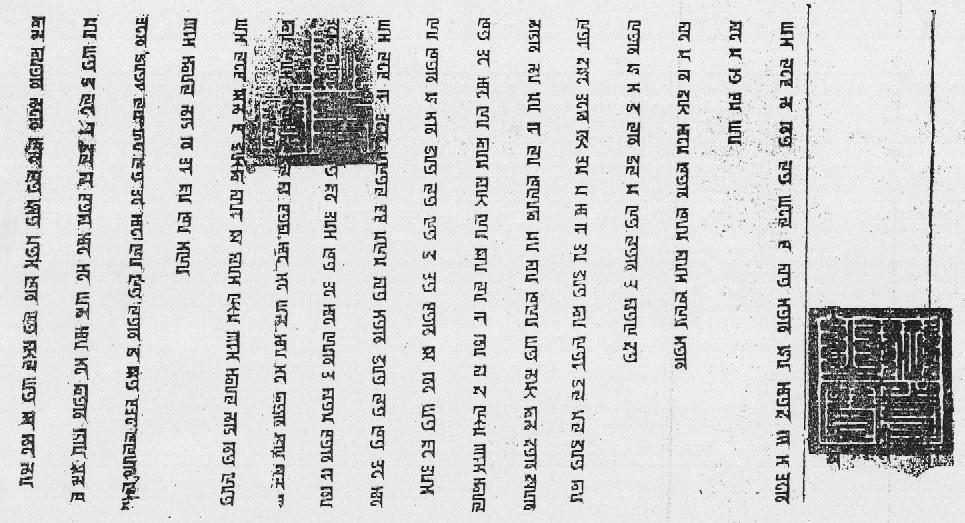

A manuscript copy of an imperial edict of the Yuan dynasty in ʼPhags-pa script
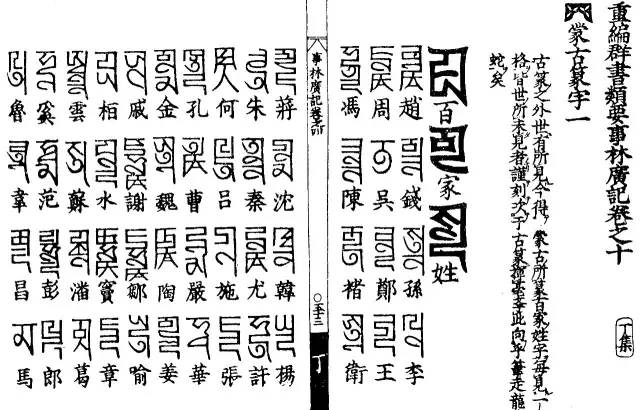

An example of the Chinese poem “Hundred Family Surnames” written in Chinese characters and in ʼPhags-pa script
So, despite the claims of some Chinese traditionalists that the Chinese languages can only be written using Chinese characters, Chinese languages, including an old form of Mandarin, have been written with an alphabet before, one that was created for Kublai Khan himself! (Interestingly, Kublai Khan was the ruler of China when Marco Polo visited there. So, this famous Italian may have been there when Chinese languages were written using an alphabet.) Méi ({(there) is not having} 没 沒) cuò ({being staggered} → [mistake] 错 錯), there is historical precedent for the idea that a Chinese language like Modern Standard Mandarin can be written with an alphabetical writing system like Pīnyīn (Pīn·yīn {Piecing Together of} · Sounds → [Pinyin] 拼音).
For convenience:
The direct link for the current generation Pīnyīn (Pīn·yīn {Piecing Together of} · Sounds → [Pinyin] 拼音) Plus resource for the Enjoy Life Forever! book is:
The short link for Chinese field language-learning links for the Enjoy Life Forever! book is:
More Pīnyīn (Pīn·yīn {Piecing Together of} · Sounds → [Pinyin] 拼音) and Pīnyīn (Pīn·yīn {Piecing Together of} · Sounds → [Pinyin] 拼音) Plus web material based on the Mandarin Enjoy Life Forever! book will be made available in the Pīnyīn (Pīn·yīn {Piecing Together of} · Sounds → [Pinyin] 拼音) Plus web resource as time allows.