Categories
Culture History Theocratic

rénkǒu

rénkǒu (rén·kǒu people · {mouths of} → [population; number of people in a family] 人口) ← Tap/click to show/hide the “flashcard”

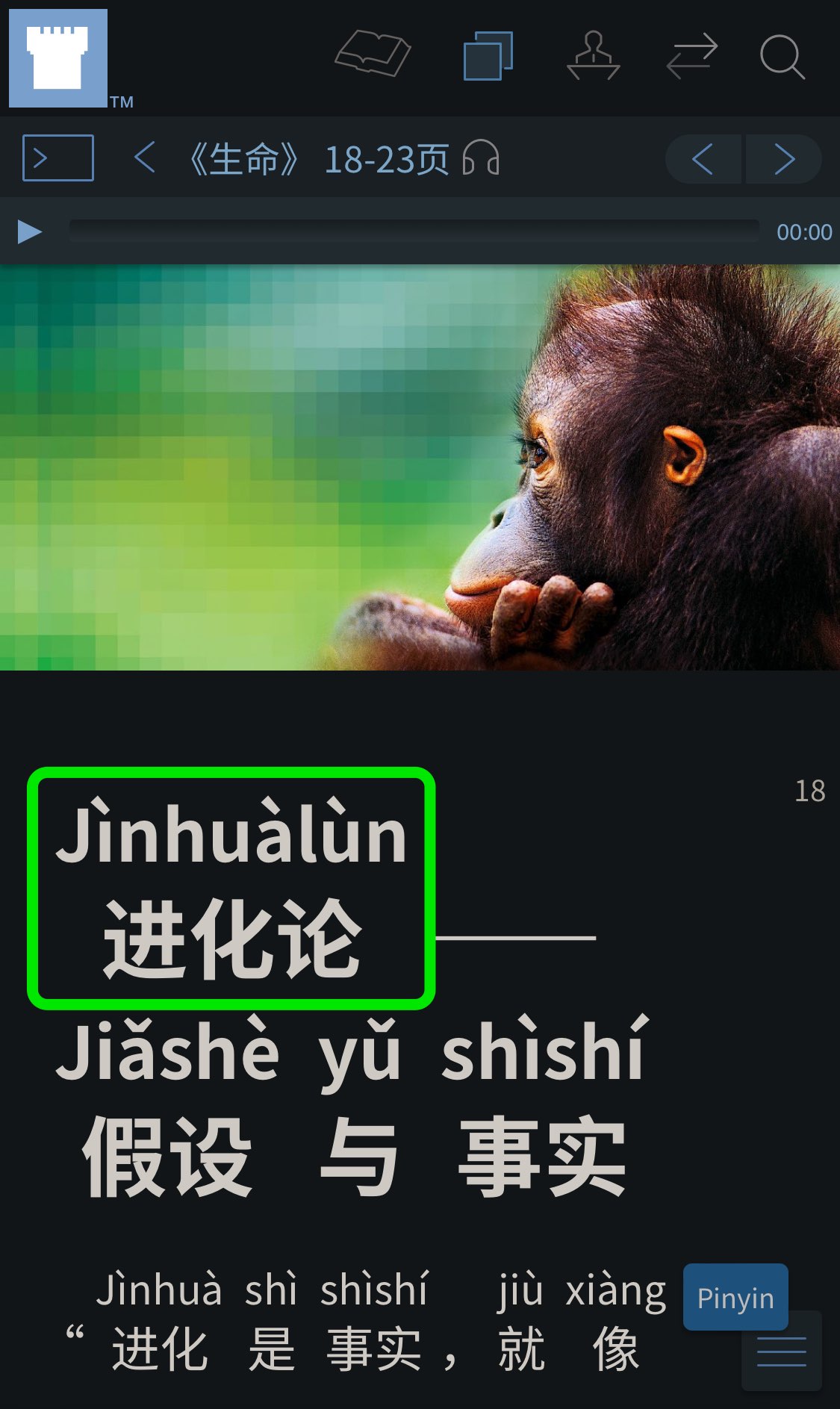
Lesson 05, point 6 of the Yǒngyuǎn Xiǎngshòu Měihǎo de Shēngmìng—Hùdòng Shì Shèngjīng Kèchéng ((Yǒng·yuǎn Eternally · {Far (in Time)} 永远 永遠) (Xiǎng·shòu Enjoy · Receive 享受) (Měi·hǎo Beautiful · Good 美好) (de ’s 的) (Shēngmìng Life 生命)—(Hù·dòng {Each Other} · Moving → [Interactive] 互动 互動) (Shì (Type 式) (Shèng·jīng Holy · Scriptures → [Bible] 圣经 聖經) (Kè·chéng Lessons · Procedure → [Course] 课程 課程) [Enjoy Life Forever!—An Interactive Bible Course (lff)]) (Enjoy Life Forever! (lff)) book contains an illustration depicting the unparalleled availability of God’s Word the Bible. One of the illustration’s captions says the following:

English:

Nearly 100% of the world’s population have access to the Bible in a language they understand

Mandarin:

📖 📄 📘 Chà‐bu‐duō ((Chà {falling short of by} 差)‐(bu not 不)‐(duō much 多) [nearly]) 100% ((bǎi {(one) hundred} 百) (fēn dividings → [parts] 分) (zhī {(among) them} 之) (bǎi {(one) hundred} 百) [one hundred percent (of)]) shìjiè (shì·jiè {generation → [world]} · extent’s → [world’s] 世界) rénkǒu (rén·kǒu people · {mouths of} → [population] 人口) dōu (even 都) néng (can 能) yòng (use 用) tāmen (tā·men he/she · [pl] → [they] 他们 他們) míngbai (míng·bai understand · clearly 明白) de (’s 的) yǔyán (yǔ·yán language · {(type of) speech} 语言 語言) dúdào (dú·dào {to read} · {arriving at} 读到 讀到) Shèngjīng (Shèng·jīng (the) Holy · Scriptures → [the Bible] 圣经 聖經)

While “rénkǒu (rén·kǒu people · {mouths of} → [population; number of people in a family] 人口)”, this week’s MEotW, is used above to mean “population”, as it is often used, one of the definitions for this expression in the highly regarded ABC Chinese-English Dictionary is “mouths to feed”. This lends credence to the hypothesis that perhaps the morphemes included in “rénkǒu (rén·kǒu people · {mouths of} → [population; number of people in a family] 人口)” reflect that historically the governments of China have viewed their population as mouths that need to be fed, since this has often been a big challenge, to the point of famine. Contrast this view to the perhaps more Western and modern cultural focus of a nation’s population as its potential human assets. (Of course, humans who are assets also need to be fed, so a balanced approach would give sufficient weight to both aspects.)

Eating or Being “Eaten”?

It may be that historically the governments of China have had feeding the people as one of their primary concerns, however, ironically, it’s also the case that archaeologists have found evidence of human sacrifice in ancient China, which involves ancient Chinese society “eating” individual members of its population. How much human sacrifice are we talking about? One web article that I found speaks of exceptionally large scale human sacrifice in ancient China, comparable in scale to the human sacrifice practiced in the ancient Mayan culture:

While the phenomenon of ritual human killings have been present in many societies throughout history [source], the types of human sacrifice that were practiced by ancient Chinese and pre-Colombian Mesoamerican cultures…were exceptional in terms of the sheer number of people sacrificed, the frequency at which it was done, and the high degree of formalization of their sacrificial rituals. Large-scale, systematic human sacrifice functioned as important political and religious spectacles in [the] Shang dynasty.[source]

Another web article that I found gives us some estimated numbers:

Prior worked revealed an extraordinary number of ritual human sacrifices were conducted during the Shang dynasty, which spanned from the 16th century B.C. to the 11th century B.C. It is the earliest dynasty in China for which archaeologists have evidence. For instance, sacrificial pits are common across the entire site of the last Shang capital, Yinxu, which researchers discovered in 1928 in central China’s Henan Province. Scientists have estimated that over the course of about 200 years, more than 13,000 people were sacrificed in Yinxu, usually males ages 15 to 35, and that on average, each sacrificial ritual there likely claimed at least 50 human victims. The biggest sacrifice found so far killed at least 339 people.

As the MEotW post on “xīshēng (xī·shēng {sacrifice (n or v) | sacrificial} · {[(as with a)] domestic animal} → [sacrifice] 牺牲 犧牲)” noted:

It’s interesting to note, though, that an Internet search for “ancient China sacrifices” will turn up many references to human sacrifices in ancient China, as there were in ancient Canaan—let us be careful not to think more highly of worldly Chinese history and culture than they actually deserve!

A Metaphorically Cannibalistic Society

Speaking of Chinese society “eating” people, Lǔ Xùn ((Lǔ Stupid; Rash (surname)) (Xùn Fast; Quick; Swift 迅) (pen name of Zhōu Shùrén, the greatest Chinese writer of the 20th cent. and a strong advocate of alphabetic writing)), recognized as China’s greatest 20th century writer, wrote a short story called “Kuángrén Rìjì ((Kuáng·rén Mad·man’s 狂人) (Rì·jì {Sun’s → [Day’s]} · Record → [Diary] 日记 日記) [Diary of a Madman (short story by Lǔ Xùn)])” (“Diary of a Madman”) which uses this as a metaphor. Wikipedia provides the following summary concerning this metaphor:

The story is not just a depiction of a man suffering from mental illness with the delusion of being eaten but rather a symbol of the cannibalistic nature of Chinese customs and society wrapped up in the veneer of Confucianism. The story progresses with the appearance of imagery such as that of a dog, which symbolizes cannibalism and a certain “slave mentality”.[source]

The metaphor of “eating people” symbolises the oppressive and feudalistic social structure and values entrenched within Chinese culture.[source] The madman represents the “awakened” individual who re-gains his individuality and refuses to abide by the traditional and harmful cultural norms society,[source] with the neighbors whom he believes to want to devour him representing Chinese society in general. …

Because China was built upon and continued to be informed by Confucian morality and principles over long stretches of history, concepts such as democracy, individualism, natural rights and freedom of thought did not exist and were therefore difficult to take root within the Chinese psyche. Lu Xun remarked that “[we] Chinese have always been a bit arrogant –unfortunately it is never “individual arrogance” but without exception “collective and patriotic arrogance”.[source]

Lǔ Xùn ((Lǔ Stupid; Rash (surname)) (Xùn Fast; Quick; Swift 迅) (pen name of Zhōu Shùrén, the greatest Chinese writer of the 20th cent. and a strong advocate of alphabetic writing)) ends “Kuángrén Rìjì ((Kuáng·rén Mad·man’s 狂人) (Rì·jì {Sun’s → [Day’s]} · Record → [Diary] 日记 日記) [Diary of a Madman (short story by Lǔ Xùn)])” (“Diary of a Madman”) with this appeal:

📖 📄 📘 Jiùjiù (Jiù·jiù save · save 救救 救/捄救/捄) háizi (hái·zi (the) children · [suf for nouns] 孩子)

(Save the children…)

(The original text of “Kuángrén Rìjì ((Kuáng·rén Mad·man’s 狂人) (Rì·jì {Sun’s → [Day’s]} · Record → [Diary] 日记 日記) [Diary of a Madman (short story by Lǔ Xùn)])” (“Diary of a Madman”) can be found here. An English translation can be found here.)

Chinese Characters and Life and Death

Besides being one of China’s greatest writers, Lǔ Xùn ((Lǔ Stupid; Rash (surname)) (Xùn Fast; Quick; Swift 迅) (pen name of Zhōu Shùrén, the greatest Chinese writer of the 20th cent. and a strong advocate of alphabetic writing)) was also a strong proponent of alphabetic writing over Chinese characters. An English translation of an article he wrote on this subject can be found here. In this article, he wrote:

Latinization has another advantage: one can write fast. The Americans say, “Time is money.” But I think that time is life. To squander other people’s time for no reason is, in fact, no different than robbing and murdering them.

Indeed, since time is life, by unnecessarily taking such extraordinary amounts of time to learn and remember, Chinese characters make themselves part of the Chinese traditions that take away life from people. In this regard, one of the web articles quoted above mentioned a connection that’s been found between the earliest Chinese characters and human sacrifice:

Yinxu is also home to the earliest known writing in China, in the form of oracle bone inscriptions. Diviners carved these questions on turtle shells or ox bones, addressing the king’s concerns and ranging from personal issues such as unsettling toothaches to state matters such as crop failures. These inscriptions also recorded the king’s ritual activities, such as human sacrifices to the ruler’s ancestors or the gods.

Yes, it’s literally true that Chinese characters have been involved with taking life away from Chinese people since their very beginning! Additionally, regarding our life-saving preaching and teaching work today, my article “Pīnyīn (Pīn·yīn {Piecing Together} · Sounds → [Pinyin] 拼音) Was Plan A says:

Concerning the obstacles presented by Chinese characters, the great Chinese writer Lǔ Xùn, who passed away in 1936, reportedly said, “Hànzì bú miè, Zhōngguó bì wáng.” (“汉字不灭,中国必亡。/ 漢字不滅,中國必亡。” “If Chinese characters are not abolished, China will certainly die.”) True, with the simplification of the characters, the assistance of Pīnyīn, and the extra hard work put forth by the Chinese people to “tough out” the extra technical burdens presented by the characters, it now seems unlikely from a worldly viewpoint that the use of characters will cause the nation of China to die (although we know it will die at Armageddon, and its culture’s influence will eventually fade away completely after that). However, how sad it would be if many Chinese people died unnecessarily because the ongoing obstacles presented by Chinese characters hindered our efforts to reach their hearts with the life-saving message from God’s Word.

Indeed, how many Chinese people will ultimately end up getting sacrificed on the altar of worldly Chinese culture and tradition?

Who’s a Madman?

Speaking of madmen and Chinese writing, today, many would consider it mad to use an alphabetical system like Pīnyīn (Pīn·yīn {Piecing Together} · Sounds → [Pinyin] 拼音) to write Mandarin Chinese, instead of the traditionally entrenched Chinese characters. However, remember that Jesus’ relatives thought that he had “gone out of his mind”, when in fact their minds were stuck in their traditional worldview while Jesus was showing people the way forward. (Mark 3:21) Now, we look back and think the people who had the opportunity to be taught by Jesus in person but passed on it were crazy!

A couple of million years or so into the new system, if we ever think about it at all, we’ll also undoubtedly think it was crazy that so many people thought that a writing system that had been around for just a few millennia was impressively old, and we’ll also undoubtedly think it was crazy that so many people thought that everyone involved should always use an unnecessarily convoluted and time-consuming writing system like Chinese characters for an urgent life-saving work when a much easier-to-learn and much easier-to-use writing system like Pīnyīn (Pīn·yīn {Piecing Together} · Sounds → [Pinyin] 拼音) was available.


For convenience:

The direct link for the current generation Pīnyīn (Pīn·yīn {Piecing Together of} · Sounds → [Pinyin] 拼音) Plus resource for the Enjoy Life Forever! book is:

The short link for Chinese field language-learning links for the Enjoy Life Forever! book is:

More Pīnyīn (Pīn·yīn {Piecing Together of} · Sounds → [Pinyin] 拼音) and Pīnyīn (Pīn·yīn {Piecing Together of} · Sounds → [Pinyin] 拼音) Plus web material based on the Mandarin Enjoy Life Forever! book will be made available in the Pīnyīn (Pīn·yīn {Piecing Together of} · Sounds → [Pinyin] 拼音) Plus web resource as time allows.

Categories
Culture Language Learning Science Theocratic

yīnyì

yīnyì (yīn·yì sound · translating → [transcribing | transcription] 音译 音譯) ← Tap/click to show/hide the “flashcard”

Appendix A2 of the English New World Translation of the Holy Scriptures (Study Edition), entitled “Features of This Revision”, discusses vocabulary changes that have been made in the current revision, words that have been translated differently than before. As noted in various entries in the excellent resource Referenced Theo. Expressions (RTE), Appendix A2 of the current Mandarin version of the New World Translation Bible (nwtsty) correspondingly discusses words that have been translated differently in the current revision of the Mandarin NWT Bible, compared to how they had been translated before.

Since we base what we say in Jehovah’s service on his Word the Bible, the vocabulary used in it—and the way those vocabulary words are translated—should be reflected in how we speak in our ministry, at our meetings, etc. So, it is beneficial for us Mandarin field language learners to be familiar with the latest thinking from the organization on how Bible terms should be translated into Mandarin.

Units of Measurement

Appendix A2 of the current Mandarin version of the New World Translation Bible (nwtsty) points out that in previous editions of the Mandarin New World Translation, basically metric system units of measurement were used, although sometimes units from the original language were used. However, the whole number metric measurements that were considered best to use in the main text generally ended up being inexact conversions from the original measurements. Also, some metric units of measurement are named differently in different places. For example, some places use “ (metre 米)” to mean “metre”, while other places use “gōngchǐ (gōng·chǐ {collective → [metric]} · {Chinese foot (⅓ of a metre)} → [metre] 公尺)”. So, the current version of the Mandarin NWT in most scriptures uses the original language units of measurement through what in Mandarin is called “yīnyì (yīn·yì sound · translating → [transcribing | transcription] 音译 音譯)”, and in footnotes it provides the metric equivalents and perhaps other information.

What does “yīnyì (yīn·yì sound · translating → [transcribing | transcription] 音译 音譯)” involve? Some Chinese-English dictionaries say that this word is used to mean either “transliterate”/“transliteration” or “transcribe”/“transcription”. What’s the difference? Is there a difference?

[Note on terminology:Writing system” and “script” are synonymous, while an “orthography” is a “set of conventions [connected to a writing system/script] for writing a language, including norms of spelling, capitalization, emphasis, hyphenation, punctuation, and word breaks”.]

Transliteration?

The Wikipedia page on transliteration provides the following summaries to help define transliteration:

Transliteration is a type of conversion of a text from one script to another that involves swapping letters (thus trans- + liter-) in predictable ways

Transliteration is not primarily concerned with representing the sounds of the original but rather with representing the characters, ideally accurately and unambiguously.

Systematic transliteration is a mapping from one system of writing into another, typically grapheme to grapheme [e.g., letter to letter]. Most transliteration systems are one-to-one, so a reader who knows the system can reconstruct the original spelling.

Echoing the above quote, the academic paper “Two Steps Toward Digraphia in China” (Sino-Platonic Paper Number 134), by Xieyan Hincha, provides this rigorous definition of transliteration:

By transliteration is meant the letter-by-letter conversion of a text written in an alphabet into another alphabetical script, if necessary using diacritical marks, in such a way that the text can be correctly converted back into the original text by means of a transliteration table.

Transcription?

Now, compare the above to summaries provided by the Wikipedia page on transcription that help to define transcription:

Transcription in the linguistic sense is the systematic representation of spoken language in written form.

There are two main types of linguistic transcription. Phonetic transcription focuses on phonetic and phonological properties of spoken language. Systems for phonetic transcription thus furnish rules for mapping individual sounds or phones to written symbols. Systems for orthographic transcription, by contrast, consist of rules for mapping spoken words onto written forms as prescribed by the orthography of a given language. Phonetic transcription operates with specially defined character sets, usually the International Phonetic Alphabet. [emphasis added]

The above-mentioned academic paper “Two Steps Toward Digraphia in China” also provides a rigorous definition for transcription, which seems to specifically refer to phonetic transcription, as referred to in the Wikipedia quote above:

It is time to ask what exactly is a transcription system. It is a graphic system whose elements unambiguously represent the sounds of a spoken language. The transcription can be narrow or broad: in both cases one graphic symbol represents in principle precisely one single sound.

“There is Too Much…Let Me Sum Up”


To sum up, basically transliteration refers to mapping from one writing system to another writing system, while transcription refers to mapping from a language’s sounds to a graphic system like the IPA (phonetic transcription), or to a writing system with an orthography (orthographic transcription).

Thus, I would say that it’s not really appropriate to use “yīnyì (yīn·yì sound · translating → [transcribing | transcription] 音译 音譯)”—which literally means “sound translating”—to mean “transliterate” or “transliteration”. From the literal meanings of its morphemes, “yīnyì (yīn·yì sound · translating → [transcribing | transcription] 音译 音譯)” is a much better fit for meaning “transcribe” or “transcription”, which refer to mapping the sounds of a language to a graphic system or a writing system.

Going back to Appendix A2 of the current Mandarin version of the NWT Bible, when it says that this version in most scriptures yīnyì (yīn·yì sound · translates → [transcribes] 音译 音譯) (transcribes) the original language’s units of measurement, that means that it uses Chinese characters/Pīnyīn (Pīn·yīn {Piecing Together} · Sounds → [Pinyin] 拼音) to represent (as well as they can) how these units of measurement sounded in the original language. For example, the original language unit of measurement translated into English as “seah measure” is translated into Mandarin as “xìyà ({seah (measure)} 细亚 細亞)”.—2 Kings 7:1 (English/Mandarin).

Transliteration, Transcription, and Pīnyīn (Pīn·yīn {Piecing Together} · Sounds → [Pinyin] 拼音)

Besides offering definitions of transliteration and transcription, the academic paper “Two Steps Toward Digraphia in China” mentioned above also discusses whether these terms apply to Pīnyīn (Pīn·yīn {Piecing Together} · Sounds → [Pinyin] 拼音). Here are a couple of quotes:

In the case of Chinese characters, ISO has established that a transliteration between Chinese characters and Pīnyīn (Pīn·yīn {Piecing Together} · Sounds → [Pinyin] 拼音) is impossible: the supposedly more than 40,000 (“ideo-phonographic”) characters cannot be represented by the 26 letters of the Latin alphabet. There is no doubt about that. This clearly shows that Hànyǔ (Hàn·yǔ {Han (Chinese)} · Language → [(Modern Standard) Mandarin] 汉语 漢語) Pīnyīn (Pīn·yīn {Piecing Together} · Sounds → [Pinyin] 拼音) Fāng’àn (Fāng’·àn {Direction → [Method]} · {Long, Narrow Table or Desk → [Plan]} 方案) is not a transliteration system, because it does not fulfill all the criteria of a transliteration system.

If Hànyǔ (Hàn·yǔ {Han (Chinese)} · Language → [(Modern Standard) Mandarin] 汉语 漢語) Pīnyīn (Pīn·yīn {Piecing Together} · Sounds → [Pinyin] 拼音) Fāng’àn (Fāng’·àn {Direction → [Method]} · {Long, Narrow Table or Desk → [Plan]} 方案) were a transcription system, this table would contain three state-prescribed violations of the transcription principle, namely: y+i, y+in, and y+ing. In all three of these cases, two letters represent one sound. The same is true when writing y+u and w+u. This rule does not concern phonetic transcription; rather, it is an orthographic rule: in these cases <y> and <w> are artificial and arbitrary initial symbols. But phonetically these are not consonants. Consequently, in this respect Hànyǔ (Hàn·yǔ {Han (Chinese)} · Language → [(Modern Standard) Mandarin] 汉语 漢語) Pīnyīn (Pīn·yīn {Piecing Together} · Sounds → [Pinyin] 拼音) Fāng’àn (Fāng’·àn {Direction → [Method]} · {Long, Narrow Table or Desk → [Plan]} 方案) is not a transcription system.

The above quote explains that Pīnyīn (Pīn·yīn {Piecing Together} · Sounds → [Pinyin] 拼音) does not qualify as a phonetic transcription system. However, it shows that Pīnyīn (Pīn·yīn {Piecing Together} · Sounds → [Pinyin] 拼音) has orthographic rules connected to it, meaning it could be used for orthographic transcription…

No, Could It Be?

So, this academic paper concludes that Pīnyīn (Pīn·yīn {Piecing Together} · Sounds → [Pinyin] 拼音) is not a system for transliterating Chinese characters, nor is it a system for phonetically transcribing Mandarin speech. What is it, then? The paper comes to this conclusion:

As is well known, the Chinese leadership refuses to recognize Hànyǔ (Hàn·yǔ {Han (Chinese)} · Language → [(Modern Standard) Mandarin] 汉语 漢語) Pīnyīn (Pīn·yīn {Piecing Together} · Sounds → [Pinyin] 拼音) as a script and to permit digraphia [the state of having two standard scripts, Chinese characters and Pīnyīn (Pīn·yīn {Piecing Together} · Sounds → [Pinyin] 拼音)]. But scientific facts demonstrate that Hànyǔ (Hàn·yǔ {Han (Chinese)} · Language → [(Modern Standard) Mandarin] 汉语 漢語) Pīnyīn (Pīn·yīn {Piecing Together} · Sounds → [Pinyin] 拼音) Fāng’àn (Fāng’·àn {Direction → [Method]} · {Long, Narrow Table or Desk → [Plan]} 方案), including its orthography, is a writing system for Chinese. [emphasis added]

Categories
Language Learning Science Technology Theocratic

lìjīng

lìjīng (lì·jīng {go through}; experience; undergo · {pass through; undergo; experience [→ [bear; endure]]} 历经 歷經) ← Tap/click to show/hide the “flashcard”

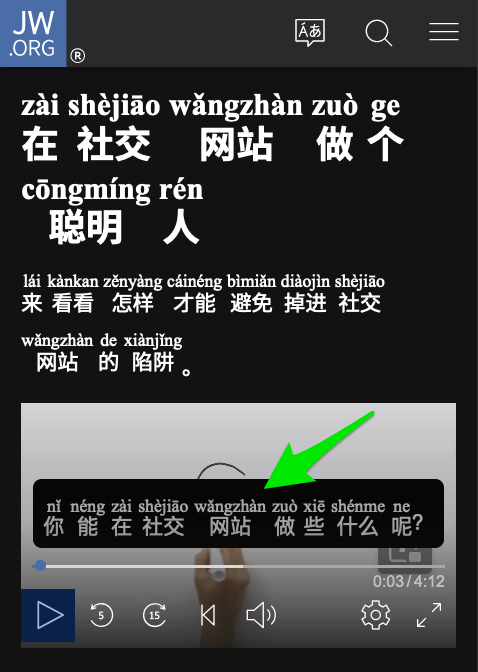
One of the unique features of Pīnyīn (Pīn·yīn {Piecing Together} · Sounds → [Pinyin] 拼音) Plus material at this time is Pīnyīn (Pīn·yīn {Piecing Together} · Sounds → [Pinyin] 拼音) Plus video transcripts. These should help us Mandarin field language learners to analyze and understand the Mandarin speech used in the many videos referenced in the Mandarin Enjoy Life Forever! book, for example. This in turn should help us make more effective use of these videos while participating in Mandarin Bible discussions using this book. Hopefully in the future, Pīnyīn (Pīn·yīn {Piecing Together} · Sounds → [Pinyin] 拼音) Plus transcripts will also be available for other publications that use videos.

lff Lesson 01 - Video Transcripts - Enjoy Life Forever! Bk. (Pīnyīn Plus, Web)

The Pīnyīn (Pīn·yīn {Piecing Together} · Sounds → [Pinyin] 拼音) Plus transcript for the video used in lesson 04 point 5 of the Mandarin Enjoy Life Forever! book contains the expression “lìjīng (lì·jīng {go through}; experience; undergo · {pass through; undergo; experience [→ [bear; endure]]} 历经 歷經)”, which is this week’s MEotW:

51
00:03:12,542 → 00:03:14,344
📖 📄 📘 Lìjīng (Lì·jīng {having gone through} · {having experienced → [having endured]} 历经 歷經) qiānxīn‐wànkǔ ((qiān·xīn {a thousand} · {(things) being hot in taste → [sufferings]} 千辛)‐(wàn·kǔ {ten thousand} · {(things) being bitter → [hardships]} 万苦 萬苦) [innumerable trials and tribulations (an interweaving of qiānwàn and xīnkǔ)]),

Lìjīng (Lì·jīng {go through}; experience; undergo · {pass through; undergo; experience [→ [bear; endure]]} 历经 歷經)” is noteworthy especially because of the meanings of the morphemes that make it up, and because of some of the other expressions that these morphemes are used in.

Mirrors, Histories, and Calendars

First, note that when written in Chinese characters, “lìjīng (lì·jīng {go through}; experience; undergo · {pass through; undergo; experience [→ [bear; endure]]} 历经 歷經)” (历经) is an anadrome (a word which is a different word spelled backwards, its mirror image, if you will) of “jīnglì (jīng·lì {pass/go through}; undergo; experience · {experience (v)} | {passed/gone through; undergone; experienced (thing)} · {experience (n)} → [experience (n)] 经历 經歷)” (经历), which in its verb form seems to mean basically the same thing as “lìjīng (lì·jīng {go through}; experience; undergo · {pass through; undergo; experience [→ [bear; endure]]} 历经 歷經)”. (A “jīnglì (jīng·lì {experienced (thing)} · {experience (n)} → [experience (n)] 经历 經歷)” (noun) is an “experience”, but in contrast, it seems that “lìjīng (lì·jīng {go through}; experience; undergo · {pass through; undergo; experience [→ [bear; endure]]} 历经 歷經)” is not used as a noun.)

Interestingly, the “ ({pass/go through}; experience; undergo | {experienced (thing[s])} → [experience[s]; record; history] | experienced → [all previous] | calendar)” in “lìjīng (lì·jīng {go through}; experience; undergo · {pass through; undergo; experience [→ [bear; endure]]} 历经 歷經)” is also used in “lìshǐ (lì·shǐ {experienced (things) → [history; record[s]} · history → [history; record[s]] 历史 歷史)”, and in “Lìdàizhì Shàng ((Lì·dài·zhì {Experienced → [All Previous]} · {Replacings → [Generations]} · Records 历代志 歷代志) (Shàng Upper 上) [1 Chronicles])” and “Lìdàizhì Xià ((Lì·dài·zhì {Experienced → [All Previous]} · {Replacings → [Generations]} · Records 历代志 歷代志) (Xià Lower 下) [2 Chronicles])”.

In its meaning as “calendar”, this “ ({pass/go through}; experience; undergo | {experienced (thing[s])} → [experience[s]; record; history] | experienced → [all previous] | calendar)” also appears in, for example, “gōnglì (gōng·lì {common → [Gregorian]} · calendar 公历 公曆)”, meaning “Gregorian calendar”. Connected to this, the Referenced Theo. Expressions (RTE) resource has an interesting entry on “Gōnglì (Gōng·lì {Common → [Gregorian]} · Calendar 公历 公曆) Jìyuán (Jì·yuán Era · Unit → [Era] 纪元 紀元)”:

common era; wtl09 index sync. Lit. “Gregorian-calendar beginning-of-era”. Often abbreviated to 公元 gōngyuán (see 2001 NWT’s table of books). Note that in Chinese you put 公元 and 公元前 BEFORE the year number, not after it as in English. E.g. 公元29年 = 29C.E.

Warp, Weft, and Scriptures

The “jīng ({pass through; undergo; experience [→ [bear; endure]]} | scripture; canon; classics | constant; regular | {warp (textiles)} [→ [longitude]])” in “lìjīng (lì·jīng {go through}; experience; undergo · {pass through; undergo; experience [→ [bear; endure]]} 历经 歷經)” also appears in some noteworthy expressions. Since it can mean “pass through; undergo; experience”, it’s no surprise that “jīng ({pass through; undergo; experience [→ [bear; endure]]} | scripture; canon; classics | constant; regular | {warp (textiles)} [→ [longitude]])” appears in “jīngguò (jīng·guò {pass through} · pass; cross [→ [go through; undergo]] 经过 經過)” and in “jīngyàn (jīng·yàn {having passed through} · testing → [experience] 经验 經驗)”. (Jīngyàn (Jīng·yàn {having passed through} · testing → [experience] 经验 經驗) (experience) is what one gains after going through jīnglì (jīng·lì {experienced (things)} · experiences → [experiences] 经历 經歷) (experiences), although an experience can also be called a jīngyàn (jīng·yàn {having passed through} · testing → [experience] 经验 經驗).)

Jīng ({pass through; undergo; experience [→ [bear; endure]]} | scripture; canon; classics | constant; regular | {warp (textiles)} [→ [longitude]])” also has a meaning—possibly its root meaning—of “warp”, a term from weaving. As summarized by Wikipedia:

Warp and weft are the two basic components used in weaving to turn thread or yarn into fabric. The lengthwise or longitudinal warp yarns are held stationary in tension on a frame or loom while the transverse weft (sometimes woof) is drawn through and inserted over and under the warp.[source]

Thus, in the picture below, the warp is the threads that are mounted on the loom, that go up and down, and the weft is the threads that go left and right.

Diagram of a loom, in a Chinese museum
Public Domain Dedication (CC0) Some rights reserved by Gary Lee Todd, Ph.D.

Note that the quote above from Wikipedia calls the warp the longitudinal threads. Mandarin takes this comparison to the place of actually using “jīng ({pass through; undergo; experience [→ [bear; endure]]} | scripture; canon; classics | constant; regular | {warp (textiles)} [→ [longitude]])” to also mean “longitude”, as used in geography. So, “jīngwěi (jīng·wěi {warp (textiles) [→ [longitude]]} · {weft; woof [→ [latitude]]} [→ [logical planning; plan; orderliness | situation; state of affairs | manage; administer]] 经纬 經緯)”, which means “warp and weft” in weaving, also means “longitude and latitude” in geography.

Of course, as students of the Bible, we Mandarin field language learners should also be aware that the “jīng ({pass through; undergo; experience [→ [bear; endure]]} | scripture; canon; classics | constant; regular | {warp (textiles)} [→ [longitude]])” in “lìjīng (lì·jīng {go through}; experience; undergo · {pass through; undergo; experience [→ [bear; endure]]} 历经 歷經)” can mean “scripture”. So, it appears in expressions that we see and hear a lot, like “Shèngjīng (Shèng·jīng (the) Holy · Scriptures → [the Bible] 圣经 聖經)”, “jīngwén (jīng·wén scripture · writing → [scripture] 经文 經文)”, and jīngjuàn (jīng·juàn scripture · volume [→ [Bible book]] 经卷 經卷).


For convenience:

The direct link for the current generation Pīnyīn (Pīn·yīn {Piecing Together of} · Sounds → [Pinyin] 拼音) Plus resource for the Enjoy Life Forever! book is:

The short link for Chinese field language-learning links for the Enjoy Life Forever! book is:

More Pīnyīn (Pīn·yīn {Piecing Together of} · Sounds → [Pinyin] 拼音) and Pīnyīn (Pīn·yīn {Piecing Together of} · Sounds → [Pinyin] 拼音) Plus web material based on the Mandarin Enjoy Life Forever! book will be made available in the Pīnyīn (Pīn·yīn {Piecing Together of} · Sounds → [Pinyin] 拼音) Plus web resource as time allows.