Categories
Culture Language Learning Science

gòngtōng

gòngtōng (gòng·tōng shared · {through → [connecting | [in] common]} [→ [applicable to both/all; shared; common; universal]] 共通) 👈🏼 Tap/click to show/hide the “flashcard”

As part of a series of posts about some common myths about Chinese characters, this post discusses the Universality Myth. So, this week’s MEotW is “gòngtōng (gòng·tōng shared · {through → [connecting | [in] common]} [→ [applicable to both/all; shared; common; universal]] 共通)”, an expression that seems to express well the supposed universality that is the subject of this myth.

In “gòngtōng (gòng·tōng shared · {through → [connecting | [in] common]} [→ [applicable to both/all; shared; common; universal]] 共通)”, “gòng (share | common | together | altogether 共) means “share | common | together | altogether”. This morpheme also appears in other well-known expressions such as “gòngtóng (gòng·tóng shared · {same | together} 共同)”, “gònghé‐guó ((gòng·hé shared · harmony → [republic] 共和)‐(guó country; nation; state) [republic])”, and “Gòngchǎn (Gòng·chǎn {Commonly Possessing} · {Produced (Things) → [Property]} → [Communist] 共产 共產)Dǎng (Party黨/党)”.

As for “tōng ({[(going)] through[(out)]; open [to]} [→ [common; general | connecting/communicating [to/with] [→ [logical; coherent]]]] 通)”, it here literally means “through”, and effectively means “connecting” or “in common”. It also appears in well-known expressions such as “gōutōng (gōu·tōng {(through) channel} · {(going) through → [communicating]} → [communicating; communication | linking up] 沟通 溝通)”, “jiāotōng (jiāo·tōng crossing; intersecting; meeting; joining · {(going) through → [connecting; communicating]} → [traffic; communications; transportation] 交通)”, “pǔtōng (pǔ·tōng common; general; universal; widespread · {through(out) → [general; common]} → [ordinary; common; average; general] 普通)”, and “tōngguò (tōng·guò through · passing → [passing through] → [through] 通过 通過)”.

When put together, the morphemes in “gòngtōng (gòng·tōng shared · {through → [connecting | [in] common]} [→ [applicable to both/all; shared; common; universal]] 共通) can effectively mean “shared; common; universal”, which in itself can generally be good. In fact, in our ministry, we look for “gòngtōng (gòng·tōng shared · {through → [in common]} → [common] 共通) diǎn (points) (common ground) with those with whom we speak. How universal, though, are Chinese characters? Are they really more universal than, say, alphabets?

Basis and Beliefs

In the book The Chinese Language: Fact and Fantasy, linguist and sinologist John DeFrancis writes the following in the chapter entitled “The Universality Myth”:

The Universality Myth is the logical extension of the Ideographic Myth. It is based on the threefold belief that:

1. Chinese characters enable a speaker from Beijing and another from Canton to communicate in writing even though they cannot understand each other’s speech. …
2. Chinese characters make it possible to read today’s newspapers as well as poems written a thousand years ago and philosophical essays written long before Christ. …
3. Chinese characters can function as a universal means of communication among people speaking totally unrelated languages. …

Implicitly or explicitly, the statements are meant to contrast Chinese characters with the familiar alphabetic scripts of the West. Chinese characters, it is believed, can do all these things, whereas alphabetic scripts cannot.

In other words, the Universality Myth regarding Chinese characters is that these visible, supposedly ideographic (representing meaning visually, without dependence on speech sounds) symbols of worldly Chinese culture can function across barriers of space, time, and language as universal enablers of communication. That seems amazing, if true. But, is it true? And, is it any more true for Chinese characters than it is for alphabets?

Testing the Relative Universality

DeFrancis goes on to test the Universality Myth by examining what it would take for an illiterate Mandarin speaker and an illiterate Cantonese speaker to learn how to communicate with each other by writing in characters, compared to what it would take for an illiterate French speaker and an illiterate Spanish speaker to learn how to communicate with each other by writing in French (which, as is widely known, is written using the Latin alphabet):

My Chinese colleagues estimate on the basis of their own experience and direct contact with the Chinese educational system that it takes seven to eight years for a Mandarin speaker to learn how to read and write three thousand characters and another year or two for a speaker of Cantonese to reach the same level in Standard Chinese. …My colleagues in French and Spanish estimate it would take the two imagined European illiterates less than half the time to reach a comparable level of proficiency in French.

…The overall picture is clear. It seems incontestable that both Europeans will find it easier to learn to read and write French than it be for either Cantonese or Mandarin speakers to learn to read and write Chinese. If we could add up the combined number of hours needed for the two members of each group to accomplish the same thing, the total would be enormously greater in the case of Chinese written in characters than in the case of French written in an alphabetic script. Even more significant, it would also be enormously greater for Chinese written in characters than for Chinese written in Pinyin. That is to say, it would be much easier for illiterates from Peking and those from Canton, even if the latter remain incapable of speaking Mandarin, to acquire the ability to communicate with each other by learning to read and write Standard Chinese written in Pinyin rather than in characters. Where, then, is the vaunted marvel of tongue-tied Chinese o’er-leaping barriers in speech by communicating with each other by means of those magical Chinese characters?

So, it’s possible for speakers of Mandarin, Cantonese, Japanese, Korean, English, French, Spanish, etc. to learn Chinese characters and use these as a means of communication. However, they could also do this with Pīnyīn (Pīn·yīn {Piecing Together of} · Sounds → [Pinyin] 拼音)! Also, it would actually be much faster and easier to do this with Pīnyīn (Pīn·yīn {Piecing Together of} · Sounds → [Pinyin] 拼音) than it would be to do it with the crazy complex characters!

Going Back in Time

What about the claim that characters allow us to still be able to read Chinese writings from long ago? Concerning this, DeFrancis writes:

Apart from learning the characters in their current meanings, Chinese must also learn the frequently different meanings of characters in earlier usage and the definitely different syntactical structures of classical versus contemporary written Chinese. This ability involves considerable training in tasks notorious for their difficulty—tasks that involve mastering differences at least as great as those between current English and the language of Chaucer. Without going into great detail, it should be readily apparent that an illiterate Chinese, regardless of whether he speaks Cantonese or Mandarin, will have a much greater task in learning to read classical Chinese than will an illiterate European, regardless of whether he speaks Spanish or French, in learning to read Latin. In the case of those already literate in current Chinese or French, it is doubtful that Chinese readers would enjoy any advantage over Europeans in respect to the amount of additional effort required to read classical Chinese in contrast to Latin.

So, it would probably be harder for a Chinese person to learn characters and then learn classical Chinese, than it would be for a European person to learn the Latin alphabet, and then learn Latin!

For us Mandarin field language learners specifically, since Jehovah’s organization is continually moving forward with ever broader, deeper, and clearer understandings of various truths, we in contrast seek to use the newest, most up-to-date writings from the organization whenever possible. Even with regard to the Bible itself, first written long ago, we seek, as a rule, to use the most up-to-date translations available. For specific examples in this regard, Appendix A2 (English, Mandarin) of the New World Translation Bible lists ways in which the current version of this Bible has been carefully revised to be more beneficial for modern readers.

It’s worth noting that the Chinese versions of the organization’s publications used to be written only in Chinese characters, but the most recent versions of the organization’s important writings generally have Pīnyīn (Pīn·yīn {Piecing Together of} · Sounds → [Pinyin] 拼音) available for them as well now.

Sunk Costs and Future Investments

Of course, those who have already spent years of hard work learning characters wouldn’t have to start that particular long and difficult process from zero (although, tíbǐ (tí·bǐ {carry (hanging down from the hand) → [raise; lift]} · pen; pencil; {writing brush} [→ [start writing; write]] 提笔 提筆)wàng (forget 忘) (character 字) (character amnesia) is real thing that takes constant ongoing effort to ward off). And, if they happen to meet others, even others who don’t speak the same language, who have also already spent years of hard work learning characters, then, yes, they might be able to use characters to imperfectly communicate with these others, to a limited extent—that is indeed one imperfect benefit arising from the massive sunk costs they have incurred in the process of learning characters.

However, those who have not already poured enormous amounts of time and effort into learning characters still have the opportunity to objectively weigh how much time and effort it is reasonable and worthwhile to sink into the characters going forward. As they consider this, they can keep in mind the inescapable reality that, due to the inherent extraordinary complexity of the characters, and due to the way that Jehovah actually designed us humans to use language, Pīnyīn (Pīn·yīn {Piecing Together of} · Sounds → [Pinyin] 拼音) and other sound-prioritizing writing systems (like Hangul, for those learning Korean) offer much greater ROI (return on investment) than characters do for those considering investing time and effort into learning how to actually communicate with others. Dedicated servants of Jehovah should also keep in mind that the time and energy they have are not theirs alone to spend or waste—their time, energy, etc. actually belong to Jehovah, and should thus be used and invested accordingly.

Anyway, to summarize, the Universality Myth regarding Chinese characters is…BUSTED!
Categories
Culture Current Events History Language Learning Names Science Technology

Hāmǐjíduōdùn

Hāmǐjíduōdùn (Armageddon 哈米吉多顿 哈米吉多頓) 👈🏼 Tap/click to show/hide the “flashcard”

[Notes: Tap/click on a Pīnyīn (Pīn·yīn {Piecing Together of} · Sounds → [Pinyin] 拼音) expression to reveal its “flashcard”; tap/click on a “flashcard” or its Pīnyīn (Pīn·yīn {Piecing Together of} · Sounds → [Pinyin] 拼音) expression to hide the “flashcard”. 📖 📄 📘 icons mean 📖 Reveal All, 📄 Reveal Advanced, and 📘 Reveal None re all the “flashcards” in the heading, paragraph, etc. that they are placed at the beginning of.]

[As part of a series of posts about some common myths about Chinese characters, this reposting of the post on “Hāmǐjíduōdùn (Armageddon 哈米吉多顿 哈米吉多頓) discusses the Ideographic Myth.]

[The first time this post was posted], jw.org was featuring an article with the following title:

English:

Will Armageddon Begin in Israel?—What Does the Bible Say?

Mandarin:

📖 📄 📘 Hāmǐjíduōdùn (Armageddon 哈米吉多顿 哈米吉多頓) Dàzhàn (Dà·zhàn {Big → [Great]} · War 大战 大戰) Huì (Will) zài (in 在) Yǐsèliè (Israel 以色列) Bàofā (Bào·fā Explode · {Issue Forth} → [Erupt] 爆发 爆發) ma ([? ptcl for “yes/no” questions])? Shèngjīng (Shèng·jīng (the) Holy · Scriptures → [the Bible] 圣经 聖經) de (’s 的) Guāndiǎn (Guān·diǎn {Looking At → [View]} · Point → [Viewpoint] 观点 觀點) Shì (Is 是) Shénme (Shén·me What · [suf] 什么 什/甚麼)?

This week’s MEotW is “Hāmǐjíduōdùn (Armageddon 哈米吉多顿 哈米吉多頓)”, the Mandarin syllables of which were obviously chosen first because of how much they sound like the English word “Armageddon” (and perhaps the original Hebrew word from which that came), not because of the meanings of the supposedly ideographic Chinese characters used to write them out (“Exhale Rice Lucky Much Pausing”??? 🤷🏻).

This emphasizes to us that when it comes to human language, SPEECH is primary—SOUNDS are the primary medium for transmitting meaning, and a writing system that transmits meaning purely with its visual symbols, without any dependency on speech sounds, is not a thing. However, this erroneous concept is so prevalent that there’s a name for it: The Ideographic Myth.

Several past MEotW posts have mentioned in passing the Ideographic Myth concerning Chinese characters, so it’s about time this blog took a deeper dive into this subject. Below are some selected excerpts from the chapter “The Ideographic Myth”, of the book The Chinese Language: Fact and Fantasy, by John DeFrancis, along with some commentary.


the concept of written symbols conveying their message directly to our minds, thus bypassing the restrictive intermediary of speech

This is a definition of the concept of “ideographic” writing.

Aren’t Chinese characters a sophisticated system of symbols that similarly convey meaning without regard to sound? Aren’t they an ideographic system of writing?

The answer to these questions is no. Chinese characters are a phonetic, not an ideographic, system of writing…There never has been, and never can be, such a thing as an ideographic system of writing.

Indeed, Chinese characters are always used to represent some language’s speech, are they not? They can be used to represent the speech of multiple languages, but they are not used in any way in which they do not represent the speech of any language, are they? There are no Chinese characters that have no spoken pronunciation in any language, are there? So, while some may find the idea of Chinese characters being an ideographic writing system fascinating, in real-life, actual use, Chinese characters are a phonetic writing system representing a language’s speech sounds (which do the actual representing of meanings)—Chinese characters are not an ideographic writing system directly representing meanings.

Origin of the Myth

The concept of Chinese writings as a means of conveying ideas without regard to speech took hold as part of the chinoiserie fad among Western intellectuals that was stimulated by the generally highly laudatory writings of Catholic missionaries from the sixteenth to the eighteenth centuries.

It was not acquaintance with Chinese but decipherment of Egyptian hieroglyphic writing following Napoleon’s conquests in North Africa that led to the coining of several expressions related to the ideographic idea.

Decipherment of this script had long been impeded by the notion that it was symbolic of ideas, particularly mystical or spiritual ones. It was not just the discovery of the famous Rosetta Stone, with its bilingual text in three scripts (Hieroglyphic Egyptian, Demotic Egyptian, and Greek) that made this possible. As Gordon (1968:24) stresses: “The decipherment of Hieroglyphic Egyptian required the replacement of the deep-seated notion of symbolism by the correct view that the main (though not the only) feature of the script is phonetic.”

Champollion’s success in deciphering the Egyptian script was due to his recognition of its phonetic aspect.

The rebus idea seems obvious to us since we use it in children’s games, but it actually constitutes a stupendous invention, an act of intellectual creation of the highest order—a quantum leap forward beyond the stage of vague and imprecise pictures to a higher stage that leads into the ability to represent all the subtleties and precision expressible in spoken language. Writing is now directly, clearly, firmly related to language: to speech. If there was ever any question whether a symbol had a sound attached to it, this now receives a positive answer. In the earliest form known to us, the character for “wheat” was borrowed to represent the word “come” precisely because both were pronounced in the same way.

What is crucial is to recognize that the diverse forms perform the same function in representing sound. To see that writing has the form of pictures and to conclude that it is pictographic is correct in only one sense—that of the form, but not the function, of the symbols. We can put it this way:

QUESTION: When is a pictograph not a pictograph?

ANSWER: When it represents a sound.

The use of the pictograph for “wheat” to represent the homophonous word ləg (“come”) transformed the function of the symbol from pictographic depiction of an object to syllabic representation of a sound. This change in function has been the essential development marking the emergence of all true systems of writing, including Chinese.

Sinological Contribution to the Myth

The fact that some Chinese pictographs have not undergone a change in form parallel to the change in function has tended to obscure the significance of the change that did take place. As a result, the phonetic aspect of Chinese writing is minimized by many people, even specialists in the field.

The error of exaggerating the pictographic and hence semantic aspect of Chinese characters and minimizing if not totally neglecting the phonetic aspect tends to fix itself very early in the minds of many people, both students of Chinese and the public at large, because their first impression of the characters is likely to be gained by being introduced to the Chinese writing system via some of the simplest and most interesting pictographs…. Unless a determined effort is made to correct this initial impression, it is likely to remain as an article of faith not easily shaken by subsequent exposure to different kinds of graphs.

Myth vs. Reality

A limited number of pictographic or semantic characters…cannot be considered indicative of full systems of nonphonetic writing that can function like ordinary orthographies to express nearly everything we can express in spoken language. The fact is that such a full system of nonphonetic writing has never existed. The system of Chinese characters, the Sumerian, Accadian, and Hittite cuneiform systems, and the Egyptian hieroglyphic system were none of them complete systems of semantic writing.

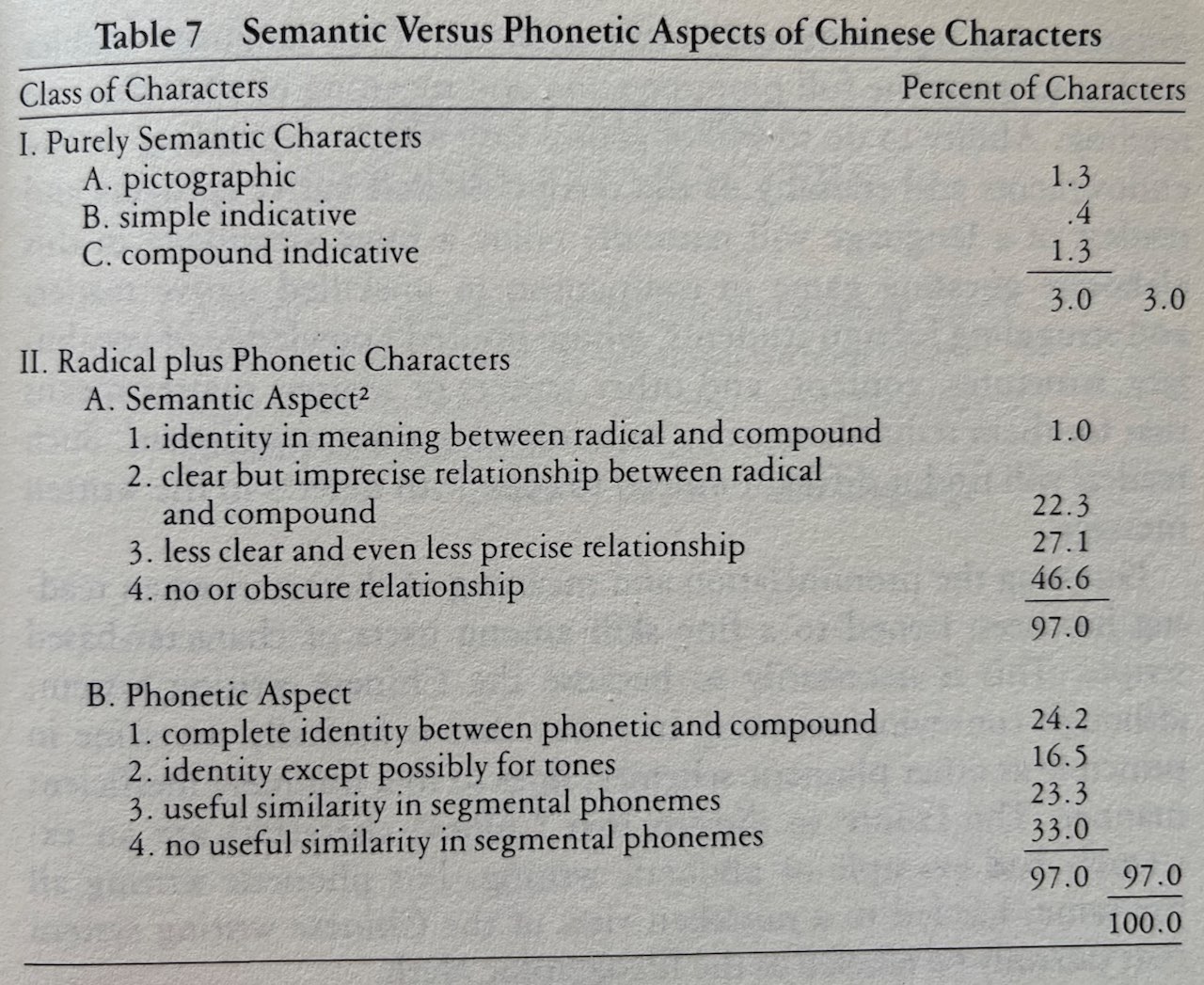
How limited is the number of pictographic or semantic characters, like “人”, “口”, “山”, etc., as opposed to the number of characters with some phonetic component related to pronunciation? This table from p. 129 of the book The Chinese Language: Fact and Fantasy says that only about 3% of all Chinese characters are purely pictographic or semantic:

Table 7 Semantic Versus Phonetic Aspects of Chinese Characters, p. 129, _The Chinese Language: Fact and Fantasy_

This myth, it is apparent, exists in two aspects. Both must be rejected. The first is that the Chinese characters constitute an existing system of ideographic writing. This has been shown to be factually untrue. The second aspect is the validity of the ideographic concept itself. I believe it to be completely untenable because there is no evidence that people have the capacity to master the enormous number of symbols that would be needed in a written system that attempts to convey thought without regard to sound, which means divorced from spoken language. …But while it is possible for a writing system to have many individual “ideographs” or “ideograms”, it is not possible to have a whole writing system based on the ideographic principle. Alphabetic writing requires mastery of several dozen symbols that are needed for phonemic representation. Syllabic writing requires mastery of what may be several hundred or several thousand symbols that are needed for syllabic representation. Ideographic writing, however, requires mastery of the tens of thousands or hundreds of thousands of symbols that would be needed for ideographic representation of words or concepts without regard to sound. A bit of common sense should suggest that unless we supplement our brains with computer implants, ordinary mortals are incapable of such memory feats.

Indeed, how many concepts exist, or could potentially come into existence as they get invented? That’s how many symbols an actual ideographic writing system would need to have. Obviously, even if such a system could be made to exist, it would be unusable by actual imperfect humans. Even Chinese characters, which “only” number somewhere over 100,000, are not numerous enough to be an actual ideographic writing system, and Chinese characters are already inhumanly complex and numerous.

Objections to the Term “Ideographic”

We need to go further and throw out the term itself.

Chinese characters represent words (or better, morphemes), not ideas, and they represent them phonetically, for the most part, as do all real writing systems despite their diverse techniques and differing effectiveness in accomplishing the task.

Both terms [“logographic” and “ideographic”] are inadequate and misleading because they fail to indicate that the process of getting from graph to word/morpheme involves the phonetic aspect of the latter and because this failure leaves the way open to the idea that we get from graph to word/morpheme by means of some nonphonetic, in a word, “ideographic”, approach. Only the adoption of some such term as “morphosyllabic”, which calls attention to the phonetic aspect, can contribute to dispelling the widespread misunderstanding of the nature of Chinese writing.

Chinese characters being a “morphosyllabic” writing system means that “each character is pronounced as a single syllable and represents a single morpheme* (smallest unit of language SOUND with meaning)—a Chinese character does NOT bypass language sounds to directly represent an idea.


So, every time you hear in Mandarin a name like “Hāmǐjíduōdùn (Armageddon 哈米吉多顿 哈米吉多頓) that came from another language, and is made up in Mandarin of syllables that make no sense except that they sound like the name in the original language, remember that the Ideographic Myth is just that—a myth!

As worshippers of the one true God Jehovah, we carefully avoid spiritual idolatry, realizing that no visible idol or image can be allowed to replace the invisible, almighty Spirit Jehovah as the object of our worship. Similarly, us Chinese field language learners must also carefully avoid the linguistic idolatry of considering visible Chinese characters to be direct representations of meaning in Chinese languages, when the truth is that in human languages, including Chinese languages, meaning is primarily transmitted via invisible speech.


* John DeFrancis, The Chinese Language: Fact and Fantasy (Honolulu: University of Hawaii Press, 1984), p. 125. ^

Categories
Culture Language Learning Science

shénhuà

shénhuà (shén·huà gods · {(set[s] of) words → [story/stories]} → [mythology | myth; fairy tale] 神话 神話) 👈🏼 Tap/click to show/hide the “flashcard”

Last year’s MEotW post on “jiǎ (false; fake假/叚) xiāoxi (xiāo·xi disappearing · news → [news; information] 消息) contains the following:

Myths and Misinformation About Chinese Characters, Etc.

As Mandarin field language learners, we need to be aware that many myths and much misinformation have been spread about the Chinese languages, especially when it comes to Chinese characters. Indeed, there is so much misinformation about Chinese characters that Victor Mair wrote the following in the foreword of the book Ideogram: Chinese Characters and the Myth of Disembodied Meaning, by J. Marshall Unger:

There is probably no subject on earth concerning which more misinformation is purveyed and more misunderstandings circulated than Chinese characters (漢字, Chinese hanzi, Japanese kanji, Korean hanja), or sinograms.

Also, in his book The Chinese Language: Fact and Fantasy, John DeFrancis lists the following myths regarding Chinese characters, that many believe:

  • The Ideographic Myth
    • The MEotW post on “Hāmǐjíduōdùn (Armageddon 哈米吉多顿 哈米吉多頓) contains a discussion of this myth, with some selected excerpts on this subject from DeFrancis’ book.
  • The Universality Myth
  • The Emulatability Myth
  • The Monosyllabic Myth
  • The Indispensability Myth
  • The Successfulness Myth

Regarding these myths, in p. 2–3 of his aforementioned book, J. Marshall Unger provides this summary:

Passing for the moment over the history of how the hunt for the perfect language unfolded, let us jump ahead to the result: the intellectual baggage about Chinese characters that we have inherited from the Renaissance and Enlightenment. John DeFrancis, in his classic book The Chinese Language (1984), sums up that weighty legacy under six headings, and a better summary would be hard to find. The source of all the confusion is what DeFrancis calls the Ideographic Myth, the notion that Chinese characters represent meaning directly, without reference to language (that is, speech) in any way. Its logical extension is the Universality Myth, according to which Chinese script allows for communication between mutually uninteligible dialects and languages. This leads in turn to the Emulatability Myth, which holds that Chinese script can serve as a model for a general system of signs that transcends natural language. These first three myths have little to do with the actual structure or history of the Chinese language or its writing system, in contrast with the remaining three: the Monosyllabic Myth, Indispensability Myth, and Successfulness Myth. Each of these—the names are more or less self-explanatory—makes a strong claim about language and the writing system, claims that have had significant social and political consequences.

At least some of the political consequences referred to above have been deliberate, meaning that at least some of the myths and misinformation spread about Chinese languages and Chinese characters qualify as political propaganda. If we’re not careful, we could end up parroting this political propaganda. (We could also end up parroting worldly human cultural propaganda, which is also a bad thing for people who seek to be no part of the world.) Also, all the difficulties and confusion caused by all the myths and misinformation surrounding Chinese languages and Chinese characters massively hinder the efforts of Mandarin field language learners to stay spiritually strong and to reach the hearts of Mandarin-speakers with Bible truth. This can result in deeply negative spiritual consequences that should be of great concern to us. To complete the sentence quoted from the video mentioned at the beginning of this post:

Misinformation isn’t just inaccurate; it can also be dangerous!

It seems that it would be good for this blog to discuss more fully each of the above-mentioned myths about Chinese characters. As a prelude, this week’s MEotW is “shénhuà (shén·huà gods · {(set[s] of) words → [story/stories]} → [mythology | myth; fairy tale] 神话 神話)”, the Mandarin word generally used to translate “myth”.

False Gods and False Stories

The “shén (god [→ [supernatural; magical; miraculous]] | spirit; mind 神) in “shénhuà (shén·huà gods · {(set[s] of) words → [story/stories]} → [mythology | myth; fairy tale] 神话 神話) is often used by Christendom to refer to “God”, with a capital “G”. Occasionally, Jehovah’s organization also uses “Shén (God 神) to correspond with “God”, as can be seen by comparing the renditions of Deuteronomy 4:35 in the current English and Mandarin versions of the New World Translation Bible:

English:

You yourselves have been shown these things so you will know that Jehovah is the true God; there is no other besides him.

Mandarin (WOL, Pīnyīn (Pīn·yīn {Piecing Together of} · Sounds → [Pinyin] 拼音) Plus):

📖 📄 📘 Zhè (these) yíqiè (yí·qiè {one (whole)} · {corresponding (set)} → [all] 一切) xiǎngěi (xiǎn·gěi {having been shown} · {to be given to} 显给 顯給) (you 你) kàn ({to see} 看), shì ({has been} 是) yào ({to be going to} 要) ràng (let) (you 你) zhīdào (zhī·dào know · {(the) way (of)} → [know] 知道) Yēhéhuá (Jehovah 耶和华 耶和華) shì (is 是) zhēn (true 真)Shén (God 神), chúle (chú·le {eliminating → [besides]} · {to completion} 除了) (him 他), zài (additionally 再) méiyǒu (méi·yǒu (there) not · {is having → [is]} → [(there) is not] 没有 沒有) biéde (bié·de other · ’s 别的 別的) Shén (God 神).

Usually, though, “shén (god [→ [supernatural; magical; miraculous]] | spirit; mind 神) is used to refer to “god” with a lower case “g”, which typically refers to a false god that’s not the true God. When that’s put together with “huà (word; {spoken word}; saying; talk; speech [→ [story]])”, the resulting expression can mean “stories about (false) gods”, or “myths”.

The above-mentioned myths about Chinese characters are widely believed and often repeated in this world that is controlled by Satan, but they are actually as false as false gods like Zeus, Apollo, Baal, Guānyīn (Guān·yīn (The One Who) Observes · Sounds → [Guanyin; Goddess of Mercy] 观音 觀音) (Wikipedia article), etc. (1 John 5:19) Be on the lookout for future posts on this blog that further discuss each of these myths, or fairy tales, about Chinese characters.